
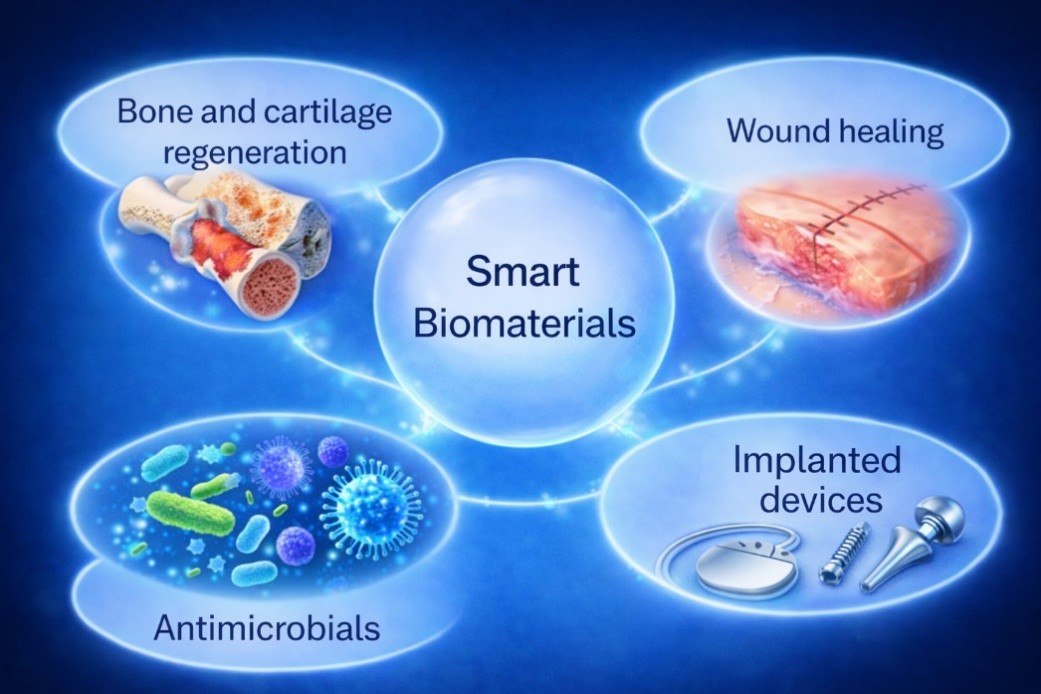
Biomaterials have progressed from passive structural supports to dynamic therapeutic platforms with multi-functions that actively regulate biological processes. Modern smart biomaterials integrate antimicrobial, immunomodulatory, and regenerative functions to foster optimal healing environments. Innovations such as advanced hydrogels and electrospun nanofibers, enhanced with biological agents, effectively resolve inflammation, promote angiogenesis, and suppress biofilms. Composite scaffolds with controlled stiffness and spatial delivery of growth factors are redefining bone and cartilage repair. Smart biomaterials enhance implanted devices by responding to biological signals and improving tissue integration. They can adapt to body conditions, release drugs when needed, and resist infection—reducing rejection and promoting faster healing. Antimicrobial biomaterials now emphasize infection-triggered activity, reducing cytotoxicity and resistance. Immune coordination is increasingly recognized as essential for clinical success. Addressing challenges in safety, cost, and scalability will enable smart biomaterials to serve as therapeutic systems, accelerating tissue repair in both acute and chronic settings.
- Open Access
- Perspective
Smart Biomaterials in Regenerative and Antimicrobial Medicine: A Forward-Looking Perspective
Author Information
Received: 26 Nov 2025 | Revised: 02 Jan 2026 | Accepted: 13 Jan 2026 | Published: 20 Jan 2026
Abstract
Graphical Abstract
Keywords
smart biomaterials | wound healing | antimicrobial biomaterials | bone regeneration | cartilage regeneration | immunomodulation | bioactive scaffolds | infection-responsive materials
References
- 1.
Niinomi, M.; Nakai, M. Titanium-based biomaterials for preventing stress shielding between implant devices and bone. Int. J. Biomater. 2011, 2011, 836587. https://doi.org/10.1155/2011/836587.
- 2.
Jones, J.R. Review of bioactive glass: From Hench to hybrids. Acta Biomater. 2013, 9, 4457–4486. https://doi.org/10.1016/j.actbio.2012.08.023.
- 3.
Makadia, H.K.; Siegel, S.J. Poly lactic-co-glycolic acid (PLGA) as biodegradable controlled drug delivery carrier. Polymers 2011, 3, 1377–1397. https://doi.org/10.3390/polym3031377.
- 4.
Yue, K.; Trujillo-de Santiago, G.; Alvarez, M.M.; et al. Synthesis, properties, and biomedical applications of gelatin methacryloyl (GelMA) hydrogels. Biomaterials 2015, 73, 254–271. https://doi.org/10.1016/j.biomaterials.2015.08.045.
- 5.
Bose, S.; Roy, M.; Bandyopadhyay, A. Recent advances in bone tissue engineering scaffolds. Trends Biotechnol. 2012, 30, 546–554. https://doi.org/10.1016/j.tibtech.2012.07.005.
- 6.
Kostarelos, K.; Novoselov, K.S. Exploring the interface of graphene and biology. Science 2014, 344, 261–263. https://doi.org/10.1126/science.1246736.
- 7.
Delaey, J.; Dubruel, P.; Van Vlierberghe, S. Shape-memory polymers for biomedical applications. Adv. Funct. Mater. 2020, 30, 1909047. https://doi.org/10.1002/adfm.201909047.
- 8.
Vepari, C.; Kaplan, D.L. Silk as a biomaterial. Prog. Polym. Sci. 2007, 32, 991–1007. https://doi.org/10.1016/j.progpolymsci.2007.05.013.
- 9.
Kuan, C.H.; Chang, L.; Ho, C.Y.; et al. Immunomodulatory hydrogel orchestrates pro-regenerative response of macrophages and angiogenesis for chronic wound healing. Biomaterials 2025, 314, 122848. https://doi.org/10.1016/j.biomaterials.2024.122848.
- 10.
Willemse, J.; van Tienderen, G.; van Hengel, E.; et al. Hydrogels derived from decellularized liver tissue support the growth and differentiation of cholangiocyte organoids, Biomaterials 2022, 284, 121473. https://doi.org/10.1016/j.biomaterials.2022.121473.
- 11.
Raju, N.; Silina, E.; Stupin, V.; et al. Multifunctional and smart wound dressings-a review on recent research advancements in skin regenerative medicine. Pharmaceutics 2022, 14, 1574. https://doi.org/10.3390/pharmaceutics14081574.
- 12.
Zhong, J.X.; Raghavan, P.; Desai, T.A. Harnessing biomaterials for immunomodulatory-driven tissue engineering. Regen. Eng. Transl. Med. 2023, 9, 224–239. https://doi.org/10.1007/s40883-022-00279-6.
- 13.
Li, P.; Yin, R.; Cheng, J.; et al. Bacterial biofilm formation on biomaterials and approaches to its treatment and prevention. Int. J. Mol. Sci. 2023, 24, 11680. https://doi.org/10.3390/ijms241411680.
- 14.
Pahlevanzadeh, F.; Setayeshmehr, M.; Bakhsheshi-Rad, H.R.; et al. A review on antibacterial biomaterials in biomedical applications: From materials perspective to bioinks design. Polymers 2022, 14, 2238. https://doi.org/10.3390/polym14112238.
- 15.
Luong, A.D.; Maruthapandi, M.; Gedanken, A.; et al. Rare-earth oxide nanoparticles: A new weapon against multidrug-resistant pathogens with potential wound healing treatment. Nanomaterials 2025, 15, 1862. https://doi.org/10.3390/nano15241862.
- 16.
Elbehiry, A.; Abalkhail, A. Antimicrobial nanoparticles against superbugs: Mechanistic insights, biomedical applications, and translational frontiers. Pharmaceuticals 2025, 18, 1195. https://doi.org/10.3390/ph18081195.
- 17.
Bryaskova, R.; Philipova, N.; Bakov, V.; et al. Innovative antibacterial polymer coatings. Appl. Sci. 2025, 15, 1780. https://doi.org/10.3390/app15041780.
- 18.
Wen, J.; Huang, S.; Hu, Q.; et al. Recent advances in zwitterionic polymers-based non-fouling coating strategies for biomedical applications. Mater. Today Chem. 2024, 40, 102232. https://doi.org/10.1016/j.mtchem.2024.102232.
- 19.
Tao, J.; Sun, Y.; Wang, G.; et al. Advanced biomaterials for targeting mature biofilms in periodontitis therapy. Bioact. Mater. 2025, 48, 474–492. https://doi.org/10.1016/j.bioactmat.2025.02.026.
- 20.
Heckler, I.; Boon, E.M. Insights into nitric oxide modulated quorum sensing pathways. Front. Microbiol. 2019, 10, 2174. https://doi.org/10.3389/fmicb.2019.02174.
- 21.
Zhuang, P.; Yang, W.; Chen, Y.; et al. Biomaterials that passively and actively target macrophages promote the regeneration of injured tissues. Biomed. Technol. 2024, 8, 17–49. https://doi.org/10.1016/j.bmt.2024.09.005.
- 22.
Liu, H.; Lv, H.; Duan, X.; et al. Advancements in macrophage-targeted drug delivery for effective disease management. Int. J. Nanomed. 2023, 18, 6915–6940. https://doi.org/10.2147/IJN.S430877.
- 23.
Rumbaugh, K.P.; Whiteley, M. Towards improved biofilm models. Nat. Rev. Microbiol. 2025, 23, 57–66. https://doi.org/10.1038/s41579-024-01086-2.
- 24.
Chen, L.; Xiao, L.; Ma, Y.; et al. Bioengineered composite hydrogel scaffold for accelerated skin regeneration and wound repair. Chem. Eng. J. 2025, 504, 158773. https://doi.org/10.1016/j.cej.2024.158773.
- 25.
Ding, K.; Liao, M.; Wang, Y.; et al. Advances in composite stimuli-responsive hydrogels for wound healing: Mechanisms and applications. Gels 2025, 11, 420. https://doi.org/10.3390/gels11020420.
- 26.
Wang, P.; Huang, S.; Hu, Z.; et al. In situ formed anti-inflammatory hydrogel loading plasmid DNA encoding VEGF for burn wound healing. Acta Biomater. 2019, 100, 191–201. https://doi.org/10.1016/j.actbio.2019.10.004.
- 27.
Chelu, M.; Popa, M.; Calderón Moreno, J.M. Applications of hydrogels in emergency therapy. Gels 2025, 11, 234. https://doi.org/10.3390/gels11040234.
- 28.
Li, Z.; Mei, S.; Dong, Y.; et al. Multi-functional core–shell nanofibers for wound healing. Nanomaterials 2021, 11, 1546. https://doi.org/10.3390/nano11061546.
- 29.
Jiang, X.; Zeng, Y.E.; Li, C.; et al. Enhancing diabetic wound healing: Advances in electrospun scaffolds from pathogenesis to therapeutic applications. Front. Bioeng. Biotechnol. 2024, 12, 1354286. https://doi.org/10.3389/fbioe.2024.1354286.
- 30.
Wang, J.; Lin, Y.; Fan, H.; et al. ROS/pH dual-responsive hydrogel dressings loaded with amphiphilic structured nano-micelles for the repair of infected wounds. Int. J. Nanomedicine 2025, 20, 8119–8142. https://doi.org/10.2147/IJN.S522589.
- 31.
Fang, Y.; Han, Y.; Yang, L.; et al. Conductive hydrogels: Intelligent dressings for monitoring and healing chronic wounds. Regen. Biomater. 2024, 12, rbae127. https://doi.org/10.1093/rb/rbae127.
- 32.
Sousa, A.B.; Águas, A.P.; Barbosa, M.A.; et al. Immunomodulatory biomaterial-based wound dressings advance the healing of chronic wounds via regulating macrophage behavior. Regen. Biomater. 2022, 9, rbac065. https://doi.org/10.1093/rb/rbac065.
- 33.
Laurano, R.; Boffito, M.; Ciardelli, G.; et al. Wound dressing products: A translational investigation from the bench to the market. Eng. Regen. 2022, 3, 182–200. https://doi.org/10.1016/j.engreg.2022.04.002.
- 34.
Arif, Z.U.; Khalid, M.Y.; Tariq, A.; et al. 3D printing of stimuli-responsive hydrogel materials: Literature review and emerging applications. Giant 2024, 17, 100209.
- 35.
Wang, Q.; Li, X.; Song, Q.; et al. 3D-printed stimuli-responsive hydrogels for smart wound dressings. Bioact. Mater. 2022, 17, 36–58. https://doi.org/10.1016/j.bioactmat.2021.12.021.
- 36.
Morouço, P.; Fernandes, C.; Lattanzi, W. Challenges and innovations in osteochondral regeneration: Insights from biology and inputs from bioengineering toward the optimization of tissue engineering strategies. J. Funct. Biomater. 2021, 12, 17. https://doi.org/10.3390/jfb12010017.
- 37.
Pereira, H.; Rodrigues, F.; Madeira, S.; et al. High-density hydroxyapatite/β-TCP composites for bone substitutes: Physicochemical and mechanical properties. Ceram. Int. 2026, 52, 65–72. https://doi.org/10.1016/j.ceramint.2025.11.072.
- 38.
Luo, Y.; Zhang, H.; Wang, Z.; et al. Strategic incorporation of metal ions in bone regenerative scaffolds: Multifunctional platforms for advancing osteogenesis. Regen. Biomater. 2025, 12, rbaf068. https://doi.org/10.1093/rb/rbaf068.
- 39.
Trimeche, M.; Cheikh Ridha, B. Polymer-ceramic composites for bone challenging applications: Materials and manufacturing processes. J. Thermoplast. Compos. Mater. 2023, 37, 1540–1557. https://doi.org/10.1177/08927057231190066.
- 40.
Argentati, C.; Morena, F.; Tortorella, I.; et al. Insight into mechanobiology: How stem cells feel mechanical forces and orchestrate biological functions. Int. J. Mol. Sci. 2019, 20, 5337. https://doi.org/10.3390/ijms20215337.
- 41.
Chen, L.; Wei, L.; Su, X.; et al. Preparation and characterization of biomimetic functional scaffold with gradient structure for osteochondral defect repair. Bioengineering 2023, 10, 213. https://doi.org/10.3390/bioengineering10020213.
- 42.
Yu, L.; Cavelier, S.; Hannon, B.; et al. Recent development in multizonal scaffolds for osteochondral regeneration. Bioact. Mater. 2023, 25, 122–159. https://doi.org/10.1016/j.bioactmat.2023.01.012.
- 43.
Lai, Y.; Fan, J.; Li, P.; et al. Recent advances in 3D bioprinting for cartilage and osteochondral regeneration. Int. J. Bioprint. 2025, 11, 154–184. https://doi.org/10.36922/IJB025120098.
- 44.
Chen, Y.T.; Chuang, Y.-H.; Chen, C.-M.; et al. Development of hybrid scaffolds with biodegradable polymer composites and bioactive hydrogels for bone tissue engineering. Biomater. Adv. 2023, 153, 213562. https://doi.org/10.1016/j.bioadv.2023.213562.
- 45.
Whitaker, R.; Hernaez-Estrada, B.; Hernandez, R.M.; et al. Immunomodulatory biomaterials for tissue repair. Chem. Rev. 2021, 121, 11305–11335. https://doi.org/10.1021/acs.chemrev.0c00895.
- 46.
Lin, X.; Zhang, Y.; Li, J.; et al. Biomimetic multizonal scaffolds for the reconstruction of zonal articular cartilage in chondral and osteochondral defects. Bioact. Mater. 2025, 43, 510–549. https://doi.org/10.1016/j.bioactmat.2024.10.001.
- 47.
International Organization for Standardization. ISO 10993‑1:2025 Biological Evaluation of Medical Devices—Part 1: Evaluation and Testing within a Risk Management Process. 2025. Available online: https://www.iso.org/standard/68936.html (accessed on 16 January 2026).
- 48.
Hassani, M.; Kamankesh, M.; Rad-Malekshahi, R.; et al. Biomaterials coated with zwitterionic polymer brush demonstrated significant resistance to bacterial adhesion and biofilm formation in comparison to brush coatings incorporated with antibiotics. Colloids Surf. B Biointerface 2024, 234, 113671.
- 49.
Guazzo, R.; Gardin, C.; Bellin, G.; et al. Graphene-based nanomaterials for tissue engineering in the dental field. Nanomaterials 2018, 8, 349. https://doi.org/10.3390/nano8050349.
- 50.
Stan, D.; Enciu, A.M.; Mateescu, A.L.; et al. Natural compounds with antimicrobial and antiviral effect and nanocarriers used for their transportation. Front. Pharmacol. 2021, 12, 723233. https://doi.org/10.3389/fphar.2021.723233.
- 51.
Silvestro, I.; Lopreiato, M.; Scotto d’Abusco, A.; et al. Hyaluronic acid reduces bacterial fouling and promotes fibroblasts’ adhesion onto chitosan 2D-wound dressings. Int. J. Mol. Sci. 2020, 21, 2070. https://doi.org/10.3390/ijms21062070.
- 52.
Zhong, Y.; Bellamkonda, R.V. Dexamethasone-coated neural probes elicit attenuated inflammatory response and neuronal loss compared to uncoated neural probes. Brain Res. 2007, 1148, 15–27. https://doi.org/10.1016/j.brainres.2007.02.024.
- 53.
Lu, B.; Luo, D.; Zhao, A.; et al. pH responsive chitosan and hyaluronic acid layer by layer film for drug delivery applications. Prog. Org. Coat. 2019, 135, 240–247.
- 54.
Chen, X.; Lin, Z.; Cheng, N.; et al. Recent advances in NIR-II photothermal and photodynamic therapies for drug-resistant wound infections. Mater. Today Bio 2025, 32, 101871. https://doi.org/10.1016/j.mtbio.2025.101871.
- 55.
Zhou, Q.; Si, Z.; Wang, K.; et al. Enzyme-triggered smart antimicrobial drug release systems against bacterial infections. J. Control Release 2022, 352, 507–526. https://doi.org/10.1016/j.jconrel.2022.10.038.
- 56.
Bilem, I.; Chevallier, P.; Plawinski, L.; et al. RGD and BMP-2 mimetic peptide crosstalk enhances osteogenic commitment of human bone marrow stem cells. Acta Biomater. 2016, 36, 132–142. https://doi.org/10.1016/j.actbio.2016.03.032.
- 57.
Bellis, S.L. Advantages of RGD peptides for directing cell association with biomaterials. Biomaterials 2011, 32, 4205–4210. https://doi.org/10.1016/j.biomaterials.2011.02.029.
- 58.
Xu, Z.; Miao, L.; Meng, X.; et al. Strontium-doped bioactive glass-functionalized polyetheretherketone enhances osseointegration by facilitating cell adhesion. Colloids Surfaces B Biointerfaces 2024, 241, 114042. https://doi.org/10.1016/j.colsurfb.2024.114042.
- 59.
Wang, Q.; Huang, J.Y.; Li, H.Q.; et al. TiO2 nanotube platforms for smart drug delivery: A review. Int. J. Nanomed. 2016, 11, 4819–4834. https://doi.org/10.2147/IJN.S108847.
- 60.
Piñera-Avellaneda, D.; Buxadera-Palomero, J.; Delint, R.C.; et al. Gallium and silver-doped titanium surfaces provide enhanced osteogenesis, reduce bone resorption and prevent bacterial infection in co-culture. Acta Biomater. 2024, 180, 154–170. https://doi.org/10.1016/j.actbio.2024.04.019.
- 61.
Casella, G.; Garzetti, L.; Gatta, A.T.; et al. IL4 induces IL6-producing M2 macrophages associated to inhibition of neuroinflammation in vitro and in vivo. J. Neuroinflamm. 2016, 13, 139. https://doi.org/10.1186/s12974-016-0596-5.
- 62.
Varnum, M.M.; Kiyota, T.; Ingraham, K.L.; et al. The anti-inflammatory glycoprotein, CD200, restores neurogenesis and enhances amyloid phagocytosis in a mouse model of Alzheimer’s disease. Neurobiol. Aging 2015, 36, 2995–3007. https://doi.org/10.1016/j.neurobiolaging.2015.07.027.
- 63.
Wang, X.; Sun, Y.; Han, C.; et al. Research trends of piezoelectric materials in neurodegenerative disease applications. Bioact. Mater. 2025, 52, 366–392. https://doi.org/10.1016/j.bioactmat.2025.06.022.
- 64.
Guex, A.G.; Puetzer, J.L.; Armgarth, A.; et al. Highly porous scaffolds of PEDOT:PSS for bone tissue engineering. Acta Biomater. 2017, 62, 91–101. https://doi.org/10.1016/j.actbio.2017.08.045.
- 65.
Bianchi, E.; Bañobre-Lopez, M.; Ruggeri, M.; et al. Magnetic scaffolds for the mechanotransduction stimulation in tendon tissue regeneration. Mater. Today Bio 2025, 32, 101699.
- 66.
Zou, Y.; Lai, B.F.; Kizhakkedathu, J.N.; et al. Inhibitory effect of hydrophilic polymer brushes on surface-induced platelet activation and adhesion. Macromol. Biosci. 2010, 10, 1432–1443. https://doi.org/10.1002/mabi.201000223.
- 67.
Melchiorri, A.J.; Hibino, N.; Fisher, J.P. Strategies and techniques to enhance the in situ endothelialization of small-diameter biodegradable polymeric vascular grafts. Tissue Eng. Part. B Rev. 2013, 19, 292–307. https://doi.org/10.1089/ten.TEB.2012.0577.
- 68.
Tabish, T.A.; Crabtree, M.J.; Townley, H.E.; et al. Nitric oxide releasing nanomaterials for cardiovascular applications. JACC Basic. Transl. Sci. 2023, 9, 691–709. https://doi.org/10.1016/j.jacbts.2023.07.017.
- 69.
Teixeira-Santos, R.; Lima, M.; Gomes, L.C.; et al. Antimicrobial coatings based on chitosan to prevent implant-associated infections: A systematic review. iScience 2021, 24, 103480. https://doi.org/10.1016/j.isci.2021.103480.
- 70.
Hassan, M.; Khaleel, A.; Karam, S.M.; et al. Bacterial inhibition and osteogenic potentials of Sr/Zn co-doped nano-hydroxyapatite-PLGA composite scaffold for bone tissue engineering applications. Polymers 2023, 15, 1370. https://doi.org/10.3390/polym15061370.
- 71.
da Cruz, M.B.; Marques, J.F.; Marques, A.F.S.; et al. Modification of zirconia implant surfaces by Nd:YAG laser grooves: Does it change cell behavior? Biomimetics 2022, 7, 49. https://doi.org/10.3390/biomimetics7020049.
- 72.
ZimVie Dental. Osseotite® Dental Implant System. Available online: https://www.zimvie.com/en/dental/dental-implant-systems/osseotite-implant.html. (accessed on 16 January 2026).
- 73.
ICU Medical, Inc. ClearGuard™ HD Antimicrobial Barrier Caps. ICU Medical. Available online: https://www.icumed.com/en-ca/products/renal-care/clearguard-hd/ (accessed on 16 January 2026)
- 74.
Kuros Biosciences AG. MagnetOs® Bone Graft Substitute: FDA 510(k) Clearance Announcement. Kuros Biosciences, 2017. Available online: https://ir.kurosbio.com/news-releases/news-release-details/kuros-biosciences-debuts-commercial-launch-magnetos-mis-delivery (accessed on 16 January 2026).
- 75.
Credentis AG. P11‑4 Self‑Assembling Peptide Technology for Enamel Regeneration. Available online: https://en.wikipedia.org/wiki/Oligopeptide_P11-4 (accessed on 16 January 2026).
- 76.
TechSci Research. Medical Device Coatings Market—Global Industry Size, Share, Trends, Opportunity & Forecast, 2020–2030F. 2025. Available online: https://www.techsciresearch.com/report/medical-device-coatings-market/20942.html (accessed on 16 January 2026).
- 77.
Zhang, W.; Zeng, X.; Deng, X.; et al. Smart biomaterials: As active immune modulators to shape pro-regenerative microenvironments. Front. Cell Dev. Biol. 2025, 13, 1669399. https://doi.org/10.3389/fcell.2025.1669399.
- 78.
Yang, Y.; Wang, J.; Huang, S.; et al. Bacteria-responsive programmed self-activating antibacterial hydrogel to remodel regeneration microenvironment for infected wound healing. Nat. Sci. Rev. 2024, 11, nwae044. https://doi.org/10.1093/nsr/nwae044.
- 79.
Li, B.; Li, M.; Wang, Y. Smart hydrogels in wearable electronics for wound treatments. Small 2025, 21, e07368. https://doi.org/10.1002/smll.202507368.
- 80.
Guan, J.; Li, Z.; Hu, H.; et al. AI-assisted design and application of wound dressings. Sens. Actuators Rep. 2025, 11, 100414. https://doi.org/10.1016/j.snr.2025.100414.
- 81.
Gokcekuyu, Y.; Ekinci, F.; Guzel, M.S.; et al. Artificial intelligence in biomaterials: A comprehensive review. Appl. Sci. 2024, 14, 6590. https://doi.org/10.3390/app14156590.
- 82.
Davis, R., Jr.; Duggal, I.; Peppas, N.A.; et al. Designing the next generation of biomaterials through nanoengineering. Adv. Mater. 2025, 37, e2501761. https://doi.org/10.1002/adma.202501761.
- 83.
Sagdic, K.; Eş, I.; Sitti, M.; et al. Smart materials: Rational design in biosystems via artificial intelligence. Trends Biotechnol. 2022, 40, 987–1003. https://doi.org/10.1016/j.tibtech.2022.01.005.
- 84.
Jiang, P.; Dai, Y.; Hou, Y.; et al. Artificial intelligence-assisted design, synthesis and analysis of smart biomaterials. Bioeng. Transl. Med. 2025, 3, e70004. https://doi.org/10.1002/bmm2.70004.
- 85.
Mansourinia, F.; Adibhosseini, M.S.; Yazdi, M.K. Artificial intelligence-assisted biomaterials synthesis. In Artificial Intelligence in Biomaterials Design and Development; Zarrintaj, P., Yazdi, M.K., Bencherif, S.A., et al., Eds.; Elsevier: Amsterdam, The Netherlands, 2026; pp. 97–116. https://doi.org/10.1016/B978-0-323-95464-8.00006-2.
- 86.
Mozafari, M. How artificial intelligence shapes the future of biomaterials. Next Materials 2025, 7, 100381. https://doi.org/10.1016/j.nxmate.2024.100381.
- 87.
Datta, S.; Kamaraj, M. Artificial intelligence-assisted biomaterials for hard tissue implants. In Artificial Intelligence in Biomaterials Design and Development; Zarrintaj, P., Yazdi, M.K., Bencherif, S.A., et al., Eds.; Elsevier: Amsterdam, The Netherlands, 2026; pp. 277–308. https://doi.org/10.1016/B978-0-323-95464-8.00007-4.
- 88.
Zhou, B.; Li, X.; Pan, Y.; et al. Artificial intelligence-assisted next-generation biomaterials: From design and preparation to medical applications. Colloids Surf. B Biointerface 2025, 255, 114970. https://doi.org/10.1016/j.colsurfb.2025.114970.
- 89.
World Health Organization. WHO Updates List of Drug-Resistant Bacteria Most Threatening to Human Health [Internet]. 17 May 2024. Available online: https://www.who.int/news/item/17-05-2024-who-updates-list-of-drug-resistant-bacteria-most-threatening-to-human-health (accessed on 16 January 2026).
- 90.
Goshisht, A.K.; Goshisht, A.; Bajpaid, A.; et al. Recent advances in biomedical applications of smart nanomaterials: A comprehensive review. RSC Pharm. 2025, 2, 1227–1267. https://doi.org/10.1039/D5PM00137D.
- 91.
Cecen, B.; Hassan, S.; Li, X.; et al. Smart biomaterials in biomedical applications: Current advances and possible future directions. Macromol. Biosci. 2024, 24, e2200550. https://doi.org/10.1002/mabi.202200550.
- 92.
Amukarimi, S.; Ramakrishna, S.; Mozafari, M. Smart biomaterials—A proposed definition and overview of the field. Curr. Opin. Biomed. Eng. 2021, 19, 100311.

This work is licensed under a Creative Commons Attribution 4.0 International License.

 Suite 4002 Level 4, 447 Collins Street, Melbourne, Victoria 3000, Australia
 General Inquiries: info@sciltp.com