
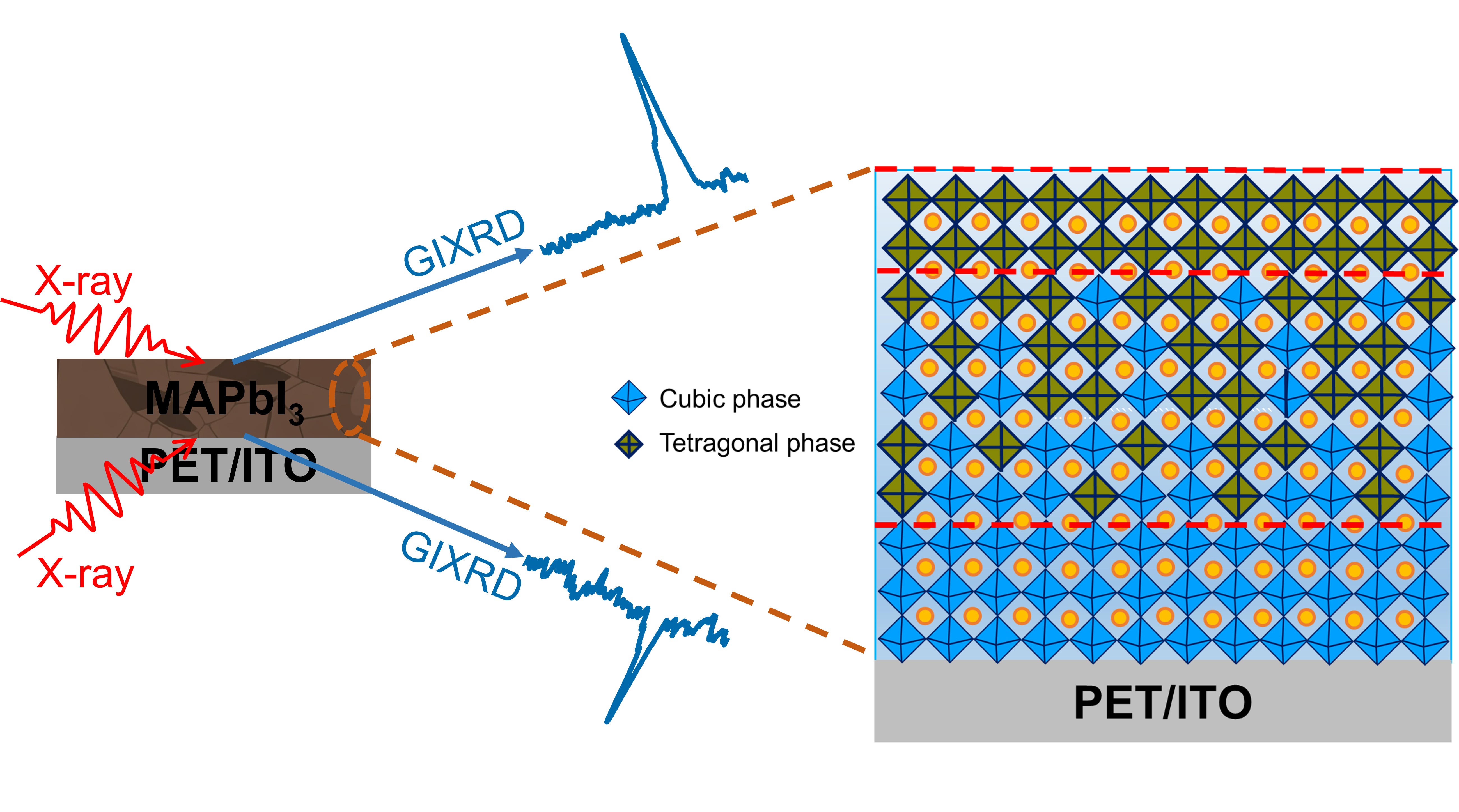
Interfaces between the perovskite absorber and charge-transport layers play a critical role in determining the performance of planar perovskite solar cells (PSCs). However, the lack of non-destructive techniques capable of directly probing the microstructure of buried interfaces beneath perovskite films has significantly hindered a comprehensive understanding of their interfacial properties. Here, we employ flexible substrates to enable synchrotron-based grazing-incidence X-ray diffraction (GIXRD) measurements from the backside of the substrate, allowing direct investigation of buried interfaces. By combining back- and surface-incidence GIXRD, we construct a depth-resolved phase diagram spanning from the film surface to the buried interface in one-step deposited MAPbI3 films. The film surface is dominated by a thin tetragonal perovskite layer, whereas a cubic phase gradually emerges with increasing depth, leading to phase coexistence within the film interior. Closer to the buried interface, the cubic phase progressively dominates, with the tetragonal phase completely disappearing at the interface. Meanwhile, high-resolution synchrotron X-ray diffraction measurements of MAPbI3 powders at variable temperatures reveal that cubic and tetragonal phases can coexist, with their relative fractions strongly dependent on thermal history, despite the thermodynamic preference for the tetragonal phase at room temperature. The observed depth-dependent phase distribution in MAPbI3 films is therefore attributed to an incomplete cubic-to-tetragonal phase transition during cooling after annealing, which becomes increasingly suppressed with depth due to substrate confinement. These findings provide new insights into the structure – performance relationship of one-step deposited MAPbI3-based PSCs and demonstrate that back-incidence GIXRD is a powerful and broadly applicable tool for probing buried interfaces in thin-film systems.
- Open Access
- Article
Probing Buried Interfaces and Phase Gradients in MAPbI3 Films via Combined Back- and Surface-Incidence GIXRD
- Liujiang Zhang 1,2,3,4,†,
- Guanhaojie Zheng 1,2,*,†,
- Zhenhuang Su 1,
- Zhen Wang 1,
- Chenyue Wang 1,
- Li Chen 1,
- Jianhua He 4,*,
- Xingyu Gao 1,2,3,*
Author Information
Received: 02 Feb 2026 | Revised: 10 Mar 2026 | Accepted: 11 Mar 2026 | Published: 31 Mar 2026
Abstract
Graphical Abstract
Keywords
MAPbI3 perovskite | back-incidence grazing incidence X-ray diffraction | depth dependent phase distribution
References
- 1.
Shi, D.; Adinolfi, V.; Comin, R.; et al. Low trap-state density and long carrier diffusion in organolead trihalide perovskite single crystals. Science 2016, 347, 519.
- 2.
De Wolf, S.; Holovsky, J.; Moon, S.J.; et al. Organometallic halide perovskites sharp optical absorption edge and its relation to photovoltaic performance. J. Phys. Chem. Lett. 2014, 5, 1035.
- 3.
Chu, W.; Zheng, Q.; Prezhdo, O.V.; et al. Low-frequency lattice phonons in halide perovskites explain high defect tolerance toward electron-hole recombination. Sci. Adv. 2020, 6, eaaw7453.
- 4.
Jamal, M.S.; Bashar, M.S.; Hasan, A.K.M.; et al. Fabrication techniques and morphological analysis of perovskite absorber layer for high-efficiency perovskite solar cell: A review. Renew. Sust. Energ. Rev. 2018, 98, 469.
- 5.
Jeong, M.; Choi, I.W.; Go, E.M.; et al. Stable perovskite solar cells with efficiency exceeding 24.8% and 0.3-V voltage loss. Science 2020, 369, 1615.
- 6.
Jeong, J.; Kim, M.; Seo, J.; et al. Pseudo-halide anion engineering for α-FAPbI3 perovskite solar cells. Nature 2021, 592, 381.
- 7.
Min, H.; Lee, D.Y.; Kim, J.; et al. Perovskite solar cells with atomically coherent interlayers on SnO2 electrodes Nature 2021, 598, 444.
- 8.
Xiong Z.; Zhang Q.; Cai K.; et al. Homogenized chlorine distribution for >27% power conversion efficiency in perovskite solar cells. Science 2025, 390, 638.
- 9.
National Renewable Energy Laboratory (NREL). Best Research-Cell Efficiency Chart. Available online: https://www.nrel.gov/pv/cell-efficiency.html (accessed on 1 February 2026).
- 10.
Taylor, A.D.; Sun, Q.; Goetz, K.P.; et al. A general approach to high-efficiency perovskite solar cells by any antisolvent. Nat. Commun. 2021, 12, 1878.
- 11.
Li, H.; Zhou, J.; Tan, L.; et al. Sequential vacuum-evaporated perovskite solar cells with more than 24% efficiency. Sci. Adv. 2022, 8, eabo7422.
- 12.
Wang, Q.K.; Wang, R.B.; Shen, P.F.; et al Energy level offsets at lead halide perovskite/organic hybrid interfaces and their impacts on charge separation. Adv. Mater. Interfaces 2015, 2,1400528.
- 13.
Qin, M.; Chan, P.F.; Lu, X. A systematic review of metal halide perovskite crystallization and film formation mechanism unveiled by In-situ GIWAXS. Adv. Mater. 2021, 33, e2105290.
- 14.
Aydin, E.; De Bastiani, M.; De Wolf, S. Defect and contact passivation for perovskite solar cells. Adv. Mater. 2019, 31, e1900428.
- 15.
Stolterfoht, M.; Wolff, C.M.; Márquez, J.A.; et al. Visualization and suppression of interfacial recombination for high-efficiency large-area pin perovskite solar cells. Nat. Energy 2018, 3, 847.
- 16.
Shao, S.; Loi, M.A. The role of the interfaces in perovskite solar cells. Adv. Mater. Interfaces 2019, 7, 1901469.
- 17.
Jiang, Q.; Zhao, Y.; Zhang, X.; et al. Surface passivation of perovskite film for efficient solar cells. Nat. Photonics 2019, 13, 460.
- 18.
Chen, R.; Wang, Y.; Nie, S.; et al. Sulfonate-assisted surface iodide management for high-performance perovskite solar cells and modules. J. Am. Chem. Soc. 2021, 143, 10624.
- 19.
Li, Z.; Li, B.; Wu, X.; et al. Organometallic-functionalized interfaces for highly efficient inverted perovskite solar cells. Science 2022, 376, 416.
- 20.
Azmi, R.; Ugur, E.; Seitkhan, A.; et al. Damp heat-stable perovskite solar cells with tailored-dimensionality 2D/3D heterojunctions. Science 2022, 376, 73.
- 21.
Jiang, Q.; Tong, J.; Xian, Y.; et al. Surface reaction for efficient and stable inverted perovskite solar cells. Nature 2022, 611, 278.
- 22.
Xu, H.; Miao, Y.; Wei, N.; et al. CsI enhanced buried interface for efficient and UV-robust perovskite solar cells. Adv. Energy Mater. 2021, 12, 2103151.
- 23.
Chen, B.; Chen, H.; Hou, Y.; et al. Passivation of the buried interface via preferential crystallization of 2D perovskite on metal oxide transport layers. Adv. Mater. 2021, 33, e2103394.
- 24.
Yang, X.; Li, L.; Wu, J.; et al. Optimizing vertical crystallization for efficient perovskite solar cells by buried composite layers. Sol. RRL 2021, 5, 2100457.
- 25.
Xu, Y.; Xiong, S.; Jiang, S.; et al. Synchronous modulation of defects and buried interfaces for highly efficient inverted perovskite solar cells. Adv. Energy Mater. 2022, 13, 2203505.
- 26.
Wei, K.; Deng, J.; Yang, L.; et al. A core@dual-shell nanostructured SnO2 to modulate the buried interfaces toward stable perovskite solar cells with minimized energy losses. Adv. Energy Mater. 2022, 13, 2203448.
- 27.
Yang, X.; Luo, D.; Xiang, Y.; et al. Buried interfaces in halide perovskite photovoltaics. Adv. Mater. 2021, 33, e2006435.
- 28.
Chen, S.; Xiao, X.; Chen, B.; et al. Crystallization in one-step solution deposition of perovskite films: Upward or downward?. Sci. Adv. 2021, 7, eabb2412.
- 29.
Onoda-Yamamuro, N.; Yamamuro, O.; Matsuo, T.; et al. P-T phase relations of CH3NH3PbX3 (X = Cl, Br, I) crystals. J. Phys. Chem. Solids 1992, 53, 277.
- 30.
Baikie, T.; Fang, Y.; Kadro, J.M.; et al. Synthesis and crystal chemistry of the hybrid perovskite CH3NH3PbI3 for solid-state sensitised solar cell applications. J. Mater. Chem. A 2013, 1, 5628.
- 31.
Saidi, W.A.; Choi, J.J. Nature of the cubic to tetragonal phase transition in methylammonium lead iodide perovskite. J. Chem. Phys. 2016, 145, 144702.
- 32.
Soe, C.M.; Stoumpos, C.C.; Harutyunyan, B.; et al. Room temperature phase transition in methylammonium lead iodide perovskite thin films induced by hydrohalic acid additives. ChemSusChem 2016, 9, 2656.
- 33.
Wang, Q.; Lyu, M.; Zhang, M.; et al. Transition from the tetragonal to cubic phase of organohalide perovskite: the role of chlorine in crystal formation of CH3NH3PbI3 on TiO2 Substrates. J. Phys. Chem. Lett. 2015, 6, 4379.
- 34.
Palazon, F.; Perez-Del-Rey, D.; Danekamp, B.; et al. Room-temperature cubic phase crystallization and high stability of vacuum-deposited methylammonium lead triiodide thin films for high-efficiency solar cells. Adv. Mater. 2019, 31, e1902692.
- 35.
Tie-Ying, Y.; Wen, W.; Guang-Zhi, Y.; et al. Introduction of the X-ray diffraction beamline of SSRF. Nucl. Sci. Tech. 2015, 25, 5.
- 36.
Saini, I.; Rozra, J.; Chandak, N.; et al. Tailoring of electrical, optical and structural properties of PVA by addition of Ag nanoparticles. Mater. Chem. Phys. 2013, 139, 802.
- 37.
Kavadiya, S.; Strzalka, J.; Niedzwiedzki, M.; et al. Crystal reorientation in methylammonium lead iodide perovskite thin film with thermal annealing. J. Mater. Chem. A 2019, 7, 12790.
- 38.
Jacobsson, T.J.; Schwan, L.J.; Ottosson, M.; et al. Determination of thermal expansion coefficients and locating the temperature-induced phase transition in methylammonium lead perovskites using X-ray diffraction. Inorg. Chem. 2015, 54, 10678.
- 39.
Wei, Q.; Liang, H.; Haruta, Y.; et al. From tetragonal to cubic: perovskite phase structure evolution for high-performance solar cells. Sci. Bull. 2023, 68, 141–145.


This work is licensed under a Creative Commons Attribution 4.0 International License.

 Suite 4002 Level 4, 447 Collins Street, Melbourne, Victoria 3000, Australia
 General Inquiries: info@sciltp.com