
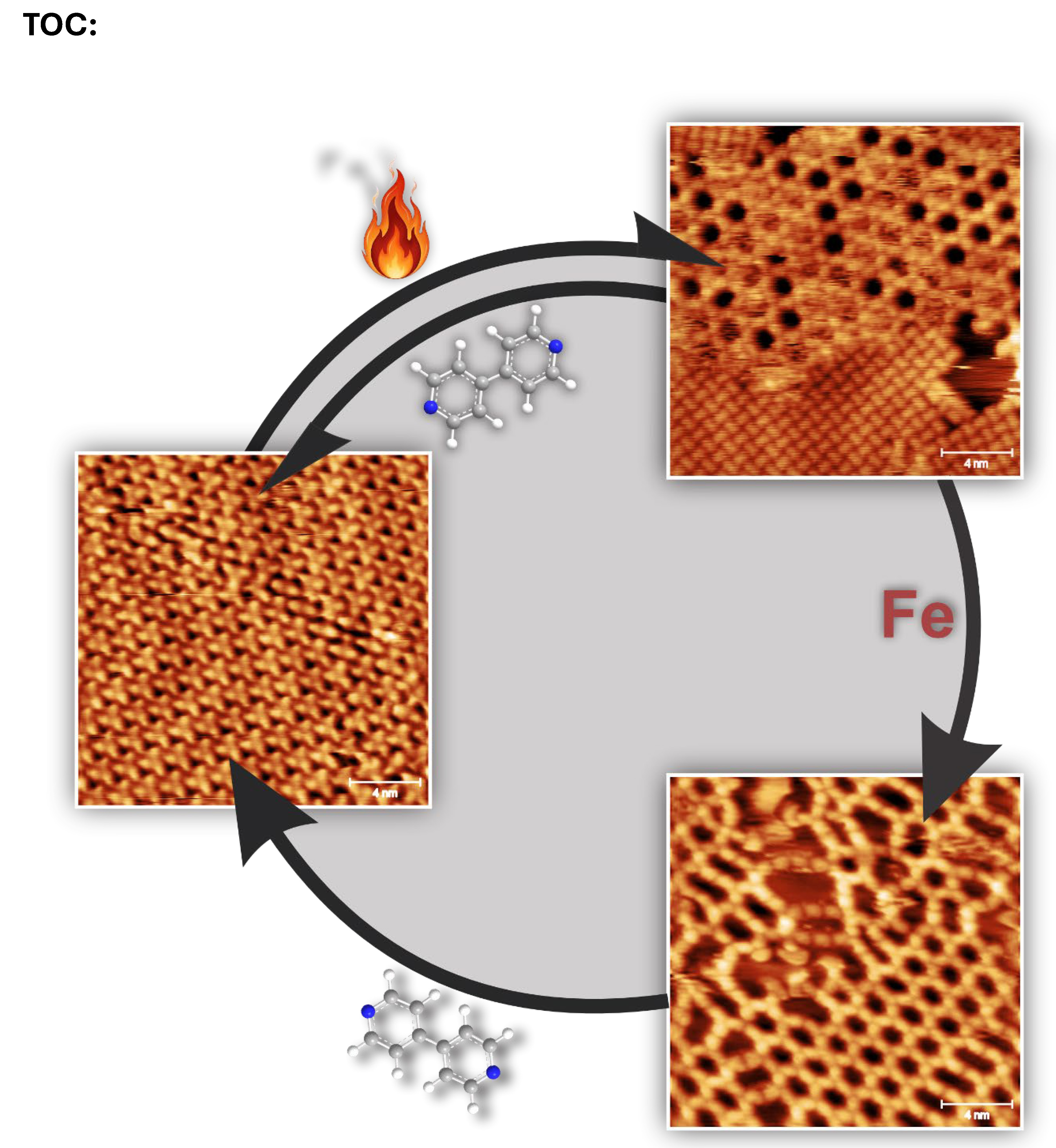
Surface-confined metal–organic frameworks (2D MOFs) provide a versatile platform for studying low-dimensional coordination chemistry and tunable molecular architectures at atomic and molecular levels. Here, we investigate the self-assembly of 4,4-bipyridine and Fe on Au(111) and reveal a coverage-dependent phase behavior governed by metal–ligand coordination and surface availability. In the absence of Fe, 4,4-bipyridine forms a weakly substrate-coupled molecular network stabilized by intermolecular interactions. Fe coordination induces a sequence of distinct two-dimensional architectures, ranging from dense three-fold-coordinated tripod networks to open Kagome lattices composed of hexagonally arranged metal centers bridged by molecular linkers. Using scanning probe microscopy, low-energy electron diffraction, and density-functional theory calculations, we identify three thermodynamically stable phases with different coordination numbers, symmetries, and molecular densities. Transformations between these phases are reversible and controlled by the Fe-to-ligand ratio. These findings demonstrate how subtle control over coordination chemistry and surface coverage enables programmable structural transitions in two-dimensional metal–organic frameworks.
- Open Access
- Article
Reversible Structure Formation in 4,4-Bipyridine—Fe 2D Metal-Organic Frameworks on Au(111)
- Afra Gezmis 1,
- Simon Steinbach 1,
- Julien Steffen 2,
- Alisson Ceccatto 1,
- Isabela Tonon 3,
- Natalie Waleska-Wellnhofer 1,
- Abner de Siervo 3,
- Hans-Peter Steinrück 1,*
Author Information
Received: 27 Mar 2026 | Revised: 07 May 2026 | Accepted: 07 May 2026 | Published: 25 May 2026
Abstract
Graphical Abstract
Keywords
4,4-bipyridine | Fe | 2D MOF | structure transformation | STM | DFT
References
- 1.
Chakraborty, G.; Park, I.-H.; Medishetty, R.; et al. Two-Dimensional Metal–Organic Framework Materials: Synthesis, Structures, Properties and Applications. Chem. Rev. 2021, 121, 3751–3891. https://doi.org/10.1021/acs.chemrev.0c01049.
- 2.
Lee, M.K.; Shokouhimehr, M.; Kim, S.Y.; et al. Two-Dimensional Metal–Organic Frameworks and Covalent–Organic Frameworks for Electrocatalysis: Distinct Merits by the Reduced Dimension. Adv. Energy Mater. 2022, 12, 2003990. https://doi.org/10.1002/aenm.202003990.
- 3.
Liu, J.; Xing, G.; Chen, L. 2D Conjugated Metal–Organic Frameworks: Defined Synthesis and Tailor-Made Functions. Acc. Chem. Res. 2024, 57, 1032–1045. https://doi.org/10.1021/acs.accounts.3c00788.
- 4.
Furukawa, H.; Cordova, K.E.; O’Keeffe, M.; et al. The Chemistry and Applications of Metal‑Organic Frameworks. Science 2013, 341, 1230444. https://doi.org/10.1126/science.1230444.
- 5.
Cadiau, A.; Adil, K.; Bhatt, P.M.; et al. A Metal–Organic Framework–Based Splitter for Separating Propylene from Propane. Science 2016, 353, 137–140. https://doi.org/10.1126/science.aaf6323.
- 6.
Kim, E.J.; Siegelman, R.L.; Jiang, H.Z.H.; et al. Cooperative Carbon Capture and Steam Regeneration with Tetraamine‑Appended Metal–Organic Frameworks. Science 2020, 369, 392–396. https://doi.org/10.1126/science.abb3976.
- 7.
Bavykina, A.; Kolobov, N.; Khan, I.S.; et al. Metal–Organic Frameworks in Heterogeneous Catalysis: Recent Progress, New Trends, and Future Perspectives. Chem. Rev. 2020, 120, 8468–8535. https://doi.org/10.1021/acs.chemrev.9b00685.
- 8.
Lin, Z.-J.; Lü, J.; Hong, M.; et al. Metal–Organic Frameworks Based on Flexible Ligands (FL-MOFs): Structures and Applications. Chem. Soc. Rev. 2014, 43, 5867–5895. https://doi.org/10.1039/C3CS60483G.
- 9.
Mínguez Espallargas, G.; Coronado, E. Magnetic Functionalities in MOFs: From the Framework to the Pore. Chem. Soc. Rev. 2018, 47, 533–557. https://doi.org/10.1039/C7CS00653E.
- 10.
Deng, H.; Grunder, S.; Cordova, K.E.; et al. Large-Pore Apertures in a Series of Metal‑Organic Frameworks. Science 2012, 336, 1018–1023. https://doi.org/10.1126/science.1220131.
- 11.
Férey, G.; Serre, C. Large Breathing Effects in Three-Dimensional Porous Hybrid Matter: Facts, Analyses, Rules and Consequences. Chem. Soc. Rev. 2009, 38, 1380–1399. https://doi.org/10.1039/B804302G.
- 12.
Beurroies, I.; Boulhout, M.; Llewellyn, P.L.; et al. Using Pressure to Provoke the Structural Transition of Metal–Organic Frameworks. Angew. Chem. Int. Ed. 2010, 49, 7526–7529. https://doi.org/10.1002/anie.201003048.
- 13.
Fernández-Seriñán, P.; Roztocki, K.; Safarifard, V.; et al. Modulation of the Dynamics of a Two‑Dimensional Interweaving Metal‑Organic Framework through Induced Hydrogen Bonding. Inorg. Chem. 2024, 63, 5552–5558. https://doi.org/10.1021/acs.inorgchem.3c04522.
- 14.
Shi, Z.; Liu, J.; Lin, T.; et al. Thermodynamics and Selectivity of Two-Dimensional Metallo-Supramolecular Self-Assembly Resolved at Molecular Scale. J. Am. Chem. Soc. 2011, 133, 6150–6153. https://doi.org/10.1021/ja2010434.
- 15.
Fan, Q.; Liu, L.; Dai, J.; et al. Surface Adatom Mediated Structural Transformation in Bromoarene Monolayers: Precursor Phases in Surface Ullmann Reaction. ACS Nano 2018, 12, 2267–2274. https://doi.org/10.1021/acsnano.7b06787.
- 16.
Urgel, J.I.; Écija, D.; Lyu, G.; et al. Quasicrystallinity Expressed in Two‑Dimensional Coordination Networks. Nat. Chem. 2016, 8, 657–662. https://doi.org/10.1038/nchem.2507.
- 17.
Lu, J.; Nieckarz, D.; Jiang, H.; et al. Order–Disorder Transition of Two‑Dimensional Molecular Networks through a Stoichiometric Design. ACS Nano 2023, 17, 20194–20202. https://doi.org/10.1021/acsnano.3c05945.
- 18.
Legon, A.C.; Millen, D.J. Angular Geometries and Other Properties of Hydrogen-Bonded Dimers: A Simple Electrostatic Interpretation of the Success of the Electron‑Pair Model. Chem. Soc. Rev. 1987, 16, 467–498. https://doi.org/10.1039/CS9871600467.
- 19.
Jeffrey, G.A. An Introduction to Hydrogen Bonding; Oxford University Press: Oxford, UK, 1997.
- 20.
Ireta, J.; Neugebauer, J.; Scheffler, M. On the Accuracy of DFT for Describing Hydrogen Bonds: Dependence on the Bond Directionality. J. Phys. Chem. A 2004, 108, 5692–5698. https://doi.org/10.1021/jp0377073.
- 21.
Holland, B.W.; Woodruff, D.P. Missing Spots in Low Energy Electron Diffraction. Surf. Sci. 1973, 36, 488–493. https://doi.org/10.1016/0039-6028(73)90397-X.
- 22.
Yang, W.S.; Jona, F. Missing Spots in Low-Energy Electron-Diffraction Patterns. Phys. Rev. B 1984, 29, 899–906. https://doi.org/10.1103/PhysRevB.29.899.
- 23.
Dubois, M.; Guillermet, O.; Gauthier, S.; et al. Influence of Cu Adatoms on the Molecular Assembly of 4,4′‑Bipyridine on Cu(111). Phys. Chem. Chem. Phys. 2018, 20, 15350–15357. https://doi.org/10.1039/c8cp01184b.
- 24.
Lin, W.-C.; Chang, H.-Y.; Hu, Y.-C.; et al. Manipulated Nucleation of Fe Nanostructures on Au(111) with Combined Growth Methods. Nanotechnology 2010, 21, 015606. https://doi.org/10.1088/0957-4484/21/1/015606.
- 25.
Kuliga, J.; Zhang, L.; Lepper, M.; et al. Metalation and Coordination Reactions of 2H-meso-trans-Di(p-cyanophenyl)porphyrin on Ag(111) with Coadsorbed Cobalt Atoms. Phys. Chem. Chem. Phys. 2018, 20, 25062–25068. https://doi.org/10.1039/c8cp05255g.
- 26.
He, X.; Zhang, L.; Chua, R.; et al. Selective Self-Assembly of 2,3-Diaminophenazine Molecules on MoSe2 Mirror Twin Boundaries. Nat. Commun. 2019, 10, 2847. https://doi.org/10.1038/s41467-019-10801-0.
- 27.
Syôzi, I. Statistics of Kagomé Lattice. Prog. Theor. Phys. 1951, 6, 306–308. https://doi.org/10.1143/ptp/6.3.306.
- 28.
Hua, M.; Xia, B.; Wang, M.; et al. Highly Degenerate Ground States in a Frustrated Antiferromagnetic Kagome Lattice in a Two-Dimensional Metal–Organic Framework. J. Phys. Chem. Lett. 2021, 12, 3733–3739. https://doi.org/10.1021/acs.jpclett.1c00598.
- 29.
Farnell, D.J.J. Emergence of Magnetic Order in Kagomé Antiferromagnets. Front. Phys. 2019, 14, 23302. https://doi.org/10.1007/s11467-019-0886-3.
- 30.
Han, T.-H.; Helton, J.S.; Chu, S.; et al. Fractionalized Excitations in the Spin-Liquid State of a Kagome‑Lattice Antiferromagnet. Nature 2012, 492, 406–410. https://doi.org/10.1038/nature11659.
- 31.
Pati, S.K.; Rao, C.N.R. Kagome Network Compounds and Their Novel Magnetic Properties. Chem. Commun. 2008, 39, 4683–4693. https://doi.org/10.1039/B807207H.
- 32.
Wang, X.-B.; Xia, B.; Lyu, C.-K.; et al. A p-Orbital Honeycomb-Kagome Lattice Realized in a Two-Dimensional Metal-Organic Framework. Commun. Chem. 2023, 6, 73. https://doi.org/10.1038/s42004-023-00869-7.
- 33.
Ohgushi, K.; Murakami, S.; Nagaosa, N. Spin Anisotropy and Quantum Hall Effect in the Kagomé Lattice: Chiral Spin State Based on a Ferromagnet. Phys. Rev. B 2000, 62, R6065‑R6068. https://doi.org/10.1103/PhysRevB.62.R6065.
- 34.
Carreño-Diaz, V.; Ceccatto, A.; Ferreira, E.; et al. Tailoring Pt-Based Organometallic Porous Network on Ag(111): A Model System for “Host-Guest” Chemistry. ACS Nanosci. Au 2026, 6, 139–147. https://doi.org/10.1021/acsnanoscienceau.5c00124.
- 35.
Ceccatto, A.; Freiberger, E.M.; Waleska-Wellnhofer, N.J.; et al. Engineering Large Nanoporous Networks with Size and Shape Selected by Appropriate Precursors. Carbon 2024, 221, 118945. https://doi.org/10.1016/j.carbon.2024.118945.
- 36.
Nečas, D.; Klapetek, P. Gwyddion: An Open-Source Software for SPM Data Analysis. Open Phys. 2012, 10, 181–188. https://doi.org/10.2478/s11534-011-0096-2.
- 37.
Horcas, I.; Fernández, R.; Gómez-Rodríguez, J.M.; et al. WSXM: A Software for Scanning Probe Microscopy and a Tool for Nanotechnology. Rev. Sci. Instrum. 2007, 78, 013705. https://doi.org/10.1063/1.2432410.
- 38.
Rahe, P.; Bechstein, R.; Kühnle, A. Vertical and Lateral Drift Corrections of Scanning Probe Microscopy Images. J. Vac. Sci. Technol. B 2010, 28, C4E31–C4E38. https://doi.org/10.1116/1.3360909.
- 39.
Prochazka, P.; Cechal, J. ProLEED Studio: Software for Modeling Low-Energy Electron Diffraction Patterns. J. Appl. Crystallogr. 2024, 57, 187–193. https://doi.org/10.1107/S1600576723010312.
- 40.
Kresse, G.; Furthmüller, J. Efficient iterative schemes for ab initio total-energy calculations using a plane-wave basis set. Phys. Rev. B 1996, 54, 11169–11186.
- 41.
Kresse, G.; Furthmüller, J. Efficiency of ab-initio total energy calculations for metals and semiconductors using a plane-wave basis set. Comput. Mater. Sci. 1996, 6, 15–50.
- 42.
Kresse, G.; Joubert, D. From Ultrasoft Pseudopotentials to the Projector Augmented-Wave Method. Phys. Rev. B 1999, 59, 1758–1775.
- 43.
Perdew, J.P.; Burke, K.; Ernzerhof, M. Generalized Gradient Approximation Made Simple. Phys. Rev. Lett. 1996, 77, 3865–3868.
- 44.
Grimme, S.; Antony, J.; Ehrlich, S.; et al. A consistent and accurate ab initio parametrization of density functional dispersion correction (DFT-D) for the 94 elements H-Pu. J. Chem. Phys. 2010, 132, 154104.
- 45.
Grimme, S.; Ehrlich, S.; Goerigk, L. Effect of the damping function in dispersion corrected density functional theory. J. Comput. Chem. 2011, 32, 1456–1465.


This work is licensed under a Creative Commons Attribution 4.0 International License.

 Suite 4002 Level 4, 447 Collins Street, Melbourne, Victoria 3000, Australia
 General Inquiries: info@sciltp.com