
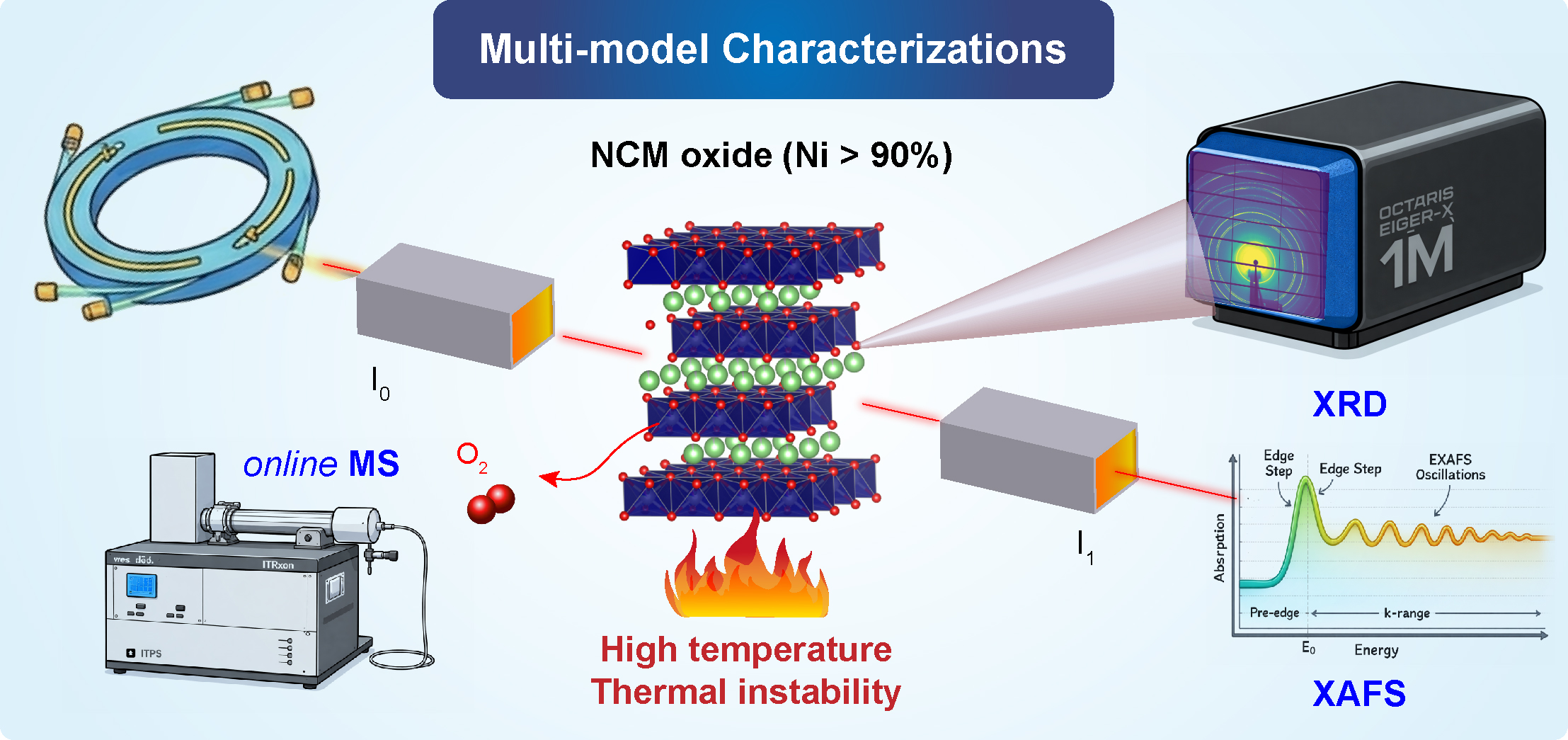
Deciphering the fundamental triggers of thermal instability in ultra-high nickel cathodes is vital for advancing safe, high-energy-density lithium-ion batteries. In this work, we present a reaction device that enables operando synchrotron XRD, XAFS, and online mass spectrometry (OMS) measurements simultaneously, individually, or in paired combinations under identical heating and gas conditions. Using delithiated NCM96 as a model cathode, the complementary measurements correlate structural degradation, transition-metal redox evolution, and gas release during thermal decomposition, providing comprehensive insights into the thermal instability of high-nickel cathodes. Our findings reveal that thermal failure is a synergistic process initiated by electronic instability and the onset of lattice oxygen loss at approximately 175 °C. Operando XRD identifies a distinct H3-to-H2 structural relaxation and subsequent amorphization, while XAFS captures rapid Ni reduction and local coordination expansion between 185–330 °C. These electronic and local fluctuations drive the bulk phase transition from layered to spinel, which is tightly coupled with a dominant oxygen evolution event (OT1 comprising 74.9% of total O2 release) and a vigorous exothermic response at ~210 °C. This study provides a refined mechanistic view of thermal instability of ultra-high Ni cathodes, offering a blueprint for the design of thermally safe high-nickel cathodes.
- Open Access
- Article
Deciphering the “Thermal Snap” on Ultra-High Ni Cathodes via Multi-Modal Operando Synchrotron X-ray and Mass Spectrometry
- Yuying Zhang 1,†,
- Hanwei Liu 1,†,
- Zhenzhong Li 1,
- Chao Wang 1,
- Wencheng Su 1,
- Wei Zhou 1,
- Jingfu He 1,*,
- Chunzhen Yang 1,2,*
Author Information
Received: 24 Apr 2026 | Revised: 30 May 2026 | Accepted: 02 Jun 2026 | Published: 10 Jun 2026
Abstract
Graphical Abstract
Keywords
operando XRD | online mass spectroscopy | thermal runaway | cathode materials | Ni-Co-Mn layered oxide
References
- 1.
Meng, D.; Shi, X.; Jiang, J.; et al. Experimental Study on Thermal Runaway Propagation Characteristics and Combustion Behaviors of LFP and NCM Lithium-Ion Batteries Induced by Dual Heat Sources. Appl. Therm. Eng. 2026, 294, 130589. https://doi.org/10.1016/j.applthermaleng.2026.130589.
- 2.
Ren, X.; Kong, D.; Ping, P.; et al. Experimental Study on the Evolution Patterns of Thermal Runaway and Safety Boundaries of Commercial Lithium-Ion Batteries under Overheating Failure. Mater. Today Energy 2025, 52, 101937. https://doi.org/10.1016/j.mtener.2025.101937.
- 3.
Ma, L.; He, Y.; Zhang, J.; et al. Experimental Study on Thermal Runaway Characteristics and Propagation Mechanisms of Large-Capacity NCM Batteries Triggered by Overheating under Charging Conditions. Process Saf. Environ. Prot. 2025, 202, 107719. https://doi.org/10.1016/j.psep.2025.107719.
- 4.
Maleki, H.; Howard, J.N. Internal Short Circuit in Li-Ion Cells. J. Power Sources 2009, 191, 568–574. https://doi.org/10.1016/j.jpowsour.2009.02.070.
- 5.
Wang, H.; Lara-Curzio, E.; Rule, E.T.; et al. Mechanical Abuse Simulation and Thermal Runaway Risks of Large-Format Li-Ion Batteries. J. Power Sources 2017, 342, 913–920. https://doi.org/10.1016/j.jpowsour.2016.12.111.
- 6.
Zhao, H.; Bo, X.K.; Zhang, Z.G.; et al. Insight into Puncture-Induced Thermal Runaway in Lithium-Ion Batteries to Reduce Fire Risks in Electric Vehicle Collisions. Battery Energy 2025, 4, e70041. https://doi.org/10.1002/bte2.20250036.
- 7.
Jia, Y.; Yue, Y.; Xu, W.; et al. Thermal Runaway Features of Prismatic NCM Battery Undergone High-Rate Charging/Discharging: Mechanism Investigation and Safety Evaluation. Appl. Therm. Eng. 2025, 275, 126634. https://doi.org/10.1016/j.applthermaleng.2025.126634.
- 8.
Chen, J.; Xu, C.; Wang, Q.; et al. The Thermal-Gas Coupling Mechanism of Lithium Iron Phosphate Batteries during Thermal Runaway. J. Power Sources 2025, 625, 235728. https://doi.org/10.1016/j.jpowsour.2024.235728.
- 9.
Ouyang, D.X.; Chen, M.Y.; Weng, J.W.; et al. Exploring the Thermal Stability of Lithium-Ion Cells via Accelerating Rate Calorimetry: A Review. J. Energy Chem. 2023, 81, 543–573. https://doi.org/10.1016/j.jechem.2023.02.030.
- 10.
Jiang, Z.-J.; Luo, Z.-H.; Guo, J.-X.; et al. Thermal Safety Overview of Silicon-Carbon Anode in Lithium-Ion Batteries: Key Parameters in Determining the Reactivity. Particuology 2025, 100, 178–185. https://doi.org/10.1016/j.partic.2025.03.013.
- 11.
Zhu, X.Q.; Wang, H.; Wang, X.; et al. Internal Short Circuit and Failure Mechanisms of Lithium-Ion Pouch Cells under Mechanical Indentation Abuse Conditions: An Experimental Study. J. Power Sources 2020, 455, 227939. https://doi.org/10.1016/j.jpowsour.2020.227939.
- 12.
Barkholtz, H.M.; Preger, Y.; Ivanov, S.; et al. Multi-Scale Thermal Stability Study of Commercial Lithium-Ion Batteries as a Function of Cathode Chemistry and State-of-Charge. J. Power Sources 2019, 435, 226777. https://doi.org/10.1016/j.jpowsour.2019.226777.
- 13.
Jo, S.; Seo, S.; Kang, S.K.; et al. Thermal Runaway Mechanism in Ni-Rich Cathode Full Cells of Lithium-Ion Batteries: The Role of Multidirectional Crosstalk. Adv. Mater. 2024, 36, e2402024. https://doi.org/10.1002/adma.202402024.
- 14.
Zhou, W.; Zhang, Y.; Wang, C.; et al. Rare-Earth Oxide Additives Mitigate Oxygen Release and Thermal Runaway in Ni-Rich NCM Cathodes. J. Rare Earths 2026, in press. https://doi.org/10.1016/j.jre.2026.03.010.
- 15.
Bak, S.M.; Hu, E.Y.; Zhou, Y.N.; et al. Structural Changes and Thermal Stability of Charged LiNixMnyCoZO2 Cathode Materials Studied by Combined In Situ Time-Resolved XRD and Mass Spectroscopy. ACS Appl. Mater. Interfaces 2014, 6, 22594–22601. https://doi.org/10.1021/am506712c.
- 16.
Mai, A.N.T.; Chern, C.-S.; Kuss, C.; et al. Enhancing Thermal Properties and Electrochemical Performance of LiNi0.6Co0.2Mn0.2O2 Cathode with Bismaleimide-Cyanuric Acid Polymer Coating for Safer Lithium-Ion Batteries. Mater. Today Commun. 2025, 47, 113033. https://doi.org/10.1016/j.mtcomm.2025.113033.
- 17.
Cui, Z.H.; Manthiram, A. Thermal Stability and Outgassing Behaviors of High-Nickel Cathodes in Lithium-Ion Batteries. Angew. Chem. Int. Ed. 2023, 62, e202307243. https://doi.org/10.1002/anie.202307243.
- 18.
Liu, X.; Xu, G.L.; Yin, L.; et al. Probing the Thermal-Driven Structural and Chemical Degradation of Ni-Rich Layered Cathodes by Co/Mn Exchange. J. Am. Chem. Soc. 2020, 142, 19745–19753. https://doi.org/10.1021/jacs.0c09961.
- 19.
Peiris, M.D.H.C.; Liepinya, D.; Liu, H.; et al. Electrolyte Reactivity, Oxygen States, and Degradation Mechanisms of Nickel-Rich Cathodes. Cell Rep. Phys. Sci. 2024, 5, 102039. https://doi.org/10.1016/j.xcrp.2024.102039.
- 20.
Zhang, B.; Zhang, H.Y.; Su, Y.F.; et al. Rare-Earth Doping Induced Pinning Effect with Enhanced Chemo-Mechanical Stability in Ni-Rich Cathodes for Lithium-Ion Batteries. Chin. J. Chem. 2025, 43, 889–896. https://doi.org/10.1002/cjoc.202401071.
- 21.
Liu, J.Z.; Dong, J.Y.; Wang, M.; et al. Redox-Active Stabilizer-Enhanced Structural and Thermal Stability of Ni-Rich Cathodes via an Economical Blending Strategy. eTransportation 2025, 24, 100428. https://doi.org/10.1016/j.etran.2025.100428.
- 22.
Liang, Y.Z.; Xue, H.Y.; Zhan, M.Z.; et al. Stationary Oxygen Vacancy Construction toward a Superior-Performance Ultrahigh Nickel Single-Crystal Cathode. ACS Nano 2025, 19, 25879–25889. https://doi.org/10.1021/acsnano.5c05412.
- 23.
Jiang, Z.X.; Liu, C.G.; Huang, L.; et al. Interfacial Reactions Take the Lead: Elucidating the Dominant Role of Cathode-Electrolyte Interactions in Triggering Thermal Runaway of High-Nickel Lithium-Ion Batteries. Energy Environ. Sci. 2025, 18, 8232–8243. https://doi.org/10.1039/d5ee01431j.
- 24.
Song, Y.J.; Cui, Y.P.; Li, B.Y.; et al. Revealing the Origin of High-Thermal-Stability of Single-Crystal Ni-Rich Cathodes toward Higher-Safety Batteries. Nano Energy 2023, 116, 108846. https://doi.org/10.1016/j.nanoen.2023.108846.
- 25.
Wang, C.; Zhang, R.; Kisslinger, K.; et al. Atomic-Scale Observation of O1 Faulted Phase-Induced Deactivation of LiNiO2 at High Voltage. Nano Lett. 2021, 21, 3657–3663. https://doi.org/10.1021/acs.nanolett.1c00862.
- 26.
Hu, E.; Bak, S.-M.; Liu, J.; et al. Oxygen-Release-Related Thermal Stability and Decomposition Pathways of LixNi0.5Mn1.5O4 Cathode Materials. Chem. Mater. 2013, 26, 1108–1118. https://doi.org/10.1021/cm403400y.
- 27.
Britala, L.; Marinaro, M.; Kucinskis, G. A Review of the Degradation Mechanisms of NCM Cathodes and Corresponding Mitigation Strategies. J. Energy Storage 2023, 73, 108875. https://doi.org/10.1016/j.est.2023.108875.
- 28.
Wang, Y.; Ren, D.; Feng, X.; et al. Thermal Kinetics Comparison of Delithiated Li[NixCoyMn1−x−y]O2 Cathodes. J. Power Sources 2021, 514, 230582. https://doi.org/10.1016/j.jpowsour.2021.230582.
- 29.
Wei, Z.S.; Liang, C.; Jiang, L.H.; et al. Probing the Thermal Degradation Mechanism of Polycrystalline and Single-Crystal Li(Ni0.8Co0.1Mn0.1)O2 Cathodes from the Perspective of Oxygen Vacancy Diffusion. Energy Storage Mater. 2023, 56, 495–505. https://doi.org/10.1016/j.ensm.2023.01.029.
- 30.
da Silva, S.P.; Sita, L.E.; dos Santos, C.S.; et al. Effects on the Phases and Crystalline Structures of LiCoO2 Cathode under Thermal Treatments up to 400 °C. J. Alloys Compd. 2019, 810, 151933. https://doi.org/10.1016/j.jallcom.2019.151933.
- 31.
Wang, C.Y.; Wang, X.L.; Zhang, R.; et al. Resolving Complex Intralayer Transition Motifs in High-Ni-Content Layered Cathode Materials for Lithium-Ion Batteries. Nat. Mater. 2023, 22, 235–241. https://doi.org/10.1038/s41563-022-01461-5.
- 32.
Park, G.T.; Ryu, H.H.; Park, N.Y.; et al. Single-Crystal vs. Polycrystalline Cathodes for Lithium-Ion Batteries. Chem. Rev. 2025, 125, 9930–10000. https://doi.org/10.1021/acs.chemrev.5c00441.
- 33.
Wang, C.; Zhang, Y.; Li, Z.; et al. A Comprehensive Understanding of the Structural Evolution and Capacity Contribution of Fast-Charging NCM Cathodes. J. Energy Chem. 2026, 114, 183–193. https://doi.org/10.1016/j.jechem.2025.09.066.
- 34.
Li, Y.; Gao, D.; Chang, C.; et al. Improved Electrochemical Performance of Nb5+ Doped NCM Cathode upon 4.5 V Application Beneficial from the Suppressed H2-H3 Phase Transition and Promoted Li+ Migration Kinetics. J. Energy Storage 2023, 73, 109139. https://doi.org/10.1016/j.est.2023.109139.
- 35.
Zhang, F.; Lou, S.; Li, S.; et al. Surface Regulation Enables High Stability of Single-Crystal Lithium-Ion Cathodes at High Voltage. Nat. Commun. 2020, 11, 3050. https://doi.org/10.1038/s41467-020-16824-2.
- 36.
Zhang, Y.; Wang, C.; Zhang, J.; et al. Structural Evolution and Thermal Behavior of High-Ni Cathodes: Coupled Operando XAS, XRD, and Mass Spectrometry Analysis. ACS Energy Lett. 2026, 11, 3936–3944. https://doi.org/10.1021/acsenergylett.6c00367.
- 37.
Zhao, J.; Ma, L.; Zhao, L.; et al. Experimental Study on Thermal Runaway Characteristics and Gas Generation Behavior Induced by Overcharge: Single Cells and Modules of Large-Capacity NCM Lithium-Ion Battery. J. Energy Storage 2025, 133, 117925. https://doi.org/10.1016/j.est.2025.117925.
- 38.
Chen, K.; Zhang, D.; Guo, J.-X.; et al. Hydrogen Generated from Binders: An Overlooked Thermal Runaway Source in Lithium-Ion Batteries. J. Energy Chem. 2025, 109, 602–608. https://doi.org/10.1016/j.jechem.2025.06.004.

This work is licensed under a Creative Commons Attribution 4.0 International License.

 Suite 4002 Level 4, 447 Collins Street, Melbourne, Victoria 3000, Australia
 General Inquiries: info@sciltp.com