
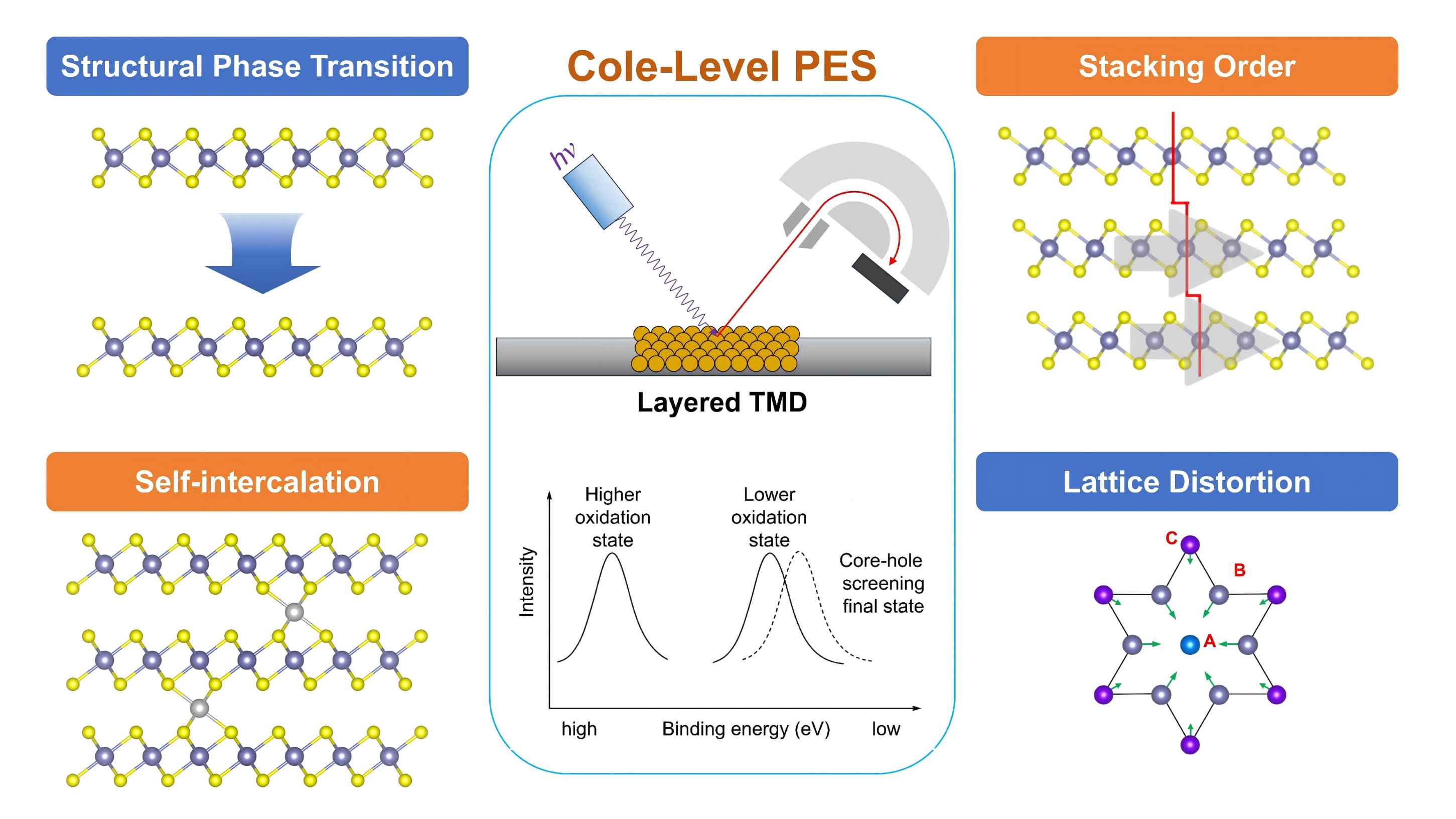
Layered transition metal dichalcogenides (TMDs) exhibit remarkable structural flexibility and electronic tunability, where subtle structural variations, such as defects, self-intercalation, lattice distortion, stacking sequence and phase transitions, can significantly modify their physical properties. However, reliably identifying these structural degrees of freedom remains challenging when changes in stoichiometry or long-range order are minimal. Core-level photoelectron spectroscopy (PES) provides a uniquely sensitive approach to probe the local electronic structure and chemical environment. In this review, we establish a unified framework showing how different structural modulations give rise to distinct spectroscopic signatures governed by initial-state chemical shift and final-state core-hole screening. Vacancy defects and self-intercalation primarily induce core-level shifts of the defective element. Periodic lattice distortion leads to spectral splitting. Inter-layer sliding leads to subtle binding energy variations without new features. The structural phase transitions generate new spectral components with pronounced binding energy shifts. Using representative TMD systems, we demonstrate how core-level PES can identify defect types, quantify self-intercalation, clarify lattice distortion and track stacking arrangements and phase evolution. These capabilities highlight PES as a powerful probe of local structural modulation and many-body electronic responses, providing a direct spectroscopic link between structural variations and electronic properties.
- Open Access
- Review
Photoelectron Spectroscopy for Structural Characterization of Layered Transition Metal Dichalcogenides
- Haoran Li 1,2,
- Hai Xu 1,*,
- Liang Cao 2,*
Author Information
Received: 01 May 2026 | Revised: 24 Jun 2026 | Accepted: 25 Jun 2026 | Published: 30 Jun 2026
Abstract
Graphical Abstract
Keywords
defect | self-intercalation | charge density wave | stacking order and structural phase transition
References
- 1.
Novoselov, K.S.; Geim, A.K.; Morozov, S.V.; et al. Electric field effect in atomically thin carbon films. Science 2004, 306, 666–669.
- 2.
Chowdhury, T.; Sadler, E.C.; Kempa, T.J. Progress and prospects in transition-metal dichalcogenide research beyond 2D. Chem. Rev. 2020, 120, 12563–12591.
- 3.
Zhai, W.; Li, Z.; Wang, Y.; et al. Phase engineering of nanomaterials: Transition metal dichalcogenides. Chem. Rev. 2024, 124, 4479–4539.
- 4.
Wang, Q.H.; Kalantar-Zadeh, K.; Kis, A.; et al. Electronics and optoelectronics of two-dimensional transition metal dichalcogenides. Nat. Nanotechnol. 2012, 7, 699–712.
- 5.
Chhowalla, M.; Shin, H.S.; Eda, G.; et al. The chemistry of two-dimensional layered transition metal dichalcogenide nanosheets. Nat. Chem. 2013, 5, 263–275.
- 6.
Li, H.; Li, Y.; Aljarb, A.; et al. Epitaxial growth of two-dimensional layered transition-metal dichalcogenides: Growth mechanism, controllability, and scalability. Chem. Rev. 2017, 118, 6134–6150.
- 7.
Manzeli, S.; Ovchinnikov, D.; Pasquier, D.; et al. 2D transition metal dichalcogenides. Nat. Rev. Mater. 2017, 2, 17033.
- 8.
Hu, Z.; Wu, Z.; Han, C.; et al. Two-dimensional transition metal dichalcogenides: Interface and defect engineering. Chem. Soc. Rev. 2018, 47, 3100–3128.
- 9.
Addou, R.; Wallace, R.M. Using photoelectron spectroscopy in the integration of 2D materials for advanced devices. J. Electron Spectrosc. Relat. Phenom. 2019, 231, 94–103.
- 10.
Zhang, X.; Qiao, X.-F.; Shi, W.; et al. Phonon and Raman scattering of two-dimensional transition metal dichalcogenides from monolayer, multilayer to bulk material. Chem. Soc. Rev. 2015, 44, 2757–2785.
- 11.
Zeng, L.; Olsson, E. Control of electrically and optically active structural disorder in 2D transition metal dichalcogenides. npj 2D Mater. Appl. 2026, 10, 8.
- 12.
Hu, J.; Huang, C.; Liu, L.; et al. Defect-Mediated Phase Transitions and Structural Dynamics in Single-Layer VSe2. ACS Appl. Mater. Interfaces 2025, 17, 47781–47789.
- 13.
Liang, Z.; Zhang, J.; Hua, C.; et al. Ferroelectric manipulation and enhancement of Rashba spin splitting in van der Waals heterostructures. Phys. Rev. B 2024, 110, 085110.
- 14.
Lin, Z.; Carvalho, B.R.; Kahn, E.; et al. Defect engineering of two-dimensional transition metal dichalcogenides. 2D Mater. 2016, 3, 022002.
- 15.
Bussolotti, F.; Kawai, H.; Maddumapatabandi, T.D.; et al. Role of S-vacancy concentration in air oxidation of WS2 single crystals. ACS Nano 2024, 18, 8706–8717.
- 16.
Zhang, P.; Xue, M.; Chen, C.; et al. Mechanism regulating self-intercalation in layered materials. Nano Lett. 2023, 23, 3623–3629.
- 17.
Zhao, X.; Song, P.; Wang, C.; et al. Engineering covalently bonded 2D layered materials by self-intercalation. Nature 2020, 581, 171–177.
- 18.
Wu, S.; Tian, W.; Li, R.; et al. Self-intercalated 6R-TaS2 with reduced symmetry for room temperature nonlinear Hall effect. Matter 2025, 8, 102153.
- 19.
Han, Z.; Han, X.; Wu, S.; et al. Phase and composition engineering of self-intercalated 2D metallic tantalum sulfide for second-harmonic generation. ACS Nano 2024, 18, 6256–6265.
- 20.
Wang, H.; Zhang, J.; Shen, C.; et al. Direct visualization of stacking-selective self-intercalation in epitaxial Nb1+xSe2 films. Nat. Commun. 2024, 15, 2541.
- 21.
Hong, J.; Peela, B.; Georgescu, A.B.; et al. Influence of chromium intercalation in self-intercalated van der Waals magnets Cr1+δTe2. Phys. Rev. Mater. 2025, 9, 094414.
- 22.
Sung, H.Y.; Wang, C.H.; Lee, M.P.; et al. Titanium Self-Intercalation in Titanium Diselenide Devices: Insights from In Situ Transmission Electron Microscopy. Adv. Mater. 2025, 37, 2418557.
- 23.
Chen, K.; Song, M.; Sun, Y.-Y.; et al. Defects controlled doping and electrical transport in TiS2 single crystals. Appl. Phys. Lett. 2020, 116, 121901.
- 24.
Mak, K.F.; Lee, C.; Hone, J.; et al. Atomically thin MoS2: A new direct-gap semiconductor. Phys. Rev. Lett. 2010, 105, 136805.
- 25.
Lin, Y.-C.; Dumcenco, D.O.; Huang, Y.-S.; et al. Atomic mechanism of the semiconducting-to-metallic phase transition in single-layered MoS2. Nat. Nanotechnol. 2014, 9, 391–396.
- 26.
Cao, Y.; Fatemi, V.; Demir, A.; et al. Correlated insulator behaviour at half-filling in magic-angle graphene superlattices. Nature 2018, 556, 80–84.
- 27.
Cao, Y.; Fatemi, V.; Fang, S.; et al. Unconventional superconductivity in magic-angle graphene superlattices. Nature 2018, 556, 43–50.
- 28.
Vizner Stern, M.; Waschitz, Y.; Cao, W.; et al. Interfacial ferroelectricity by van der Waals sliding. Science 2021, 372, 1462–1466.
- 29.
Han, X.; Zhao, X. Stackingtronics: Programmable Interlayer Sliding in 2D Materials. Nano Lett. 2025, 25, 16955–16962.
- 30.
Hughes, H.P.; Starnberg, H. Electron Spectroscopies Applied to Low-Dimensional Structures; Springer Dordrecht: Dordrecht, The Netherlands, 2001.
- 31.
Fox, C.; Mao, Y.; Zhang, X.; et al. Stacking order engineering of two-dimensional materials and device applications. Chem. Rev. 2023, 124, 1862–1898.
- 32.
Yasuda, K.; Wang, X.; Watanabe, K.; et al. Stacking-engineered ferroelectricity in bilayer boron nitride. Science 2021, 372, 1458–1462.
- 33.
Yasuda, K.; Zalys-Geller, E.; Wang, X.; et al. Ultrafast high-endurance memory based on sliding ferroelectrics. Science 2024, 385, 53–56.
- 34.
Wang, X.; Yasuda, K.; Zhang, Y.; et al. Interfacial ferroelectricity in rhombohedral-stacked bilayer transition metal dichalcogenides. Nat. Nanotechnol. 2022, 17, 367–371.
- 35.
Bian, R.; He, R.; Pan, E.; et al. W. Developing fatigue-resistant ferroelectrics using interlayer sliding switching. Science 2024, 385, 57–62.
- 36.
Wang, Y.; Li, Z.; Luo, X.; et al. Dualistic insulator states in 1T-TaS2 crystals. Nat. Commun. 2024, 15, 3425.
- 37.
Wang, Z.; Sun, Y.-Y.; Abdelwahab, I.; et al. Surface-limited superconducting phase transition on 1T-TaS2. ACS Nano 2018, 12, 12619–12628.
- 38.
Tison, Y.; Martinez, H.; Baraille, I.; et al. X-ray photoelectron spectroscopy and scanning tunneling microscopy investigations of the solid solutions TixTa1−xS2 (0 ≤ x ≤ 1). Surf. Sci. 2004, 563, 83–98.
- 39.
Crawack, H.; Pettenkofer, C. Calculation and XPS measurements of the Ta 4f CDW splitting in Cu, Cs and Li intercalation phases of 1T-TaX2 (X = S, Se). Solid State Commun. 2001, 118, 325–332.
- 40.
Luxa, J.; Mazánek, V.; Pumera, M.; et al. 2H→1T phase engineering of layered tantalum disulfides in electrocatalysis: Oxygen reduction reaction. Chem. Eur. J. 2017, 23, 8082–8091.
- 41.
Yin, X.; Wang, Q.; Cao, L.; et al. Tunable inverted gap in monolayer quasi-metallic MoS2 induced by strong charge-lattice coupling. Nat. Commun. 2017, 8, 486.

This work is licensed under a Creative Commons Attribution 4.0 International License.

 Suite 4002 Level 4, 447 Collins Street, Melbourne, Victoria 3000, Australia
 General Inquiries: info@sciltp.com