
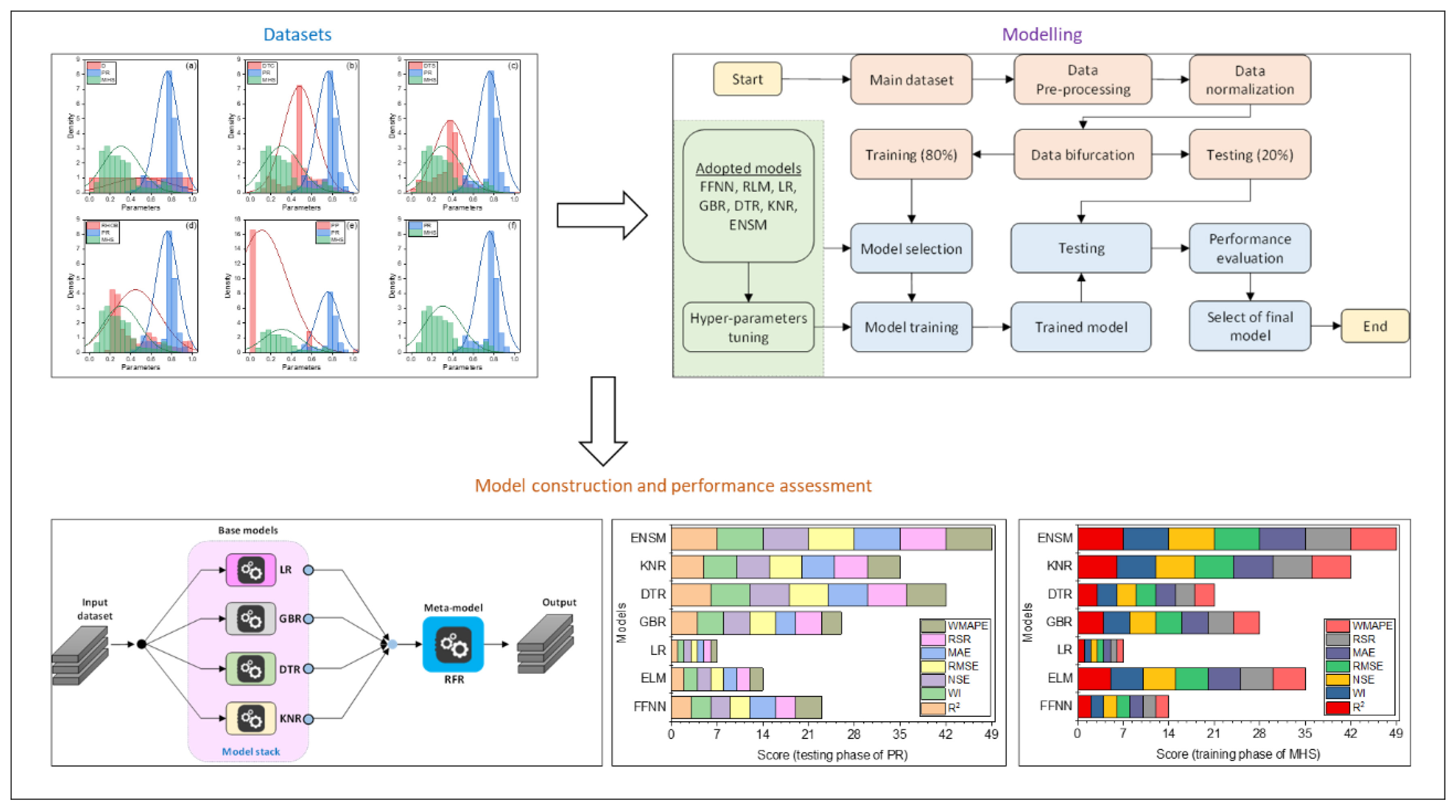
This study develops an efficient meta-ensemble paradigm for predicting geotechnical-geological parameters namely static Poisson’s ratio (PR) and maximum horizontal stress (MHS) significant to casing collapse hazards. Engineers strive to reduce the risk of casing collapse due to drilling through the meticulous design of wells and operation practices. Thus, identifying casing collapse hazards in oil and gas wellbores necessitates a thorough geotechnical examination. For this purpose, a stacking ensemble paradigm was developed to predict PR and MHS, the two most important variables of casing collapse hazards. Three conventional models (viz., gradient boosting regressor, decision tree regressor, and k-nearest neighbour regressor) and linear regressor were used as base models to construct a stacking ensemble paradigm (ENSM) in which a random forest regressor was used as the meta-model. The performance of the ENSM model was compared with two additional standalone models namely feed-forward neural network and extreme learning machine. Experimental results exhibit that the ENSM paradigm delivers higher prediction accuracy than all other employed models with R2 values ranging from 0.9755 to 0.9991. The experimental results confirmed that the proposed ENSM paradigm achieves high prediction accuracy in predicting the PR and MHS of soils and can be considered an effective approach to aid engineers in assessing the risk of casing collapse hazards in oil and gas wellbores and operation practices.
- Open Access
- Article
An Efficient Meta-Ensemble Paradigm for Modelling Poisson’s Ratio and Maximum Horizontal Stress in Casing Collapse Hazard
- Abidhan Bardhan 1,*,
- Navid Kardani 2
Author Information
Received: 17 Dec 2025 | Revised: 21 Feb 2026 | Accepted: 17 Mar 2026 | Published: 03 Apr 2026
Abstract
Graphical Abstract
Keywords
wellbore casing collapse | geological sub-surface model | applied geophysics | ensemble machine learning model | artificial intelligence
References
- 1.
Bradley, W.B. Failure of inclined boreholes. J. Energy Resour. Technol. 1979, 101, 232–239.
- 2.
Mohamadian, N.; Ghorbani, H.; Wood, D.A.; et al. A geomechanical approach to casing collapse prediction in oil and gas wells aided by machine learning. J. Pet. Sci. Eng. 2021, 196, 107811.
- 3.
Willson, S.M.; Fossum, A.F.; Fredrich, J.T. Assessment of salt loading on well casings. SPE/IADC Drill. Complet. 2003, 18, 13–21.
- 4.
Gao, D.L.; Zheng, C.K.; Tan, C.J. Numerical simulation of external pressure distribution of casing string with wear in creep formation. J. China Univ. Pet. 2007, 31, 56–61.
- 5.
Hu, B.; Xu, Z. Casing failure mechanisms and protection measures of oil and water wells in Daqing Oilfield. Drill. Prod. Technol. 1998, 20, 95–99.
- 6.
Hu, C.; Ai, C.; Tao, F.; et al. Optimization of well completion method and casing design parameters to delay casing impairment caused by formation slippage. In Proceedings of the SPE/IADC Middle East Drilling Technology Conference and Exhibition, Abu Dhabi, UAE, 26–28 January 2016.
- 7.
Jiang, K.; Li, Q.; Chen, Y.; et al. Influence of cementing quality on casing failures in horizontal shale gas wells. Nat. Gas Ind. 2015, 35, 77–82.
- 8.
Zhou, X.; He, S.; Tang, M.; et al. Mechanism of collapse failure and analysis of yield collapse resistance of casing under combined load. Eng. Struct. 2019, 191, 12–22.
- 9.
Liu, X.; Yang, X.; Wang, J. A nonlinear creep model of rock salt and its numerical implement in FLAC 3D. Adv. Mater. Sci. Eng. 2015, 2015, 285158.
- 10.
Wang, H.; Samuel, R. 3D geomechanical modeling of salt-creep behavior on wellbore casing for presalt reservoirs. SPE Drill. Complet. 2016, 31, 261–272.
- 11.
Firme, P.A.L.P.; Roehl, D.; Romanel, C. An assessment of the creep behaviour of Brazilian salt rocks using the multi-mechanism deformation model. Acta Geotech. 2016, 11, 1445–1463.
- 12.
Tong, H.; Guo, D.; Zhu, X. Application of multiphysics coupling FEM on open wellbore shrinkage and casing remaining strength in an incomplete borehole in deep salt formation. Math. Probl. Eng. 2015, 2015, 575492.
- 13.
Hedayatikhah, S.; Abdideh, M. 3D Geomechanical modeling of casing collapse in plastic formations (Cap Rock of Hydrocarbon Reservoir). Nat. Resour. Res. 2019, 28, 273–286.
- 14.
Salehi, S.; Hareland, G.; Dehkordi, K.K.; et al. Casing collapse risk assessment and depth prediction with a neural network system approach. J. Pet. Sci. Eng. 2009, 69, 156–162.
- 15.
Wang, P.; Zhong, C.; Fan, S.; et al. Prediction of Collapsing Strength of High-Strength Collapse-Resistant Casing Based on Machine Learning. Processes 2023, 11, 3007.
- 16.
Xue, J. Casing damage classification method using random forest algorithms. J. Phys. Conf. Ser. 2020, 1437, 012131.
- 17.
Noshi, C.I.; Noynaert, S.F.; Schubert, J.J. Failure predictive analytics using data mining: How to predict unforeseen casing failures? In Proceedings of the Abu Dhabi International Petroleum Exhibition & Conference, Abu Dhabi, UAE, 11–15 November 2018.
- 18.
Nilashi, M.; bin Ibrahim, O.; Ahmadi, H.; et al. An analytical method for diseases prediction using machine learning techniques. Comput. Chem. Eng. 2017, 106, 212–223.
- 19.
Mosavi, A.; Ozturk, P.; Chau, K. Flood prediction using machine learning models: Literature review. Water 2018, 10, 1536.
- 20.
Matloob, F.; Ghazal, T.M.; Taleb, N.; et al. Software defect prediction using ensemble learning: A systematic literature review. IEEE Access 2021, 9, 98754–98771.
- 21.
Lee, J.; Wang, W.; Harrou, F.; et al. Wind power prediction using ensemble learning-based models. IEEE Access 2020, 8, 61517–61527.
- 22.
Lee, J.; Wang, W.; Harrou, F.; et al. Reliable solar irradiance prediction using ensemble learning-based models: A comparative study. Energy Convers. Manag. 2020, 208, 112582.
- 23.
Quan, V.; Do, H.Q. Prediction of California bearing ratio (CBR) of stabilized expansive soils with agricultural and industrial waste using light gradient boosting machine. J. Sci. Transp. Technol. 2021. https://doi.org/10.58845/jstt.utt.2021.en3.
- 24.
Khatti, J.; Grover, K.S. Relationship Between Index Properties and CBR of Soil and Prediction of CBR. In Transportation and Environmental Geotechnics; Springer: Singapore, 2021; pp. 171–185.
- 25.
Iqbal, M.; Onyelowe, K.C.; Jalal, F.E. Smart computing models of California bearing ratio, unconfined compressive strength, and resistance value of activated ash-modified soft clay soil with adaptive neuro-fuzzy inference system and ensemble random forest regression techniques. Multiscale Multidiscip. Model. Exp. Des. 2021, 4, 207–225.
- 26.
Zhang, W.; Li, H.; Han, L.; et al. Slope stability prediction using ensemble learning techniques: A case study in Yunyang County, Chongqing, China. J. Rock Mech. Geotech. Eng. 2022, 14, 1089–1099.
- 27.
Ullah, H.S.; Khushnood, R.A.; Farooq, F.; et al. Prediction of compressive strength of sustainable foam concrete using individual and ensemble machine learning approaches. Materials 2022, 15, 3166.
- 28.
Song, Y.; Zhao, J.; Ostrowski, K.A.; et al. Prediction of compressive strength of fly-ash-based concrete using ensemble and non-ensemble supervised machine-learning approaches. Appl. Sci. 2021, 12, 361.
- 29.
Li, Q.-F.; Song, Z.-M. High-performance concrete strength prediction based on ensemble learning. Constr. Build. Mater. 2022, 324, 126694.
- 30.
Li, Q.; Song, Z. Prediction of compressive strength of rice husk ash concrete based on stacking ensemble learning model. J. Clean. Prod. 2023, 382, 135279.
- 31.
Ikeagwuani, C.C.; Nwonu, D.C. Statistical analysis and prediction of spatial resilient modulus of coarse-grained soils for pavement subbase and base layers using MLR, ANN and Ensemble techniques. Innov. Infrastruct. Solut. 2022, 7, 273.
- 32.
Raheem, Z.; Mohammed, Z.; Barzan, Z.; et al. Hybrid Data-Driven and Explainable Modeling of Compressive Strength in GGBFS–MRP Concrete with Environmental Optimization. Bull. Comput. Intell. 2026, 2, 13–30.
- 33.
Benzaamia, A.; Ghrici, M.; Rbouh, R.; et al. Prediction of chloride resistance level in concrete using optimized tree-based machine learning Models. Bull. Comput. Intell. 2025, 1, 104–117.
- 34.
Sarhadi, A.; Ravanshadnia, M.; Monirabbasi, A.; et al. Optimizing concrete crack detection: An attention-based swin u-net approach. IEEE Access 2024, 12, 77575–77585.
- 35.
Savvides, A.A.; Papadopoulos, L. A neural network approach for the reliability analysis on failure of shallow foundations on cohesive soils. Int. J. Geo-Eng. 2024, 15, 15.
- 36.
Silewu, K.; Kahanji, C.; Simwanda, L.; et al. Intelligent Data Driven Ensemble Approaches for Bending Strength Prediction of Ultra-High Performance Concrete Beams. Bull. Comput. Intell. 2025, 1, 31–52.
- 37.
Shahin, M.A.; Jaksa, M.B.; Maier, H.R. State of the art of artificial neural networks in geotechnical engineering. Electron. J. Geotech. Eng. 2008, 8, 1–26.
- 38.
Muhammed, A.M.; Omer, M.A.I.; Haider, R.S.; et al. Predicting the Compressive Strength of Fly Ash Composite Foam Concrete Using Artificial Neural Networks and Soft Computing Techniques. Bull. Comput. Intell. 2026, 2, 83–102.
- 39.
Huang, G.B.; Zhu, Q.Y.; Siew, C.K. Extreme learning machine: Theory and applications. Neurocomputing 2006, 70, 489–501. https://doi.org/10.1016/j.neucom.2005.12.126.
- 40.
Spross, J.; Johansson, F. When is the observational method in geotechnical engineering favourable? Struct. Saf. 2017, 66, 17–26.
- 41.
Shahriar, K.; Sharifzadeh, M.; Hamidi, J.K. Geotechnical risk assessment based approach for rock TBM selection in difficult ground conditions. Tunn. Undergr. Space Technol. 2008, 23, 318–325.
- 42.
Ansari, S.S.; Ansari, M.A.; Ibrahim, S.M. Explainable Predictive Modelling of Sustainable Slag–Fly Ash Based Geopolymer Concrete with Life Cycle and Carbon-Neutrality Assessment. Bull. Comput. Intell. 2026, 2, 54–82.
- 43.
Fehrmann, L.; Lehtonen, A.; Kleinn, C.; et al. Comparison of linear and mixed-effect regression models and a k-nearest neighbour approach for estimation of single-tree biomass. Can. J. For. Res. 2008, 38, 1–9.
- 44.
Jong, Y.-H.; Lee, C.-I. Influence of geological conditions on the powder factor for tunnel blasting. Int. J. Rock Mech. Min. Sci. 2004, 41, 533–538.


This work is licensed under a Creative Commons Attribution 4.0 International License.

 Suite 4002 Level 4, 447 Collins Street, Melbourne, Victoria 3000, Australia
 General Inquiries: info@sciltp.com