
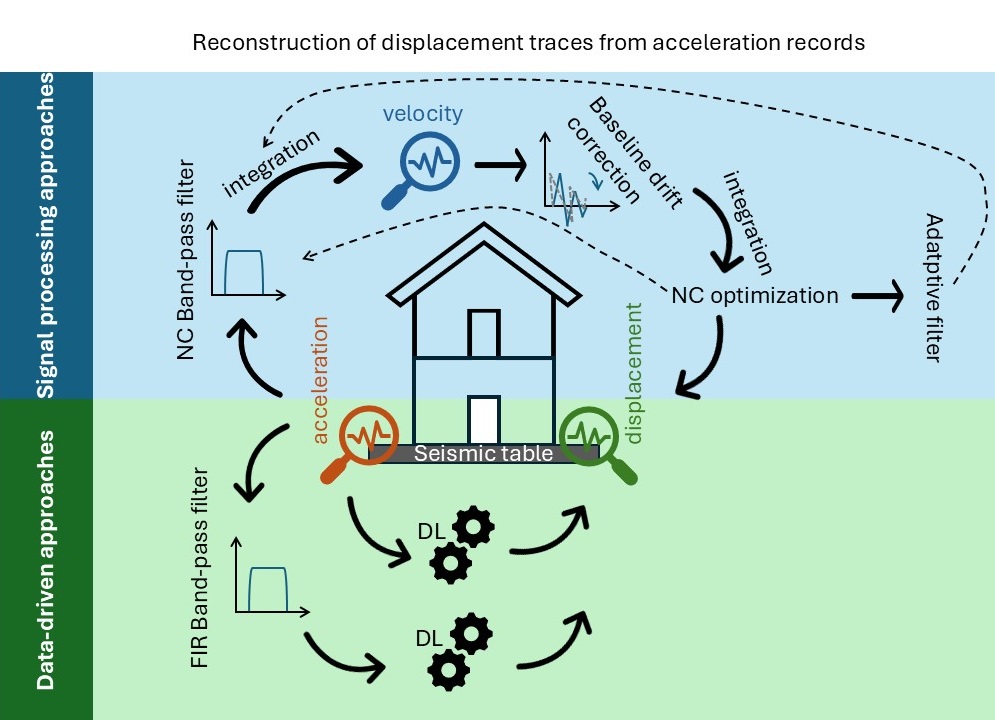
Reliable displacement reconstruction from acceleration measurements is a persistent challenge in shaking-table testing because sensor noise and baseline drift can accumulate through numerical integration, biasing the inferred kinematic response. This study investigates and compares two complementary strategies for noise suppression and displacement estimation: (i) an optimized signal-processing workflow that combines band-limited integration with systematic parameter tuning, and (ii) a data-driven approach based on a Long Short-Term Memory (LSTM) neural network trained to map acceleration time histories to displacement. For the signal-processing workflow, filter parameters are selected through a multi-objective search using Latin Hypercube Sampling (LHS) to minimize reconstruction error against reference displacement measurements while limiting drift and spurious low-frequency content. For the LSTM approach, model hyperparameters are selected via Bayesian optimization to balance accuracy and generalization across excitation phases. The methods are assessed on shaking-table records from an instrumented experimental campaign, using displacement transducers as reference. Results indicate that both approaches substantially reduce integration drift and noise-induced artefacts compared with conventional fixed filtering and detrending. The optimized signal-processing pipeline provides a transparent, physically interpretable baseline with strong accuracy, whereas the LSTM model can achieve comparable performance with reduced need for manual tuning and improved robustness to non-stationary noise characteristics. The proposed framework offers a reproducible benchmark for computational-intelligence methods in vibration data post-processing and supports more reliable displacement estimation in experimental structural dynamics.
- Open Access
- Article
Optimized Noise Suppression of Acceleration Records from Shaking-Table Tests Using Signal Processing and Deep Learning Techniques
Author Information
Received: 07 Mar 2026 | Revised: 15 Apr 2026 | Accepted: 21 Apr 2026 | Published: 08 May 2026
Abstract
Graphical Abstract
Keywords
structural displacement reconstruction | shaking-table testing | non-causal filtering | adaptive filtering | deep learning
References
- 1.
Severn, R.T. The development of shaking tables-A historical note. Earthq. Eng. Struct. Dyn. 2011, 40, 195–213. https://doi.org/10.1002/eqe.1015.
- 2.
Stiros, S.C. Errors in velocities and displacements deduced from accelerographs: An approach based on the theory of error propagation. Soil Dyn. Earthq. Eng. 2008, 28, 415–420. https://doi.org/10.1016/j.soildyn.2007.07.004.
- 3.
Strobbia, C.; Zarkhidze, A.; May, R.; et al. Model-based attenuation for scattered dispersive waves. Geophys. Prospect. 2014, 62, 1143–1161. https://doi.org/10.1111/1365-2478.12118.
- 4.
Boore, D.M.; Bommer, J.J. Processing of strong-motion accelerograms: Needs, options and consequences. Soil Dyn. Earthq. Eng. 2005, 25, 93–115. https://doi.org/10.1016/j.soildyn.2004.10.007.
- 5.
Smerzini, C.; Galasso, C.; Iervolino, I.; et al. Ground Motion Record Selection Based on Broadband Spectral Compatibility. Earthq. Spectra 2014, 30, 1427–1448. https://doi.org/10.1193/052312EQS197M.
- 6.
Thong, Y.K.; Woolfson, M.S.; Crowe, J.A.; et al. Numerical double integration of acceleration measurements in noise. Measurement 2004, 36, 73–92. https://doi.org/10.1016/j.measurement.2004.04.005.
- 7.
Zheng, W.; Dan, D.; Cheng, W.; et al. Real-time dynamic displacement monitoring with double integration of acceleration based on recursive least squares method. Measurement 2019, 141, 460–471. https://doi.org/10.1016/j.measurement.2019.04.053.
- 8.
Pan, C.; Zhang, R.; Luo, H.; et al. Baseline correction of vibration acceleration signals with inconsistent initial velocity and displacement. Adv. Mech. Eng. 2016, 8, 1–11. https://doi.org/10.1177/1687814016675534.
- 9.
Chen, Z.; Fu, J.; Peng, Y.; et al. Baseline Correction of Acceleration Data Based on a Hybrid EMD–DNN Method. Sensors 2021, 21, 6283. https://doi.org/10.3390/s21186283.
- 10.
Chen, T.; Son, Y.J.; Park, A.; et al. Baseline correction using a deep-learning model combining ResNet and UNet. Analyst 2022, 147, 4285–4292. https://doi.org/10.1039/d2an00868h.
- 11.
Gillet, L.C.; Guo, X.; Liu, M.; et al. Deep learning baseline correction method via multi-scale analysis and regression. Chemom. Intell. Lab. Syst. 2023, 235, 104779. https://doi.org/10.1016/j.chemolab.2023.104779.
- 12.
Drosopoulos, G.A.; Stavroulakis, G.E. DeepONet for the Prediction of Failure Response of a Two-Dimensional Fibre-Reinforced Composite Plate. Bull. Comput. Intell. 2025, 1, 76–88. https://doi.org/10.53941/bci.2025.100005.
- 13.
Khatti, J.; Kontoni, D.-P. N. Assessment of Bearing Capacity of Concrete Piles in Alluvial Soils Using Bio and Swarm-Optimized Artificial Neural Network Models. Bull. Comput. Intell. 2025, 1, 53–75. https://doi.org/10.53941/BCI.2025.100004.
- 14.
Bardhan, A.; Kardani, N. An Efficient Meta-Ensemble Paradigm for Modelling Poisson’s Ratio and Maximum Horizontal Stress in Casing Collapse Hazard. Bull. Comput. Intell. 2026, 2, 146–163. https://doi.org/10.53941/BCI.2026.100008.
- 15.
Ghorbanzadeh, S.; Daei, A.; Armaghani, D.J.; et al. On the interpretability of machine and deep learning techniques for predicting CBR of stabilized soil containing agro-industrial wastes. Sci. Rep. 2026, 16, 1570. https://doi.org/10.1038/s41598-025-30501-8.
- 16.
Afrazi, M.; Jahed Armaghani, D.; Afrazi, H.; et al. Real-time monitoring of tunnel structures using digital twin and artificial intelligence: A short overview. Deep Undergr. Sci. Eng. 2025. https://doi.org/10.1002/DUG2.70029.
- 17.
Newland, D.E. An Introduction to Random Vibrations, Spectral & Wavelet Analysis; Dover Publications: Garden City, NY, USA, 2012.
- 18.
Inman, D.J. Engineering Vibration, 3rd ed.; Pearson Education, Inc.: Hoboken, NJ, USA, 2001.
- 19.
Calvi, G.M.; Pavese, A.; Ceresa, P.; et al. Design of a Large-Scale Dynamic and Pseudo-Dynamic Testing Facility; IUSS Press: Rome, Italy, 2005.
- 20.
Magenes, G.; Penna, A.; Galasco, A. A Full-Scale Shaking Table Test on a Two-Storey Stone Masonry Building. In Proceedings of the 14th European Conference on Earthquake Engineering, Ohrid, FYROM, 30 August–3 September 2010.
- 21.
Magenes, G.; Penna, A.; Senaldi, I.E.; et al. Shaking Table Test of a Strengthened Full-Scale Stone Masonry Building with Flexible Diaphragms. Int. J. Archit. Herit. 2014, 8, 349–375. https://doi.org/10.1080/15583058.2013.826299.
- 22.
Kouris, L.A.S.; Penna, A.; Magenes, G. Assessment of a Full-Scale Unreinforced Stone Masonry Building Tested on a Shaking Table by Inverse Engineering. Buildings 2022, 12, 1235. https://doi.org/10.3390/buildings12081235.
- 23.
Kouris, L.A.S.; Penna, A.; Magenes, G. Seismic damage diagnosis of a masonry building using short-term damping measurements. J. Sound Vib. 2017, 394, 366–391. https://doi.org/10.1016/j.jsv.2017.02.001.
- 24.
Kouris, L.A.S.; Penna, A.; Magenes, G. Dynamic Modification and Damage Propagation of a Two-Storey Full-Scale Masonry Building. Adv. Civ. Eng. 2019, 2019, 2396452. https://doi.org/10.1155/2019/2396452.
- 25.
Zhou, Z.; Liu, G.; Bai, M.; et al. Patch selection-based dual attention unsupervised deep learning model for suppressing random and erratic noise in seismic data. J. Appl. Geophys. 2026, 246, 106107. https://doi.org/10.1016/j.jappgeo.2026.106107.
- 26.
Akeila, E.; Salcic, Z.; Swain, A. A self-resetting method for reducing error accumulation in INS-based tracking. In IEEE/ION Position, Location and Navigation Symposium; IEEE, 2010; pp 418–427. https://doi.org/10.1109/PLANS.2010.5507179.
- 27.
Thong, Y.K.; Woolfson, M.S.; Crowe, J.A.; et al. Dependence of inertial measurements of distance on accelerometer noise. Meas. Sci. Technol. 2002, 13, 1163–1172. https://doi.org/10.1088/0957-0233/13/8/301.
- 28.
Zhu, Y. An Accurate Calculation Method of Vibration Displacement Based on Vibration Acceleration Signal. J. Inf. Comput. Sci. 2015, 12, 41–49. https://doi.org/10.12733/jics20104848.
- 29.
Massa, M.; Pacor, F.; Luzi, L.; et al. The ITalian ACcelerometric Archive (ITACA): Processing of strong-motion data. Bull. Earthq. Eng. 2010, 8, 1175–1187. https://doi.org/10.1007/s10518-009-9152-3.
- 30.
Pacor, F.; Paolucci, R.; Ameri, G.; et al. Italian strong motion records in ITACA: Overview and record processing. Bull. Earthq. Eng. 2011, 9, 1741–1759. https://doi.org/10.1007/s10518-011-9295-x.
- 31.
Ciarella, S.; Trinquier, J.; Weigt, M.; et al. Machine-learning-assisted Monte Carlo fails at sampling computationally hard problems. Mach. Learn. Sci. Technol. 2023, 4, 010501. https://doi.org/10.1088/2632-2153/acbe91.
- 32.
Clarke, G.K.C. Optimum second-derivative and downward continuation filters. Geophysics 1969, 34, 424–437.
- 33.
Zeng, X.; Li, X.; Jia, W.; et al. Iterative Wiener filter for unstable linear transformations of potential field data. J. Appl. Geophys. 2015, 115, 100–109. https://doi.org/10.1016/j.jappgeo.2015.02.006.
- 34.
Trompat, H.; Boschetti, F.; Hornby, P. Improved downward continuation of potential field data. Explor. Geophys. 2003, 34, 249–256. https://doi.org/10.1071/EG03249.
- 35.
Gunn, P.J. Application of Wiener filters to transformations of gravity and magnetic fields. Geophys. Prospect. 1972, 20, 860–871.
- 36.
Zeng, X.; Liu, D.; Li, X.; et al. An improved regularized downward continuation of potential field data. J. Appl. Geophys. 2014, 106, 114–118. https://doi.org/10.1016/j.jappgeo.2014.04.015.
- 37.
Lai, C.-A. NLMS algorithm with decreasing step size for adaptive IIR filters. Signal Process. 2002, 82, 1305–1316. https://doi.org/10.1016/S0165-1684(02)00275-X.
- 38.
Wang, W.; Gu, Z.; Song, Q.; et al. U-Net3+ with full-scale fusion and deep supervision for seismic noise suppression. J. Appl. Geophys. 2026, 247, 106122. https://doi.org/10.1016/j.jappgeo.2026.106122.
- 39.
Xu, W.; Lipari, V.; Bestagini, P.; et al. Self-Supervised Seismic Swell Noise Suppression from Noisy Seismic Data. IEEE Trans. Geosci. Remote Sens. 2024, 62, 5935813. https://doi.org/10.1109/TGRS.2024.3497163.
- 40.
Shen, J.; Zhang, L.; Zhu, B. Prediction of Structural Displacement from Acceleration Based on Improved Long Short-Term Memory Networks. Struct. Control Health Monit. 2025, 2025, 2290381. https://doi.org/10.1155/stc/2290381.


This work is licensed under a Creative Commons Attribution 4.0 International License.

 Suite 4002 Level 4, 447 Collins Street, Melbourne, Victoria 3000, Australia
 General Inquiries: info@sciltp.com