
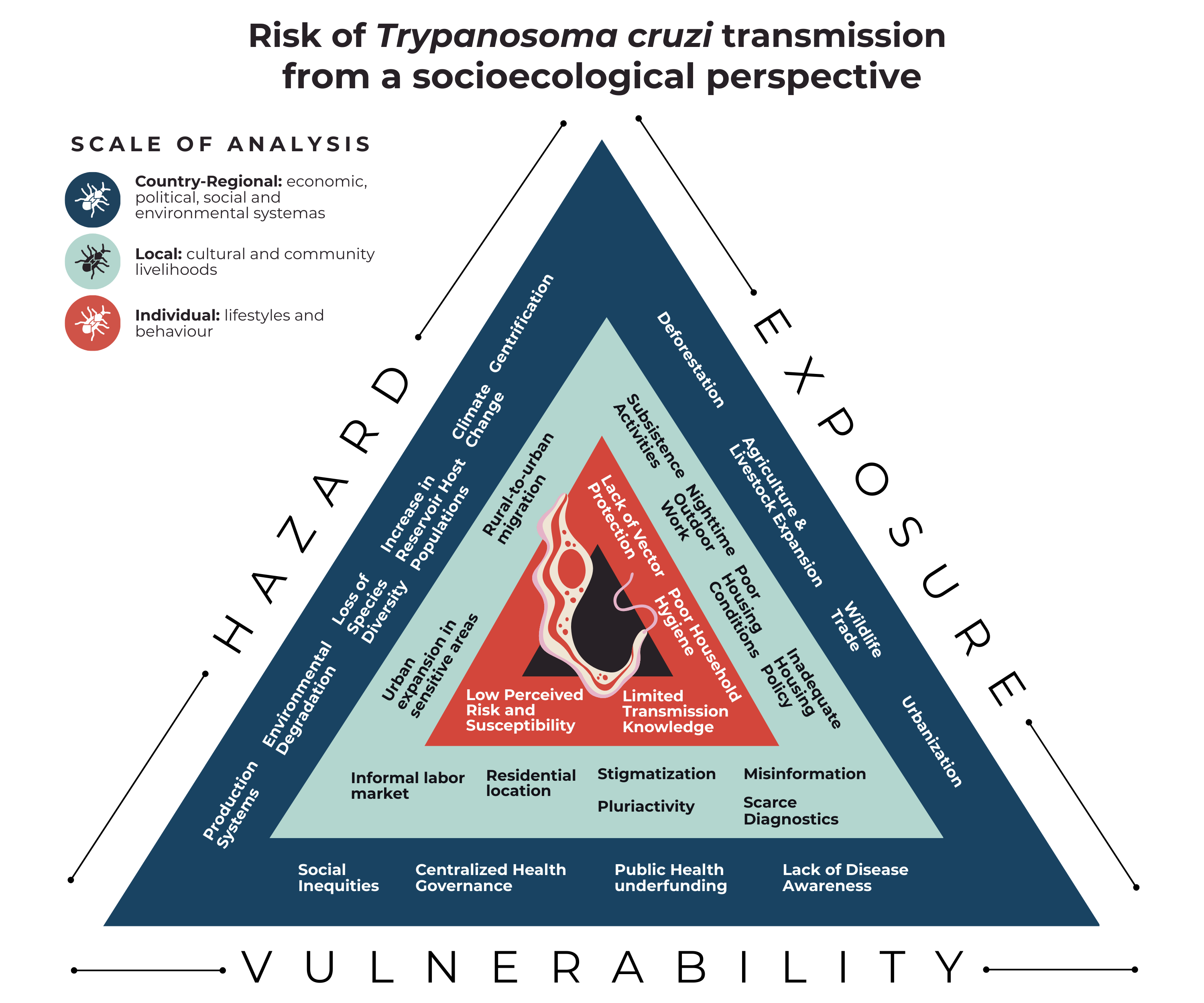
Chagas disease remains one of the most pressing and under-addressed neglected tropical diseases in Latin America and beyond. While conventionally understood through a biomedical lens centered on vectors and reservoirs, the persistence and global spread of Chagas disease cannot be fully explained without considering the social, economic, and political structures that sustain vulnerability and hinder equitable access to care. This narrative review reframes Chagas disease risk by integrating the concepts of hazard, exposure, and vulnerability into a broader socioecological framework. We explore how poverty, migration, housing precarity, weak health systems, and fragmented public policies interact to shape transmission dynamics and clinical outcomes across endemic and non-endemic settings. We further examine how climate change, urban expansion, and global economic systems—particularly those driven by extractivism and neoliberal reforms—compound risk and limit institutional response. Drawing on multidisciplinary research and case studies from Latin America and migrant populations in the United States and Europe, we argue that addressing Chagas disease requires going beyond vector control and pharmaceutical interventions. It demands a structural approach that accounts for environmental degradation, institutional invisibility, and sociocultural disconnects between policy and community needs. We conclude with policy and research recommendations grounded in equity, transdisciplinarity, and human ecology. Our review contributes to a growing body of literature calling for the reconceptualization of neglected diseases as the product of biosocial processes, rather than isolated pathogenic events.
- Open Access
- Review
Chagas Disease in Context: How Social, Economic, and Cultural Realities Shape Risk
- Mariela Aké-Chan 1,
- Andrea Chaves 2,3,
- Audrey Arnal 4,5,
- Carlos N. Ibarra-Cerdeña 1,*
Author Information
Received: 15 Jul 2025 | Revised: 16 Sep 2025 | Accepted: 25 Sep 2025 | Published: 13 Nov 2025
Abstract
Graphical Abstract
Keywords
Trypanosoma cruzi | social determinants of health | vulnerability | human ecology | neglected tropical diseases | health inequities
References
- 1.
Brindley, P.J.; Bethony, J.; Hotez, P.J. What are neglected tropical diseases? PLoS Negl. Trop. Dis. 2022, 16, e0010210.
- 2.
Hotez, P.J.; Molyneux, D.; Fenwick, A.; et al. Control of neglected tropical diseases. N. Engl. J. Med. 2007, 357, 1018–1027.
- 3.
Trouiller, P.; Olliaro, P.; Torreele, E.; et al. Drug development for neglected diseases: A deficient market and a public-health policy failure. Lancet 2002, 359, 2188–2194.
- 4.
Franco-Paredes, C.; Von, A.; Hidron, A.; et al. Chagas disease: An impediment in achieving the Millennium Development Goals in Latin America. BMC Int. Health Hum. Rights 2007, 7, 7.
- 5.
Gómez-Ochoa, S.; Rojas, L.; Echeverría, L.; et al. Global, regional, and national trends of Chagas disease from 1990 to 2019: Comprehensive analysis of the global burden of disease study. Glob. Heart 2022, 17, 59.
- 6.
Bern, C. Chagas’ disease. N. Engl. J. Med. 2015, 373, 456–466.
- 7.
Montgomery, S.; Starr, M.; Cantey, P.; et al. Neglected parasitic infections in the United States: Chagas disease. Am. J. Trop. Med. Hyg. 2014, 90, 814.
- 8.
Gascon, J.; Bern, C.; Pinazo, M. Chagas disease in Spain, the United States and other non-endemic countries. Acta Trop. 2010, 115, 22–27.
- 9.
Valdez-Tah, A.; Huicochea-Gómez, L.; Ortega-Canto, J.; et al. Social Representations and Practices Towards Triatomines and Chagas Disease in Calakmul, México. PLoS ONE 2015, 10, e0132830.
- 10.
Ibarra-Cerdeña, C.N.; González-Martínez, A.; Valdez-Tah, A.; et al. Tackling Exposure to Chagas Disease in the Yucatán from A Human Ecology Perspective. In Culture, Environment and Health in the Yucatán Peninsula, 1st ed.; Springer: Cham, Switzerland, 2019; pp. 293–325.
- 11.
Breilh, J. Critical Epidemiology and the People’s Health; Oxford University Press: Oxford, UK, 2021.
- 12.
Rohr, J.; Barrett, C.; Civitello, D.; et al. Emerging human infectious diseases and the links to global food production. Nat. Sustain. 2019, 2, 445–456.
- 13.
Glidden, C.; Nova, N.; Kain, M.; et al. Human mediated impacts on biodiversity and the consequences for zoonotic disease spillover. Curr. Biol. 2021, 31, R1342–R1361.
- 14.
Medrano-Mercado, N.; Ugarte-Fernandez, R.; Butrón, V.; et al. Urban transmission of Chagas disease in Cochabamba, Bolivia. Mem. Inst. Oswaldo Cruz 2008, 103, 423–430.
- 15.
Azogue, E. Women and congenital Chagas’ disease in Santa Cruz, Bolivia: Epidemiological and sociocultural aspects. Soc. Sci. Med. 1993, 37, 503–511.
- 16.
Espinoza-Gómez, F.; Rojas-Larios, F.; Zavala-Cerna, N.; et al. Socioeconomic determinants of Chagas disease in western Mexico. Adv. Prev. Med. Health Care 2022, 5,1032.
- 17.
Guzmán-Tapia, Y.; Ramírez-Sierra, M.; Dumonteil, E. Urban infestation by Triatoma dimidiate in the city of Mérida, Yucatán, México. Vector-Borne Zoonotic Dis. 2007, 7, 597–606.
- 18.
Montes de Oca-Aguilar, A.; González-Martínez, A.; Chan-González, R.; et al. Signs of Urban Evolution? Morpho-Functional Traits Co-variation Along a Nature-Urban Gradient in a Chagas Disease Vector. Front. Ecol. Evol. 2022, 10, 805040.
- 19.
Cajaiba-Soares, A.; Martinez-Silveira, M.; Paim Miranda, D.; et al. Healthcare Workers’ Knowledge about Chagas Disease: A Systematic Review. Am. J. Trop. Med. Hyg. 2021, 104, 1631–1638.
- 20.
Stigler, P.; Pacheco, G.; Núñez, E.; et al. Assessing the effectiveness of Chagas disease education for healthcare providers in the United States. BMC Infect. Dis. 2020, 20, 743.
- 21.
Rocha, M.; Teixeira, M.; Ribeiro, A. An update on the management of Chagas cardiomyopathy. Expert Rev. Anti-Infect. Ther. 2007, 4, 727–743.
- 22.
Shikanai-Yasuda, M.; Mediano, M.; Novaes, C.; et al. Clinical profile and mortality in patients with T. cruzi/HIV co-infection from the multicenter data base of the “Network for healthcare and study of Trypanosoma cruzi/HIV co-infection and other immunosuppression conditions”. PLoS Negl. Trop. Dis. 2021, 15, e0009809.
- 23.
Franco, P.I.; do Carmo Neto, J.R.; Miguel, M.P.; et al. Cancer and Trypanosoma cruzi: Tumor induction or protection? Biochimie 2023, 207, 113–121.
- 24.
Jimeno, I.; Mendoza, N.; Zapana, F.; et al. Social determinants in the access to health care for Chagas disease: A qualitative research on family life in the “Valle Alto” of Cochabamba, Bolivia. PLoS ONE 2021, 16, e0255226.
- 25.
Aké-Chan, M.; Sanmartino, M.; Castillo-Burguete, M.; et al. (In)coherence between Chagas disease policy and the experiences of those affected in Mexico: The need for a transdisciplinary approach. PLoS Negl. Trop. Dis. 2025, 19, e0013052.
- 26.
Forsyth, C.J.; Stigler, P.; Pacheco, G.; et al. Current Gaps and Needs for Increasing Access to Healthcare for People with Chagas Disease in the USA. Curr. Trop. Med. Rep. 2019, 6, 13–22.
- 27.
Sanmartino, M.; Avaria, A.; Gómez i Prat, J.; et al. Do not be afraid of us: Chagas disease as explained by people affected by it. Interface 2015, 19, 1063–1075.
- 28.
Ventura-Garcia, L.; Roura, M.; Pell, C.; et al. Sociocultural aspects of Chagas disease: A systematic review of qualitative research. PLoS Negl. Trop. Dis. 2013, 7, e2410.
- 29.
Ventura-Garcia, L.; Muela-Ribera, J.; Martínez-Hernández, A. Chagas, Risk and Health Seeking among Bolivian Women in Catalonia. Med. Anthropol. 2021, 40, 541–556.
- 30.
Mandrini, M.; Cejas, N.; Bazán, A. Erradicación de ranchos, ¿Erradicación de saberes? Reflexiones sobre la región noroeste de la Provincia de Córdoba, Argentina. An. Del. IAA 2018, 48, 83–94.
- 31.
Avaria, A.; Plaza, C. Health experiences of pregnant and women with chagas disease in the Atacama, Tarapaca, and Metropolitan regions of Chile. Mistreatment as an indicator of healthcare barriers. PLoS ONE 2024, 19, e0313498.
- 32.
Buekens, P.; Cafferata, M.L.; Alger, J.; et al. For The Congenital Chagas Working Group. Congenital Transmission of Trypanosoma cruzi in Argentina, Honduras, and Mexico: An Observational Prospective Study. Am. J. Trop. Med. Hyg. 2018, 98, 478–485.
- 33.
Ayres, J.; Marcus, R.; Standley, C.J. The Importance of Screening for Chagas Disease Against the Backdrop of Changing Epidemiology in the USA. Curr. Trop. Med. Rep. 2022, 9, 185–193.
- 34.
Ribeiro, A.L.; Machado, Í.; Cousin, E.; et al. The burden of Chagas disease in the contemporary world: The RAISE study. Glob. Heart 2024, 19, 2.
- 35.
Hyson, P.; Barahona, L.V.; Pedraza-Arévalo, L.C.; et al. Experiences with Diagnosis and Treatment of Chagas Disease at a United States Teaching Hospital-Clinical Features of Patients with Positive Screening Serologic Testing. Trop. Med. Infect. Dis. 2021, 6, 93.
- 36.
Bern, C.; Montgomery, S.P.; Herwaldt, B.L.; et al. Evaluation and Treatment of Chagas Disease in the United States: A Systematic Review. JAMA 2007, 298, 2171–2181.
- 37.
Fernández, M.D.; Gaspe, M.S.; Gürtler, R.E. Inequalities in the social determinants of health and Chagas disease transmission risk in indigenous and creole households in the Argentine Chaco. Parasites Vectors 2019, 12, 184.
- 38.
Waleckx, E.; Camara-Mejia, J.; Ramírez-Sierra, M.; et al. An innovative ecohealth intervention for Chagas disease vector control in Yucatan, Mexico. RSTMH 2015, 109, 143–149.
- 39.
Santos, W.S.; Gurgel-Gonçalves, R.; Garcez, L.M.; et al. Deforestation effects on Attalea palms and their resident Rhodnius, vectors of Chagas disease, in eastern Amazonia. PLoS ONE 2021, 16, e0252071.
- 40.
Valdez-Tah, A.; Ibarra-Cerdeña, C.N. Call to action: Chagas disease risk in California (1916–2018). PLoS Negl. Trop. Dis. 2021,15, e0009035.
- 41.
Imaz-Iglesia, I.; García-San Miguel, L.; Ayala-Morillas, L.; et al. Economic evaluation of Chagas disease screening in Spain. Acta Trop. 2015, 148, 77–88.
- 42.
Montgomery, S.P.; Parise, M.E.; Dotson, E.M.; et al. What do we know about Chagas disease in the United States? Am. J. Trop. Med. Hyg. 2016, 95, 1225–1227.
- 43.
Forsyth, C.; Higuita, N.; Hamer, S.; et al. Climate change and Trypanosoma cruzi transmission in North and central America. Lancet Microbe 2024, 5, 100946.
- 44.
McMichael, C. Climate change-related migration and infectious disease. Virulence 2015, 6, 548–553.
- 45.
Bamorovat, M.; Sharifi, I.; Aflatoonian, M.; et al. A prospective longitudinal study on the elimination trend of rural cutaneous leishmaniasis in southeastern Iran: Climate change, population displacement, and agricultural transition from 1991 to 2021. Sci. Total Environ. 2024, 913, 169684.
- 46.
Oscar, R.; Lemoine, J.; Direny, A.N.; et al. Haiti National Program for the Elimination of Lymphatic Filariasis A Model of Success in the Face of Adversity. PLoS Negl. Trop. Dis. 2014, 8, e2915.
- 47.
Dias, J.; Silveira, A.; Schofield, C. The impact of Chagas disease control in Latin America: A review. Mem. Inst. Oswaldo Cruz. 2002, 97, 603–612.
- 48.
Jannin, J.; Villa, L. An overview of Chagas disease treatment. Mem. Inst. Oswaldo Cruz. 2007, 102, 95–98.
- 49.
Requena-Méndez, A.; Albajar-Viñas, P.; Angheben, A.; et al. Health Policies to Control Chagas Disease Transmission in European Countries. PLoS Negl. Trop. Dis. 2014, 8, e3245.
- 50.
Borlase, A.; Le Rutte, E.A.; Castaño, S.; et al. Evaluating and mitigating the potential indirect effect of COVID-19 on control programmes for seven neglected tropical diseases: A modelling study. Lancet Glob. Health 2022, 10, e1600–e1611.
- 51.
Ehrenberg, N.; Ehrenberg, J.; Fontes, G.; et al. Neglected tropical diseases as a barometer for progress in health systems in times of COVID-19. BMJ Glob. Health 2021, 6, e004709.
- 52.
Zaidel, E.; Forsyth, C.; Novick, G.; et al. COVID-19: Implications for people with Chagas disease. Glob. Heart 2020, 15, 69.


This work is licensed under a Creative Commons Attribution 4.0 International License.

 Suite 4002 Level 4, 447 Collins Street, Melbourne, Victoria 3000, Australia
 General Inquiries: info@sciltp.com