
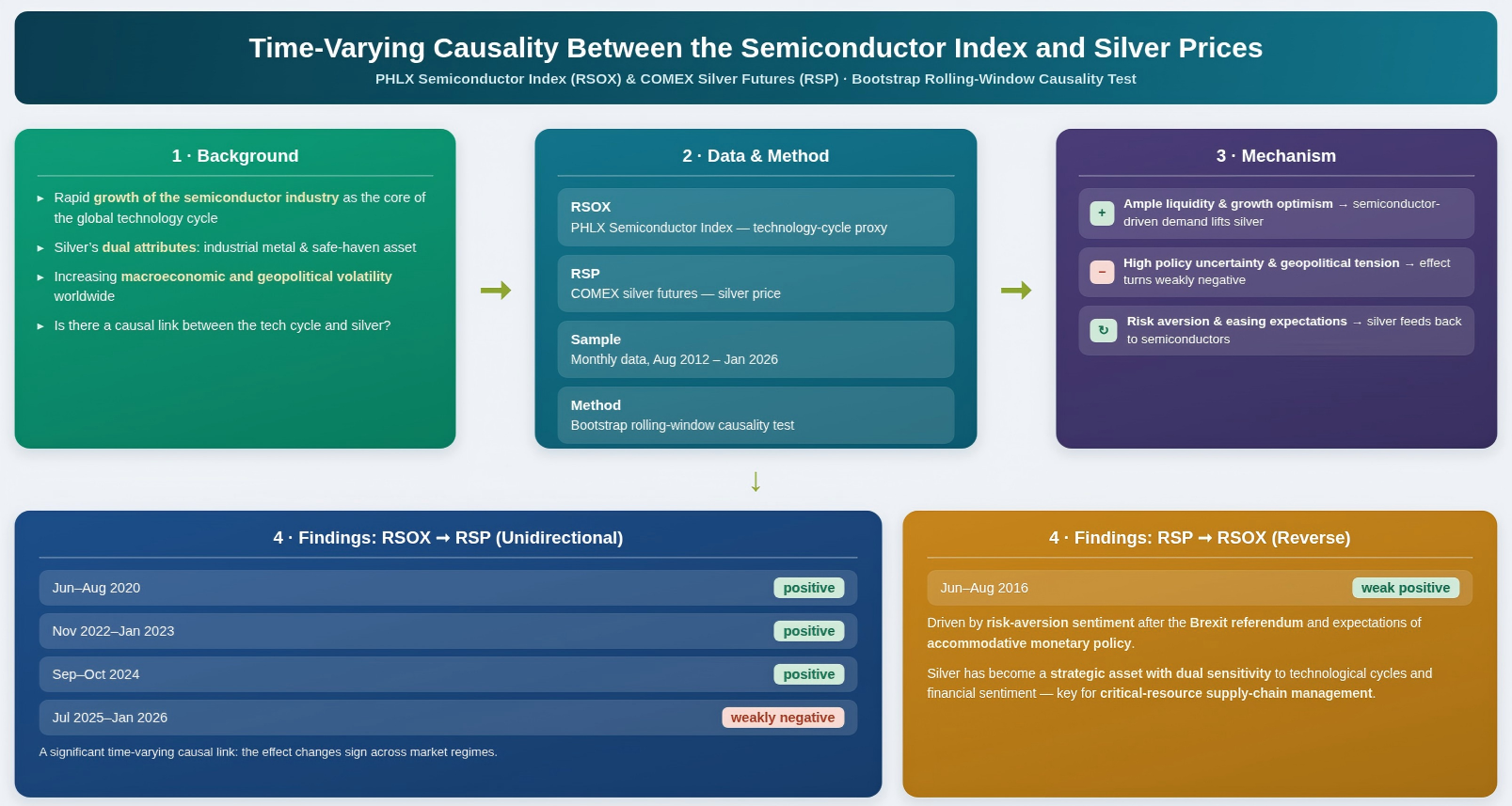
This study examines the causal relationship between the semiconductor index and silver prices, against the backdrop of the industry’s growth, silver’s dual attributes, and increasing macroeconomic and geopolitical volatility. Using monthly data from August 2012 to January 2026 and a bootstrap rolling-window causality test, we find a significant time-varying causal link. Specifically, a unidirectional causality from the semiconductor index (RSOX) to silver prices (RSP) is identified in periods such as June–August 2020, November 2022–January 2023, September–October 2024, and July 2025–January 2026. This effect is positive under conditions of ample liquidity and growth optimism but turns weakly negative during times of high policy uncertainty and geopolitical tension. Conversely, a weak positive causal effect from RSP to RSOX is observed from June to August 2016, likely driven by risk-aversion sentiment following events like the Brexit referendum and expectations of accommodative monetary policy. These findings suggest that silver has become a strategic asset with dual sensitivity to technological cycles and financial sentiment, offering important implications for managing critical resource supply chains.
- Open Access
- Article
Technology–Finance Dual-Engine Dynamics: A Time-Varying Causality Analysis of the Global Semiconductor Index and Silver Prices
- Xinchun Shi,
- Tao Zhu *
Author Information
Received: 28 May 2026 | Revised: 06 Jul 2026 | Accepted: 09 Jul 2026 | Published: 27 Jul 2026
Abstract
Graphical Abstract
Keywords
bootstrap rolling-window causality test | PHLX semiconductor index | COMEX silver futures | time-varying causality
References
- 1.
Bhosle, S.M.; Mahadik, S.C. A review of microelectronics as a catalyst for intelligent manufacturing: Trends, sectoral applications, and future directions. Aust. J. Multi-Discip. Eng. 2025, 1–20.
- 2.
Dutta, A. Impact of silver price uncertainty on solar energy firms. J. Clean. Prod. 2019, 225, 1044–1051.
- 3.
Apergis, I.; Apergis, N. Silver prices and solar energy production. Environ. Sci. Pollut. Res. 2019, 26, 8525–8532.
- 4.
Apergis, N.; Christou, C.; Payne, J.E. Precious metal markets, stock markets and the macroeconomic environment: A FAVAR model approach. Appl. Financ. Econ. 2014, 24, 691–703.
- 5.
Moguilnaia, N.A.; Vershinin, K.V.; Sweet, M.R.; et al. Innovation in power semiconductor industry: Past and future. IEEE Trans. Eng. Manag. 2005, 52, 429–439.
- 6.
Tan, H.; Mathews, J.A. Identification and analysis of industry cycles. J. Bus. Res. 2010, 63, 454–462.
- 7.
Hilmola, O.-P. Stock market performance and manufacturing capability of the fifth long-cycle industries. Futures 2007, 39, 393–407.
- 8.
Dadush, U. The policy response to global value chain disruption. Glob. Policy 2023, 14, 548–557.
- 9.
Farrand, B. The economy–security nexus: Risk, strategic autonomy and the regulation of the semiconductor supply chain. Eur. J. Risk Regul. 2025, 16, 279–293.
- 10.
Kubesa, J.; Černý, I. A study of the influence of economic factors on world silver production. GeoScience Eng. 2023, 69, 69–81.
- 11.
Shahzad, U.; Mohammed, K.S.; Tiwari, S.; et al. Connectedness between geopolitical risk, financial instability indices and precious metals markets: Novel findings from Russia Ukraine conflict perspective. Resour. Policy 2023, 80, 103190.
- 12.
Yıldırım, D.; Eren, M.; Dogan, M. Investor Trends During Periods of Geopolitical Risk in Turkey: Which Assets Serve as Safe Havens? Borsa Istanb. Rev. 2025, 25, 801-815.
- 13.
Lucey, B.M.; Li, S. What precious metals act as safe havens, and when? Some US evidence. Appl. Econ. Lett. 2015, 22, 35–45.
- 14.
Creti, A.; Joëts, M.; Mignon, V. On the links between stock and commodity markets' volatility. Energy Econ. 2013, 37, 16–28.
- 15.
Chen, Y.; Qi, H. Dynamic interplay between Chinese energy, renewable energy stocks, and commodity markets: Time-frequency causality study. Renew. Energy 2024, 228, 120578.
- 16.
Liu, Q.; Xue, D.; Li, W. A Sustainable Production Segment of Global Value Chain View on Semiconductors in China: Temporal and Spatial Evolution and Investment Network. Sustainability 2024, 16, 8617.
- 17.
Nazir, M.; Rasheed, M.Q.; Yu, X.H.; et al. Can Computer Technology, Semiconductors, and Artificial Intelligence Shape a Sustainable Future? Evidence From Leading Semiconductor‐Producing Countries. Sustain. Dev. 2025, 33, 5214–5233.
- 18.
Ju, Y.-M.; Kim, T.-W.; Lee, S.-H.; et al. Advanced WBG power semiconductor packaging: Nanomaterials and nanotechnologies for high-performance die attach paste. Nano Converg. 2025, 12, 38.
- 19.
Baker, M.; Stein, J.C. Market liquidity as a sentiment indicator. J. Financ. Mark. 2004, 7, 271–299.
- 20.
Liu, S. Investor sentiment and stock market liquidity. J. Behav. Financ. 2015, 16, 51–67.
- 21.
Li, S.; Lucey, B.M. Reassessing the role of precious metals as safe havens–What colour is your haven and why? J. Commod. Mark. 2017, 7, 1–14.
- 22.
Yen, C.-H.; Chang, C.-H.; Yu, W.W. Asymmetric Impact of Inverted Yield Curve, FRAC Spread Count, and Billings Trends for Semiconductor Equipment Manufacturers on SOX Index. IEEE Access 2023, 11, 139849–139859.
- 23.
Ayres, R.U.; Williams, E. The digital economy: Where do we stand? Technol. Forecast. Soc. Change 2004, 71, 315–339.
- 24.
Gorton, G. The history and economics of safe assets. Annu. Rev. Econ. 2017, 9, 547–586.
- 25.
Ullah, M.; Sohag, K.; Doroshenko, S.; et al. Examination of Bitcoin Hedging, diversification and safe-haven ability during financial crisis: Evidence from equity, bonds, precious metals and exchange rate markets. Comput. Econ. 2025, 66, 835–867.
- 26.
Shukur, G.; Mantalos, P. A simple investigation of the Granger-causality test in integrated-cointegrated VAR systems. J. Appl. Stat. 2000, 27, 1021–1031.
- 27.
Shukur, G.; Mantalos, P. Size and power of the RESET test as applied to systems of equations: A bootstrap approach. J. Mod. Appl. Stat. Methods 2004, 3, 10.
- 28.
Andrews, D.W. Tests for parameter instability and structural change with unknown change point. Econometrica 1993, 61, 821-856.
- 29.
Andrews, D.W.; Ploberger, W. Optimal tests when a nuisance parameter is present only under the alternative. Econometrica 1994, 62, 1383-1414.
- 30.
Nyblom, J. Testing for the constancy of parameters over time. J. Am. Stat. Assoc. 1989, 84, 223–230.
- 31.
Hansen, B.E. Tests for Parameter Instability in Regressions with I(1) Processes. J. Bus. Econ. Stat. 1992, 10, 321–335. https://doi.org/10.2307/1391545.
- 32.
Balcilar, M.; Gupta, R.; Kyei, C.; et al. Does economic policy uncertainty predict exchange rate returns and volatility? Evidence from a nonparametric causality-in-quantiles test. Open Econ. Rev. 2016, 27, 229–250.
- 33.
Su, C.-W.; Song, X.Y.; Dou, J.; et al. Fossil fuels or renewable energy? The dilemma of climate policy choices. Renew. Energy 2025, 238, 121950.
- 34.
Qin, M.; Su, C.-W.; Umar, M; et al. Are climate and geopolitics the challenges to sustainable development? Novel evidence from the global supply chain. Econ. Anal. Policy. 2023, 77, 748–763.
- 35.
Pesaran, M.H.; Timmermann, A. Small sample properties of forecasts from autoregressive models under structural breaks. J. Econom. 2005, 129, 183–217.
- 36.
Su, C.-W.; Li, Z.-Z.; Chang, H.-L.; et al. When will occur the crude oil bubbles? Energy Policy 2017, 102, 1–6.
- 37.
Su, C.-W.; Liu, Y.; Chang, T.; et al. Can gold hedge the risk of fear sentiments? Technol. Econ. Dev. Econ. 2023, 29, 23–44.
- 38.
Su, C.-W.; Qin, M.; Zhang, X.-L.; et al. Should Bitcoin be held under the US partisan conflict? Technol. Econ. Dev. Econ. 2021, 27, 511–529.
- 39.
Sun, Y.; Song, Y.; Long, C.; et al. How to improve global environmental governance? Lessons learned from climate risk and climate policy uncertainty. Econ. Anal. Policy 2023, 80, 1666–1676.
- 40.
Zeileis, A.; Leisch, F.; Kleiber, C.; et al. Monitoring structural change in dynamic econometric models. J. Appl. Econom. 2005, 20, 99–121.

This work is licensed under a Creative Commons Attribution 4.0 International License.

 Suite 4002 Level 4, 447 Collins Street, Melbourne, Victoria 3000, Australia
 General Inquiries: info@sciltp.com