
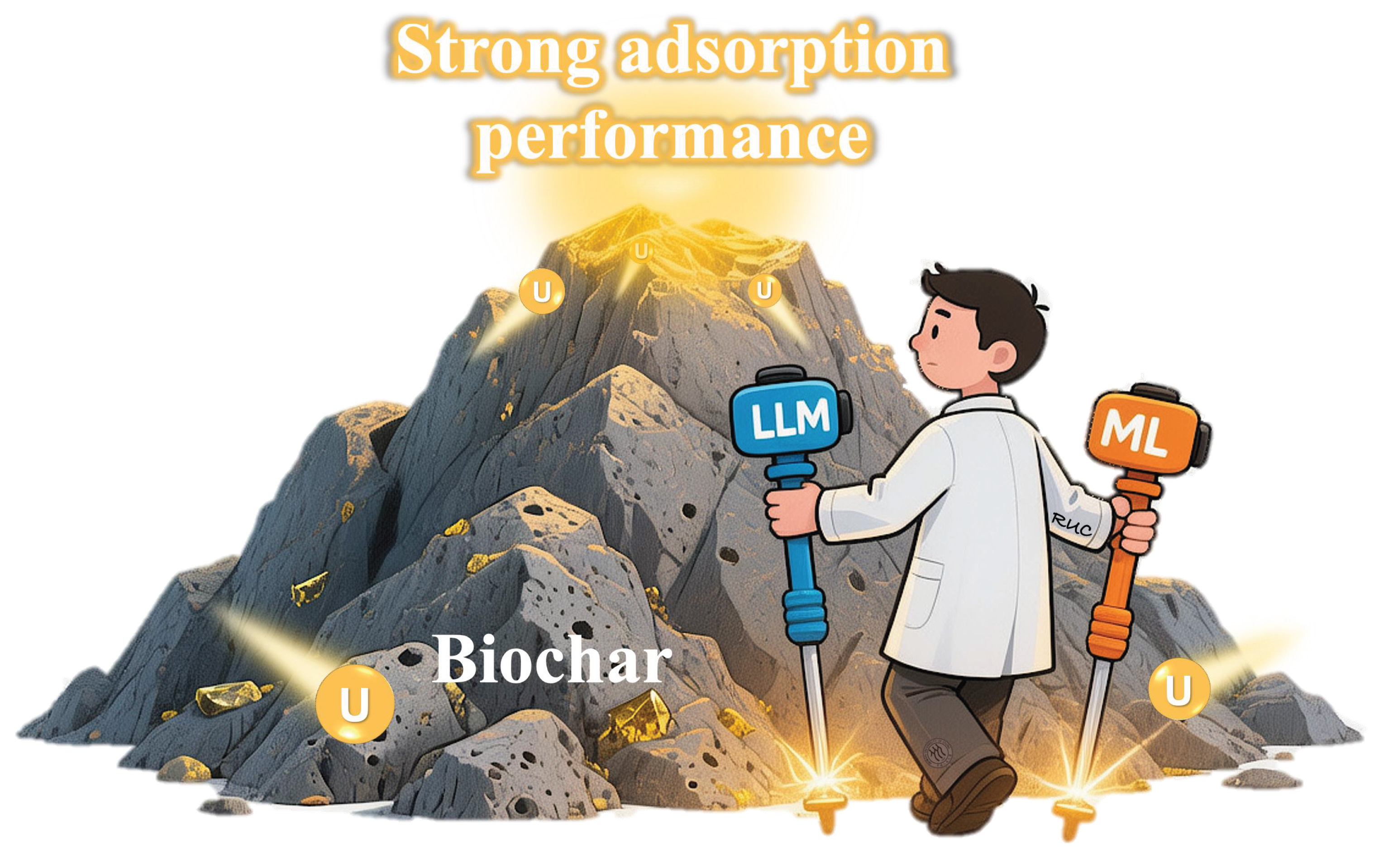
Efficient uranium recovery from radioactive wastewater is a pressing challenge in sustainable nuclear energy development. Here, we present an innovative AI-driven framework that integrates large language models with machine learning to optimize uranium adsorption by acid-modified biochar. By automatically extracting and structuring literature data, we compiled a high-quality dataset comprising 589 experimental data points. Among four tree-based ensemble models, CatBoost delivered the best performance (test R2 = 0.98, RMSE = 24.78). Feature importance indicates that adsorption conditions (71.51%) as the most influential factors, significantly outweighing biochar preparation conditions (15.27%) and physicochemical properties (13.22%). SHapley Additive exPlanations (SHAP) analysis further provided insights into how key features influence uranium adsorption, identifying important variables and their impact patterns. Finally, we developed a user-friendly graphical user interface that enables rapid, intelligent prediction of uranium adsorption capacity, supporting data-driven experimental design. This study provides a referenceable, AI-powered solution for radioactive wastewater treatment and offers a transferable framework for the intelligent remediation of other environmental pollutants.
- Open Access
- Article
AI-Driven Prediction of Uranium Adsorption on Acid-Modified Biochar: Integrating Large Language Models with Interpretable Machine Learning
- Jingyang Sun 1,
- Sut Ian Chan 2,
- Shuting Zhuang 3,*
Author Information
Received: 07 Dec 2025 | Revised: 21 Dec 2025 | Accepted: 30 Dec 2025 | Published: 06 Jan 2026
Abstract
Graphical Abstract
Keywords
uranium adsorption | acid-modified biochar | large language models | machine learning | intelligent prediction
References
- 1.
Wang, J.; Zhuang, S. Extraction and adsorption of U(VI) from aqueous solution using affinity ligand-based technologies: an overview. Rev. Environ. Sci. Biotechnol. 2019, 18, 437–452.
- 2.
Li, Z.-L.; Li, S.-F.; Zhang, Z.-M.; et al. Extracellular electron transfer-dependent bioremediation of uranium-contaminated groundwater: Advancements and challenges. Water Res. 2025, 272, 122957.
- 3.
Zhang, D.; Fang, L.; Liu, L.; et al. Uranium extraction from seawater by novel materials: A review. Sep. Purif. Technol. 2023, 320, 124204.
- 4.
Boussouga, Y.-A.; Joseph, J.; Stryhanyuk, H.; et al. Adsorption of uranium(VI) complexes with polymer-based spherical activated carbon. Water Res. 2024, 249, 120825.
- 5.
Chen, D.; Ren, Z.; Shi, M.; et al. Covalently constructed porous polyamidoxime nanofibers for enhanced uranium capture. Water Res. 2025, 124944.
- 6.
Liu, Y.-L.; Cao, P.; Zhang, Q.; et al. Solar-activated ZnS@MXene heterostructure for integrated radioactive wastewater treatment and energy harvesting. Water Res. 2025, 286, 124254.
- 7.
Bone, S.E.; Cliff, J.; Weaver, K.; et al. Complexation by Organic Matter Controls Uranium Mobility in Anoxic Sediments. Environ. Sci. Technol. 2020, 54, 1493–1502.
- 8.
Sun, J.; Yi, X.; Yuan, C.; et al. Adsorptive removal of radioactive technetium by nanomaterials. Rev. Environ. Sci. Biotechnol. 2025, 24, 115–144.
- 9.
Xie, Y.; Chen, C.; Ren, X.; et al. Emerging natural and tailored materials for uranium-contaminated water treatment and environmental remediation. Prog. Mater. Sci. 2019, 103, 180–234.
- 10.
Guilhen, S.N.; Mašek, O.; Ortiz, N.; et al. Pyrolytic temperature evaluation of macauba biochar for uranium adsorption from aqueous solutions. Biomass Bioenergy 2019, 122, 381–390.
- 11.
Ravindiran, G.; Rajamanickam, S.; Janardhan, G.; et al. Production and modifications of biochar to engineered materials and its application for environmental sustainability: A review. Biochar 2024, 6, 62.
- 12.
Xiong, X.; Liu, J.; Xiao, T.; et al. Remediation of uranium-contaminated water and soil by biochar-based materials: A review. Biochar 2025, 7, 41.
- 13.
Huang, F.; Dong, F.; Chen, L.; et al. Biochar-mediated remediation of uranium-contaminated soils: evidence, mechanisms, and perspectives. Biochar 2024, 6, 16.
- 14.
Jun, B.-M.; Jung, J.-Y.; Oh, M.; et al. Uranium removal from radioactive wastewater using biochar-based adsorbents: A review on synthesis, performance, and mechanism. J. Water Process Eng. 2025, 75, 107956.
- 15.
Mei, Y.; Zhuang, S.; Wang, J. Adsorption of heavy metals by biochar in aqueous solution: A review. Sci. Total Environ. 2025, 968, 178898.
- 16.
Paschalidou, P.; Pashalidis, I.; Manariotis, I.D.; et al. Hyper sorption capacity of raw and oxidized biochars from various feedstocks for U(VI). J. Environ. Chem. Eng. 2020, 8, 103932.
- 17.
Ahmed, W.; Mehmood, S.; Qaswar, M.; et al. Oxidized biochar obtained from rice straw as adsorbent to remove uranium(VI) from aqueous solutions. J. Environ. Chem. Eng. 2021, 9, 105104.
- 18.
Sharma, M.; Anshika; Yadav, L.; et al. Breaking new ground: Innovative adsorbents for uranium and thorium ions removal and environmental cleanup. Coord. Chem. Rev. 2024, 517, 216008.
- 19.
Li, M.; Liu, H.; Chen, T.; et al. Synthesis of magnetic biochar composites for enhanced uranium(VI) adsorption. Sci. Total Environ. 2019, 651, 1020–1028.
- 20.
Liu, F.; Wang, S.; Zhao, C.; et al. Constructing coconut shell biochar/MXenes composites through self-assembly strategy to enhance U(VI) and Cs(I) immobilization capability. Biochar 2023, 5, 31.
- 21.
Zheng, Z.; Rampal, N.; Inizan, T.J.; et al. Large language models for reticular chemistry. Nat. Rev. Mater. 2025, 10, 369–381.
- 22.
Li, Y.; Gupta, R.; You, S. Machine learning assisted prediction of biochar yield and composition via pyrolysis of biomass. Bioresour. Technol. 2022, 359, 127511.
- 23.
Shi, Y.; Rampal, N.; Zhao, C.; et al. Comparison of LLMs in extracting synthesis conditions and generating Q&A datasets for metal–organic frameworks. Digit. Discov. 2025, 4, 2676–2683.
- 24.
Polak, M.P.; Morgan, D. Extracting accurate materials data from research papers with conversational language models and prompt engineering. Nat. Commun. 2024, 15, 1569.
- 25.
Palansooriya, K.N.; Li, J.; Dissanayake, P.D.; et al. Prediction of Soil Heavy Metal Immobilization by Biochar Using Machine Learning. Environ. Sci. Technol. 2022, 56, 4187–4198.
- 26.
Zhu, X.; Wan, Z.; Tsang, D.C.W.; et al. Machine learning for the selection of carbon-based materials for tetracycline and sulfamethoxazole adsorption. Chem. Eng. J. 2021, 406, 126782.
- 27.
Zhao, S.; Guo, J.; Tang, Y.; et al. Applications of machine learning in heavy metal adsorption modeling: A review. Sep. Purif. Technol. 2025, 377, 134168.
- 28.
Li, J.; Pan, L.; Huang, Y.; et al. Biochar design for antibiotics adsorption via a hybrid machine-learning-based optimization framework. Sep. Purif. Technol. 2024, 348, 127666.
- 29.
Fabregat-Palau, J.; Ershadi, A.; Finkel, M.; et al. Modeling PFAS sorption in soils using machine learning. Environ. Sci. Technol. 2025, 59, 7678–7687.
- 30.
Jiang, X.; Wang, W.; Tian, S.; et al. Applications of natural language processing and large language models in materials discovery. NPJ Comput. Mater. 2025, 11, 79.
- 31.
Fu, W.; Feng, M.; Guo, C.; et al. Machine learning-driven prediction of phosphorus removal performance of metal-modified biochar and optimization of preparation processes considering water quality management objectives. Bioresour. Technol. 2024, 403, 130861.
- 32.
Liu, C.; Balasubramanian, P.; An, J.; et al. Machine learning prediction of ammonia nitrogen adsorption on biochar with model evaluation and optimization. NPJ Clean Water 2025, 8, 13.
- 33.
Lyu, H.; Xu, Z.; Zhong, J.; et al. Machine learning-driven prediction of phosphorus adsorption capacity of biochar: Insights for adsorbent design and process optimization. J. Environ. Manag. 2024, 369, 122405.
- 34.
Da, T.-X.; Ren, H.-K.; He, W.-K.; et al. Prediction of uranium adsorption capacity on biochar by machine learning methods. J. Environ. Chem. Eng. 2022, 10, 108449.
- 35.
Zhao, F.; Tang, L.; Song, W.; et al. Predicting and refining acid modifications of biochar based on machine learning and bibliometric analysis: Specific surface area, average pore size, and total pore volume. Sci. Total Environ. 2024, 948, 174584.
- 36.
Hossain, M.M.; Sikder, R.; Hua, G.; et al. From Model Development to Mitigation: Machine Learning for Predicting and Minimizing Iodinated Trihalomethanes in Water Treatment. Environ. Sci. Technol. 2025, 59, 11638–11652.
- 37.
Mienye, I.D.; Jere, N. A Survey of Decision Trees: Concepts, Algorithms, and Applications. IEEE Access 2024, 12, 86716–86727.
- 38.
Yang, Q.; Bao, R.; Wang, Z.; et al. Unlocking prediction and optimal design of CO2 methanation catalysts via active learning-enhanced interpretable ensemble learning. Chem. Eng. J. 2025, 509, 161154.
- 39.
Yang, W.; Wu, Y.; Jia, W.; et al. Source term inversion of nuclear accident with random release durations based on machine learning. J. Hazard. Mater. 2025, 488, 137448.
- 40.
Schilling-Wilhelmi, M.; Ríos-García, M.; Shabih, S.; et al. From text to insight: large language models for chemical data extraction. Chem. Soc. Rev. 2025, 54, 1125–1150.
- 41.
Bran, A.M.; Cox, S.; Schilter, O.; et al. Augmenting large language models with chemistry tools. Nat. Mach. Intell. 2024, 6, 525–535.
- 42.
Wu, J.; Shi, R.; Zhou, X.; et al. Empowering Chemistry Experts with Large Language Models for Literature Interpretation in Single-Atom Catalysis Toward Advanced Oxidation. Angew. Chem., Int. Ed. 2025, e202520525.
- 43.
Farris, B.R.; Leonard, K.C. Accelerating Catalysis Understanding via Large Language Model Data Extraction and Shallow Machine Learning Techniques. JACS Au 2025, 5, 5578–5589.
- 44.
Jaffari, Z.H.; Abbas, A.; Lam, S.-M.; et al. Machine learning approaches to predict the photocatalytic performance of bismuth ferrite-based materials in the removal of malachite green. J. Hazard. Mater. 2023, 442, 130031.
- 45.
Sun, Y.; Yuan, N.; Ge, Y.; et al. Adsorption behavior and mechanism of U(VI) onto phytic acid-modified biochar/MoS2 heterojunction materials. Sep. Purif. Technol. 2022, 294, 121158.
- 46.
Hu, R.; Xiao, J.; Wang, T.; et al. Engineering of phosphate-functionalized biochars with highly developed surface area and porosity for efficient and selective extraction of uranium. Chem. Eng. J. 2020, 379, 122388.
- 47.
Jin, J.; Li, S.; Peng, X.; et al. HNO3 modified biochars for uranium(VI) removal from aqueous solution. Bioresour. Technol. 2018, 256, 247–253.
- 48.
Mei, Y.; Zhuang, S.; Wang, J. Biochar: a potential and green adsorbent for antibiotics removal from aqueous solution. Rev. Environ. Sci. Biotechnol. 2024, 23, 1065–1103.
- 49.
Yu, P.; Li, Y.; Cai, Z.; et al. Simultaneous removal of Cd and ciprofloxacin hydrochloride by ZVI/biochar composite in water: Compound effects and removal mechanism. Sep. Purif. Technol. 2023, 327, 124821.
- 50.
Zhao, Z.; Li, P.; Zhang, M.; et al. Unlocking the potential of Chinese herbal medicine residue-derived biochar as an efficient adsorbent for high-performance tetracycline removal. Environ. Res. 2024, 252, 118425.
- 51.
Morshedy, A.S.; Taha, M.H.; El-Aty, D.M.A.; et al. Solid waste sub-driven acidic mesoporous activated carbon structures for efficient uranium capture through the treatment of industrial phosphoric acid. Environ. Technol. Innov. 2021, 21, 101363.
- 52.
Yi, J.; Huo, Z.; Tan, X.; et al. Plasma-facilitated modification of pumpkin vine-based biochar and its application for efficient elimination of uranyl from aqueous solution. Plasma Sci. Technol. 2019, 21, 095502.
- 53.
Yu, J.; Zhang, X.; Wang, H.; et al. Upgradation of water hyacinth for decontamination of uranium-containing radioactive wastewater with double environmental benefit. Colloids Surf., A 2025, 705, 135709.
- 54.
Yu, S.; Wu, X.; Ye, J.; et al. Dual Effect of Acetic Acid Efficiently Enhances Sludge-Based Biochar to Recover Uranium From Aqueous Solution. Front. Chem. 2022, 10, 835959.
- 55.
Jin, Q.; Cui, J. Fungi-enabled hierarchical porous magnetic carbon derived from biomass for efficient remediation of As(III)-contaminated water and soil: performance and mechanism. Environ. Sci. Nano 2023, 10, 1297–1312.
- 56.
Li, H.; Zhang, X.; Luo, C.; et al. Pomelo peel derived phosphorus-doped biochar for efficient disposal of uranium-containing nuclear wastewater: Experimental and theoretical perspectives. Sep. Purif. Technol. 2024, 333, 125947.
- 57.
Dou, S.; Ke, X.-X.; Shao, Z.-D.; et al. Fish scale-based biochar with defined pore size and ultrahigh specific surface area for highly efficient adsorption of ciprofloxacin. Chemosphere 2022, 287, 131962.
- 58.
Zhou, Y.; Xiao, J.; Hu, R.; et al. Engineered phosphorous-functionalized biochar with enhanced porosity using phytic acid-assisted ball milling for efficient and selective uptake of aquatic uranium. J. Mol. Liq. 2020, 303, 112659.
- 59.
Zeng, X.-Y.; Wang, Y.; Li, R.-X.; et al. Impacts of temperatures and phosphoric-acid modification to the physicochemical properties of biochar for excellent sulfadiazine adsorption. Biochar 2022, 4, 14.
- 60.
Sun, Y.; Yue, Q.; Gao, B.; et al. Comparative study on characterization and adsorption properties of activated carbons with H3PO4 and H4P2O7 activation employing Cyperus alternifolius as precursor. Chem. Eng. J. 2012, 181–182, 790–797.
- 61.
Zare, N.; Wu, T.; Zhang, D.; et al. Efficient removal of Congo red using adsorbents prepared via MOF-on-MOF strategy. Chem. Eng. J. 2026, 527, 171592.
- 62.
Sharker, T.; Xiao, X.; Muff, J. Hybrid capacitive deionization using MgAl-LDHs-coated graphite felt electrodes for phosphate removal. Chem. Eng. J. Adv. 2026, 25, 100985.


This work is licensed under a Creative Commons Attribution 4.0 International License.

 Suite 4002 Level 4, 447 Collins Street, Melbourne, Victoria 3000, Australia
 General Inquiries: info@sciltp.com