
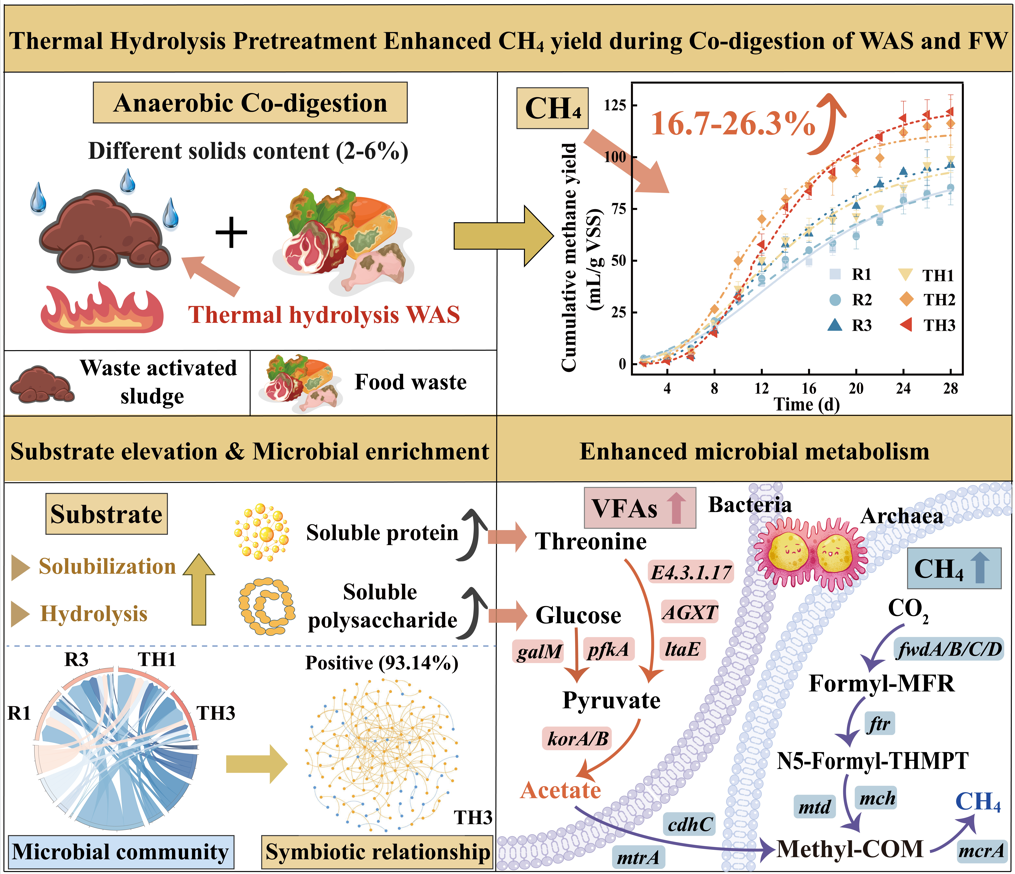
This study assessed the anaerobic co-digestion (AcoD) potential of thermal hydrolysis (TH) pretreated waste activated sludge (WAS) and food waste (FW) across various solid contents (SC). Results demonstrated that along with the SC increased from 2 to 6%, the cumulative CH4 production was ascending from 85.0 to 96.3 mL/g VSS, and this value further improved from 99.2 to 122.0 mL/g VSS in the corresponding TH-treated reactors. TH improved soluble carbohydrate and protein concentrations from 34.2–80.7 and 51.1–380.1 mg/L in the untreated group to 59.3–172.1 and 129.3–731.9 mg/L in the corresponding TH-treated reactors. The surge in bioaccessible substrates contributed to the enrichment of hydrolysis acidogenic bacteria (e.g., Bacillota) and methanogens (e.g., Methanospirillum), and meanwhile stimulated their cooperative symbiosis (e.g., positive (93.14%)). Further explorations demonstrated that, accompanied with the more bioavailable organics induced by TH, the critical metabolic pathways (e.g., fatty acid biosynthesis and acetoclastic methanogenesis) and functional gene expression (e.g., mtrA, mtrB, and mtrC) were stimulated and upregulated, maintaining optimal metabolic activity for CH4 formation. This study investigated the response and mechanisms of CH4 production to SC during AcoD of TH pretreated-WAS and FW, which provided optimized strategy for energy recovery from organic wastes.
- Open Access
- Article
Anaerobic Co-Digestion of Thermal Hydrolysis Pretreated Sludge and Food Waste: Insights of Different Solids Content on Methane Production, Substrate Metabolism, and Microbial Functional Profiles
- Chao Yao 1,2,
- Lexiang Huang 1,2,
- Zhicheng Wei 1,2,
- Xiang Zou 1,2,
- Chenxin Zhao 1,2,
- Qin Zhang 3,4,*,
- Jiashun Cao 1,2,
- Jingyang Luo 1,2,*
Author Information
Received: 10 Mar 2026 | Revised: 26 Mar 2026 | Accepted: 30 Mar 2026 | Published: 10 Apr 2026
Abstract
Graphical Abstract
Keywords
anaerobic co-digestion | solids content | thermal hydrolysis | microbial community | syntrophic relationship
References
- 1.
Uthirakrishnan, U.; Godvin Sharmila, V.; Merrylin, J.; et al. Current Advances and Future Outlook on Pretreatment Techniques to Enhance Biosolids Disintegration and Anaerobic Digestion: A Critical Review. Chemosphere 2022, 288, 132553.
- 2.
Moretto, G.; Russo, I.; Bolzonella, D.; et al. An Urban Biorefinery for Food Waste and Biological Sludge Conversion into Polyhydroxyalkanoates and Biogas. Water Res. 2020, 170, 115371.
- 3.
Li, Y.; Chen, Y.; Wu, J. Enhancement of Methane Production in Anaerobic Digestion Process: A Review. Appl. Energy 2019, 240, 120–137.
- 4.
Zhang, Q.; Xu, Y.; Yang, H.; et al. Performance and Underlying Mechanisms of Zero-Valent Iron and Percarbonate Co-Regulation for Improved Volatile Fatty Acids Production from Food Waste Anaerobic Fermentation. Bioresour. Technol. 2025, 431, 132645.
- 5.
Zhang, Q.; Cao, W.; Liu, Z.; et al. Performance and Mechanisms of Urea Exposure for Enhancement of Biotransformation of Sewage Sludge into Volatile Fatty Acids. Bioresour. Technol. 2023, 388, 129776.
- 6.
Shao, M.; Zhang, C.; Wang, X.; et al. Co-Digestion of Food Waste and Hydrothermal Liquid Digestate: Promotion Effect of Self-Generated Hydrochars. Environ. Sci. Ecotechnol. 2023, 15, 100239.
- 7.
Wu, Y.; Cao, J.; Zhang, Q.; et al. Continuous Waste Activated Sludge and Food Waste Co-Fermentation for Synchronously Recovering Vivianite and Volatile Fatty Acids at Different Sludge Retention Times: Performance and Microbial Response. Bioresour. Technol. 2020, 313, 123610.
- 8.
An, J.; Yun, S.; Wang, W.; et al. Enhanced Methane Production in Anaerobic Co-Digestion Systems with Modified Black Phosphorus. Bioresour. Technol. 2023, 368, 128311.
- 9.
Li, Z.; Chen, H. Elucidating the Role of Solids Content in Low-Temperature Thermal Hydrolysis and Anaerobic Digestion of Sewage Sludge. Bioresour. Technol. 2022, 362, 127859.
- 10.
Ruiz, H.A.; Conrad, M.; Sun, S.-N.; et al. Engineering Aspects of Hydrothermal Pretreatment: From Batch to Continuous Operation, Scale-Up and Pilot Reactor under Biorefinery Concept. Bioresour. Technol. 2020, 299, 122685.
- 11.
Martín, C.; Dixit, P.; Momayez, F.; et al. Hydrothermal Pretreatment of Lignocellulosic Feedstocks to Facilitate Biochemical Conversion. Front. Bioeng. Biotechnol. 2022, 10, 846592.
- 12.
Xu, R.; Fang, S.; Zhang, L.; et al. Revealing the Intrinsic Drawbacks of Waste Activated Sludge for Efficient Anaerobic Digestion and the Potential Mitigation Strategies. Bioresour. Technol. 2022, 345, 126482.
- 13.
Abbas, Y.; Yun, S.; Wang, Z.; et al. Recent Advances in Bio-Based Carbon Materials for Anaerobic Digestion: A Review. Renew. Sustain. Energy Rev. 2021, 135, 110378.
- 14.
Han, W.; Liu, X.; Wang, Y.; et al. The Interaction between Sludge and Microplastics during Thermal Hydrolysis of Sludge. J. Hazard. Mater. 2024, 480, 135816.
- 15.
Luo, L.; Pradhan, N. Anaerobic Mono-Digestion and Co-Digestion of Food Waste and Mixed Sewage Sludge: A Comparative Analysis of Metabolic Patterns and Taxonomic Profiles. Chem. Eng. J. 2024, 489, 151397.
- 16.
Fang, S.; Cao, W.; Wu, Q.; et al. Multifaceted Roles of Methylisothiazolinone Intervention in Sludge Disintegration and Acidogenic and Methanogenic Pathways for Efficient Carboxylate Production during Anaerobic Fermentation. Chem. Eng. J. 2023, 472, 145022.
- 17.
Luo, J.; Cao, W.; Guo, W.; et al. Antagonistic Effects of Surfactants and CeO2 Nanoparticles Co-Occurrence on the Sludge Fermentation Process: Novel Insights of Interaction Mechanisms and Microbial Networks. J. Hazard. Mater. 2022, 438, 129556.
- 18.
Abbas, Y.; Yun, S.; Wang, K.; et al. Static-Magnetic-Field Coupled with Fly-Ash Accelerant: A Powerful Strategy to Significantly Enhance the Mesophilic Anaerobic-Co-Digestion. Bioresour. Technol. 2021, 327, 124793.
- 19.
Wu, Y.; Yu, Q.; Zhou, X.; et al. MXene-Coated Piezoelectric Poly-L-Lactic Acid Membrane Accelerates Wound Healing by Biomimicking Low-Voltage Electrical Pulses. Int. J. Biol. Macromol. 2024, 278, 134971.
- 20.
Li, Z.; You, Z.; Zhang, L.; et al. Effect of Total Solids Content on Anaerobic Digestion of Waste Activated Sludge Enhanced by High-Temperature Thermal Hydrolysis. J. Environ. Manage. 2024, 359, 120980.
- 21.
Chanthong, S.; Kongjan, P.; Jariyaboon, R.; et al. Synergistic Integration of Hydrothermal Pretreatment and Co-Digestion for Enhanced Biogas Production from Empty Fruit Bunches in High Solids Anaerobic Digestion. Heliyon 2024, 10, e34817.
- 22.
Zhang, L.; Tian, S.; Yang, S.; et al. Low Intensity Ultrasound Enhances Volatile Fatty Acid Production of Waste Activated Sludge: Insights into Extracellular Polymeric Substances and Sludge Rheological Properties. J. Environ. Manage. 2025, 391, 126658.
- 23.
Lee, E.; Min, K.J.; Park, K.Y. Changes in Anaerobic Digestion Performance and Microbial Community by Increasing SRT through Sludge Recycling in Food Waste Leachate Treatment. Sci. Rep. 2025, 15, 19845.
- 24.
Wu, J.; Wang, L.; Du, J.; et al. Biogeographic Distribution, Ecotype Partitioning and Controlling Factors of Chloroflexi in the Sediments of Six Hadal Trenches of the Pacific Ocean. Sci. Total Environ. 2023, 880, 163323.
- 25.
You, J.; Farghali, M.; Osman, A.I.; et al. Mechanisms of Biochar-Mediated Reduction of Antibiotic-Resistant Bacteria and Biogas Production Enhancement in Anaerobic Digesters. Biochem. Eng. J. 2024, 211, 109465.
- 26.
Oren, A. Novel Insights into the Diversity of Halophilic Microorganisms and Their Functioning in Hypersaline Ecosystems. NPJ Biodivers. 2024, 3, 18.
- 27.
Zeibich, L.; Staege, M.; Schmidt, O.; et al. Amino Acids and Ribose: Drivers of Protein and RNA Fermentation by Ingested Bacteria of a Primitive Gut Ecosystem. Appl. Environ. Microbiol. 2019, 85, e01297-19.
- 28.
Wang, G.; Fu, P.; Zhang, B.; et al. Biochar Facilitates Methanogens Evolution by Enhancing Extracellular Electron Transfer to Boost Anaerobic Digestion of Swine Manure under Ammonia Stress. Bioresour. Technol. 2023, 388, 129773.
- 29.
Cheng, X.; Xiang, X.; Yun, Y.; et al. Archaea and Their Interactions with Bacteria in a Karst Ecosystem. Front. Microbiol. 2023, 14, 1068595.
- 30.
Huang, W.; Cheng, X.; Li, Y.; et al. Signaling Molecule Alleviates Inhibitory Impacts of Surfactant on Methane Production during Sludge and Food Waste Co-Digestion: Insights of Electron Bifurcation and Quorum Sensing. J. Hazard. Mater. 2025, 484, 136810.
- 31.
Wu, L.; Zhu, R.; Han, X.; et al. Sulfite Altered Permanganate Effects on Acetate-Enriched Short-Chain Fatty Acids Production during Sludge Anaerobic Fermentation. Bioresour. Technol. 2023, 371, 128589.
- 32.
Fang, S.; Li, Y.; Wang, F.; et al. Promoting Effects of Bioplastics and Sludge Anaerobic Co-Fermentation for Carboxylates Production with pH Regulation: Insights into the Plastic Structure, Microbial Metabolic Traits, and Adaptive Mechanism. Bioresour. Technol. 2024, 413, 131564.
- 33.
Zhao, Y.; Yuan, F.; Su, Y.; et al. Metagenomic and Proteomic Insights into Graphene Oxide-Boosted Anaerobic Co-Fermentation of Food Waste and Sewage Sludge for Volatile Fatty Acids Production. Chem. Eng. J. 2025, 504, 158706.
- 34.
Wang, J.; Cao, W.; Fang, S.; et al. Maximizing Methane Production in Sludge Anaerobic Digestion: Multifaceted Roles of Choline Chloride in Substrate Release, Microbial Adaptation and Syntrophic Interactions. Chem. Eng. J. 2025, 520, 166286.
- 35.
Murakami, E.; Ragsdale, S.W. Evidence for Intersubunit Communication during Acetyl-CoA Cleavage by the Multienzyme CO Dehydrogenase/Acetyl-CoA Synthase Complex from Methanosarcina thermophila: Evidence That the Beta Subunit Catalyzes C–C and C–S Bond Cleavage. J. Biol. Chem. 2000, 275, 4699–4707.
- 36.
Yun, S.; Fang, W.; Du, T.; et al. Use of Bio-Based Carbon Materials for Improving Biogas Yield and Digestate Stability. Energy 2018, 164, 898–909.

This work is licensed under a Creative Commons Attribution 4.0 International License.

 Suite 4002 Level 4, 447 Collins Street, Melbourne, Victoria 3000, Australia
 General Inquiries: info@sciltp.com