
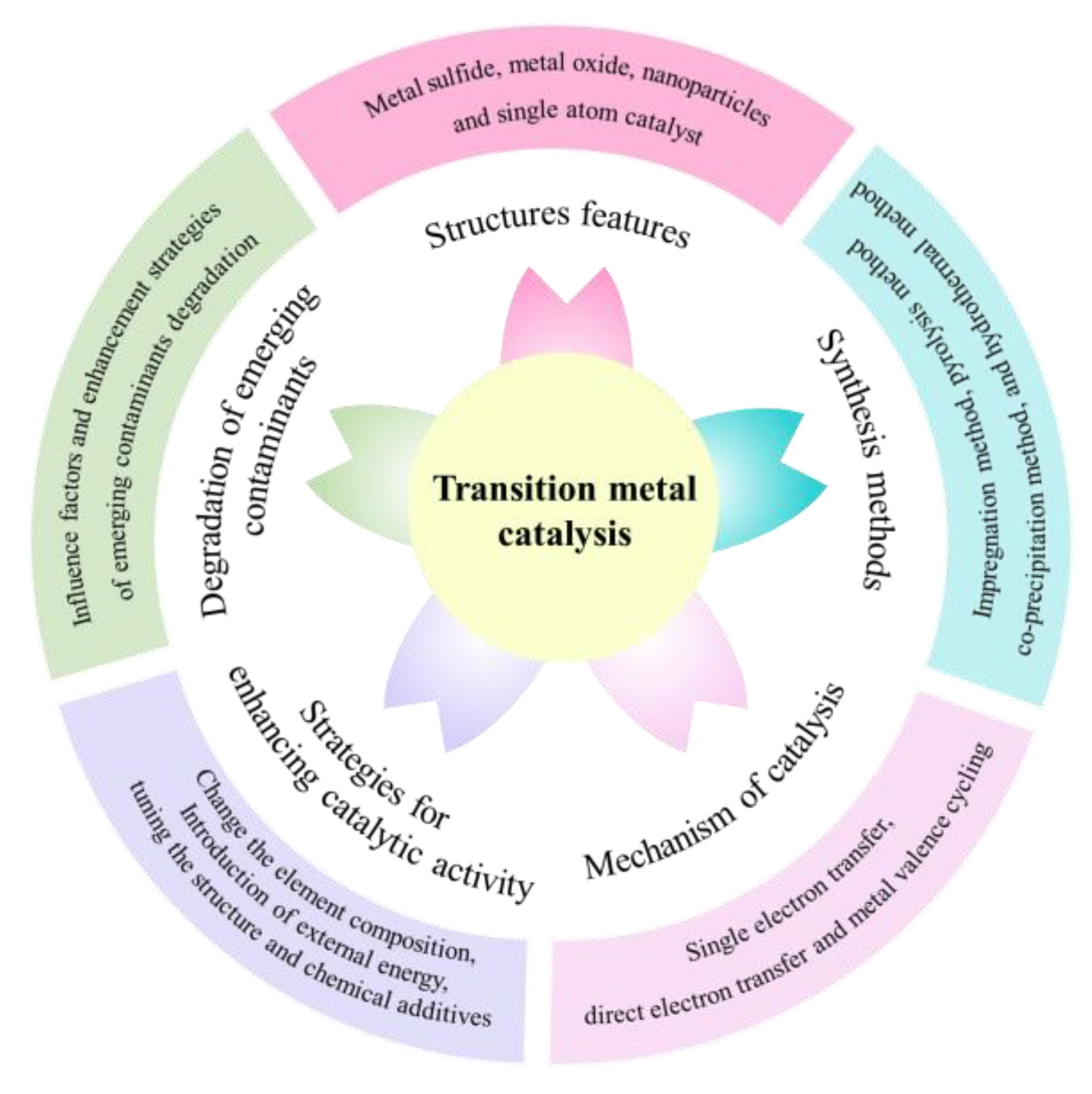
Transition metal (TM) catalysts play a pivotal role in persulfate (PS)-based advanced oxidation processes (AOPs) due to their tunable electronic structures and versatile activation mechanisms. These catalysts enable PS activation through both homogeneous and heterogeneous pathways. In homogeneous systems, the catalytic activity is governed by the elemental composition and ligand coordination of TM. For heterogeneous systems, the catalytic activity of TM active site depends dominantly on its electronic states, which are critically regulated by intrinsic structural features, including particle size, crystalline phase, surface defect density, and the coordination micro-environments. To enhance the activity and stability of TM catalysts, strategic support-loading approaches have been developed, where catalytic performance is also synergistically determined by the support’s structure and metal-support interactions. Accordingly, TM catalysts with various structures synthesized by various synthesis methods have been developed to activate PS. This review systematically summarized recent advances in the rational design of TM catalysts, focusing on: (1) synthesis methods and corresponding structure features of TM catalysts; (2) PS activation mechanisms by TM catalysts with different structure features and the catalytic activity enhancement strategies. Moreover, key factors influencing the emerging contaminants (ECs) degradation efficiency in TM-activated PS systems, such as pH, coexisting anions, and dissolved organic matter alongside the enhancement strategies were discussed. Finally, the challenges and future research directions were proposed. This review will deepen the understanding of the structural features, activation mechanisms and applications of TM catalysts in PS-based AOPs, and promote the design and development of advanced and practical application-oriented TM catalysts for the treatment of ECs in water and wastewater.
- Open Access
- Review
Transition Metal Catalysts in Persulfate-Based Advanced Oxidation Processes: Structural Features, Activation Mechanisms and Applications
- Yong Liu 1,2
Author Information
Received: 20 Apr 2026 | Revised: 02 Jun 2026 | Accepted: 12 Jun 2026 | Published: 03 Jul 2026
Abstract
Graphical Abstract
Keywords
advanced oxidation processes | persulfate | activation mechanism | emerging contaminants | transition metals
References
- 1.
Liu, Y.; Yang, Z.; Wang, J.L. Fenton/Fenton-Like Processes with In-Situ Production of Hydrogen Peroxide/Hydroxyl Radical for Degradation of Emerging Contaminants: Advances and Prospects. J. Hazard. Mater. 2021, 404, 124191.
- 2.
Liu, Y.; Wang, J.L. Multivalent Metal Catalysts in Fenton/Fenton-Like Oxidation System: A Critical Review. Chem. Eng. J. 2023, 466, 143147.
- 3.
Wang, J.L.; Chen, H. Catalytic Ozonation for Water and Wastewater Treatment: Recent Advances and Perspective. Sci. Total Environ. 2020, 704, 135249.
- 4.
Wang, J.L.; Zhuan, R. Degradation of Antibiotics by Advanced Oxidation Processes: An Overview. Sci. Total Environ. 2020, 701, 135023.
- 5.
Huang, X.X.; Wen, D.H.; Wang, J.L. Radiation-Induced Degradation of Sulfonamide and Quinolone Antibiotics: A Brief Review. Radiat. Phys. Chem. 2024, 215, 111373.
- 6.
Liu, X.Y.; Wang, J.L. Decolorization and Degradation of Various Dyes and Dye-Containing Wastewater Treatment by Electron Beam Radiation Technology: An Overview. Chemosphere 2024, 351, 141255.
- 7.
Zhang, X.; Wei, J.; Wang, C.; et al. Recent Advance of Fe-Based Bimetallic Persulfate Activation Catalysts for Antibiotics Removal: Performance, Mechanism, Contribution of the Key ROSs and Degradation Pathways. Chem. Eng. J. 2024, 487, 150514.
- 8.
Zhu, C.; Yang, M.; Jiang, B.; et al. Insights into Excitonic Behavior in Single-Atom Covalent Organic Frameworks for Efficient Photo-Fenton-Like Pollutant Degradation. Nat. Commun. 2025, 16, 790.
- 9.
Gong, F.; Wang, L.; Li, D.; et al. An Effective Heterogeneous Iron-Based Catalyst to Activate Peroxymonosulfate for Organic Contaminants Removal. Chem. Eng. J. 2015, 267, 102–110.
- 10.
Yu, C.; Zhao, Z.; Zong, Y.; et al. Electric Field-Enhanced Coupled with Metal-Free Peroxymonosulfate Activator: The Selective Oxidation of Nonradical Species-Dominated System. Water Res. 2022, 227, 119323.
- 11.
Shi, L.; Wang, Z.; Zhang, Y.; et al. Anions-Impacted Water Purification from a Dual-Substrate Perspective. Environ. Sci. Technol. 2025, 59, 12378–12386.
- 12.
Yin, Y.N.; Wang, J.L. The Evolution of Environmental Technology: From End-of-Pipe to Systemic Solutions. Environ. Microb. Technol. 2026, 1, 1.
- 13.
Wacławek, S.; Lutze, H.V.; Grübel, K.; et al. Chemistry of Persulfates in Water and Wastewater Treatment: A Review. Chem. Eng. J. 2017, 330, 44–62.
- 14.
Duan, X.; Su, C.; Zhou, L.; et al. Surface Controlled Generation of Reactive Radicals from Persulfate by Carbocatalysis on Nanodiamonds. Appl. Catal. B Environ. 2016, 194, 7–15.
- 15.
Wang, J.L.; Wang, S.Z. Activation of Persulfate (PS) and Peroxymonosulfate (PMS) and Application for the Degradation of Emerging Contaminants. Chem. Eng. J. 2018, 334, 1502–1517.
- 16.
Li, F.; Lu, Z.; Li, T.; et al. Origin of the Excellent Activity and Selectivity of a Single-Atom Copper Catalyst with Unsaturated Cu-N2 Sites via Peroxydisulfate Activation: Cu(III) as a Dominant Oxidizing Species. Environ. Sci. Technol. 2022, 56, 8765–8775.
- 17.
Wang, S.; Zhang, X.; Wang, L.; et al. Single-Atom Catalysts for Photo-Related Advanced Oxidation Processes towards Environmental Remediation. Adv. Funct. Mater. 2026, 36, 202526761.
- 18.
Afshin, T.; Kakavandi, B.; Azizi, M.; et al. Efficient Activation of Peroxymonosulfate by Using Ferroferric Oxide Supported on Carbon/UV/US System: A New Approach into Catalytic Degradation of Bisphenol A. Chem. Eng. J. 2018, 331, 729–743.
- 19.
Oh, W.; Dong, Z.; Lim, T. Generation of Sulfate Radical through Heterogeneous Catalysis for Organic Contaminants Removal: Current Development, Challenges and Prospects. Appl. Catal. B Environ. 2016, 194, 169–201.
- 20.
Peng, Y.; Tang, H.; Yao, B.; et al. Activation of Peroxymonosulfate (PMS) by Spinel Ferrite and Their Composites in Degradation of Organic Pollutants: A Review. Chem. Eng. J. 2021, 414, 128800.
- 21.
Liu, Z.; Ren, X.; Duan, X.; et al. Remediation of Environmentally Persistent Organic Pollutants (POPs) by Persulfates Oxidation System (PS): A Review. Sci. Total Environ. 2023, 863, 160818.
- 22.
Zhang, Z.; Duan, P.; Zheng, J.; et al. Nano-Island-Encapsulated Cobalt Single-Atom Catalysts for Breaking Activity-Stability Trade-Off in Fenton-Like Reactions. Nat. Commun. 2025, 16, 115.
- 23.
Su, R.; Gao, Y.; Chen, L.; et al. Utilizing the Oxygen-Atom Trapping Effect of Co3O4 with Oxygen Vacancies to Promote Chlorite Activation for Water Decontamination. Proc. Natl. Acad. Sci. USA 2024, 121, e2319427121.
- 24.
Xie, J.; Wu, S.; Luo, C.; et al. Modulating Electronic Structure of Active Sites on Iron-Based Nanoparticles Enhances Peroxymonosulfate Activation. Appl. Catal. B Environ. 2024, 354, 124138.
- 25.
Jia, H.; Yao, N.; Liao, Z.; et al. Understanding the Role of Spin State in Cobalt Oxyhydroxides for Water Oxidation. Angew. Chem. Int. Ed. 2024, 63, e202408005.
- 26.
Xu, W.; Huang, D.; Wang, G.; et al. Doped Cu0 and Sulfidation Induced Transition from R-O· to ·OH in Peracetic Acid Activation by Sulfidated Nano Zero-Valent Iron-Copper. Water Res. 2024, 256, 121621.
- 27.
Zhu, J.; Wang, S.; Li, H.; et al. Degradation of Phosphonates in Co(II)/Peroxymonosulfate Process: Performance and Mechanism. Water Res. 2021, 202, 117397.
- 28.
Zhao, Y.; Chen, S.; Qie, H.; et al. Selective Activation of Peroxymonosulfate Govern by B-Site Metal in Delafossite for Efficient Pollutants Degradation: Pivotal Role of d Orbital Electronic Configuration. Water Res. 2023, 236, 119957.
- 29.
Zhang, Y.; Yang, J.; Ge, R.; et al. The Effect of Coordination Environment on the Activity and Selectivity of Single-Atom Catalysts. Coord. Chem. Rev. 2022, 461, 214493.
- 30.
Cao, P.; Mu, X.; Chen, F.; et al. Breaking Symmetry for Better Catalysis: Insights into Single-Atom Catalyst Design. Chem. Soc. Rev. 2025, 54, 3848–3905.
- 31.
Zhu, S.; Zhong, S.; Cheng, C.; et al. Microenvironment Engineering of Heterogeneous Catalysts for Liquid-Phase Environmental Catalysis. Chem. Rev. 2024, 124, 11348–11434.
- 32.
Chang, B.; Zhang, L.; Wu, S.; et al. Engineering Single-Atom Catalysts toward Biomedical Applications. Chem. Soc. Rev. 2022, 51, 3688–3734.
- 33.
Du, Y.; Ma, W.; Liu, P.; et al. Magnetic CoFe2O4 Nanoparticles Supported on Titanate Nanotubes (CoFe2O4/TNTs) as a Novel Heterogeneous Catalyst for Peroxymonosulfate Activation and Degradation of Organic Pollutants. J. Hazard. Mater. 2016, 308, 58–66.
- 34.
Jiang, J.; Zhao, Z.; Gao, J.; et al. Nitrogen Vacancy-Modulated Peroxymonosulfate Nonradical Activation for Organic Contaminant Removal via High-Valent Cobalt-Oxo Species. Environ. Sci. Technol. 2022, 56, 5611–5619.
- 35.
Gao, S.; Cui, J.; Xiong, Y.; et al. Synergetic Effect of the Mineralization of Organic Contaminants by a Combined Use of Permanganate and Peroxymonosulfate. Sep. Purif. Technol. 2015, 144, 248–255.
- 36.
Wang, Z.; Yu, Y.; Guo, Q.; et al. Nano- and Micro-Scale Zerovalent Iron-Activated Peroxydisulfate for Methyl Phenyl Sulfoxide Probe Transformation in Aerobic Water: Quantifying the Relative Roles of SO4·−, Fe(IV), and ·OH. Water Res. 2022, 223, 119014.
- 37.
Xu, Z.; Xiao, F.; Purnell, S.; et al. Size-Dependent Catalytic Activity of Supported Metal Clusters. Nature 1994, 372, 346–348.
- 38.
Ahn, Y.; Bae, H.; Kim, H.; et al. Surface-Loaded Metal Nanoparticles for Peroxymonosulfate Activation: Efficiency and Mechanism Reconnaissance. Appl. Catal. B Environ. 2019, 241, 561–569.
- 39.
Zhu, S.; Ho, S.H.; Jin, C.; et al. Nanostructured Manganese Oxides: Natural/Artificial Formation and Their Induced Catalysis for Wastewater Remediation. Environ. Sci. Nano 2020, 7, 368–396.
- 40.
Gao, Y.; Wang, Q.; Ji, G.; et al. Degradation of Antibiotic Pollutants by Persulfate Activated with Various Carbon Materials. Chem. Eng. J. 2022, 429, 132387.
- 41.
Ghauch, A.; Tuqan, A.; Kibbi, N. Naproxen Abatement by Thermally Activated Persulfate in Aqueous Systems. Chem. Eng. J. 2015, 279, 861–873.
- 42.
Zhang, B.; Li, X.; Akiyama, K.; et al. Elucidating the Mechanistic Origin of a Spin State-Dependent FeNx-C Catalyst toward Organic Contaminant Oxidation via Peroxymonosulfate Activation. Environ. Sci. Technol. 2021, 56, 1321–1330.
- 43.
Eghbali, P.; Hassani, A.; Wacławek, S.; et al. Recent Advances in Design and Engineering of MXene-Based Catalysts for Photocatalysis and Persulfate-Based Advanced Oxidation Processes: A State-of-the-Art Review. Chem. Eng. J. 2024, 480, 147920.
- 44.
Wang, X.; Li, W.; Zhang, J.; et al. Cu2(OH)3NO3/γ-Al2O3 Catalyzes Fenton-Like Oxidation for the Advanced Treatment of Effluent Organic Matter (EfOM) in Fermentation Pharmaceutical Wastewater: The Synergy of Cu2(OH)3NO3 and γ-Al2O3. Water Res. 2024, 261, 122049.
- 45.
Zhou, H.; He, Y.; Peng, J.; et al. High-Valent Metal-Oxo Species Transformation and Regulation by Co-Existing Chloride: Reaction Pathways and Impacts on the Generation of Chlorinated By-Products. Water Res. 2024, 257, 121715.
- 46.
Chen, T.; Zhang, G.; Sun, H.; et al. Robust Fe-N4-C6O2 Single Atom Sites for Efficient PMS Activation and Enhanced FeIV=O Reactivity. Nat. Commun. 2025, 16, 2402.
- 47.
Lee, J.; Vogunten, U.; Kim, J. Persulfate-Based Advanced Oxidation: Critical Assessment of Opportunities and Roadblocks. Environ. Sci. Technol. 2020, 54, 3064–3081.
- 48.
Yang, J.; Zhu, M.; Dionysiou, D. What Is the Role of Light in Persulfate-Based Advanced Oxidation for Water Treatment? Water Res. 2021, 189, 116627.
- 49.
Zheng, X.; Niu, X.; Zhang, D.; et al. Metal-Based Catalysts for Persulfate and Peroxymonosulfate Activation in Heterogeneous Ways: A Review. Chem. Eng. J. 2022, 429, 132323.
- 50.
Yang, Q.; Deng, J.; Wu, T.; et al. Node-Activated Persulfate Reduction in a Terbium Metal–Organic Framework for Low-Potential Electrochemiluminescence and Hydroquinone Sensing. Anal. Chem. 2026, 98, 13112–13119.
- 51.
Cheng, D.; Ding, W.; Ye, H.; et al. The Mediating Roles of Aluminosilicate Minerals in Heat-Activated Persulfate Reactivity and Implications for in Situ Chemical Oxidation Remediation of Contaminated Sites. J. Environ. Chem. Eng. 2026, 14, 122438.
- 52.
He, H.; Xie, J.; Liu, Y.; et al. Differential Degradation of Organic Pollutants Based on Their Molecular Properties in BiOCl Photocatalytic and Persulfate Photoactivated Systems: Adsorption-Dependent Degradation Mechanism Analysis. J. Colloid Interface Sci. 2026, 708, 139826.
- 53.
Li, J.; Wang, T.; Liang, E. Carbon and Hydrogen Isotopic Evidence for Atrazine Degradation by Electro-Activated Persulfate: Radical Contributions and Comparisons with Heat-Activated Persulfate. Environ. Pollut. 2023, 341, 122892.
- 54.
Chen, Z.; Zhu, E.; Luo, C.; et al. Ultrasound-Persulfate Synergistic Strategy Enables Efficient Iron Removal via Goethite Crystallization. Sep. Purif. Technol. 2026, 395, 137879.
- 55.
Li, S.; Jing, B.; Sun, Y.; et al. Asymmetric Chemical Bond Modified CuO In-Situ Grown on Copper Foam Cooperates with Pollutants to Promote Copper Valence Cycling in Peroxymonosulfate Activation. Appl. Catal. B Environ. 2026, 391, 126697.
- 56.
Yao, X.; Wang, H.; Liu, J.; et al. Electroactivated Cobalt-Cobalt Prussian Blue Analog Composite Membrane for Rapid Persulfate-Driven Antibiotic Degradation and Fouling Mitigation. Chem. Eng. J. 2026, 528, 172478.
- 57.
Li, X.; Cheng, H. Crucial Role of In-Situ Formed Mn(III) Species in Pollutant Degradation by Persulfate Activated with Fe-Mn Binary Oxide-Modified Biochar. Water Res. 2026, 295, 125567.
- 58.
Firouzan, G.; Rasoulifard, M.H.; Seyed Dorraji, M.S.; et al. Engineering a Pulsed UVA-LED/Persulfate System Guided by Parrondoʼs Paradox for Efficient Degradation of Emerging Pharmaceutical Pollutants and Electrical Energy Optimization. Ind. Eng. Chem. Res. 2026, 65, 2493–2501.
- 59.
Qian, K.; Chen, H.; Li, W.; et al. Single-Atom Fe Catalyst Outperforms Its Homogeneous Counterpart for Activating Peroxymonosulfate to Achieve Effective Degradation of Organic Contaminants. Environ. Sci. Technol. 2021, 55, 7034–7043.
- 60.
Li, S.; Fan, X.; Gu, M.; et al. Confined-Space Strategy for Anchoring Catalytic Nanoparticles on Si-OH by Ball Milling for Enhanced O3/PMS Oxidation of Ciprofloxacin. Chem. Eng. J. 2022, 429, 132318.
- 61.
Liu, H.Z.; Shu, X.X.; Huang, M.; et al. Tailoring d-Band Center of High-Valent Metal-Oxo Species for Pollutant Removal via Complete Polymerization. Nat. Commun. 2024, 15, 2327.
- 62.
Zhao, X.; Jia, X.; Li, H.; et al. Efficient Degradation of Health-Threatening Organic Pollutants in Water by Atomically Dispersed Cobalt-Activated Peroxymonosulfate. Chem. Eng. J. 2022, 450, 138098.
- 63.
Cao, M.; Xu, P.; Shi, F.; et al. Ultra-Fast Atrazine Degradation through Synergistic Enhancement: Exploring the Synergistic Mechanism of CoFe2O4/MXene and Thermal on Peroxymonosulfate Activation. Chem. Eng. J. 2024, 497, 154388.
- 64.
Li, X.; Wang, S.; Chen, P.; et al. ZIF-Derived Non-Bonding Co/Zn Coordinated Hollow Carbon Nitride for Enhanced Removal of Antibiotic Contaminants by Peroxymonosulfate Activation: Performance and Mechanism. Appl. Catal. B Environ. 2023, 325, 122401.
- 65.
Jiang, N.; Xu, H.; Wang, L.; et al. Nonradical Oxidation of Pollutants with Single-Atom-Fe(III)-Activated Persulfate: Fe(V) Being the Possible Intermediate Oxidant. Environ. Sci. Technol. 2020, 54, 14057–14065.
- 66.
Wang, S.Z.; Xu, L.J.; Wang, J.L. Iron-Based Dual Active Site-Mediated Peroxymonosulfate Activation for the Degradation of Emerging Organic Pollutants. Environ. Sci. Technol. 2021, 55, 15412–15422.
- 67.
Zhen, Y.; Zhu, S.; Sun, Z.; et al. Identifying the Persistent Free Radicals (PFRs) Formed as Crucial Metastable Intermediates during Peroxymonosulfate (PMS) Activation by N-Doped Carbonaceous Materials. Environ. Sci. Technol. 2021, 55, 9293–9304.
- 68.
Zhou, R.; Liu, S.; He, F.; et al. Alkylpolyglycoside Modified MnFe2O4 with Abundant Oxygen Vacancies Boosting Singlet Oxygen Dominated Peroxymonosulfate Activation for Organic Pollutants Degradation. Chemosphere 2021, 285, 131433.
- 69.
Wu, J.; Wang, B.; Blaney, L.; et al. Degradation of Sulfamethazine by Persulfate Activated with Organo-Montmorillonite Supported Nano-Zero Valent Iron. Chem. Eng. J. 2019, 361, 99–108.
- 70.
Zhu, C.; Liu, F.; Ling, C.; et al. Growth of Graphene-Supported Hollow Cobalt Sulfide Nanocrystals via MOF-Templated Ligand Exchange as Surface-Bound Radical Sinks for Highly Efficient Bisphenol A Degradation. Appl. Catal. B Environ. 2019, 242, 238–248.
- 71.
Nekouei, F.; Nekouei, S.; Kargarzadeh, H. Enhanced Adsorption and Catalytic Oxidation of Ciprofloxacin on Hierarchical CuS Hollow Nanospheres@N-Doped Cellulose Nanocrystals Hybrid Composites: Kinetic and Radical Generation Mechanism Studies. Chem. Eng. J. 2018, 335, 567–578.
- 72.
Zhu, Y.; Wei, G.; Ma, J.; et al. Flower-Like Bentonite-Based Co3O4 with Oxygen Vacancies-Rich as Highly Efficient Peroxymonosulfate Activator for Lomefloxacin Hydrochloride Degradation. Chem. Eng. J. 2023, 455, 140673.
- 73.
Zhou, H.; Lai, L.; Wan, Y.; et al. Molybdenum Disulfide (MoS2): A Versatile Activator of Both Peroxymonosulfate and Persulfate for the Degradation of Carbamazepine. Chem. Eng. J. 2020, 384, 123264.
- 74.
Tian, Q.; Chang, J.; Yu, B.; et al. Co-Catalysis Strategy for Low-Oxidant-Consumption Fenton-Like Chemistry: From Theoretical Understandings to Practical Applications and Future Guiding Strategies. Water Res. 2024, 267, 122488.
- 75.
Duan, X.; Su, C.; Miao, J.; et al. Insights into Perovskite-Catalyzed Peroxymonosulfate Activation: Maneuverable Cobalt Sites for Promoted Evolution of Sulfate Radicals. Appl. Catal. B Environ. 2018, 220, 626–634.
- 76.
He, Z.; Chen, M.; Xu, M.; et al. LaCo0.5Ni0.5O3 Perovskite for Efficient Sulfafurazole Degradation via Peroxymonosulfate Activation: Catalytic Mechanism of Interfacial Structure. Appl. Catal. B Environ. 2023, 335, 122883.
- 77.
Shen, Y.; Martín, D.; Gorni, G.; et al. Composition-Dependent PMS Activation in SrxLa2−xCoO4±δ Perovskite-Derivatives: From Radical to Strengthen the Electron-Transfer Pathway. Appl. Catal. B Environ. 2024, 357, 124291.
- 78.
Kang, Y.; Hong, S.; Yoon, H.; et al. Mechanically Combined Persulfate on Zerovalent Iron: Mechanistic Insights into Reduction and Oxidation Processes. Chem. Eng. J. 2021, 414, 128772.
- 79.
Liu, H.; Dai, X.; Kong, L.; et al. Ball Milling Treatment of Mn3O4 Regulates Electron Transfer Pathway for Peroxymonosulfate Activation. Chem. Eng. J. 2023, 467, 143339.
- 80.
Hu, P.; Su, H.; Chen, Z.; et al. Selective Degradation of Organic Pollutants Using an Efficient Metal-Free Catalyst Derived from Carbonized Polypyrrole via Peroxymonosulfate Activation. Environ. Sci. Technol. 2017, 51, 11288–11296.
- 81.
Bao, Y.; Lian, C.; Huang, K.; et al. Generating High-Valent Iron-Oxo ≡FeIV=O Complexes in Neutral Microenvironments through Peroxymonosulfate Activation by Zn-Fe Layered Double Hydroxides. Angew. Chem. Int. Ed. 2022, 61, e202209542.
- 82.
Ke, M.; Huang, G.; Mei, S.; et al. Interface-Promoted Direct Oxidation of Parsanilic Acid and Removal of Total Arsenic by the Coupling of Peroxymonosulfate and Mn-Fe-Mixed Oxide. Environ. Sci. Technol. 2021, 55, 7063–7071.
- 83.
Zhu, S.; Li, H.; Wang, L.; et al. Oxygen Vacancies-Rich α@δ-MnO2 Mediated Activation of Peroxymonosulfate for the Degradation of CIP: The Role of Electron Transfer Process on the Surface. Chem. Eng. J. 2023, 458, 141415.
- 84.
Wu, L.; Sun, Z.; Zhen, Y.; et al. Oxygen Vacancy-Induced Nonradical Degradation of Organics: Critical Trigger of Oxygen (O2) in the Fe-Co LDH/Peroxymonosulfate System. Environ. Sci. Technol. 2021, 55, 15400–15411.
- 85.
Zhang, M.; Tao, H.; Zhai, C.; et al. Twin-Brush ZnO Mesocrystal for the Piezo-Activation of Peroxymonosulfate to Remove Ibuprofen in Water: Performance and Mechanism. Appl. Catal. B Environ. 2023, 326, 122399.
- 86.
Wang, M.; Liu, L.; Wen, J.; et al. Multimetallic CuCoNi Oxide Nanowires in Situ Grown on a Nickel Foam Substrate Catalyze Persulfate Activation via Mediating Electron Transfer. Environ. Sci. Technol. 2022, 56, 12613–12624.
- 87.
Bi, G.; Ding, R.; Song, J.; et al. Discriminating the Active Ru Species towards the Selective Generation of Singlet Oxygen from Peroxymonosulfate: Nanoparticles Surpass Single-Atom Catalysts. Angew. Chem. Int. Ed. 2024, 136, e202401551.
- 88.
Dong, Q.; Dong, H.; Li, Y.; et al. Degradation of Sulfamethazine in Water by Sulfite Activated with Zero-Valent Fe-Cu Bimetallic Nanoparticles. J. Hazard. Mater. 2022, 431, 128601.
- 89.
Li, X.; Zhang, H.; Liu, J.; et al. Revealing the Overlooked Catalytic Ability of γ-Al2O3: Efficient Activation of Peroxymonosulfate for Enhanced Water Treatment. Environ. Sci. Technol. 2024, 58, 22466–22476.
- 90.
Li, B.; Xu, H.; Liu, Y.; et al. Unveiling the Structure–Activity Relationships of Ofloxacin Degradation by Co3O4-Activated Peroxymonosulfate: From Microstructures to Exposed Facets. Chem. Eng. J. 2023, 467, 143396.
- 91.
Wang, F.; Yang, F.; Yang, J.; et al. Synthesis of a Cu-Al Bimetallic Oxide @ PVDF Composite Membrane for the Degradation of Bisphenol A via Peroxydisulfate Activation: Performance and Mechanism. Sep. Purif. Technol. 2024, 346, 127504.
- 92.
Song, C.; Zhan, Q.; Liu, F.; et al. Overturned Loading of Inert CeO2 to Active Co3O4 for Unusually Improved Catalytic Activity in Fenton-Like Reactions. Angew. Chem. Int. Ed. 2022, 61, e202200406.
- 93.
Hu, L.; Zhang, G.; Wang, Q.; et al. Facile Synthesis of Novel Co3O4-Bi2O3 Catalysts and Their Catalytic Activity on Bisphenol A by Peroxymonosulfate Activation. Chem. Eng. J. 2017, 326, 1095–1104.
- 94.
Li, W.; Wu, P.; Zhu, Y.; et al. Catalytic Degradation of Bisphenol A by CoMnAl Mixed Metal Oxides Catalyzed Peroxymonosulfate: Performance and Mechanism. Chem. Eng. J. 2015, 279, 93–102.
- 95.
Zhang, T.; Lv, Z.; Zhao, Q.; et al. Deep Insights into the Enhanced Waste Active Sludge Lysis by MoS2 and Fe2+ Co-Activated Persulfate. Chem. Eng. J. 2024, 497, 154423
- 96.
Zhu, Z.; Ye, J.; Tang, X.; et al. Vacancy-Rich CoSx@LDH@Co-NC Catalytic Membrane for Antibiotic Degradation with Mechanistic Insights. Environ. Sci. Technol. 2023, 57, 16131–16140.
- 97.
Lian, Z.; Wu, T.; Zhang, X.; et al. Synergistic Degradation of Tetracycline from Mo2C/MoO Films Mediated Peroxymonosulfate Activation and Visible-Light Triggered Photocatalysis. Chem. Eng. J. 2023, 469, 143774.
- 98.
Si, Y.; Guo, Z.; Meng, Y.; et al. Reusing Sulfur-Poisoned Palladium Waste as a Highly Active, Nonradical Fenton-Like Catalyst for Selective Degradation of Phenolic Pollutants. Environ. Sci. Technol. 2022, 56, 564–574.
- 99.
Zheng, N.; He, X.; Hu, R.; et al. Co-Activation of Persulfate by Cation and Anion from FeP for Advanced Oxidation Processes. Appl. Catal. B Environ. 2021, 298, 120505.
- 100.
Huang, J.; Zhou, Y.; Deng, S.; et al. Photo-Assisted Reductive Cleavage and Catalytic Hydrolysis-Mediated Persulfate Activation by Mixed Redox-Couple-Involved CuFeS2 for Efficient Trichloroethylene Oxidation in Groundwater. Water Res. 2022, 222, 118885.
- 101.
Feng, Y.; Li, H.; Lin, L.; et al. Degradation of 1,4-Dioxane via Controlled Generation of Radicals by Pyrite-Activated Oxidants: Synergistic Effects, Role of Disulfides, and Activation Sites. Chem. Eng. J. 2018, 336, 416–426.
- 102.
Nie, W.; Mao, Q.; Ding, Y.; et al. Highly Efficient Catalysis of Chalcopyrite with Surface Bonded Ferrous Species for Activation of Peroxymonosulfate toward Degradation of Bisphenol A: A Mechanism Study. J. Hazard. Mater. 2019, 364, 59–68.
- 103.
Wang, J.L.; Wang, S.Z. A Critical Review on Graphitic Carbon Nitride (g-C3N4)-Based Materials: Preparation, Modification and Environmental Application. Coord. Chem. Rev. 2022, 453, 214338.
- 104.
Wang, S.Z.; Wang, J.L. Single Atom Cobalt Catalyst Derived from Co-Pyrolysis of Vitamin B12 and Graphitic Carbon Nitride for PMS Activation to Degrade Emerging Pollutants. Appl. Catal. B Environ. 2023, 321, 122051.
- 105.
Fang, Q.; Yang, H.; Ye, S.; et al. Generation and Identification of 1O2 in Catalysts/Peroxymonosulfate Systems for Water Purification. Water Res. 2023, 245, 120614.
- 106.
Hu, P.; Long, M. Cobalt-Catalyzed Sulfate Radical-Based Advanced Oxidation: A Review on Heterogeneous Catalysts and Applications. Appl. Catal. B Environ. 2016, 181, 103–117.
- 107.
Hu, L.; Yang, F.; Zou, L.; et al. CoFe/SBA-15 Catalyst Coupled with Peroxymonosulfate for Heterogeneous Catalytic Degradation of Rhodamine B in Water. Chin. J. Catal. 2015, 36, 1785–1797.
- 108.
Yan, J.; Gao, W.; Dong, M.; et al. Degradation of Trichloroethylene by Activated Persulfate Using a Reduced Graphene Oxide Supported Magnetite Nanoparticle. Chem. Eng. J. 2016, 295, 309–316.
- 109.
Fu, C.; Yi, X.; Abdelhaleem, A.; et al. Diphenamid Degradation via Sulfite Activation under Visible LED Using Fe(III) Impregnated N-Doped TiO2 Photocatalyst. Appl. Catal. B Environ. Environ. 2019, 244, 823–835.
- 110.
Oh, W.; Wong, Z.; Chen, X.; et al. Enhanced Activation of Peroxydisulfate by CuO Decorated on Hexagonal Boron Nitride for Bisphenol A Removal. Chem. Eng. J. 2020, 393, 124714.
- 111.
Tang, H.; Shang, Q.; Tang, Y.; et al. Filter-Membrane Treatment of Flowing Antibiotic-Containing Wastewater through Peroxydisulfate-Coupled Photocatalysis to Reduce Resistance Gene and Microbial Inhibition during Biological Treatment. Water Res. 2021, 207, 117819.
- 112.
Zhang, X.; Feng, M.; Qu, R.; et al. Catalytic Degradation of Diethyl Phthalate in Aqueous Solution by Persulfate Activated with Nano-Scaled Magnetic CuFe2O4/MWCNTs. Chem. Eng. J. 2016, 301, 1–11.
- 113.
Jorfi, S.; Kakavandi, B.; Motlagh, H.; et al. A Novel Combination of Oxidative Degradation for Benzotriazole Removal Using TiO2 Loaded on FeⅡFe2ⅢO4@C as an Efficient Activator of Peroxymonosulfate. Appl. Catal. B Environ. 2017, 219, 216–230.
- 114.
Li, H.; Wan, J.; Ma, Y.; et al. Degradation of Refractory Dibutyl Phthalate by Peroxymonosulfate Activated with Novel Catalysts Cobalt Metal-Organic Frameworks: Mechanism, Performance, and Stability. J. Hazard. Mater. 2016, 318, 154–163.
- 115.
Feng, Y.; Lee, P.H.; Wu, D.; et al. Surface-Bound Sulfate Radical-Dominated Degradation of 1,4-Dioxane by Alumina-Supported Palladium (Pd/Al2O3) Catalyzed Peroxymonosulfate. Water Res. 2017, 120, 12–21.
- 116.
Du, J.; Bao, J.; Liu, Y.; et al. Efficient Activation of Peroxymonosulfate by Magnetic Mn-MGO for Degradation of Bisphenol A. J. Hazard. Mater. 2016, 320, 150–159.
- 117.
Qian, L.; Liu, P.; Shao, S.; et al. An Efficient Graphene Supported Copper Salen Catalyst for the Activation of Persulfate to Remove Chlorophenols in Aqueous Solution. Chem. Eng. J. 2019, 360, 54–63.
- 118.
Pi, Y.; Ma, L.; Zhao, P.; et al. Facile Green Synthetic Graphene-Based Co-Fe Prussian Blue Analogues as an Activator of Peroxymonosulfate for the Degradation of Levofloxacin Hydrochloride. J. Colloid Interface Sci. 2018, 526, 18–27.
- 119.
Li, W.; Liu, B.; Wang, Z.; et al. Efficient Activation of Peroxydisulfate (PDS) by Rice Straw Biochar Modified by Copper Oxide (RSBC-CuO) for the Degradation of Phenacetin (PNT). Chem. Eng. J. 2020, 395, 125094.
- 120.
Hong, Y.; Zhou, H.; Xiong, Z.; et al. Heterogeneous Activation of Peroxymonosulfate by CoMgFe-LDO for Degradation of Carbamazepine: Efficiency, Mechanism and Degradation Pathways. Chem. Eng. J. 2020, 391, 123604.
- 121.
Huang, J.; Li, D.; Liu, Y.; et al. Ultrathin Ag2WO4-Coated P-Doped g-C3N4 Nanosheets with Remarkable Photocatalytic Performance for Indomethacin Degradation. J. Hazard. Mater. 2020, 392, 122355.
- 122.
Feng, M.; Qu, R.; Zhang, X.; et al. Degradation of Flumequine in Aqueous Solution by Persulfate Activated with Common Methods and Polyhydroquinone-Coated Magnetite Multi-Walled Carbon Nanotubes Catalysts. Water Res. 2015, 85, 1–10.
- 123.
Dong, Y.; Wang, P.; Li, B. Fe Complex Immobilized on Waste Polypropylene Fibers for Fast Degradation of Reactive Red 195 via Enhanced Activation of Persulfate under LED Visible Irradiation. J. Clean. Prod. 2019, 208, 1347–1356.
- 124.
Lin, H.; Zhong, X.; Ciotonea, C.; et al. Efficient Degradation of Clofibric Acid by Electro-Enhanced Peroxydisulfate Activation with Fe-Cu/SBA-15 Catalyst. Appl. Catal. B Environ. 2018, 230, 1–10.
- 125.
Marinescu, C.; Ali, M.; Hamdi, A.; et al. Cobalt Phthalocyanine-Supported Reduced Graphene Oxide: A Highly Efficient Catalyst for Heterogeneous Activation of Peroxymonosulfate for Rhodamine B and Pentachlorophenol Degradation. Chem. Eng. J. 2018, 336, 465–475.
- 126.
Yan, J.; Han, L.; Gao, W.; et al. Biochar Supported Nanoscale Zerovalent Iron Composite Used as Persulfate Activator for Removing Trichloroethylene. Bioresour. Technol. 2015, 175, 269–274.
- 127.
Shao, H.; Zhao, X.; Wang, Y.; et al. Synergetic Activation of Peroxymonosulfate by Co3O4 Modified g-C3N4 for Enhanced Degradation of Diclofenac Sodium under Visible Light Irradiation. Appl. Catal. B Environ. 2017, 218, 810–818.
- 128.
Wu, D.; Ye, P.; Wang, M.; et al. Cobalt Nanoparticles Encapsulated in Nitrogen-Rich Carbon Nanotubes as Efficient Catalysts for Organic Pollutants Degradation via Sulfite Activation. J. Hazard. Mater. 2018, 352, 148–156.
- 129.
Ma, Q.; Zhang, H.; Zhang, X.; et al. Synthesis of magnetic CuO/MnFe2O4 Nanocompisite and Its High Activity for Degradation of Levofloxacin by Activation of Persulfate. Chem. Eng. J. 2019, 360, 848–860.
- 130.
Fu, H.; Ma, S.; Zhao, P.; et al. Activation of Peroxymonosulfate by Graphitized Hierarchical Porous Biochar and MnFe2O4 Magnetic Nanoarchitecture for Organic Pollutants Degradation: Structure Dependence and Mechanism. Chem. Eng. J. 2019, 360, 157–170.
- 131.
Zhuang, Y.; Wang, X.; Zhang, L.; et al. Double-Network Hydrogel Templated FeS/Graphene with Enhanced PMS Activation Performance: Considering the Effect of the Template and Iron Species. Environ. Sci. Nano 2020, 7, 817–828
- 132.
Zhang, Y.; Zhang, B.; Teng, Y.; et al. Carbon Nanofibers Supported Co/Ag Bimetallic Nanoparticles for Heterogeneous Activation of Peroxymonosulfate and Efficient Oxidation of Amoxicillin. J. Hazard. Mater. 2020, 400, 123290.
- 133.
Wu, Q.; Zhang, Y.; Liu, H.; et al. FexN Produced in Pharmaceutical Sludge Biochar by Endogenous Fe and Exogenous N Doping to Enhance Peroxymonosulfate Activation for Levofloxacin Degradation. Water Res. 2022, 224, 119022.
- 134.
Miao, J.; Song, J.; Lang, J.; et al. Single-Atom MnN5 Catalytic Sites Enable Efficient Peroxymonosulfate Activation by Forming Highly Reactive Mn(IV)-Oxo Species. Environ. Sci. Technol. 2023, 57, 4266–4275.
- 135.
Yang, M.; Hou, Z.; Zhang, X.; et al. Unveiling the Origins of Selective Oxidation in Single-Atom Catalysis via Co-N4-C Intensified Radical and Nonradical Pathways. Environ. Sci. Technol. 2022, 56, 11635–11645.
- 136.
Tian, Q.; Chang, J.; Peng, X.; et al. Iron Single-Atom Based Double-Reaction-Center Catalysis Triggers Internal-Driven and External-Driven Pathways for Green Fenton-Like Chemistry. Angew. Chem. Int. Ed. 2025, 64, e202503995.
- 137.
Wang, F.; Gao, Y.; Fu, H.; et al. Almost 100% Electron Transfer Regime over Fe-Co Dual-Atom Catalyst toward Pollutants Removal: Regulation of Peroxymonosulfate Adsorption Mode. Appl. Catal. B Environ. 2023, 339, 123178.
- 138.
Chen, C.; Yan, M.; Li, Y.; et al. Single-Atom Co Sites Confined in Layered Double Hydroxide for Selective Generation of Surface-Bound Radicals via Peroxymonosulfate Activation. Appl. Catal. B Environ. 2024, 340, 123218.
- 139.
Chu, C.; Yang, J.; Zhou, X.; et al. Cobalt Single Atoms on Tetrapyridomacrocyclic Support for Efficient Peroxymonosulfate Activation. Environ. Sci. Technol. 2020, 55, 1242–1250.
- 140.
Wu, X.; Rigby, K.; Huang, D. Single-Atom Cobalt Incorporated in a 2D Graphene Oxide Membrane for Catalytic Pollutant Degradation. Environ. Sci. Technol. 2022, 56, 1341–1351.
- 141.
Gong, H.; Zhang, L.; Deng, C.; et al. Selective Photocatalytic Aerobic Oxidation of Methane to Methyl Hydroperoxide by ZnO-Loaded Single-Atomic Ruthenium Oxide Catalyst. J. Am. Chem. Soc. 2025, 147, 119134–119146.
- 142.
Wang, B.; Cheng, C.; Jin, M.; et al. A Site Distance Effect Induced by Reactant Molecule Matchup in Single-Atom Catalysts for Fenton-Like Reactions. Angew. Chem. Int. Ed. 2022, 61, e202207268.
- 143.
Liu, C.; Li, J.; He, X.; et al. The “4 + 1” Strategy Fabrication of Iron Single-Atom Catalysts with Selective High-Valent Iron-Oxo Species Generation. Proc. Natl. Acad. Sci. USA 2024, 121, e2322283121.
- 144.
Zhang, W.; Huang, L.; Guo, W.; et al. Ultrafast Peroxymonosulfate Activation via an Easily Synthesized Cobalt Cluster for Selective Cobalt(IV)=O Generation. Environ. Sci. Technol. 2025, 59, 23622–23632.
- 145.
Zhang, L.; Jiang, X.; Zhong, Z.; et al. Carbon Nitride Supported High-Loading Fe Single-Atom Catalyst for Activation of Peroxymonosulfate to Generate 1O2 with 100% Selectivity. Angew. Chem. Int. Ed. 2021, 60, 21751–21755.
- 146.
Jin, L.; You, S.; Ren, N.; et al. Mo Vacancy-Mediated Activation of Peroxymonosulfate for Ultrafast Micropollutant Removal Using an Electrified MXene Filter Functionalized with Fe Single Atoms. Environ. Sci. Technol. 2022, 56, 11750–11759.
- 147.
Wei, R.; Wang, H.; Jiang, L.; et al. Molecular Self-Assembled Synthesis of Highly Dispersed Co Single-Atom Coordinated 2-Methylimidazole Modified Carbon Nitride for Peroxymonosulfate Activation. Chem. Eng. J. 2023, 471, 144494.
- 148.
Yang, J.; Zeng, D.; Zhang, Q.; et al. Single Mn Atom Anchored on N-Doped Porous Carbon as Highly Efficient Fenton-Like Catalyst for the Degradation of Organic Contaminants. Appl. Catal. B Environ. 2020, 279, 119363.
- 149.
Zhu, Z.; Wang, Y.; Wang, P.; et al. Multidimensional Engineering of Single-Atom Cobalt Catalysts for Ultrafast Fenton-Like Reactions. Nat. Water 2025, 3, 211–221.
- 150.
Liu, X.; Zhang, J.; Wang, S.; et al. Coordination Dependent Photocatalytic Peroxymonosulfate Activation on Biomass Derived Fe Single Atom Catalysts for Atrazine Degradation. Chem. Eng. J. 2024, 499, 156625
- 151.
Yin, K.; Xu, X.; Yue, Q.; et al. Pore Modulation of Single Atomic Fe Sites for Ultrafast Fenton-Like Chemistry with Amplified Electron Migration Oxidation. Water Res. 2025, 268, 122545.
- 152.
Chen, F.; Sun, Y.; Huang, X.; et al. Embedding Electronic Perpetual Motion into Single-Atom Catalysts for Persistent Fenton-Like Reactions. Proc. Natl. Acad. Sci. USA 2024, 121, e2314396121.
- 153.
Guo, J.; Wang, Y.; Shang, Y.; et al. Fenton-Like Activity and Pathway Modulation via Single-Atom Sites and Pollutants Comediates the Electron Transfer Process. Proc. Natl. Acad. Sci. USA 2024, 121, e2313387121.
- 154.
Zhu, G.; Fan, X.; Yu, Y.; et al. Regulating the Electronic Structure of Cu Single-Atom Catalysts toward Enhanced Electro-Fenton Degradation of Organic Contaminants via 1O2 and ·OH. Environ. Sci. Technol. 2024, 58, 19545–19554.
- 155.
Yue, N.; Yang, J.; Li, P.; et al. Intensive Electron Transfer of a Single-Atom Fe-Based Catalytic Ceramic Membrane for Municipal Wastewater Treatment: The Synergistic Effects of Nitrogen Vacancy Defect and Ultrathin Nanostructure. Water Res. 2025, 272, 122983.
- 156.
Li, S.; Wang, W.; Wu, H.; et al. Performance Enhancement and Mechanism of Electroenhanced Peroxymonosulfate Activation by Single-Atom Fe Catalyst Modified Electrodes. Proc. Natl. Acad. Sci. USA 2024, 121, e2404965121.
- 157.
Huang, B.; Wu, Z.; Wang, X. Coupled Surface-Confinement Effect and Pore Engineering in a Single-Fe-Atom Catalyst for Ultrafast Fenton-Like Reaction with High-Valent Iron-Oxo Complex Oxidation. Environ. Sci. Technol. 2023, 57, 15667–15679.
- 158.
Chai, Y.; Dai, H.; Duan, X.; et al. Elucidation of the Mechanistic Origin of Spin-State-Dependent P-Doped Fe Single-Atom Catalysts for the Oxidation of Organic Pollutants through Peroxymonosulfate Activation. Appl. Catal. B Environ. 2024, 341, 123289.
- 159.
Mi, X.; Wang, P.; Xu, S.; et al. Almost 100% Peroxymonosulfate Conversion to Singlet Oxygen on Single-Atom CoN2₊2 Sites. Angew. Chem. Int. Ed. 2021, 60, 4588–4593.
- 160.
Gao, Y.; Zhu, Y.; Li, T.; et al. Unraveling the High-Activity Origin of Single-Atom Iron Catalysts for Organic Pollutant Oxidation via Peroxymonosulfate Activation. Environ. Sci. Technol. 2021, 55, 8318–8328.
- 161.
Shi, L.; Huang, G.; Wang, Z.; et al. Dual-Substrate Synergistic Catalysis for Highly Efficient Water Purification. Nat. Water 2025, 3, 345–353.
- 162.
Gong, Y.; Chen, Z.; Wu, Y.; et al. Revisiting the Iron(II)/Cobalt(II)-Based Homogenous Fenton-Like Processes from the Standpoint of Diverse Metal-Oxygen Complexes. Environ. Sci. Technol. 2024, 58, 16589–16599.
- 163.
Li, H.; Zhao, Z.; Qian, J.; et al. Are Free Radicals the Primary Reactive Species in Co(II)-Mediated Activation of Peroxymonosulfate? New Evidence for the Role of the Co(II)-Peroxymonosulfate Complex. Environ. Sci. Technol. 2021, 55, 6397–6406.
- 164.
Chen, L.; Zuo, X.; Yang, S.; et al. Rational Design and Synthesis of Hollow Co3O4@Fe2O3 Core-Shell Nanostructure for the Catalytic Degradation of Norfloxacin by Coupling with Peroxymonosulfate. Chem. Eng. J. 2024, 359, 373–384.
- 165.
Zhang, P.; Yang, Y.; Duan, X.; et al. Density Functional Theory Calculations for Insight into the Heterocatalyst Reactivity and Mechanism in Persulfate-Based Advanced Oxidation Reactions. ACS Catal. 2021, 11, 11129–11159.
- 166.
Zhou, X.; Zhao, Q.; Wang, J.; et al. Nonradical Oxidation Processes in PMS-Based Heterogeneous Catalytic System: Generation, Identification, Oxidation Characteristics, Challenges Response and Application Prospects. Chem. Eng. J. 2021, 410, 128312.
- 167.
Liu, Y.; Zhou, H. Cu2+ Activated Persulfate for Sulfamethazine Degradation. Chemosphere 2020, 257, 127294.
- 168.
Chen, M.; Zhu, L.; Liu, S.; et al. Efficient Degradation of Organic Pollutants by Low-Level Co2+ Catalyzed Homogeneous Activation of Peroxymonosulfate. J. Hazard. Mater. 2019, 371, 456–462.
- 169.
Ling, L.; Zhang, D.; Fan, C.; et al. A Fe(II)/Citrate/UV/PMS Process for Carbamazepine Degradation at a Very Low Fe(II)/PMS Ratio and Neutral pH: The Mechanisms. Water Res. 2017, 124, 446–453.
- 170.
Zeng, Y.; He, D.; Sun, J.; et al. Non-Radical Oxidation Driven by Iron-Based Materials without Energy Assistance in Wastewater Treatment. Water Res. 2024, 264, 122255.
- 171.
Gao, Y.; Zhou, Y.; Pang, S.; et al. Enhanced Peroxymonosulfate Activation via Complexed Mn(II): A Novel Non-Radical Oxidation Mechanism Involving Manganese Intermediates. Water Res. 2021, 193, 116856.
- 172.
Yang, Z.; Cui, Y.; Pan, B.; et al. Peroxymonosulfate Activation by Fe(III)-Picolinate Complexes for Efficient Water Treatment at Circumneutral pH: Fe(III)/Fe(IV) Cycle and Generation of Oxyl Radicals. Environ. Sci. Technol. 2023, 57, 18918–18928.
- 173.
Wang, Z.; Qiu, W.; Pang, S.; et al. Further Understanding the Involvement of Fe(IV) in Peroxydisulfate and Peroxymonosulfate Activation by Fe(II) for Oxidative Water Treatment. Chem. Eng. J. 2019, 371, 842–847.
- 174.
Li, X.; Lv, R.; Zhang, W.; et al. Amorphous Zirconium Oxide Activates Peroxymonosulfate for Selective Degradation of Organic Compounds: Performance, Mechanisms and Structure-Activity Relationship. Water Res. 2023, 228, 119363.
- 175.
Peng, X.; Yang, Z.; Hu, F.; et al. Mechanistic Investigation of Rapid Catalytic Degradation of Tetracycline Using CoFe2O4@MoS2 by Activation of Peroxymonosulfate. Sep. Purif. Technol. 2022, 287, 120525.
- 176.
Du, J.; Bao, J.; Liu, Y.; et al. Facile Preparation of Porous Mn/Fe3O4 Cubes as Peroxymonosulfate Activating Catalyst for Effective Bisphenol A Degradation. Chem. Eng. J. 2019, 376, 119193.
- 177.
Xu, C.; Yang, G.; Li, J.; et al. Efficient Purification of Tetracycline Wastewater by Activated Persulfate with Heterogeneous Co-V Bimetallic Oxides. J. Colloid Interface Sci. 2022, 619, 188–197.
- 178.
Li, H.; Yuan, N.; Qian, J.; et al. Mn2O3 as an Electron Shuttle between Peroxymonosulfate and Organic Pollutants: The Dominant Role of Surface Reactive Mn(IV) Species. Environ. Sci. Technol. 2022, 56, 4498–4506.
- 179.
Wang, J.; Fan, J.; Yao, J.; et al. Facet Tailoring and Cu Doping Promoted Photo-Assisted Peroxymonosulfate Activation by Oxygen-Deficient α-MnO2 for Efficient Mineralization of Bisphenol A. Chem. Eng. J. 2023, 461, 142024.
- 180.
Wang, Z.; Xie, A.; Li, Z.; et al. Selective Oxidation of Electron-Rich Pollutants in Peroxymonosulfate-Activated Electro-Fenton System: The Role of Microenvironment-Regulated Cathode. Water Res. 2025, 268, 122699.
- 181.
Wang, Y.; Bao, S.; Liu, X.; et al. Regulating the Peroxymonosulfate Activation on N Doped δ-MnO2 Nanosheets for Tetracycline Degradation: N Species as the Degradation Pathways Switcher to Convert Radical to Nonradical. Chem. Eng. J. 2023, 477, 147050.
- 182.
Wu, L.; Hong, J.; Zhang, Q.; et al. Deciphering Highly Resistant Characteristics to Different pHs of Oxygen Vacancy-Rich Fe2Co1-LDH/PS System for Bisphenol A Degradation. Chem. Eng. J. 2020, 385, 123260.
- 183.
Ge, L.; Shao, B.; Liang, Q.; et al. Layered Double Hydroxide Based Materials Applied in Persulfate Based Advanced Oxidation Processes: Property, Mechanism, Application and Perspectives. J. Hazard. Mater. 2022, 424, 127612.
- 184.
Huang, J.; Zhang, H. Mn-Based Catalysts for Sulfate Radical-Based Advanced Oxidation Processes: A Review. Environ. Int. 2019, 133, 105141.
- 185.
Zhang, X.; Deng, H.; Zhang, G.; et al. Natural Bornite as an Efficient and Cost-Effective Persulfate Activator for Degradation of Tetracycline: Performance and Mechanism. Chem. Eng. J. 2020, 381, 122717.
- 186.
Jing, J.; Wang, X.; Zhou, M. Electro-Enhanced Activation of Peroxymonosulfate by a Novel Perovskite-Ti4O7 Composite Anode with Ultra-High Efficiency and Low Energy Consumption: The Generation and Dominant Role of Singlet Oxygen. Water Res. 2023, 232, 119682.
- 187.
Afzal, S.; Quan, X.; Zhang, J. High Surface Area Mesoporous Nanocast LaMO3 (M = Mn, Fe) Perovskites for Efficient Catalytic Ozonation and an Insight into Probable Catalytic Mechanism. Appl. Catal. B Environ. 2017, 206, 692–703.
- 188.
Liu, Y.; Guo, H.; Zhang, Y.; et al. Heterogeneous Activation of Peroxymonosulfate by Sillenite Bi25FeO4₀: Singlet Oxygen Generation and Degradation for Aquatic Levofloxacin. Chem. Eng. J. 2018, 343, 128–137.
- 189.
Wang, Y.; Liu, M.; Hu, C.; et al. Enhanced MnO2/Peroxymonosulfate Activation for Phthalic Acid Esters Degradation: Regulation of Oxygen Vacancy. Chem. Eng. J. 2022, 433, 134048.
- 190.
Yuan, C.; Li, G.; Ran, M.; et al. Fe(III) Alleviates pH Dependence of Iron-Based Bimetallic/PMS System for Organic Pollutant Oxidation. Appl. Catal. B Environ. 2025, 366, 125002.
- 191.
Deng, J.; Cheng, Y.; Lu, Y.; et al. Mesoporous Manganese Cobaltite Nanocages as Effective and Reusable Heterogeneous Peroxymonosulfate Activators for Carbamazepine Degradation. Chem. Eng. J. 2017, 330, 505–517.
- 192.
Huang, M.; Li, Y.; Zhang, C.; et al. Facilely Tuning the Intrinsic Catalytic Sites of the Spinel Oxide for Peroxymonosulfate Activation: From Fundamental Investigation to Pilot-Scale Demonstration. Proc. Natl. Acad. Sci. USA 2022, 119, e2202682119.
- 193.
Liu, Y.; Tian, L.; Huang, M.; et al. Magnesium Oxide-Supported Single Atoms with Fine-Modulated Steric Location for Polymerization Transfer Removal of Water Pollutants. Environ. Sci. Technol. 2024, 59, 880–891.
- 194.
Gao, P.; Tian, X.; Fu, W.; et al. Copper in LaMnO3 to Promote Peroxymonosulfate Activation by Regulating the Reactive Oxygen Species in Sulfamethoxazole Degradation. J. Hazard. Mater. 2021, 411, 125163.
- 195.
Zhong, Q.; Sun, Y.; Xu, C.; et al. FexSeγ@C Superlattice Nanocrystals for Peroxymonosulfate Activation: Intrinsic Nature of Fe Spin State. Appl. Catal. B Environ. 2023, 339, 123113.
- 196.
Cong, Y.; Wang, Y.; Li, X.; et al. Modulation of Co Spin State at Crystalline-Amorphous Interfaces to Enhance Peroxymonosulfate Activation for Advanced Degradation of Florfenicol. Appl. Catal. B Environ. 2026, 383, 126090.
- 197.
Fu, D.; Zhang, W.; Zhao, Z.; et al. Oxygen Vacancy-Mediated d-Band Center Regulation in NiCu0.4Fe1.6O4 via Cu-Doping Achieves Efficient Peroxymonosulfate Activation for Durable Water Purification. Appl. Catal. B Environ. 2026, 386, 126420.
- 198.
Quan, W.; Lu, W.; Luo, F.; et al. Engineering Coordination Environment of Cobalt Single-Atoms Integrated with Cobalt Nanoclusters to Construct d-Band Center Targeted Co(IV)=O and Accelerate PMS Activation. Appl. Catal. B Environ. 2026, 390, 126640.
- 199.
Wang, L.; Guo, Z.; Hou, Y.; et al. Spin-Regulated Fe-Cu Diatomic Catalytic Chemistry Enables Significant Minimization of Catalyst Consumption with High-Efficiency Fenton-Like Activity. Angew. Chem. Int. Ed. 2026, 65, e200525747.
- 200.
Liu, Y.; Zhou, A.; Duan, C.; et al. Dynamic Structural Evolution of Carbon Catalysts during Persulfate Activation Rewires Nonradical Pathways for Water Decontamination. Water Res. 2026, 391, 126100.
- 201.
Lu, J.; Ding, A.; Wang, L.; et al. Spin States of Fe-N4 Sites Regulates PMS Activation Pathways for Ultrafast Sulfamethoxazole Degradation. Small 2026, 22, e14930.
- 202.
Li, Y.H.; Li, T.; Hu, X.; et al. Synchronous Increase in Spin-State Induced by Advanced 3d–4d Orbital Hybridization for Enhancing Radical Yield. Adv. Funct. Mater. 2025, 35, e14549.
- 203.
Ma, D.; Huo, X.; Lai, C.; et al. Hollow Carbon Nanocage-Loaded Fe Single-Atom Mediated Electron Transfer Process for Antibiotics Removal: Coordination Environment and Mechanism Investigation. Appl. Catal. B Environ. 2026, 381, 125894.
- 204.
Li, X.; Wang, Z.; Zhang, B.; et al. FeCo3-O4 Nanocages Derived from Nanoscale Metal–Organic Frameworks for Removal of Bisphenol A by Activation of Peroxymonosulfate. Appl. Catal. B Environ. 2016, 181, 788–799.
- 205.
Ren, Y.; Lin, L.; Ma, J.; et al. Sulfate Radicals Induced from Peroxymonosulfate by Magnetic Ferrospinel MFe2O4 (M = Co, Cu, Mn, and Zn) as Heterogeneous Catalysts in the Water. Appl. Catal. B Environ. 2015, 165, 572–578.
- 206.
Xu, L.; Sun, X.; Hong, J.; et al. Peroxymonosulfate Activation by α-MnO2/MnFe2O4 for Norfloxacin Degradation: Efficiency and Mechanism. J. Phys. Chem. Solids 2021, 153, 110029.
- 207.
Yang, Z.; Li, X.; Huang, Y.; et al. Facile Synthesis of Cobalt-Iron Layered Double Hydroxides Nanosheets for Direct Activation of Peroxymonosulfate (PMS) during Degradation of Fluoroquinolones Antibiotics. J. Clean. Prod. 2021, 310, 127584.
- 208.
Lu, S.; Wang, G.; Chen, S.; et al. Heterogeneous Activation of Peroxymonosulfate by LaCo1−xCuxO3 Perovskites for Degradation of Organic Pollutants. J. Hazard. Mater. 2018, 353, 401–409.
- 209.
Dong, H.; Qiang, Z.; Hu, J.; et al. Accelerated Degradation of Iopamidol in Iron Activated Persulfate Systems: Roles of Complexing Agents. Chem. Eng. J. 2017, 316, 288–295.
- 210.
Yu, J.; Zeng, T.; Wang, H.; et al. Oxygen-Defective MnO2−x Rattle-Type Microspheres Mediated Singlet Oxygen Oxidation of Organics by Peroxymonosulfate Activation. Chem. Eng. J. 2020, 394, 124458.
- 211.
Zaheer Afzal, M.; Zha, M.; Zhang, H.; et al. Copper-Incorporated Zinc Manganite as a Novel Catalyst for Activating Peroxymonosulfate in the Degradation of Tetracycline. Sep. Purif. Technol. 2025, 354, 128673.
- 212.
Yang, X.; Duan, J.; Qi, J.; et al. Modulating the Electron Structure of Co-3d in Co3O4−x/WO2.72 for Boosting Peroxymonosulfate Activation and Degradation of Sulfamerazine: Roles of High-Valence W and Rich Oxygen Vacancies. J. Hazard. Mater. 2023, 445, 130576.
- 213.
Liu, S.; Du, J.; Wang, H.; et al. How Hetero-Single-Atom Dispersion Reconstructed Electronic Structure of Carbon Materials and Regulated Fenton-Like Oxidation Pathways. Water Res. 2024, 254, 121417.
- 214.
Wang, X.; Xiong, Z.; Shi, H.; et al. Switching the Reaction Mechanisms and Pollutant Degradation Routes through Active Center Size-Dependent Fenton-Like Catalysis. Appl. Catal. B Environ. 2023, 329, 122569.
- 215.
Tian, M.; Zhang, H.; Liu, Y.; et al. Breaking the Oxo-Wall for Co(IV)-Oxo Species and Their Nanoconfined Catalytic Performance within Ce-Co Lamellar Membrane. Nat. Commun. 2026, 17, 1767.
- 216.
Zhou, X.; Ke, M.; Huang, G.; et al. Identification of Fenton-Like Active Cu Sites by Heteroatom Modulation of Electronic Density. Proc. Natl. Acad. Sci. USA 2022, 119, e2119492119.
- 217.
Yin, K.; Wu, R.; Shang, Y.; et al. Microenvironment Modulation of Cobalt Single-Atom Catalysts for Boosting Both Radical Oxidation and Electron-Transfer Process in Fenton-Like System. Appl. Catal. B Environ. 2023, 329, 122558.
- 218.
Li, Z.; Wang, L.; Liu, Y.; et al. Overlooked Enhancement of Chloride Ion on the Transformation of Reactive Species in Peroxymonosulfate/Fe(II)/NH2OH System. Water Res. 2021, 195, 116973.
- 219.
Dong, Y.; He, C.; Sun, S.; et al. Mechanically Treated Mn2O3 Triggers Peracetic Acid Activation for Superior Non-Radical Oxidation of Micropollutants: Identification of Reactive Complexes. Water Res. 2024, 255, 121486.
- 220.
Sheng, B.; Yang, F.; Wang, Y.; et al. Pivotal Roles of MoS2 in Boosting Catalytic Degradation of Aqueous Organic Pollutants by Fe(II)/PMS. Chem. Eng. J. 2019, 375, 121989.
- 221.
Liu, X.; Shao, P.; Gao, S.; et al. Benzoquinone-Assisted Heterogeneous Activation of PMS on Fe3S4 via Formation of Active Complexes to Mediate Electron Transfer towards Enhanced Bisphenol A Degradation. Water Res. 2022, 226, 119218.
- 222.
Hu, J.; Tian, K.; Jiang, H. Improvement of Phenol Photodegradation Efficiency by a Combined g-C3N4/Fe(III)/Persulfate System. Chemosphere 2016, 148, 34–40.
- 223.
Dong, L.; Xu, T.; Chen, W.; et al. Synergistic Multiple Active Species for the Photocatalytic Degradation of Contaminants by Imidazole-Modified g-C3N4 Coordination with Iron Phthalocyanine in the Presence of Peroxymonosulfate. Chem. Eng. J. 2019, 357, 198–208.
- 224.
Chen, X.; Yao, J.; Dong, H.; et al. Enhanced Bezafibrate Degradation and Power Generation via the Simultaneous PMS Activation in Visible Light Photocatalytic Fuel Cell. Water Res. 2021, 207, 117800.
- 225.
Tang, R.; Zeng, H.; Deng, Y.; et al. Dual Modulation on Peroxymonosulfate Activation Site and Photocarrier Separation in Carbon Nitride for Efficient Photocatalytic Organics Degradation: Efficacy and Mechanism Evaluation. Appl. Catal. B Environ. 2023, 336, 122918.
- 226.
Cai, C.; Zhang, H.; Zhong, X.; et al. Ultrasound Enhanced Heterogeneous Activation of Peroxymonosulfate by a Bimetallic Fe-Co/SBA-15 Catalyst for the Degradation of Orange II in Water. J. Hazard. Mater. 2015, 283, 70–79.
- 227.
Pang, Y.; Lei, H. Degradation of p-Nitrophenol through Microwave-Assisted Heterogeneous Activation of Peroxymonosulfate by Manganese Ferrite. Chem. Eng. J. 2016, 287, 585–592.
- 228.
Marino, L.; Gagliano, E.; Santoro, D.; et al. Fluorescence Sensor Enabled Control of Contaminants of Emerging Concern in Reclaimed Wastewater Using Ozone-Based Treatment Processes. Water Res. 2025, 268, 122616.
- 229.
Xu, P.; Wei, R.; Wang, P.; et al. CuFe2O4/Diatomite Actuates Peroxymonosulfate Activation Process: Mechanism for Active Species Transformation and Pesticide Degradation. Water Res. 2023, 235, 119843.
- 230.
Tran, T.; Do, Q.; Kang, J.; et al. Boosted Micropollutant Removal over Urchin-Like Structured Hydroxyapatite-Incorporated Nickel Magnetite Catalyst via Peroxydisulfate Activation. Water Res. 2024, 249, 120951.
- 231.
Zhao, X.; Zhang, Z. Heterogeneous Peroxymonosulfate-Based Advanced Oxidation Mechanisms: New Wine in Old Bottles? Environ. Sci. Technol. 2025, 59, 5913–5924
- 232.
Xie, Z.; He, C.; Zhou, H.; et al. Effects of Molecular Structure on Organic Contaminantsʼ Degradation Efficiency and Dominant ROS in the Advanced Oxidation Process with Multiple ROS. Environ. Sci. Technol. 2022, 56, 8784–8795.
- 233.
Zhang, H.; Xie, C.; Chen, L.; et al. Different Reaction Mechanisms of SO4·− and ·OH with Organic Compound Interpreted at Molecular Orbital Level in Co(II)/Peroxymonosulfate Catalytic Activation System. Water Res. 2023, 229, 119392.
- 234.
Ren, W.; Xiong, L.; Yuan, X.; et al. Activation of Peroxydisulfate on Carbon Nanotubes: Electron-Transfer Mechanism. Environ. Sci. Technol. 2019, 53, 14595–14603.
- 235.
Ren, W.; Cheng, C.; Shao, P.; et al. Origins of Electron-Transfer Regime in Persulfate-Based Nonradical Oxidation Processes. Environ. Sci. Technol. 2022, 56, 78–97.
- 236.
Yang, S.; He, L.; Peng, P.; et al. Synergistic Fe2+/UV Activated Peroxydisulfate as an Efficient Method for the Degradation of Thiacloprid. Process Saf. Environ. Prot. 2022, 161, 466–475.
- 237.
Cheng, C.; Ren, W.; Miao, F.; et al. Generation of FeIV=O and Its Contribution to Fenton-Like Reactions on a Single-Atom Iron-N-C Catalyst. Angew. Chem. Int. Ed. 2023, 62, e202218510.
- 238.
Yin, K.; Shang, Y.; Chen, D.; et al. Redox Potentials of Pollutants Determining the Dominate Oxidation Pathways in Manganese Single-Atom Catalyst (Mn-SAC)/Peroxymonosulfate System: Selective Catalytic Mechanisms for Versatile Pollutants. Appl. Catal. B Environ. 2023, 338, 123029.
- 239.
Jiang, Z.; Wei, J.; Niu, X.; et al. Highly Dispersed Fe7S₈ Anchored on sp2/sp3 Hybridized Carbon Boosting Peroxymonosulfate Activation for Enhanced EOCs Elimination through Singlet Oxygen-Dominated Nonradical Pathway. J. Hazard. Mater. 2024, 461, 132607.
- 240.
Pan, J.; Wang, X.; Yang, X.; et al. Insights into the Enhanced Oxidation of Organic Micropollutants by Single-Atom Cu Catalyst Activated Peroxydisulfate: Valence-Dominated Nonradical Pathway. Appl. Catal. B Environ. 2024, 351, 123997.
- 241.
Zhou, Y.; Jiang, J.; Gao, Y.; et al. Activation of Peroxymonosulfate by Benzoquinone: A Novel Nonradical Oxidation Process. Environ. Sci. Technol. 2015, 49, 12941–12950.
- 242.
Meng, C.; Wang, Z.; Zhang, W.; et al. Laminar Membranes Assembled by Ultrathin Cobalt-Copper Oxide Nanosheets for Nanoconfined Catalytic Degradation of Contaminants. Chem. Eng. J. 2022, 449, 137811.
- 243.
Asif, M.; Kang, H.; Zhang, Z. Assembling CoAl-Layered Metal Oxide into the Gravity-Driven Catalytic Membrane for Fenton-Like Catalytic Degradation of Pharmaceuticals and Personal Care Products. Chem. Eng. J. 2023, 463, 142340.
- 244.
Chen, W.; Li, X.; Wei, X.; et al. Activation of Peroxymonosulfate for Degrading Ibuprofen via Single Atom Cu Anchored by Carbon Skeleton and Chlorine Atom: The Radical and Non-Radical Pathways. Sci. Total Environ. 2023, 858, 160097.
- 245.
Guan, Y.; Ma, J.; Li, X.; et al. Influence of pH on the Formation of Sulfate and Hydroxyl Radicals in the UV/Peroxymonosulfate System. Environ. Sci. Technol. 2011, 45, 9308–9314.
- 246.
Yang, Y.; Guo, H.; Zhang, Y.; et al. Analysis on the Removal of Ammonia Nitrogen Using Peroxymonosulfate Activated by Nanoparticulate Zero-Valent Iron. Chem. Pap. 2017, 71, 1497–1505.
- 247.
Peydayesh, M.; Suta, T.; Usuelli, M.; et al. Sustainable Removal of Microplastics and Natural Organic Matter from Water by Coagulation–Flocculation with Protein Amyloid Fibrils. Environ. Sci. Technol. 2021, 55, 8848–8858.
- 248.
Peng, Y.; Zhang, Q.; Ren, W.; et al. Thermodynamic and Kinetic Behaviors of Persulfate-Based Electron-Transfer Regime in Carbocatalysis. Environ. Sci. Technol. 2023, 57, 19012–19022.
- 249.
Chen, L.; Wang, S.; Yang, Z.; et al. Selective Interfacial Oxidation of Organic Pollutants in Fenton-Like System Mediated by Fe(III)-Adsorbed Carbon Nanotubes. Appl. Catal. B Environ. 2021, 292, 120193.
- 250.
Du, J.; Sun, B.; Zhang, J.; et al. Parabola-Like Shaped pH-Rate Profile for Phenols Oxidation by Aqueous Permanganate. Environ. Sci. Technol. 2012, 46, 8860–8867.
- 251.
Chen, T.; Sun, Y.; Dong, H.; et al. Understanding the Importance of Periodate Species in the pH-Dependent Degradation of Organic Contaminants in the H2O2/Periodate Process. Environ. Sci. Technol. 2022, 56, 10372–10380.
- 252.
Zhang, X.; Zhang, Y.; Tian, J.; et al. Generating 1O2 and CoIV=O through Efficient Peroxymonosulfate Activation by ZnCo2O4 Nanosheets for Pollutant Control. Nano Res. 2024, 17, 8025–8035.
- 253.
Shi, P.; Singh, S.; Rani, M.; et al. Bimetallic CoMn2O4 Spinel as an Effective Catalyst for Peroxymonosulfate Activation toward Perfluorooctanoic Acid Degradation. Chem. Eng. Sci. 2026, 321, 122792.
- 254.
Liu, Z.; Bikogiannakis, A.K.; Qing, X.; et al. Activation of Peroxymonosulfate by a Core-Shell Structured Carbon-Encapsulated Cobalt Ferrite (CoFe2O4/CoFe@C) for Bisphenol S Removal: Temperature-Dependent Structure and Degradation Mechanism Elucidation. Chem. Eng. J. 2025, 505, 159185.
- 255.
Xu, X.; Ji, X.; Bao, Y.; et al. MOF-Derived Porous CoMn Bimetallic Oxide for Efficient Peroxymonosulfate Activation: Electron Transfer Pathway Transition Steered by Synergistic Effect of Nanoconfinement and Bimetallic Sites. Chem. Eng. J. 2025, 525, 170194.
- 256.
Li, J.; Zou, J.; Zhang, S.; et al. Sodium Tetraborate Simultaneously Enhances the Degradation of Acetaminophen and Reduces the Formation Potential of Chlorinated By-Products with Heat-Activated Peroxymonosulfate Oxidation. Water Res. 2022, 224, 119095.
- 257.
Wang, L.; Peng, L.; Xie, L.; et al. Compatibility of Surfactants and Thermally Activated Persulfate for Enhanced Subsurface Remediation. Environ. Sci. Technol. 2017, 51, 7055–7064.
- 258.
Arvaniti, O.; Ioannidi, A.; Mantzavinos, D.; et al. Heat-Activated Persulfate for the Degradation of Micropollutants in Water: A Comprehensive Review and Future Perspectives. J. Environ. Manag. 2022, 318, 115568.
- 259.
Li, H.; Yang, Y.; Li, X.; et al. Degradation of Sulfamethazine by Vacuum Ultraviolet-Activated Sulfate Radical-Advanced Oxidation: Efficacy, Mechanism and Influences of Water Constituents. Sep. Purif. Technol. 2022, 282, 120058.
- 260.
Li, N.; Wang, Y.; Cheng, X.; et al. Influences and Mechanisms of Phosphate Ions onto Persulfate Activation and Organic Degradation in Water Treatment: A Review. Water Res. 2022, 222, 118896.
- 261.
Chen, Y.; Tong, Y.; Xue, Y.; et al. Degradation of the β-Blocker Propranolol by Sulfite Activation Using FeS. Chem. Eng. J. 2020, 385, 123884.
- 262.
Yan, Y.; Wei, Z.; Duan, X.; et al. Merits and Limitations of Radical vs. Nonradical Pathways in Persulfate-Based Advanced Oxidation Processes. Environ. Sci. Technol. 2023, 57, 12153–12179.
- 263.
Qin, Y.; Li, H.; Ma, J. Enhanced Degradation of Organic Contaminants by Thermally Activated Peroxymonosulfate in the Presence of Chloride Ion. Chem. Eng. J. 2023, 451, 138814.
- 264.
Li, L.; Cheng, M.; Sun, H.; et al. Assessing the Discrepant Role of Anions in the Transformation of Reactive Oxygen Species in H2O2 and PDS System: A Comparative Kinetic Analysis. J. Hazard. Mater. 2024, 480, 136465.
- 265.
Cao, S.; Yin, Y.; Zheng, S.; et al. Peroxymonosulfate Activation by Ni–Co Nanoparticles Encapsulated in Nitrogen-Doped Carbon Derived from Co-Doped Ni Metal–Organic Frameworks for Efficient Enrofloxacin Degradation. Chem. Eng. J. 2025, 503, 158281.
- 266.
Dai, C.; Huang, X.; Liu, Q.; et al. Peroxymonosulfate Activation by Ruthenium in Homogeneous Systems for Degradation of Triclosan: Comparison between Ru(II) and Ru(III). Sep. Purif. Technol. 2024, 332, 125820.
- 267.
An, Y.; Li, X.; Liu, Z.; et al. Constant Oxidation of Atrazine in Fe(III)/PDS System by Enhancing Fe(III)/Fe(II) Cycle with Quinones: Reaction Mechanism, Degradation Pathway and DFT Calculation. Chemosphere 2023, 317, 137883.
- 268.
Yin, R.; Hou, X.; Lu, S.; et al. Making Waves: Sustainable Control of Micropollutants via NOM-Mediated Photosensitized Activation of Oxidants. Water Res. 2025, 280, 123492.
- 269.
Wang, C.; Xue, S.; Xu, Y.; et al. Novel Electrocatalytic Capacitive Deionization with Catalytic Electrodes for Selective Phosphonate Degradation: Performance and Mechanism. Water Res. 2024, 256, 121614.
- 270.
Zhang, Y.; Yip, K.; Kim, Y.; et al. Monolithic Ceramic CoTiO3/TiO2 Membrane Balancing Catalytic Efficiency and Durability in Advanced Oxidation Processes. Environ. Sci. Technol. 2025, 59, 6863–6871.
- 271.
Xiang, S.; Dong, H.; Li, Y.; et al. Novel Flower-Like Fe-Mo Composite for Peroxydisulfate Activation toward Efficient Degradation of Carbamazepine. Sep. Purif. Technol. 2023, 305, 122487.
- 272.
Wang, S.; Wang, J. Cobalt-Silicon Coordination-Induced Nonradical Activation of Peroxymonosulfate for Enhancing the Degradation of Organic Pollutants in Real Wastewater. Small 2025, 21, 2500434.
- 273.
Chen, F.; Liu, L.; Chen, J.; et al. Efficient Decontamination of Organic Pollutants under High Salinity Conditions by a Nonradical Peroxymonosulfate Activation System. Water Res. 2021, 191, 116799.
- 274.
Yao, Y.; Wang, C.; Yan, X.; et al. Rational Regulation of Co-N-C Coordination for High-Efficiency Generation of 1O2 toward Nearly 100% Selective Degradation of Organic Pollutants. Environ. Sci. Technol. 2022, 56, 8833–8843.
- 275.
Chen, Z.; Wang, J.; Yang, B.; et al. Organic Carbon Transfer Process in Advanced Oxidation Systems for Water Clean-Up. Nat. Water 2025, 3, 334–344.
- 276.
Zhu, C.; Cun, F.; Fan, Z.; et al. Heterogeneous Fe-Co Dual-Atom Catalyst Outdistances the Homogeneous Counterpart for Peroxymonosulfate-Assisted Water Decontamination: New Surface Collision Oxidation Path and Diatomic Synergy. Water Res. 2023, 241, 120164.
- 277.
Liu, Y.; Lin, Q.; Guo, Y.; et al. The Nitrogen-Doped Multi-Walled Carbon Nanotubes Modified Membrane Activated Peroxymonosulfate for Enhanced Degradation of Organics and Membrane Fouling Mitigation in Natural Waters Treatment. Water Res. 2022, 209, 117960.
- 278.
Li, Y.; Chen, C.; Gao, S.; et al. Unveiling Roles of Nonradical Electron-Donation Pathway in Peroxymonosulfate Activation for Boosted Interfacial Radical Generation. Angew. Chem. Int. Ed. 2025, 64, e202507772.
- 279.
Xiao, Z.; Yang, B.; Feng, X.; et al. Density Functional Theory and Machine Learning-Based Quantitative Structure-Activity Relationship Models Enabling Prediction of Contaminant Degradation Performance with Heterogeneous Peroxymonosulfate Treatments. Environ. Sci. Technol. 2023, 57, 3951–3961.
- 280.
Deng, J.; Li, F.; Qi, Z.; et al. A Novel Redox Synergistic Mechanism of Peroxymonosulfate Activation Using Pd-Fe3O4 for Ultra-Fast Chlorinated Hydrocarbon Degradation. Appl. Catal. B Environ. 2024, 359, 124499.
- 281.
Hu, X.; Zhu, M. Were Persulfate-Based Advanced Oxidation Processes Really Understood? Basic Concepts, Cognitive Biases, and Experimental Details. Environ. Sci. Technol. 2024, 58, 10415–10444.
- 282.
Liu, X.; Liu, Y.; Qin, H.; et al. Selective Removal of Phenolic Compounds by Peroxydisulfate Activation: Inherent Role of Hydrophobicity and Interface ROS. Environ. Sci. Technol. 2022, 56, 2665–2676
- 283.
Pei, J.; Liu, J.; Fu, K.; et al. Non-Metallic Iodine Single-Atom Catalysts with Optimized Electronic Structures for Efficient Fenton-Like Reactions. Nat. Commun. 2025, 16, 800.
- 284.
Luo, H.; Fu, H.; Yin, Q.; et al. Carbon Materials in Persulfate-Based Advanced Oxidation Processes: The Roles and Construction of Active Sites. J. Hazard. Mater. 2022, 426, 128044.
- 285.
Yan, C.; Xu, Z.; Xue, D.; et al. DFT-Assisted Machine Learning for Global Optimization of Fe–Carbon Catalyst: Persulfate Activation and Targeted Removal of Emerging Contaminants. Catalysts 2026, 16, 444.


This work is licensed under a Creative Commons Attribution 4.0 International License.

 Suite 4002 Level 4, 447 Collins Street, Melbourne, Victoria 3000, Australia
 General Inquiries: info@sciltp.com