
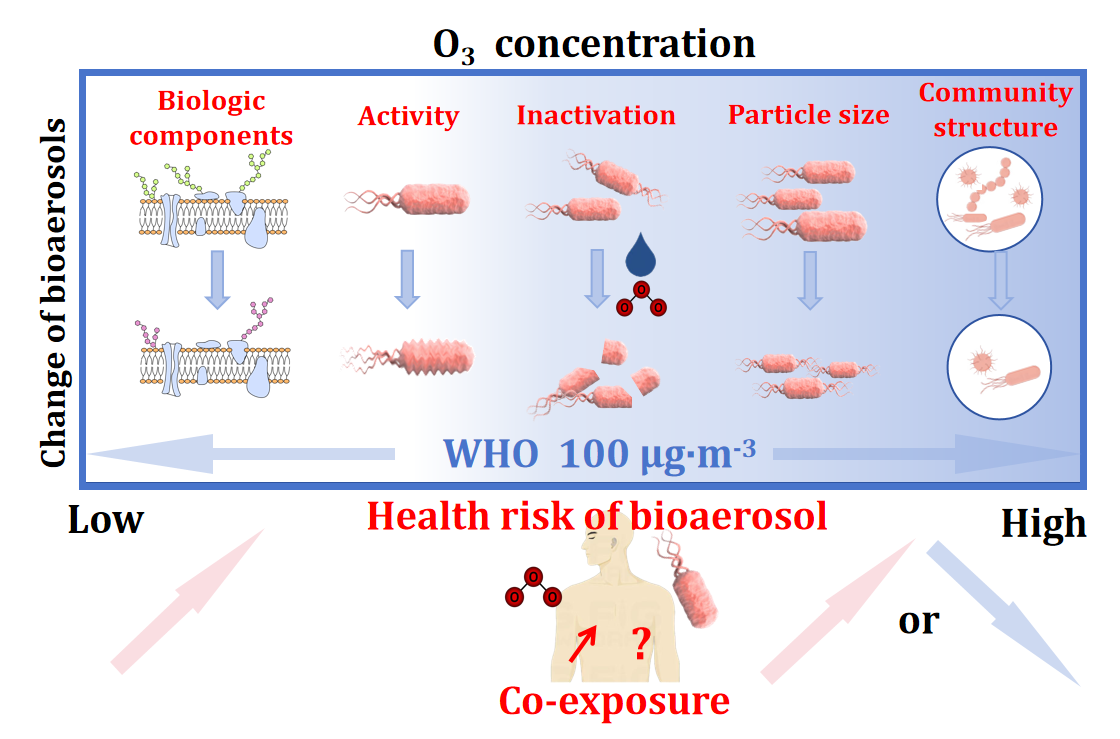
- High concentration atmospheric O3affects the size distribution and community structure of bioaerosols
- Low concentration atmospheric O3 affects the biologic components and activity of bioaerosols
- Human health risks of O3 mediated bioaerosols are complicated
- Open Access
- Review
A Critical Mini‑Review on Atmospheric Ozone Mediated Alterations of Bioaerosols and Their Effects on Human Health
- Linghui Peng 1, 2,
- Caiqing Peng 1, 2,
- Guiying Li 1, 2,
- Taicheng An 1, 2, *
Author Information
Received: 03 Feb 2025 | Revised: 12 Mar 2025 | Accepted: 14 Mar 2025 | Published: 17 Mar 2025
Highlights
Abstract
Bioaerosols are airborne particles that contain microorganisms and their derivatives, attracting much attention recently due to global epidemic of COVID-19. In fact, characteristics of bioaerosols can be significantly influenced by pollutants in air. As one of the most common ambient air pollutants, ozone (O3) may influence the characteristics of bioaerosols and finally affects their health effects. However, the interaction association between the atmospheric ozone pollution and bioaerosols are poorly understood. In this critical mini-review, recent research about the influences of O3 on biological components, physical characteristics, bio-activity, evolution of community structure as well as health risk of bioaerosols is reviewed. In addition, this mini-review also highlights that atmospheric O3 may play a potential role to boost the spread of antibiotics resistance genes to some extent, which warns the public to properly control atmospheric O3 and bioaerosol pollutions synchronously.
Graphical Abstract
Keywords
bioaerosol | ozone pollution | alteration of characteristics | change of community structure | health risk
References
- 1.Amin, H.; Šantl-Temkiv, T.; Cramer, C.; Finster, K.; Real, F.G.; Gislason, T.; Holm, M.; Janson, C.; Jögi, N.O.; Jogi, R.; et al. Indoor airborne microbiome and endotoxin: Meteorological events and occupant characteristics are important determinants. Environ. Sci. Technol. 2023, 57, 11750–11766.
- 2.Li, P.; Li, L.; Yang, K.; Zheng, T.; Liu, J.; Wang, Y. Characteristics of microbial aerosol particles dispersed downwind from rural sanitation facilities: Size distribution, source tracking and exposure risk. Environ. Res. 2021, 195, 110798.
- 3.Chen, Y.; Liang, Z.; Li, G.; An, T. Indoor/Outdoor airborne microbiome characteristics in residential areas across four seasons and its indoor purification. Environ. Int. 2024, 190, 108857.
- 4.Su, K.; Liang, Z.; Zhang, S.; Liao, W.; Gu, J.; Guo, Y.; Li, G.; An, T. The abundance and pathogenicity of microbes in automobile air conditioning filters across the typical cities of China and Europe. J. Hazar. Mater. 2024, 472, 134459.
- 5.Zhang, S.; Liang, Z.; Wang, X.; Ye, Z.; Li, G.; An, T. Bioaerosols in an industrial park and the adjacent houses: Dispersal between indoor/outdoor, the impact of air purifier, and health risk reduction. Environ. Int. 2023, 172, 107778.
- 6.Liang, Z.; Yu, Y.; Wang, X.; Liao, W.; Li, G.; An, T. The exposure risks associated with pathogens and antibiotic resistance genes in bioaerosol from municipal landfill and surrounding area. J. Environ. Sci.-China 2023, 129, 90–103.
- 7.Yue, S.; Li, L.; Xu, W.; Zhao, J.; Ren, H.; Ji, D.; Li, P.; Zhang, Q.; Wei, L.; Xie, Q.; et al. Biological and nonbiological sources of fluorescent aerosol particles in the urban atmosphere. Environ. Sci. Tech., 2022, 56, 7588–7597.
- 8.Geng, X.; Nie, C.; Chen, H.; Tang, X.; Wei, M.; Wang, Y.; Gao, H.; Li, D.; Fang, M.; Ju, R.; et al. Nycterohemeral airborne fungal and bacterial communities and health risks of potential pathogens in Shanghai. Environ. Sci. Atmos. 2024, 4, 190–201.
- 9.Cariñanos, P.; Foyo-Moreno, I.; Alados, I.; Guerrero-Rascado, J.L.; Ruiz-Peñuela, S.; Titos, G.; Cazorla, A.; Alados-Arboledas, L.; de la Guardia, C.D. Bioaerosols in urban environments: Trends and interactions with pollutants and meteorological variables based on quasi-climatological series. J. Environ. Manag. 2021, 282, 111963.
- 10.Wang, H.; Wang, H.; Lu, X.; Lu, K.; Zhang, L.; Tham, Y.J.; Shi, Z.; Aikin, K.; Fan, S.; Brown, S.S.; et al. Increased night-time oxidation over China despite widespread decrease across the globe. Nat. Geosci. 2022, 16, 217–223.
- 11.Wang, Y.; Zhao, Y.; Liu, Y.; Jiang, Y.; Zheng, B.; Xing, J.; Liu, Y.; Wang, S.; Nielsen, C.P. Sustained emission reductions have restrained the ozone pollution over China. Nat. Geosci. 2023, 16, 967–974.
- 12.
Wang, H.; Peng, L.; Li, G.; Liu, H.; Liang, Z.; Zhao, H.; An, T. Enhanced catalytic ozonation inactivation of bioaerosols by MnO2/Ni foam with abundant oxygen vacancies and O3 at atmospheric concentration. Appl. Catal. B Environ., 2024, 344, 123675.
- 13.
Kakaei, K.; Padervand, M.; Akinay, Y.; Dawi, E.; Ashames, A.; Saleem, L.; Wang, C. A critical mini-review on challenge of gaseous O3 toward removal of viral bioaerosols from indoor air based on collision theory. Environ. Sci. Pollut. Res. 2023, 30, 84918–84932.
- 14.Truyols-Vives, J.; Botella-Grau, S.; Mercader-Barceló; J; Baldoví, H.G. Antimicrobial activity of safe concentrations of ozone, hydrogen peroxide, and triethylene glycol in air and surfaces. Environ. Sci. Atmos. 2024, 4, 620–633.
- 15.Liang, Z.; Yu, Y.; Ye, Z.; Li, G.; Wang, W.; An, T. Pollution profiles of antibiotic resistance genes associated with airborne opportunistic pathogens from typical area, Pearl River Estuary and their exposure risk to human. Environ. Inter. 2020, 143, 105934.
- 16.Liu, Z.; Xiao, X.; Jiang, C.; Wang, Y.; He, J. Assessment of the air disinfection effect of low-concentration ozone in a closed environment. Build. Environ. 2023, 244, 110747.
- 17.Yao, M.; Zhang, L.; Ma, J.; Zhou, L. On airborne transmission and control of SARS-CoV-2. Sci. Total. Environ. 2020, 731, 139178.
- 18.Premjit, Y.; Sruthi, N.U.; Pandiselvam, R.; Kothakota, A. Aqueous ozone: Chemistry, physiochemical properties, microbial inactivation, factors influencing antimicrobial effectiveness, and application in food. Compr. Rev. Food Sci. Food Saf. 2022, 21, 1054–1085.
- 19.Afonso, N.F.; Pires, J.C. Characterization of surface ozone behavior at different regimes. Appl. Sci. 2017, 7, 944.
- 20.
Li, G.; Liu, X.; An, T.; Yang, H.; Zhang, S.; Zhao, H. Photocatalytic and photoelectrocatalytic degradation of small biological compounds at TiO2 photoanode: A case study of nucleotide bases. Catal. Today 2015, 242, 363–371.
- 21.Sun, H.; Li, G.; Nie, X.; Shi, H.; Wong, P.K.; Zhao, H.; An, T. Systematic approach to in-depth understanding of photoelectrocatalytic bacterial inactivation mechanisms by tracking the decomposed building blocks. Environ. Sci. Technol. 2014, 48, 9412–9419.
- 22.Wang, H.; Peng, L.; Li, G.; Zhang, W.; Liang, Z.; Zhao, H.; An, T. Photocatalytic ozonation inactivation of bioaerosols by NiFeOOH nanosheets in situ grown on nickel foam. Appl. Catal. B Environ. 2023, 324, 122273.
- 23.Pironti, C.; Moccia, G.; Motta, O.; Boccia, G.; Franci, G.; Santoro, E.; Capunzo, M.; De Caro, F. The influence of microclimate conditions on ozone disinfection efficacy in working places. Environ. Sci. Poll. Res. 2021, 28, 64687–64692.
- 24.Yang, Y.; Yang, L.; Hu, X.; Shen, Z. Characteristics of bioaerosols under high-ozone periods, haze episodes, dust storms, and normal days in Xi’an, China. Particuology. 2024, 9, 140–148.
- 25.Gong, J.; Qi, J.; Beibei, E.; Yin, Y.; Gao, D. Concentration, viability and size distribution of bacteria in atmospheric bioaerosols under different types of pollution. Environ. Pollut. 2020, 257, 113485.
- 26.Zuo, Z.; Pan, Y.; Huang, X.; Yuan, T.; Liu, C.; Cai, X.; Xu, Z. Seasonal distribution of human-to-human pathogens in airborne PM2.5 and their potential high-risk ARGs. Front. Microbiol. 2024, 15, 1422637.
- 27.Hao, W.; Huang, Y.W.; Wang, Y. Bioaerosol size as a potential determinant of airborne E. coli viability under ultraviolet germicidal irradiation and ozone disinfection. Nanotechnology 2024, 35, 145702.
- 28.Li, Z.; Lu, J.; Tong, Y.; Li, S.; He, F. Differences in microbial community composition and factors affecting different particulate matter during autumn in three cities of Xinjiang, China. Sci. Total. Environ. 2023, 866, 161275.
- 29.Liu, H.; Zhang, X.; Zhang, H.; Yao, X.; Zhou, M.; Wang, J.; He, Z.; Zhang, H.; Lou, L.; Mao, W.; et al. Effect of air pollution on the total bacteria and pathogenic bacteria in different sizes of particulate matter. Environ. Pollut. 2018, 233, 483–493.
- 30.Góralska, K.; Lis, S.; Gawor, W.; Karuga, F.; Romaszko, K.; Brzeziańska-Lasota, E. Culturable filamentous fungi in the air of recreational areas and their relationship with bacteria and air pollutants during winter. Atmosphere 2022, 13, 207.
- 31.Cordero, J.M.; Núñez, A.; García, A.M.; Borge, R. Assessment and statistical modelling of airborne microorganisms in Madrid. Environ. Pollut. 2021, 269, 116124.
- 32.Wang, Y.; Qi, J.; Han, C.; Zhang, T.; Zhang, D. Microbial characteristics of culturable fungi and bacteria in aerosol particles of a coastal region. Aerobiologia 2020, 36, 507–525.
- 33.Ai, Y.; Wang, C.; Pan, Y.L.; Videen, G. Characterization of single fungal aerosol particles in a reactive atmospheric environment using time-resolved optical trapping-raman spectroscopy (OT-RS). Environ. Sci. Atmos. 2022, 2, 591–600.
- 34.Pan, Y.L.; Santarpia, J.L.; Ratnesar-Shumate, S.; Corson, E.; Eshbaugh, J.; Hill, S.C.; Chatt; Williamson, C.; Coleman, M.; Bare, C.; Kinahan, S. Effects of ozone and relative humidity on fluorescence spectra of octapeptide bioaerosol particles. J. Quant. Spectrosc. Radiat. Transf. 2014, 133, 538–550.
- 35.Pan, Y.L.; Kalume, A.; Wang, C.; Santarpia, J. Atmospheric aging processes of bioaerosols under laboratory-controlled conditions: A review. J. Aerosol. Sci. 2021, 155, 105767.
- 36.Ratnesar-Shumate, S.; Pan, Y.L.; Hill, S.C.; Kinahan, S.; Corson, E.; Eshbaugh, J.; Santarpia, J.L. Fluorescence spectra and biological activity of aerosolized bacillus spores and MS2 bacteriophage exposed to ozone at different relative humidities in a rotating drum. J. Quant. Spectrosc. Radiat. Transf. 2015, 153, 13–28.
- 37.D’Amato, G.; Annesi-Maesano, I.; Biagioni, B.; Lancia, A.; Cecchi, L.; D’Ovidio, M.C.; D’Amato, M. New developments in climate change, air pollution, pollen allergy, and interaction with SARS-CoV-2. Atmosphere 2023, 14, 848.
- 38.Tiedemann, A.V.; Firsching, K.H. Interactive effect of elevated ozone and carbon dioxide on growth and yield of leaf rust infected versus non infected wheat. Environ. Pollut. 2000, 108, 357–363.
- 39.
Zoran, M.A.; Savastru, R.S.; Savastru, D.M.; Tautan, M.N. Assessing the relationship between ground levels of ozone (O3) and nitrogen dioxide (NO2) with coronavirus (COVID-19) in Milan, Italy. Sci. Total. Environ. 2020, 740, 140005.
- 40.Bai, C.; Cai, Y.; Sun, T.; Li, G.; Wang, W.; Wong, P.K.; An, T. Mechanism of antibiotic resistance spread during sub-lethal ozonation of antibiotic-resistant bacteria with different resistance targets. Water Res. 2024, 259, 121837.
- 41.Alexander, J.; Knopp, G.; Dötsch, A.; Wieland, A.; Schwartz, T. Ozone treatment of conditioned wastewater selects antibiotic resistance genes, opportunistic bacteria, and induce strong population shifts. Sci. Total Environ. 2016, 559, 103–112.
- 42.Wang, Y.; Yang, Y.; Yuan, Q.; Li, T.; Zhou, Y.; Zong, L.; Wang, M.; Xie, Z.; Ho, H.C.; Gao, M.; et al. Substantially underestimated global health risks of current ozone pollution. Nat. Commun. 2025, 16, 102.
- 43.Zong, L.; Yang, Y.; Xia, H.; Gao, M.; Sun, Z.; Zheng, Z.; Li, X.; Ning, G.; Li, Y.; Lolli, S. Joint occurrence of heatwaves and ozone pollution and increased health risks in Beijing, China: Role of synoptic weather pattern and urbanization. Atmos. Chem. Phys. 2022, 22, 6523–6538.
- 44.
Carvalho, R.B.; Marmett, B.; Dorneles, G.P.; da Silva, I.M.; Romão, P.R.T.; da Silva Júnior, F.M.R.; Rhoden, C.R. O3 concentration and duration of exposure are factors influencing the environmental health risk of exercising in Rio Grande, Brazil. Environ. Geochem. Health 2022, 44, 2733–2742.
How to Cite
Peng, L.; Peng, C.; Li, G.; An, T. A Critical Mini‑Review on Atmospheric Ozone Mediated Alterations of Bioaerosols and Their Effects on Human Health. Global Environmental Science 2025, 1 (1), 35–42. https://doi.org/10.53941/ges.2025.100004.
RIS
BibTex
Copyright & License

Copyright (c) 2025 by the authors.
This work is licensed under a Creative Commons Attribution 4.0 International License.
Article Metrics
524
Article Views
3
Citations
Contents
References

 Suite 4002 Level 4, 447 Collins Street, Melbourne, Victoria 3000, Australia
 General Inquiries: info@sciltp.com