
- Wirelessand Biocompatible Control for Diverse Applications
- Emerging Contaminants Degradation as a Promising Future Direction
- Future Research Focus on Material Optimization and Expanded Applications
- Open Access
- Review
Ultrasonic-Assisted Piezoelectricity by Barium Titanate Materials: Multi-Domain Application and Mechanism Exploration
- Chen Yang 1, 2, 3, †,
- Wenhui Ji 1, 2, 3, †,
- Zhipeng Zheng 1, 2, 3,
- Ru Fang 1, 2, 3,
- Jie Jiang 4, *,
- Dong Wu 1, 2, 3, *
Author Information
Received: 16 Apr 2025 | Revised: 11 May 2025 | Accepted: 19 May 2025 | Published: 20 May 2025
Highlights
Abstract
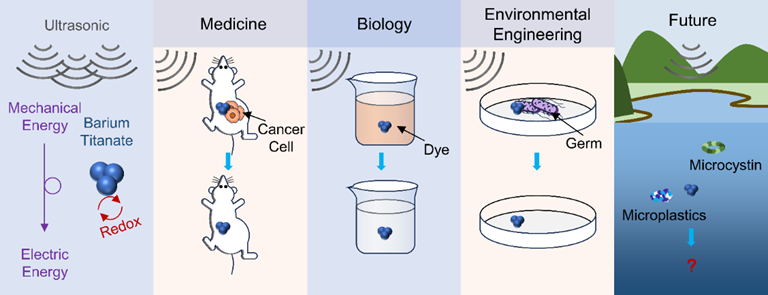
Barium titanate-based materials serve as highly efficient catalysts in the realm of piezoelectric ceramics. With the aid of ultrasound, these piezoelectric ceramics have been widely used and exhibit remarkable potential in advancing wireless, precise control of therapeutic technologies, medical applications, and environmental pollutant control. There is a growing interest in leveraging these materials to develop innovative methods for degrading emerging contaminants, but limited articles have explored the feasibility of this application. As such, we review the progress of research in ultrasonic-assisted piezoelectric catalysis by barium titanate materials (BTO&US) and discuss the underlying catalytic mechanisms in various application scenarios. In addition, we outline its future research directions, focusing on crystal structure optimization, electronic density regulation, medium, and catalytic applications for the degradation of emerging contaminants. This review on BTO&US offers novel ideas and methodologies that contribute to the development and application of piezoelectric ceramics.
Graphical Abstract
Keywords
BaTiO3 | emerging contaminants degradation | piezoelectric catalysis | radical | ultrasound
References
- 1.Wang, Y.; Gray, D.; Berry, D.; et al. An Extremely Low Equivalent Magnetic Noise Magnetoelectric Sensor. Adv. Mater. 2011, 23, 4111–4114.
- 2.Wei, X.K.; Domingo, N.; Sun, Y.; et al. Progress on Emerging Ferroelectric Materials for Energy Harvesting, Storage and Conversion. Adv. Energy Mater. 2022, 12, 2201199.
- 3.Najjari, A.; Aghdam, R.M.; Ebrahimi, S.S.; et al. Smart piezoelectric biomaterials for tissue engineering and regenerative medicine: A review. Biomed. Eng.-Biomed. Tech. 2022, 67, 71–88.
- 4.Dong, W.; Xiao, H.; Jia, Y.; et al. Engineering the Defects and Microstructures in Ferroelectrics for Enhanced/Novel Properties: An Emerging Way to Cope with Energy Crisis and Environmental Pollution. Adv. Sci. 2022, 9, 2105368.
- 5.Zhao, C.; Huang, Y.; Wu, J. Multifunctional barium titanate ceramics via chemical modification tuning phase structure. Infomat 2020, 2, 1163–1190.
- 6.Wang, Z.L.; Song, J.H. Piezoelectric nanogenerators based on zinc oxide nanowire arrays. Science 2006, 312, 242–246.
- 7.
Yu, C.; He, J.; Tan, M.; et al. Selective Enhancement of Photo-Piezocatalytic Performance in BaTiO3 Via heterovalent Ion Doping. Adv. Funct. Mater. 2022, 32, 2209365.
- 8.Tu, S.; Guo, Y.; Zhang, Y.; et al. Piezocatalysis and Piezo-Photocatalysis: Catalysts Classification and Modification Strategy, Reaction Mechanism, and Practical Application. Adv. Funct. Mater. 2020, 30, 2005158.
- 9.Lin, E.; Wu, J.; Qin, N.; et al. Silver modified barium titanate as a highly efficient piezocatalyst. Catal. Sci. Technol. 2018, 8, 4788–4796.
- 10.
Lan, S.; Zeng, X.; Rather, R.A.; et al. Enhanced trimethoxypyrimidine degradation by piezophotocatalysis of BaTiO3/Ag3PO4 using mechanical vibration and visible light simultaneously. Environ. Sci.-Nano 2019, 6, 554–564.
- 11.Trolier-McKinstry, S.; Randall, C.A. Movers, shakers, and storers of charge: The legacy of ferroelectricians L. Eric Cross and Robert E. Newnham. J. Am. Ceram. Soc. 2017, 100, 3346–3359.
- 12.
Tang, Q.; Wu, J.; Kim, D.; et al. Enhanced Piezocatalytic Performance of BaTiO3 Nanosheets with Highly Exposed {001} Facets. Adv. Funct. Mater. 2022, 32, 2202180.
- 13.
Adak, A.; Das, I.; Mondal, B.; et al. Degradation of 2,4-dichlorophenoxyacetic acid by UV 253.7 and UV-H2O2: Reaction kinetics and effects of interfering substances. Emerg. Contam. 2019, 5, 53–60.
- 14.Titchou, F.E.; Zazou, H.; Afanga, H.; et al. Removal of organic pollutants from wastewater by advanced oxidation processes and its combination with membrane processes. Chem. Eng. Process.-Process Intensif. 2021, 169, 108631.
- 15.Qian, W.; Zhao, K.; Zhang, D.; et al. Piezoelectric Material-Polymer Composite Porous Foam for Efficient Dye Degradation via the Piezo-Catalytic Effect. ACS Appl. Mater. Interfaces 2019, 11, 27862–27869.
- 16.
Yu, M.; Ni, C.; Hou, T.; et al. Peroxymonosulfate Activation by BaTiO3 Piezocatalyst. Catalysts 2022, 12, 1452.
- 17.
Zhu, P.; Chen, Y.; Shi, J. Piezocatalytic Tumor Therapy by Ultrasound-Triggered and BaTiO3-Mediated Piezoelectricity. Adv. Mater. 2020, 32, 2001976.
- 18.Wang, P.; Tang, Q.; Zhang, L.; et al. Ultrasmall Barium Titanate Nanoparticles for Highly Efficient Hypoxic Tumor Therapy via Ultrasound Triggered Piezocatalysis and Water Splitting. Acs Nano 2021, 15, 11326–11340.
- 19.Zhan, L.; Xiao, C.; Li, C.; et al. Internal Wireless Electrical Stimulation from Piezoelectric Barium Titanate Nanoparticles as a New Strategy for the Treatment of Triple-Negative Breast Cancer. Acs Appl. Mater. Interfaces 2022, 14, 45032–45041.
- 20.Sasikala, A.R.K.; Kaliannagounder, V.K.; Alluri, N.R.; et al. Development of self-powered multifunctional piezomagnetic nanoparticles for non-invasive post-surgical osteosarcoma theranogeneration. Nano Energy 2022, 96, 107134.
- 21.Marino, A.; Almici, E.; Migliorin, S.; et al. Piezoelectric barium titanate nanostimulators for the treatment of glioblastoma multiforme. J. Colloid. Interface Sci. 2019, 538, 449–461.
- 22.Marino, A.; Battaglini, M.; De Pasquale, D.; et al. Ultrasound-Activated Piezoelectric Nanoparticles Inhibit Proliferation of Breast Cancer Cells. Sci. Rep. 2018, 8, 6257.
- 23.
Cheng, S.; Luo, Y.; Zhang, J.; et al. The highly effective therapy of ovarian cancer by Bismuth-doped oxygen-deficient BaTiO3 with enhanced sono-piezocatalytic effects. Chem. Eng. J. 2022, 442, 136380.
- 24.
Zhao, Y.; Wang, S.; Ding, Y.; et al. Piezotronic Effect-Augmented Cu2-x-O-BaTiO3 Sonosensitizers for Multifunctional Cancer Dynamic Therapy. Acs Nano 2022, 16, 9304–9316.
- 25.Han, J.; Zhang, Y.; Wang, X.; et al. Ultrasound-mediated piezoelectric nanoparticle modulation of intrinsic cardiac autonomic nervous system for rate control in atrial fibrillation. Biomater. Sci. 2023, 11, 655–665.
- 26.Sood, A.; Desseigne, M.; Dev, A.; et al. A Comprehensive Review on Barium Titanate Nanoparticles as a Persuasive Piezoelectric Material for Biomedical Applications: Prospects and Challenges. Small 2022, 19, 2206401.
- 27.Vannozzi, L.; Ricotti, L.; Filippeschi, C.; et al. Nanostructured ultra-thin patches for ultrasound-modulated delivery of anti-restenotic drug. Int. J. Nanomed. 2016, 11, 69–92.
- 28.Wan, X.; Zhang, X.; Liu, Z.; et al. Noninvasive manipulation of cell adhesion for cell harvesting with piezoelectric composite film. Appl. Mater. Today 2021, 25, 101218.
- 29.Marino, A.; Arai, S.; Hou, Y.; et al. Piezoelectric Nanoparticle-Assisted Wireless Neuronal Stimulation. Acs Nano 2015, 9, 7678–7689.
- 30.
Biswas, A.; Saha, S.; Pal, S.; et al. TiO2-Templated BaTiO3 Nanorod as a Piezocatalyst for Generating Wireless Cellular Stress. ACS Appl. Mater. Interfaces 2020, 12, 48363–48370.
- 31.Rojas, C.; Tedesco, M.; Massobrio, P.; et al. Acoustic stimulation can induce a selective neural network response mediated by piezoelectric nanoparticles. J. Neural Eng. 2018, 15, 036016.
- 32.Marino, A.; Barsotti, J.; de Vito, G.; et al. Two-Photon Lithography of 3D Nanocomposite Piezoelectric Scaffolds for Cell Stimulation. ACS Appl. Mater. Interfaces 2015, 7, 25574–25579.
- 33.Paci, C.; Iberite, F.; Arrico, L.; et al. Piezoelectric nanocomposite bioink and ultrasound stimulation modulate early skeletal myogenesis. Biomater. Sci. 2022, 10, 5265–5283.
- 34.
Genchi, G.G.; Ceseracciu, L.; Marino, A.; et al. P(VDF-TrFE)/BaTiO3 Nanoparticle Composite Films Mediate Piezoelectric Stimulation and Promote Differentiation of SH-SY5Y Neuroblastoma Cells. Adv. Healthc. Mater. 2016, 5, 1808–1820.
- 35.
Chen, J.; Li, S.; Jiao, Y.; et al. In Vitro Study on the Piezodynamic Therapy with a BaTiO3-Coating Titanium Scaffold under Low-Intensity Pulsed Ultrasound Stimulation. Acs Appl. Mater. Interfaces 2021, 13, 49542–49555.
- 36.Shi, X.; Chen, Y.; Zhao, Y.; et al. Ultrasound-activable piezoelectric membranes for accelerating wound healing. Biomater. Sci. 2022, 10, 692–701.
- 37.
Feng, J.; Fu, Y.; Liu, X.; et al. Significant Improvement and Mechanism of Ultrasonic Inactivation to Escherichia coil with Piezoelectric Effect of Hydrothermally Synthesized t-BaTiO3. Acs Sustain. Chem. Eng. 2018, 6, 6032–6041.
- 38.Lei, J.; Wang, C.; Feng, X.; et al. Sulfur-regulated defect engineering for enhanced ultrasonic piezocatalytic therapy of bacteria-infected bone defects. Chem. Eng. J. 2022, 435, 134624.
- 39.Wu, M.; Zhang, Z.; Liu, Z.; et al. Piezoelectric nanocomposites for sonodynamic bacterial elimination and wound healing. Nano Today 2021, 37, 101104.
- 40.Yu, X.; Wang, S.; Zhang, X.; et al. Heterostructured nanorod array with piezophototronic and plasmonic effect for photodynamic bacteria killing and wound healing. Nano Energy 2018, 46, 29–38.
- 41.Xia, D.; Tang, Z.; Wang, Y.; et al. Piezo-catalytic persulfate activation system for water advanced disinfection: Process efficiency and inactivation mechanisms. Chem. Eng. J. 2020, 400, 125894.
- 42.
Zheng, H.; Chen, J.; Que, M.; et al. Highly efficient piezoelectric field enhanced photocatalytic performance via in situ formation of BaTiO3 on Ti3C2Tx for phenolic compound degradation. Inorg. Chem. Front. 2022, 9, 4201–4215.
- 43.Wang, Y.; Wen, X.; Jia, Y.; et al. Piezo-catalysis for nondestru-ctive tooth whitening. Nat. Commun. 2020, 11, 1328.
- 44.
Liu, X.; Xiao, L.; Zhang, Y.; et al. Significantly enhanced piezo-photocatalytic capability in BaTiO3 nanowires for degrading organic dye. J. Mater. 2020, 6, 256–262.
- 45.Jin, C.; Liu, D.; Hu, J.; et al. The role of microstructure in piezocatalytic degradation of organic dye pollutants in wastewater. Nano Energy 2019, 59, 372–379.
- 46.
Chen, P.; Li, X.; Ren, Z.; et al. Enhancing Photocatalysis of Ag Nanoparticles Decorated BaTiO3 Nanofibers through Plasmon-Induced Resonance Energy Transfer Turned by Piezoelectric Field. Catalysts 2022, 12, 987.
- 47.
Ding, X.; Shi, J.; He, Y.; et al. Boosting piezo/photo-induced charge transfer of a bi-piezoelectrics BaTiO3/CdS isotype junction for kinetic optimization. J. Alloys Compd. 2023, 931, 167434.
- 48.
Fu, B.; Li, J.; Jiang, H.; et al. Enhanced piezotronics by single-crystalline ferroelectrics for uniformly strengthening the piezo-photocatalysis of electrospun BaTiO3@TiO2 nanofibers. Nanoscale 2022, 14, 14073–14081.
- 49.
Hu, Z.; Dong, W.; Dong, Z.; et al. Facile fabrication of tetragonal phase single-crystalline BaTiO3 terrace-like dendrite by a simple solvothermal method and its piezocatalytic properties. Mater. Chem. Phys. 2023, 293, 126911.
- 50.
Xu, S.; Liu, Z.; Zhang, M.; et al. Piezotronics enhanced photocatalytic activities of Ag-BaTiO3 plasmonic photocatalysts. J. Alloys Compd. 2019, 801, 483–488.
- 51.
Alfryyan, N.; Kumar, S.; Ben Ahmed, S.; et al. Electric Poling Effect on Piezocatalytic BaTiO3/Polymer Composites for Coatings. Catalysts 2022, 12, 1228.
- 52.
Zheng, H.; Li, X.; Zhu, K.; et al. Semiconducting BaTiO3@C core-shell structure for improving piezo-photocatalytic performance. Nano Energy 2022, 93, 106831.
- 53.
Liu, D.; Jin, C.; Shan, F.; et al. Synthesizing BaTiO3 Nanostructures to Explore Morphological Influence, Kinetics, and Mechanism of Piezocatalytic Dye Degradation. Acs Appl. Mater. Interfaces 2020, 12, 17443–17451.
- 54.
Zheng, W.; Tang, Y.; Liu, Z.; et al. Enhanced charge carrier separation by bi-piezoelectric effects based on pine needle-like BaTiO3/ZnO continuous nanofibers. J. Mater. Chem. A 2022, 10, 13544–13555.
- 55.
Wang, X.; Gao, X.; Li, M.; et al. Synthesis of flexible BaTiO3 nanofibers for efficient vibration-driven piezocatalysis. Ceram. Int. 2021, 47, 25416–25424.
- 56.Xiong, S.; Zeng, H.; Deng, Y.; et al. Insights into the dual Z-scheme and piezoelectricity co-driven photocatalyst for ultra-speed degradation of nitenpyram. Chem. Eng. J. 2023, 451, 138399.
- 57.
Gao, S.; Xing, H.; Zhang, J.; et al. Oxalic acid functionalization of BaTiO3 nanobelts for promoting their piezo-degradation organic contaminants. J. Mater. 2021, 7, 1275–1283.
- 58.
Ji, M.; Kim, J.H.; Ryu, C.-H.; et al. Synthesis of self-modified black BaTiO3−x nanoparticles and effect of oxygen vacancy for the expansion of piezocatalytic application. Nano Energy 2022, 95, 106993.
- 59.
Xu, J.; Zang, T.; Du, D.; et al. Effect of poling on piezocatalytic removal of muti-pollutants using BaTiO3. J. Am. Ceram. Soc. 2021, 104, 1661–1668.
- 60.
Masekela, D.; Hintsho-Mbita, N.C.; Ntsendwana, B.; et al. Thin Films (FTO/BaTiO3/AgNPs) for Enhanced Piezo-Photocatalytic Degradation of Methylene Blue and Ciprofloxacin in Wastewater. Acs Omega 2022, 7, 24329–24343.
- 61.
Wan, L.; Tian, W.; Li, N.; et al. Hydrophilic porous PVDF membrane embedded with BaTiO3 featuring controlled oxygen vacancies for piezocatalytic water cleaning. Nano Energy 2022, 94, 106930.
- 62.
Lv, Y.; Sui, M.; Lv, X.; et al. Piezoelectric catalytic performance of BaTiO3 for sulfamethoxazole degradation. Environ. Sci.-Water Res. Technol. 2022, 8, 3007–3018.
- 63.Peng, F.; Yin, R.; Liao, Y.; et al. Kinetics and mechanisms of enhanced degradation of ibuprofen by piezo-catalytic activation of persulfate. Chem. Eng. J. 2020, 392, 123818.
- 64.Lan, S.; Feng, J.; Xiong, Y.; et al. Performance and Mechanism of Piezo-Catalytic Degradation of 4-Chlorophenol: Finding of Effective Piezo-Dechlorination. Environ. Sci. Technol. 2017, 51, 6560–6569.
- 65.
Zhao, L.; Zhang, Y.; Wang, F.; et al. BaTiO3 nanocrystal-mediated micro pseudo-electrochemical cells with ultrasound-driven piezotronic enhancement for polymerization. Nano Energy 2017, 39, 461–469.
- 66.Xu, W.; Li, K.; Shen, L.; et al. Piezodeposition of Metal Cocatalysts for Promoted Piezocatalytic Generation of Reactive Oxygen Species and Hydrogen in Water. Chemcatchem 2022, 14, e202200312.
- 67.Guo, S.-L.; Lai, S.-N.; Wu, J.M. Strain-Induced Ferroelectric Heterostructure Catalysts of Hydrogen Production through Piezophototronic and Piezoelectrocatalytic System. Acs Nano 2021, 15, 16106–16117.
- 68.
Zhou, X.; Shen, B.; Zhai, J.; et al. High Performance Generation of H2O2 under Piezophototronic Effect with Multi-Layer In2S3 Nanosheets Modified by Spherical ZnS and BaTiO3 Nanopiezoelectrics. Small Methods 2021, 5, 2100269.
- 69.
Wu, J.; Qin, N.; Bao, D. Effective enhancement of piezocatalytic activity of BaTiO3 nanowires under ultrasonic vibration. Nano Energy 2018, 45, 44–51.
- 70.Zhao, L.; Deng, J.; Sun, P.; et al. Nanomaterials for treating emerging contaminants in water by adsorption and photocatalysis: Systematic review and bibliometric analysis. Sci. Total Environ. 2018, 627, 1253–1263.
- 71.Rathi, B.S.; Kumar, P.S.; Show, P.-L. A review on effective removal of emerging contaminants from aquatic systems: Current trends and scope for further research. J. Hazard. Mater. 2021, 409, 124413.
- 72.Li, Y.; Xu, D.; Zheng, H.; et al. Light-driven inactivation of harmful algae Microcystis aeruginosa and degradation of microcystin by oxygen-doped carbon nitride nanosheets. Chem. Eng. J. 2021, 417, 128094.
- 73.Feitz, A.J.; Waite, T.D.; Jones, G.J.; et al. Photocatalytic degradation of the blue green algal toxin microcystin-LR in a natural organic-aqueous matrix. Environ. Sci. Technol. 1999, 33, 243–249.
- 74.
Rey, A.; Mena, E.; Chavez, A.M.; et al. Influence of structural properties on the activity of WO3 catalysts for visible light photocatalytic ozonation. Chem. Eng. Sci. 2015, 126, 80–90.
- 75.
Miranda-Garcia, N.; Suarez, S.; Sanchez, B.; et al. Photocatalytic degradation of emerging contaminants in municipal wastewater treatment plant effluents using immobilized TiO2 in a solar pilot plant. Appl. Catal. B-Environ. 2011, 103, 294–301.
- 76.Viet Ha Tran, T.; Lee, B.-K. Great improvement on tetracycline removal using ZnO rod-activated carbon fiber composite prepared with a facile microwave method. J. Hazard. Mater. 2017, 324, 329–339.
- 77.Linley, S.; Liu, Y.; Ptacek, C.J.; et al. Recyclable Graphene Oxide-Supported Titanium Dioxide Photocatalysts with Tunable Properties. Acs Appl. Mater. Interfaces 2014, 6, 4658–4668.
- 78.Mirzaei, A.; Chen, Z.; Haghighat, F.; Yerushalmi, L. Removal of pharmaceuticals from water by homo/heterogonous Fenton-type processes—A review. Chemosphere 2017, 174, 665–688.
- 79.Scaria, J.; Gopinath, A.; Nidheesh, P.V. A versatile strategy to eliminate emerging contaminants from the aqueous environment: Heterogeneous Fenton process. J. Clean. Prod. 2021, 278, 124014.
- 80.Zhang, H.; Yu, B.; Li, X.; et al. Inactivation of Microcystis aeruginosa by peroxydisulfate activated with single-atomic iron catalysis: Efficiency and mechanisms. J. Environ. Chem. Eng. 2022, 10, 108310.
- 81.Kavitha, V.; Palanivelu, K. The role of ferrous ion in Fenton and photo-Fenton processes for the degradation of phenol. Chemosphere 2004, 55, 1235–1243.
- 82.Khan, S.; Naushad, M.; Govarthanan, M.; et al. Emerging contaminants of high concern for the environment: Current trends and future research. Environ. Res. 2022, 207, 112609.
- 83.Xing, R.; Chen, Z.; Sun, H.; et al. Free radicals accelerate in situ ageing of microplastics during sludge composting. J. Hazard. Mater. 2022, 429, 128405.

How to Cite
Yang, C.; Ji, W.; Zheng, Z.; Fang, R.; Jiang, J.; Wu, D. Ultrasonic-Assisted Piezoelectricity by Barium Titanate Materials: Multi-Domain Application and Mechanism Exploration. Global Environmental Science 2025, 1 (1), 43–55. https://doi.org/10.53941/ges.2025.100005.
RIS
BibTex
Copyright & License

Copyright (c) 2025 by the authors.
This work is licensed under a Creative Commons Attribution 4.0 International License.
Article Metrics
457
Article Views
1
Citations
Contents
References

 Suite 4002 Level 4, 447 Collins Street, Melbourne, Victoria 3000, Australia
 General Inquiries: info@sciltp.com