
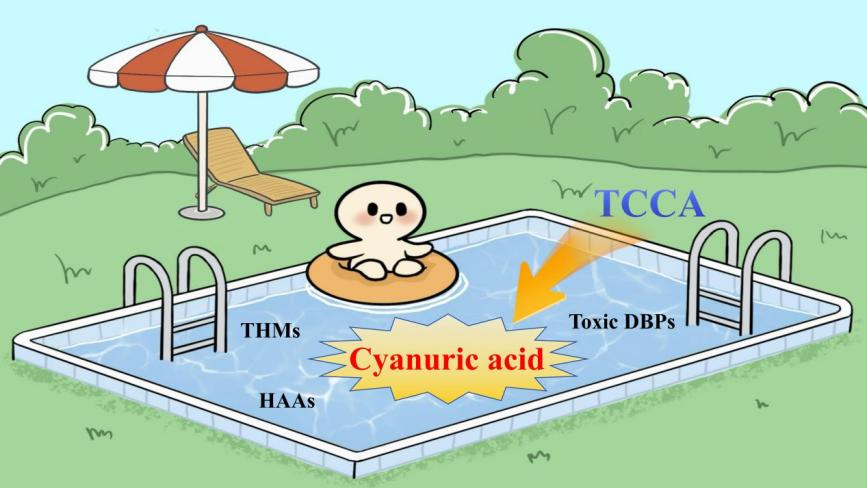
- Cyanuric acid is a dominant non-halogenated cyclic DBP in swimming pool water
- Reported average cyanuric acid levels of 26,600 µg/L, 3–5 orders of magnitude higher than other organic DBPs
- Quantified cyanuric acid contribution (21.4%) to total cytotoxicity of known DBPs in swimming pool water
- Collected data on biodegradation half-life, Log Kow, and BCF to reveal environmental persistence and mobility characteristics
- Open Access
- Article
Re-Examining Cyanuric Acid: An Overlooked Non-Halogenated Cyclic Disinfection Byproduct in Swimming Pool Water
- Tian Qiu 1, †,
- Zhuorong Du 1, †,
- Jingsi Chen 1,
- Jiafu Li 1, *,
- Baiyang Chen 2, *
Author Information
Received: 10 Sep 2025 | Revised: 04 Nov 2025 | Accepted: 10 Nov 2025 | Published: 13 Nov 2025
Highlights
Abstract
Cyanuric acid, as a by-product of chloroisocyanuric acids, is frequently detected in swimming pool water. However, its cytotoxicity, persistence, mobility, and bioaccumulation potential remain poorly understood. This study evaluates the cytotoxicity of cyanuric acid and investigates its occurrence and toxicological impact in water samples. Additionally, data on its biodegradation half-life, octanol-water partition coefficient (Kow), and bioconcentration factor (BCF) were collected. The average concentrations of cyanuric acid in 20 swimming pools were 26,600 µg/L, which were 3–5 orders of magnitude higher than other known organic disinfection byproducts (DBPs). The median lethal concentration (LC50) of cyanuric acid for Chinese hamster ovary (CHO) cells was 13.7 mM. Given its widespread occurrence and high concentration, cyanuric acid is likely a significant contributor to swimming pool cytotoxicity. The calculated cytotoxicity of cyanuric acid (15,054) exceeded that of all reported cyclic DBPs in swimming pools, including halonitrobenzoic acids (0.04), halonitrophenols (0.1), and halobenzoquinones (4.4). Furthermore, its calculated cytotoxicity was also much higher than most aliphatic DBPs. Overall, cyanuric acid contributed approximately 21.4% of pool water cytotoxicity, identifying it as an overlooked cyclic DBP. In terms of environmental persistence, cyanuric acid had a biodegradation half-life of 6.17 days, which is approximately comparable to the median level of aliphatic DBPs. The LogKow and BCF of cyanuric acid was −0.72 and 0.501 L/kg, suggesting a high mobility and minor bioaccumulation potential. Moreover, due to its extremely high concentration in swimming pool water (up to 79,000 µg/L), these values do not eliminate concerns about its environmental risks. Given that chloroisocyanuric acids have been identified as ideal oxidants in advanced oxidation processes (AOPs) for micropollutant degradation in water in recent years, this study may reveal the potential risk of cyanuric acid in swimming pool water and UV/chloroisocyanuric acid-treated water.
Graphical Abstract
Keywords
cyanuric acid | disinfection by-products | swimming pool water | cytotoxicity
References
- 1.Teo, T.L.L.; Coleman, H.M.; Khan, S.J. Chemical contaminants in swimming pools: Occurrence, implications and control. Environ. Int. 2015, 76, 16–31.
- 2.Qiu, T.; Zhang, Z.L.; Li, M.; et al. Influence of disinfection techniques on aliphatic disinfection byproduct formation and cytotoxicity/genotoxicity in swimming pools: A review. Chem. Eng. J. 2023, 470, 144213.
- 3.Carter, R.A.A.; Joll, C.A. Occurrence and formation of disinfection by-products in the swimming pool environment: A critical review. J. Environ. Sci. 2017, 58, 19–50.
- 4.Li, J.; Chen, J.; Hu, Z.; et al. Overlooked inorganic DBPs in trichloroisocyanuric acid (TCCA) disinfected indoor swimming pool: Evidences from concentration, cytotoxicity, and human health risk. Chemosphere 2023, 335, 139061.
- 5.Gossner, C.M.E.; Schlundt, J.; Ben Embarek, P.; et al. The Melamine Incident: Implications for International Food and Feed Safety. Environ. Health Perspect. 2009, 117, 1803–1808.
- 6.Bischoff, K. Chapter 26—Melamine and cyanuric acid. In Reproductive and Developmental Toxicology, 3rd ed.; Gupta, R.C., Ed.; Academic Press: Cambridge, MA, USA, 2022; pp. 503–511.
- 7.Kobayashi, T.; Okada, A.; Fujii, Y.; et al. The mechanism of renal stone formation and renal failure induced by administration of melamine and cyanuric acid. Urol. Res. 2010, 38, 117–125.
- 8.Huang, F.F.; Long, Q.L.; Liu, S.J.; et al. Urinary Excretion of Cyanuric Acid in Association with Urolithiasis: A Matched Case-Control Study in Shanghai Adults. Int. J. Environ. Res. Public Health 2022, 19, 8726.
- 9.Brown, C.A.; Jeong, K.S.; Poppenga, R.H.; et al. Outbreaks of renal failure associated with melamine and cyanuric acid in dogs and cats in 2004 and 2007. J. Vet. Diagn. Investig. 2007, 19, 525–531.
- 10.Han X., P.L., Su B., Yao X. Investigation on Sanitary Indicators of Swimming Places. J. Environ. Hyg. 2016, 6, 437–442. (In Chinese)
- 11.Falk, R.A.; Blatchley, E.R.; Kuechler, T.C.; et al. Assessing the Impact of Cyanuric Acid on Bather's Risk of Gastrointestinal Illness at Swimming Pools. Water 2019, 11, 1314.
- 12.Wang, Z.; Zhou, Z.K.; Zhao, Z.H.; et al. A network toxicology and machine learning approach to investigate the mechanism of kidney injury from melamine and cyanuric acid co-exposure. Ecotoxicol. Environ. Saf. 2025, 293, 118029.
- 13.Chowdhury, S.; Alhooshani, K.; Karanfil, T. Disinfection byproducts in swimming pool: Occurrences, implications and future needs. Water Res. 2014, 53, 68–109.
- 14.Tardif, R.; Catto, C.; Haddad, S.; et al. Assessment of air and water contamination by disinfection by-products at 41 indoor swimming pools. Environ. Res. 2016, 148, 411–420.
- 15.Catto, C.; Sabrina, S.; Ginette, C.T.; et al. Occurrence and Spatial and Temporal Variations of Disinfection By-Products in the Water and Air of Two Indoor Swimming Pools. Int. J. Environ. Res. Public Health 2012, 9, 2562–2586.
- 16.Villanueva, C.M.; Cantor, K.P.; Grimalt, J.O.; et al. Bladder cancer and exposure to water disinfection by-products through ingestion, bathing, showering, and swimming in pools. Am. J. Epidemiol. 2007, 165, 148–156.
- 17.Zhang, D.; Dong, S.K.; Chen, L.; et al. Disinfection byproducts in indoor swimming pool water: Detection and human lifetime health risk assessment. J. Environ. Sci. 2023, 126, 378–386.
- 18.Bove, G.E.; Rogerson, P.A.; Vena, J.E. Case control study of the geographic variability of exposure to disinfectant byproducts and risk for rectal cancer. Int. J. Health Geogr. 2007, 6, 18.
- 19.Richardson, S.D.; Plewa, M.J.; Wagner, E.D.; et al. Occurrence, genotoxicity, and carcinogenicity of regulated and emerging disinfection by-products in drinking water: A review and roadmap for research. Mutat. Res.-Rev. Mutat. Res. 2007, 636, 178–242.
- 20.Du, Z.; Li, J. Clarifying the misuse of EC50, IC50, and LC50 in cytotoxicity study of water disinfection byproducts: A critical analysis and perspective. Hyg. Environ. Health Adv. 2025, 15, 100124.
- 21.Richardson, S.D.; DeMarini, D.M.; Kogevinas, M.; et al. What's in the Pool? A Comprehensive Identification of Disinfection By-products and Assessment of Mutagenicity of Chlorinated and Brominated Swimming Pool Water. Environ. Health Perspect. 2010, 118, 1523–1530.
- 22.Richardson, S.D.; Temes, T.A. Water Analysis: Emerging Contaminants and Current Issues. Anal. Chem. 2018, 90, 398–428.
- 23.Cantú, R.; Evans, O.; Kawahara, F.K.; et al. HPCL determination of cyanuric acid in swimming pool waters using phenyl and confirmatory porous graphitic carbon columns. Anal. Chem. 2001, 73, 3358–3364.
- 24.Fu, X.Y., Huang L., Zou Y. J., Du W. J., & Wang T. Y. Analysis of cyanuric acid level and related factors in swimming pool water in a district of Beijing. J. Environ. Hyg. 2019, 9, 339–343. (In Chinese)
- 25.Tilstam, U.; Weinmann, H. Trichloroisocyanuric acid: A safe and efficient oxidant. Org. Process Res. Dev. 2002, 6, 384–393.
- 26.Chai, Z.Z.; Wang, J.Q.; Dai, Y.X.; et al. Synergy between UV light and trichloroisocyanuric acid on methylisothiazolinone degradation: Performance, kinetics and degradation pathway. Environ. Res. 2023, 236, 116693.
- 27.Morgenthau, A.; Nicolae, A.M.; Laursen, A.E.; et al. Assessment of the working range and effect of sodium dichloroisocyanurate on Pseudomonas aeruginosa biofilms and planktonic cells. Biofouling 2012, 28, 111–120.
- 28.Peng, F.Y.; Yang, Z.G.; Li, H.P.; et al. Caffeine degradation via UV/trichloroisocyanuricacid: Kinetic, influencing parameters and chlorinated disinfection byproducts. J. Water Process Eng. 2023, 56, 104582.
- 29.Zhao, J.; Shang, C.; Yin, R. A High-Radical-Yield Advanced Oxidation Process Coupling Far-UVC Radiation with Chlorinated Cyanurates for Micropollutant Degradation in Water. Environ. Sci. Technol. 2023, 57, 18867–18876.
- 30.Downes, C.J.; Mitchell, J.W.; Viotto, E.S.; et al. Determination of cyanuric acid levels in swimming pool waters by uv absorbance, hplc and melamine cyanurate precipitation. Water Res. 1984, 18, 277–280.
- 31.Qiu, T.; Shi, W.S.; Chen, J.S.; et al. Haloketones: A class of unregulated priority DBPs with high contribution to drinking water cytotoxicity. Water Res. 2024, 259, 121866.
- 32.Li, J.F.; Shi, W.S.; Liu, Y.T.; et al. Revealing the impact of sample enrichment method on concentration and cytotoxicity of volatile disinfection byproducts in drinking water: A quantitative study for liquid-liquid extraction. Water Res. 2024, 266, 122370.
- 33.Plewa, M.J.; Kargalioglu, Y.; Vankerk, D.; et al. Mammalian cell cytotoxicity and genotoxicity analysis of drinking water disinfection by-products. Environ. Mol. Mutagen. 2002, 40, 134–142.
- 34.Plewa, M.J.; Wagner, E.D.; Richardson, S.D. TIC-Tox: A preliminary discussion on identifying the forcing agents of DBP-mediated toxicity of disinfected water. J. Environ. Sci. 2017, 58, 208–216.
- 35.Lau, S.S.; Wei, X.; Bokenkamp, K.; et al. Assessing Additivity of Cytotoxicity Associated with Disinfection Byproducts in Potable Reuse and Conventional Drinking Waters. Environ. Sci. Technol. 2020, 54, 5729–5736.
- 36.Wagner, E.D.; Plewa, M.J. CHO cell cytotoxicity and genotoxicity analyses of disinfection by-products: An updated review. J. Environ. Sci. 2017, 58, 64–76.
- 37.Muellner, M.G.; Wagner, E.D.; McCalla, K.; et al. Haloacetonitriles vs. regulated haloacetic acids: Are nitrogen-containing DBPs more toxic? Environ. Sci. Technol. 2007, 41, 645–651.
- 38.Plewa, M.J.; Muellner, M.G.; Richardson, S.D.; et al. Occurrence, synthesis, and mammalian cell cytotoxicity and genotoxicity of haloacetamides: An emerging class of nitrogenous drinking water disinfection byproducts. Environ. Sci. Technol. 2008, 42, 955–961.
- 39.Plewa, M.J.; Simmons, J.E.; Richardson, S.D.; et al. Mammalian Cell Cytotoxicity and Genotoxicity of the Haloacetic Acids, A Major Class of Drinking Water Disinfection By-Products. Environ. Mol. Mutagen. 2010, 51, 871–878.
- 40.Plewa, M.J.; Wagner, E.D.; Jazwierska, P.; et al. Halonitromethane drinking water disinfection byproducts: Chemical characterization and mammalian cell cytotoxicity and genotoxicity. Environ. Sci. Technol. 2004, 38, 62–68.
- 41.Jeong, C.H.; Postigo, C.; Richardson, S.D.; et al. Occurrence and Comparative Toxicity of Haloacetaldehyde Disinfection Byproducts in Drinking Water. Environ. Sci. Technol. 2015, 49, 13749–13759.
- 42.Liu, Z.F.; Liu, Y.J.; Zeng, G.M.; et al. Application of molecular docking for the degradation of organic pollutants in the environmental remediation: A review. Chemosphere 2018, 203, 139–150.
- 43.Hang, C.; Zhang, B.B.; Gong, T.T.; et al. Occurrence and health risk assessment of halogenated disinfection byproducts in indoor swimming pool water. Sci. Total Environ. 2016, 543, 425–431.
- 44.Granger, C.O.; Richardson, S.D. Do DBPs swim in salt water pools? Comparison of 60 DBPs formed by electrochemically generated chlorine vs. conventional chlorine. J. Environ. Sci. 2022, 117, 232–241.
- 45.Ilyas, H.; Masih, I.; van der Hoek, J.P. Disinfection Methods for Swimming Pool Water: Byproduct Formation and Control. Water 2018, 10, 797.
- 46.Momeniha, F.; Oskouie, A.A.; Esrafili, A.; et al. Trihalomethanes in exhaled air, indoor air and water: A parallel design trial in chlorine and ozone-chlorine disinfected swimming pools. Build. Environ. 2021, 205, 108316.
- 47.Cheema, W.A.; Manasfi, T.; Kaarsholm, K.M.S.; et al. Effect of medium-pressure UV-lamp treatment on disinfection by-products in chlorinated seawater swimming pool waters. Sci. Total Environ. 2017, 599, 910–917.
- 48.Cimetiere, N.; De Laat, J. Effects of UV-dechloramination of swimming pool water on the formation of disinfection by-products: A lab-scale study. Microchem. J. 2014, 112, 34–41.
- 49.Daiber, E.J.; DeMarini, D.M.; Ravuri, S.A.; et al. Progressive Increase in Disinfection Byproducts and Mutagenicity from Source to Tap to Swimming Pool and Spa Water: Impact of Human Inputs. Environ. Sci. Technol. 2016, 50, 6652–6662.
- 50.Lee, J.; Jun, M.J.; Lee, M.H.; et al. Production of various disinfection byproducts in indoor swimming pool waters treated with different disinfection methods. Int. J. Hyg. Environ. Health 2010, 213, 465–474.
- 51.Lourencetti, C.; Grimalt, J.O.; Marco, E.; et al. Trihalomethanes in chlorine and bromine disinfected swimming pools: Air-water distributions and human exposure. Environ. Int. 2012, 45, 59–67.
- 52.Manasfi, T.; De Méo, M.; Coulomb, B.; et al. Identification of disinfection by-products in freshwater and seawater swimming pools and evaluation of genotoxicity. Environ. Int. 2016, 88, 94–102.
- 53.Zhang, X.L.; Yang, H.W.; Wang, X.F.; et al. Concentration levels of disinfection by-products in 14 swimming pools of China. Front. Environ. Sci. Eng. 2015, 9, 995–1003.
- 54.Kanan, A.A. Occurrence and Formation of Disinfection By-Products in Indoor Swimming Pools Water. Ph.D. Thesis, Clemson University, Clemson, SC, USA, 2010.
- 55.Aggazzotti, G.; Fantuzzi, G.; Righi, E.; et al. Environmental and biological monitoring of chloroform in indoor swimming pools. J. Chromatogr. A 1995, 710, 181–190.
- 56.Aggazzotti, G.; Fantuzzi, G.; Righi, E.; et al. Blood and breath analyses as biological indicators of exposure to trihalomethanes in indoor swimming pools. Sci. Total Environ. 1998, 217, 155–163.
- 57.Berg, M.; Müller, S.R.; Mühlemann, J.; et al. Concentrations and mass fluxes of chloroacetic acids and trifluoroacetic acid in rain and natural waters in Switzerland. Environ. Sci. Technol. 2000, 34, 2675–2683.
- 58.Caro, J.; Gallego, M. Assessment of exposure of workers and swimmers to trihalomethanes in an indoor swimming pool. Environ. Sci. Technol. 2007, 41, 4793–4798.
- 59.Lee, J.; Ha, K.T.; Zoh, K.D. Characteristics of trihalomethane (THM) production and associated health risk assessment in swimming pool waters treated with different disinfection methods. Sci. Total Environ. 2009, 407, 1990–1997.
- 60.Mallika, P.; Sarisak, S.; Pongsri, P. Cancer risk assessment from exposure to trihalomethanes in tap water and swimming pool water. J. Environ. Sci. 2008, 20, 372–378.
- 61.Villanueva, C.M.; Gagniere, B.; Monfort, C.; et al. Sources of variability in levels and exposure to trihalomethanes. Environ. Res. 2007, 103, 211–220.
- 62.Allen, J.M.; Plewa, M.J.; Wagner, E.D.; et al. Making Swimming Pools Safer: Does Copper-Silver Ionization with Chlorine Lower the Toxicity and Disinfection Byproduct Formation? Environ. Sci. Technol. 2021, 55, 2908–2918.
- 63.Kim, H.; Shim, J.; Lee, S. Formation of disinfection by-products in chlorinated swimming pool water. Chemosphere 2002, 46, 123–130.
- 64.Wang, J.J.; Zhang, M.Q.; Hu, S.Y.; et al. Occurrence and Cytotoxicity of Aliphatic and Aromatic Halogenated Disinfection Byproducts in Indoor Swimming Pool Water and Their Incoming Tap Water. Environ. Sci. Technol. 2022, 56, 17763–17775.
- 65.Kim, H. Human Exposure to Dichloroacetic Acid and Trichloroacetic Acid from Chlorinated Water During Household Use and Swimming. Ph.D. Thesis, Rutgers The State University of New Jersey, New Brunswick, NJ, USA, 1997.
- 66.Mah, D.; BCIT School of Health Sciences, Environmental Health; Heacock, H. The effectiveness of ozone-chlorine treatment for reducing chloramine concentration compared to chlorine treatment in swimming pools and whirlpools. BCIT Environ. Public Health J. 2014. https://doi.org/10.47339/ephj.2014.145.
- 67.Wu, H.; Long, K.L.; Lu, D.; et al. Occurrence and formation of halobenzoquinones in indoor and outdoor swimming pool waters of Nanning City, Southwest China. Environ. Sci. Pollut. Res. 2019, 26, 31537–31545.
- 68.Wallis, D.J.; Kotlarz, N.; Knappe, D.R.U.; et al. Estimation of the Half-Lives of Recently Detected Per- and Polyfluorinated Alkyl Ethers in an Exposed Community. Environ. Sci. Technol. 2023, 57, 15348–15355.
- 69.An, H.X.; Liu, J.; Li, X.M.; et al. The fate of cyanuric acid in biological wastewater treatment system and its impact on biological nutrient removal. J. Environ. Manag. 2018, 206, 901–909.
- 70.Chen, Z.; Su, Y.; Chen, J.; et al. Study on the health risk of cyanuric acid in swimming pool water and its prevention and control measures. Front. Public Health 2024, 11, 1294842.
- 71.Hua, A.; Gueuné, H.; Cregut, M.; et al. Development of a bacterial bioassay for atrazine and cyanuric acid detection. Front. Microbiol. 2015, 6, 211.
- 72.Bhatt, P.; Kumar, M.S.; Mudliar, S.; et al. Biodegradation of chlorinated compounds—A review. Crit. Rev. Environ. Sci. Technol. 2007, 37, 165–198.
- 73.Ren, X.L.; Chen, H.B. Effect of residual chlorine on the interaction between bacterial growth and assimilable organic carbon and biodegradable organic carbon in reclaimed water. Sci. Total Environ. 2021, 752, 141223.
- 74.Wang, W.W.; Qu, X.L.; Lin, D.H.; et al. Octanol-water partition coefficient (logKow) dependent movement and time lagging of polycyclic aromatic hydrocarbons (PAHs) from emission sources to lake sediments: A case study of Taihu Lake, China. Environ. Pollut. 2021, 288, 117709.
- 75.Zhu, M.; Su, H.J.; Bao, Y.R.; et al. Experimental determination of octanol-water partition coefficient (KOW) of 39 liquid crystal monomers (LCMs) by use of the shake-flask method. Chemosphere 2022, 287, 132407.
- 76.Allen, L.M.; Briggle, T.V.; Pfaffenberger, C.D. Absorption And Excretion Of Cyanuric Acid In Long-Distance Swimmers. Drug Metab. Rev. 1982, 13, 499–516.
- 77.Sinclair, M.; Roddick, F.; Grist, S.; et al. Variability in 24 hour excretion of cyanuric acid: Implications for water exposure assessment. J. Water Health 2016, 14, 192–198.
- 78.Li, J.F.; Aziz, M.T.; Granger, C.O.; et al. Halocyclopentadienes: An Emerging Class of Toxic DBPs in Chlor(am)inated Drinking Water. Environ. Sci. Technol. 2022, 56, 11387–11397.
- 79.Arnot, J.A.; Gobas, F. A review of bioconcentration factor (BCF) and bioaccumulation factor (BAF) assessments for organic chemicals in aquatic organisms. Environ. Rev. 2006, 14, 257–297.
- 80.Costanza, J.; Lynch, D.G.; Boethling, R.S.; et al. Use of the bioaccumulation factor to screen chemicals for bioaccumulation potential. Environ. Toxicol. Chem. 2012, 31, 2261–2268.

How to Cite
Qiu, T.; Du, Z.; Chen, J.; Li, J.; Chen, B. Re-Examining Cyanuric Acid: An Overlooked Non-Halogenated Cyclic Disinfection Byproduct in Swimming Pool Water. Global Environmental Science 2025, 1 (2), 116–127. https://doi.org/10.53941/ges.2025.100010.
RIS
BibTex
Copyright & License

Copyright (c) 2025 by the authors.
This work is licensed under a Creative Commons Attribution 4.0 International License.
Article Metrics
392
Article Views
1
Citations
Contents
References
