
- Chemically diverse BVOCs play key roles in plant defense.
- BVOC emissions strongly influence atmospheric chemistry and climate.
- Improved measurements and high-resolution models are needed to better understand BVOCs.
- Open Access
- News & Views
The Science behind the Scent: The Role of Biogenic Volatile Organic Compounds in the Atmosphere
Author Information
Received: 30 Sep 2025 | Revised: 13 Nov 2025 | Accepted: 18 Nov 2025 | Published: 20 Nov 2025
Highlights
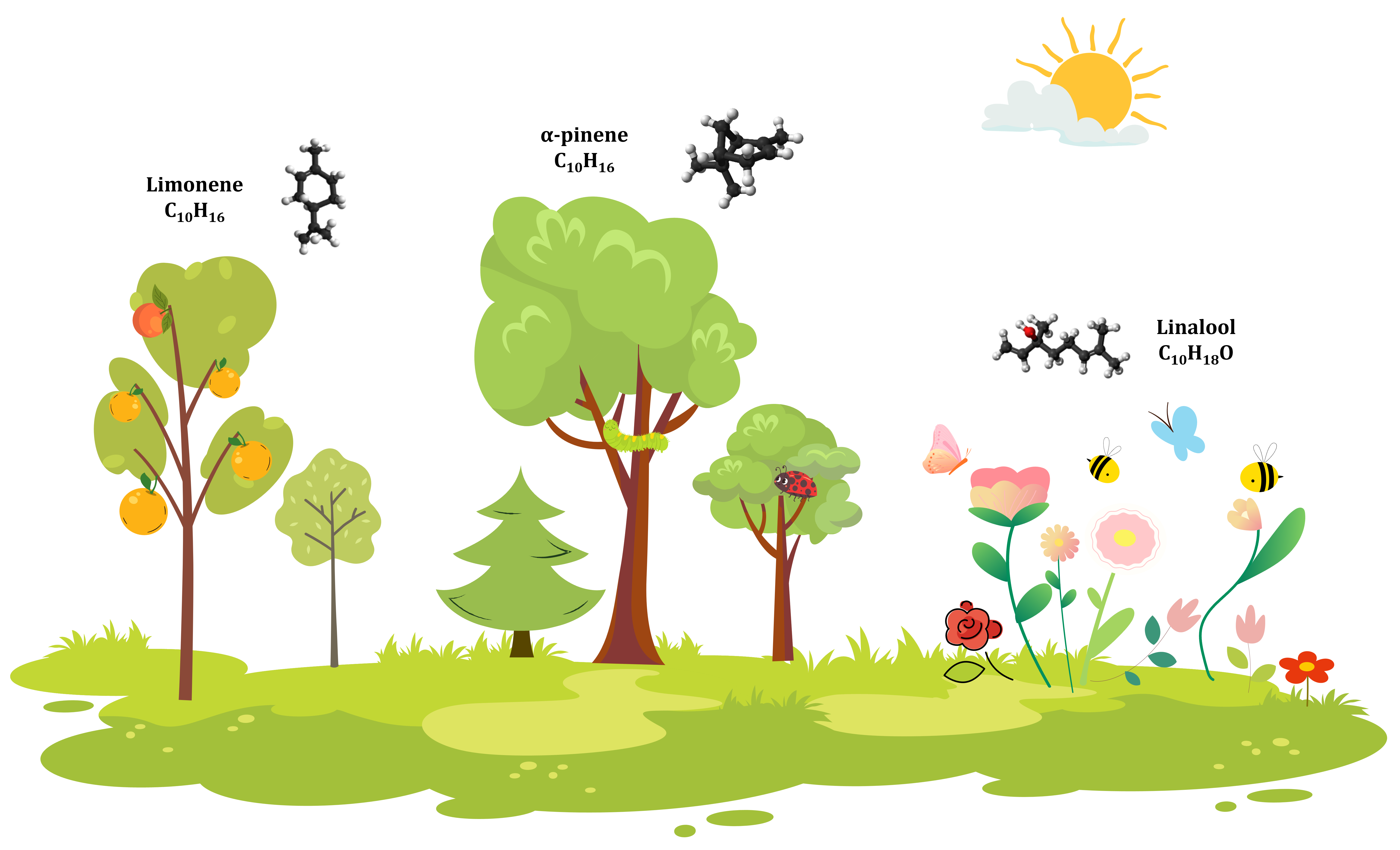
Graphical Abstract
References
- 1.Rasmussen, R.A. Isoprene: Identified as a forest-type emission to the atmosphere. Environ. Sci. Technol. 1970, 4, 667–670.
- 2.Guenther, A.B.; Jiang, X.; Heald, C.L.; et al. The Model of Emissions of Gases and Aerosols from Nature version 2.1 (MEGAN2.1): An extended and updated framework for modeling biogenic emissions. Geosci. Model Dev. 2012, 5, 1471–1492.
- 3.Peñuelas, J.; Llusià, J. BVOCs: Plant defense against climate warming? Trends Plant Sci. 2003, 8, 105–109.
- 4.Guenther, A.; Karl, T.; Harley, P.; et al. Estimates of global terrestrial isoprene emissions using MEGAN (Model of Emissions of Gases and Aerosols from Nature). Atmos. Chem. Phys. 2006, 6, 3181–3210.
- 5.Jardine, K.J.; Zorzanelli, R.F.; Gimenez, B.O.; et al. Leaf isoprene and monoterpene emission distribution across hyperdominant tree genera in the Amazon basin. Phytochemistry 2020, 175, 112366.
- 6.Loreto, F.; Schnitzler, J.P. Abiotic stresses and induced BVOCs. Trends Plant Sci. 2010, 15, 154–166.
- 7.Kutty, N.N.; Mishra, M. Dynamic distress calls: Volatile info chemicals induce and regulate defense responses during herbivory. Front. Plant Sci. 2023, 14, 1135000.
- 8.Heil, M.; Karban, R. Explaining evolution of plant communication by airborne signals. Trends Ecol. Evol. 2010, 25, 137–144.
- 9.Kegge, W.; Pierik, R. Biogenic volatile organic compounds and plant competition. Trends Plant Sci., 2010, 15, 126–132.
- 10.Guenther A.B.; Hewitt C.N.; Erickson D.; et al. A global model of natural volatile organic compound emissions. J. Geophys. Res. 1995, 100, 8873.
- 11.Hodzic, A.; Kasibhatla, P.S.; Jo, D.S.; et al. Rethinking the global secondary organic aerosol (SOA) budget: Stronger production, faster removal, shorter lifetime. Atmos. Chem. Phys. 2016, 16, 7917–7941.
- 12.Sporre, M.K.; Blichner, S.M.; Schrödner, R.; et al. Large difference in aerosol radiative effects from BVOC-SOA treatment in three Earth system models. Atmos. Chem. Phys. 2020, 20, 8953–8973.
- 13.Chen, W.W.; Guenther, A.B.; Jia, S.G.; et al. Synergistic effects of biogenic volatile organic compounds and soil nitric oxide emissions on summertime ozone formation in China. Sci. Total Environ. 2022, 828, 154218.
- 14.Tsigaridis, K; Kanakidou, M. Global modelling of secondary organic aerosol in the troposphere: A sensitivity analysis. Atmos. Chem. Phys. 2003, 3, 1849–1869.
- 15.He, C.; Liu, J.; Zhou, Y.; et al. Synergistic PM2.5 and O3 control to address the emerging global PM2.5-O3 compound pollution challenges. Eco. Environ. Health 2024, 3, 325–337.
- 16.Fitzky, A.C.; Sandén, H.; Karl, T.; et al. The interplay between ozone and urban vegetation—BVOC emissions, ozone deposition, and tree ecophysiology. Front. For. Global Chang. 2019, 2, 50.
- 17.Calfapietra, C.; Fares, S.; Manes, F.; et al. Role of Biogenic Volatile Organic Compounds (BVOC) emitted by urban trees on ozone concentration in cities: A review. Environ. Pollut. 2013, 183, 71–80.
- 18.Shrivastava, M.; Andreae, M.O.; Artaxo, P. Urban pollution greatly enhances formation of natural aerosols over the Amazon rainforest. Nat. Commun. 2019, 10, 1046.
- 19.Arneth, A.; Harrison, S.P.; Zaehle, S.; et al. Terrestrial biogeochemical feedbacks in the climate system. Nat. Geosci. 2010, 3, 525–532.
- 20.Weber, J.; Archer-Nicholls, S.; Abraham, N.L; et al. Chemistry-driven changes strongly influence climate forcing from vegetation emissions. Nat. Commun. 2022, 13, 7202.
- 21.Rap, A., Scott, C. E., Reddington, C. L.; et al. Enhanced global primary production by biogenic aerosol via diffuse radiation fertilization. Nat. Geosci. 2018, 11, 640–644.
- 22.Jones, R.; Bolas, C.G.; Staniaszek, Z.; et al. Modelling the effect of the 2018 summer heatwave and drought on isoprene emissions in a UK woodland. Global Chang. Biol. 2020, 26, 2320–2335.
- 23.Peñuelas, J.; Staudt, M. BVOCs and global change. Trends Plant Sci. 2010, 15, 133–144.
- 24.Mooney, H.; Arnold, S.; Silver, B.; et al. Future forests: Estimating biogenic emissions from net-zero aligned afforestation pathways in the UK. Biogeosciences 2025, 22, 5309–5328.

How to Cite
Chen, W.; Zhou, L.; Dong, P.; Wang, X.; Shao, M. The Science behind the Scent: The Role of Biogenic Volatile Organic Compounds in the Atmosphere. Global Environmental Science 2025, 1 (2), 128–133. https://doi.org/10.53941/ges.2025.100011.
RIS
BibTex
Copyright & License

Copyright (c) 2025 by the authors.
This work is licensed under a Creative Commons Attribution 4.0 International License.
Article Metrics
292
Article Views
0
Citations
Contents
References
