
- First application of wastewater surveillance to estimate alcohol consumption in Japan
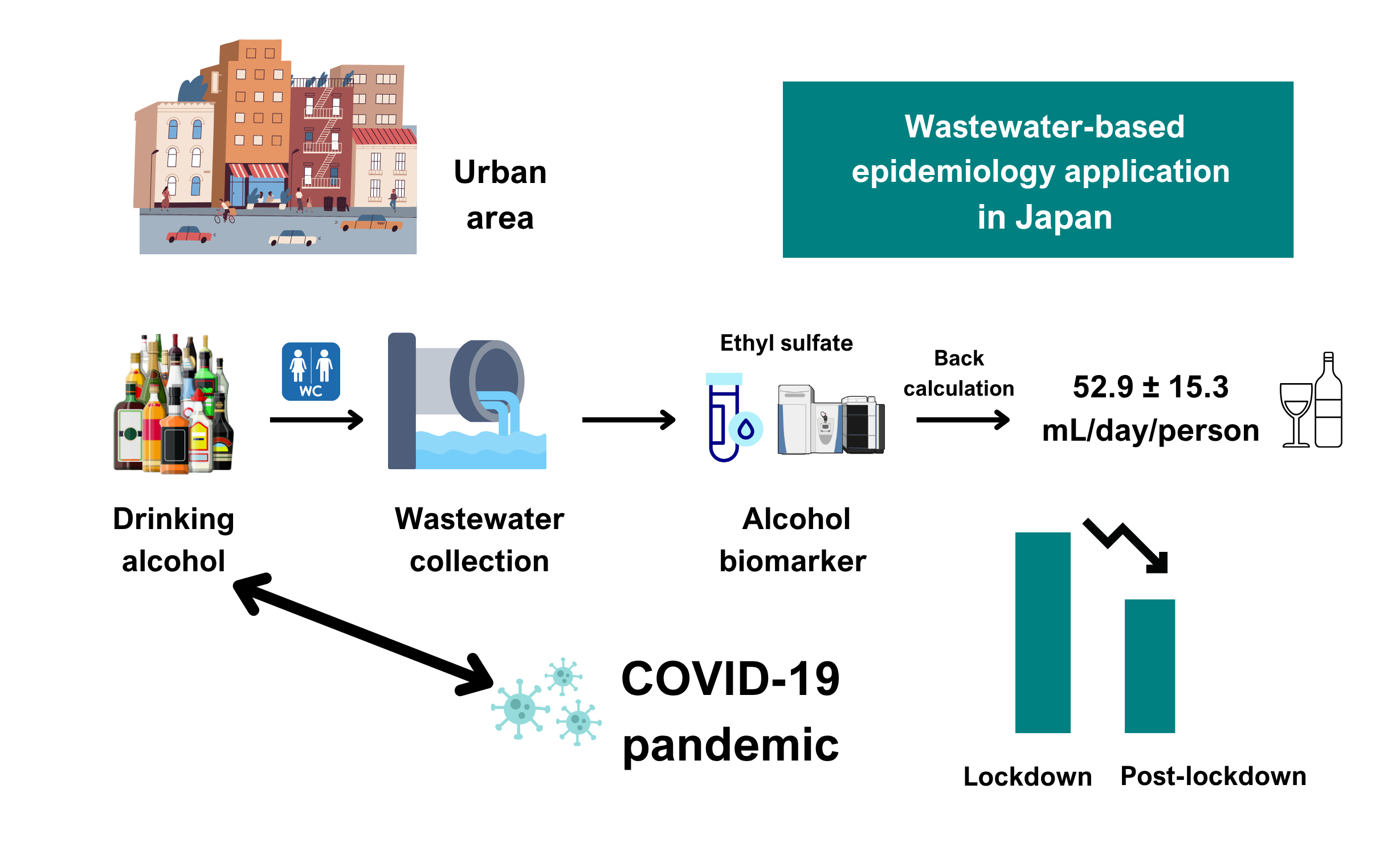
- The average alcohol consumption was 52.9 ± 15.3 mL/day/person
- The level of alcohol consumption was lower after the COVID-19 lockdown period
- Higher alcohol use during lockdown is likely due to increased drinking at home
- Open Access
- Article
Changes in Alcohol Consumption Behaviour in a Large Population of Japan during the COVID-19 Pandemic
Author Information
Received: 16 Sep 2025 | Revised: 07 Nov 2025 | Accepted: 18 Nov 2025 | Published: 25 Nov 2025
Highlights
Abstract
Alcohol consumption poses a significant public health risk but alcohol may also be used as an anti-anxiolytic by the public. Understanding the actual change in alcohol consumption behaviour is therefore important to formulate appropriate public health policies. This study, for the first time, employed wastewater-based epidemiology (WBE) to estimate alcohol consumption in a catchment of approximately 1.8 million inhabitants in the Kanto region, Japan. Twenty-four-hour composite wastewater samples were collected over four weeks from September to October 2021, during and after a COVID-19 lockdown period. Twenty-seven influent wastewater samples were analysed for ethyl sulfate (EtS), an alcohol biomarker, using the Liquid Chromatography-Tandem Mass Spectrometry (LC-MSMS) method and used to estimate alcohol consumption. EtS was detected in all samples, with concentrations ranging from 11.8 to 45.5 µg/L. The average estimated alcohol consumption in the study population was 52.9 ± 15.3 mL/day/person, which is higher than wastewater data from other countries. Alcohol consumption remained stable throughout the week. Additionally, consumption decreased after the lockdown (p < 0.001), and a strong positive correlation was observed between alcohol intake and daily reported COVID-19 cases (r = 0.735, p < 0.001), likely reflecting population mobility and behavioural responses to restrictions. Higher alcohol consumption during the lockdown was likely due to increased use in private settings rather than public spaces. This study provides the first objective evidence of alcohol consumption prevalence in Japan and warrants a broader wastewater monitoring program to inform policies reducing alcohol-related harm.
Graphical Abstract
Keywords
wastewater analysis | COVID-19 restrictions | stimulant | ethyl sulfate | LC-MS/MS
References
- 1.World Health Organization (WHO). Alcohol Japan 2019 Country Profile; World Health Organization (WHO): Geneva, Switzerland, 2019.
- 2.Yoshioka, T.; So, R.; Takayama, A.; et al. Strong chū-hai, a Japanese ready-to-drink high-alcohol-content beverage, and hazardous alcohol use: A nationwide cross-sectional study. Alcohol Clin. Exp. Res. 2023, 47, 285–295.
- 3.Iwase, M.; Matsuo, K.; Koyanagi, Y.N.Y.; et al. Alcohol consumption and breast cancer risk in Japan: A pooled analysis of eight population-based cohort studies. Int. J. Cancer 2021, 148, 2736–2747.
- 4.Takahashi, F.; Okada, H.; Hashimoto, Y.; et al. Association between alcohol consumption and incidence of type 2 diabetes in middle-aged Japanese from Panasonic cohort study 12. Sci. Rep. 2024, 14, 20315.
- 5.Suzuki, T.; Fukui, S.; Shinozaki, T.; et al. Lipid Profiles After Changes in Alcohol Consumption Among Adults Undergoing Annual Checkups. JAMA Netw. Open 2025, 8, e250583.
- 6.BBC News Japan Urges its Young People to Drink More to Boost Economy. Available online: https://www.bbc.com/news/world-asia-62585809 (accessed on 16 September 2025).
- 7.Ministry of Health, Labour and Welfare. The National Health and Nutrition Survey (NHNS) Japan; Ministry of Health, Labour and Welfare: Tokyo, Japan, 2019.
- 8.Zuccato, E.; Chiabrando, C.; Castiglioni, S.; et al. Cocaine in surface waters: A new evidence-based tool to monitor community drug abuse. Environ. Health 2005, 4, 14.
- 9.Anh, P.N.; Ngo, H.K.T.; Wang, Z.; et al. Six years of alcohol consumption in Hanoi, Vietnam, by wastewater analysis: Assessing changes impacted by socio-economical factors. Public Health 2025, 245, 105771.
- 10.Tscharke, B.; Livingston, M.; O’Brien, J.W.; et al. Seven-years of alcohol consumption in Australia by wastewater analysis: Exploring patterns by remoteness and socioeconomic factors. Drug Alcohol Depend. 2024, 259, 111317.
- 11.Zheng, Q.; Chan, G.C.K.; Wang, Z.; et al. Assessing alcohol consumption in a Chinese urban population and a university town using high temporal resolution wastewater-based epidemiology. Drug Alcohol Depend. 2022, 230, 109178.
- 12.Azuma, T.; Otomo, K.; Kunitou, M.; et al. Environmental fate of pharmaceutical compounds and antimicrobial-resistant bacteria in hospital effluents, and contributions to pollutant loads in the surface waters in Japan. Sci. Total Environ. 2019, 657, 476–484.
- 13.Kadokami, K.; Miyawaki, T.; Iwabuchi, K.; et al. Inflow and outflow loads of 484 daily-use chemicals in wastewater treatment plants across Japan. Environ. Monit. Contam. Res. 2021, 1, 1–16.
- 14.Rousis, N.; Bade, R.; Gracia-Lor, E. Wastewater-based epidemiology as a surveillance tool to assess human consumption of psychotropic substances: Alcohol, nicotine and caffeine as case studies. TrAC Trends Anal. Chem. 2023, 167, 117230.
- 15.Gao, J.; Li, J.; Jiang, G.; et al. Stability of alcohol and tobacco consumption biomarkers in a real rising main sewer. Water Res. 2018, 138, 19–26.
- 16.Reid, M.J.; Langford, K.H.; Mørland, J.; et al. Analysis and interpretation of specific ethanol metabolites, ethyl sulfate, and ethyl glucuronide in sewage effluent for the quantitative measurement of regional alcohol consumption. Alcohol. Clin. Exp. Res. 2011, 35, 1593–1599.
- 17.Thai, P.K.; Tscharke, B.J.; O’Brien, J.W.; et al. Estimating Alcohol Consumption by Wastewater-Based Epidemiology: An Assessment of the Correction Factor for Ethyl Sulfate Using Large-Scale National Monitoring Data. Environ. Sci. Technol. Lett. 2021, 8, 333–338.
- 18.Ministry of Health, Labour and Welfare. Open Data on COVID-19. Available online: https://www.mhlw.go.jp/stf/covid-19/open-data.html (accessed on 8 September 2025).
- 19.Bui, T.X.; Ngo, H.K.T.; Vu, G.T.; et al. Assessing the impact of stricter drink driving policy on alcohol consumption in a population of Hanoi, Vietnam using wastewater analysis. Drug Alcohol Rev. 2025, 44, 70–79.
- 20.Wilson, M.K.; Phung, K.; Chappell, A.; et al. Wastewater-based Epidemiology to Investigate Spatio-Temporal Trends in Alcohol Consumption in Aotearoa, New Zealand. Chem. Asian J. 2024, 19, e202301120.
- 21.Zheng, Q.; Tscharke, B.J.; Krapp, C.; et al. New approach for the measurement of long-term alcohol consumption trends: Application of wastewater-based epidemiology in an Australian regional city. Drug Alcohol Depend. 2020, 207, 107795.
- 22.López-García, E.; Pérez-López, C.; Postigo, C.; et al. Assessing alcohol consumption through wastewater-based epidemiology: Spain as a case study. Drug Alcohol Depend. 2020, 215, 108241.
- 23.Room, R.; Mäkelä, P.; Benegal, V.; et al. Times to drink: Cross-cultural variations in drinking in the rhythm of the week. Int. J. Public Health 2012, 57, 107–117.
- 24.Kinjo, A.; Kuwabara, Y.; Minobe, R.; et al. Different socioeconomic backgrounds between hazardous drinking and heavy episodic drinking: Prevalence by sociodemographic factors in a Japanese general sample. Drug Alcohol Depend. 2018, 193, 55–62.
- 25.Høiseth, G.; Morini, L.; Polettini, A.; et al. Blood kinetics of ethyl glucuronide and ethyl sulphate in heavy drinkers during alcohol detoxification. Forensic Sci. Int. 2009, 188, 52–56.
- 26.Høiseth, G.; Bernard, J.P.; Stephanson, N.; et al. Comparison between the urinary alcohol markers EtG, EtS, and GTOL/5-HIAA in a controlled drinking experiment. Alcohol Alcohol. 2008, 43, 187–191.
- 27.Hughes, K.; Quigg, Z.; Bellis, M.A.; et al. Drinking behaviours and blood alcohol concentration in four European drinking environments: A cross-sectional study. BMC Public Health 2011, 11, 918.
- 28.Asicioglu, F.; Kuloglu Genc, M.; Tekin Bulbul, T.; et al. Investigation of temporal illicit drugs, alcohol and tobacco trends in Istanbul city: Wastewater analysis of 14 treatment plants. Water Res. 2021, 190, 116729.
- 29.Guindon, G.E.; Li, C.; Trivedi, R.; et al. The effectiveness and cost-effectiveness of population-level policies to reduce alcohol use: A systematic umbrella review. Can. J. Public Health 2025. https://doi.org/10.17269/s41997-025-01013-9.
- 30.Okui, T. An analysis of predictors for heavy alcohol drinking using nationally representative survey data in Japan. BMC Public Health 2021, 21, 359.
- 31.World Health Organization (WHO). Global Status Report on Alcohol and Health 2018; World Health Organization (WHO): Geneva, Switzerland, 2018.
- 32.Kato, M.; Ishikawa, H.; Kiuchi, T.; et al. Patterns of alcohol and alcohol-flavoured non-alcoholic beverage advertisements over Japanese free-to-air television networks. BMC Public Health 2022, 22, 1864.
- 33.Reinstadler, V.; Ausweger, V.; Grabher, A.L.; et al. Monitoring drug consumption in Innsbruck during coronavirus disease 2019 (COVID-19) lockdown by wastewater analysis. Sci. Total Environ. 2021, 757, 144006.
- 34.Estévez-Danta, A.; Bijlsma, L.; Capela, R.; et al. Use of illicit drugs, alcohol and tobacco in Spain and Portugal during the COVID-19 crisis in 2020 as measured by wastewater-based epidemiology. Sci. Total Environ. 2022, 836, 155697.
- 35.Chen, J.; Venkatesan, A.K.; Halden, R.U. Alcohol and nicotine consumption trends in three U.S. communities determined by wastewater-based epidemiology. Sci. Total Environ. 2019, 656, 174–183.
- 36.Japan, N.T.A. Alcohol Guidebook; Japan, N.T.A.: Tokyo, Japan, 2024.
- 37.Bramson, A.; Hori, M.; Zha, B.; et al. Social and economic flows across multimodal transportation networks in the Greater Tokyo Area. Appl. Netw. Sci. 2020, 5, 7.
- 38.Schouten, A.; Kawano, Y. COVID-19 and the demand for transit access: Residential real estate prices in the Tokyo metropolitan area. J. Transp. Geogr. 2024, 114, 103742.
- 39.O’Brien, J.W.; Thai, P.K.; Eaglesham, G.; et al. A model to estimate the population contributing to the wastewater using samples collected on census day. Environ. Sci. Technol. 2014, 48, 517–525.
- 40.Hardie, I.; Stevely, A.K.; Sasso, A.; et al. The impact of changes in COVID-19 lockdown restrictions on alcohol consumption and drinking occasion characteristics in Scotland and England in 2020: An interrupted time-series analysis. Addiction 2022, 117, 1622–1639.
- 41.Stickley, A.; Shirama, A.; Inagawa, T.; et al. Binge drinking in Japan during the COVID-19 pandemic: Prevalence, correlates and association with preventive behaviors. Drug Alcohol Depend. 2022, 234, 109415.
- 42.Sugaya, N.; Yamamoto, T.; Suzuki, N.; et al. Change in Alcohol Use during the Prolonged COVID-19 Pandemic and Its Psychosocial Factors: A One-Year Longitudinal Study in Japan. Int. J. Environ. Res. Public Health 2023, 20, 3871.
- 43.Kishimoto, M.; Masuko, K.; Yamamoto, S.; et al. Changes in lifestyle-related behaviour during the COVID-19 pandemic in Japan: A questionnaire survey for examinees who underwent an annual health check-up. J. Int. Med. Res. 2023, 51, 03000605231184036.
- 44.Shibata, T.; Yamaoka, Y.; Nawa, N.; et al. Association of lifestyle and flourishing during the COVID-19 pandemic in Japan. Front. Psychol. 2024, 15, 1341711.
- 45.Capasso, A.; Jones, A.M.; Ali, S.H.; et al. Increased alcohol use during the COVID-19 pandemic: The effect of mental health and age in a cross-sectional sample of social media users in the U.S. Prev. Med. 2021, 145, 106422.
- 46.Sonoda, K.; Okawa, S.; Tabuchi, T. Association of remote work with tobacco and alcohol use: A cross-sectional study in Japan. BMC Public Health 2025, 25, 103.
How to Cite
Ngo, H. K. T.; Do, Q. T. T.; Zheng, Q.; Masahiro, O.; Thai, P. K. Changes in Alcohol Consumption Behaviour in a Large Population of Japan during the COVID-19 Pandemic. Global Environmental Science 2025, 1 (2), 180–187. https://doi.org/10.53941/ges.2025.100015.
RIS
BibTex
Copyright & License

Copyright (c) 2025 by the authors.
This work is licensed under a Creative Commons Attribution 4.0 International License.
Article Metrics
755
Article Views
0
Citations
Contents
References
