
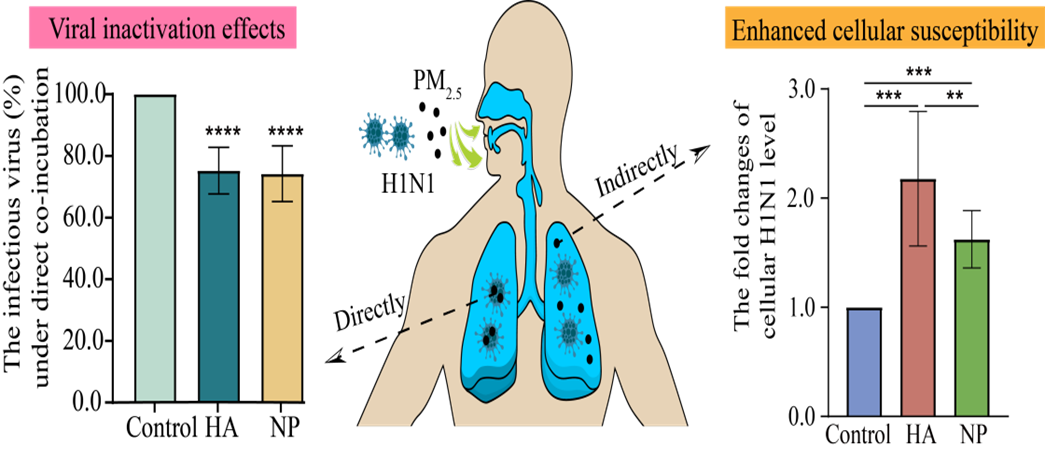
- WSM increased cellular susceptibility to H1N1 influenza virus by 1.5- to 3.5-fold
- H1N1 infection was mainly inversely correlated with key antiviral mediator MxA
- WSM directly reduced H1N1 virion and yet potentiated cellular infection
- As, Cd, Na+ had dual effects, rising infection level and reducing virion infectivity
- Open Access
- Article
Dual Role of PM2.5 Water-Soluble Constituents in Respiratory Viral Infection: Enhanced Cellular Susceptibility and Reduced Virion Infectivity
- Shuyi Peng 1,2,
- Baichuan Gou 1,2,
- Yaohao Hu 1,2,
- Juying Lin 2,
- Wei Sun 1,
- Guohua Zhang 1,3,
- Wei Song 1,3,
- Bin Jiang 1,3,
- Chenglei Pei 4,
- Jinpu Zhang 4,
- Jianwei Dai 5,
- Xinming Wang 1,3,
- Ping’an Peng 1,3,
- Xinhui Bi 1,3,*
Author Information
Received: 10 Nov 2025 | Revised: 04 Dec 2025 | Accepted: 16 Dec 2025 | Published: 23 Dec 2025
Highlights
Abstract
Fine particulate matter (PM2.5), recognized as a critical risk factor for respiratory viral infection, frequently co-exists with respiratory viruses and elicits diverse toxic effects within host microenvironment. However, the specific PM2.5 constituents that affect viral infection and the respective roles of host-mediated processes versus direct virion interactions have not been fully elucidated. This study investigated the impacts of water-soluble matters (WSM) from PM2.5 collected in Guangzhou on human influenza A virus (H1N1) infection, focusing on its dual role in modulating bronchial epithelial cells (BEAS-2B) susceptibility and altering viral activity. The results demonstrated that WSM exposure potentiated cellular H1N1 infection level by 1.5- to 3.5-fold, accompanied by 30–40% defense-related signaling (e.g., MxA) reduction. It also perturbed the inflammatory response, including increased IL-6 and IL-8 (20–40%) and 50% reduction in TNF-α. Spearman analysis showed viral infectivity was associated with MxA, IL-6, and TNF-α levels, among which only MxA displayed a dose-dependent inhibitory trend. These results suggested that WSM primarily enhanced infection by suppressing antiviral defenses. Interestingly, WSM also exhibited direct viricidal effect by reducing 25% infectious H1N1 virions after short-term co-incubation and thereby partially modulated the overall viral infectivity in BEAS-2B cells. Further analysis implicated heterogeneous constituents in viral infection outcomes, with heavy metals (e.g., As, Cd) and Na+ exerting dual effects, both enhancing cellular viral infection and directly reducing virion infectivity. These findings establish a link between prevalence of respiratory viral infection and PM2.5 chemical constituents, highlighting the need for public health-guided mitigation strategies.
Graphical Abstract
Keywords
fine particulate matter | water-soluble matter | influenza virus | viral susceptibility | virucidal activity | antiviral defense | health risk | PM2.5 exposure
References
- 1.
Urmi, U.L.; Vijay, A.K.; Willcox, M.D.P.; et al. Exploring the Efficacy of Peptides and Mimics against Influenza A Virus, Adenovirus, and Murine Norovirus. Int. J. Mol. Sci. 2024, 25, 7030.
- 2.
Demchenko, V.; Kobylinskyi, S.; Iurzhenko, M.; et al. Nanocomposites Based on Polylactide and Silver Nanoparticles and Their Antimicrobial and Antiviral Applications. React. Funct. Polym. 2022, 170, 105096.
- 3.
Hu, Y.; Peng, S.; Su, B.; et al. Laboratory Studies on the Infectivity of Human Respiratory Viruses: Experimental Conditions, Detections, and Resistance to the Atmospheric Environment. Fundam. Res. 2024, 4, 471–483.
- 4.
Liang, J.; Luz, S.; Li, Y.; et al. Associations between Environmental Conditions and Infection with Respiratory Syncytial Virus in Japan: A Spatiotemporal Analysis. Open Forum Infect. Dis. 2025, 12, 392.
- 5.
Shi, S.T.; Lin, H.W.; Jiang, L.M.; et al. Development of a Respiratory Virus Risk Model with Environmental Data Based on Interpretable Machine Learning Methods. NPJ Clim. Atmos. Sci. 2025, 8, 1918–1929.
- 6.
Yu, X.; Wang, H.; Ma, S.; et al. Estimating the Global and Regional Burden of Lower Respiratory Infections Attributable to Leading Pathogens and the Protective Effectiveness of Immunization Programs. Int. J. Infect. Dis. 2024, 149, 107268.
- 7.
Ma, P.; Zhou, N.; Wang, X.; et al. Stronger Susceptibilities to Air Pollutants of Influenza A than B were Identified in Subtropical Shenzhen, China. Environ. Res. 2023, 219, 115100.
- 8.
Li, Z.; Zhou, L.; Zhang, Q.; et al. Different Effects of Air Pollutant Concentrations on Influenza A and B in Sichuan, China. Ecotoxicol. Environ. Saf. 2024, 284, 116923.
- 9.
Almeida, A.S.; Neves, B.M.; Duarte, R. Contribution of Water-Soluble Extracts to the Oxidative and Inflammatory Effects of Atmospheric Aerosols: A Critical Review. Environ. Pollut. 2024, 342, 123121.
- 10.
Chowdhury, P.H.; Okano, H.; Honda, A.; et al. Aqueous and Organic Extract of PM2.5 Collected in Different Seasons and Cities of Japan Differently Affect Respiratory and Immune Systems. Environ. Pollut. 2018, 235, 223–234.
- 11.
Bandoro, C.; Runstadler, J.A. Bacterial Lipopolysaccharide Destabilizes Influenza Viruses. mSphere 2017, 2, e00267-17.
- 12.
Sun, S.; Xu, Y.; Qiu, M.; et al. Manganese Mediates Its Antiviral Functions in a cGAS-STING Pathway Independent Manner. Viruses 2023, 15, 646.
- 13.
Dong, Z.; Ma, J.; Qiu, J.; et al. Airborne Fine Particles Drive H1N1 Viruses Deep into the Lower Respiratory Tract and Distant Organs. Sci. Adv. 2023, 9, eadf2165.
- 14.
Chive, C.; Martiotan-Faivre, L.; Eon-Bertho, A.; et al. Exposure to PM2.5 Modulate the Pro-Inflammatory and Interferon Responses against Influenza Virus Infection in a Human 3D Bronchial Epithelium Model. Environ. Pollut. 2024, 348, 123781.
- 15.
Stapleton, E.M.; Welch, J.L.; Ubeda, E.A.; et al. Urban Particulate Matter Impairment of Airway Surface Liquid–Mediated Coronavirus Inactivation. J. Infect. Dis. 2022, 225, 214–218.
- 16.
Huang, R.J.; Zhang, Y.; Bozzetti, C.; et al. High Secondary Aerosol Contribution to Particulate Pollution during Haze Events in China. Nature 2014, 514, 218–222.
- 17.
Wu, C.; Yang, J.; Fu, Q.; et al. Molecular Characterization of Water-Soluble Organic Compounds in PM2.5 Using Ultrahigh Resolution Mass Spectrometry. Sci. Total Environ. 2019, 668, 917–924.
- 18.
Wang, S.Y.; Zhang, X.; Lin, K.S.; et al. Impact of Secondary Organic Aerosol on the Respiratory Viral Infection. Environ. Sci. Technol. Lett. 2024, 11, 566–572.
- 19.
Lin, J.; Sun, W.; Peng, S.; et al. Molecular Characteristics of Organic Matters in PM2.5 Associated with Upregulation of Respiratory Virus Infection in Vitro. J. Hazard. Mater. 2025, 482, 136583.
- 20.
Peng, S.; Lin, J.; Sun, W.; et al. An Overlooked Health Risk of PM2.5: Elevated Respiratory Viral Susceptibility Revealed by Assessing Inflammatory and Antiviral Responses to Chemical Constituents. Atmos. Environ. 2025, 361, 121519.
- 21.
Rius-Rocabert, S.; Arranz-Herrero, J.; Fernandez-Valdes, A.; et al. Broad Virus Inactivation Using Inorganic Micro/Nano-Particulate Materials. Mater. Today Bio 2022, 13, 100191.
- 22.
Kamila, P.S.; Sano, D.; Oishi, W. The Role of Ammonia in Virus Inactivation: A Systematic and Meta-Analysis Review. Water Res. 2025, 287, 124493.
- 23.
Li, T.; Wang, Z.; Wang, Y.; et al. Chemical Characteristics of Cloud Water and the Impacts on Aerosol Properties at a Subtropical Mountain Site in Hong Kong SAR. Atmos. Chem. Phys. 2020, 20, 391–407.
- 24.
Cheng, J.Y.W.; Hui, E.L.C.; Lau, A.P.S. Bioactive and Total Endotoxins in Atmospheric Aerosols in the Pearl River Delta region, China. Atmos. Environ. 2012, 47, 3–11.
- 25.
Martin, B.E.; Harris, J.D.; Sun, J.; et al. Cellular Co-Infection can Modulate the Efficiency of Influenza A Virus Production and Shape the Interferon Response. PLoS Pathog. 2020, 16, e1008974.
- 26.
Mishra, R.; Krishnamoorthy, P.; Gangamma, S.; et al. Particulate Matter (PM10) Enhances RNA Virus Infection through Modulation of Innate Immune Responses. Environ. Pollut. 2020, 266, 115148.
- 27.
Marin, D.; Tabares-Guevara, J.H.; Zapata-Cardona, M.I.; et al. PM10 Promotes an Inflammatory Cytokine Response that may Impact SARS-CoV-2 Replication in Vitro. Front. Immunol. 2023, 14, 1161135.
- 28.
Brocke, S.A.; Billings, G.T.; Taft-Benz, S.; et al. Woodsmoke Particle Exposure Prior to SARS-CoV-2 Infection Alters Antiviral Response Gene Expression in Human Nasal Epithelial Cells in a Sex-Dependent Manner. Am. J. Physiol. Lung Cell. Mol. Physiol. 2022, 322, L479–L494.
- 29.
Wu, N.C.; Wilson, I.A. Influenza Hemagglutinin Structures and Antibody Recognition. Cold Spring Harb. Perspect. Med. 2020, 10, a038778.
- 30.
Wang, Y.; Zhang, R.; Yang, F.; et al. Potential Mechanisms Mediating PM2.5-Induced Alterations of H3N2 Influenza Virus Infection and Cytokine Production in Human Bronchial Epithelial Cells. Ecotoxicol. Environ. Saf. 2023, 259, 115069.
- 31.
Yang, W.; Chen, H.; Wu, J.; et al. Characteristics of the Source Apportionment of Primary and Secondary Inorganic PM2.5 in the Pearl River Delta Region during 2015 by Numerical Modeling. Environ. Pollut. 2020, 267, 115418.
- 32.
Yu, Y.; Cao, J. Chemical Fingerprints and Source Profiles of PM10 and PM2.5 from Agricultural Soil in a Typical Polluted Region of Northwest China. Aerosol Air Qual. Res. 2023, 23, 220419.
- 33.
Xing, C.; Zeng, Y.; Yang, X.; et al. Molecular Characterization of Major Oxidative Potential Active Species in Ambient PM2.5: Emissions from Biomass Burning and Ship Exhaust. Environ. Pollut. 2024, 363, 125291.
- 34.
Li, S.; Ju, X.; Liu, Q.; et al. Ambient Atmospheric PM Worsens Mouse Lung Injury Induced by Influenza A Virus through Lysosomal Dysfunction. Respir. Res. 2023, 24, 306.
- 35.
An, W.; Lakhina, S.; Leong, J.; et al. Host Innate Antiviral Response to Influenza A Virus Infection: From Viral Sensing to Antagonism and Escape. Pathogens 2024, 13, 561.
- 36.
Savan, R.; Gale, M., Jr. Innate Immunity and Interferon in SARS-CoV-2 Infection Outcome. Immunity 2023, 56, 1443–1450.
- 37.
Dienz, O.; Rud, J.G.; Eaton, S.M.; et al. Essential role of IL-6 in Protection against H1N1 Influenza Virus by Promoting Neutrophil Survival in the Lung. Mucosal Immunol. 2012, 5, 258–266.
- 38.
Velazquez-Salinas, L.; Verdugo-Rodriguez, A.; Rodriguez, L.L.; et al. The Role of Interleukin 6 During Viral Infections. Front. Microbiol. 2019, 10, 1057.
- 39.
Ma, H.; Li, J.; Wan, C.; et al. Inflammation Response of Water-Soluble Fractions in Atmospheric Fine Particulates: A Seasonal Observation in 10 Large Chinese Cities. Environ. Sci. Technol. 2019, 53, 3782–3790.
- 40.
Matzinger, S.R.; Carroll, T.D.; Dutra, J.C.; et al. Myxovirus Resistance Gene A (MxA) Expression Suppresses Influenza a Virus Replication in Alpha Interferon-Treated Primate Cells. J. Virol. 2013, 87, 1150–1158.
- 41.
Amouzougan, E.A.; Lira, R., Jr.; Klimecki, W.T. Chronic Exposure to Arsenite Enhances Influenza Virus Infection in Cultured Cells. J. Appl. Toxicol. 2020, 40, 458–469.
- 42.
Hsiao, T.C.; Cheng, P.C.; Chi, K.H.; et al. Interactions of Chemical Components in Ambient PM2.5 with Influenza Viruses. J. Hazard. Mater. 2022, 423, 127243.
- 43.
de la Fuente, J.; Armas, O.; Barroso-Arévalo, S.; et al. Good and Bad Get Together: Inactivation of SARS-CoV-2 in Particulate Matter Pollution from Different Fuels. Sci. Total Environ. 2022, 844, 157241.
- 44.
Socol, D.C. Clinical Review of Humic Acid as an Antiviral: Leadup to Translational Applications in Clinical Humeomics. Front. Pharmacol. 2022, 13, 1018904.
- 45.
Alavi, M.; Kamarasu, P.; McClements, D.J.; et al. Metal and Metal Oxide-Based Antiviral Nanoparticles: Properties, Mechanisms of Action, and Applications. Adv. Colloid Interface Sci. 2022, 306, 102726.
- 46.
Xu, S.; Wang, D.; Zhao, W.; et al. Non-Negligible Role of Trace Elements in Influenza Virus Infection. Metabolites 2023, 13, 184.
- 47.
Checconi, P.; Sgarbanti, R.; Celestino, I.; et al. The Environmental Pollutant Cadmium Promotes Influenza Virus Replication in MDCK Cells by Altering Their Redox State. Int. J. Mol. Sci. 2013, 14, 4148–4162.
- 48.
Rashid, M.U.; Coombs, K.M. Chloride Intracellular Channel Protein 1 (CLIC1) Is a Critical Host Cellular Factor for Influenza A Virus Replication. Viruses 2024, 16, 129.
- 49.
Hermann, A.C.; Kim, C.H. Effects of Arsenic on Zebrafish Innate Immune System. Mar. Biotechnol. 2005, 7, 494–505.
- 50.
Kolluru, V.; Tyagi, A.; Chandrasekaran, B.; et al. Profiling of Differentially Expressed Genes in Cadmium-Induced Prostate Carcinogenesis. Toxicol. Appl. Pharmacol. 2019, 375, 57–63.
- 51.
Croft, D.P.; Zhang, W.J.; Lin, S.; et al. Associations between Source-Specific Particulate Matter and Respiratory Infections in New York State Adults. Environ. Sci. Technol. 2020, 54, 975–984.
- 52.
Prokopciuk, N.; Taminskiene, V.; Vaideliene, L.; et al. The Incidence of Upper Respiratory Infections in Children is Related to the Concentration of Vanadium in Indoor Dust Aggregates. Front. Public Health 2024, 12, 1339755.
- 53.
Pemmada, R.; Zhu, X.; Dash, M.; et al. Science-Based Strategies of Antiviral Coatings with Viricidal Properties for the COVID-19 Like Pandemics. Materials 2020, 13, 4041.
- 54.
Schaub, A.; Luo, B.; David, S.C.; et al. Salt Supersaturation as an Accelerator of Influenza A Virus Inactivation in 1 μL Droplets. Environ. Sci. Technol. 2024, 58, 18856–18869.
- 55.
Skalny, A.V.; Lima, T.R.R.; Ke, T.; et al. Toxic Metal Exposure as a Possible Risk Factor for COVID-19 and Other Respiratory Infectious Diseases. Food Chem. Toxicol. 2020, 146, 111809.
- 56.
Bi, J.; Mo, C.; Li, S.; et al. Immunotoxicity of Metal and Metal Oxide Nanoparticles: From Toxic Mechanisms to Metabolism and Outcomes. Biomater. Sci. 2023, 11, 4151–4183.
- 57.
Xu, F.; Shi, X.; Qiu, X.; et al. Investigation of the Chemical Components of Ambient Fine Particulate Matter (PM2.5) Associated with in Vitro Cellular Responses to Oxidative Stress and Inflammation. Environ. Int. 2020, 136, 105475.
- 58.
Kuang, Y.; Shang, J.; Sheng, M.; et al. Molecular Composition of Beijing PM2.5 Brown Carbon Revealed by an Untargeted Approach Based on Gas Chromatography and Time-of-Flight Mass Spectrometry. Environ. Sci. Technol. 2023, 57, 909–919.
- 59.
Jiang, X.; Han, Y.; Qiu, X.; et al. Organic Components of Personal PM2.5 Exposure Associated with Inflammation: Evidence from an Untargeted Exposomic Approach. Environ. Sci. Technol. 2021, 55, 10589–10596.
- 60.
Jiang, X.; Han, Y.; Qiu, X.; et al. Metabolic Disorder Enhances Oxidative Stress after Exposure to Aromatic Components of Fine Particulate Matter. Environ. Sci. Technol. Lett. 2022, 9, 863–868.
- 61.
Li, R.; Yan, C.; Meng, Q.; et al. Key Toxic Components and Sources Affecting Oxidative Potential of Atmospheric Particulate Matter Using Interpretable Machine Learning: Insights from Fog Episodes. J. Hazard. Mater. 2023, 465, 133175.
- 62.
Song, C.; Becagli, S.; Beddows, D.C.S.; et al. Understanding Sources and Drivers of Size-Resolved Aerosol in the High Arctic Islands of Svalbard Using a Receptor Model Coupled with Machine Learning. Environ. Sci. Technol. 2022, 56, 11189–11198.
How to Cite
Peng, S.; Gou, B.; Hu, Y.; Lin, J.; Sun, W.; Zhang, G.; Song, W.; Jiang, B.; Pei, C.; Zhang, J.; Dai, J.; Wang, X.; Peng, P.; Bi, X. Dual Role of PM2.5 Water-Soluble Constituents in Respiratory Viral Infection: Enhanced Cellular Susceptibility and Reduced Virion Infectivity. Global Environmental Science 2026, 2 (1), 43–52. https://doi.org/10.53941/ges.2026.100004.
RIS
BibTex
Copyright & License

Copyright (c) 2025 by the authors.
This work is licensed under a Creative Commons Attribution 4.0 International License.
Article Metrics
395
Article Views
0
Citations
Contents
References

 Suite 4002 Level 4, 447 Collins Street, Melbourne, Victoria 3000, Australia
 General Inquiries: info@sciltp.com