
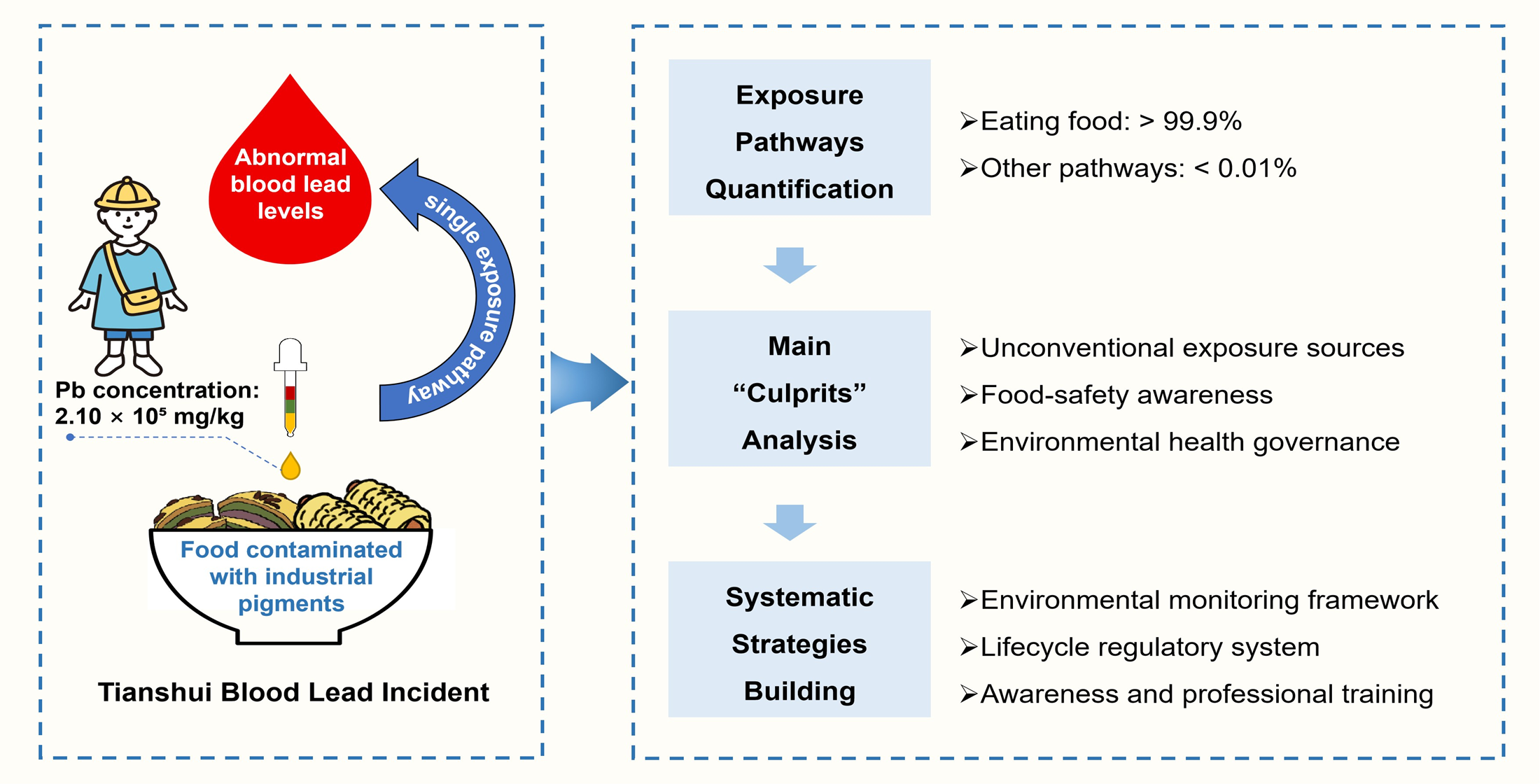
- Exposure pathway of this incident was contaminated food by industrial pigments
- “Culprits”: Unregulated pigments, food safety, environmental governance
- Strategies: targeted monitoring, traceability systems, targeted safety training
- Open Access
- Viewpoint
Who Are the “Culprits”: Environmental Health Alert from the Lead Poisoning Incident at a Kindergarten in Tianshui, Gansu, China
- Huiji Liu 1,2,
- Tong Qiu 1,
- Leicheng Zhao 1,2,
- Zhiguo Cao 1,2,*,
- Taicheng An 3,4,*
Author Information
Received: 18 Oct 2025 | Revised: 12 Dec 2025 | Accepted: 18 Dec 2025 | Published: 23 Dec 2025
Highlights
Abstract
The blood lead (Pb) poisoning incident at a kindergarten in Tianshui, Gansu, China in July 2025, underscores the persistent challenge of heavy metal exposure among vulnerable populations. Despite strengthened global controls on heavy metals such as Pb, environmental residues and diverse exposure pathways continue to pose health risks, particularly to children with developing nervous systems. The abnormal blood Pb levels in the affected kindergarten children were almost entirely (>99.9%) attributable to a single exposure pathway: consumption of food contaminated with industrial pigments. The severity of this incident was intensified by three main “culprits”: inadequate oversight of unconventional pollution sources, insufficient food safety awareness, and poorly coordinated environmental health governance. Effective prevention requires a comprehensive approach: enhanced monitoring of child-centric environments, interdisciplinary risk assessment, lifecycle regulation of heavy metal-containing products, and science-based public awareness campaigns. We propose a targeted monitoring framework for kindergartens in historically contaminated regions, including quarterly soil/dust Pb testing, semi-annual air quality assessments, and annual blood Pb screening of children, supported by a digital traceability system for industrial pigments. Protecting children from such hidden threats demands systematic and collaborative action across research, governance, and society.
Graphical Abstract
Keywords
heavy metals | children exposure | exposure pathway | lead poisoning incident | health risk
References
- 1.
de Burbure, C.; Buchet, J.P.; Leroyer, A.; et al. Renal and Neurologic Effects of Cadmium, Lead, Mercury, and Arsenic in Children: Evidence of Early Effects and Multiple Interactions at Environmental Exposure Levels. Environ. Health Perspect. 2005, 114, 584–590.
- 2.
Zhang, Y.; Li, G.; Gu, J.; et al. Advancing Health Risk Assessment: Integrating Exposure Routes and Bioavailability to Quantify Internal Dose. Glob. Environ. Sci. 2025, 1, 157–163.
- 3.
Lu, P.; He, R.J.; Wu, Y.J.; et al. Urinary Metabolic Alterations Associated with Occupational Exposure to Metals and Polycyclic Aromatic Hydrocarbons Based on Non-Target Metabolomics. J. Hazard. Mater. 2025, 487, 137158.
- 4.
Cao, Y.; Liu, M.; Zhang, W.; et al. Characterization and Childhood Exposure Assessment of Toxic Heavy Metals in Household Dust under True Living Conditions from 10 China Cities. Sci. Total Environ. 2024, 925, 171669.
- 5.
Ding, G.D.; Gao, Y.; Kan, H.D.; et al. Environmental Exposure and Child Health in China. Environ. Int. 2024, 187, 108722.
- 6.
Pipoyan, D.; Stepanyan, S.; Beglaryan, M.; et al. Health Risks of Heavy Metals in Food and Their Economic Burden in Armenia. Environ. Int. 2023, 172, 107794.
- 7.
Yun, P.; Han, X.; Liu, H.; et al. Soil and Dust Ingestion Rate: Concept, Methodology, Available Data and Knowledge Gaps. Glob. Environ. Sci. 2025, 1, 56–68.
- 8.
USEPA. Soil and Dust Ingestion. In Update for Chapter 5 of the Exposure Factors Handbook; U.S. Environmental Protection Agency: Washington, DC, USA, 2017.
- 9.
Guney, M.; Zagury, G.J. Heavy Metals in Toys and Low-Cost Jewelry: Critical Review of U.S. and Canadian Legislations and Recommendations for Testing. Environ. Sci. Technol. 2012, 46, 4265–4274.
- 10.
Franken, A.; Eloff, F.C.; Du Plessis, J.; et al. In Vitro Permeation of Metals through Human Skin: A Review and Recommendations. Chem. Res. Toxicol. 2015, 28, 2237–2249.
- 11.
Zhu, M.T.; Fitzgerald, E.F.; Gelberg, K.H.; et al. Maternal Low-Level Lead Exposure and Fetal Growth. Environmental Health Perspectives 2010, 118, 1471–1475.
- 12.
Zhang, H.X.; Mao, Z.X.; Huang, K.; et al. Multiple Exposure Pathways and Health Risk Assessment of Heavy Metal(loid)s for Children Living in Fourth-Tier Cities in Hubei Province. Environ. Int. 2019, 129, 517–524.
- 13.
Hou, D.; Jia, X.; Wang, L.; et al. Global Soil Pollution by Toxic Metals Threatens Agriculture and Human Health. Science 2025, 388, 316–321.
- 14.
Shen, M.; Ren, M.; Wang, Y.; et al. Identifying Dust as the Dominant Source of Exposure to Heavy Metals for Residents Around Battery Factories in the Battery Industrial Capital of China. Sci. Total Environ. 2021, 765, 144375.
How to Cite
Liu, H.; Qiu, T.; Zhao, L.; Cao, Z.; An, T. Who Are the “Culprits”: Environmental Health Alert from the Lead Poisoning Incident at a Kindergarten in Tianshui, Gansu, China. Global Environmental Science 2026, 2 (1), 38–42. https://doi.org/10.53941/ges.2026.100003.
RIS
BibTex
Copyright & License

Copyright (c) 2025 by the authors.
This work is licensed under a Creative Commons Attribution 4.0 International License.
Article Metrics
483
Article Views
1
Citations
Contents
References

 Suite 4002 Level 4, 447 Collins Street, Melbourne, Victoria 3000, Australia
 General Inquiries: info@sciltp.com