
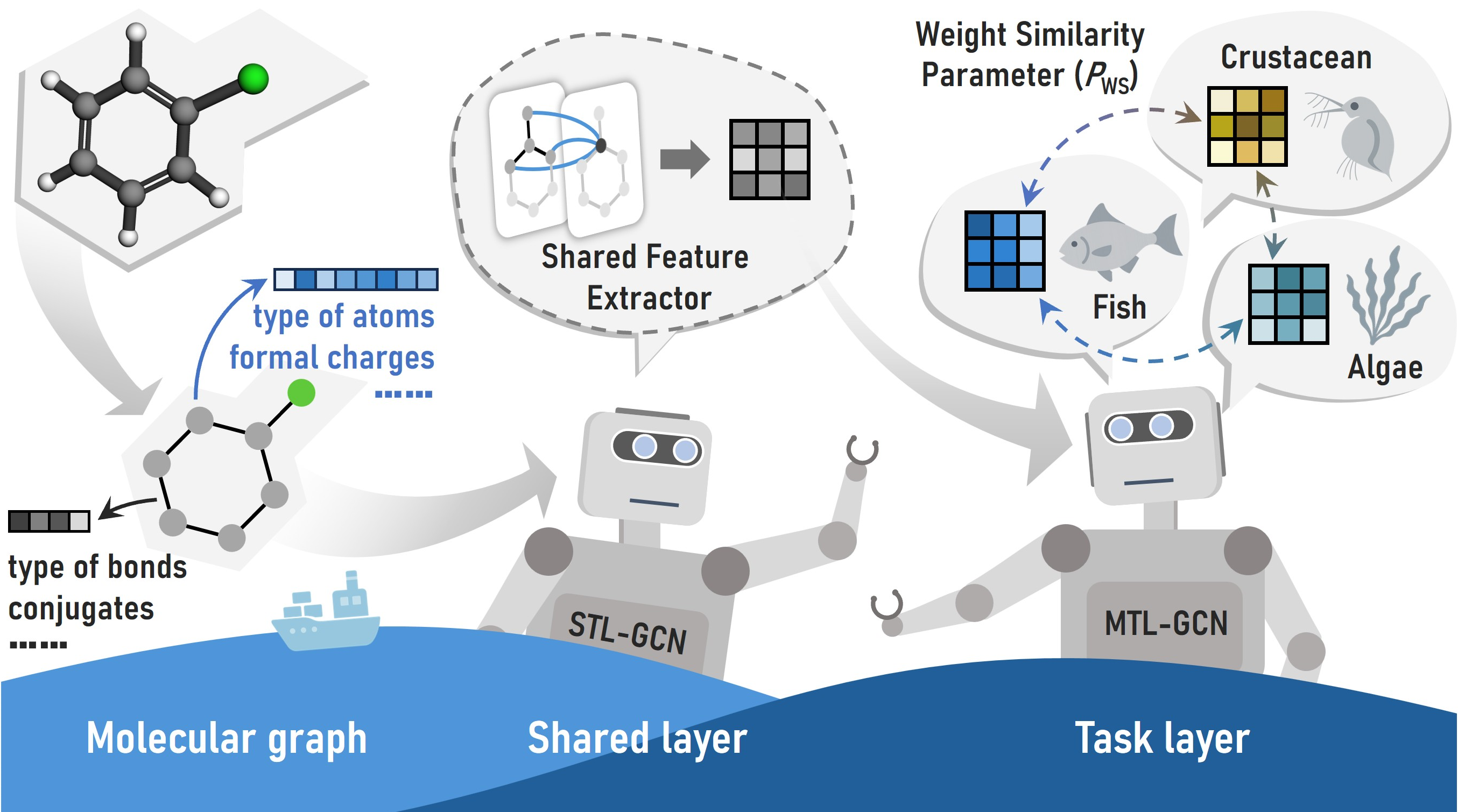
- Aquatic toxicity datasets covering six endpoints expanded chemical coverage by 66.0% on average.
- MTL-GCN achieved high prediction accuracy and broad applicability domains.
- MTL-GCN with ADSAL enabled reliable screening with 94.7% coverage.
- Open Access
- Article
Multi-Task Graph Convolutional Network Model with Improved Performance and Broad Applicability Domains for Identifying Aquatic Toxic Chemicals
Author Information
Received: 25 Feb 2026 | Revised: 13 Apr 2026 | Accepted: 23 Apr 2026 | Published: 22 Jul 2026
Highlights
Abstract
High-throughput computational models are essential for regulatory screening of large chemical inventories for aquatic toxicity, while their performance is frequently constrained by limited datasets, inadequate exploitation of inter-endpoint correlations, and lack of applicability domain (AD) characterization. This study curated a regulation-oriented aquatic toxicity dataset comprising 17,514 chemicals across six ecotoxicological endpoints. An end-to-end multi-task learning graph convolutional network (MTL-GCN) was constructed to enable joint modeling of multiple toxicity endpoints. Relative to single-task learning (STL-GCN), the MTL-GCN improved the area under the receiver operating characteristic curve by 0.4~13.4% across the six endpoints. A weight similarity parameter (PWS) was calculated, indicating that MTL effectively captures intrinsic correlations among endpoints. The integrated attention mechanism enhanced interpretability by identifying aquatic toxicophores. AD characterization method based on the structure-activity landscape (ADSAL) analysis confirmed that MTL-GCN improves in-domain screening accuracy while maintaining comparable coverage to STL-GCN. When applied to 783,681 inventory chemicals, the combined MTL-GCN and ADSAL framework achieved reliable screening with 94.7% of chemicals located in the AD of at least one endpoint. The constructed dataset and the MTL-GCN framework establish benchmarks for aquatic toxicity prediction and provide a robust method for large-scale ecological hazard assessment.
Graphical Abstract
Keywords
aquatic toxicity | multi-task learning | graph convolutional network | attention mechanism | applicability domain
References
- 1.
Schwarzenbach, R.P.; Escher, B.I.; Fenner, K.; et al. The Challenge of Micropollutants in Aquatic Systems. Science 2006, 313, 1072–1077.
- 2.
Wang, M.; Bodirsky, B.L.; Rijneveld, R.; et al. A Triple Increase in Global River Basins with Water Scarcity Due to Future Pollution. Nat. Commun. 2024, 15, 880.
- 3.
Singh, P.K.; Kumar, U.; Kumar, I.; et al. Critical Review on Toxic Contaminants in Surface Water Ecosystem: Sources, Monitoring, and Its Impact on Human Health. Environ. Sci. Pollut. Res. 2024, 31, 56428–56462.
- 4.
Lin, L.; Yang, H.; Xu, X. Effects of Water Pollution on Human Health and Disease Heterogeneity: A Review. Front. Environ. Sci. 2022, 10, 880246.
- 5.
Münzel, T.; Hahad, O.; Lelieveld, J.; et al. Soil and Water Pollution and Cardiovascular Disease. Nat. Rev. Cardiol. 2025, 22, 71–89.
- 6.
European Parliament; Council of the European Union. Regulation (EC) No. 1907/2006 Concerning the Registration, Evaluation, Authorisation and Restriction of Chemicals (REACH); Luxembourg, 2006. Available online: https://eur-lex.europa.eu/legal-content/EN/TXT/?uri=CELEX:32006R1907 (accessed on 15 July 2025).
- 7.
U.S. Environmental Protection Agency. United States Code, 2006 Edition, Supplement 5, Title 15—Commerce and Trade Chapter 53—Toxic Substances Control; Washington, DC, USA, 2006. Available online: https://www.govinfo.gov/app/details/USCODE-2011-title15/USCODE-2011-title15-chap53 (accessed on 15 July 2025).
- 8.
Ministry of Ecology and Environment of the People’s Republic of China. Measures for the Environmental Management Registration of New Chemical Substances (Mee Order No. 12); Beijing, 2020. Available online: https://www.gov.cn/gongbao/content/2020/content_5530350.htm (accessed on 15 July 2025).
- 9.
United Nations. Globally Harmonized System of Classification and Labelling of Chemicals (GHS Rev. 10, 2023); New York and Geneva, 2023. Available online: https://unece.org/transport/standards/transport/dangerous-goods/ghs-rev10-2023 (accessed on 17 July 2025).
- 10.
Zhou, N.; Sui, S.; Liu, H.; et al. Determining High Priority Disinfection Byproducts Based on Experimental Aquatic Toxicity Data and Predictive Models: Virtual Screening and in Vivo Study. Sci. Total Environ. 2024, 951, 175489.
- 11.
Wang, Y.; Liu, H.; Yang, X.; et al. Aquatic Toxicity and Aquatic Ecological Risk Assessment of Wastewater-Derived Halogenated Phenolic Disinfection Byproducts. Sci. Total Environ. 2022, 809, 151089.
- 12.
Hartung, T.; Rovida, C. Chemical Regulators Have Overreached. Nature 2009, 460, 1080–1081.
- 13.
Krewski, D.; Andersen, M.E.; Tyshenko, M.G.; et al. Toxicity Testing in the 21st Century: Progress in the Past Decade and Future Perspectives. Arch. Toxicol. 2020, 94, 1–58.
- 14.
Merchant, A.; Batzner, S.; Schoenholz, S.S.; et al. Scaling Deep Learning for Materials Discovery. Nature 2023, 624, 80–85.
- 15.
Rao, Z.; Tung, P.-Y.; Xie, R.; et al. Machine Learning–Enabled High-Entropy Alloy Discovery. Science 2022, 378, 78–85.
- 16.
Anand, G.; Koniusz, P.; Kumar, A.; et al. Graph Neural Networks-Enhanced Relation Prediction for Ecotoxicology (GRAPE). J. Hazard. Mater. 2024, 472, 134456.
- 17.
Allah, M.A.-A.; Toor, I.U.; Shams, A.; et al. Application of Machine Learning and Deep Learning Techniques for Corrosion and Cracks Detection in Nuclear Power Plants: A Review. Arab. J. Sci. Eng. 2025, 50, 3017–3045.
- 18.
Bi, K.; Xie, L.; Zhang, H.; et al. Accurate Medium-Range Global Weather Forecasting with 3D Neural Networks. Nature 2023, 619, 533–538.
- 19.
Reichstein, M.; Benson, V.; Blunk, J.; et al. Early Warning of Complex Climate Risk with Integrated Artificial Intelligence. Nat. Commun. 2025, 16, 2564.
- 20.
Gohr, C.; Rodríguez, G.; Belomestnykh, S.; et al. Artificial Intelligence in Sustainable Development Research. Nat. Sustain. 2025, 8, 970–978.
- 21.
Tuia, D.; Kellenberger, B.; Beery, S.; et al. Perspectives in Machine Learning for Wildlife Conservation. Nat. Commun. 2022, 13, 792.
- 22.
Kavitha, R.; Guru, D.S. Quantitative Structure-Activity Relationship Modeling for the Prediction of Fish Toxicity Lethal Concentration on Fathead Minnow. In Proceedings of the Pattern Recognition ICPR 2024, Kolkata, India, 1–5 December 2024.
- 23.
Cao, Q.; Liu, L.; Yang, H.; et al. In Silico Estimation of Chemical Aquatic Toxicity on Crustaceans Using Chemical Category Methods. Environ. Sci. Process. Impacts 2018, 20, 1234–1243.
- 24.
Gajewicz-Skretna, A.; Wyrzykowska, E.; Gromelski, M. Quantitative Multi-Species Toxicity Modeling: Does a Multi-Species, Machine Learning Model Provide Better Performance Than a Single-Species Model for the Evaluation of Acute Aquatic Toxicity by Organic Pollutants? Sci. Total Environ. 2023, 861, 160590.
- 25.
Xu, M.; Yang, H.; Liu, G.; et al. In Silico Prediction of Chemical Aquatic Toxicity by Multiple Machine Learning and Deep Learning Approaches. J. Appl. Toxicol. 2022, 42, 1766–1776.
- 26.
Gustavsson, M.; Käll, S.; Svedberg, P.; et al. Transformers Enable Accurate Prediction of Acute and Chronic Chemical Toxicity in Aquatic Organisms. Sci. Adv. 2024, 10, eadk6669.
- 27.
Sheffield, T.Y.; Judson, R.S. Ensemble QSAR Modeling to Predict Multispecies Fish Toxicity Lethal Concentrations and Points of Departure. Environ. Sci. Technol. 2019, 53, 12793–12802.
- 28.
Li, F.; Fan, D.; Wang, H.; et al. In Silico Prediction of Pesticide Aquatic Toxicity with Chemical Category Approaches. Toxicol. Res. 2017, 6, 831–842.
- 29.
Lunghini, F.; Marcou, G.; Azam, P.; et al. Consensus QSAR Models Estimating Acute Toxicity to Aquatic Organisms from Different Trophic Levels: Algae, Daphnia and Fish. SAR QSAR Environ. Res. 2020, 31, 655–675.
- 30.
Gunnarsson, L.; Snape, J.R.; Verbruggen, B.; et al. Pharmacology Beyond the Patient—The Environmental Risks of Human Drugs. Environ. Int. 2019, 129, 320–332.
- 31.
Chen, C.; Yang, B.; Li, M.; et al. Quantitative Structure–Activity Relationship Predicting Toxicity of Pesticides Towards Daphnia Magna. Ecotoxicology 2024, 33, 560–568.
- 32.
Ding, F.; Wang, Z.; Yang, X.; et al. Development of Classification Models for Predicting Chronic Toxicity of Chemicals to Daphnia Magna and Pseudokirchneriella Subcapitata. SAR QSAR Environ. Res. 2019, 30, 39–50.
- 33.
Jin, X.; Jin, M.; Sheng, L. Three Dimensional Quantitative Structure–Toxicity Relationship Modeling and Prediction of Acute Toxicity for Organic Contaminants to Algae. Comput. Biol. Med. 2014, 51, 205–213.
- 34.
Yang, Y.; Yang, Y.; Pan, W.; et al. Multimodal Integration of Chemical and Biological Descriptors for Cross-Species Prediction of Fish Acute Toxicity. Environ. Sci. Technol. 2026, 60, 2556–2565.
- 35.
Liang, W.; Li, J.; Wang, X.; et al. Machine Learning-Driven Cross-Species Toxicity Prediction for Advancing Ecologically Relevant PFAS Water Quality Criteria. Environ. Sci. Technol. 2025, 59, 25688–25702.
- 36.
Pizzo, F.; Lombardo, A.; Manganaro, A.; et al. Integrated in Silico Strategy for PBT Assessment and Prioritization under REACH. Environ. Res. 2016, 151, 478–492.
- 37.
Merkwirth, C.; Lengauer, T. Automatic Generation of Complementary Descriptors with Molecular Graph Networks. J. Chem. Inf. Model. 2005, 45, 1159–1168.
- 38.
Yang, K.; Swanson, K.; Jin, W.; et al. Analyzing Learned Molecular Representations for Property Prediction. J. Chem. Inf. Model. 2019, 59, 3370–3388.
- 39.
Deng, J.; Yang, Z.; Wang, H.; et al. A Systematic Study Of key Elements Underlying Molecular Property Prediction. Nat. Commun. 2023, 14, 6395.
- 40.
Li, J.; Zhao, T.; Yang, Q.; et al. A Review of Quantitative Structure-Activity Relationship: The Development and Current Status of Data Sets, Molecular Descriptors and Mathematical Models. Chemom. Intell. Lab. Syst. 2025, 256, 105278.
- 41.
Toma, C.; Cappelli, C.I.; Manganaro, A.; et al. New Models to Predict the Acute and Chronic Toxicities of Representative Species of the Main Trophic Levels of Aquatic Environments. Molecules 2021, 26, 6983.
- 42.
Kramer, L.; Schulze, T.; Klüver, N.; et al. Curated Mode-of-Action Data and Effect Concentrations for Chemicals Relevant for the Aquatic Environment. Sci. Data 2024, 11, 60.
- 43.
Zhang, K.; Schwaller, P.; Fenner, K. Predicting Toxicity toward Nitrifiers by Attention-Enhanced Graph Neural Networks and Transfer Learning from Baseline Toxicity. Environ. Sci. Technol. 2025, 59, 4518–4529.
- 44.
Tan, X.; Liu, Q.; Zhou, M.; et al. Pepadmet: A Novel Computational Platform for Systematic Admet Evaluation of Peptides. J. Chem. Inf. Model. 2026, 66, 936–946.
- 45.
Xiao, Z.; Zhu, M.; Chen, J.; et al. Integrated Transfer Learning and Multitask Learning Strategies to Construct Graph Neural Network Models for Predicting Bioaccumulation Parameters of Chemicals. Environ. Sci. Technol. 2024, 58, 15650–15660.
- 46.
Xiao, Z.; Zhu, M.; Chen, J. Improving Prediction Performance on Solute Parameters Using Multitask Relational Graph Convolutional Networks with Explicit Hydrogens. ACS ES&T Water 2024, 4, 5969–5979.
- 47.
Mayr, A.; Klambauer, G.; Unterthiner, T.; et al. Large-Scale Comparison of Machine Learning Methods for Drug Target Prediction on Chembl. Chem. Sci. 2018, 9, 5441–5451.
- 48.
Schlender, T.; Viljanen, M.; van Rijn, J.N.; et al. The Bigger Fish: A Comparison of Meta-Learning QSAR Models on Low-Resourced Aquatic Toxicity Regression Tasks. Environ. Sci. Technol. 2023, 57, 17818–17830.
- 49.
Muratov, E.N.; Bajorath, J.; Sheridan, R.P.; et al. QSAR without Borders. Chem. Soc. Rev. 2020, 49, 3525–3564.
- 50.
Jiménez-Luna, J.; Grisoni, F.; Schneider, G. Drug Discovery with Explainable Artificial Intelligence. Nat. Mach. Intell. 2020, 2, 573–584.
- 51.
Proietti, M.; Ragno, A.; Rosa, B.L.; et al. Explainable Ai in Drug Discovery: Self-Interpretable Graph Neural Network for Molecular Property Prediction Using Concept Whitening. Mach. Learn. 2024, 113, 2013–2044.
- 52.
Wong, F.; Zheng, E.J.; Valeri, J.A.; et al. Discovery of a Structural Class of Antibiotics with Explainable Deep Learning. Nature 2024, 626, 177–185.
- 53.
Novakovsky, G.; Dexter, N.; Libbrecht, M.W.; et al. Obtaining Genetics Insights from Deep Learning Via Explainable Artificial Intelligence. Nat. Rev. Genet. 2023, 24, 125–137.
- 54.
Polishchuk, P. Interpretation of Quantitative Structure–Activity Relationship Models: Past, Present, and Future. J. Chem. Inf. Model. 2017, 57, 2618–2639.
- 55.
Wang, H.; Wang, Z.; Chen, J.; et al. Graph Attention Network Model with Defined Applicability Domains for Screening PBT Chemicals. Environ. Sci. Technol. 2022, 56, 6774–6785.
- 56.
Wang, H.; Liu, W.; Chen, J.; et al. Transfer Learning with a Graph Attention Network and Weighted Loss Function for Screening of Persistent, Bioaccumulative, Mobile, and Toxic Chemicals. Environ. Sci. Technol. 2025, 59, 578–590.
- 57.
Xiong, Z.; Wang, D.; Liu, X.; et al. Pushing the Boundaries of Molecular Representation for Drug Discovery with the Graph Attention Mechanism. J. Med. Chem. 2020, 63, 8749–8760.
- 58.
Wu, J.; D’Ambrosi, S.; Ammann, L.; et al. Predicting Chemical Hazard across Taxa through Machine Learning. Environ. Int. 2022, 163, 107184.
- 59.
Organisation for Economic Co-operation and Development (OECD). Guidance Document on the Validation of (Quantitative) Structure Activity Relationships (Q)SAR Models; OECD: Paris, France, 2014. https://doi.org/10.1787/9789264085442-en.
- 60.
Zhang, Z.; Sangion, A.; Wang, S.; et al. Chemical Space Covered by Applicability Domains of Quantitative Structure–Property Relationships and Semiempirical Relationships in Chemical Assessments. Environ. Sci. Technol. 2024, 58, 3386–3398.
- 61.
Cumming, J.G.; Davis, A.M.; Muresan, S.; et al. Chemical Predictive Modelling to Improve Compound Quality. Nat. Rev. Drug Discov. 2013, 12, 948–962.
- 62.
Weaver, S.; Gleeson, M.P. The Importance of the Domain of Applicability in QSAR Modeling. J. Mol. Graph. Model. 2008, 26, 1315–1326.
- 63.
Wang, H.; Liu, W.; Chen, J.; et al. Applicability Domains Based on Molecular Graph Contrastive Learning Enable Graph Attention Network Models to Accurately Predict 15 Environmental End Points. Environ. Sci. Technol. 2023, 57, 16906–16917.
- 64.
Liu, W.; Wang, Z.; Chen, J.; et al. Machine Learning Model for Screening Thyroid Stimulating Hormone Receptor Agonists Based on Updated Datasets and Improved Applicability Domain Metrics. Chem. Res. Toxicol. 2023, 36, 947–958.
- 65.
Wu, C.; Chen, J.; Zhang, Y.; et al. Machine Learning Models Based on Enlarged Chemical Spaces for Screening Carcinogenic Chemicals. Chem. Res. Toxicol. 2025, 38, 1192–1202.
- 66.
Organisation for Economic Co-Operation and Development (OECD). Test No. 203: Fish, Acute Toxicity Test; OECD: Paris, France, 2025. https://doi.org/10.1787/9789264069961-en.
- 67.
Organisation for Economic Co-Operation and Development (OECD). Test No. 210: Fish, Early-Life Stage Toxicity Test; OECD: Paris, France, 2025. https://doi.org/10.1787/9789264203785-en.
- 68.
Organisation for Economic Co-Operation and Development (OECD). Test No. 202: Daphnia Sp. Acute Immobilisation Test; OECD: Paris, France, 2004. https://doi.org/10.1787/9789264069947-en.
- 69.
Organisation for Economic Co-Operation and Development (OECD). Test No. 211: Daphnia Magna Reproduction Test; OECD: Paris, France, 2012. https://doi.org/10.1787/9789264185203-en.
- 70.
Organisation for Economic Co-Operation and Development (OECD). Test No. 201: Freshwater Alga and Cyanobacteria, Growth Inhibition Test; OECD: Paris, France, 2011. https://doi.org/10.1787/9789264069923-en.
- 71.
U.S. Environmental Protection Agency. ECOTOX Knowledgebase; Washington, DC, USA. Available online: https://cfpub.epa.gov/ecotox/ (accessed on 31 July 2025).
- 72.
Organisation for Economic Co-Operation and Development (OECD). eChemPortal: Global Portal to Information on Chemical Substances; Paris. Available online: https://echemportal.org/echemportal/ (accessed on 31 July 2025).
- 73.
Connors, K.A.; Beasley, A.; Barron, M.G.; et al. Creation of a Curated Aquatic Toxicology Database: EnviroTox. Environ. Toxicol. Chem. 2019, 38, 1062–1073.
- 74.
Wu, L.; Yan, B.; Han, J.; et al. TOXRIC: A Comprehensive Database of Toxicological Data and Benchmarks. Nucleic Acids Res. 2022, 51, D1432–D1445.
- 75.
Ministry of the Environment Government of Japan. Results of Aquatic Toxicity Tests of Chemicals Conducted by Ministry of the Environment in Japan; Tokyo, 2016. Available online: https://www.env.go.jp/en/chemi/sesaku/aquatic_Mar_2016.pdf (accessed on 31 July 2025).
- 76.
Wang, Z.; Chen, J.; Hong, H. Developing QSAR Models with Defined Applicability Domains on PPARγ Binding Affinity Using Large Data Sets and Machine Learning Algorithms. Environ. Sci. Technol. 2021, 55, 6857–6866.
- 77.
Liu, W.; Wang, H.; Fu, Z.; et al. Mcgpcr: A Multimodal Learning Model with Improved Applicability Domain Characterization for Predicting G Protein-Coupled Receptor Affinity of Plastic Chemicals. Environ. Sci. Technol. 2025, 59, 25938–25949.
- 78.
Fourches, D.; Muratov, E.; Tropsha, A. Trust, but Verify: On the Importance of Chemical Structure Curation in Cheminformatics and QSAR Modeling Research. J. Chem. Inf. Model. 2010, 50, 1189–1204.
- 79.
Wang, M.; Zheng, D.; Ye, Z.; et al. Deep Graph Library: A Graph-Centric, Highly-Performant Package for Graph Neural Networks. arXiv 2020, arXiv:1909.01315.
- 80.
Wu, Z.; Jiang, D.; Wang, J.; et al. Mining Toxicity Information from Large Amounts of Toxicity Data. J. Med. Chem. 2021, 64, 6924–6936.
- 81.
Wang, Z.; Chen, J.; Hong, H. Applicability Domains Enhance Application of PPARγ Agonist Classifiers Trained by Drug-Like Compounds to Environmental Chemicals. Chem. Res. Toxicol. 2020, 33, 1382–1388.
- 82.
Gajewicz-Skretna, A.; Gromelski, M.; Wyrzykowska, E.; et al. Aquatic Toxicity (Pre)Screening Strategy for Structurally Diverse Chemicals: Global or Local Classification Tree Models? Ecotoxicol. Environ. Saf. 2021, 208, 111738.
- 83.
Lambert, F.N.; Vivian, D.N.; Raimondo, S.; et al. Relationships between Aquatic Toxicity, Chemical Hydrophobicity, and Mode of Action: Log Kow Revisited. Arch. Environ. Contam. Toxicol. 2022, 83, 326–338.
- 84.
Yang, L.; Sang, C.; Wang, Y.; et al. Development of QSAR Models for Evaluating Pesticide Toxicity against Skeletonema Costatum. Chemosphere 2021, 285, 131456.
- 85.
Tinkov, O.V.; Grigorev, V.Y.; Razdolsky, A.N.; et al. Effect of the Structural Factors of Organic Compounds on the Acute Toxicity toward Daphnia Magna. SAR QSAR Environ. Res. 2020, 31, 615–641.
- 86.
Mackay, D.; Arnot, J.A.; Petkova, E.P.; et al. The Physicochemical Basis of QSARs for Baseline Toxicity. SAR QSAR Environ. Res. 2009, 20, 393–414.
- 87.
Netzeva, T.I.; Pavan, M.; Worth, A.P. Review of (Quantitative) Structure–Activity Relationships for Acute Aquatic Toxicity. QSAR Comb. Sci. 2008, 27, 77–90.
- 88.
Enoch, S.J.; Ellison, C.M.; Schultz, T.W.; et al. A Review of the Electrophilic Reaction Chemistry Involved in Covalent Protein Binding Relevant to Toxicity. Crit. Rev. Toxicol. 2011, 41, 783–802.
- 89.
Escher, B.I.; Hermens, J.L.M. Modes of Action in Ecotoxicology: Their Role in Body Burdens, Species Sensitivity, QSARs, and Mixture Effects. Environ. Sci. Technol. 2002, 36, 4201–4217.
- 90.
Park, W.H. A Comprehensive Review of Pyrogallol: From Fundamental Chemistry to Advanced Applications and Toxicological Insights. Biotechnol. Bioeng. 2026, 123, 527–543.
- 91.
Yan, Z.-G.; Zhang, Z.-S.; Wang, H.; et al. Development of Aquatic Life Criteria for Nitrobenzene in China. Environ. Pollut. 2012, 162, 86–90.
- 92.
Li, Y.; Wen, W.; Zhang, J.; et al. Halogenated Organic Pollutants in Aquatic Invertebrate—Fish Food Webs: Global Distributions and Trophic Magnification. J. Environ. Sci. 2025, 157, 123–133.
- 93.
Li, J.J.; Yue, Y.X.; Shi, S.J.; et al. Investigation on Toxicity Mechanism of Halogenated Aromatic Disinfection by-Products to Zebrafish Based on Molecular Docking and QSAR Model. Chemosphere 2023, 341, 139916.
- 94.
Sharma, G.; Chadha, P. Toxic Effects of Aniline in Liver, Gills and Kidney of Freshwater Fish Channa Punctatus after Acute Exposure. Comp. Biochem. Physiol. C Toxicol. Pharmacol. 2024, 281, 109916.
- 95.
Dewulf, F.; Semmouri, I.; Van Nieuwerburgh, F.; et al. Exploring Mode of Action for Acute Toxicity of Primary Aromatic Amines with Daphnia Magna Using Differential Gene Expression Analysis. J. Hazard. Mater. 2025, 488, 137377.
- 96.
Dobaradaran, S.; Schmidt, T.C.; Mutke, X.A.M.; et al. Aromatic Amines Leachate from Cigarette Butts into Aquatic Environments: Is There Risk for Water Organisms? Environ. Res. 2023, 216, 114717.
- 97.
Butina, D. Unsupervised Data Base Clustering Based on Daylight’s Fingerprint and Tanimoto Similarity: A Fast and Automated Way to Cluster Small and Large Data Sets. J. Chem. Inf. Comput. Sci. 1999, 39, 747–750.
How to Cite
Ji, S.; Liu, W.; Bi, G.; Wang, H.; Chen, J. Multi-Task Graph Convolutional Network Model with Improved Performance and Broad Applicability Domains for Identifying Aquatic Toxic Chemicals. Global Environmental Science 2026, 2 (3), 278–294. https://doi.org/10.53941/ges.2026.100019.
RIS
BibTex
Copyright & License

Copyright (c) 2026 by the authors.
This work is licensed under a Creative Commons Attribution 4.0 International License.
Article Metrics
174
Article Views
0
Citations
Contents
References

 Suite 4002 Level 4, 447 Collins Street, Melbourne, Victoria 3000, Australia
 General Inquiries: info@sciltp.com