
- Study during COVID-19 lockdown offers a unique natural experiment in free traffic-related air pollution (TRAP)
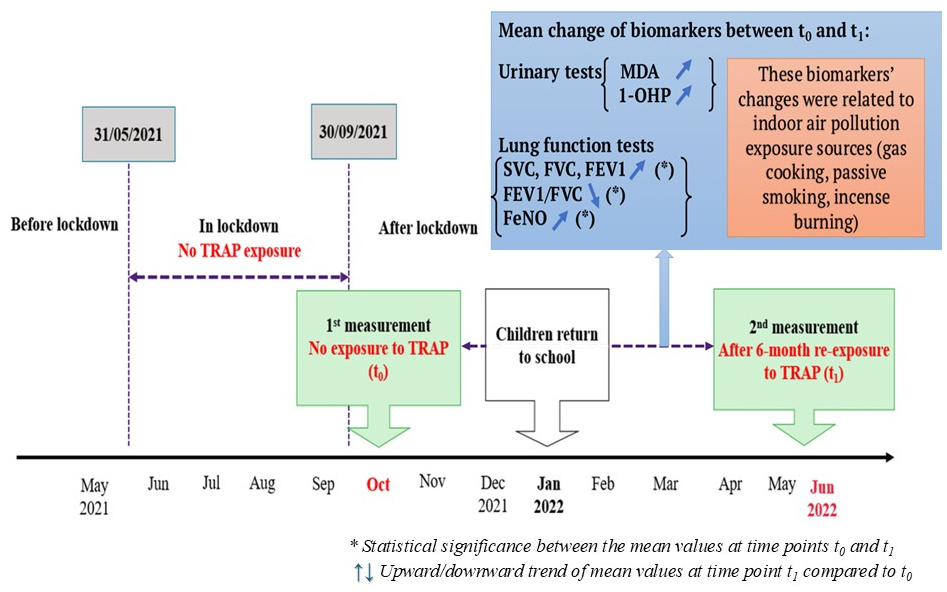
- Combined biomarker and lung function tests captured children’s pollution exposure
- Urban children still faced harmful indoor smoke despite reduced TRAP
- Urinary 1-OHP decreased after 6 months of TRAP re-exposure post-lockdown
- FeNO increased in children exposed to smoke from indoor air pollution sources
- Open Access
- Article
Urinary Biomarkers and Respiratory Responses to Indoor and Traffic-Related Air Pollution in Urban Children: A Prospective Cohort Study
- Hong H.T.C. Le 1,*,
- Dung Phung 1,
- Phong K. Thai 2,
- Nguyen Nhu Vinh 3,
- Tran Ngoc Dang 3,
- Huynh Ngoc Thanh 3,
- Linh Le Tran 3,
- Quynh Nhat Nguyen 3,
- Hoang Thuy Dung Phan 3,
- Thi Hoai Thuong Do 3,
- Nguyen Thi Tuong Vy 4,
- Truong Thi Thuy Dung 3,
- To Thi Hien 5,
- Pham Le An 3
Author Information
Received: 16 Jun 2026 | Revised: 10 Aug 2026 | Accepted: 08 Sep 2026 | Published: 23 Sep 2026
Highlights
Abstract
COVID-19 lockdowns unintentionally improved air quality by reducing traffic and industrial activity. This study assessed changes in respiratory health and urinary biomarkers of air pollution exposure among children with no traffic-related air pollution (TRAP) exposure and TRAP re-exposure under COVID-19-related lockdowns. A prospective cohort study was conducted with 53 children from urban districts in Ho Chi Minh City, Vietnam. Two time measurements were taken: t0 (immediately post-lockdown, no TRAP exposure) and t1 (six months after TRAP re-exposure). The children underwent physical examinations, respiratory tests (spirometry, fractional exhaled nitric oxide (FeNO)), and urine collection for 1-hydroxypyrene (1-OHP) and malondialdehyde (MDA) analysis. Overall, thirty-five children were eligible for the analysis. FeNO and lung function parameters (SVC, FVC, FEV1, FEV1/FVC) showed significant changes after TRAP re-exposure. Following the return to normal daily activities after the COVID-19 pandemic, children exposed to passive smoking exhibited lower 1-OHP levels, which may be attributable to increased time spent outdoors. Significant increases in FeNO were observed in children exposed to passive smoke (p = 0.007), incense smoke (p = 0.003), and gas cooking (p = 0.003). The respiratory function values (SVC, FVC, and FEV1) of children underwent significant increases (p < 0.05) after the lockdown was eased and their exposure to indoor pollution was reduced while being re-exposed to TRAP. Urban children remained exposed to harmful indoor pollutants despite TRAP being limited during the COVID-19 lockdown. The findings call for continued efforts to reduce air pollution exposure among children and highlight the need for further investigation into passive smoking and incense smoke.
Graphical Abstract
Keywords
indoor air pollution | traffic-related air pollution | urinary biomarkers | respiratory health | children | COVID-19 lockdown
References
- 1.
Health Effects Institute. State of Global Air 2024; Special Report; Health Effects Institute: Boston, MA, USA, 2024.
- 2.
Children’s Environmental Health Collaborative. Traffic-Related Air Pollution. Available online: https://ceh.unicef.org/spotlight-risk/traffic-related-air-pollution (accessed on 22 September 2023)
- 3.
WHO Director-General’s Opening Remarks at the Media Briefing on COVID-19–11 March 2020. Available online: https://www.who.int/news-room/speeches/item/who-director-general-s-opening-remarks-at-the-media-briefing-on-covid-19---11-march-2020 (accessed on 13 March 2023).
- 4.
Bonardi, J.P.; Gallea, Q.; Kalanoski, D.; et al. Saving the world from your couch: The heterogeneous medium-run benefits of COVID-19 lockdowns on air pollution. Environ. Res. Lett. 2021, 16, 074010.
- 5.
Venter, Z.S.; Aunan, K.; Chowdhury, S.; et al. COVID-19 lockdowns cause global air pollution declines. Proc. Natl. Acad. Sci. USA 2020, 117, 18984–18990. Erratum in Proc. Natl. Acad. Sci. USA 2023, 120, e2320514120.
- 6.
Senerat, A.M.; Manemann, S.M.; Clements, N.S.; et al. Biomarkers and indoor air quality: A translational research review. J. Clin. Transl. Sci. 2021, 5, e39.
- 7.
Bae, S.; Pan, X.C.; Kim, S.Y.; et al. Exposures to Particulate Matter and Polycyclic Aromatic Hydrocarbons and Oxidative Stress in Schoolchildren. Environ. Health Perspect. 2010, 118, 579–583.
- 8.
Zielińska-Danch, W.; Wardas, W.; Sobczak, A. Determination of urinary cotinine and 1-hydroxypyrene and blood carboxyhemoglobine as the biomarkers of tobacco smoke exposure. Przegl. Lek. 2006, 63, 922–925.
- 9.
Shahsavani, S.; Dehghani, M.; Hoseini, M.; et al. Biological monitoring of urinary 1-hydroxypyrene by PAHs exposure among primary school students in Shiraz, Iran. Int. Arch. Occup. Environ. Health 2017, 90, 179–187.
- 10.
Li, Z.; Liu, Q.; Xu, Z.; et al. Association between short-term exposure to ambient particulate air pollution and biomarkers of oxidative stress: A meta-analysis. Environ. Res. 2020, 191, 110105.
- 11.
Gong, J.; Zhu, T.; Kipen, H.; et al. Malondialdehyde in exhaled breath condensate and urine as a biomarker of air pollution induced oxidative stress. J. Expo. Sci. Environ. Epidemiol. 2013, 23, 322–327.
- 12.
Pearce, N.; Aït-Khaled, N.; Beasley, R.; et al. Worldwide trends in the prevalence of asthma symptoms: Phase III of the International Study of Asthma and Allergies in Childhood (ISAAC). Thorax 2007, 62, 758–766.
- 13.
Graham, B.L.; Steenbruggen, I.; Miller, M.R.; et al. Standardization of Spirometry 2019 Update. An Official American Thoracic Society and European Respiratory Society Technical Statement. Am. J. Respir. Crit. Care Med. 2019, 200, e70–e88.
- 14.
King, G.G.; Bates, J.; Berger, K.I.; et al. Technical standards for respiratory oscillometry. Eur. Respir. J. 2020, 55, 1900753.
- 15.
American Thoracic Society; European Respiratory Society. ATS/ERS recommendations for standardized procedures for the online and offline measurement of exhaled lower respiratory nitric oxide and nasal nitric oxide, 2005. Am. J. Respir. Crit. Care Med. 2005, 171, 912–930.
- 16.
Truong, H.T.; Truong, T.T.; Son, T.T. Housing and Transportation in Vietnam’s Ho Chi Minh City; Friedrich‑Ebert‑Stiftung: Berlin, Germany, 2017.
- 17.
Quang, T.N.; Hue, N.T.; Dat, M.V.; et al. Motorcyclists have much higher exposure to black carbon compared to other commuters in traffic of Hanoi, Vietnam. Atmos. Environ. 2021, 245, 118029.
- 18.
Ramos, C.A.; Wolterbeek, H.T.; Almeida, S.M. Air pollutant exposure and inhaled dose during urban commuting: A comparison between cycling and motorized modes. Air Qual. Atmos. Health 2016, 9, 867–879.
- 19.
Ezani, E.; Brimblecombe, P. Exposure of Malaysian Children to Air Pollutants over the School Day. Urban Sci. 2022, 6, 4.
- 20.
Ngo, C.Q.; Vu, G.V.; Phan, P.T.; et al. Passive Smoking Exposure and Perceived Health Status in Children Seeking Pediatric Care Services at a Vietnamese Tertiary Hospital. Int. J. Environ. Res. Public Health 2020, 17, 1188.
- 21.
Öberg, M.; Jaakkola, M.S.; Woodward, A.; et al. Worldwide burden of disease from exposure to second-hand smoke: A retrospective analysis of data from 192 countries. Lancet 2011, 377, 139–146.
- 22.
Silva, G.V.; Martins, A.O.; Martins, S.D.S. Indoor Air Quality: Assessment of Dangerous Substances in Incense Products. Int. J. Environ. Res. Public Health 2021, 18, 8086.
- 23.
Mannix, R.C.; Nguyen, K.P.; Tan, E.W.; et al. Physical characterization of incense aerosols. Sci Total Environ. 1996, 193, 149–158.
- 24.
Zhao, H.; Chan, W.R.; Cohn, S.; et al. Indoor air quality in new and renovated low-income apartments with mechanical ventilation and natural gas cooking in California. Indoor Air 2021, 31, 717–729.
- 25.
Lebel, E.D.; Finnegan, C.J.; Ouyang, Z.; et al. Methane and NOx Emissions from Natural Gas Stoves, Cooktops, and Ovens in Residential Homes. Environ. Sci. Technol. 2022, 56, 2529–2539. Correction to Environ. Sci. Technol. 2022, 56, 6791.
- 26.
Tran, C.T.; Nguyen, L.M.T.; Wu, T.G.; et al. Co-effects of COVID-19 and Meteorology on PM2.5 Decrease in Ho Chi Minh City, Vietnam: A Comparison of 2016–2019 and 2020–2021. Aerosol Air Qual. Res. 2024, 24, 230186.
- 27.
Draper, H.H.; Polensek, L.; Hadley, M.; et al. Urinary malondialdehyde as an indicator of lipid peroxidation in the diet and in the tissues. Lipids 1984, 19, 836–843.
- 28.
Velasco, E.; Ha, H.H.; Pham, A.D.; et al. Effectiveness of wearing face masks against traffic particles on the streets of Ho Chi Minh City, Vietnam. Environ. Sci. Atmos. 2022, 2, 1450–1468.
- 29.
National Institute for Occupational Safety and Health. Community Respirators and Masks. Available online: https://www.cdc.gov/niosh/ppe/php/community-respirators-masks/index.html (accessed on 22 September 2026).
- 30.
Abdel-Salam, M.M.M. Assessment of children’s exposure to air pollutants in urban residences during the COVID-19 pandemic. Front. Environ. Sci. 2022, 10, 1050623.
- 31.
Fischer, P.H.; Steerenberg, P.A.; Snelder, J.D.; et al. Association between exhaled nitric oxide, ambient air pollution and respiratory health in school children. Int. Arch. Occup. Environ. Health 2002, 75, 348–353.
- 32.
Koenig, J.Q.; Jansen, K.; Mar, T.F.; et al. Measurement of offline exhaled nitric oxide in a study of community exposure to air pollution. Environ. Health Perspect. 2003, 111, 1625–1629.
- 33.
Barraza-Villarreal, A.; Sunyer, J.; Hernandez-Cadena, L.; et al. Air pollution, airway inflammation, and lung function in a cohort study of Mexico City schoolchildren. Environ. Health Perspect. 2008, 116, 832–838.
- 34.
Delfino, R.J.; Staimer, N.; Gillen, D.; et al. Personal and Ambient Air Pollution is Associated with Increased Exhaled Nitric Oxide in Children with Asthma. Environ. Health Perspect. 2006, 114, 1736–1743.
- 35.
Holguin, F. Traffic, outdoor air pollution, and asthma. Immunol. Allergy Clin. North Am. 2008, 28, 577–588.
- 36.
Flamant-Hulin, M.; Caillaud, D.; Sacco, P.; et al. Air Pollution and Increased Levels of Fractional Exhaled Nitric Oxide in Children with No History of Airway Damage. J. Toxicol. Environ. Health Part A 2010, 73, 272–283.
- 37.
Dweik, R.A.; Boggs, P.B.; Erzurum, S.C.; et al. An official ATS clinical practice guideline: Interpretation of exhaled nitric oxide levels (FENO) for clinical applications. Am. J. Respir. Crit. Care Med. 2011, 184, 602–615.
- 38.
Zhang, Y.; Eckel, S.P.; Berhane, K.; et al. Long-term exposures to air pollutants affect FeNO in children: A longitudinal study. Eur. Respir. J. 2021, 58, 2100705.
- 39.
Tsai, Y.G.; Chio, C.P.; Yang, K.D.; et al. Long-term PM2.5 exposure is associated with asthma prevalence and exhaled nitric oxide levels in children. Pediatr. Res. 2025, 97, 370–377.
- 40.
Jayaweera, G.; Wimalasekera, S.; Goonewardena, S. FENO and spirometry for the assessment of respiratory functions of women exposed to biomass fuel smoke: A cross sectional study in Sri Lanka. Eur. Respir. J. 2020, 56, 2167. https://doi.org/10.1183/13993003.congress-2020.2167.
- 41.
Mayeux, R. Biomarkers: Potential uses and limitations. NeuroRx 2004, 1, 182–188.
How to Cite
Le, H. H. T. C.; Phung, D.; Thai, P. K.; Vinh , N. N.; Dang, T. N.; Thanh, H. N.; Tran, L. L.; Nguyen, Q. N.; Phan, H. T. D.; Do, T. H. T.; Vy, N. T. T.; Dung, T. T. T.; Hien, T. T.; An, P. L. Urinary Biomarkers and Respiratory Responses to Indoor and Traffic-Related Air Pollution in Urban Children: A Prospective Cohort Study. Global Environmental Science 2026, 2 (3), 392–403. https://doi.org/10.53941/ges.2026.100025.
RIS
BibTex
Copyright & License

Copyright (c) 2026 by the authors.
This work is licensed under a Creative Commons Attribution 4.0 International License.
Article Metrics
106
Article Views
0
Citations
Contents
References

 Suite 4002 Level 4, 447 Collins Street, Melbourne, Victoria 3000, Australia
 General Inquiries: info@sciltp.com