
Soft robotics represents an emerging field that offers inherent compliance and adaptability. Over the past five years, research on actuation for soft robotic hands has grown explosively. Classic tendon-motor and pneumatic systems now incorporate high-torque micro-servos, textile bellows rated for millions of cycles, and millisecond-level smart valves. Meanwhile, new actuation methods such as electro-hydraulic HASEL pouches, photothermal liquid-crystal elastomers, and bio-hybrid muscle strips bring additional advantages to the robotic hands, including high energy density, cable-free light activation, self-repair capabilities, and quiet operation. This review first examines the fundamental designs of soft dexterous hands and soft metacarpophalangeal joints, looking at their working principles and key implementations for each actuation type. Then, this review explores their performance metrics, advantages, limitations, and suitable application scenarios. Finally, this review comprehensively compares critical parameters like actuation force, speed, and control complexity, highlighting the complementary strengths of these approaches and identifying areas for potential integration and future development.
- Open Access
- Mini Review
A Review of Recent Advances in Soft Robotic Dexterous Hands
- Xiaoyin Zheng 1,
- Jiajun An 2,*,
- Daifeng Wang 2,
- Yiding Nie 2,
- Tianhao Jiang 3,
- Zihan Oliver Zeng 4,
- Youcheng Han 2,
- Xinsheng Zhang 5,
- Hanyu Yao 6,
- Weimin Zhu 6,
- Zhao Tang 2,
- Dongliang Fan 2,
- Xin Ma 7
Author Information
Received: 16 Jun 2025 | Revised: 30 Jul 2025 | Accepted: 05 Aug 2025 | Published: 10 Dec 2025
Abstract
Keywords
robotic hand | soft robotics | humanoid dexterous hand | embodied intelligence | prosthetics | robotic manipulation
1. Introduction
The field of humanoid robotics is currently experiencing a significant surge in both research activity and the development of commercial prototypes. These advanced systems are progressively transitioning from traditional controlled industrial environments to operating in collaborative settings alongside humans [1]. This increased demand for human-machine interaction reveals a critical limitation of traditional robotic hands, whose rigid nature can be unsafe and clumsy when dealing with the unpredictability of the real world [2]. Soft robotic dexterous hands, however, have emerged as a promising alternative to traditional rigid grippers, offering inherent compliance, adaptability to object geometry, and safe interaction capabilities. These advantages arise from their construction using flexible and deformable materials that can conform to irregular shapes and absorb impacts or unexpected forces [3]. Concepts of structural reconfigurability have also been explored beyond the scope of hand designs. For example, in intelligent automotive factories and in evolutionary robotics, adaptive mechanism can be utilized for deformable morphing and multivariable stiffness [4,5].
In recent years, several key trends have driven soft robotic hand research. One major trend is the emergence of novel actuation methods. Beyond conventional electric motors, researchers are now exploring innovative ways to power soft hands, including electro-hydraulic HASEL (Hydraulically Ampluated Self-healing Electrostatic) pouches, which offer high power density in flexible forms [6], and photothermal liquid-crystal elastomers that change shape in response to light and heat [7]. There are even explorations into using living muscle tissue for bio-inspired designs, which offer inherent self-healing capabilities and highly efficient energy conversion from nutrients [8]. These new methods contribute significantly to soft robotic hands that are lighter, quieter, and can be more highly integrated within compact designs. In addition, drawing upon the insipiration of advancement in lightweight material in the automotive industry, soft hand skeletons can be improved to minimize mass while preserving durability [9].
Simultaneously, substantial progress has been made by enhancing traditional actuation methods, notably tendon-driven systems and pneumatics, through sophisticated control strategies, novel materials, and integrated sensing. For instance, conventional tendon-driven systems now achieve nuanced, compliant movements thanks to advanced algorithms, often integrating high-torque micro-servos to achieve greater precision and force density [10]. For pneumatic systems, advancements include textile bellows rated for millions of cycles and millisecond-level smart valves, which have significantly improved their precision and response time, narrowing the gap with tendon-driven systems [11,12]. Advanced manufacturing techniques such as reconfigurable intelligent assembly lines found in the automotive industry may be capable of creating more complex and task-specific soft-hand modules [13].
Previous reviews of soft robotic dexterous hands mainly focused on either general soft robotics principles or specific categories of soft grippers and continuum manipulators. These often provided broad overviews of materials, fabrication, or basic actuation mechanisms [14,15]. While these existing surveys offered valuable insights into foundational aspects, they frequently lack a detailed, comparative analysis of the diverse emerging actuation types specifically tailored for multi-fingered dexterous hands. Other studies adopted a compartmentalized approach, examining palm or finger designs in isolation [16]. Many didn’t delve into the nuances of how these varied mechanisms enable complex, multi-degree-of-freedom movements crucial for dexterous manipulation. They also didn’t comprehensively compare their performance trade-offs regarding force, speed, precision, or practical considerations like integration and weight distribution. This created a notable gap in the current literature. To address this, we conducted a comprehensive review covering various recent advancements in actuation for soft robotic dexterous hands. By examining multiple actuation approaches in this specific context, we aim to provide insights into their relative strengths and weaknesses, guiding future research and application development.
This review is structured as follows. Section 2 is dedicated to in-depth examinations of individual actuation families: pneumatic systems, tendon-driven mechanisms, electro-hydraulic HASEL pouches, photothermal liquidcrystal elastomers, and bio-hybrid actuators, respectively. These sections illustrated the working principles, recent innovations, and representative implementations of each actuation types. Section 3 then provides a comprehensive comparative analysis, evaluating these diverse actuation methods across key performance metrics such as force output, response speed, control precision, and integration adaptability, further contextualized by a detailed table of specific robotic hand systems. Finally, Section 4 concludes the paper by summarizing the key findings, highlighting critical trade-offs, and offering perspectives on future research directions and the potential for synergistic development in the field of soft robotic dexterous hands.
2. Soft Robotic Dexterous Hands
2.1. Pneumatic Soft Robotic Dexterous Hands
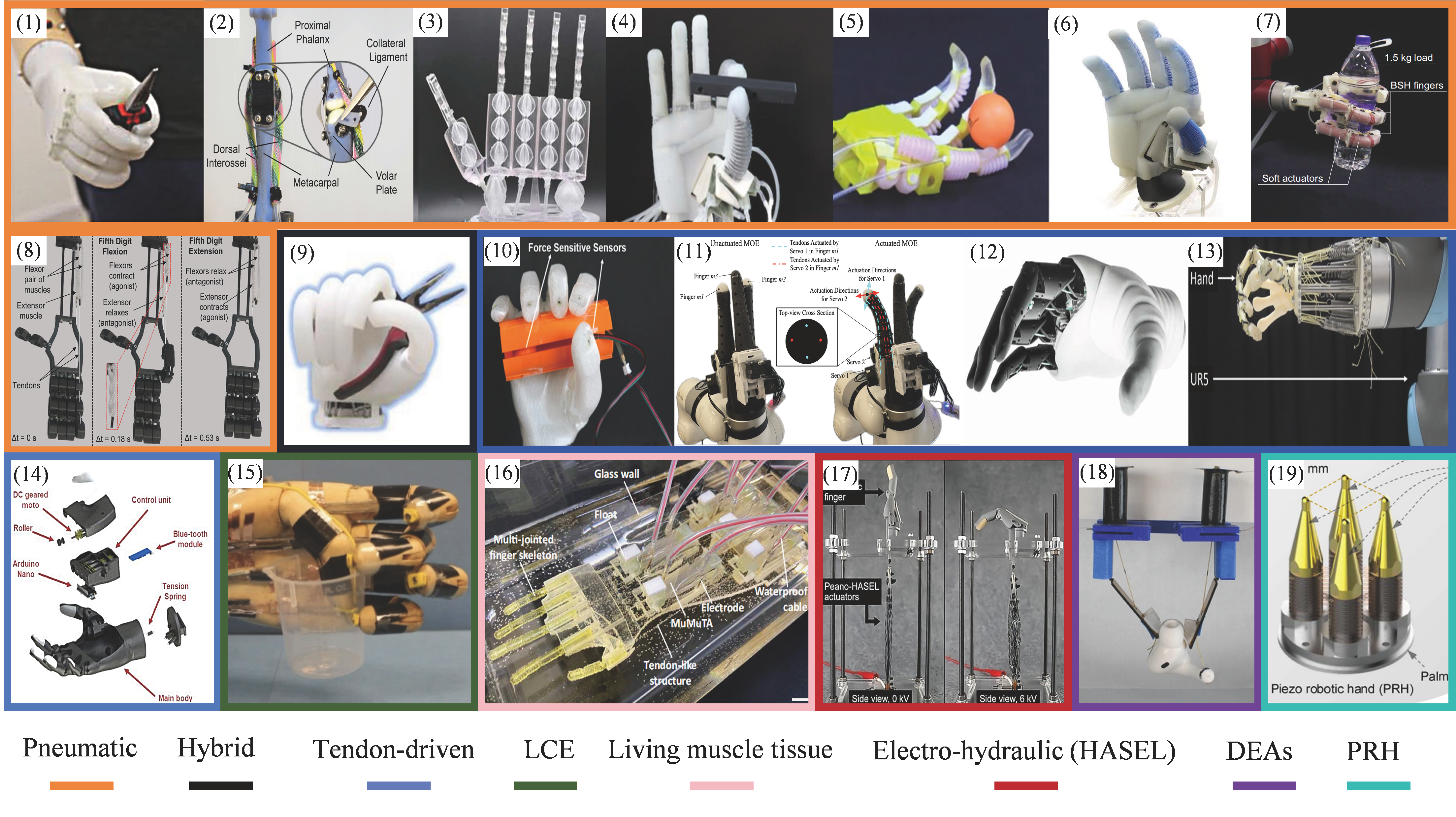
Pneumatic soft robotic dexterous hands (Figure 1 (1–8)) operate on the principle of controlled deformation through pressurized air. These systems typically consist of elastomeric chambers arranged in finger-like structures that, when pressurized, expand in predetermined directions to generate motion patterns similar to human fingers. Multi-fingered pneumatic soft hands have gained significant attention due to their inherent compliance and ability to conform to various object shapes without complex control systems.
The design and fabrication of pneumatic soft dexterous hands have seen significant advances in recent years. Devi et al. developed a novel underactuated multi-fingered soft robotic hand for prosthetic applications, utilizing asymmetric bellows flexible pneumatic actuators (ABFPA) to create versatile, dexterous motion. Their design incorporated strategic chamber geometries and reinforcement patterns to achieve anthropomorphic finger movements with minimal control complexity [17]. For purely pneumatic systems, Gupta et al. demonstrated learning dexterous manipulation for a pneumatically actuated soft robotic hand capable of in-hand manipulation tasks through the coordinated control of multiple soft fingers [18]. Recent designs exploit compliant mechanisms to amplify effectual output; Zhang et al. combine rigid skeletal structures with soft ligaments and elastic tendon actuation to mimic the musculoskeletal system of human fingers. This design achieves high dexterity and adaptability while maintaining structural and control simplicity [10]. Higueras-Ruiz et al. introduce a monolithic helical “cavatappi” artificial muscle made from twisted, coiled PVC tubes. It can exhibit a maximum work and power of 1.42 kw per kilogram, and robust operation over 10,000 cycles [19].
Control strategies for pneumatic dexterous hands have evolved to address the nonlinear dynamics inherent in soft structures. Preston et al. developed programmable soft pneumatic valves which enabled complex actuation sequences and precise force control in soft multi-fingered hands [11]. These valves use piston actuators and bistable pneumatic switches, supporting digital and analog control. This allows for pressure regulation, logic operations, and human-robot interfacing. Such control advancements have significantly improved the performance of pneumatic dexterous hands, addressing earlier limitations in precision and response time.
The performance characteristics of pneumatic soft dexterous hands include high inherent compliance, excellent force distribution across contact surfaces, and the ability to absorb impacts. These properties make them particularly suitable for handling fragile or irregularly shaped objects. Cao et al. combined soft fingers with bellows actuators to achieve flexible and adaptable grasping. In this work, the pneumatic bellows act as dampers, absorbing shocks and impacts during manipulation. This design enables the robotic hand to distribute forces evenly across the contact surface, reducing stress concentration and minimizing the risk of damaging fragile items. In the demo, the hand can grab fruits with a mass of 356.4 g [37]. Li et al. demonstrated a pneumatic soft robotic hand equipped with a hybrid actuator system for real-time control of bending shapes and programmable grasping modes. The hand can perform both pure bending and helical motions, enabling multimodal grasping and dexterous manipulation [38]. These hands utilize specialized valve systems that facilitate rapid pressure changes for improved response times while maintaining the inherent safety advantages of pneumatic systems.
2.2. Tendon-Driven Soft Robotic Dexterous Hands
Tendon-driven soft robotic dexterous hands (Figure 1 (10–14)) operate on principles inspired by biological musculoskeletal systems. These hands typically employ flexible cables or tendons attached to specific points on soft, multi-fingered structures and controlled by motors located remotely. When the tendons are pulled, they create tension that deforms the soft fingers in predetermined ways, resulting in controlled movements like bending or grasping, allowing for complex multi-fingered coordination. As a result, tendon-driven hands achieve excellent conformance and grip stability through purely mechanical means, while using fewer actuators than degrees of freedom.
The design and fabrication of tendon-driven soft dexterous hands have shown remarkable innovation in creating biomimetic systems. Mizushima et al. developed a multi-fingered robotic hand based on a hybrid mechanism of tendon-driven actuation and jamming transition, enabling variable stiffness control across multiple fingers [39]. This approach enabled both robust power grasping and precise fingertip manipulation. King et al. presented a comprehensive framework for designing, fabricating, and evaluating tendon-driven multi-fingered foam hands, demonstrating how soft, compliant structures could achieve complex, human-like manipulation patterns [40]. Their design incorporated distributed routing pathways through foam fingers to achieve differential tension distributions across multiple joints. Schlagenhauf et al. further advanced the control methodology for these tendon-driven soft foam robot hands, enabling more sophisticated multi-fingered coordination for complex manipulation tasks [41].
Recent advancements in tendon-driven systems for dexterous hands include the work of Li et al., who developed the Tactile SoftHand-A, a 3D-printed, tactile, highly-underactuated anthropomorphic robot hand with an antagonistic tendon mechanism [42]. This design incorporated distributed tactile sensing across multiple soft fingers while maintaining a minimalistic actuation approach. Zhou et al. presented a novel design and control approach for tendon-driven robotic fingers based on grasping task analysis, which incorporated biomimetic principles into a multi-fingered dexterous configuration [43]. Their system effectively adapted to various object geometries while maintaining precise control over individual fingers.
Beyond advancements in mechanical design, the manipulation capabilities of tendon-driven soft hands have also advanced significantly in recent years. Yao et al. developed the SWIFT hand, enabling the system to learn optimal tendon tensions and motion primitives directly through real-world interaction. Through self-supervised learning, the hand acquires dynamic in-hand pen-spinning skills entirely via trial-and-error—without prior object models—achieving 100% success with three pens after just 130 sampled actions per pen [28]. The arrangement of tendons in multi-fingered designs presents unique challenges. Li et al. conducted a comprehensive fingertip manipulability assessment of tendon-driven multi-fingered hands, providing important insights into optimal tendon routing strategies for maximizing dexterity [42]. They demonstrated how proper routing configurations could significantly enhance manipulation capabilities with minimal actuation complexity.
2.3. Electro-Hydraulic HASEL Pouches
Electro-hydraulic HASEL (Hydraulically Amplified Self-healing Electrostatic) actuators were introduced by Kellaris et al. as thin, thermoplastic pouches partially filled with a liquid dielectric and patterned with compliant electrodes [6] (Figure 1 (17)). When a few micro-amperes of high voltage (4–9 kV) are applied, Maxwell stresses drive the liquid toward one end, causing the opposite polymer shell to contract—producing muscle-like strokes.
HASEL pouches give a rare mix of large, muscle-like strain, millisecond response and built-in self-healing.
These strengths make them attractive for lightweight prostheses and soft grippers. Yoder et al. demonstrates that Peano-HASEL actuators enable a prosthetic finger to be much faster (10.6×), have higher bandwidth (11.1×), and consume less energy (8.7× less) than a DC motor-driven finger, while reaching 91% of the original range of motion [34]. Yet the architecture of HASEL still demands a 4–9 kV supply plus fault-tolerant insulation, and leaked dielectric oil is unacceptable in clinical settings—practical hurdles that have so far limited HASEL hands to laboratory prototypes with forces below high-power tendon systems [6,34].
2.4. Photothermal Liquid-Crystal Elastomers (LCEs)
Liquid-crystal elastomers combine an aligned mesogenic network with an elastic backbone; heating disorder-drives the mesogens, yielding anisotropic contraction along the director. Ware et al. manipulated the alignment of LCE domains to achieve controllable shape changes [44]. More recently, advanced fabrication techniques—such as fiber drawing and UV-programmed alignment—have enabled the creation of tendon-like LCE filaments that exhibit reversible actuation strains of 30–45%, closely matching the compliance of biological tissues [45].
Recent innovations have integrated these LCE tendons into functional soft robotic devices (Figure 1 (15)). For example, Lu et al. demonstrated a biomimetic prosthetic hand with LCE tendons and integrated liquid metal heating elements, achieving up to 43.6% contraction strain and 536 kPa contraction stress under joule heating; this hand can coordinate all five fingers to carry a 200 g water bottle and use four fingers to lift a 252 g bag [32]. Since LCE tendons are entirely polymeric, they operate silently and are MRI-transparent, making them suitable for medical applications and stealth robotics.
2.5. Living-Muscle (Bio-Hybrid) Actuators Wires
Bio-hybrid hands harness cultured skeletal-muscle bundles to pull artificial tendons, providing unmatched compliance and inherent proprioception (Figure 1 (16)). Cvetković et al. showed that millimetre-scale muscle rings can drive 3-D printed hydrogel skeletons for hundreds of cycles [46]. Building on microfluidic nutrient circulation, Morimoto and Takeuchi demonstrated centimetre-scale muscle sheets delivering milli-newton forces for soft-robotic fins [47]. Most recently, Ren et al. arranged five MuMuTA muscle bundles around a 3-D printed hand skeleton and achieved individually controlled finger flexion in a culture bath [33]. Nevertheless, force density lags synthetic actuators by up to two orders of magnitude, and continuous operation outside CO2-controlled incubators faces unresolved challenges in nutrient delivery, sterility, and temperature management. Thus, bio-hybrid hands remain a compelling but still exploratory path toward lifelike robotic manipulation.
2.6. Dielectric Elastomer Actuators
Dielectric elastomer actuators (DEAs) promise fast, silent muscle-like motion, yet fitting enough active material into a hand-sized mechanism is still hard. Yuen et al. [35] tackled this by rolling six-layer silicone strips twice around themselves and threading a Kevlar tendon through the hollow core, so axial stretch becomes remote cable tension (Figure 1 (18)). The resulting 1.42 g double-roll module delivered 0.69 N blocked force with 1.84 mm free stroke at 1.25 kV. A pair of these cable-DEAs, plus a 3-D-printed frame, formed a 4.4 g two-finger gripper that reliably lifted objects up to 5.5 g. These results highlight cable-driven DEAs as a compact path to bring high-bandwidth artificial muscles into compliant robotic hands without overcrowding the fingertip.
2.7. Piezoelectric Ceramics Actuators
Piezo-ceramic stacks deliver an exceptional blend of sub-millisecond response, nanometre positioning and high force density. Zhang et al. [36] embed twelve metal-ceramic “sandwich” stacks directly into the fingers of a 390 g robotic hand, eliminating gears and backlash (Figure 1 (19)). Each stack achieves 15 nm open-loop resolution and drives a full stroke in roughly 0.5 ms. Despite the lightweight frame, the hand lifts 14.76 kg. These figures show that piezoelectric ceramics can scale from micro-actuation to macro-scale grasping while offering high stiffness, low hysteresis (around 3.95 %) and immunity to electromagnetic interference—qualities well-suited to precision industrial and surgical manipulation.
2.8. Hybrid Approaches
Researchers have increasingly explored hybrid approaches that integrate multiple mechanisms within multifingered dexterous hands (Figure 1 (9)). These approaches aim to combine the inherent compliance and the distributed force capabilities of pneumatic systems with the precision and control efficiency of tendon-driven mechanisms.
Zhu et al. developed pneumatic and tendon actuation coupled multi-mode actuators specifically for soft robotic dexterous hands, enabling a broad force and speed range that would be unattainable with either approach alone [48]. Their system incorporated pneumatic chambers for primary force generation and tendons for fine positioning, allowing individual fingers to switch between high-force and high-precision modes. Li et al. presented a dual-mode actuator for soft robotic hands that integrated pneumatic and tendon-driven elements in an antagonistic configuration, enhancing both the grasping strength and precision control of multi-fingered manipulation [26]. This approach enabled variable stiffness control across multiple fingers simultaneously, addressing one of the key limitations of purely soft systems.
Kumar et al. demonstrated fast, strong, and compliant pneumatic actuation for dexterous tendon-driven hands, using specialized pneumatic systems to drive tendon-based multi-fingered hands with improved response characteristics [49]. Their design maintained the advantages of remote actuation while enhancing the speed and force capabilities through precision-controlled pneumatic assistance. Zhou et al. introduced the DexCo hand, a dexterous and compliant multi-fingered robotic hand that employs a hybrid soft fluidic actuation system, combining pneumatic actuation in the palm with hydraulic actuation in the fingers. This innovative design leverages the rapid response and compressibility of pneumatics for palm flexibility while utilizing the precise force transmission of hydraulics for fine finger control. The DexCo hand demonstrates remarkable in-hand manipulation capabilities, rivaling human dexterity, and represents a significant advancement in fluidic actuation for robotic hands [50]. These hybrid approaches represent a promising direction for multi-fingered dexterous hands, potentially offering better performance across multiple metrics compared to single-mode actuation systems.
3. Comparative Analysis
To effectively evaluate and compare soft robotic dexterous hands with different actuation types, we must consider multiple performance metrics that are critical for dexterous manipulation tasks (Table 1). The selection of these parameters is guided by the fundamental requirements of dexterous hands in various application domains.
Different implementations across multiple research groups demonstrate consistent patterns in performance trade-offs between these actuation methods. The Harvard RBO Hand [12], utilizing pneumatic actuation, demonstrates excellent adaptability and compliance, but with less precision compared to tendon-driven systems like the Yale OpenHand [51]. These implementation-specific Differences reveal fundamental characteristics inherent to each actuation approach.
Comparison of specific soft robotic dexterous hand implementations.
|
# |
Paper |
Actuation Type |
DoF |
Mass (g) |
Force/Payload |
Response Time |
Stand-Out Feature(s) |
|---|---|---|---|---|---|---|---|
|
1 |
Gu [20] |
Pneumatic |
6 |
292 |
2.3 kg load |
0.2 Hz |
Bidirectional human–machine interface |
|
2 |
Gollob [21] |
Pneumatic (metacarpopha-langeal joint) |
2 |
- |
50 N |
0.5 Hz |
Hybrid rigid–soft, multi-material construction |
|
3 |
De Pascali [22] |
Pneumatic |
7 |
8/actuator |
18 N pulling force |
1 Hz |
Direct integration into functional devices |
|
4 |
Puhlmann [12] |
Fabric pneumatic |
16 |
- |
39 N |
- |
Actuated palm + thumb spread |
|
5 |
Zhang [23] |
Pneumatic bellows |
11 |
138 |
0.86 N blocking force |
- |
Multi-material 3D-printing |
|
6 |
Ridremont [52] |
Pneumatic |
6 |
1400 |
0.06 N·m/finger |
1 Hz |
Customizable rehabilitation tasks in both flexion and extension modes |
|
7 |
Zhou [25] |
Pneumatic |
3 active |
- |
Grasping a 1.5 kg bottle |
- |
Multi-material 3D-printing |
|
8 |
Higueras-Ruiz [19] |
Pneumatic |
1/finger |
0.014/mm |
0.5 kg tensile load |
2 Hz |
High mechanical efficiency (45%) and high power density |
|
9 |
Laffranchi [29] |
Tendon-driven |
13 |
480 |
150 N |
- |
Underactuated differential drive |
|
10 |
Mohammadi [27] |
Tendon-driven |
13 |
253 |
21.5 N grip |
0.77 Hz |
Low-budget printed prosthesis (material cost 200 USD) |
|
11 |
Yao [28] |
Tendon-driven |
6 |
- |
Dynamic in-hand pen-spinning through self-supervision |
||
|
12 |
Gilday [30] |
Tendon-driven |
11 |
120 |
- |
Silicone fingertips for high friction and gentle contact |
|
|
13 |
Nazari [31] |
Tendon-driven |
6 |
360 |
5 N for fingertip/18 N for palmar grasping |
- |
Non-invasive sonomyography via a wearable ultrasound probe |
|
14 |
Lu [32] |
LCE |
5 |
- |
252 g |
- |
Independent finger control |
|
15 |
Ren [33] |
Living muscle tissue |
5 |
- |
8 mN/finger |
2 Hz |
Individual finger control |
|
16 |
Yoder [34] |
Electro-hydraulic (HASEL) |
1/finger |
(38∼43) |
- |
25 Hz |
High actuation speed |
|
17 |
Yuen [35] |
DEA |
1/finger |
4.42 |
0.69 N |
25 Hz |
Ultra-light rolled DEA modules, low fingertip inertia |
|
18 |
Zhang [36] |
Piezoelectric Ceramic |
12 |
390 |
14.76 kg |
2000 Hz |
High frequency |
|
19 |
Li [26] |
Hybrid |
2/finger |
1800 |
4.3 N |
- |
Compact, untethered operation |
Force generation capabilities represent a critical parameter for evaluating soft dexterous hands, directly impacting their ability to manipulate objects of varying weights and apply appropriate pressure during grasping tasks. Pneumatic soft dexterous hands typically generate higher forces at their operational pressure ranges than tendon-driven systems of similar size and weight. For example, the RBO Hand-2 demonstrates fingertip forces up to 8.3 N at normal operational pressures, while the comparable Yale OpenHand Model T achieves approximately 10 N with its tendon-driven system. The stress of photothermal LCEs remains in the hundreds-of-kilopascal range, an order of magnitude below pneumatic fabrics, and UV-induced ageing gradually reduces stroke; even the best laboratory samples show measurable loss after a few thousand high-temperature cycles [44]. This difference is particularly important for applications requiring robust grasping of heavier objects.
Response speed and bandwidth show significant variation between actuation types, with direct implications for dynamic manipulation tasks. Tendon-driven dexterous hands consistently demonstrate faster response times due to direct mechanical actuation, as evidenced by the tendon-driven hand developed by Zhang et al. shows response speed of 2.5 Hz [10]. In comparison, Pascali et al. developed a 3D-printed pneumatic robotic hand that only shows a 1 Hz response speed despite comparable finger dimensions [53]. HASEL cells can match the speeds of tendon-driven dexterous hands because fluid inertia is low and dielectric relaxation is fast (10.6 times faster than a DC motor actuator) [34]. Classic pneumatic actuators operate safely at around 1 Hz, limited by pneumatic filling [22]. Living muscle sheets contract at physiological rates (1–2 Hz) but tire quickly without nutrient perfusion [47]. Piezo-ceramic stacks push the response speed at kilohertz level [36]. For photothermal LCEs, fast-cooling hollow fibres have cut recovery to sub-second times, making cyclic actuation plausible for lightweight grippers.
Control precision emerges as another distinguishing factor between these actuation approaches. Tendon-driven systems generally provide better position control precision, as shown by the ProMain-I’s positioning accuracy of ±5 mm [53] compared to the Makenzie’s research ±10 mm [54]. This precision advantage derives from the more direct force transmission pathway in tendon systems and the avoidance of compressibility issues associated with pneumatic actuation. However, recent advancements in valve technology for pneumatic systems have narrowed this gap. Decker et al. developed programmable soft pneumatic valves, enabling differential pressurization across finger segments. The glove-controlled soft robotic hand they developed could match human finger angles within 2° over a range of 0° to 130° [11]. Furthermore, insights from intelligent connected vehicles, where two-degree-of-freedom tire models allow for higher precision automatic lane change, could inspire an improved in-hand manipulation planner to further enhance control precision [55].
Weight distribution capabilities differ significantly between these approaches, with important implications for hand design. Tendon-driven dexterous hands allow for remote placement of actuators, potentially resulting in lighter end effectors, as demonstrated by Gilday et al.'s design with 120 g total system weight [30]. Pneumatic systems often require proximal valves and pressure regulation components. Although recent innovations have improved their distribution capabilities, even miniaturised setups add over 100 g to the user [23]. HASEL electronics weigh less than 50 g but introduce kilovolt insulation and oil handling issues [34]. LCEs require nothing beyond thin wires or optical fibres, making them attractive for confined joints [32]. Yuen et al.'s DEA finger only weights 4.42 g, indicating significant light-weight advantage [35]. Living muscle tissue demands the heaviest support—reservoirs, microfluidics, and temperature control—keeping the system firmly in the lab for now [33].
4. Conclusions and Future Perspectives
This review has examined the fundamental principles, key implementations, performance characteristics, and applications of soft robotic dexterous hands with different actuation types. The comparative analysis reveals that each approach offers distinct advantages and faces specific challenges, making them complementary rather than competitive technologies for multi-fingered dexterous manipulation. Pneumatic soft dexterous hands excel in inherent compliance, force distribution, and impact absorption, making them particularly suitable for handling delicate or irregularly shaped objects in structured environments. However, they face challenges in miniaturization, energy efficiency, and precision control. Tendon motors dominate commercial prosthetics: they satisfy the simultaneous demand for high force, fast response, battery operation, and compact packaging. On the other hand, Tendon-driven robotic hands struggle with issues related to the tendon routing complexity, friction, and lower force output. These challenges underscore the importance of flexible joints control algorithms [56,57], which can effectively translate actuator outputs into precise and reliable manipulation performance. Origami-enabled structures [58] represent another compelling approach with significant potential for enhancing dexterous hand designs. At the same time, hybrid palms that embed pneumatic thumb-spread hint at a near-term future where small compliant sub-actuators overlay the high-power tendon core to boost dexterity without inflating battery load [12]. Therefore, future research should focus on the integrated design of mechanisms, control strategies, and actuators to advance soft dexterous hands towards robust, reliable, and practical manipulation capabilities.
A second wave of research converges on soft-fluid and electro-active architectures that foreground safety, transparency, or niche operating environments. HASEL pouches already rival motor bandwidth while providing self-healing dielectric resilience [34]; their bottlenecks are kilovolt electronics and oil containment, both solvable with piezo-step HV converters and gel-encapsulated fluids now appearing in stretchable-battery research. Joule-heated LCEs can be driven wirelessly and remain MRI-safe, making them attractive for in-body tools [32].
Looking forward, integrating structural reconfiguration frameworks from automotive manufacturers and morphing-stiffness strategies from evolutionary robotics could inspire new soft-hand architecture that can dynamically alter form and compliance to respond to task requirements [4,5]. Moreover, digital-twin approaches utilized in automotive production for real-time simulation and optimization can offer a direct blueprint for virtual prototyping of soft hands [59]. In fact, adopting Industry 4.0 paradigms, including cyber-physical systems, digital twins, and cloud-connected big-data analysis in metal-forming, offers another direct template for scalable prototyping [60].
Looking further ahead, we can expect muscle bundles to grow by densifying myofibrils and embedding vasculature-mimicking microfluidics in the next decade [33,47]. To escape the incubator, closed-loop perfusion with antibiotic-loaded hydrogels and thermoelectric heaters may keep tissue viable in ambient air for days, long enough for exploratory field trials.
These research directions hold the potential to significantly advance soft robotic dexterous hands, leading to systems that combine the adaptability and safety of soft structures with the precision and functionality needed for complex manipulation tasks. As the field continues to mature, with the ongoing miniaturization of high-energy-density flexible batteries, roboticists could, for the first time, choose actuators on a spectrum ranging from metal gears to living tissue, assembling “cyber-organic” hands that adjust their mechanics as naturally as the human original.
Author Contributions
Conceptualization, X.Z. (Xiaoyin Zheng), J.A.; Data Curation, D.W., Y.N.; Formal Analysis, D.W.; Validation, D.W.; Investigation, Y.N., Z.O.Z., Y.H., X.Z. (Xinsheng Zhang), H.Y., W.Z.; Visualization, T.J.; Resources, Z.O.Z., H.Y., W.Z. Writing—Original Draft, X.Z. (Xiaoyin Zheng); Writing—Review and Editing, X.Z. (Xiaoyin Zheng), J.A., Y.N., Y.H., X.Z. (Xinsheng Zhang), Z.T., D.F., X.M.; Project Administration, X.Z. (Xiaoyin Zheng). Supervision, J.A., X.M.; Funding Acquisition, W.Z., X.M. All authors have read and agreed to the published version of the manuscript.
Funding
This research was supported in part by the National Natural Science Foundation of China under grant 52205032, Research Grants Council of Hong Kong (Ref. No. 14204423), in part by the Guangdong Basic and Applied Basic Research Foundation under grant 2023A1515010062, in part by the Science, Technology and Innovation Commission of Shenzhen Municipality under Grants ZDSYS20220527171403009 and KQTD20240729102052065.
Institutional Review Board Statement
Not applicable.
Informed Consent Statement
Not applicable.
Data Availability Statement
Not applicable.
Conflicts of Interest
The authors declare no conflict of interest.
Use of AI and AI-Assisted Technologies
No AI tools were utilized for this paper.
References
- 1.
Tong, Y.; Liu, H.; Zhang, Z. Advancements in Humanoid Robots: A Comprehensive Review and Future Prospects. IEEE/CAA J. Autom. Sin. 2024, 11, 301–328.
- 2.
Ghobadi, N.; Sepehri, N.; Kinsner, W.; Szturm, T. Beyond Human Touch: Integrating Soft Robotics with Environmental Interaction for Advanced Applications. Actuators 2024, 13, 507.
- 3.
Laschi, C.; Mazzolai, B.; Cianchetti, M. Soft robotics: Technologies and systems pushing the boundaries of robot abilities. Sci. Robot. 2016, 1, eaah3690.
- 4.
Feng, H.; Xue, Y.; Li, H.; Tang, Z.; Wang, W.; Wei, Z.; Zeng, G.; Li, M.; Dai, J.S. Deformable morphing and multivariable stiffness in the evolutionary robotics. Int. J. Automot. Manuf. Mater. 2023, 2, 1.
- 5.
Zhuang, Z.; Guan, Y.; Xu, S.; Dai, J.S. Reconfigurability in automobiles—structure, manufacturing and algorithm for automobiles. Int. J. Automot. Manuf. Mater. 2022, 1, 1.
- 6.
Kellaris, N.; Venkata, V.G.; Rothemund, P.; Keplinger, C. An analytical model for the design of Peano-HASEL actuators with drastically improved performance. Extrem. Mech. Lett. 2019, 29, 100449.
- 7.
Li, K.; Zhang, Q.; Cui, X.; Liu, Y.; Liu, Y.; Yang, Y. Photothermal-driven soft actuator capable of alternative control based on coupled-plasmonic effect. Chem. Eng. J. 2024, 498, 155057.
- 8.
Yuan, Z.; Guo, Q.; Jin, D.; Zhang, P.; Yang, W. Biohybrid Soft Robots Powered by Myocyte: Current Progress and Future Perspectives. Micromachines 2023, 14, 1643.
- 9.
Zhou, X.; Jiang, J.; Hu, Z.; Hua, L. Lightweight materials in electric vehicles. Int. J. Automot. Manuf. Mater. 2022, 1, 3.
- 10.
Zhang, N.; Zhou, P.; Yang, X.; Shen, F.; Ren, J.; Hou, T.; Dong, L.; Bian, R.; Wang, D.; Gu, G.; et al. Biomimetic rigid-soft finger design for highly dexterous and adaptive robotic hands. Sci. Adv. 2025, 11, eadu2018.
- 11.
Decker, C.J.; Jiang, H.J.; Nemitz, M.P.; Root, S.E.; Rajappan, A.; Alvarez, J.T.; Tracz, J.; Wille, L.; Preston, D.J.; Whitesides, G.M. Programmable soft valves for digital and analog control. Proc. Natl. Acad. Sci. USA 2022, 119, e2205922119.
- 12.
Puhlmann, S.; Harris, J.; Brock, O. RBO Hand 3: A platform for soft dexterous manipulation. IEEE Trans. Robot. 2022, 38, 3434–3449.
- 13.
Liu, Z. Current progress in automobile design and manufacturing. Int. J. Automot. Manuf. Mater. 2022, 1, 11.
- 14.
Wang, Y.; Xie, Z.; Huang, H.; Liang, X. Pioneering healthcare with soft robotic devices: A review. Smart Med. 2024, 3, e20230045.
- 15.
Yu, C.; Wang, P. Dexterous Manipulation for Multi-Fingered Robotic Hands with Reinforcement Learning: A Review. Front. Neurorobot. 2022, 16, 861825.
- 16.
Pozzi, M.; Malvezzi, M.; Prattichizzo, D.; Salvietti, G. Actuated Palms for Soft Robotic Hands: Review and Perspectives. IEEE/Asme Trans. Mechatronics 2024, 29, 902–912.
- 17.
Devi, M.A.; Udupa, G.; Sreedharan, P. A novel underactuated multi-fingered soft robotic hand for prosthetic application. Robot. Auton. Syst. 2018, 100, 267–277.
- 18.
Gupta, A.; Eppner, C.; Levine, S.; Abbeel, P. Learning Dexterous Manipulation for a Soft Robotic Hand from Human Demonstrations. In Proceedings of the IEEE/RSJ International Conference on Intelligent Robots and Systems (IROS), Daejeon, Republic of Korea, 9–14 October 2016; pp. 3786–3793.
- 19.
Higueras-Ruiz, D.R.; Shafer, M.W.; Feigenbaum, H.P. Cavatappi artificial muscles from drawing, twisting, and coiling polymer tubes. Sci. Robot. 2021, 6, eabd5383.
- 20.
Gu, G.; Zhang, N.; Xu, H.; Lin, S.; Yu, Y.; Chai, G.; Ge, L.; Yang, H.; Shao, Q.; Sheng, X.; et al. A soft neuroprosthetic hand providing simultaneous myoelectric control and tactile feedback. Nat. Biomed. Eng. 2023, 7, 589—598.
- 21.
Gollob, S.D.; Poss, J.; Memoli, G.; Roche, E.T. A Multi-Material, Anthropomorphic Metacarpophalangeal Joint with Abduction and Adduction Actuated by Soft Artificial Muscles. IEEE Robot. Autom. Lett. 2022, 7, 5882–5887.
- 22.
De Pascali, C.; Giorgio-Serchi, F.; Usai, F.G.; Renda, F.; Ciuti, G.; Rossiter, J.; Cianchetti, M.; Cacucciolo, V. 3D-printed biomimetic artificial muscles using soft actuators that contract and elongate. Sci. Robot. 2022, 7, eabn4155.
- 23.
Zhang, N.; Ge, L.; Xu, H.; Zhu, X.; Gu, G. 3D printed, modularized rigid-flexible integrated soft finger actuators for anthropomorphic hands. Sensors Actuators Phys. 2020, 312, 112090.
- 24.
Wall, V.; Z¨oller, G.; Brock, O. A method for sensorizing soft actuators and its application to the RBO hand 2. In Proceedings of the 2017 IEEE International Conference on Robotics and Automation (ICRA), Singapore, 29 May–3 June 2017; pp. 4965–4970.
- 25.
Zhou, P.; Zhang, N.; Gu, G. A biomimetic soft-rigid hybrid finger with autonomous lateral stiffness enhancement. Adv. Intell. Syst. 2022, 4, 2200170.
- 26.
Li, Y.; Chen, Y.; Ren, T.; Hu, Y.; Liu, H.; Lin, S. A Dual-Mode Actuator for Soft Robotic Hand. IEEE Robot. Autom. Lett. 2021, 6, 1866–1873.
- 27.
Mohammadi, A.; Lavranos, J.; Zhou, H.; Mutlu, R.; Alici, G.; Tan, Y.; Choong, P.; Oetomo, D. A Practical 3D-Printed Soft Robotic Prosthetic Hand with Multi-Articulating Capabilities. PloS ONE 2020, 15, e0232766.
- 28.
Yao, Y.; Yoo, U.; Oh, J.; Atkeson, C.G.; Ichnowski, J. Soft Robotic Dynamic In-Hand Pen Spinning. arXiv 2024, arXiv:2411.12734v1.
- 29.
Laffranchi, M.; Boccardo, N.; Traverso, S.; Lombardi, L.; Canepa, M.; Lince, A.; Semprini, M.; Saglia, J.A.; Naceri, A.; Sacchetti, R.; et al. The Hannes hand prosthesis replicates the key biological properties of the human hand. Sci. Robot. 2020, 5, eabb0467.
- 30.
Gilday, K.; Hughes, J.; Iida, F. Wrist-driven passive grasping: interaction-based trajectory adaption with a compliant anthropomorphic hand. Bioinspir. Biomimetics 2021, 16, 026024.
- 31.
Nazari, V.; Zheng, Y.P. ProRuka: A highly efficient HMI algorithm for controlling a novel prosthetic hand with 6-DOF using sonomyography. arXiv 2024, arXiv:2407.19859.
- 32.
Lu, H.; Zou, Z.; Wu, X.; Shi, C.; Liu, Y.; Xiao, J. Biomimetic Prosthetic Hand Enabled by Liquid Crystal Elastomer Tendons. Micromachines 2021, 12, 736.
- 33.
Ren, X.; Morimoto, Y.; Takeuchi, S. Biohybrid hand actuated by multiple human muscle tissues. Sci. Robot. 2025, 10, eadr5512.
- 34.
Yoder, Z.; Kellaris, N.; Chase-Markopoulou, C.; Ricken, D.; Mitchell, S.K.; Emmett, M.B.; Weir, R.F.F.; Segil, J.; Keplinger, C. Design of a High-Speed Prosthetic Finger Driven by Peano-HASEL Actuators. Front. Robot. 2020, 7, 586216.
- 35.
Yuen, M.C.; Keroull´e, T.; Xu, S.; Wood, R.J. Electrostatic Artificial Muscles for Cable-Driven Actuation of Compliant Mechanisms. Npj Robot. 2025, 3, 12.
- 36.
Zhang, S.; Liu, Y.; Deng, J.; Gao, X.; Li, J.; Wang, W.; Xun, M.; Ma, X.; Chang, Q.; Liu, J.; et al. Piezo robotic hand for motion manipulation from micro to macro. Nat. Commun. 2023, 14, 500.
- 37.
Cao, M.; Sun, Y.; Zhang, J.; Ying, Z. A novel pneumatic gripper driven by combination of soft fingers and bellows actuator for flexible grasping. Sensors Actuators Phys. 2023, 355, 114335.
- 38.
Li, N.; Pi, Y.; Ding, J.; Yang, G.; Li, J. Soft hand with programmable grasping mode for dexterous manipulation. Sensors Actuators Phys. 2024, 377, 115723.
- 39.
Mizushima, K.; Oku, T.; Suzuki, Y.; Tsuji, T.; Watanabe, T. Multi-Fingered Robotic Hand Based on Hybrid Mechanism of Tendon-Driven and Jamming Transition. In Proceedings of the IEEE International Conference on Soft Robotics (RoboSoft), Livorno, Italy, 24–28 April 2018; pp. 65–70.
- 40.
King, J.P.; Bauer, D.; Schlagenhauf, C.; Zhang, K.H.; Moro, F.; Pollard, N. Design, Fabrication, and Evaluation of Tendon-Driven Multi-Fingered Foam Hands. In Proceedings of the IEEE-RAS International Conference on Humanoid Robots, Beijing, China, 6–9 November 2018; pp. 1–9.
- 41.
Schlagenhauf, C.; Bauer, D.; Zhang, K.H.; King, J.P.; Moro, F.; Coros, S.; Pollard, N. Control of Tendon-Driven Soft Foam Robot Hands. In Proceedings of the IEEE-RAS International Conference on Humanoid Robots, Beijing, China, 6–9 November 2018; pp. 1–7.
- 42.
Li, H.; Ford, C.J.; Lu, C.; Lin, Y.; Bianchi, M.; Catalano, M.G.; Psomopoulou, E.; Lepora, N.F. Tactile SoftHand-A: 3D-Printed, Tactile, Highly-underactuated, Anthropomorphic Robot Hand with an Antagonistic Tendon Mechanism. arXiv 2024, arXiv:cs.RO/2406.12731.
- 43.
Zhou, X.; Fu, H.; Shentu, B.; Wang, W.; Cai, S.; Bao, G. Design and Control of a Tendon-Driven Robotic Finger Based on Grasping Task Analysis. Biomimetics 2024, 9, 370.
- 44.
Ware, T.H.; McConney, M.E.; Wie, J.J.; Tondiglia, V.P.; White, T.J. Voxelated liquid crystal elastomers. Science 2015, 347, 982–984.
- 45.
Zhang, W.; Nan, Y.; Wu, Z.; Shen, Y.; Luo, D. Photothermal-Driven Liquid Crystal Elastomers: Materials, Alignment and Applications. Molecules 2022, 27, 4330.
- 46.
Cvetkovic, C.; Raman, R.; Chan, V.; Williams, B.J.; Tolish, M.; Bajaj, P.; Saif, M.T.A.; Bashir, R. Three-dimensionally printed biological machines powered by skeletal muscle. Proc. Natl. Acad. Sci. 2014, 111, 10125–10130.
- 47.
Morimoto, Y.; Onoe, H.; Takeuchi, S. Biohybrid robot powered by an antagonistic pair of skeletal muscle tissues. Sci. Robot. 2018, 3, eaat4440.
- 48.
JiaQin, Z.; Menghao, P.; Han, C.; Yi, X.; Han, D.; ZhiGang, W. Pneumatic and tendon actuation coupled muti-mode actuators for soft robots with broad force and speed range. Sci. China Technol. Sci. 2022, 65, 2156–2169.
- 49.
Kumar, V.; Xu, Z.; Todorov, E. Fast, Strong and Compliant Pneumatic Actuation for Dexterous Tendon-Driven Hands. In Proceedings of the IEEE International Conference on Robotics and Automation (ICRA), Karlsruhe, Germany, 6–10 May 2013; pp. 1512–1519.
- 50.
Zhou, J.; Huang, J.; Dou, Q.; Abbeel, P.; Liu, Y. A Dexterous and Compliant (DexCo) Hand Based on Soft Hydraulic Actuation for Human-Inspired Fine In-Hand Manipulation. IEEE Trans. Robot. 2025, 41, 666–686.
- 51.
GRAB Lab, Yale University. OpenHand: Model T. Available online: https://www.eng.yale.edu/grablab/openhand/model_t.html (accessed on 26 October 2023).
- 52.
Ridremont, T.; Singh, I.; Bruzek, B.; Jamieson, A.; Gu, Y.; Merzouki, R.; Wijesundara, M.B.J. Pneumatically Actuated Soft Robotic Hand and Wrist Exoskeleton for Motion Assistance in Rehabilitation. Actuators 2024, 13, 180.
- 53.
Ramirez, J.L.; Rubiano, A.; Jouandeau, N.; El Korso, M.N.; Gallimard, L.; Polit, O. Hybrid kinematic model applied to the under-actuated robotic hand prosthesis ProMain-I and experimental evaluation. In Proceedings of the 2015 IEEE International Conference on Rehabilitation Robotics (ICORR), Singapore, 11–14 August 2015; pp. 301–306.
- 54.
McKenzie, R.M.; Barraclough, T.W.; Stokes, A.A. Integrating Soft Robotics with the Robot Operating System: A Hybrid Pick and Place Arm. Front. Robot. AI 2017, 4, 39.
- 55.
Wang, H.; Yang, X.; Liu, Z.; Wang, Z. Research and analysis on motion planning method of intelligent network connected vehicles. Int. J. Automot. Manuf. Mater. 2022, 1, 4.
- 56.
Spyrakos-Papastavridis, E.; Dai, J.S. Minimally Model-Based Trajectory Tracking and Variable Impedance Control of Flexible-Joint Robots. IEEE Trans. Ind. Electron. 2021, 68, 6031–6041.
- 57.
Spyrakos-Papastavridis, E.; Dai, J.S. Stable Flexible-Joint Floating-Base Robot Balancing and Locomotion via Variable Impedance Control. IEEE Trans. Ind. Electron. 2023, 70, 2748–2758.
- 58.
Salerno, M.; Zhang, K.; Menciassi, A.; Dai, J.S. A novel 4-DOFs origami enabled, SMA actuated, robotic end-effector for minimally invasive surgery. In Proceedings of the 2014 IEEE International Conference on Robotics and Automation (ICRA), Hong Kong, China, 31 May–7 June 2014; pp. 2844–2849.
- 59.
Liu, H.; Zhang, B.; Wu, V.; Yang, X.; Wang, L. Review of digital twin in the automotive industry on products, processes and systems. Int. J. Automot. Manuf. Mater. 2025, 4, 6.
- 60.
Liu, H.; Saksham, D.; Shen, M.; Chen, K.; Wu, V.; Wang, L. Industry 4.0 in metal forming industry towards automotive applications: A review. Int. J. Automot. Manuf. Mater. 2022, 1, 2.

This work is licensed under a Creative Commons Attribution 4.0 International License.

 Suite 4002 Level 4, 447 Collins Street, Melbourne, Victoria 3000, Australia
 General Inquiries: info@sciltp.com