
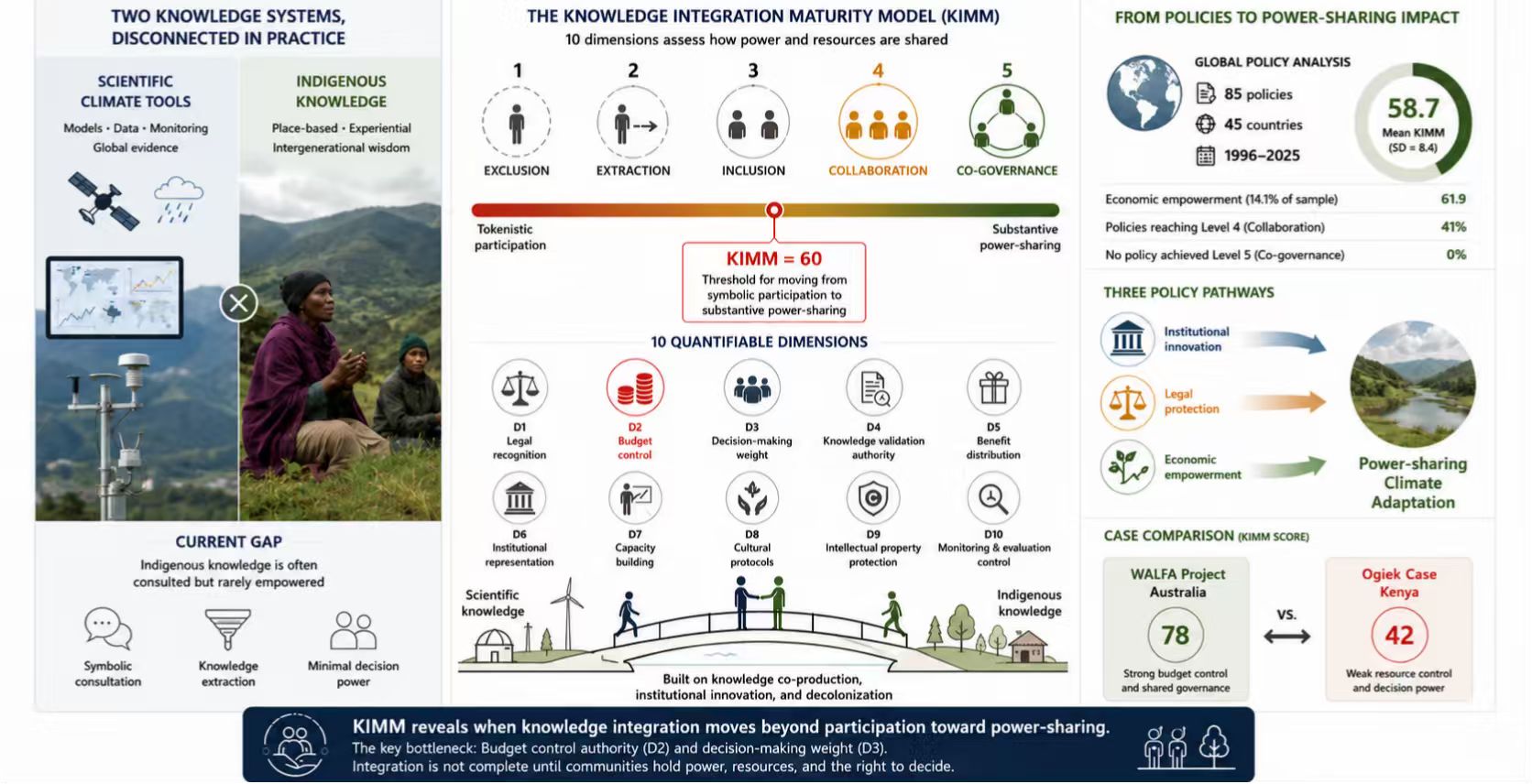
Despite growing recognition of indigenous knowledge in climate adaptation, existing frameworks fail to distinguish genuine integration from tokenistic inclusion. This study develops the Knowledge Integration Maturity Model (KIMM)—a five-stage framework grounded in knowledge co-production theory, institutional innovation theory, and decolonization theory—featuring ten quantifiable dimensions anchored by indigenous decision-making power ratios. A PRISMA-compliant systematic review of the Scopus database identified 6324 records, of which 1980 were included for bibliometric analysis and 62 for in-depth qualitative synthesis. Applying KIMM to 85 global climate adaptation policies (1996–2025) across 45 countries, supplemented by case studies of Australia’s WALFA project, Colombia’s T-248 ruling, and Kenya’s Ogiek case, we find that global policies are transitioning from Level 3 (Inclusion) toward Level 4 (Collaboration), with a mean score of 58.7 (SD = 8.4) and none achieving Level 5 (Co-governance). Economic empowerment policies, though only 14.1% of the sample, demonstrate superior outcomes (mean = 61.9, Level 4 attainment = 50%), while budget control authority (D2 = 5.12) emerges as the critical bottleneck. A threshold effect at KIMM = 60 marks the shift from symbolic participation to substantive power-sharing, evidenced by the 36-point gap between WALFA (78) and Ogiek (42). These findings extend knowledge co-production theory by identifying structural preconditions for genuine collaboration, enrich institutional theory by revealing sequential change patterns where resource redistribution lags behind legal recognition, and operationalize decolonization theory through measurable indicators. The KIMM framework provides policymakers with diagnostic tools to advance from recognizing knowledge to empowering communities through institutionalized power redistribution.
- Open Access
- Review
Collaborative Innovation Across Knowledge Systems: A New Shift in Integrating Indigenous Knowledge and Scientific Climate Adaptation Tools—A Systematic Review and Policy Analysis
- Yinan Gao 1,*,
- Kenichiro Hiramoto 1,
- Fang Lian 1,
- Youyue Tian 1,
- Seira Mary Cherian 1,
- Takuma Ozaki 1,
- Nidhi Prathap 2 and
- Rajib Shaw 1
Author Information
Received: 08 December 2025 | Revised: 08 February 2026 | Accepted: 09 February 2026 | Published: 28 February 2026
Abstract
Graphical Abstract
Keywords
indigenous knowledge integration | knowledge integration maturity model | climate adaptation policy | knowledge co-production | institutional innovation | decolonization | power redistribution
References
- 1.
Bohensky, E.L.; Maru, Y. Indigenous knowledge, science, and resilience: What have we learned from a decade of international literature on integration? Ecol. Soc. 2011, 16, 6.
- 2.
Hermans, T.D.G.; Šakić Trogrlić, R.; van den Homberg, M.J.C.; et al. Exploring the integration of local and scientific knowledge in early warning systems. Nat. Hazards 2022, 114, 1352–1386. https://doi.org/10.1007/s11069-022-05435-3.
- 3.
IPCC. Climate Change 2022: Impacts, Adaptation and Vulnerability; Cambridge University Press: Cambridge, UK, 2022.
- 4.
Dorji, T.; Rinchen, K.; Morrison-Saunders, A.; et al. Understanding how indigenous knowledge contributes to climate change adaptation in Bhutan. Environ. Manag. 2024, 74, 720–735. https://doi.org/10.1007/s00267-024-02025-w.
- 5.
Maracle, K.B.; General, Z.; Hill, S.; et al. Indigenous knowledge as an independent cognitive framework for climate decision-making. Environ. Sci. Policy 2025, 163, 103925. https://doi.org/10.1016/j.envsci.2025.103925.
- 6.
Nalau, J.; Becken, S.; Schliephack, J.; et al. The role of indigenous and traditional knowledge in ecosystem-based adaptation. Weather Clim. Soc. 2018, 10, 851–865. https://doi.org/10.1175/WCAS-D-17-0098.1.
- 7.
Convention on Biological Diversity. Kunming-Montreal Global Biodiversity Framework; CBD/COP/15/L.25; Secretariat of the CBD: Montreal, QC, Canada, 2022.
- 8.
Troncarelli, L.T.; de Ataide, M.T.; Morsello, C. Existing evidence of conceptual differences in research on climate change perceptions: A systematic map. Environ. Evid. 2023, 12, 26. https://doi.org/10.1186/s13750-023-00317-y.
- 9.
Arnstein, S.R. A ladder of citizen participation. J. Am. Inst. Plan. 1969, 35, 216–224. https://doi.org/10.1080/01944366908977225.
- 10.
Pretty, J.N. Participatory learning for sustainable agriculture. World Dev. 1995, 23, 1247–1263.
- 11.
Page, M.J.; McKenzie, J.E.; Bossuyt, P.M.; et al. The PRISMA 2020 statement: An updated guideline for reporting systematic reviews. BMJ 2021, 372, n71. https://doi.org/10.1136/bmj.n71.
- 12.
Moher, D.; Liberati, A.; Tetzlaff, J.; et al. Preferred reporting items for systematic reviews and meta-analyses: The PRISMA statement. PLoS Med. 2009, 6, e1000097. https://doi.org/10.1371/journal.pmed.1000097.
- 13.
Thomas, J.; Harden, A. Methods for the thematic synthesis of qualitative research in systematic reviews. BMC Med. Res. Methodol. 2008, 8, 45. https://doi.org/10.1186/1471-2288-8-45.
- 14.
Cajete, G.A. Indigenous science, climate change, and indigenous community building: A framework of foundational perspectives. Sustainability 2020, 12, 9569. https://doi.org/10.3390/su12229569.
- 15.
Williams, P.A.; Sikutshwa, L.; Shackleton, S. Acknowledging indigenous and local knowledge to facilitate collaboration in landscape approaches. Land 2020, 9, 331.
- 16.
Crate, S.; Ulrich, M.; Habeck, J.O.; et al. Permafrost livelihoods: A transdisciplinary review and analysis. Anthropocene 2017, 18, 89–104. https://doi.org/10.1016/j.ancene.2017.06.001.
- 17.
Dunmall, K.M.; Langan, J.A.; Cunningham, C.J.; et al. Pacific salmon in the Canadian Arctic: A range-expansion pathway. Glob. Chang. Biol. 2024, 30, e17353. https://doi.org/10.1111/gcb.17353.
- 18.
Eilola, S.; Horstkotte, T.; Forbes, B.C.; et al. Perceptions on environmental changes among reindeer herders. Reg. Environ. Chang. 2024, 24, 72. https://doi.org/10.1007/s10113-024-02248-x.
- 19.
Rai, P.; Khawas, V. Traditional knowledge system in disaster risk reduction. Jamba: J. Disaster Risk Stud. 2020, 11, 484. https://doi.org/10.4102/jamba.v11i1.484.
- 20.
McMichael, C.; Kothari, U.; McNamara, K.E.; et al. Spatial and temporal ways of knowing sea level rise. Wiley Interdiscip. Rev. Clim. Chang. 2021, 12, e703. https://doi.org/10.1002/wcc.703.
- 21.
Berkes, F. Sacred Ecology, 4th ed.; Routledge: New York, NY, USA, 2018.
- 22.
Carter, L. He korowai o matainaka/the cloak of matainaka: Traditional ecological knowledge in climate science. New Zealand J. Ecol. 2019, 43, 3386. https://doi.org/10.20417/nzjecol.43.35.
- 23.
Berkes, F.; Colding, J.; Folke, C. Rediscovery of traditional ecological knowledge as adaptive management. Ecol. Appl. 2000, 10, 1251–1262. https://doi.org/10.1890/1051-0761(2000)010[1251:ROTEKA]2.0.CO;2.
- 24.
Camacho-Villa, T.C.; Martinez-Cruz, T.E.; Ramírez-López, A.; et al. Mayan traditional knowledge on weather forecasting. Front. Sustain. Food Syst. 2021, 5, 618453. https://doi.org/10.3389/fsufs.2021.618453.
- 25.
Gagnon, C.A.; Hamel, S.; Russell, D.E.; et al. Merging indigenous and scientific knowledge links climate with caribou growth. J. Appl. Ecol. 2020, 57, 1644–1655. https://doi.org/10.1111/1365-2664.13648.
- 26.
Priadka, P.; Moses, B.; Kozmik, C.; et al. Weaving indigenous and Western knowledge systems to discern drivers of moose population decline. People Nat. 2024, 6, 2090–2103. https://doi.org/10.1002/pan3.10704.
- 27.
Chisholm Hatfield, S.; Marino, E.; Whyte, K.P.; et al. Indian time: Time, seasonality, and culture in Traditional Ecological Knowledge of climate change. Ecol. Process. 2018, 7, 25. https://doi.org/10.1186/s13717-018-0136-6.
- 28.
Olazabal, M.; Chu, E.; Castán Broto, V.; et al. Subaltern forms of knowledge are required to boost local adaptation. One Earth 2021, 4, 758–762. https://doi.org/10.1016/j.oneear.2021.05.006.
- 29.
Smith, B.M.; Basu, P.C.; Chatterjee, A.; et al. Collating and validating indigenous and local knowledge to apply multiple knowledge systems. Biol. Conserv. 2017, 211, 20–28. https://doi.org/10.1016/j.biocon.2017.04.020.
- 30.
Ali, T.; Paton, D.; Buergelt, P.T.; et al. Integrating indigenous perspectives and community-based disaster risk reduction: A systematic review. Int. J. Disaster Risk Reduct. 2020, 42, 101352. https://doi.org/10.1016/j.ijdrr.2019.101352.
- 31.
Chambon, M.; Wambiji, N.; Alvarez Fernandez, S.; et al. Weaving scientific and local knowledge on climate change impacts in coastal Kenya. Environ. Sci. Policy 2024, 160, 103846. https://doi.org/10.1016/j.envsci.2024.103846.
- 32.
Gagnon, C.A.; Hamel, S.; Russell, D.E.; et al. Climate, caribou and human needs linked by indigenous and scientific knowledge. Nat. Sustain. 2023, 6, 1265–1273. https://doi.org/10.1038/s41893-023-01155-z.
- 33.
Obwocha, E.B.; Ramisch, J.J.; Duguma, L.; et al. The relationship between climate change, variability, and food security. Sustainability 2022, 14, 765. https://doi.org/10.3390/su14020765.
- 34.
Ofoegbu, C.; New, M. Evaluating the effectiveness of climate information communication for smallholder farmers. Agriculture 2022, 12, 160. https://doi.org/10.3390/agriculture12020160.
- 35.
Kom, Z.; Nethengwe, N.S.; Mpandeli, S.; et al. Indigenous knowledge indicators employed by farmers for adaptation in rural South Africa. J. Environ. Plan. Manag. 2023, 66, 1227–1249. https://doi.org/10.1080/09640568.2022.2029669.
- 36.
Whyte, K.P. Indigenous science (fiction) for the Anthropocene: Ancestral dystopias and fantasies of climate change crises. Environ. Plan. E Nat. Space 2018, 1, 224–242. https://doi.org/10.1177/2514848618777621.
- 37.
Cameron, E.S.; Toner, A.; Pyke, G. Integrating indigenous and Western sciences in environmental assessments. Environ. Sci. Policy 2019, 94, 27–35. https://doi.org/10.1016/j.envsci.2018.12.026.
- 38.
Utami, F.P.; Cahyandari, D.; Muslihudin, M. Bridging knowledge systems: Integration challenges in community-based climate adaptation. Clim. Risk Manag. 2024, 45, 100622. https://doi.org/10.1016/j.crm.2024.100622.
- 39.
Jasanoff, S. (Ed.) States of Knowledge: The Co-Production of Science and the Social Order; Routledge: London, UK, 2004.
- 40.
Tengö, M.; Brondizio, E.S.; Elmqvist, T.; et al. Connecting diverse knowledge systems for enhanced ecosystem governance: The multiple evidence base approach. Ambio 2014, 43, 579–591. https://doi.org/10.1007/s13280-014-0501-3.
- 41.
Heatta, M.J.; Hausner, V.H.; Utsi, T.A. The use of multiple evidence base methods in climate change research among Sámi reindeer herders. Ambio 2025, 54, 118–134. https://doi.org/10.1007/s13280-024-02060-1.
- 42.
DiMaggio, D.J.; Powell, W.W. The iron cage revisited: Institutional isomorphism and collective rationality in organizational fields. Am. Sociol. Rev. 1983, 48, 147–160.
- 43.
Scott, W.R. Institutions and Organizations: Ideas, Interests, and Identities, 4th ed.; SAGE Publications: Thousand Oaks, CA, USA, 2014.
- 44.
Folke, C.; Hahn, T.; Olsson, P.; et al. Adaptive governance of social-ecological systems. Annu. Rev. Environ. Resour. 2005, 30, 441–473. https://doi.org/10.1146/annurev.energy.30.050504.144511.
- 45.
Burch, S.; Gupta, A.; Inoue, C.Y.A.; et al. New frontiers in earth system governance: Research priorities for the decade ahead. Earth Syst. Gov. 2019, 1, 100006. https://doi.org/10.1016/j.esg.2019.100006.
- 46.
United Nations. United Nations Declaration on the Rights of Indigenous Peoples; A/RES/61/295; UN General Assembly: New York, NY, USA, 2007.
- 47.
Foucault, M. Power/Knowledge: Selected Interviews and Other Writings, 1972-1977; Gordon, C., Ed.; Pantheon Books: New York, NY, USA, 1980.
- 48.
Smith, L.T. Decolonizing Methodologies: Research and Indigenous Peoples; Zed Books: London, UK, 1999.
- 49.
Government of Norway. Nature Diversity Act (Act of 19 June 2009 No. 100 Relating to the Management of Biological, Geological and Landscape Diversity). Available online: https://www.regjeringen.no/en/dokumenter/nature-diversity-act/id570549/ (accessed on 20 November 2025).
- 50.
Impact Assessment Agency of Canada. Indigenous Knowledge Policy Framework for Project Reviews and Regulatory Decisions. Available online: https://www.canada.ca/en/impact-assessment-agency/programs/aboriginal-consultation-federal-environmental-assessment/indigenous-knowledge-policy-framework-initiative/indigenous-knowledge-policy-framework-project-reviews-regulatory-decisions.html (accessed on 20 November 2025).
- 51.
Landis, J.R.; Koch, G.G. The measurement of observer agreement for categorical data. Biometrics 1977, 33, 159–174.
- 52.
Koo, T.K.; Li, M.Y. A guideline of selecting and reporting intraclass correlation coefficients for reliability research. J. Chiropr. Med. 2016, 15, 155–163. https://doi.org/10.1016/j.jcm.2016.02.012.
- 53.
Muelbert, M.M.C.; Copertino, M.; Cotrim da Cunha, L.; et al. The Ocean and Cryosphere in Latin America. Front. Clim. 2021, 3, 748344. https://doi.org/10.3389/fclim.2021.748344.
- 54.
Neef, A.; Boruff, B.; Bruce, E.; et al. Climate change adaptation in disaster-prone communities in Cambodia and Fiji. APN Sci. Bull. 2020, 10, 95–101. https://doi.org/10.30852/sb.2020.983.
- 55.
Pfeffer, J.; Salancik, G.R. The External Control of Organizations: A Resource Dependence Perspective; Harper & Row: New York, NY, USA, 1978.
- 56.
Russell-Smith, J.; Yates, C.; Edwards, A.; et al. Contemporary fire regimes of northern Australia. Int. J. Wildland Fire 2003, 12, 283–297. https://doi.org/10.1071/WF03015.
- 57.
Sinclair, E.A.; Statton, J.; Austin, R.; et al. Healing country together: A seagrass restoration case study from Gathaagudu. Ocean Coast. Manag. 2024, 256, 107274. https://doi.org/10.1016/j.ocecoaman.2024.107274.
- 58.
Turner, H.; Rogers, B.; Kneebone, S.; et al. An organizing framework to break down Western-centric views of knowledge in Northern Australia water management. Sustain. Sci. 2024, 19, 1329–1347. https://doi.org/10.1007/s11625-024-01548-9.
- 59.
Fa, J.E.; Luiselli, L. Weaving the middle spaces between indigenous and scientific knowledge for biodiversity conservation. Afr. J. Ecol. 2025, 63, e70030. https://doi.org/10.1111/aje.70030.
- 60.
Huambachano, M.; Soto, G.R.N.; Mwampamba, T.H. Making room for meaningful inclusion of indigenous and local knowledge in global science–policy platforms. Ecol. Soc. 2025, 30, 16. https://doi.org/10.5751/ES-15994-300116.

This work is licensed under a Creative Commons Attribution 4.0 International License.
