
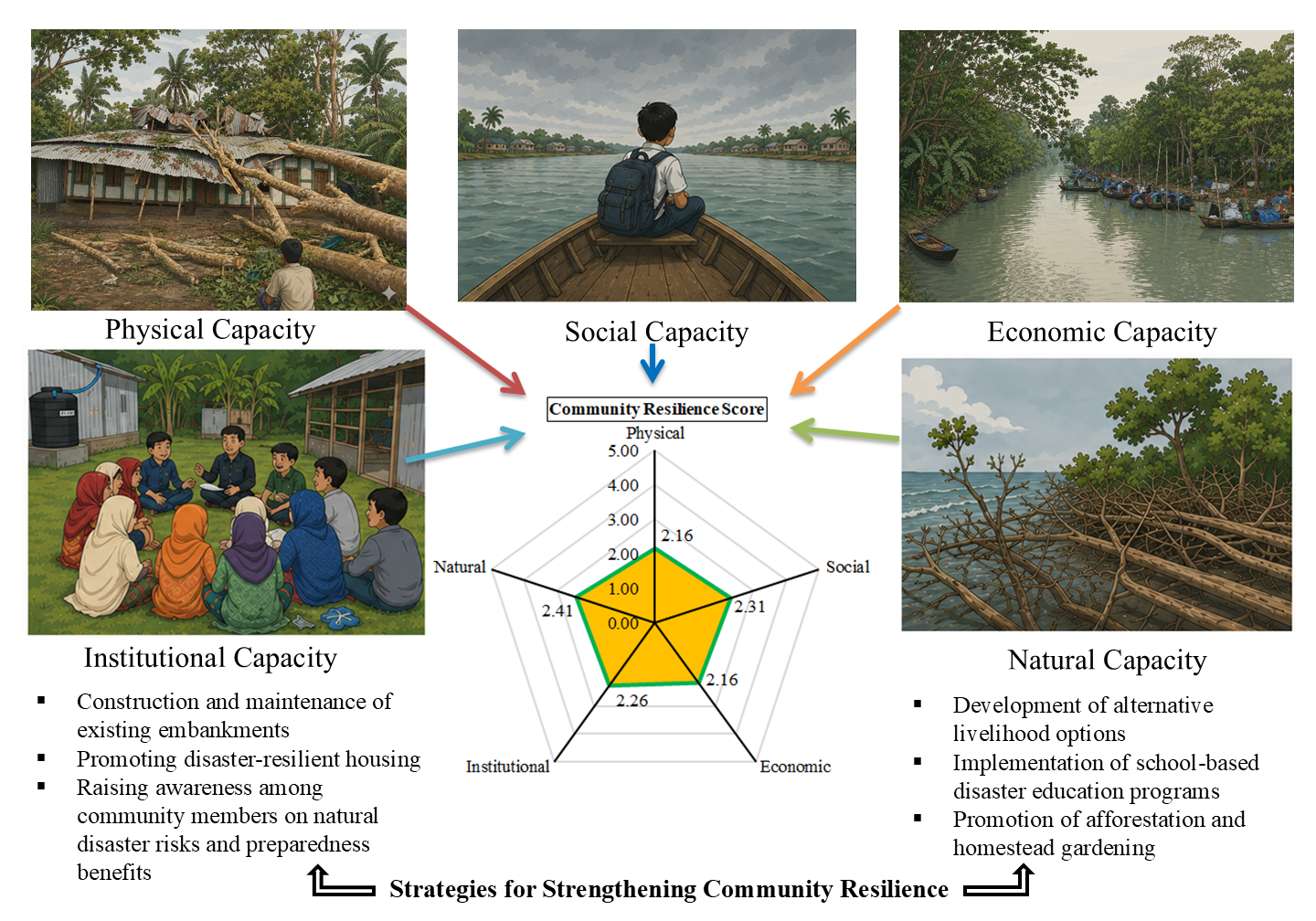
The coastal region of Bangladesh is highly vulnerable to multiple climate-induced hazards, including cyclones, storm surges, tidal flooding, and salinity intrusion, which significantly threaten local livelihoods and ecosystems. Assessing community resilience in these hazard-prone areas is therefore essential for effective disaster risk reduction (DRR) planning. This study aimed to identify the major natural hazards affecting coastal communities and to assess community hazard resilience using the Climate Disaster Resilience Index (CDRI) framework. The study was conducted in Latachapli Union under Kalapara Upazila of Patuakhali District, Bangladesh. Primary data were collected from 120 randomly selected households through semi-structured questionnaires and also 5 Focus Group Discussion (FGD) were conducted on October–November 2025. The CDRI framework evaluates resilience across five dimensions-physical, social, economic, institutional, and natural-where indicator variables are aggregated into parameters, parameters into dimensions, and finally into an overall resilience index ranging from 1 (very low resilience) to 5 (very high resilience). The results show that the overall community resilience score is 2.26, indicating a moderate level of resilience according to the CDRI classification scale. Among the five dimensions, the natural dimension recorded the highest score (2.41), while the physical and economic dimensions had the lowest scores (2.16 each). The social and institutional resilience scores were 2.31 and 2.26, respectively. Despite the moderate overall resilience score, the community faces substantial structural and socio-economic vulnerabilities, including fragile housing conditions, limited financial capacity, and inadequate access to basic services. The findings highlight the need for targeted interventions focusing on resilient infrastructure, livelihood diversification, improved disaster governance, and community-based adaptation strategies. These insights can support policymakers, development practitioners, and disaster management agencies in designing effective programs to enhance coastal resilience and sustainable development in Bangladesh.
- Open Access
- Article
Measuring Natural Hazards Resilience of Coastal Community in Kalapara Upazila, Patuakhali, Bangladesh
Author Information
Received: 09 February 2026 | Revised: 20 April 2026 | Accepted: 21 April 2026 | Published: 28 April 2026
Abstract
Graphical Abstract
Keywords
coastal community | disaster resilience measurement | Climate Disaster Resilience Index (CDRI) | disaster risk reduction
References
- 1.
Biswas, A.A.A.; Hasan, M.M.; Rahman, M.S.; et al. Disaster Risk Identification in Agriculture Sector: Farmer’s Perceptions and Mitigation Practices in Faridpur. Am. J. Rural Dev. 2015, 3, 60–73. https://doi.org/10.12691/ajrd-3-3-1.
- 2.
Faisal, M.; Saha, M.K.; Sattar, M.A.; et al. Evaluation of Climate Induced Hazards Risk for Coastal Bangladesh: A Participatory Approach‑Based Assessment. Geomat. Nat. Hazards Risk 2021, 12, 2477–2499. https://doi.org/10.1080/19475705.2021.1967203.
- 3.
Metz, B.; Davidson, O.; Bosch, P.; et al. Climate Change Mitigation: The Working Group III Contribution to the IPCC Third Assessment Report. Available online: https://unfccc.int/sites/default/files/metz.pdf (accessed on 5 October 2025).
- 4.
Cohen, O.; Goldberg, A.; Lahad, M.; et al. Building Resilience: The Relationship between Information Provided by Municipal Authorities during Emergency Situations and Community Resilience. Technol. Forecast. Soc. Chang. 2017, 121, 119–125. https://doi.org/10.1016/j.techfore.2016.11.008.
- 5.
Islam, M.B.; Ali, M.Y.; Amin, M.; et al. Climatic Variations: Farming Systems and Livelihoods in the High Barind Tract and Coastal Areas of Bangladesh. In Climate Change and Food Security in South Asia; Springer: Dordrecht, The Netherlands, 2010; pp. 477–497. https://doi.org/10.1007/978-90-481-9516-9_29.
- 6.
Baten, M.A.; Seal, L.; Lisa, K.S. Salinity Intrusion in Interior Coast of Bangladesh: Challenges to Agriculture in South‑Central Coastal Zone. Am. J. Clim. Chang. 2015, 4, 248–262. https://doi.org/10.4236/ajcc.2015.43020.
- 7.
Biswas, A.K.M.A.A.; Sattar, M.A.; Hossain, M.A.; et al. An Internal Environmental Displacement and Livelihood Security in Uttar Bedkashi Union of Bangladesh. Sci. Educ. 2015, 3, 163–175. https://doi.org/10.12691/aees-3-6-2.
- 8.
Ahamed, M. Community Based Approach for Reducing Vulnerability to Natural Hazards (Cyclone, Storm Surges) in Coastal Belt of Bangladesh. Procedia Environ. Sci. 2013, 17, 361–371. https://doi.org/10.1016/j.proenv.2013.02.049.
- 9.
Saha, C.K. Dynamics of Disaster‑Induced Risk in Southwestern Coastal Bangladesh: An Analysis on Tropical Cyclone Aila 2009. Nat. Hazards 2015, 75, 727–754. https://doi.org/10.1007/s11069-014-1343-9.
- 10.
Rabbani, G.; Huq, S. Adaptation Technologies in Agriculture: The Economics of Rice‑Farming Technology in Climate-Vulnerable Areas of Bangladesh. Available online: https://www.osti.gov/etdeweb/servlets/purl/1031198#page=115 (accessed on 2 October 2025).
- 11.
Badjeck, M.C.; Allison, E.H.; Halls, A.S.; et al. Impacts of Climate Variability and Change on Fishery‑Based Livelihoods. Mar. Policy 2010, 34, 375–383. https://doi.org/10.1016/j.marpol.2009.08.007.
- 12.
Biswas, A.; Sonia, N.J.; Nahar, L.; et al. Women’s Vulnerabilities to Climate Induced Hazards and Their Coping Strategies in Chandradip Union of Southern Bangladesh. Br. J. Educ. Soc. Behav. Sci. 2016, 14, 1–15. https://doi.org/10.9734/BJESBS/2016/22763.
- 13.
Biswas, A.; Zaman, A.M.; Sattar, M.A.; et al. Assessment of Disaster Impact on the Health of Women and Children. J. Health Environ. Res. 2015, 1, 19–28. https://doi.org/10.11648/j.jher.20150103.11.
- 14.
Faisal, M.; Biswas, A.M.A.A.; Saha, M.K. Climate Smart Disaster Risk Reduction: Indigenous Knowledge Practiced for Housing Technology in Coastal Zone of Bangladesh. Int. J. Disaster Manag. 2024, 7, 107–128. https://doi.org/10.24815/ijdm.v7i1.36786.
- 15.
Ortiz, C.A.C. Sea‑Level Rise and Its Impact on Bangladesh. Ocean Coast. Manag. 1994, 23, 249–270. https://doi.org/10.1016/0964-5691(94)90022-1.
- 16.
Akanda, M.G.R.; Howlader, M.S. Coastal Farmers’ Perception of Climate Change Effects on Agriculture at Galachipa Upazila under Patuakhali District of Bangladesh. Glob. J. Sci. Front. Res. Agric. Vet. 2015, 15, 30–39.
- 17.
Faisal, M.; Saha, M.K.; Biswas, A.M.A.A. Risk Analysis of Climate‑Induced Hazards in Coastal Bangladesh: Study on Dashmina Upazila in Patuakhali District. Int. J. Disaster Manag. 2024, 6, 355–368. https://doi.org/10.24815/ijdm.v6i3.36483.
- 18.
Faisal, M.; Saha, M.K.; Biswas, A.M.A.A. Climate Smart Disaster Risk Reduction: Indigenous Knowledge Practiced for Agriculture Sector in Coastal Bangladesh. Int. J. Disaster Risk Manag. 2025, 7, 87–112. https://doi.org/10.18485/ijdrm.2025.7.2.6.
- 19.
Saha, M.K.; Biswas, A.A.A.; Faisal, M. Livelihood Vulnerability of Coastal Communities in Context of the Climate Change: An Index‑Based Assessment. World Dev. Sustain. 2024, 4, 100152. https://doi.org/10.1016/j.wds.2024.100152.
- 20.
Asgary, A.; Halim, A. Measuring People’s Preferences for Cyclone Vulnerability Reduction Measures in Bangladesh. Disaster Prev. Manag. 2011, 20, 186–198. https://doi.org/10.1108/09653561111126111.
- 21.
Iva, T.T.; Hazra, P.; Faisal, M.; et al. River Bank Erosion and Its Impact on Population Displacement in Bauphal Upazila under Patuakhali District, Bangladesh. J. Sci. Technol. Environ. Inform. 2017, 5, 371–381. https://doi.org/10.18801/jstei.050217.39.
- 22.
Rahim, M.A.; Munmuna, K.A.; Nura, M.N.B.; et al. Assessment of Community Resilience to Disasters: A Case Study at Chotto Bighai Union in Patuakhali District, Bangladesh. Available online: https://sparc.cmb.ac.lk/wp-content/uploads/2019/07/Final-version-of-the-ASCENT-Book-volume-.pdf#page=49 (accessed on 3 October 2025).
- 23.
Shameem, M.I.M.; Momtaz, S.; Rauscher, R. Vulnerability of Rural Livelihoods to Multiple Stressors: A Case Study from the Southwest Coastal Region of Bangladesh. Ocean Coast. Manag. 2014, 102, 79–87. https://doi.org/10.1016/j.ocecoaman.2014.09.002.
- 24.
Mirza, M.M.Q. Global Warming and Changes in the Probability of Occurrence of Floods in Bangladesh and Implications. Global Environ. Chang. 2002, 12, 127–138. https://doi.org/10.1016/S0959-3780(02)00002-X.
- 25.
Saroar, M.M.; Routray, J.K.; Filho, W.L. Livelihood Vulnerability and Displacement in Coastal Bangladesh: Understanding the Nexus. In Climate Change in the Asia‑Pacific Region; Springer: Cham, Switzerland, 2015; pp. 9–31. https://doi.org/10.1007/978-3-319-14938-7.
- 26.
Islam, M.A.; Shamsuzzoha, M.; Rasheduzzaman, M.; et al. Assessment on Climate Change Adaptation: A Study on Coastal Area of Khulna District in Bangladesh. Aust. J. Eng. Innov. Technol. 2019, 1, 14–20. https://doi.org/10.34104/ajeit.019.014020.
- 27.
Khan, T.M.A.; Singh, O.P.; Rahman, M.S. Recent Sea Level and Sea Surface Temperature Trends along the Bangladesh Coast in Relation to the Frequency of Intense Cyclones. Mar. Geod. 2000, 23, 103–116. https://doi.org/10.1080/01490410050030670.
- 28.
Saha, M.K.; Biswas, A.A.A.; Faisal, M.; et al. Factors Affecting to Adoption of Climate‑Smart Agriculture Practices by Coastal Farmers in Bangladesh. Am. J. Environ. Sustain. Dev. 2019, 4, 113–121.
- 29.
Choudhury, A.M.; Haque, M.A.; Quadir, D.A. Consequences of Global Warming and Sea Level Rise in Bangladesh. Mar. Geod. 1997, 20, 13–31. https://doi.org/10.1080/01490419709388092.
- 30.
Begum, S.; Fleming, G. Climate Change and Sea Level Rise in Bangladesh, Part II: Effects. Mar. Geod. 1997, 20, 55–68. https://doi.org/10.1080/01490419709388094.
- 31.
Nur, M.N.B.; Nisa, S.N.; Rasheduzzaman, M.; et al. Analyzing the Socio‑Economic Impacts of Cyclone at Pangasia Union in Dumki Upazila under Patuakhali District, Bangladesh. Int. J. Res. Innov. Soc. Sci. 2025, 9, 2391–2400. https://doi.org/10.47772/IJRISS.2025.907000192.
- 32.
Mukherjee, A.; Faisal, M.; Saha, M.K. Measuring Resilience of Urban Slum to Climate‑Induced Hazards: A Study on Barishal City Corporation, Bangladesh. Int. J. Disaster Manag. 2020, 3, 34–47. https://doi.org/10.24815/ijdm.v3i2.17815.
- 33.
Burton, C.G. A Validation of Metrics for Community Resilience to Natural Hazards and Disasters Using the Recovery from Hurricane Katrina as a Case Study. Ann. Am. Assoc. Geogr. 2015, 105, 67–86. https://doi.org/10.1080/00045608.2014.960039.
- 34.
BBS, BS. Population and Housing Census 2022. Available online: http://203.112.218.101/storage/files/1/Publications/PHC_2021%20Community%20Report/Barishal%20Division/Community%20Report%20Patuakhali.pdf (accessed on 5 October 2025).
- 35.
Suissa, S.; Shuster, J.J. Exact Unconditional Sample Sizes for the 2 × 2 Binomial Trial. J. R. Stat. Soc. Ser. A 1985, 148, 317–327. https://doi.org/10.2307/2981892.
- 36.
Joerin, J.; Shaw, R. Climate and Disaster Resilience in Cities. In Chapter 3: Mapping Climate and Disaster Resilience in Cities; Emerald Group Publishing: Leeds, UK, 2011; pp. 47–61. https://doi.org/10.1108/S2040-7262(2011)0000006009.
- 37.
Sahana, M.I.; Fuji, R.; Takahashi, T.; et al. Tsunami Data Assimilation Using High‑Frequency Radar‑Derived Surface Currents by Considering Beam Angle‑Dependent Measurement Error Distributions. Earth Space Sci. 2024, 11, e2024EA003561. https://doi.org/10.1029/2024EA003561.
- 38.
Wang, Y.; Imai, K.; Horikawa, H. Tsunami Early Warning Using High‑Frequency Ocean Radar System in the Kii Channel, Japan. Seismol. Res. Lett. 2025, 96, 990–1000. https://doi.org/10.1785/0220240168.
- 39.
Sitko, P. Urban Disaster Resilience: Learning from the 2011 Bangkok Flood. Ph.D. Thesis, Oxford Brookes University, Oxford, UK, 2016.
- 40.
Nurzaman, A.; Shaw, R.; Roychansyah, M.S. Measuring Community Resilience against Coastal Hazards: Case Study in Baron Beach, Gunungkidul Regency. Prog. Disaster Sci. 2020, 5, 100067. https://doi.org/10.1016/j.pdisas.2020.100067.
- 41.
Yoon, D.K.; Kang, J.E.; Brody, S.D. A Measurement of Community Hazard Resilience in Korea. J. Environ. Plan. Manag. 2016, 59, 436–460. https://doi.org/10.1080/09640568.2015.1016142.
- 42.
Kabir, M.H.; Sato, M.; Habbiba, U.; et al. Assessment of Urban Disaster Resilience in Dhaka North City Corporation (DNCC), Bangladesh. Procedia Eng. 2018, 212, 1107–1114. https://doi.org/10.1016/j.proeng.2018.01.143.

This work is licensed under a Creative Commons Attribution 4.0 International License.
