
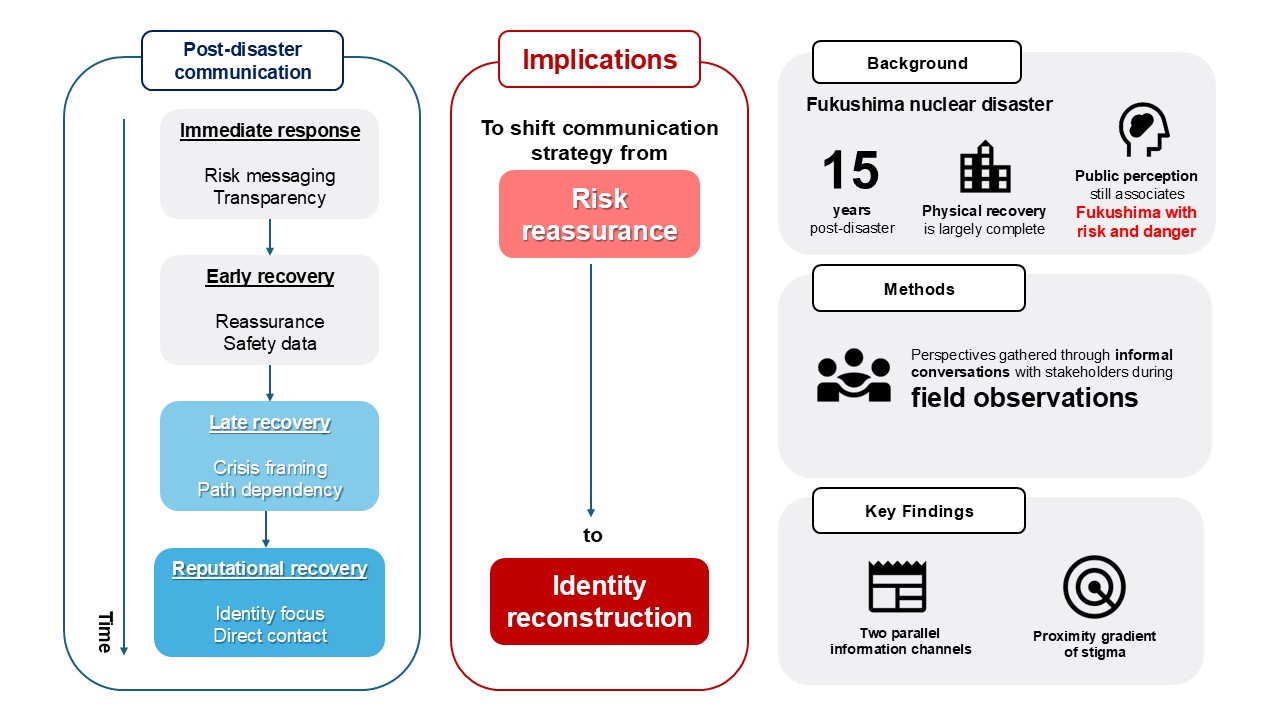
Crisis communication approaches that emphasize transparency, clear messaging, and visible recovery efforts are well developed for managing public risk perception during acute disasters. However, these approaches are less well equipped to address the challenges that persist long after physical recovery, particularly when a location becomes associated with a disaster in public consciousness. This paper examines Fukushima Prefecture, Japan, as a case study of post-disaster reputational recovery, drawing on field observations during a graduate practicum conducted approximately fourteen years after the 2011 triple disaster (earthquake, tsunami, and nuclear accident). Observations included field visits, conversations with residents and community stakeholders, and review of communication materials spanning disaster education, tourism promotion, and local and international-facing information channels. Our findings reveal two parallel information channels: disaster-era content dominates wider public-facing materials, while post-disaster recovery regional identity content is primarily circulated within local channels, with limited reach to international audiences. Field observations also indicate that disaster associations seem to weaken with direct experience of the place, suggesting that stigma operates through mental associations that informational reassurance alone may not fully address. We argue that effective post-disaster recovery communication requires a transition from risk reassurance to identity reconstruction, including strategies that increase direct engagement with the place, expand the visibility of post-disaster recovery narratives to wider audiences, and better align local self-perception with the current phase of recovery. This study is exploratory in nature, and further empirical research is needed to validate its findings across comparable post-disaster recovery contexts.
- Open Access
- Article
Rethinking Communication in Post-Disaster Recovery: A Case Study from Fukushima, Japan
- Aisha Arsyaningrum 1,2,
- Yoshitaka Nishikawa 2,3,
- Isamu Amir 2,4 and
- Aya Goto 2,5,*
Author Information
Received: 28 April 2026 | Revised: 16 June 2026 | Accepted: 16 June 2026 | Published: 17 June 2026
Abstract
Graphical Abstract
Keywords
disasters | social stigma | perception | health communication | Fukushima
References
- 1.
Kulariya, M.; Saha, S.K. Damage Assessment of Buildings in the Western Himalayan Region under Soil Subsidence, Debris Flood, and Soil Erosion Events Occurred during 2023 Monsoon Season. Innov. Infrastruct. Solut. 2025, 10, 534. https://doi.org/10.1007/s41062-025-02345-8.
- 2.
Kron, W.; Bell, R.; Thiebes, B.; et al. The July 2021 Flood Disaster in Germany. In 2022 HELP Global Report on Water and Disasters; Hiraki, K., Ed.; High-level Experts and Leaders Panel on Water and Disasters (HELP): Tokyo, Japan, 2022; pp. 12–44.
- 3.
De Maeyer, N.; Nagabhatla, N.; Toles, O.M.; et al. The Medium-Term Psychosocial Impact of the 2021 Floods in Belgium: A Survey-Based Study. Clim. Change 2025, 13, 61. https://doi.org/10.3390/cli13030061.
- 4.
Sayers, P.; Penning-Rowsell, E.C.; Horritt, M. Flood Vulnerability, Risk, and Social Disadvantage: Current and Future Patterns in the UK. Reg. Environ. Change 2018, 18, 339–352. https://doi.org/10.1007/s10113-017-1252-z.
- 5.
Miyagawa, S.; Satoh, M.; Furuya, S.; et al. External Support and Community Cooperation during Long-Term Sheltering—From the Case of the Great East Japan Earthquake. In Public Health and Disasters: Health Emergency and Disaster Risk Management in Asia; Chan, E.Y.Y., Shaw, R., Eds.; Springer Nature: Singapore, 2020; pp. 201–219.
- 6.
Chan, E.Y.Y.; Hung, H.; Murray, V.; et al. Health-EDRM in International Policy Agenda I: Sendai Framework for Disaster Risk Reduction 2015–2030. In Public Health and Disasters: Health Emergency and Disaster Risk Management in Asia; Chan, E.Y.Y., Shaw, R., Eds.; Springer Nature: Singapore, 2020; pp. 59–74.
- 7.
Reich, M.R. Toxic Politics: Responding to Chemical Disasters; Cornell University Press: Ithaca, NY, USA, 1991.
- 8.
Coombs, W.T. Protecting Organization Reputations during a Crisis: The Development and Application of Situational Crisis Communication Theory. Corp. Reput. Rev. 2007, 10, 163–176. https://doi.org/10.1057/palgrave.crr.1550049.
- 9.
Centers for Disease Control and Prevention. Crisis and Emergency Risk Communication (CERC): Introduction; Centers for Disease Control and Prevention: Atlanta, GA, USA, 2018.
- 10.
Reynolds, B.; Seeger, M.W. Crisis and Emergency Risk Communication as an Integrative Model. J. Health Commun. 2005, 10, 43–55. https://doi.org/10.1080/10810730590904571.
- 11.
Fukushima Revitalization Information Portal Website. Available online: https://www.pref.fukushima.lg.jp/site/portal-english/ (accessed on 16 April 2026).
- 12.
Liu, M.; Kashiwazaki, Y.; Matsunaga, H.; et al. The Impact of Nuclear Disaster Experiences on Perception of Spatial Stigma: A Study of Fukushima Residents 13 Years after the Accident. J. Radiol. Prot. 2026, 46, 011507. https://doi.org/10.1088/1361-6498/ae38ee.
- 13.
Maeda, M.; Oe, M. Mental Health Consequences and Social Issues after the Fukushima Disaster. Asia Pac. J. Public. Health 2017, 29, 36S–46S. https://doi.org/10.1177/1010539516689695.
- 14.
Decontamination in the Prefecture. Available online: https://www.pref.fukushima.lg.jp/site/portal-english/en02-03.html (accessed on 24 February 2026).
- 15.
Ono, A. Fukushima Daiichi Decontamination and Decommissioning: Current Status and Challenges. Ann. ICRP 2021, 50, 24–30. https://doi.org/10.1177/01466453211010865.
- 16.
Yamashita, S.; Ohto, H.; Abe, M.; et al. Comprehensive Health Risk Management after the Fukushima Nuclear Power Plant Accident. Clin. Oncol. 2016, 28, 255–262. https://doi.org/10.1016/j.clon.2016.01.001.
- 17.
Yasumura, S.; Hosoya, M.; Yamashita, S.; et al. Study Protocol for the Fukushima Health Management Survey. J. Epidemiol. 2012, 22, 375–383. https://doi.org/10.2188/jea.je20120105.
- 18.
Progress of Post-Disaster Reconstruction Work. Available online: https://www.pref.fukushima.lg.jp/site/portal-english/en-5-1-2.html (accessed on 24 February 2026).
- 19.
Murakami, M.; Sato, A.; Matsui, S.; et al. Communicating with Residents about Risks following the Fukushima Nuclear Accident. Asia Pac. J. Public. Health 2017, 29, 74S–89S. https://doi.org/10.1177/1010539516681841.
- 20.
Schreurs, M.A. Reconstruction and Revitalization in Fukushima a Decade after the Triple Disaster: Striving for Sustainability and a New Future Vision. Int. J. Disaster Risk Reduct. 2021, 53, 102006. https://doi.org/10.1016/j.ijdrr.2020.102006.
- 21.
Sandman, P.M. Responding to Community Outrage: Strategies for Effective Risk Communication; American Industrial Hygiene Association: Fairfax, VA, USA, 1993.
- 22.
Kahneman, D. Thinking, Fast and Slow; Farrar, Straus and Giroux: New York, NY, USA, 2011.
- 23.
Isaji, R.; Rahman, N.K.; Goto, A. Fukushima Field Course from a Public. Health Perspective: A Review of the 2025 Harvard Course. J. Glob. Health Sci. 2025, 7, e32. https://doi.org/10.35500/jghs.2025.7.e32.
- 24.
2020 Population Census: Summary of Results and Statistical Tables. Available online: https://www.stat.go.jp/english/data/kokusei/2020/summary.html (accessed on 16 April 2026).
- 25.
Fukushima Prefecture Outlines. Available online: https://www.pref.fukushima.lg.jp/site/portal-english/en05-01.html (accessed on 16 April 2026).
- 26.
Greenhalgh, T. Case Studies: A Guide for Researchers, Educators, and Implementers. BMJ Med. 2025, 4, e001623. https://doi.org/10.1136/bmjmed-2025-001623.
- 27.
CAST-D—Reporting Guideline for Case Study in Public Health and Medicine Related to Disasters. Available online: https://www.equator-network.org/library/reporting-guidelines-under-development/reporting-guidelines-under-development-for-other-study-designs/#CAST (accessed on 10 February 2026).
- 28.
Great East Japan Earthquake and Nuclear Disaster Memorial Museum. Available online: https://www.fipo.or.jp/lore/en (accessed on 24 February 2026).
- 29.
Transition and Current Status of Air Dose Rates in Fukushima Prefecture. Available online: https://www.pref.fukushima.lg.jp/site/portal-english/en-2-3-1.html (accessed on 24 February 2026).
- 30.
Ensuring the Safety and Security of Food. Available online: https://www.pref.fukushima.lg.jp/site/portal-english/en-m4-2.html (accessed on 9 February 2026).
- 31.
Marusei Orchard: About Us. Available online: https://www.maruseifukushima.com/about/ (accessed on 24 February 2026).
- 32.
Fukushima City Tourism Note. Available online: https://www.f-kankou.jp/ (accessed on 15 February 2026).
- 33.
GLOBALG.A.P. Smart Farm Assurance Solutions. Available online: https://www.globalgap.org/ (accessed on 2 March 2026).
- 34.
Xiao, X.; Orita, M.; Kashiwazaki, Y.; et al. Risk perception in long-term evacuees of Futaba town, Fukushima: A cross-sectional study reveals greater concerns outside the prefecture, 12 years after the accident. J. Radiat. Res. 2024, 65, 549–554. https://doi.org/10.1093/jrr/rrae039.
- 35.
Aimoto, K. Radiation-Damaged: After a Soccer Match, Discriminatory Remarks Directed at Fukushima Supporters. HuffPost Japan 2024. Available online: https://www.huffingtonpost.jp/entry/story_jp_67528c4fe4b0807fc8972041 (accessed on 16 April 2026).
- 36.
Tversky, A.; Kahneman, D. Judgment under Uncertainty: Heuristics and Biases. Science 1974, 185, 1124–1131. https://doi.org/10.1126/science.185.4157.1124.
- 37.
Pierson, P. Increasing Returns, Path Dependence, and the Study of Politics. Am. Polit. Sci. Rev. 2000, 94, 251–267. https://doi.org/10.2307/2586011.
- 38.
Wodak, S.; Erdene-Ochir, M.; Fung, B.; et al. Countering Misinformation about Refugees and Migrants: An Evidence-Based Framework; UNSW Sydney: Sydney, Australia, 2025.
- 39.
Hosting Researchers and Students. Available online: https://www.ier.fukushima-u.ac.jp/en/study/hosting (accessed on 24 February 2026).
- 40.
Callaghan, K.; Schnell, F. Who Says What to Whom: Why Messengers and Citizen Beliefs Matter in Social Policy Framing. Soc. Sci. J. 2009, 46, 12–28. https://doi.org/10.1016/j.soscij.2008.12.001.

This work is licensed under a Creative Commons Attribution 4.0 International License.
