
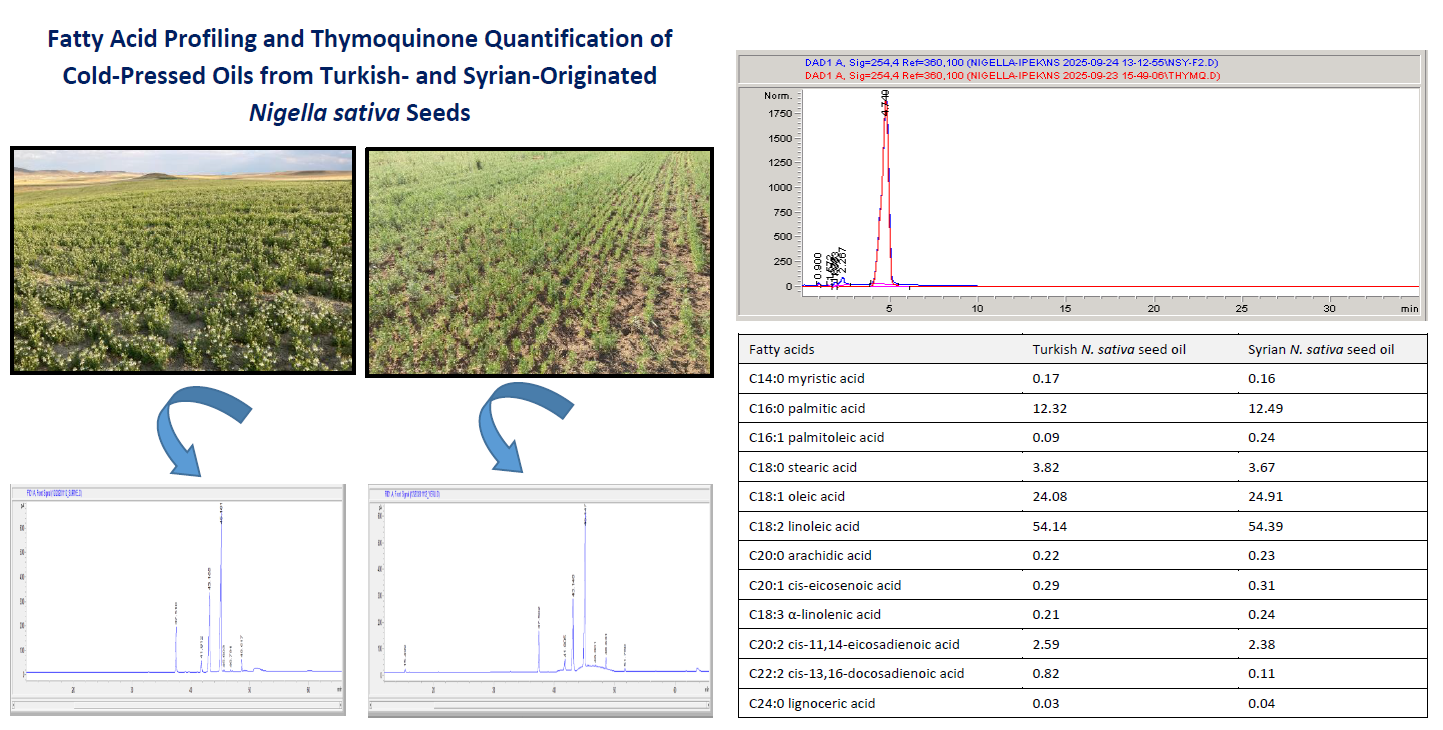
Nigella sativa L. (black cumin) is an annual herb of the Ranunculaceae family, traditionally used in Middle Eastern and Asian medicine for the management of various health conditions. Its seeds and oils are rich in bioactive compounds, including alkaloids, essential fatty acids, nigellone, saponins, and thymoquinone (TQ), which contribute to diverse pharmacological activities such as anticancer, antidiabetic, anti-inflammatory, antimicrobial, antioxidant and hepatoprotective effects. In the present study, oils obtained from Turkish and Syrian N. sativa seeds through cold pressing were investigated. Phytochemical composition was characterized using Gas Chromatography (GC) and High Performance Liquid Chromatography (HPLC), with particular focus on fatty acid profiles and TQ content. Additionally, tyrosinase inhibitory activities of the fixed oils and TQ were evaluated. It was noted that variations in the composition of seed samples originating from different countries influence the phytochemical features of the plant materials. Accordingly, maintaining genetic diversity and implementing appropriate cultivation strategies are essential for the sustainability of agricultural production.
- Open Access
- Article
Fatty Acid Profiling and Thymoquinone Quantification of Cold-Pressed Oils from Turkish- and Syrian-Originated Nigella sativa Seeds
- Ipek Süntar 1,*,
- Aysel Berkkan 2,
- Sinem Aslan Erdem 3,
- F. Sezer Şenol Deniz 1,
- Mithat Atak 4
Author Information
Received: 03 Oct 2025 | Revised: 03 Nov 2025 | Accepted: 03 Nov 2025 | Published: 13 Nov 2025
Abstract
Graphical Abstract
Keywords
cold-pressed oil | fatty acids | Nigella sativa | phytochemical analysis | thymoquinone | tyrosinase inhibition
References
- 1.Ahmad, A.; Husain, A.; Mujeeb, M.; et al. A Review on Therapeutic Potential of Nigella sativa: A Miracle Herb. Asian Pac. J. Trop. Biomed. 2013, 3, 337–352.
- 2.Alam, M.; Bhat, S.A.; Rather, S.A.; et al. A Comprehensive review of Nigella sativa (kalonji) from the Unani perspective. J. Drug Delivery Ther. 2023, 13, 121–128.
- 3.Aygün, S.B.; Karataş, E. The effect of Nigella sativa (black cumin seed) on health. Toros Univ. J. Nutr. Gastron. 2024, 3, 83–98.
- 4.Ali, B.H.; Blunden, G. Pharmacological and Toxicological Properties of Nigella sativa. Phytother. Res. 2003, 17, 299–305.
- 5.Salem, M.L. Immunomodulatory and Therapeutic Properties of Nigella sativa. Int. Immunopharmacol. 2005, 5, 1749–1770.
- 6.Boskabady, M.H.; Kiani, S.; Jandaghi, P. Comparison of Antitussive Effect of Nigella sativa with Codein in Guinea Pig. Iran. J. Med. Sci. 2003, 28, 111–115.
- 7.Kalus, U.; Pruss, A.; Bystron, J.; et al. Effect of Nigella sativa (Black Seed) on Subjective Feeling in Patients with Allergic Diseases. Phytother. Res. 2003, 17, 1209–1214.
- 8.Gali-Muhtasib, H.; El-Najjar, N.; Schneider-Stock, R. The Medicinal Potential of Black Seed (Nigella sativa) and Its Components. In Advances in Phytomedicine; Mahmud, T.H.K., Arjumand, A., Eds.; Elsevier: Amsterdam, The Netherlands, 2006; pp. 133–153.
- 9.Houghton, P.J.; Zarka, R.; de las Heras, B.; et al. Fixed Oil of Nigella sativa and Derived Thymoquinone Inhibit Eicosanoid Generation in Leukocytes and Membrane Lipid Peroxidation. Planta Med. 1995, 61, 33–36.
- 10.Randhawa, M.A.; Alghamdi, M.S. Anticancer Activity of Nigella sativa (Black Seed)—A Review. Am. J. Chin. Med. 2011, 39, 1075–1091.
- 11.Dollah, M.A.; Parhizkar, S.; Izwan, M. Effect of Nigella sativa on the Kidney Function in Rats. Avicenna J. Phytomed. 2013, 3, 152–158.
- 12.Rahman, A.U.; Abdullah, A.; Faisal, S.; et al. Unlocking the therapeutic potential of Nigella sativa extract: Phytochemical analysis and revealing antimicrobial and antioxidant marvels. BMC Complement. Med. Ther. 2024, 24, 266, 1-14.
- 13.Akhtar, M.S.; Riffat, S. Field Trial of Saussurea lappa Roots against Nematodes and Nigella sativa Seeds against Cestodes in Children. J. Pak. Med. Assoc. 1991, 41, 185–187.
- 14.Hanafy, M.S.; Hatem, M.E. Studies on the Antimicrobial Activity of Nigella sativa Seed (Black Cumin). J. Ethnopharmacol. 1991, 34, 275–278.
- 15.Mahmoud, M.R.; El-Abhar, H.S.; Saleh, S. The Effect of Nigella sativa Oil against the Liver Damage Induced by Schistosoma mansoni Infection in Mice. J. Ethnopharmacol. 2002, 79, 1–11.
- 16.Al-Mubarak, F.T.M.; Hizam, M.M.; Faleh Hashem Al-Gorani, A.; et al. Antiviral Effectiveness of Nigella sativa Oil on LaSota Strain of Newcastle Disease Virus In Vitro. Med. J. Babylon 2024, 21, 101–106.
- 17.El-Dakhakhny, M.; Madi, N.J.; Lembert, N.; et al. Nigella sativa Oil, Nigellone and Derived Thymoquinone Inhibit Synthesis of 5-Lipoxygenase Products in Polymorphonuclear Leukocytes from Rats. J. Ethnopharmacol. 2002, 81, 161–164.
- 18.Al-Jassir, M.S. Chemical Composition and Microflora of Black Cumin (Nigella sativa L.) Seeds Growing in Saudi Arabia. Food Chem. 1992, 45, 239–242.
- 19.Nickavar, B.; Mojab, F.; Javidnia, K.; et al. Chemical Composition of the Fixed and Volatile Oils of Nigella sativa L. from Iran. Z. Naturforsch. C Biosci. 2003, 58, 629–631.
- 20.Matthäus, B.; Özcan, M.M. Fatty Acids, Tocopherol, and Sterol Contents of Some Nigella Species Seed Oil. Czech J. Food Sci. 2011, 29, 559–562.
- 21.Chakravarty, N. Inhibition of Histamine Release from Mast Cells by Nigellone. Ann. Allergy 1993, 70, 237–242.
- 22.Woo, C.C.; Kumar, A.P.; Sethi, G.; et al. Thymoquinone: Potential Cure for Inflammatory Disorders and Cancer. Biochem. Pharmacol. 2012, 83, 443–451.
- 23.Wienkotter, N.; Hopner, D.; Schutte, U.; et al. The Effect of Nigellone and Thymoquinone on Inhibiting Trachea Contraction and Mucociliary Clearance. Planta Med. 2008, 74, 105–108.
- 24.Gürel, Ş.H.; Çiçek Polat, D. Nigella sativa L.: An overview. J. Fac. Pharm. Ank. Univ. 2025, 49, 133–145.
- 25.Gholamnezhad, Z.; Havakhah, S.; Boskabady, M.H. Preclinical and Clinical Effects of Nigella sativa and Its Constituent, Thymoquinone: A Review. J. Ethnopharmacol. 2016, 190, 372–386.
- 26.Çetinkaya, S.; Çınar Ayan, İ.; Dursun, H.G.; et al. Enhanced Apoptosis in Pancreatic Cancer Cells through Thymoquinone-rich Nigella sativa L. Methanol Extract: Targeting NRF2/HO-1 and TNF-α Pathways. Anticancer Agents Med. Chem. 2025, 25, 1607–1621.
- 27.
International Olive Oil Council. Method of Analysis, Preparation of the Fatty Acid Methyl Esters from Olive Oil and Olive-Pomace Oil; COI/T.20/Doc.no.24; International Olive Oil Council: Madrid, Spain, 2001; p. 3. Available online: http://www.internationaloliveoil.org/ (accessed on 3 October 2025).
- 28.
Restek Corporation. Applications Note for FAMEs Analyses: High Resolution GC Analyses of Fatty Acid Methyl Esters (FAMEs); Restek Pure Chromatography: Bellefonte, PA, USA, 2025; p. 3. https://www.restek.com/global/en/chromatogram-detail/GC_FF1261 (accessed on 3 October 2025).
- 29.Berkkan, A.; Dede Türk, B.N.; Pekacar, S.; et al. Evaluation of Marketed Almond Oils [Prunus dulcis (Mill.) D.A. Webb] in Terms of European Pharmacopoeia Criteria. Turk. J. Pharm. Sci. 2022, 19, 322–329.
- 30.Rezaei, F.; Isik, S.; Aslan Erdem, S.; et al. Effect of Priming on Thymoquinone Content and in vitro Plant Regeneration with Tissue Culture of Black Cumin (Nigella sativa L.) Seeds. J. Chem. Metrol. 2018, 12, 89–98.
- 31.Masamoto, Y.; Iida, S.; Kubo, M. Inhibitory Effect of Chinese Crude Drugs on Tyrosinase. Planta Med. 1980, 40, 361–365.
- 32.Lee, S.-H.; Sancheti, S.; Sancheti, S.; et al. Potent Antielastase and Antityrosinase Activities of Astilbe chinensis. Am. J. Pharmacol. Toxicol. 2009, 4, 127–129.
- 33.Barut, M.; Cavdar, A.S.; Tansı, L.S.; et al. Yield and Quality Traits of Black Cumin (Nigella sativa L.) Genotypes in Response to the Different Sowing Dates. Turk. J. Agric. Food Sci. Technol. 2023, 11, 2276–2287.
- 34.Dąbrowski, G.; Czaplicki, S.; Konopka, I. Variation in the Composition and Quality of Nigella sativa L. Seed Oils—The Underestimated Impact on Possible Health-Promoting Properties. Molecules 2024, 29, 1360.
- 35.Ravi, Y.; Periyanadar, I.V.; Saxena, S.N.; et al. Identification, Validation and Quantification of Thymoquinone in Conjunction with Assessment of Bioactive Possessions and GC-MS Profiling of Pharmaceutically Valuable Crop Nigella (Nigella sativa L.) Varieties. PeerJ 2024, 12, e17177.
- 36.Işık, S.; Kartal, M.; Aslan Erdem, S. Quantitative Analysis of Thymoquinone in Nigella sativa L. (Black Cumin) Seeds and Commercial Seed Oils and Seed Oil Capsules from Turkey. J. Fac. Pharm. Ankara Univ. 2017, 41, 34–41.
- 37.Telci, I.; Ozek, T.; Demirtas, I.; et al. Studies on Black Cumin Genotypes of Türkiye: Agronomy, Seed and Thymoquinone Yields. SSRN Electron. J. 2023, 35, 100494.
- 38.Ando, H.; Ryu, A.; Hashimoto, A.; Oka, M.; et al. Linoleic Acid and α-Linolenic Acid Lighten Ultraviolet-Induced Hyperpigmentation of the Skin. Arch. Dermatol. Res. 1998, 290, 375–381.
- 39.Chang, T.-S. An Updated Review of Tyrosinase Inhibitors. Int. J. Mol. Sci. 2009, 10, 2440–2475.
- 40.Jeong, H.; Yu, S.M.; Kim, S.J. Inhibitory Effects on Melanogenesis by Thymoquinone Are Mediated through the β-Catenin Pathway in B16F10 Mouse Melanoma Cells. Int. J. Oncol. 2020, 56, 379–389.

This work is licensed under a Creative Commons Attribution 4.0 International License.

 Suite 4002 Level 4, 447 Collins Street, Melbourne, Victoria 3000, Australia
 General Inquiries: info@sciltp.com