
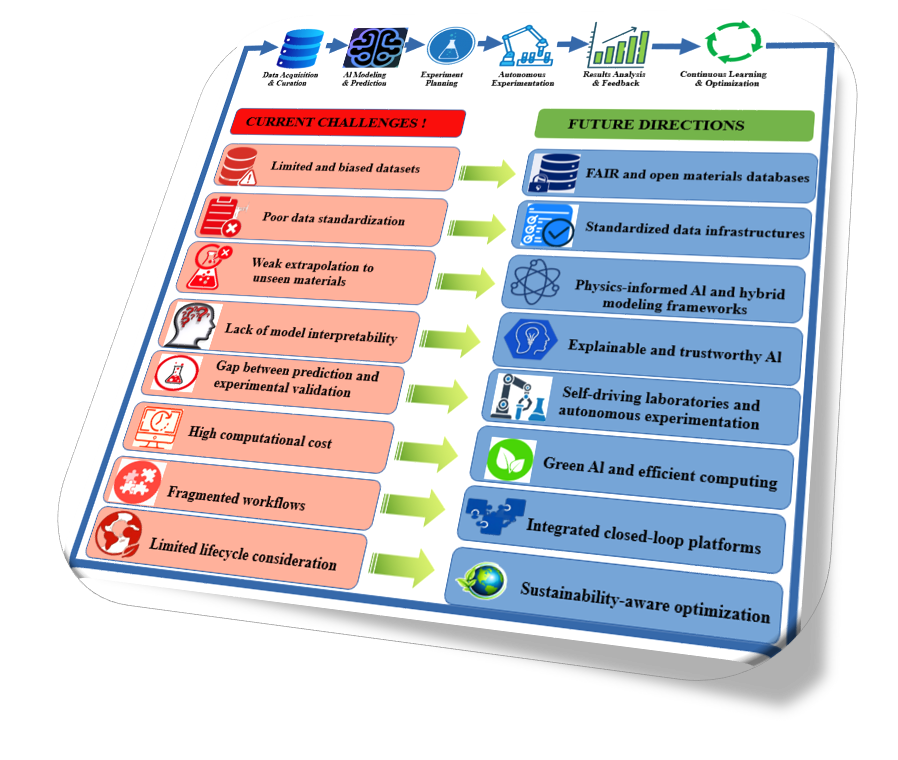
The rapid transition toward sustainable energy systems has created an urgent demand for advanced functional materials capable of improving energy conversion, storage, and utilization technologies. Artificial intelligence has emerged as a key enabling technology for accelerating materials discovery through data-driven prediction, inverse design, autonomous experimentation, and intelligent decision-making. This mini-review critically examines recent advances in AI-assisted discovery and optimization of advanced energy materials, covering machine learning, deep learning, graph neural networks, transformer models, generative AI, large language models, and self-driving laboratories. Unlike previous reviews that primarily focus on individual AI methodologies or specific classes of energy materials, this work provides an integrated assessment of recent developments across the entire AI-driven materials discovery workflow, encompassing data infrastructures, predictive modelling, generative design, autonomous experimentation, and intelligent closed-loop optimization. Representative studies demonstrate that AI-assisted optimization has reduced battery fast-charging optimization time from approximately 500 days to 16 days and achieved prediction accuracies of up to R2 = 0.88 in virtual materials screening. Representative studies further demonstrate that recent generative AI models have produced more than twice as many stable novel materials while generating structures over ten times closer to DFT ground-state configurations, whereas AI-assisted image analysis has achieved automated materials characterisation with segmentation accuracies exceeding 91%. These advances demonstrate the growing practical value of artificial intelligence across batteries, photovoltaics, electrocatalysis, hydrogen technologies, and other sustainable energy applications. This mini-review further discusses recent progress in open materials databases, autonomous experimentation, foundation models, and AI-enabled research platforms that are reshaping modern materials development. Critical evaluation of the available literature indicates that data quality, model generalization, interpretability, computational cost, and experimental validation remain the principal barriers to broader implementation of AI in materials research. Based on the literature synthesized in this mini-review, future advances are expected to depend on the effective integration of generative AI, foundation models, physics-informed learning, and autonomous experimentation within intelligent closed-loop materials discovery ecosystems.
- Open Access
- Mini-Review
Recent Progress, Challenges, and Future Perspectives in AI-Driven Discovery and Optimization of Advanced Energy Materials
- Dilshod Nematov 1,2,*,
- Iskandar Raufov 1,
- Sherali Murodzoda 1,
- Saidjafar Murodzoda 1,
- Sakhidod Sattorzoda 1,
- Anushervon Ashurov 1
Author Information
Received: 17 Jun 2026 | Revised: 27 Jun 2026 | Accepted: 29 Jun 2026 | Published: 14 Jul 2026
Abstract
Graphical Abstract
Keywords
artificial intelligence | machine learning | generative AI | large language models | self-driving laboratories | advanced energy materials | materials discovery | sustainable energy
References
- 1.
Xiao, P.; Yun, X.; Chen, Y.; et al. Insights into the Solvation Chemistry in Liquid Electrolytes for Lithium-Based Rechargeable Batteries. Chem. Soc. Rev. 2023, 52, 5255–5316.
- 2.
Jiang, X.; Fu, H.; Bai, Y.; et al. Interpretable Machine Learning Applications: A Promising Prospect of AI for Materials. Adv. Funct. Mater. 2025, 35, 2507734.
- 3.
Fan, Z.; Chen, X.; Shi, J.; et al. Functionalized Separators Boosting Electrochemical Performances for Lithium Batteries. Nano-Micro Lett. 2025, 17, 128.
- 4.
Wu, T.; Qin, Z.; Wang, Y.; et al. The Main Progress of Perovskite Solar Cells in 2020–2021. Nano-Micro Lett. 2021, 13, 209.
- 5.
Nematov, D.; Raufov, I.; Ashurov, A.; et al. The Promise of Lead-Free Perovskites: Can They Replace Toxic Alternatives in Solar Cells and Lead the Future? Int. J. Res. Innov. Appl. Sci. 2025, 10, 353–377.
- 6.
Jain, A.; Ong, S.P.; Hautier, G.; et al. Commentary: The Materials Project: A Materials Genome Approach to Accelerating Materials Innovation. APL Mater. 2013, 1, 011002.
- 7.
Kim, S.; Xu, J.; Shang, W.; et al. A Review on Machine Learning-Guided Design of Energy Materials. Prog. Energy 2024, 6, 042005.
- 8.
Ren, J.T.; Chen, L.; Wang, H.Y.; et al. Water Electrolysis for Hydrogen Production: From Hybrid Systems to Self-Powered/Catalyzed Devices. Energy Environ. Sci. 2024, 17, 49–113.
- 9.
Wang, J.; Ma, J.; Cheng, H. Nanomaterials-Based Enzymatic Biofuel Cells for Wearable and Implantable Bioelectronics. Front. Energy 2025, 19, 283–299.
- 10.
Salas, M.; Singh, A.; Pignataro, C.; et al. AI-Powered Open-Source Infrastructure for Accelerating Materials Discovery and Advanced Manufacturing. Commun. Mater. 2026, 7, 65.
- 11.
Merchant, A.; Batzner, S.; Schoenholz, S.S.; et al. Scaling Deep Learning for Materials Discovery. Nature 2023, 624, 80–85.
- 12.
Takahashi, K.; Tanaka, Y. Materials Informatics: A Journey towards Material Design and Synthesis. Dalton Trans. 2016, 45, 10497–10499.
- 13.
Sun, S.; Hartono, N.T.P.; Ren, Z.D.; et al. Accelerated Development of Perovskite-Inspired Materials via High-Throughput Synthesis and Machine-Learning Diagnosis. Joule 2019, 3, 1437–1451.
- 14.
Cherukara, M.J.; Mannodi-Kanakkithodi, A. Deep Learning the Properties of Inorganic Perovskites. Model. Simul. Mater. Sci. Eng. 2022, 30, 034005.
- 15.
Hossain, M.H.; Islam, M.A.; Chowdhury, M.A.; et al. Prospects and Challenges of Anode Materials for Lithium-Ion Batteries—A Review. Clean. Energy Syst. 2024, 9, 100145.
- 16.
Kolev, M. A Novel Approach to Predict the Effect of Chemical Composition and Thermo-Mechanical Processing Parameters on Cu-Ni-Si Alloys Using a Hybrid Deep Learning and Ensemble Learning Model. Compos. Commun. 2024, 48, 101903.
- 17.
Han, Z.; Chen, A.; Li, Z.; et al. Machine Learning-Based Design of Electrocatalytic Materials Towards High-Energy Lithium∥Sulfur Batteries Development. Nat. Commun. 2024, 15, 8433.
- 18.
Cui, K.; Wang, T.; Zhang, Q.; et al. Multi-Functional Descriptor Design of V-Based Double Atomic Catalysts for Room Temperature Sodium-Sulfur Batteries. Small 2025, 21, 2409866.
- 19.
Mishra, A.K.; Rajput, S.; Karamta, M.; et al. Exploring the Possibility of Machine Learning for Predicting Ionic Conductivity of Solid-State Electrolytes. ACS Omega 2023, 8, 16419–16427.
- 20.
Chen, D.; Wang, B.; Li, S.; et al. Superionic Ionic Conductor Discovery via Multiscale Topological Learning. J. Am. Chem. Soc. 2025, 147, 20888–20898.
- 21.
Nematov, D.; Raufov, I.; Murodzoda, S.; et al. The Bright Future of Materials Science with AI: Self-Driving Laboratories and Closed-Loop Discovery. J. Mod. Nanotechnol. 2025, 5. https://doi.org/10.53964/jmn.2025002.
- 22.
Klein Moberg, H.; Abbondanza, G.; Nedrygailov, I.; et al. Deep Learning-Enabled Online Mass Spectrometry of the Reaction Product of a Single Catalyst Nanoparticle. Nat. Commun. 2025, 16, 7203.
- 23.
Li, G.; Zhu, Y.; Guo, Y.; et al. Deep Learning to Reveal the Distribution and Diffusion of Water Molecules in Fuel Cell Catalyst Layers. ACS Appl. Mater. Interfaces 2023, 15, 5247–5258.
- 24.
Bi, T.; Liu, Y.; Wei, Y.; et al. Deep Learning-Based Structural Characterisation and Mass Transport Analysis of CO2 Reduction Catalyst Layers. Front. Energy 2025, 19, 681–693.
- 25.
Jiang, M.; Zhou, J.; An, Y.; et al. Artificial Intelligence for Energy Materials Research: From Classical Machine Learning to Large Models. ENG. Energy 2026, 20, 10535.
- 26.
Wang, X.; He, N.; Zhou, Z.; et al. AI-Driven Exploration and Design of Inorganic Battery Materials. Renew. Sustain. Energy Rev. 2026, 229, 116633.
- 27.
Jiang, M.; Yang, Z.; Lu, T.; et al. Machine Learning Accelerated Study for Predicting the Lattice Constant and Substitution Energy of Metal Doped Titanium Dioxide. Ceram. Int. 2024, 50, 1079–1086.
- 28.
Peng, Z.; Liu, Y.; Zhou, H.; et al. CReBot: Exploring Interactive Question Prompts for Critical Paper Reading. Int. J. Hum.-Comput. Stud. 2022, 167, 102898.
- 29.
Butler, K.T.; Davies, D.W.; Cartwright, H.; et al. Machine Learning for Molecular and Materials Science. Nature 2018, 559, 547–555.
- 30.
Attia, P.M.; Grover, A.; Jin, N.; et al. Closed-Loop Optimization of Fast-Charging Protocols for Batteries with Machine Learning. Nature 2020, 578, 397–402.
- 31.
Du, J.; Guo, J.; Sun, Q.; et al. Data-Driven Discovery of Carbonyl Organic Electrode Molecules: Machine Learning and Experiment. J. Mater. Chem. A 2024, 12, 12034–12042.
- 32.
de la Asunción-Nadal, V.; Sprague, C.I.; Guijarro-Berdiñas, B.; et al. Machine Learning for Perovskite Solar Cells: A Comprehensive Review on Opportunities and Challenges for Materials Scientists. EES Sol. 2025, 1, 927–957.
- 33.
Pan, H.; Zhao, X.; Gong, X.; et al. Advances in Design Engineering and Merits of Electron Transporting Layers in Perovskite Solar Cells. Mater. Horiz. 2020, 7, 2276–2291.
- 34.
Han, N.; Su, B.-L. AI-Driven Material Discovery for Energy, Catalysis and Sustainability. Natl. Sci. Rev. 2025, 12, nwaf110.
- 35.
Tao, S.; Liu, H.; Sun, C. Collaborative and Privacy-Preserving Retired Battery Sorting for Profitable Direct Recycling via Federated Machine Learning. Nat. Commun. 2023, 14, 8032.
- 36.
Kumar, M.S.; Sai, R.H.N.; Palivela, H.; et al. AI-Driven Materials Discovery and Design: Engineering Intelligent Solutions for Next-Generation Sustainable Technologies. J. Chem. Health Risks 2025, 15, 3156–3162.
- 37.
Cheng, M.; Fu, C.L.; Okabe, R.; et al. Artificial Intelligence-Driven Approaches for Materials Design and Discovery. Nat. Mater. 2026, 25, 174–190.
- 38.
Xian, Y.; Li, C.; Xu, Y.; et al. AI-Driven Advances in Sustainable Materials for Green Energy: From Innovation to Lifecycle Management. SusMat 2025, 5, e70030.
- 39.
Malica, C.; Novoselov, K.S.; Barnard, A.S.; et al. Artificial Intelligence for Advanced Functional Materials: Exploring Current and Future Directions. J. Phys. Mater. 2025, 8, 021001.
- 40.
Chen, J.; Panchal, S.; Gross, O.; et al. Transfer Learning-Based Battery State of Power Estimation Techniques with Updating Through Battery Lifetime. U.S. Patent US20260110742 A1, 23 April 2026.
- 41.
Panchal, S.; Masoudi, Y.; Arora, D.; et al. Techniques for Estimating Battery System Power Capability Using Machine Learning Models and Search Algorithms. U.S. Patent US20260109260 A1, 23 April 2026.
- 42.
Dehury, B.; Nahidmobarakeh, L.; Ahmed Mohammed, K.; et al. Optimization of Filter Frequency and Size of a Feedforward Neural Network Machine Learning Battery Model for an Automotive Prismatic Cell. In Proceedings of the WCX SAE World Congress Experience, Detroit, MI, USA, 14–16 April 2026.
- 43.
Cissé, A.; Cooper, M.E.; Zhu, M.; et al. Can We Automate Scientific Reasoning in Closed-Loop Experiments Using Large Language Models? Digit. Discov. 2026, 5, 1132–1160.
- 44.
Hlophe, P.; Tawalbeh, M.; Al-Othman, A.; et al. Autonomous AI Agents in ORR Electrocatalyst Discovery: A Review of Closed-Loop Workflows, Materials Bottlenecks, and Energy System Translation. Mater. Adv. 2026, 7, 6474–6485.
- 45.
Hargreaves, C.J.; Gaultois, M.W.; Daniels, L.M.; et al. A Database of Experimentally Measured Lithium Solid Electrolyte Conductivities Evaluated with Machine Learning. NPJ Comput. Mater. 2023, 9, 9.
- 46.
Dilshod, N.; Kholmirzo, K.; Aliona, S.; et al. On the Optical Properties of the Cu2ZnSn[S1−xSex]4 System in the IR Range. Trends Sci. 2022, 20, 4058.
- 47.
Nematov, D. Molecular and Dissociative Adsorption of H2O on ZrO2/YSZ Surfaces. Int. J. Innov. Sci. Mod. Eng. 2023, 11, 1–7. https://doi.org/10.35940/ijisme.D7927.10111023.
- 48.
Häse, F.; Roch, L.M.; Aspuru-Guzik, A. Next-Generation Experimentation with Self-Driving Laboratories. Trends Chem. 2019, 1, 282–291.
- 49.
Dilshod, N. DFT Calculations of the Main Optical Constants of the Cu2ZnSnSexS4−x System as High-Efficiency Potential Candidates for Solar Cells. Int. J. Appl. 2022, 11, 287–293.
- 50.
Soldatov, M.A.; Butova, V.V.; Pashkov, D.; et al. Self-Driving Laboratories for Development of New Functional Materials and Optimizing Known Reactions. Nanomaterials 2021, 11, 619.
- 51.
Nematov, D. Computer Analysis of Electronic and Structural Properties of CsSnI3:Cl and CsPbI3:Cl Nanocrystals. Sci-Article 2019, 76, 187–196.
- 52.
Nematov, D. Titanium Dioxide and Photocatalytic CO2 Reduction: A Detailed Review of the Current Status and Future Prospects. Innov. Discov. 2025, 2, 5.
- 53.
Gulyuk, A.V.; Abu Zaid, N.; Chirkova, R.; et al. Data Integration and Data Fusion Approaches in Self-Driving Labs: A Perspective. APL Mach. Learn. 2025, 3, 040901.
- 54.
Nematov, D. Linear Frequency-Dependent Optical Characteristics of Perovskites of the CsSn[Br1−xIx]3 System. Int. J. Appl. Phys. 2022, 7, 67–72.
- 55.
Kumar Yadav, A. Artificial Intelligence in Accelerating Materials Discovery: Opportunities and Challenges. ChemistrySelect 2026, 11, e07191.
- 56.
Pathak, P.; Srivastava, S. Smart Material Design: Integrating Data-Driven Optimization and Complexity Analysis for Next-Generation Materials. In Smart Materials Engineering: Data-Driven Approaches and Multiscale Modelling; Springer: Cham, Switzerland, 2026; pp. 41–63.
- 57.
Bajaj, S.H.; Nesamani, S.L.; Dharmalingam, G.; et al. The Artificial Intelligence-Based Revolution in Material Science for Advanced Energy Storage. In Introduction to Functional Nanomaterials; CRC Press: Boca Raton, FL, USA, 2024; pp. 85–92.
- 58.
Fawzy, S.M.; M. Ali, M.K.; Allam, N.K. Artificial Intelligence-Driven Materials Design for Next-Generation Sustainable Energy Technologies. ACS Sustain. Chem. Eng. 2026, 14, 4745–4761.
- 59.
Zhou, L.; Yin, Y.; Nematov, D.; et al. A High-Performance Cobalt-Free Cathode for Proton-Conducting Solid Oxide Fuel Cells via Multi-Element Doping in Sr2Fe2O6. Sustain. Mater. Technol. 2026, 48, e01936.
- 60.
Nizomov, Z.; Asozoda, M.; Nematov, D. Characteristics of Nanoparticles in Aqueous Solutions of Acetates and Sulfates of Single and Doubly Charged Cations. Arab. J. Sci. Eng. 2023, 48, 867–873.
- 61.
Raufov, I.; Murodzoda, S.; Ashurov, A.; et al. Band Gap Engineering and Electronic Structure of Cu2Ni(Sn,Ge,Si)Se4 Kesterites: A DFT Perspective on New Earth-Abundant Semiconductors for High-Performance Photovoltaics. Next Mater. 2025, 8, 100786.
- 62.
Tobias, A.V.; Wahab, A. Autonomous ’Self-Driving’ Laboratories: A Review of Technology and Policy Implications. R. Soc. Open Sci. 2025, 12, 250646.

This work is licensed under a Creative Commons Attribution 4.0 International License.
