
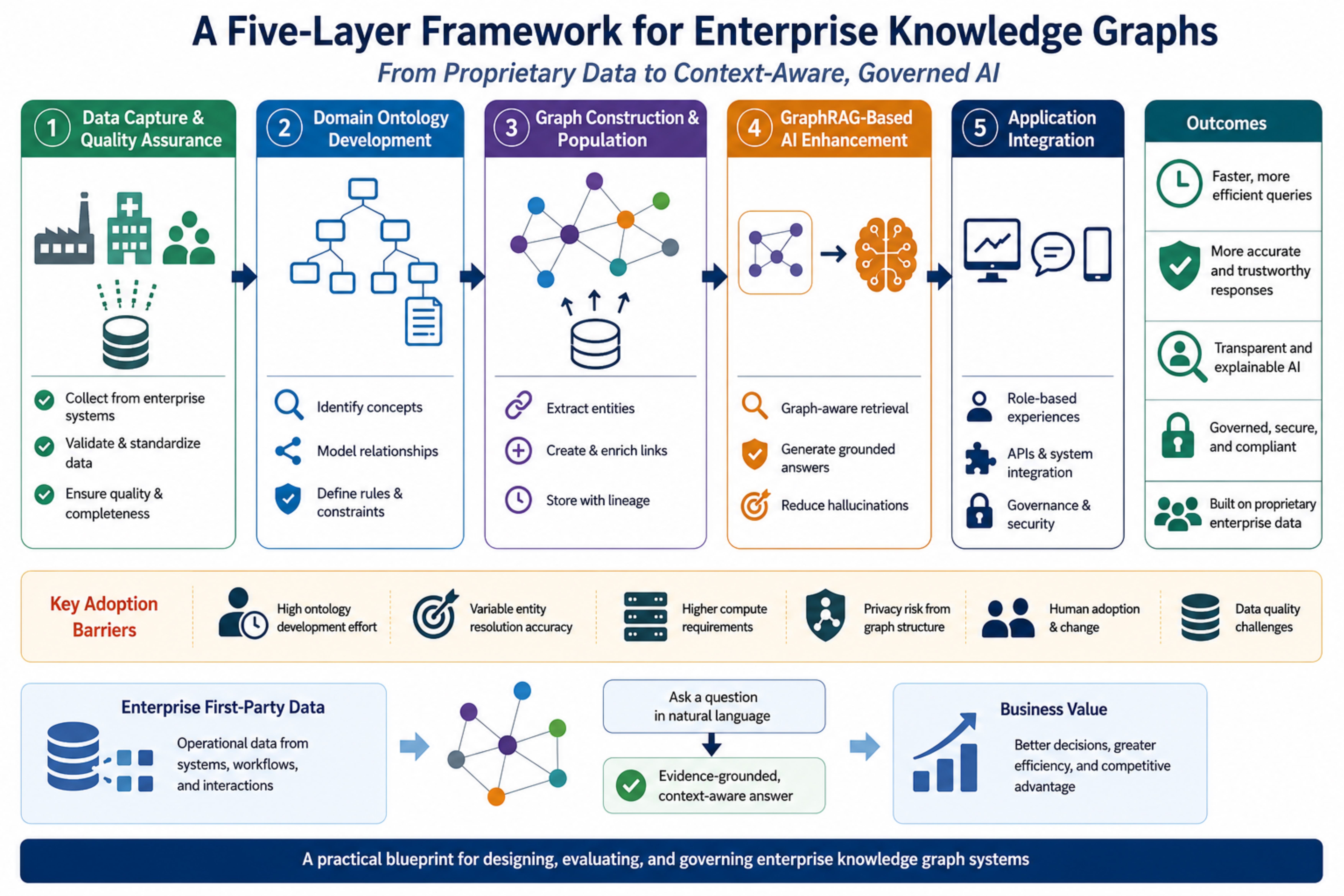
Organizations produce significant amounts of first-party data as part of their day-to-day operations in manufacturing, clinical, and customer experience domains, which are not accessible to generic large language models. The paper discusses the five-layer approach to using this information asset: (1) data ingestion and quality assurance, (2) domain ontology engineering, (3) knowledge graph engineering and population, (4) GraphRAG-enabled AI augmentation, and (5) downstream application enablement. The paper focuses on the design considerations, implementation tactics, and lessons learned from real-world applications in manufacturing, healthcare, and professional networks rather than presenting original research results. The implementation results show up to 70–80% query time reduction and close to 85% fewer hallucinations on average for GraphRAG over the standard RAG for most of the use cases analyzed. The main barriers to adoption are the substantial manual effort involved in ontology engineering, 73–94% entity resolution accuracy across different industries, and 3–5× higher computational costs for GraphRAG compared to RAG. The framework gives practitioners and researchers a reference architecture for designing, evaluating, and governing enterprise knowledge graph deployments built on proprietary organizational data.
- Open Access
- Article
A Five-Layer Reference Architecture for First-Party Enterprise Knowledge Graphs with GraphRAG Integration and Governance Controls
Author Information
Received: 04 May 2026 | Revised: 26 Jul 2026 | Accepted: 06 Aug 2026 | Published: 14 Aug 2026
Abstract
Graphical Abstract
Keywords
knowledge graphs | first-party data | GraphRAG | enterprise AI | semantic ontology | data governance | LLM integration | entity resolution | information retrieval | privacy compliance
References
- 1.
Chui, M.; Manyika, J.; Bughin, J.; et al. The Social Economy: Unlocking Value and Productivity Through Social Technologies. McKinsey Global Institute. 2012. Available online: https://www.mckinsey.com/industries/technology-media-and-telecommunications/our-insights/the-social-economy (accessed on 22 March 2026).
- 2.
How Knowledge Graphs Manage Complex Technical Documentation. Context Clue, 29 December 2025. Available online: https://context-clue.com/blog/the-power-of-knowledge-graphs-in-managing-complex-technical-documentation/ (accessed on 28 March 2026).
- 3.
Hogan, A.; Blomqvist, E.; Cochez, M.; et al. Knowledge Graphs. ACM Comput. Surv. 2022, 54, 71. https://doi.org/10.1145/3447772.
- 4.
Huang, L.; Yu, W.; Ma, W.; et al. A Survey on Hallucination in Large Language Models: Principles, Taxonomy, Challenges, and Open Questions. arXiv 2023, arXiv:2311.05232.
- 5.
The State of Enterprise AI. OpenAI. 2025. Available online: https://openai.com/index/the-state-of-enterprise-ai-2025-report/ (accessed on 10 April 2026).
- 6.
McKinsey & Company. The State of AI in early 2024: Gen AI adoption spikes and starts to generate value. McKinsey Global Survey. 2024. Available online: https://www.mckinsey.com/capabilities/quantumblack/our-insights/the-state-of-ai-2024 (accessed on 22 March 2026).
- 7.
Edge, D.; Trinh, H.; Cheng, N.; et al. From Local to Global: A Graph RAG Approach to Query-Focused Summarization. arXiv 2024, arXiv:2404.16130.
- 8.
ISO/IEC 25012:2008; Software Engineering—Software Product Quality Requirements and Evaluation (SQuaRE)—Data Quality Model. International Organization for Standardization (ISO): Geneva, Switzerland, 2008. Available online: https://www.iso.org/standard/35736.html (accessed on 28 June 2026).
- 9.
Singhal, A. Introducing the Knowledge Graph: Things, Not Strings. Google Official Blog, 16 May 2012. Available online: https://blog.google/products/search/introducing-knowledge-graph-things-not/ (accessed on 1 April 2026).
- 10.
Brickley, D.; Guha, R.V. RDF Schema 1.1. W3C Recommendation. 2014. Available online: https://www.w3.org/TR/rdf-schema/ (accessed on 1 Feb 2026).
- 11.
Robinson, I.; Webber, J.; Eifrem, E. Graph Databases: New Opportunities for Connected Data, 2nd ed.; O’Reilly Media: Sebastopol, CA, USA, 2015.
- 12.
Knowledge Graphs: The Missing Link in Enterprise AI. CIO, 29 January 2025. Available online: https://www.cio.com/article/3808569/knowledge-graphs-the-missing-link-in-enterprise-ai.html (accessed on 4 April 2026).
- 13.
Gartner. Optimize First-Party Data Collection Through Value Exchanges; Research Report No. 5870611; Gartner Inc.: Stamford, CT, USA, 2024.
- 14.
Wang, R.; Mason, H. Constellation Research’s 2025 AI Survey. Constellation Research. 2025. Available online: https://www.constellationr.com/research/constellation-researchs-2025-ai-survey (accessed on 14 Feb 2026).
- 15.
Wang, R. AI? Whatever. It’s All About the First Party Data. Constellation Research, 16 March 2025. Available online: https://www.constellationr.com/insights/news/ai-whatever-its-all-about-first-party-data (accessed on 10 March 2026).
- 16.
Unlocking AI’s True Potential: Why High-Quality First-Party Data and Orchestration Drive Real Business Value. Digitalisation World, 14 February 2026. Available online: https://digitalisationworld.com/blogs/6850-unlocking-ais-true-potential-why-high-quality-first-party-data-and-orchestration-drive-real-business-value(accessed on 10 March 2026).
- 17.
Lewis, P.; Perez, E.; Piktus, A.; et al. Retrieval-Augmented Generation for Knowledge-Intensive NLP Tasks. In Proceedings of the Advances in Neural Information Processing Systems, Virtual, 6–12 December 2020; Volume 33, pp. 9459–9474.
- 18.
Liu, N.F.; Lin, K.; Hewitt, J.; et al. Lost in the Middle: How Language Models Use Long Contexts. Trans. Assoc. Comput. Linguist. 2024, 12, 157–173.
- 19.
Xiang, Z.; Wu, C.; Zhang, Q.; et al. When to Use Graphs in RAG: A Comprehensive Analysis for Graph Retrieval-Augmented Generation. arXiv 2025, arXiv:2506.05690.
- 20.
Gruber, T.R. A Translation Approach to Portable Ontology Specifications. Knowl. Acquis. 1993, 5, 199–220. https://doi.org/10.1006/knac.1993.1008.
- 21.
EDM Council and Object Management Group. The Financial Industry Business Ontology (FIBO). EDM Council. 2024. Available online: https://spec.edmcouncil.org/fibo/ (accessed on 30 April 2026).
- 22.
Liu, D.; Pang, Q.; Liu, G.; et al. SNOMED CT-powered Knowledge Graphs for Structured Clinical Data and Diagnostic Reasoning. arXiv 2025, arXiv:2510.16899.
- 23.
ISO/TS Standard 15926-11:2023; Simplified Industrial Usage of Reference Data Based on RDFS Methodology, 2nd, ed. International Organization for Standardization: Geneva, Switzerland, 2023. Available online: https://www.iso.org/obp/ui/es/#iso:std:iso:ts:15926:-11:ed-2:v1:en (accessed on 30 April 2026).
- 24.
ISO 15926-13:2018; Industrial Automation Systems and Integration—Integration of Life-Cycle Data for Process Plants Including Oil and Gas Production Facilities. International Organization for Standardization (ISO): Geneva, Switzerland, 2018. Available online: https://www.iso.org/standard/70694.html (accessed on 28 June 2026).
- 25.
Paslaru Bontas Simperl, E.; Tempich, C.; Sure, Y. ONTOCOM: A Cost Estimation Model for Ontology Engineering. In The Semantic Web-ISWC 2006; Cruz, I., Decker, S., Allemang, D., et al., Eds.; Lecture Notes in Computer Science; Springer: Berlin/Heidelberg, Germany, 2006; Volume 4273. https://doi.org/10.1007/11926078_45.
- 26.
Babaei Giglou, H.; D’Souza, J.; Auer, S. LLMs4OL: Large Language Models for Ontology Learning. arXiv 2023, arXiv:2307.16648.
- 27.
LinkedIn Economic Graph Research Institute. Building LinkedIn's Skills Graph to Power a Skills-First World. LinkedIn. 2022. Available online: https://www.linkedin.com/blog/engineering/skills-graph/building-linkedin-s-skills-graph-to-power-a-skills-first-world (accessed on 20 April 2026).
- 28.
Alsentzer, E.; Li, M.M.; Kobren, S.N.; et al. Few Shot Learning for Phenotype-Driven Diagnosis of Patients with Rare Genetic Diseases. npj Digit. Med. 2025, 8, 380. https://doi.org/10.1038/s41746-025-01749-1.
- 29.
ISO 8601-1:2019; Date and Time—Representations for Information Interchange Part 1: Basic Rules. International Organization for Standardization (ISO): Geneva, Switzerland, 2019. Available online: https://www.iso.org/standard/70907.html (accessed on 28 June 2026).
- 30.
Haug, A.; Zachariassen, F.; van Liempd, D. The Costs of Poor Data Quality. J. Ind. Eng. Manag. 2011, 4, 168–193. Available online: https://www.researchgate.net/publication/277237089_The_costs_of_poor_data_quality (accessed on 28 June 2026).
- 31.
Simard, V.; Rönnqvist, M.; Lebel, L.; et al. A Method to Classify Data Quality for Decision Making Under Uncertainty. ACM J. Data Inf. Qual. 2023. 15, 17. https://doi.org/10.1145/3592534.
- 32.
Vittor, L.; Arango, I.; Noori, A.; et al. A Scalable Platform to Build the Data Layer of Knowledge Graph AI. In Proceedings of the NeurIPS Workshop: New Perspectives in Graph Machine Learning, San Diego, CA, USA, 7 December 2025. Available online: https://openreview.net/forum?id=8OXD0yNZoD (accessed on 18 April 2026).
- 33.
Wei, J.; Wang, X.; Schuurmans, D.; et al. Chain-of-Thought Prompting Elicits Reasoning in Large Language Models. In Proceedings of the Advances in Neural Information Processing Systems, New Orleans, LA, USA, 28 November–9 December 2022; Volume 35, pp. 5517–5528.
- 34.
Dwork, C.; McSherry, F.; Nissim, K.; et al. Calibrating Noise to Sensitivity in Private Data Analysis. J. Priv. Confidentiality 2017, 7, 17–51. https://doi.org/10.29012/jpc.v7i3.405.
- 35.
Rjoob, K.; McGurk, K.A.; Zheng, S.L.; et al. A multimodal vision knowledge graph of cardiovascular disease. Nat. Cardiovasc. Res. 2026, 5, 18–33. https://doi.org/10.1038/s44161-025-00757-4.
- 36.
LinkedIn Work Change Report 2025; LinkedIn Economic Graph Research Institute: Sunnyvale, CA, USA, 2025.
- 37.
Gartner. Gartner Predicts Over 40% of Agentic AI Projects Will Be Canceled by End of 2027. Gartner Newsroom, 25 June 2025. Available online: https://www.gartner.com/en/newsroom/press-releases/2025-06-25-gartner-predicts-over-40-percent-of-agentic-ai-projects-will-be-canceled-by-end-of-2027 (accessed on 18 April 2026).
- 38.
Edjlali, R. Lack of AI-Ready Data Puts AI Projects at Risk. Gartner Newsroom, 26 February 2025. Available online: https://www.gartner.com/en/newsroom/press-releases/2025-02-26-lack-of-ai-ready-data-puts-ai-projects-at-risk (accessed on 31 March 2026).
- 39.
The State of AI in the Enterprise. 2026 AI Report. Deloitte. 2026. Available online: https://www.deloitte.com/us/en/what-we-do/capabilities/applied-artificial-intelligence/content/state-of-ai-in-the-enterprise.html (accessed on 25 April 2026).
- 40.
Gartner, Inc. Gartner Announces Top Predictions for Data and Analytics in 2026. Gartner Newsroom, 11 March 2026. Available online: https://www.gartner.com/en/newsroom/press-releases/2026-03-11-gartner-announces-top-predictions-for-data-and-analytics-in-2026 (accessed on 13 April 2026).
- 41.
Zhu, X.; Li, Z.; Wang, X.; et al. Multi-Modal Knowledge Graph Construction and Application: A Survey. IEEE Trans. Knowl. Data Eng. 2024, 36, 715–735. https://doi.org/10.1109/TKDE.2023.3279574.
- 42.
Kairouz, P.; McMahan, H.B.; Avent, B.; et al. Advances and Open Problems in Federated Learning. Found. Trends Mach. Learn. 2021, 14, 1–210.


This work is licensed under a Creative Commons Attribution 4.0 International License.

 Suite 4002 Level 4, 447 Collins Street, Melbourne, Victoria 3000, Australia
 General Inquiries: info@sciltp.com