
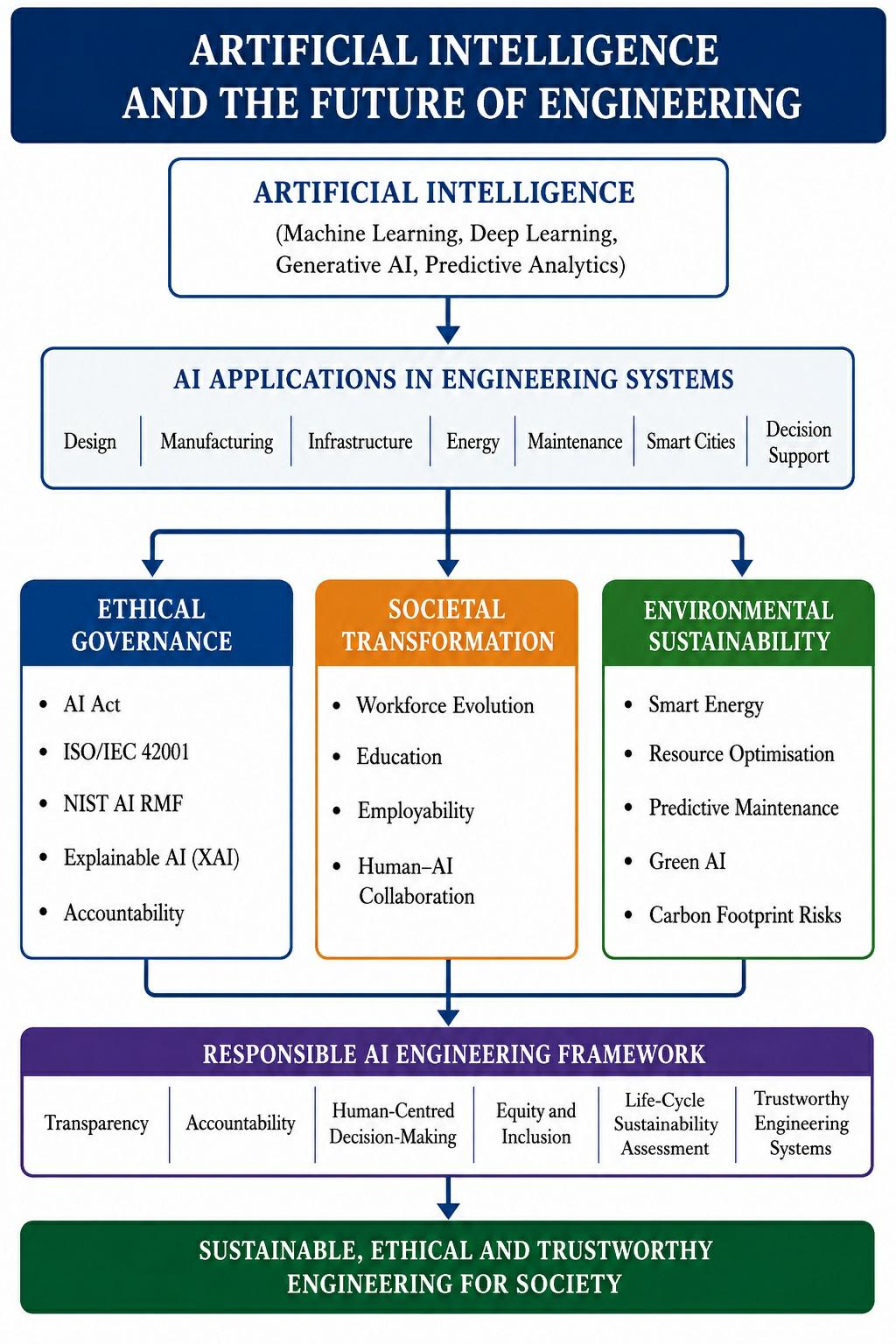
Artificial intelligence (AI) is increasingly being incorporated into engineering practices, transforming the design, construction, operation, and maintenance of systems. The present study explores recent peer-reviewed literature on three interwoven aspects of this transformation: ethical governance, societal change, and environmental sustainability. The review covers new governance instruments such as the European Union Artificial Intelligence Act, ISO/IEC 42001, and the NIST AI Risk Management Framework, as well as explainable-AI (XAI) methods that engineers are increasingly using to explain to regulators, clients, and the public why their safety-critical decisions are made. Also, it addresses the implications of AI on engineering labor markets, professional education and decision-making power, including the differential exposure of high-skill cognitive tasks to automation, and the need for new skills. Furthermore, it considers the dual nature of AI in terms of its contribution to resource optimization, predictive maintenance and integration of renewable energy, and its contribution to an increasing computational carbon and water footprint that can offset these benefits, a tension that is sometimes referred to as the Jevons paradox. The review suggests an integrated framework of responsible AI engineering that connects the three elements of responsible AI: technical explainability, institutional accountability, and life-cycle environmental auditing. The review concludes that long-term acceptability and acceptance of AI in engineering practice will not only be determined by the performance of the models themselves, but also by the ability of the engineering discipline to govern AI transparently, fairly and within planetary limits.
- Open Access
- Review
Artificial Intelligence and the Future of Engineering: A Review of Ethical Governance, Societal Transformation, and Environmental Sustainability
Author Information
Received: 20 Jun 2026 | Revised: 10 Jul 2026 | Accepted: 11 Aug 2026 | Published: 17 Aug 2026
Abstract
Graphical Abstract
Keywords
artificial intelligence | engineering ethics | AI governance | explainable AI | environmental sustainability | responsible innovation
References
- 1.
Suo, J.; Li, M.; Guo, J.; et al. Engineering Safety and Ethical Challenges in 2045 Artificial Intelligence Singularity. Sustainability 2024, 16, 10337.
- 2.
Chamola, V.; Hassija, V.; Sulthana, A.R.; et al. A review of trustworthy and explainable artificial intelligence (XAI). IEEE Access 2023, 11, 78994–79015.
- 3.
Ali, S.; Abuhmed, T.; El-Sappagh, S.; et al. Explainable Artificial Intelligence (XAI): What we know and what is left to attain trustworthy artificial intelligence. Inf. Fusion 2023, 99, 101805.
- 4.
Hassija, V.; Chamola, V.; Mahapatra, A.; et al. Interpreting black-box models: A review on explainable artificial intelligence. Cogn. Comput. 2024, 16, 45–74.
- 5.
Cazzaniga, M.; Jaumotte, F.; Li, L.; et al. Gen-AI: Artificial Intelligence and the Future of Work; IMF Staff Discussion Note SDN/2024/001; International Monetary Fund: Washington, DC, USA, 2024.
- 6.
Huang, J.; Gopal, S. Green AI—A multidisciplinary approach to sustainability. Environ. Sci. Ecotechnol. 2025, 24, 100536.
- 7.
Schwartz, R.; Dodge, J.; Smith, N.A.; et al. Green AI. Commun. ACM 2020, 63, 54–63.
- 8.
Wright, D.; Igel, C.; Samuel, G.; et al. Efficiency is not enough: A critical perspective on environmentally sustainable AI. Commun. ACM 2025, 68, 62–69.
- 9.
Camilleri, M.A. Artificial intelligence governance: Ethical considerations and implications for social responsibility. Expert Syst. 2024, 41, e13406.
- 10.
Floridi, L.; Cowls, J.; King, T.C.; et al. How to design AI for social good: Seven essential factors. In Ethics, Governance, and Policies in Artificial Intelligence; Springer International Publishing: Cham, Switzerland, 2021; Volume 144, pp. 125–151.
- 11.
Ahangar, M.N.; Farhat, Z.A.; Sivanathan, A.; et al. Explainable AI-Driven Quality and Condition Monitoring in Smart Manufacturing. Sensors 2026, 26, 911. https://doi.org/10.3390/s26030911.
- 12.
Luccioni, A.S.; Strubell, E.; Crawford, K. From efficiency gains to rebound effects: The problem of Jevons’ Paradox in AI’s polarized environmental debate. In Proceedings of the 2025 ACM Conference on Fairness, Accountability, and Transparency (FAccT ’25), Athens, Greece, 23–26 June 2025; pp. 76–88.
- 13.
Jobin, A.; Ienca, M.; Vayena, E. The global landscape of AI ethics guidelines. Nat. Mach. Intell. 2019, 1, 389–399.
- 14.
Hagendorff, T. The ethics of AI ethics: An evaluation of guidelines. Minds Mach. 2020, 30, 99–120.
- 15.
European Parliament and Council of the European Union. Regulation (EU) 2024/1689 Laying Down Harmonised Rules on Artificial Intelligence (Artificial Intelligence Act). Official Journal of the European Union, 13 June 2024.
- 16.
Finch, W.W.; Butt, M. Gaps in AI-Compliant Complementary Governance Frameworks’ Suitability (for Low-Capacity Actors), and Structural Asymmetries (in the Compliance Ecosystem)—A Systematic Review. J. Cybersecur. Priv. 2025, 5, 101.
- 17.
ISO/IEC 42001:2023; Information Technology—Artificial Intelligence—Management System. ISO: Geneva, Switzerland, 2023. Available online: https://www.iso.org/standard/42001 (accessed on 19 July 2026).
- 18.
National Institute of Standards and Technology. Artificial Intelligence Risk Management Framework (AI RMF 1.0); NIST: Gaithersburg, MD, USA, 2023. https://doi.org/10.6028/NIST.AI.100-1.
- 19.
Papagiannidis, E.; Enholm, I.M.; Dremel, C.; et al. Toward AI governance: Identifying best practices and potential barriers and outcomes. Inf. Syst. Front. 2023, 25, 123–141.
- 20.
Adelakun, N.O.; Lasisi, M.A.; Kolawole, T.D. System Based Artificial Intelligence Adoption in Nigerian Tertiary Education: A Conceptual Governance Model for Learning, Academic Integrity, and Equity. J. Appl. Artif. Intell. Educ. 2026, 2, 155–176.
- 21.
Mishra, A.; Jatti, V.S. Employing explainable artificial intelligence (XAI) methodologies to analyze the correlation between input variables and tensile strength in additively manufactured samples. arXiv 2023, arXiv:2305.18426.
- 22.
Koniakou, V. From the “rush to ethics” to the “race for governance” in artificial intelligence. Inf. Syst. Front. 2023, 25, 71–102.
- 23.
Mäntymäki, M.; Minkkinen, M.; Birkstedt, T.; et al. Putting AI ethics into practice: The hourglass model of organizational AI governance. arXiv 2022, arXiv:2206.00335. https://doi.org/10.48550/arXiv.2206.00335.
- 24.
Cath, C. Governing artificial intelligence: Ethical, legal and technical opportunities and challenges. Philos. Trans. R. Soc. A 2018, 376, 20180080.
- 25.
Rosyad, A.M.; Adelakun, N.O.; Amiarsa, P.; et al. Implementation challenges of data protection law in Nigerian higher education. FOCUS J. Law 2025, 6, 136–149.
- 26.
Adelakun, N.O.; Mande, S. Integrating artificial intelligence into entrepreneurship education for engineering graduates in Nigeria. Andalasian Int. J. Appl. Sci. Eng. Technol. 2026, 6, 46–62.
- 27.
Ernst, E.; Berg, J.; Moore, P.V. Editorial: Artificial intelligence and the future of work: Humans in control. Front. Artif. Intell. 2024, 7, 1378893.
- 28.
Iyanda, D.F.; Adelakun, N.O.; Salami, A. The role of artificial intelligence in enhancing library services for teaching and learning in Nigerian colleges of education. Res. J. Pure Sci. Technol. 2025, 8, 81–90.
- 29.
Vieriu, A.M.; Petrea, G. The Impact of Artificial Intelligence (AI) on Students’ Academic Development. Educ. Sci. 2025, 15, 343.
- 30.
Adewojo, A.A.; Amzat, O.B.; Abiola, H.S. AI-powered libraries: Enhancing user experience and efficiency in Nigerian knowledge repositories. Libr. Hi Tech News 2025, 42, 12–16.
- 31.
Adelakun, N.O.; Adebesin, A.A. Enhancing engineering graduates’ employability through industry-relevant training and placement. Platf. J. Manag. Humanit. 2024, 7, 45–54.
- 32.
Sánchez-Rodríguez, A.; García-Vidal, G.; Fernández-Ochoa, Y.; et al. Navigating Uncertainty Through AI Adoption: Dynamic Capabilities, Strategic Innovation Performance, and Competitiveness in Ecuadorian SMEs. Adm. Sci. 2025, 15, 468.
- 33.
Zhang, P.; Chen, X.; Liu, Y.; et al. Towards net-zero carbon emissions in network AI for 6G and beyond. IEEE Commun. Mag. 2024, 62, 58–64.
- 34.
Adelakun, N.O. Enhancing decentralised renewable energy trading through artificial intelligence and blockchain technology. In Combined Proceedings of the 39th iSTEAMS Multidisciplinary Bespoke Conference 17th–19th July, 2025 & iSTEAMS Emerging Technologies Conference 30th–31st October, 2025; Ghana-Korean Information Resource Centre, Balme Library, University of Ghana: Accra, Ghana, 2025. pp. 25–42.
- 35.
Li, J.; Liu, Z.; Han, G.; et al. The relationship between Artificial Intelligence (AI) and Building Information Modeling (BIM) technologies for sustainable building in the context of smart cities. Buildings 2024, 14, 3727.
- 36.
Ali, T.H.; Akhund, M.A.; Memon, N.A.; et al. Application of Artifical Intelligence in Construction Waste Management. In Proceedings of the 8th International Conference on Industrial Technology and Management (ICITM), Cambridge, UK, 2–4 March 2019; pp. 50–55. 2019, 50–55. https://doi.org/10.1109/ICITM.2019.8710680.
- 37.
Bibri, S.E.; Huang, J.; Jagatheesaperumal, S.K.; et al. The synergistic interplay of artificial intelligence and digital twin in environmentally planning sustainable smart cities: A comprehensive systematic review. Environ. Sci. Ecotechnol. 2024, 20, 100433.
- 38.
Toderas, M. Artificial Intelligence for Sustainability: A Systematic Review and Critical Analysis of AI Applications, Challenges, and Future Directions. Sustainability 2025, 17, 8049.
- 39.
Liao, X.; Li, Y.; Zhang, S.; et al. Predicting GPU Training Energy Consumption in Data Centers Using Task Metadata via Symbolic Regression. Energies 2026, 19, 448.


This work is licensed under a Creative Commons Attribution 4.0 International License.

 Suite 4002 Level 4, 447 Collins Street, Melbourne, Victoria 3000, Australia
 General Inquiries: info@sciltp.com