
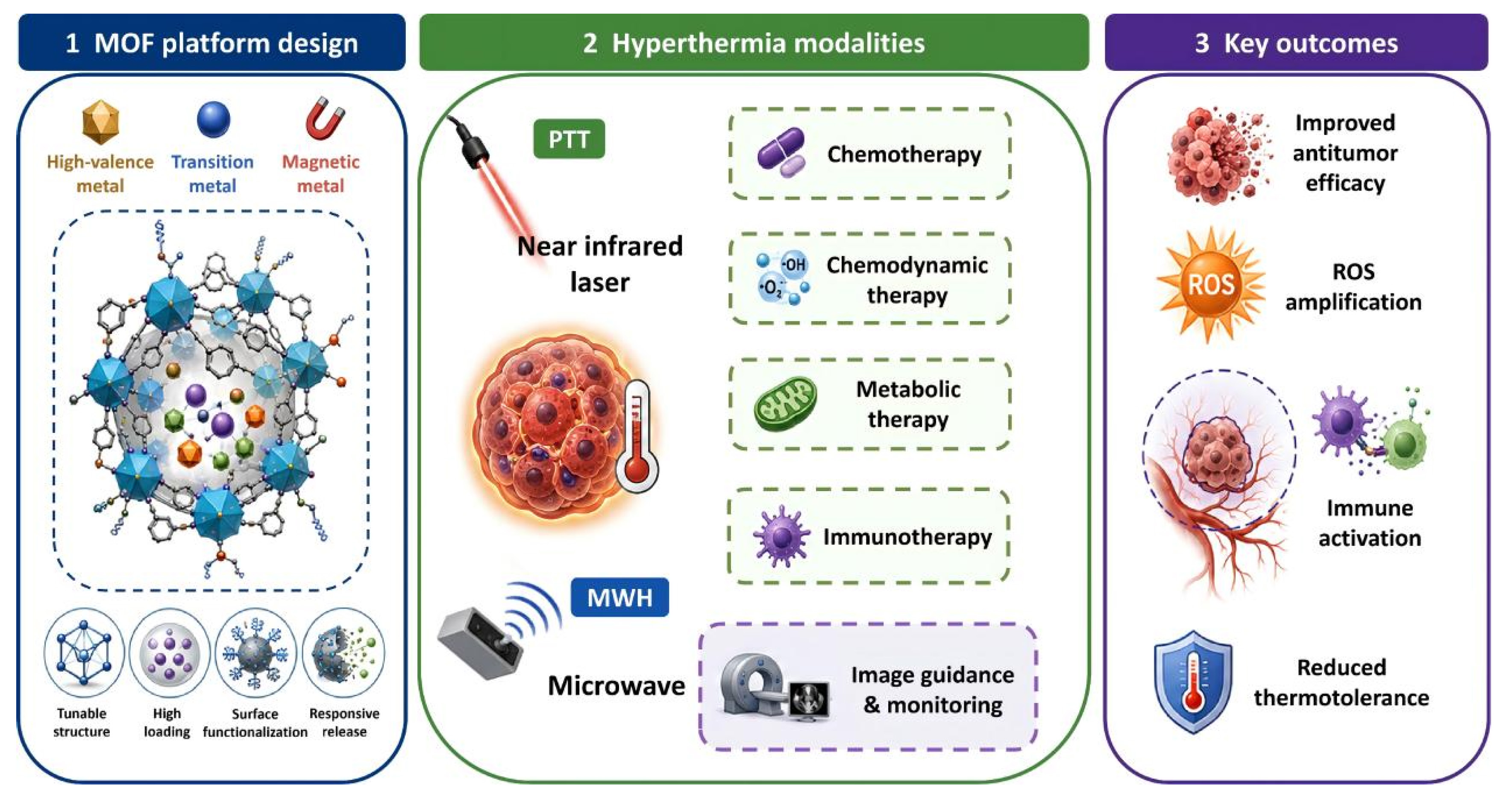
Tumor hyperthermia represents a minimally invasive therapeutic modality designed to selectively eliminate cancer cells or augment the efficacy of combination regimens via localized temperature elevation. Conventional interventions, including surgical resection, radiotherapy (RT), and chemotherapy (CT) are constrained by intrinsic tumor heterogeneity, acquired drug resistance, and the complex tumor microenvironment, factors that collectively limit therapeutic outcomes. In this context, localized hyperthermia provides a physical mechanism to disrupt malignant cells while concurrently enhancing chemotherapeutic penetration and potentiating antitumor immune responses. Metal-organic frameworks (MOFs) have recently emerged as highly versatile platforms for tumor hyperthermia owing to their precisely tunable three-dimensional porous structures, diverse metal node compositions, and adaptable surface functionalization capabilities. These materials can directly convert light or MW energy into thermal energy and can also function as carriers for chemotherapeutic drugs or microwave (MW) sensitizers, thereby enabling multimodal synergistic interventions. This review presents a comprehensive analysis of recent progress in MOF-based photothermal therapy (PTT) and microwave hyperthermia (MWH), with particular emphasis on material design, mechanistic insights into heat generation, and strategies for functional integration. By systematically evaluating intrinsic, composite, and derived MOF systems, the review seeks to establish a theoretical and materials science framework for the rational development of efficient, controllable, and clinically translatable MOF-based tumor hyperthermia platforms.
- Open Access
- Review
Functional MOF-Mediated Platforms for Potentiating Tumor Hyperthermia: A Review
- Diyi Feng,
- Liqin Ge *
Author Information
Received: 18 May 2026 | Revised: 27 May 2026 | Accepted: 09 Jun 2026 | Published: 18 Jun 2026
Abstract
Graphical Abstract
Keywords
MOFs | tumor hyperthermia | photothermal therapy | microwave hyperthermia | functionalized materials | combination therapy
References
- 1.
Charbonneau, A.; Brady, A.; Coon, T.; et al. Abstract 1064: Cancer Data Aggregator: A New Cancer Data Discovery Tool. Cancer Res. 2025, 85, 1064.
- 2.
Bray, F.; Laversanne, M.; Sung, H.; et al. Global Cancer Statistics 2022: GLOBOCAN Estimates of Incidence and Mortality Worldwide for 36 Cancers in 185 Countries. CA Cancer J. Clin. 2024, 74, 229–263.
- 3.
Mohanty, S.P.; Pai Kanhangad, M.; Kundangar, R. The Extended Posterior Approach for Resection of Sacral Tumours. Eur. Spine J. 2019, 28, 1461–1467.
- 4.
Wu, Y.; Song, Y.; Wang, R.; et al. Molecular Mechanisms of Tumor Resistance to Radiotherapy. Mol. Cancer 2023, 22, 96.
- 5.
Akakuru, O.U.; Zhang, Z.; Iqbal, M.Z.; et al. Chemotherapeutic Nanomaterials in Tumor Boundary Delineation: Prospects for Effective Tumor Treatment. Acta Pharm. Sin. B 2022, 12, 2640–2657.
- 6.
Shirmanova, M.V.; Sinyushkina, S.D.; Komarova, A.D. Metabolic Heterogeneity of Tumors. Mol. Biol. 2023, 57, 1130–1149.
- 7.
Dang, N.; Waer, M.; Sprangers, B.; et al. Establishment of Operational Tolerance to Sustain Antitumor Immunotherapy. J. Heart Lung Transplant. 2022, 41, 568–577.
- 8.
Anderson, N.M.; Simon, M.C. The Tumor Microenvironment. Curr. Biol. 2020, 30, R921–R925.
- 9.
Peter, D.; Ogawa, S.; Elhanani, O.; et al. Tumor Heterogeneity. Cancer Cell 2021, 39, 1015–1017.
- 10.
Lang, J.A.; Bhalla, S.; Ganeshan, D.; et al. Side Effects of Oncologic Treatment in the Chest: Manifestations at FDG PET/CT. RadioGraphics 2021, 41, 2071–2089.
- 11.
van den Boogaard, W.M.C.; Komninos, D.S.J.; Vermeij, W.P. Chemotherapy Side-Effects: Not All DNA Damage Is Equal. Cancers 2022, 14, 627–642.
- 12.
Lugat, A.; Drui, D.; Baron, S.; et al. Effets Secondaires Endocriniens de la Radiothérapie: Diagnostic, Prévention et Traitements. Cancer/Radiothérapie 2022, 26, 1078–1089.
- 13.
Diez de los Rios de la Serna, C.; Boers-Doets, C.B.; Wiseman, T.; et al. Early Recognition and Management of Side Effects Related to Systemic Anticancer Therapy for Advanced Breast Cancer. Semin. Oncol. Nurs. 2024, 40, 151553.
- 14.
Xie, G.; Li, B.; Guo, S.; et al. Nonmetallic Magnetic Hyperthermia and Chemo-Immunotherapy of Tumors. Mater. Today Bio 2025, 32, 101910.
- 15.
Markezana, A.; Goldberg, S.N.; Kumar, G.; et al. Incomplete Thermal Ablation of Tumors Promotes Increased Tumorigenesis. Int. J. Hyperthermia 2021, 38, 263–272.
- 16.
Lyon, P.C.; Suomi, V.; Jakeman, P.; et al. Quantifying Cell Death Induced by Doxorubicin, Hyperthermia or HIFU Ablation with Flow Cytometry. Sci. Rep. 2021, 11, 4404.
- 17.
Kirui, D.K.; Koay, E.J.; Guo, X.; et al. Tumor Vascular Permeabilization Using Localized Mild Hyperthermia to Improve Macromolecule Transport. Nanomedicine 2014, 10, 1487–1496.
- 18.
Huang, Y.; Wei, D.; Wang, B.; et al. NIR-II Light Evokes DNA Cross-Linking for Chemotherapy and Immunogenic Cell Death. Acta Biomater. 2023, 160, 198–210.
- 19.
Ahmed, K.; Zaidi, S.F.; Rehman, M.-U.; et al. Hyperthermia and Protein Homeostasis: Cytoprotection and Cell Death. J. Therm. Biol. 2020, 91, 102615.
- 20.
Wang, M.; Chen, Q.; Xu, D.; et al. Self-Cycling Redox Nanoplatform in Synergy with Mild Magnetothermal and Autophagy Inhibition for Efficient Cancer Therapy. Nano Today 2022, 43, 101374.
- 21.
Yan, Z.; Wu, X.; Tan, W.; et al. Single-Atom Cu Nanozyme-Loaded Bone Scaffolds for Ferroptosis-Synergized Mild Photothermal Therapy in Osteosarcoma Treatment. Adv. Healthcare Mater. 2024, 13, e2304595.
- 22.
Xiao, L.; Wang, Q.; Hu, J.; et al. pH-Responsive Biodegradable Nanozymes for Mild NIR-II Hyperthermia-Enhanced Tumor-Specific Chemotherapy and Chemodynamic Therapy. Appl. Mater. Today 2024, 39, 102280.
- 23.
Deng, Z.; Jiang, C.; Younis, M.R.; et al. Mild Hyperthermia-Enhanced Chemo-Photothermal Synergistic Therapy Using Doxorubicin-Loaded Gold Nanovesicles. Chin. Chem. Lett. 2021, 32, 2411–2414.
- 24.
Ma, K.; Wang, L.; Li, W.; et al. Turning Cold into Hot: Emerging Strategies to Fire Up the Tumor Microenvironment. Trends Cancer 2025, 11, 117–134.
- 25.
Kong, X.-X.; Jiang, S.; Liu, T.; et al. Paclitaxel Increases Sensitivity of SKOV3 Cells to Hyperthermia by Inhibiting Heat Shock Protein 27. Biomed. Pharmacother. 2020, 132, 110907.
- 26.
Kim, C.; Guo, Y.; Velalopoulou, A.; et al. Closed-Loop Trans-Skull Ultrasound Hyperthermia Leads to Improved Drug Delivery from Thermosensitive Drugs and Promotes Changes in Vascular Transport Dynamics in Brain Tumors. Theranostics 2021, 11, 7276–7293.
- 27.
Li, B.; Fu, G.; Liu, C.; et al. Ti2C3 MXene-Based Nanocomposite as an Intelligent Nanoplatform for Efficient Mild Hyperthermia Treatment. J. Colloid Interface Sci. 2024, 665, 389–398.
- 28.
Marchant, E.D.; Kaluhiokalani, J.P.; Wallace, T.E.; et al. Localized Heat Therapy Improves Mitochondrial Respiratory Capacity but Not Fatty Acid Oxidation. Int. J. Mol. Sci. 2022, 23, 8500.
- 29.
Covarrubias, G.; Lorkowski, M.E.; Sims, H.M.; et al. Hyperthermia-Mediated Changes in the Tumor Immune Microenvironment Using Iron Oxide Nanoparticles. Nanoscale Adv. 2021, 3, 5890–5899.
- 30.
Carter, T.J.; Agliardi, G.; Lin, F.-Y.; et al. Potential of Magnetic Hyperthermia to Stimulate Localized Immune Activation. Small 2021, 17, e2005241.
- 31.
Lee, T.H.; Bu, J.; Kim, B.H.; et al. Sub-Lethal Hyperthermia Promotes Epithelial-to-Mesenchymal-Like Transition of Breast Cancer Cells: Implication of the Synergy between Hyperthermia and Chemotherapy. RSC Adv. 2019, 9, 52–57.
- 32.
Zhang, Y.; Gao, X.; Yan, B.; et al. Enhancement of CD8⁺ T-Cell-Mediated Tumor Immunotherapy via Magnetic Hyperthermia. ChemMedChem 2022, 17, e202100656.
- 33.
Wang, Y.; Hong, W.; Che, S.; et al. Outcomes for Hyperthermia Combined with Concurrent Radiochemotherapy for Patients with Cervical Cancer. Int. J. Radiat. Oncol. Biol. Phys. 2020, 107, 499–511.
- 34.
Lassche, G.; Crezee, J.; Van Herpen, C.M.L. Whole-Body Hyperthermia in Combination with Systemic Therapy in Advanced Solid Malignancies. Crit. Rev. Oncol. Hematol. 2019, 139, 67–74.
- 35.
Li, Y.; Ma, X.; Liu, X.; et al. Redox-Responsive Functional Iron Oxide Nanocrystals for Magnetic Resonance Imaging-Guided Tumor Hyperthermia Therapy and Heat-Mediated Immune Activation. ACS Appl. Nano Mater. 2022, 5, 4537–4549.
- 36.
Chiang, C.-F.; Hsu, Y.-H.; Liu, C.-C.; et al. Pulsed-Wave Ultrasound Hyperthermia Enhanced Nanodrug Delivery Combined with Chloroquine Exerts Effective Antitumor Response and Postpones Recurrence. Sci. Rep. 2019, 9, 12448.
- 37.
Singh, G.; Paul, A.; Shekhar, H.; et al. Pulsed Ultrasound Assisted Thermo-Therapy for Subsurface Tumor Ablation: A Numerical Investigation. J. Therm. Sci. Eng. Appl. 2021, 13, 041010.
- 38.
Mohanty, B.; Kumari, S.; Yadav, P.; et al. Metal-Organic Frameworks (MOFs) and MOF Composites Based Biosensors. Coord. Chem. Rev. 2024, 519, 216102.
- 39.
Qi, X.; Chen, Q.; Chang, Z.; et al. Breaking Pore Size Limit of Metal-Organic Frameworks: Bio-Etched ZIF-8 for Lactase Immobilization and Delivery in Vivo. Nano Res. 2022, 15, 5646–5652.
- 40.
Bisercic, M.S.; Marjanovic, B.; Zasonska, B.A.; et al. Novel Microporous Composites of MOF-5 and Polyaniline with High Specific Surface Area. Synth. Met. 2020, 262, 116348.
- 41.
Deng, X.; Li, J.; Zhao, B.; et al. Design of a Novel Ag-MOF@GO Composite with a High Specific Surface Area and Structural Stability for the Efficient Removal of Malachite Green. New J. Chem. 2023, 47, 16022–16029.
- 42.
Wu, J.; Jiang, S.; Xie, W.; et al. Surface Modification of the Ti Surface with Nanoscale Bio-MOF-1 for Improving Biocompatibility and Osteointegration in Vitro and in Vivo. J. Mater. Chem. B 2022, 10, 8535–8548.
- 43.
Bachinin, S.; Marunchenko, A.; Zhestkij, N.; et al. Metal-Organic Framework Single Crystal Infrared Photodetector. Photonics Nanostruct. Fundam. Appl. 2023, 55, 101145.
- 44.
Li, J.; Yan, Y.; Chen, Y.; et al. Flexible Curcumin-Loaded Zn-MOF Hydrogel for Long-Term Drug Release and Antibacterial Activities. Int. J. Mol. Sci. 2023, 24, 11439.
- 45.
Wang, Y.; Xu, S.; Shi, L.; et al. Cancer-Cell-Activated in Situ Synthesis of Mitochondria-Targeting AIE Photosensitizer for Precise Photodynamic Therapy. Angew. Chem. Int. Ed. 2021, 60, 14945–14953.
- 46.
Ma, X.; Pan, F.; Xiu, Z.; et al. Bridging Dielectric-Magnetic Synergistic Units with MOFs on Fibers Structure for High-Efficient Microwave Absorption at Low Filler Loading. Carbon 2024, 229, 119444.
- 47.
Lin, J.-Y.; Wang, H.; Oh, W.D.; et al. Integrated MOF-Mesh and TEMPO-Grafted Carbon Fiber as a Sandwich-Like Catalytic System for Selective Valorization of Lignin-Derived Compound under Microwave Irradiation. Chem. Eng. J. 2021, 411, 128605.
- 48.
Hong, D.; Zhang, K.; Yang, M.; et al. Effects of MOF-MoO3−x Derivatives Synthesis and Oxygen Defect Engineering on Photocatalytic CO2 Reduction. Ceram. Int. 2024, 50, 47042–47050.
- 49.
Abbas, M.; Bisht, S.; Murari, B.; et al. Structural and Magnetic Study of Fluorinated Gadolinium Metal-Organic Frameworks. Cryst. Growth Des. 2025, 25, 5183–5192.
- 50.
Wang, D.; Zhou, J.; Shi, R.; et al. Biodegradable Core-Shell Dual-Metal-Organic-Frameworks Nanotheranostic Agent for Multiple Imaging Guided Combination Cancer Therapy. Theranostics 2017, 7, 4605–4617.
- 51.
Nikazar, S.; Barani, M.; Rahdar, A.; et al. Photo- and Magnetothermally Responsive Nanomaterials for Therapy, Controlled Drug Delivery and Imaging Applications. ChemistrySelect 2020, 5, 12590–12609.
- 52.
Pillai, N.G.; Knavaneeth, A.; Rhee, K.Y.; et al. PEGylation of a Shell over Core-Shell MOFs—A Novel Strategy for Preventing Agglomeration and Synergism in Terms of Physicochemical and Biological Properties. J. Mater. Chem. B 2023, 11, 10665–10677.
- 53.
Hintz, H.; Wuttke, S. Postsynthetic Modification of an Amino-Tagged MOF Using Peptide Coupling Reagents: A Comparative Study. Chem. Commun. 2014, 50, 11472–11475.
- 54.
Falsafi, M.; Zahiri, M.; Saljooghi, A.S.; et al. Aptamer Targeted Red Blood Cell Membrane-Coated Porphyrinic Copper-Based MOF for Guided Photochemotherapy against Metastatic Breast Cancer. Microporous Mesoporous Mater. 2021, 325, 111337.
- 55.
Liu, J.; Yang, L.; Cao, X.; et al. PEGylated Mn Containing MOF Nanoparticles for Potential Immunotherapy of Pancreatic Cancer via Manganese Induced Activation of Anti-Tumor Immunity. Colloid Interface Sci. Commun. 2021, 42, 100409.
- 56.
Jiang, H.; Xia, W.; Xia, T.; et al. Chemotactic Recruitment of Genetically Engineered Cell Membrane-Camouflaged Metal-Organic Framework Nanoparticles for Ischemic Osteonecrosis Treatment. Acta Biomater. 2024, 185, 410–428.
- 57.
Liu, W.; Li, Y.; Wang, Y.; et al. Bioactive Metal-Organic Frameworks as a Distinctive Platform to Diagnosis and Treat Vascular Diseases. Small 2024, 20, 2310249.
- 58.
Oh, J.Y.; Jana, B.; Seong, J.; et al. Unveiling the Power of Cloaking Metal-Organic Framework Platforms via Supramolecular Antibody Conjugation. ACS Nano 2024, 18, 15790–15801.
- 59.
Nangare, S.; Ramraje, G.; Patil, P. Formulation of Lactoferrin Decorated Dextran Based Chitosan-Coated Europium Metal-Organic Framework for Targeted Delivery of Curcumin. Int. J. Biol. Macromol. 2024, 259, 129325.
- 60.
Tabish, T.A.; Hussain, M.Z.; Fischer, R.A.; et al. Mitochondria-Targeted Metal-Organic Frameworks for Cancer Treatment. Mater. Today 2023, 66, 302–320.
- 61.
Chen, J.; Li, Y. The Road to MOF-Related Functional Materials and Beyond: Desire, Design, Decoration, and Development. Chem. Rec. 2016, 16, 1456–1476.
- 62.
Benecke, J.; Mangelsen, S.; Engesser, T.A.; et al. A Porous and Redox Active Ferrocenedicarboxylic Acid Based Aluminium MOF with a MIL-53 Architecture. Dalton Trans. 2019, 48, 16737–16743.
- 63.
Kouser, S.; Hezam, A.; Khanum, S.A. Synthesis, Characterization, and Catalytic Activity of Zinc-Isonicotinic Acid MOF. J. Mol. Struct. 2025, 1321, 140061.
- 64.
Mínguez Espallargas, G.; Coronado, E. Magnetic Functionalities in MOFs: From the Framework to the Pore. Chem. Soc. Rev. 2018, 47, 533–557.
- 65.
Li, T.; Wu, Q.; Wang, W.; et al. MOF-Derived Nano-Popcorns Synthesized by Sonochemistry as Efficient Sensitizers for Tumor Microwave Thermal Therapy. Biomaterials 2020, 234, 119773.
- 66.
Hao, Q.; Han, T.; Yang, Y.; et al. Multifunctional Dual-Ligand MOF for Capture, Imaging, and Photodynamic Clearance of Circulating Tumor Cells. Anal. Chem. 2025, 97, 23269–23279.
- 67.
Nguyen, M.V.; Dong, H.C.; Truong, V.T.N.; et al. A New Porphyrinic Vanadium-Based MOF Constructed from Infinite V(OH)O4 Chains: Syntheses, Characterization and Photoabsorption Properties. New J. Chem. 2022, 46, 632–641.
- 68.
Jiang, M.; Weng, Y.-G.; Zhou, Z.-Y.; et al. Cobalt Metal-Organic Frameworks Incorporating Redox-Active Tetrathiafulvalene Ligand: Structures and Effect of LLCT within the MOF on Photoelectrochemical Properties. Inorg. Chem. 2020, 59, 10727–10735.
- 69.
Rabiee, N. Sustainable Metal-Organic Frameworks (MOFs) for Drug Delivery Systems. Mater. Today Commun. 2023, 35, 106244.
- 70.
Schlachter, A.; Asselin, P.; Harvey, P.D. Porphyrin-Containing MOFs and COFs as Heterogeneous Photosensitizers for Singlet Oxygen-Based Antimicrobial Nanodevices. ACS Appl. Mater. Interfaces 2021, 13, 26651–26672.
- 71.
Liu, S.; Xin, R.; Zhang, X.; et al. Separable Microneedle Patch Integrated with the Dictamnine-Loaded Copper MOF Nanozyme for Atopic Dermatitis Treatment. ACS Appl. Mater. Interfaces 2025, 17, 26386–26401.
- 72.
Zhang, B.; Chen, J.; Zhu, Z.; et al. Advances in Immunomodulatory MOFs for Biomedical Applications. Small 2024, 20, e2307299.
- 73.
Díaz, J.C.; Glatz, J.; Olivas, E.M.; et al. Direct Synthesis of High-Valence Protein@UiO-66 Composites: Linking Crystallization Pathways to Protein Encapsulation. Adv. Mater. 2026, 38, e21603.
- 74.
Wang, D.; Wu, H.; Zhou, J.; et al. In Situ One-Pot Synthesis of MOF-Polydopamine Hybrid Nanogels with Enhanced Photothermal Effect for Targeted Cancer Therapy. Adv. Sci. 2018, 5, 1800287.
- 75.
Tajahmadi, S.; Bagri, F.; Shojaei, A.; et al. A Novel Dual-Functional Quercetin Carrier Based on Gd-MOF for Drug Delivery and MR Imaging. Mater. Des. 2026, 262, 115570.
- 76.
Zhao, C.; Xu, Y.; Xiao, F.; et al. Perfluorooctane Sulfonate Removal by Metal-Organic Frameworks (MOFs): Insights into the Effect and Mechanism of Metal Nodes and Organic Ligands. Chem. Eng. J. 2021, 406, 126852.
- 77.
Zhang, N.; Feng, X.; Rao, D.; et al. Lattice Oxygen Activation Enabled by High-Valence Metal Sites for Enhanced Water Oxidation. Nat. Commun. 2020, 11, 4066.
- 78.
Takhsha, M.; Cabassi, R.; Cavazzini, G.; et al. Self-Regulating Magnetic Hyperthermia by Magnetostructural Phase Transformation of Magnetic-Shape-Memory Ni–Mn–Cu-Ga Heusler-Type Particles. Mater. Today Chem. 2025, 48, 103006.
- 79.
Zhang, S.; Liu, G.; Lv, S.; et al. Ti-MOF@Metal-Polyphenol Network Derived TiN0.9@NC/Magnetic MWCNTs Composites for Microwave Absorption. Chem. Eng. J. 2023, 468, 143763.
- 80.
Subramaniyam, V.; Ravi, P.V.; Pichumani, M. Structure Co-ordination of Solitary Amino Acids as Ligands in Metal-Organic Frameworks (MOFs): A Comprehensive Review. J. Mol. Struct. 2022, 1251, 131931.
- 81.
Ranjbar, K.; Masoudpanah, S.M.; Koohdar, H.R. MOF-Derived NiCo2O4/NiO Nanocomposites as Microwave Absorbers: Effects of Organic Ligands. J. Mol. Liq. 2024, 394, 123779.
- 82.
Wang, H.; Gu, M.; Huang, X.; et al. Ligand-Based Modulation of the Electronic Structure at Metal Nodes in MOFs to Promote the Oxygen Evolution Reaction. J. Mater. Chem. A 2023, 11, 7239–7245.
- 83.
Qin, L.; Zhao, Y.-X.; Liu, Q.; et al. Tuning the Organic Ligands to Optimize the Nitrogen Reduction Performance of Co(II) or Ni(II)-Based MOFs. Mater. Chem. Front. 2024, 8, 3203–3213.
- 84.
Panda, S.; Kundu, S.; Malik, P.; et al. Leveraging Metal Node-Linker Self-Assembly to Access Functional Anisotropy of Zirconium-Based MOF-on-MOF Epitaxial Heterostructure Thin Films. Chem. Sci. 2024, 15, 2586–2592.
- 85.
Qin, L.; Zheng, Q.-M.; Liu, J.-L.; et al. A Novel and Efficient Method of MOF-Derived Electrocatalyst for HER Performance through Doping Organic Ligands. Mater. Chem. Front. 2021, 5, 7833–7842.
- 86.
Li, X.; Wang, R.; Zhao, H.; et al. Co-MOFs with 1,1′-(5-Methyl-1,3-phenylene)bis(1H-imidazole) and Aromatic Carboxylates as Coligands: Synthesis, Structure, and Spectroscopic and Thermal Characterizations. J. Coord. Chem. 2016, 69, 2247–2262.
- 87.
Xian, J.-Y.; Xie, X.-X.; Huang, Z.-Y.; et al. Structure and Properties of a Mixed-Ligand Co-MOF That Was Synthesized in Situ from a Single Imidazole-Pyridyl-Tetrazole Trifunctional Ligand. Cryst. Growth Des. 2023, 23, 1448–1454.
- 88.
Ha, J.; Moon, H.R. Synthesis of MOF-on-MOF Architectures in the Context of Interfacial Lattice Matching. CrystEngComm 2021, 23, 2337–2354.
- 89.
Dong, M.; Zhou, H.; Cao, Q.; et al. Rational Design and Controlled Synthesis of MOF-on-MOF Heterostructures: Overcoming Lattice Mismatch. Chem. Eng. Sci. 2026, 327, 123651.
- 90.
Chang, L.-M.; Ma, Z.-Z.; Huang, J.; et al. Liquid-Phase Epitaxial Growth of Multiple MOF Thin Films with High Lattice Mismatch. Inorg. Chem. Front. 2023, 10, 1136–1142.
- 91.
Jian, C.; Xuejiao, L.; Hongqi, T. Metal-Organic Framework (MOF)-Based Drug Delivery. Curr. Med. Chem. 2020, 27, 5949–5969.
- 92.
Tomalia, N.A.; Rakova, Y.; Tubman, A.N.; et al. Tunable on-Demand Explosives Derived from Isoreticular Metal-Organic Framework Nanocomposites. Chem. Mater. 2026, 38, 2055–2062.
- 93.
Boopalan, A.S.; Rahulan, K.M.; Little Flower, N.A.; et al. Synergistic Effects of Europium Doping on MOF-5: Exploring Its Photoluminescent and Non-Linear Optical Behaviour for Enhanced Optical Limiting. Nanoscale 2025, 17, 8836–8849.
- 94.
Zhao, W.; Guo, Z.; Lan, D.; et al. Construction of Multicomponent Bimetallic MOF-Derived Transition Metal Sulfide Composites for Electromagnetic Wave Absorption. Small 2025, 21, e2409339.
- 95.
Guo, Y.; Zhu, Y.; Sun, J.; et al. MOF-Derived Carbon Nanotube Bridged Co/MoC@NC Composites for Enhanced Electromagnetic Wave Absorption. J. Alloys Compd. 2025, 1010, 177346.
- 96.
Wang, Y.; Ban, Y.; Hu, Z.; et al. Hetero-Lattice Intergrown and Robust MOF Membranes for Polyol Upgrading. Angew. Chem. Int. Ed. 2022, 61, e202114479.
- 97.
Wang, J.; Qin, J.; Zhu, H.; et al. MOF-Based Hierarchically Porous Monoliths Prepared via High Internal Phase Emulsion Template: Morphology, Thermal Stability, Mechanical Property, and MOF Accessibility. Macromol. Mater. Eng. 2022, 307, 2200309.
- 98.
Yang, L.; Xu, T.; Zou, H.; et al. Self-Assembled Fluorescent Zn-MOF with High Specific Surface Area Based on the Coordination Interaction for Sensitive Detection and Selective Removal of Tetracycline Antibiotic in Water. Opt. Mater. 2024, 157, 116126.
- 99.
Wang, S.-M.; Mu, X.-T.; Liu, H.-R.; et al. Pore-Structure Control in Metal-Organic Frameworks (MOFs) for Capture of the Greenhouse Gas SF₆ with Record Separation. Angew. Chem. Int. Ed. 2022, 61, e202207066.
- 100.
Indra, A.; Song, T.; Paik, U. Metal Organic Framework Derived Materials: Progress and Prospects for the Energy Conversion and Storage. Adv. Mater. 2018, 30, 1705146.
- 101.
Zheng, X.; Chen, L.; Zhang, H.; et al. Optimized Sieving Effect for Ethanol/Water Separation by Ultramicroporous MOFs. Angew. Chem. Int. Ed. 2023, 62, e202216710.
- 102.
Hu, A.; Xie, Q.; Chen, L.; et al. Hierarchically Ordered Meso-/Macroporous MOF-Based Materials for Catalysis and Energy Applications. EnergyChem 2024, 6, 100137.
- 103.
Li, T.; Kozlowski, M.T.; Doud, E.A.; et al. Stepwise Ligand Exchange for the Preparation of a Family of Mesoporous MOFs. J. Am. Chem. Soc. 2013, 135, 11688–11691.
- 104.
Ambroz, F.; Macdonald, T.J.; Martis, V.; et al. Evaluation of the BET Theory for the Characterization of Meso and Microporous MOFs. Small Methods 2018, 2, 1800173.
- 105.
Laybourn, A.; Katrib, J.; Ferrari-John, R.S.; et al. Metal–Organic Frameworks in Seconds via Selective Microwave Heating. J. Mater. Chem. A 2017, 5, 7333–7338.
- 106.
Sun, M.; Li, Z.; Wei, B.; et al. MOFs Derived Fe/Co/C Heterogeneous Composite Absorbers for Efficient Microwave Absorption. Synth. Met. 2023, 292, 117229.
- 107.
Ma, X.; Cai, C.; Sun, W.; et al. Enhancing Energetic Performance of Multinuclear Ag(I)-Cluster MOF-Based High-Energy-Density Materials by Thermal Dehydration. ACS Appl. Mater. Interfaces 2019, 11, 9233–9238.
- 108.
Cao, Y.; Abazari, R.; Li, Q.; et al. Dynamic Interfaces in Metal–Organic Frameworks. Chem. Soc. Rev. 2026, 55, 5227–5268.
- 109.
Mallik, S.; Chand Pal, S.; Mondal, S.; et al. Stress-Driven Recrystallization of Pentacene Films via Diffusion-Induced Ingress of MOF Nanocrystals into the Grain Boundaries. Appl. Surf. Sci. 2024, 654, 159420.
- 110.
Zhu, Y.; Zhang, Z.; Li, W.; et al. Highly Exposed Active Sites of Defect-Enriched Derived MOFs for Enhanced Oxygen Reduction Reaction. ACS Sustain. Chem. Eng. 2019, 7, 17855–17862.
- 111.
Sun, C.; Lan, D.; Jia, Z.; et al. Kirkendall Effect-Induced Ternary Heterointerfaces Engineering for High Polarization Loss MOF-LDH-MXene Absorbers. Small 2024, 20, e2405874.
- 112.
Schlachter, A.; Asselin, P.; Fortin, D.; et al. Strong Host–Guest Dependence on the Emissive Properties of MOF-5 and [Zn2(BTTB)(DMF)2·(H2O)3]n. Inorg. Chem. 2023, 62, 13757–13764.
- 113.
Chen, Y.; Wang, P.; Yu, F.; et al. Ciprofloxacin Self-Promoted Degradation Mechanism: Local Symmetry-Breaking of MOF Driven Radical-Dipole Cooperativity for Enhanced Charge Carrier Separation. Chem. Eng. J. 2025, 527, 171607.
- 114.
Qu, L.; Xu, Y.; Cui, W.; et al. Trends in Conductive MOFs for Sensing: A Review. Anal. Chim. Acta 2025, 1336, 343307.
- 115.
Ning, Y.; Jiang, X.; Huang, J.; et al. Trimetallic MOFs Derived NiFe2O4/MoNi4-NC Schottky Heterojunctions with Abundant Defects and Dielectric-Magnetic Coupling for Electromagnetic Response. J. Mater. Sci. Technol. 2025, 213, 1–13.
- 116.
Babal, A.S.; Chaudhari, A.K.; Yeung, H.H.M.; et al. Guest-Tunable Dielectric Sensing Using a Single Crystal of HKUST-1. Adv. Mater. Interfaces 2020, 7, 2000408.
- 117.
Lee, G.; Lee, S.; Oh, S.; et al. Tip-To-Middle Anisotropic MOF-on-MOF Growth with a Structural Adjustment. J. Am. Chem. Soc. 2020, 142, 3042–3049.
- 118.
Han, G.-Y.; Sun, M.; Zhao, R.; et al. Defect Engineered Ti-MOFs and Their Applications. Chem. Soc. Rev. 2025, 54, 5081–5107.
- 119.
Shan, Y.; Zhang, G.; Shi, Y.; et al. Synthesis and Catalytic Application of Defective MOF Materials. Cell Rep. Phys. Sci. 2023, 4, 101301.
- 120.
Li, N.; Li, H.; Ji, R.; et al. Fabrication of Bimetallic MOF with 2D Nanosheets Structure and Rich Active Sites for Enhanced Removal of Organic Pollutants by Activation of Peroxymonosulfate. J. Environ. Chem. Eng. 2023, 11, 110607.
- 121.
Shen, X.; Ma, Y.; Luo, H.; et al. Peptide Aptamer-Paclitaxel Conjugates for Tumor Targeted Therapy. Molecules 2025, 30, 40.
- 122.
Zhang, R.; Hu, Q.; Yang, S.; et al. MOF-Fe@C Nanocomposites for Microwave Absorption. Adv. Eng. Mater. 2024, 26, 2400527.
- 123.
Li, K.; Liu, Y.; Yan, Y.; et al. Cross-Scale Regulation of MOF-Derived Gradient Heterointerfaces for Microwave Absorption. Adv. Funct. Mater. 2026, 36, e75348.
- 124.
Zorlu, T.; Hetey, D.; Reithofer, M.R.; et al. Physicochemical Methods for the Structuring and Assembly of MOF Crystals. Acc. Chem. Res. 2024, 57, 2105–2116.
- 125.
Li, L.; Meng, C.; Xu, C.; et al. Morphology-Engineered MOFs for Advanced Carbon Capture and Separation: From Zero-Dimensional Particles to Three-Dimensional Architectures. Renew. Sustain. Energy Rev. 2026, 237, 117018.
- 126.
Zhou, C.; Pan, M.; Li, S.; et al. Metal Organic Frameworks (MOFs) as Multifunctional Nanoplatform for Anticorrosion Surfaces and Coatings. Adv. Colloid Interface Sci. 2022, 305, 102707.
- 127.
Liu, J.; Cao, Q.; Meng, C.; et al. Composition Manipulation of Heat-Resistant Iron-Based Cores@Graphitic Carbon@Amorphous Carbon Derived from Urea-Modulated MOFs for High-Efficient Microwave Absorption. Ceram. Int. 2022, 48, 23348–23356.
- 128.
Zhang, G.; Chang, L.; Xu, X.; et al. Ultrasmall Iridium-Encapsulated Porphyrin Metal-Organic Frameworks for Enhanced Photodynamic/Catalytic Therapy by Producing Reactive Oxygen Species Storm. J. Colloid Interface Sci. 2025, 677, 1022–1033.
- 129.
Xie, Z.; Zhao, H.; Chen, F.; et al. Magnetically Aligned Co-C/MWCNT/Polyacrylamide with Directional Thermal Conduction for Enhanced Electromagnetic Wave Absorption by Synergistic Engineering of Dielectric and Magnetic Loss. Diam. Relat. Mater. 2025, 157, 112519.
- 130.
Luo, X.; Sun, H.-Y.; Lu, S.-Y.; et al. Fe-Doped Cu-Based Bimetallic Metal–Organic Frameworks as Nanoscale Microwave Sensitizers for Enhancing Microwave Thermal and Dynamic Therapy for Hepatocellular Carcinoma. Nanoscale 2024, 16, 11069–11080.
- 131.
Wang, J.; Deng, S.-Q.; Zhao, T.-T.; et al. A Mn(II)-MOF with Inherent Missing Metal-Ion Defects Based on an Imidazole-Tetrazole Tripodal Ligand and Its Application in Supercapacitors. Dalton Trans. 2020, 49, 12150–12155.
- 132.
Yao, X.; He, Y.; Fu, S.; et al. Bimetallic MOF-Derived CeO2/Co3O4 Microflowers with Synergy of Oxygen Vacancy and p-n Heterojunction for High-Performance n-Butanol Sensors. Mater. Today Commun. 2022, 33, 104445.
- 133.
Chen, J.; Hang, X.; Du, M.; et al. Intermolecular Forces-Oriented Growth of MOF-on-MOF Heterostructures. Chem. Eur. J. 2025, 31, e202403746.
- 134.
Ren, J.; Ledwaba, M.; Musyoka, N.M.; et al. Structural Defects in Metal-Organic Frameworks (MOFs): Formation, Detection and Control towards Practices of Interests. Coord. Chem. Rev. 2017, 349, 169–197.
- 135.
El-Boubbou, K.; Lemine, O.M.; Algessair, S.; et al. Preparation and Characterization of Various PVPylated Divalent Metal-Doped Ferrite Nanoparticles for Magnetic Hyperthermia. RSC Adv. 2024, 14, 15664–15679.
- 136.
Chen, L.; Zhao, D.; Ren, X.; et al. Shikonin-Loaded Hollow Fe-MOF Nanoparticles for Enhanced Microwave Thermal Therapy. ACS Biomater. Sci. Eng. 2023, 9, 5405–5417.
- 137.
Cai, X.; Zhao, Y.; Wang, L.; et al. Synthesis of Au@MOF Core-Shell Hybrids for Enhanced Photodynamic/Photothermal Therapy. J. Mater. Chem. B 2021, 9, 6646–6657.
- 138.
Dong, J.; Boukhvalov, D.W.; Lv, C.; et al. Enhancing the Electrocatalytic Activity of Metal–Organic Frameworks in the Oxygen Evolution Reaction by Introducing High-Valent Metal Centers. J. Mater. Chem. A 2023, 11, 16683–16694.
- 139.
Deng, Z.; Fang, C.; Ma, X.; et al. One Stone Two Birds: Zr-Fc Metal-Organic Framework Nanosheet for Synergistic Photothermal and Chemodynamic Cancer Therapy. ACS Appl. Mater. Interfaces 2020, 12, 20321–20330.
- 140.
Cao, K.; Ye, W.; Zhang, Y.; et al. Fabrication of MOF-rGO Aerogels to Enhance Electromagnetic Wave Absorption by Adjusting the Morphology and Structure of MOFs by Electron Transfer. Chem. Eng. J. 2024, 489, 151384.
- 141.
Feng, Y.; Chen, Q.; Jin, C.; et al. Microwave-Activated Cu-Doped Zirconium Metal-Organic Framework for a Highly Effective Combination of Microwave Dynamic and Thermal Therapy. J. Controlled Release 2023, 361, 102–114.
- 142.
Li, H.; Xiao, Z.; Hao, R.; et al. Encapsulating Carbon Quantum Dots by Zr-MOF-Supported Pt Nanoparticles for Enhanced Photothermal RWGS Reaction. Sep. Purif. Technol. 2025, 365, 132637.
- 143.
He, J.; Zhang, H.; Zhu, J.; et al. Layer-by-Layer Synthesis of Au Nanorods@Metal-Organic Framework Core-Shell Nanohybrids for Magnetic Resonance Imaging Guided Photothermal Therapy. Mater. Today Commun. 2022, 33, 104560.
- 144.
Kumar, D.; Veena, P.; Singhal, N.; et al. Microneedle-Assisted Transdermal Delivery of Photothermally Active Porous Cu-ZIF-8 MOF Formulations for Localized Combinational Therapy of Cancer. Surfaces Interfaces 2026, 83, 108566.
- 145.
Wang, J.; Lin, Y.; Wang, T.; et al. Polydopamine-Coated Fe-MOF-NH2@Pt@PDA Nanoparticles for Multimodal Synergistic Chemodynamic/Sonodynamic/Photothermal Cancer Therapy. J. Appl. Polym. Sci. 2025, 142, e57542.
- 146.
Jiang, W.; Zhang, H.; Wu, J.; et al. CuS@MOF-Based Well-Designed Quercetin Delivery System for Chemo-Photothermal Therapy. ACS Appl. Mater. Interfaces 2018, 10, 34513–34523.
- 147.
Ma, R.; Liu, S.; Liu, G.; et al. A Triple-Mode Strategy Combining Low-Temperature Photothermal, Photodynamic, and Chemodynamic Therapies for Treating Infectious Skin Wounds. Biomater. Sci. 2024, 12, 5521–5533.
- 148.
Khan, I.S.; Garzon-Tovar, L.; Mateo, D.; et al. Metal-Organic-Frameworks and Their Derived Materials in Photo-Thermal Catalysis. Eur. J. Inorg. Chem. 2022, 2022, e202200316.
- 149.
Jiang, X.; Huang, Z.; Liu, Z.; et al. MOF-Derived Oxygen-Deficient Titania-Mediated Photodynamic/Photothermal-Enhanced Immunotherapy for Tumor Treatment. ACS Appl. Mater. Interfaces 2024, 16, 34591–34606.
- 150.
Yue, J.; Li, C.; Tao, Y.; et al. Synergistic Defect and Heterojunction Engineering of Carbonized MOF@MoS2 for Self-Powered Sensing Micro-System with Photothermal Therapy. Chem. Eng. J. 2024, 495, 153367.
- 151.
Marpaung, F.; Kim, M.; Khan, J.H.; et al. Metal-Organic Framework (MOF)-Derived Nanoporous Carbon Materials. Chem. Asian J. 2019, 14, 1331–1343.
- 152.
Wang, J.; Zhang, Y.; Ma, Y.; et al. Electrocatalytic Reduction of Carbon Dioxide to High-Value Multicarbon Products with Metal-Organic Frameworks and Their Derived Materials. ACS Mater. Lett. 2022, 4, 2058–2079.
- 153.
Li, T.; Sun, J.; Yin, Y.; et al. Photothermal/Nitric Oxide Synergistic Anti-Tumour Therapy Based on MOF-Derived Carbon Composite Nanoparticles. Nanoscale 2022, 14, 16193–16207.
- 154.
Rafiq, K.; Sabir, M.; Abid, M.Z.; et al. Unveiling the Scope and Perspectives of MOF-Derived Materials for Cutting-Edge Applications. Nanoscale 2024, 16, 16791–16837.
- 155.
Geng, P.; Yu, N.; Macharia, D.K.; et al. MOF-Derived CuS@Cu-MOF Nanocomposites for Synergistic Photothermal-Chemodynamic-Chemo Therapy. Chem. Eng. J. 2022, 441, 135964.
- 156.
Abdelkareem, M.A.; Abbas, Q.; Sayed, E.T.; et al. Recent Advances on Metal-Organic Frameworks (MOFs) and Their Applications in Energy Conversion Devices: Comprehensive Review. Energy 2024, 299, 131127.
- 157.
Wang, K.-f.; Mu, Y.-p.; Wang, S.; et al. NIR/pH-Responsive Erythrocyte Membrane-Camouflaged Metal-Organic Framework for Photothermal Therapy of Pancreatic Cancer. Mater. Today Commun. 2023, 34, 105221.
- 158.
Li, X.; Chen, K.; Guo, R.; et al. Ionic Liquids Functionalized MOFs for Adsorption. Chem. Rev. 2023, 123, 10432–10467.
- 159.
Du, T.; Qin, Z.; Zheng, Y.; et al. The “Framework Exchange”-Strategy-Based MOF Platform for Biodegradable Multimodal Therapy. Chem 2019, 5, 2942–2954.
- 160.
Wang, Q.; Astruc, D. State of the Art and Prospects in Metal-Organic Framework (MOF)-Based and MOF-Derived Nanocatalysis. Chem. Rev. 2020, 120, 1438–1511.
- 161.
Esmailzadeh, F.; Taheri-Ledari, R.; Kashtiaray, A.; et al. Sustainable CelloMOF Cargoes for Regenerative Medicine and Drug Delivery Therapies: A Review. Ind. Crops Prod. 2024, 212, 118293.
- 162.
Hu, Z.; Zhou, X.; Zhang, W.; et al. Photothermal Amplified Multizyme Activity for Synergistic Photothermal-Catalytic Tumor Therapy. J. Colloid Interface Sci. 2025, 679, 375–383.
- 163.
Wei, C.; Jin, X.; Wu, C.; et al. Carbon Spheres with High Photothermal Conversion Efficiency for Photothermal Therapy of Tumor. Diam. Relat. Mater. 2022, 126, 109048.
- 164.
Jiang, J.; Hu, J.; Li, M.; et al. NIR-II Fluorescent Thermophoretic Nanomotors for Superficial Tumor Photothermal Therapy. Adv. Mater. 2025, 37, 2417440.
- 165.
Wang, D.; Zhou, J.; Chen, R.; et al. Controllable Synthesis of Dual-MOFs Nanostructures for pH-Responsive Artemisinin Delivery, Magnetic Resonance and Optical Dual-Model Imaging-Guided Chemo/Photothermal Combinational Cancer Therapy. Biomaterials 2016, 100, 27–40.
- 166.
Zhang, X.; Liu, C.; Li, J.; et al. Dual Source-Powered Multifunctional Pt/FePc@Mn-MOF Spindle-Like Janus Nanomotors for Active CT Imaging-Guided Synergistic Photothermal/Chemodynamic Therapy. J. Colloid Interface Sci. 2024, 657, 799–810.
- 167.
Zhang, Y.; Zhang, G.; Wang, G.; et al. The Synergistic Strategies for the Immuno-Oncotherapy with Photothermal Nanoagents. WIREs Nanomed. Nanobiotechnol. 2021, 13, e1717.
- 168.
Wang, Z.; Yu, W.; Yu, N.; et al. Construction of CuS@Fe-MOF Nanoplatforms for MRI-Guided Synergistic Photothermal-Chemo Therapy of Tumors. Chem. Eng. J. 2020, 400, 125877.
- 169.
Wei, L.; Zhang, Y.-M.; Yin, X.-L.; et al. Green-Reduced Biodegradable Core–Shell Smart-Responsive MOFs for Photothermal-Enhanced Chemo-Chemodynamic in Tumor Catalysis Therapy. Mol. Pharmaceutics 2025, 22, 3433–3446.
- 170.
Zhu, Y.; Huang, Y.; Yan, T.-H.; et al. Metal-Organic Framework-Based Nanoheater with Photo-Triggered Cascade Effects for On-Demand Suppression of Cellular Thermoresistance and Synergistic Cancer Therapy. Adv. Healthcare Mater. 2022, 11, 2200004.
- 171.
Han, Y.-C.; Liu, M.-L.; Sun, L.; et al. A General Strategy for Overcoming the Trade-Off between Ultrasmall Size and High Loading of MOF-Derived Metal Nanoparticles by Millisecond Pyrolysis. Nano Energy 2022, 97, 107125.
- 172.
Zhang, Y.; Li, Y.; Lu, J.; et al. A MOF-in-MOF Nanoplatform for Photothermal/Chemodynamic Therapy That Enhances Antitumor Immunity through Targeted Suppression of the COX-2/PGE2 Axis. J. Nanobiotechnology 2026, in press. https://doi.org/10.1186/s12951-026-04330-4.
- 173.
You, S.; Ding, G.; Chi, B.; et al. Construction a Starving Therapy Induced Photothermal Enhanced Cascade Nanoreactor for Imaging Guided Catalytic Synergistic Therapy of Tumor. Colloids Surf. A Physicochem. Eng. Asp. 2023, 674, 131941.
- 174.
Nazari, M.; Ramezani, M.; Eshghi, H.; et al. Synthesis of RGD-Dextran-Coated Fe-Porphyrin-Based Zr-MOF for CT/MR Imaging and Targeted Chemo-Photothermal Therapy of Melanoma. Carbohydr. Polym. 2025, 360, 123614.
- 175.
Zhang, F.; Liu, W.; Hao, Z.; et al. Defect-Engineered Iron Single-Site Catalysts with Tailored Atomic Coordination for Enhanced Mild Photothermal Therapy via Triad Modulation of Apoptosis and Ferroptosis. BMEMat 2025, 4, e70051.
- 176.
Zhang, Q.; Kuang, G.; Wang, H.; et al. Multi-Bioinspired MOF Delivery Systems from Microfluidics for Tumor Multimodal Therapy. Adv. Sci. 2023, 10, 2303818.
- 177.
Wu, Y.; Guo, Y.; Feng, K.; et al. MOF-Based Hypocrellin Composite Nanomaterials as Advanced Plant-Derived Photosensitizers for Multimodal Therapy. Chem. Eng. J. 2025, 520, 166071.
- 178.
Li, Y.; Xu, N.; Zhou, J.; et al. Facile Synthesis of a Metal–Organic Framework Nanocarrier for NIR Imaging-Guided Photothermal Therapy. Biomater. Sci. 2018, 6, 2918–2924.
- 179.
Wang, L.; Xu, Y.; Liu, C.; et al. Copper-Doped MOF-Based Nanocomposite for GSH Depleted Chemo/Photothermal/Chemodynamic Combination Therapy. Chem. Eng. J. 2022, 438, 135567.
- 180.
Zeng, Z.; Fu, C.; Sun, X.; et al. Reversing the Immunosuppressive Microenvironment with Reduced Redox Level by Microwave-Chemo-Immunostimulant Ce-Mn MOF for Improved Immunotherapy. J. Nanobiotechnology 2022, 20, 512.
- 181.
Wu, Q.; Zhao, L.; Tan, L.; et al. Microwave-Responsive AlEu-MOFs Potentiate NLRP3-Mediated Pyroptosis via a “Triple Initiating” Tactic for Breast Cancer Microwave-Immunotherapy. Small 2025, 21, 2501157.
- 182.
Elkayal, H.A.; Ismail, N.E. Efficient Focusing of Microwave Hyperthermia for Small Deep-Seated Breast Tumors Treatment Using Particle Swarm Optimization. Comput. Methods Biomech. Biomed. Eng. 2021, 24, 985–994.
- 183.
Jian, S.; Wu, X.; Yu, H.; et al. Enhancing Strategies of MOFs-Derived Materials for Microwave Absorption: Review and Perspective. Adv. Colloid Interface Sci. 2025, 338, 103412.
- 184.
Qin, Q.; Yang, M.; Shi, Y.; et al. Mn-Doped Ti-Based MOFs for Magnetic Resonance Imaging-Guided Synergistic Microwave Thermal and Microwave Dynamic Therapy of Liver Cancer. Bioact. Mater. 2023, 27, 72–81.
- 185.
Yu, H.; Yao, J.; Lv, J.; et al. Low-Temperature Carbonization MOF/CNF Aerogel for High-Performance Microwave Absorption and Thermal Camouflage. Carbon 2025, 243, 120485.
- 186.
Zhang, F.; Li, N.; Shi, J.-F.; et al. Cation Bimetallic MOF Anchored Carbon Fiber for Highly Efficient Microwave Absorption. Small 2024, 20, e2312135.
- 187.
Feng, W.; Liu, Y.; Bi, Y.; et al. Recent Advancement of Magnetic MOF Composites in Microwave Absorption. Synth. Met. 2023, 294, 117307.
- 188.
Fu, C.; Zhou, H.; Tan, L.; et al. Microwave-Activated Mn-Doped Zirconium Metal–Organic Framework Nanocubes for Highly Effective Combination of Microwave Dynamic and Thermal Therapies against Cancer. ACS Nano 2018, 12, 2201–2210.
- 189.
Wang, D.; Wu, Q.; Tan, L.; et al. Tumor Microenvironment-Responsive Nanoregulator CoMnMOF Superparticles for Enhanced Microwave Dynamic Therapy via Multi-Pronged Amplification of Reactive Oxygen Species. J. Colloid Interface Sci. 2025, 697, 137963.
- 190.
Yue, K.; Wei, Y.; Jin, X.; et al. Molecular Mechanism of Thermal Sensitization Effect of Potential Materials for Microwave Hyperthermia. Mol. Simul. 2020, 46, 932–941.
- 191.
Li, S.; Chen, Z.; Tan, L.; et al. MOF@COF Nanocapsule for the Enhanced Microwave Thermal-Dynamic Therapy and Anti-Angiogenesis of Colorectal Cancer. Biomaterials 2022, 283, 121472.
- 192.
Zhou, H.; Fu, C.; Chen, X.; et al. Mitochondria-Targeted Zirconium Metal-Organic Frameworks for Enhancing the Efficacy of Microwave Thermal Therapy against Tumors. Biomater. Sci. 2018, 6, 1535–1545.
- 193.
Ndamyabera, C.A.; Langmi, H.W. Recent Developments in Organic Radical Inclusion in MOFs and Radical MOFs. ChemistryOpen 2025, 14, e202500069.
- 194.
Khalil, I.E.; Fonseca, J.; Reithofer, M.R.; et al. Tackling Orientation of Metal-Organic Frameworks (MOFs): The Quest to Enhance MOF Performance. Coord. Chem. Rev. 2023, 481, 215043.
- 195.
Bathula, S.; Thottathil, S.; Puttaiahgowda, Y.M. MOFs and MOF-Based Composites for the Adsorptive Removal of Ciprofloxacin. Macromol. Mater. Eng. 2025, 310, 2400238.
- 196.
Gupta, D.K.; Kumar, S.; Wani, M.Y. MOF Magic: Zirconium-Based Frameworks in Theranostic and Bio-Imaging Applications. J. Mater. Chem. B 2024, 12, 2691–2710.
- 197.
Chen, Z.; Guo, W.; Liang, T.; et al. Logic Gate Controlled Theranostic Nanoagents for in Situ Microwave Thermal Therapeutic Efficacy Evaluation. Biomaterials 2023, 302, 122299.
- 198.
Liu, N.; Ren, X.; Guo, W.; et al. Microwave-Responsive, Energy-Metabolism-Regulating Nanosystem for Tumor Treatment through Co-Promotion of Cuproptosis/Ferroptosis. J. Colloid Interface Sci. 2026, 704, 139424.
- 199.
Zhao, L.; Tan, L.; Wu, Q.; et al. A Two-Stage Exacerbated Hypoxia Nanoengineering Strategy Induced Amplifying Activation of Tirapazamine for Microwave Hyperthermia-Chemotherapy of Breast Cancer. J. Colloid Interface Sci. 2024, 659, 178–190.
- 200.
Wang, Q.; Zhu, X.; Meng, X.; et al. Lenvatinib Delivery Using a Gd/Fe Bimetallic MOF: Enhancing Antitumor Immunity Following Microwave-Based Thermal Therapy. Acta Biomater. 2023, 172, 382–394.
- 201.
Ma, S.; Wang, Q.; Zhang, Y.; et al. Targeted Microwave Sensitizers Reprogram Cancer-Associated Fibroblasts via Nitric Oxide Delivery to Potentiate Hepatocellular Carcinoma Therapy. J. Control. Release 2026, 394, 114900.
- 202.
Zhu, X.; He, C.; Tan, L.; et al. An Fe-Cu Bimetallic Organic Framework as a Microwave Sensitizer for Treating Tumors Using Combined Microwave Thermotherapy and Chemodynamic Therapy. J. Pharm. Anal. 2024, 14, 100952.
- 203.
Zhao, L.; Zhang, W.; Wu, Q.; et al. Lanthanide Europium MOF Nanocomposite as the Theranostic Nanoplatform for Microwave Thermo-Chemotherapy and Fluorescence Imaging. J. Nanobiotechnology 2022, 20, 133.
- 204.
Guo, W.; Niu, M.; Chen, Z.; et al. Programmed Upregulation of HSP70 by Metal-Organic Frameworks Nanoamplifier for Enhanced Microwave Thermal-Immunotherapy. Adv. Healthcare Mater. 2022, 11, 2201441.
- 205.
Zhang, D.; Zhang, Y.; Luo, Y.; et al. Perfluoropentane/Apatinib-Encapsulated Metal–Organic Framework Nanoparticles Enhanced the Microwave Ablation of Hepatocellular Carcinoma. Nanoscale Adv. 2023, 5, 4892–4900.
- 206.
Xue, T.; Xu, C.; Wang, Y.; et al. Doxorubicin-Loaded Nanoscale Metal-Organic Framework for Tumor-Targeting Combined Chemotherapy and Chemodynamic Therapy. Biomater. Sci. 2019, 7, 4615–4623.
- 207.
Wang, L.; Yu, X.; Li, X.; et al. MOF-Derived Yolk-Shell Ni@C@ZnO Schottky Contact Structure for Enhanced Microwave Absorption. Chem. Eng. J. 2020, 383, 123099.
- 208.
Cui, X.; Ruan, Q.; Zhuo, X.; et al. Photothermal Nanomaterials: A Powerful Light-to-Heat Converter. Chem. Rev. 2023, 123, 6891–6952.
- 209.
Paściak, A.; Marin, R.; Abiven, L.; et al. Quantitative Comparison of the Light-to-Heat Conversion Efficiency in Nanomaterials Suitable for Photothermal Therapy. ACS Appl. Mater. Interfaces 2022, 14, 33555–33566.
- 210.
Han, C.; Wu, F.; Lin, Q.; et al. Microwave-Induced Energy Activation: Mechanisms and Material Advances. iScience 2026, 29, 115172.
- 211.
Li, Q.; Liao, H.; Jiang, L.; et al. Low-Dimensional Transition Metal Sulfides Empower Emergent Microwave Attenuation Materials: Nanoarchitectonic, Progress, and Outlook. Mater. Res. Bull. 2025, 184, 113273.
- 212.
Zhao, L.; Jiang, M.; Xu, Z.; et al. Selective Thermotherapy of Tumor by Self-Regulating Photothermal Conversion System. J. Colloid Interface Sci. 2022, 605, 752–765.
- 213.
Chen, X.; Gao, H.; Tang, Z.; et al. Optimization Strategies of Composite Phase Change Materials for Thermal Energy Storage, Transfer, Conversion and Utilization. Energy Environ. Sci. 2020, 13, 4498–4535.
- 214.
Su, Z.; Kong, L.; Dai, Y.; et al. Bioresponsive Nano-Antibacterials for H2S-Sensitized Hyperthermia and Immunomodulation against Refractory Implant–Related Infections. Sci. Adv. 2022, 8, eabn1701.
- 215.
Zhou, G.; Wang, Y.S.; Jin, Z.; et al. Porphyrin-Palladium Hydride MOF Nanoparticles for Tumor-Targeting Photoacoustic Imaging-Guided Hydrogenothermal Cancer Therapy. Nanoscale Horiz. 2019, 4, 1185–1193.
- 216.
Kumar, D.; Singh, H.; Deep, A.; et al. Microneedles-Integrated Photothermal-Based Combinational Therapeutics for Cancer Treatment. Adv. Mater. Technol. 2026, 11, e71039.
- 217.
Xia, Z.; Hu, Y.; Zhang, W.; et al. Overcoming Biological Barriers with a Microwave-Sensitizing Nanomotor for Empowering Microwave Thermal Immunotherapy. ACS Appl. Mater. Interfaces 2026, 18, 11022–11036.
- 218.
Zhang, J.; Wang, K.; Xu, S.; et al. Silk Fibroin-Coated Nano-MOFs Enhance the Thermal Stability and Immunogenicity of HBsAg. ACS Appl. Mater. Interfaces 2024, 16, 8346–8364.
- 219.
Hu, X.; Li, R.; Liu, J.; et al. Engineering Dual-Responsive Prodrug-MOFs as Immunogenic Cell Death Initiator for Enhancing Cancer Immunotherapy. Adv. Healthcare Mater. 2024, 13, e2302333.


This work is licensed under a Creative Commons Attribution 4.0 International License.
