
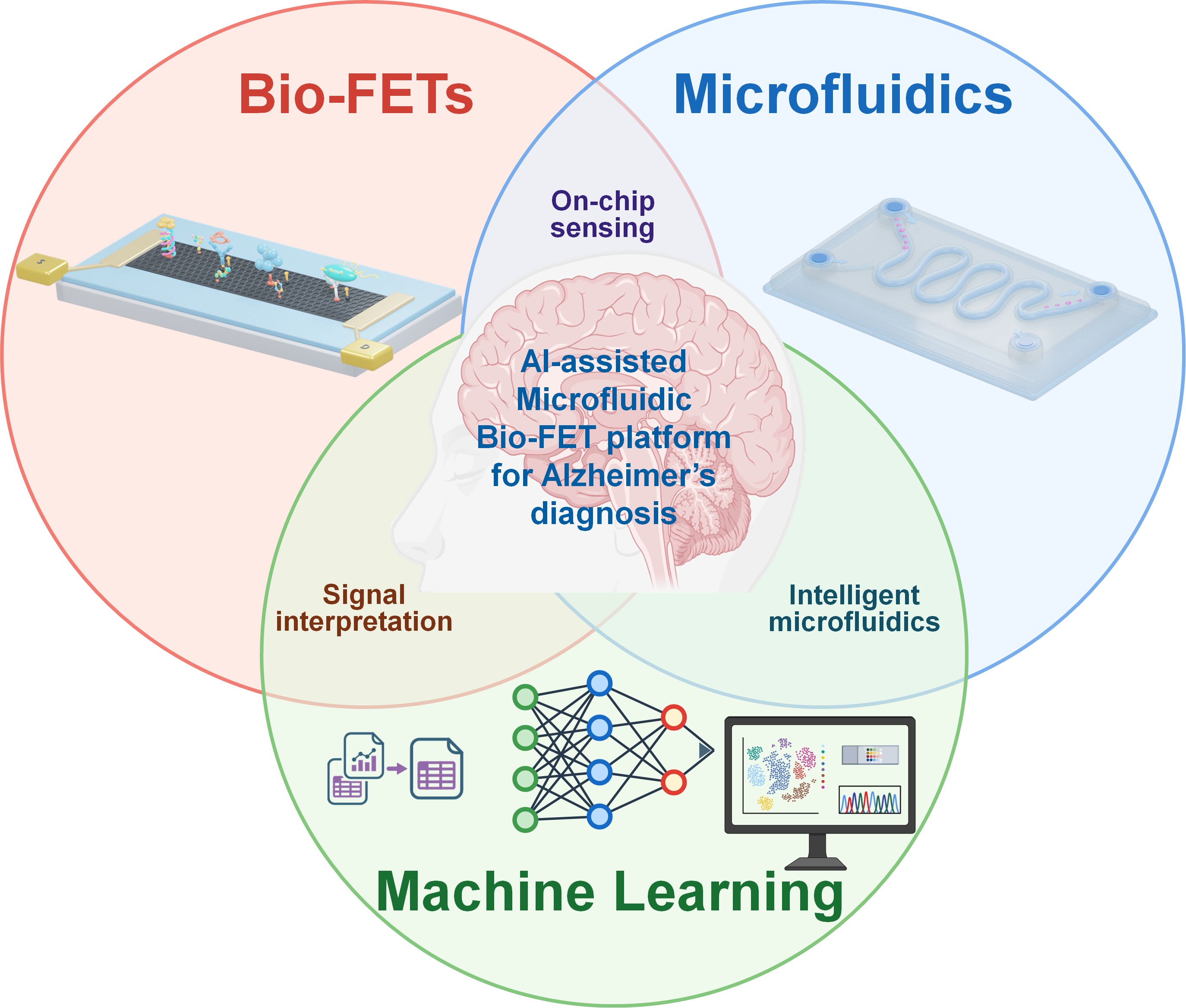
Alzheimer’s disease (AD) diagnostic workflows are undergoing a paradigm shift from symptom-centric cognitive assessment to biomarker-guided pathological stratification, fuelling an urgent need for minimally invasive analytical tools to quantify ultralow-concentration pathological markers within peripheral biofluids. Biological field-effect transistors (Bio-FETs) stand out as competitive label-free transducers for ultrasensitive biomolecular detection; nevertheless, persistent drawbacks including unstable solid-liquid interfaces, severe signal drift, and limited multiplexing capacity impede their real-world clinical deployment. This review first outlines high-specificity circulating AD biomarkers and elaborates the fundamental transduction principles of Bio-FET sensors, before systematically dissecting two complementary hardware–software strategies to mitigate intrinsic device defects: microfluidic chip integration and artificial intelligence (AI)-assisted data processing. Microfluidic engineering standardizes pre-analytical sample manipulation, precisely regulates on-chip biochemical reactions, and facilitates monolithic sensor integration, whereas AI algorithms streamline microchannel layout optimization, refine biomolecular signal deconvolution, suppress electronic noise, and unify device quality management. Jointly, the combinatorial microfluidic-AI framework creates a clinically feasible route for decentralized, multiplexed, high-fidelity liquid biopsy screening of early Alzheimer’s disease.
- Open Access
- Review
Enhancing Biological Field Effect Transistors (Bio-FETs) Performance for Alzheimer’s Disease Diagnostics: Microfluidics and Artificial Intelligence Integration
- Jiao Wang 1,2,
- Zi-Jin Wei 1,
- Zi-An Zhao 1,
- Yan-Hong Liu 1,
- Ke-Yu Yao 1,
- James Chung-Wai Cheung 1,3,*
Author Information
Received: 31 Jul 2026 | Revised: 23 Aug 2026 | Accepted: 27 Aug 2026 | Published: 02 Sep 2026
Abstract
Graphical Abstract
Keywords
Alzheimer’s disease | biomarkers | Bio-FET biosensor | microfluidics | artificial intelligence
References
- 1.
Jack, C.; Bennett, D.; Blennow, K.; et al. NIA-AA Research Framework: Toward a biological definition of Alzheimer’s disease. Alzheimer’s Dement. 2018, 14, 535–562. https://doi.org/10.1016/j.jalz.2018.02.018.
- 2.
Stevenson-Hoare, J.; Heslegrave, A.; Leonenko, G.; et al. Plasma biomarkers and genetics in the diagnosis and prediction of Alzheimer’s disease. Brain 2023, 146, 690–699. https://doi.org/10.1093/brain/awac128.
- 3.
Zhong, X.; Wang, Q.; Yang, M.; et al. Plasma p-tau217 and p-tau217/Aβ1–42 are effective biomarkers for identifying CSF- and PET imaging-diagnosed Alzheimer’s disease: Insights for research and clinical practice. Alzheimer’s Dement. 2025, 21, e14536. https://doi.org/10.1002/alz.14536.
- 4.
Jack, C.; Andrews, J.; Beach, T.; et al. Revised criteria for diagnosis and staging of Alzheimer’s disease: Alzheimer’s Association Workgroup. Alzheimer’s Dement. 2024, 20, 5143–5169. https://doi.org/10.1002/alz.13859.
- 5.
Arslan, B.; Zetterberg, H.; Ashton, N. Blood-based biomarkers in Alzheimer’s disease—moving towards a new era of diagnostics. Clin. Chem. Lab. Med. 2024, 62, 1063–1069. https://doi.org/10.1515/cclm-2023-1434.
- 6.
Zhang, Y.; Bi, K.; Zhou, L.; et al. Advances in Blood Biomarkers for Alzheimer’s Disease: Ultra-Sensitive Detection Technologies and Impact on Clinical Diagnosis. Degener. Neurol. Neuromuscul. Dis. 2024, 14, 85–102. https://doi.org/10.2147/dnnd.s471174.
- 7.
Heneka, M.; Gauthier, S.; Chandekar, S.A.; et al. Neuroinflammatory fluid biomarkers in patients with Alzheimer’s disease: A systematic literature review. Mol. Psychiatry 2025, 30, 2783–2798. https://doi.org/10.1038/s41380-025-02939-9.
- 8.
Roveta, F.; Bonino, L.; Piella, E.; et al. Neuroinflammatory Biomarkers in Alzheimer’s Disease: From Pathophysiology to Clinical Implications. Int. J. Mol. Sci. 2024, 25, 11941. https://doi.org/10.3390/ijms252211941.
- 9.
Lee, P.Y.; Osman, J.; Low, T.; et al. Plasma/serum proteomics: Depletion strategies for reducing high-abundance proteins for biomarker discovery. Bioanalysis 2019, 11, 1799–1812. https://doi.org/10.4155/bio-2019-0145.
- 10.
Chen, H.; Xiao, M.; He, J.; et al. Aptamer-Functionalized Carbon Nanotube Field-Effect Transistor Biosensors for Alzheimer’s Disease Serum Biomarker Detection. ACS Sens. 2022, 7, 2075–2083. https://doi.org/10.1021/acssensors.2c00967.
- 11.
Pandey, M.; Bhaiyya, M.; Rewatkar, P.; et al. Advanced Materials for Biological Field-Effect Transistors (Bio-FETs) in Precision Healthcare and Biosensing. Adv. Healthc. Mater. 2025, 14, 2500400. https://doi.org/10.1002/adhm.202500400.
- 12.
Wang, S.; Deng, R.; Chen, Z.; et al. High-Performance Plasma Biomarker Panel for Alzheimer’s Disease Screening Using a Femtomolar-Level Label-Free Biosensing System. ACS Nano 2024, 18, 2117–2130. https://doi.org/10.1021/acsnano.3c09311.
- 13.
Naresh, V.; Lee, N. A Review on Biosensors and Recent Development of Nanostructured Materials-Enabled Biosensors. Sensors 2021, 21, 1109. https://doi.org/10.3390/s21041109.
- 14.
Ryazantsev, D.; Shustinskiy, M.; Sheshil, A.; et al. A Portable Readout System for Biomarker Detection with Aptamer-Modified CMOS ISFET Array. Sensors 2024, 24, 3008. https://doi.org/10.3390/s24103008.
- 15.
Mia, A.K.; Meyyappan, M.; Giri, P. Two-Dimensional Transition Metal Dichalcogenide Based Biosensors: From Fundamentals to Healthcare Applications. Biosensors 2023, 13, 169. https://doi.org/10.3390/bios13020169.
- 16.
Wang, J.; Huang, S.; Lan, G.; et al. Diagnostic accuracy of plasma p-tau217/Aβ42 for Alzheimer’s disease in clinical and community cohorts. Alzheimer’s Dement. 2025, 21, e70038. https://doi.org/10.1002/alz.70038.
- 17.
Le, P.G.; Choi, S.; Cho, S. Alzheimer’s Disease Biomarker Detection Using Field Effect Transistor-Based Biosensor. Biosensors 2023, 13, 987. https://doi.org/10.3390/bios13110987.
- 18.
Shoukat, C.A.; Tariq, M.; Aqib, R.; et al. Plasmonic ELISA for Biomarker Detection: A Review of Mechanisms, Functionalization Strategies, and Emerging Modalities. ACS Appl. Bio Mater. 2025, 8, 5512–5531. https://doi.org/10.1021/acsabm.5c00738.
- 19.
Malhotra, K.; Hansen, L.; Han, S.; et al. Ultrasensitive Enzyme-Free Detection of Proteins on Magnetic Beads. J. Am. Chem. Soc. 2026, 148, 11641–11653. https://doi.org/10.1021/jacs.5c19560.
- 20.
Genco, E.; Modena, F.; Sarcina, L.; et al. A Single-Molecule Bioelectronic Portable Array for Early Diagnosis of Pancreatic Cancer Precursors. Adv. Mater. 2023, 35, 2304102. https://doi.org/10.1002/adma.202304102.
- 21.
Kong, D.; Xu, Z.; Chen, C.; et al. Biochemical Interface Engineering for Transistor-Based Point-of-Care Diagnostics. Acc. Chem. Res. 2026, 59, 411–423. https://doi.org/10.1021/acs.accounts.5c00732.
- 22.
Sakata, T. Signal transduction interfaces for field-effect transistor-based biosensors. Commun. Chem. 2024, 7, 35. https://doi.org/10.1038/s42004-024-01121-6.
- 23.
Albarghouthi, F.; Semeniak, D.; Khanani, I.; et al. Addressing Signal Drift and Screening for Detection of Biomarkers with Carbon Nanotube Transistors. ACS Nano 2024. https://doi.org/10.1021/acsnano.3c11679.
- 24.
Gao, N.; Zhou, W.; Jiang, X.; et al. General strategy for biodetection in high ionic strength solutions using transistor-based nanoelectronic sensors. Nano Lett. 2015, 15, 2143–2148. https://doi.org/10.1021/acs.nanolett.5b00133.
- 25.
Bhattacharyya, I.M.; Shalev, G. Electrostatically-governed Debye screening length at the solution-solid interface for biosensing applications. ACS Sens. 2020, 5, 154–161. https://doi.org/10.1021/acssensors.9b01939.
- 26.
Antonelli, G.; Filippi, J.; D’Orazio, M.; et al. Integrating machine learning and biosensors in microfluidic devices: A review. Biosens. Bioelectron. 2024, 263, 116632. https://doi.org/10.1016/j.bios.2024.116632.
- 27.
Zu, L.; Wang, X.; Liu, P.; et al. Ultrasensitive and Multiple Biomarker Discrimination for Alzheimer’s Disease via Plasmonic & Microfluidic Sensing Technologies. Adv. Sci. 2024, 11, 2308783. https://doi.org/10.1002/advs.202308783.
- 28.
Hansson, O.; Blennow, K.; Zetterberg, H.; et al. Blood biomarkers for Alzheimer’s disease in clinical practice and trials. Nat. Aging 2023, 3, 506–519. https://doi.org/10.1038/s43587-023-00403-3.
- 29.
Suresh, S.; Maffei, L.; Bauermeister, S.; et al. Blood biomarkers for diagnosis and differential diagnosis of Alzheimer’s disease in real-world clinical populations: A systematic review. J. Alzheimer’s Dis. 2025, 109, 1574–1589. https://doi.org/10.1177/13872877251408510.
- 30.
Ashton, N.; Janelidze, S.; Mattsson-Carlgren, N.; et al. Differential roles of Aβ42/40, p-tau231 and p-tau217 for Alzheimer’s trial selection and disease monitoring. Nat. Med. 2022, 28, 2555–2562. https://doi.org/10.1038/s41591-022-02074-w.
- 31.
Leipp, F.; Vialaret, J.; Mohaupt, P.; et al. Glial fibrillary acidic protein in Alzheimer’s disease: A narrative review. Brain Commun. 2024, 6, fcae396. https://doi.org/10.1093/braincomms/fcae396.
- 32.
Palmqvist, S.; Janelidze, S.; Quiroz, Y.; et al. Discriminative Accuracy of Plasma Phospho-tau217 for Alzheimer Disease vs Other Neurodegenerative Disorders. JAMA 2020, 324, 772–781. https://doi.org/10.1001/jama.2020.12134.
- 33.
Khalafi, M.; Dartora, W.; McIntire, L.; et al. Diagnostic accuracy of phosphorylated tau217 in detecting Alzheimer’s disease pathology among cognitively impaired and unimpaired: A systematic review and meta-analysis. Alzheimer’s Dement. 2025, 21, e14458. https://doi.org/10.1002/alz.14458.
- 34.
Therriault, J.; Vermeiren, M.-C.; Servaes, S.; et al. Association of Phosphorylated Tau Biomarkers With Amyloid Positron Emission Tomography vs. Tau Positron Emission Tomography. JAMA Neurol. 2023, 80, 188–199. https://doi.org/10.1001/jamaneurol.2022.4485.
- 35.
Therriault, J.; Servaes, S.; Tissot, C.; et al. Equivalence of plasma p-tau217 with cerebrospinal fluid in the diagnosis of Alzheimer’s disease. Alzheimer’s Dement. 2023, 19, 4967–4977. https://doi.org/10.1002/alz.13026.
- 36.
Thijssen, E.H.; La Joie, R.; Strom, A.; et al. Plasma phosphorylated tau217 and phosphorylated tau181 as biomarkers in Alzheimer’s disease and frontotemporal lobar degeneration: A retrospective diagnostic performance study. Lancet Neurol. 2021, 20, 739–752. https://doi.org/10.1016/S1474-4422(21)00214-3.
- 37.
Wang, J.; Yao, K.; Li, J.; et al. Ultrasensitive and Label-Free Detection of Phosphorylated Tau-217 Protein in Alzheimer’s Disease Using Carbon Nanotube Field-Effect Transistor (CNT-FET) Biosensor. Biosensors 2025, 15, 784. https://doi.org/10.3390/bios15120784.
- 38.
Dyer, A.; Dolphin, H.; O’Connor, A.; et al. Performance of plasma p-tau217 for the detection of amyloid-β positivity in a memory clinic cohort using an electrochemiluminescence immunoassay. Alzheimer’s Res. Ther. 2024, 16, 186. https://doi.org/10.1186/s13195-024-01555-z.
- 39.
Sun, M.; Zhang, C.; Lu, S.; et al. Recent Advances in Graphene Field-Effect Transistor Toward Biological Detection. Adv. Funct. Mater. 2024, 34, 2405471. https://doi.org/10.1002/adfm.202405471.
- 40.
Tang, W.; Fu, Y.; Huang, Y.; et al. Solution processed low power organic field-effect transistor bio-chemical sensor of high transconductance efficiency. npj Flex. Electron. 2022, 6, 18. https://doi.org/10.1038/s41528-022-00149-9.
- 41.
Nakamura, A.; Kaneko, N.; Villemagne, V.L.; et al. High performance plasma amyloid-β biomarkers for Alzheimer’s disease. Nature 2018, 554, 249–254. https://doi.org/10.1038/nature25456.
- 42.
Li, Y.; Schindler, S.; Bollinger, J.; et al. Validation of Plasma Amyloid-β42/40 for Detecting Alzheimer Disease Amyloid Plaques. Neurology 2022, 98, e688–e699. https://doi.org/10.1212/wnl.0000000000013211.
- 43.
Schindler, S.; Bollinger, J.; Ovod, V.; et al. High-precision plasma β-amyloid 42/40 predicts current and future brain amyloidosis. Neurology 2019, 93, e1647–e1659. https://doi.org/10.1212/wnl.0000000000008081.
- 44.
West, T.; Kirmess, K.; Meyer, M.; et al. A blood-based diagnostic test incorporating plasma Aβ42/40 ratio, ApoE proteotype, and age accurately identifies brain amyloid status: Findings from a multi cohort validity analysis. Mol. Neurodegener. 2021, 16, 30. https://doi.org/10.1186/s13024-021-00451-6.
- 45.
Kutovyi, Y.; Hlukhova, H.; Boichuk, N.; et al. Amyloid-beta peptide detection via aptamer-functionalized nanowire sensors exploiting single-trap phenomena. Biosens. Bioelectron. 2020, 154, 112053. https://doi.org/10.1016/j.bios.2020.112053.
- 46.
Napit, R.; Jaysawal, S.K.; Chowdhury, R.; et al. Aptasensors and Advancement in Molecular Recognition Technology. Adv. Mater. Technol. 2025, 10, 2400504. https://doi.org/10.1002/admt.202400504.
- 47.
Wang, S.; Sun, M.-J.; Zhang, Y.; et al. Concurrent Detection of Amyloid-β Biomarkers via Dual-Channel Graphene Field-Effect Transistor with Liquid-Metal Van Der Waals Contacts for Alzheimer Screening. ACS Sens. 2025, 10, 5067–5076. https://doi.org/10.1021/acssensors.5c01060.
- 48.
Lantero-Rodriguez, J.; Montoliu-Gaya, L.; Benedet, A.; et al. CSF p-tau205: A biomarker of tau pathology in Alzheimer’s disease. Acta Neuropathol. 2024, 147, 12. https://doi.org/10.1007/s00401-023-02659-w.
- 49.
Barthélemy, N.; Li, Y.; Joseph-Mathurin, N.; et al. A soluble phosphorylated tau signature links tau, amyloid and the evolution of stages of dominantly inherited Alzheimer’s disease. Nat. Med. 2020, 26, 398–407. https://doi.org/10.1038/s41591-020-0781-z.
- 50.
Neddens, J.; Temmel, M.; Flunkert, S.; et al. Phosphorylation of different tau sites during progression of Alzheimer’s disease. Acta Neuropathol. Commun. 2018, 6, 52. https://doi.org/10.1186/s40478-018-0557-6.
- 51.
Xia, Y.; Prokop, S.; Gorion, K.-M.; et al. Tau Ser208 phosphorylation promotes aggregation and reveals neuropathologic diversity in Alzheimer’s disease and other tauopathies. Acta Neuropathol. Commun. 2020, 8, 88. https://doi.org/10.1186/s40478-020-00967-w.
- 52.
Therriault, J.; Brum, W.; Trudel, L.; et al. Blood phosphorylated tau for the diagnosis of Alzheimer’s disease: A systematic review and meta-analysis. Lancet Neurol. 2025, 24, 740–752. https://doi.org/10.1016/s1474-4422(25)00227-3.
- 53.
Park, D.; Kim, J.; Kim, H.J.; et al. Multiplexed femtomolar detection of Alzheimer’s disease biomarkers in biofluids using a reduced graphene oxide field-effect transistor. Biosens. Bioelectron. 2020, 167, 112505. https://doi.org/10.1016/j.bios.2020.112505.
- 54.
Montoliu-Gaya, L.; Benedet, A.; Tissot, C.; et al. Mass spectrometric simultaneous quantification of tau species in plasma shows differential associations with amyloid and tau pathologies. Nat. Aging 2023, 3, 661–669. https://doi.org/10.1038/s43587-023-00405-1.
- 55.
Shabana, S.; Hamouda, H.; Shang, A.; et al. Recent molecular insights and biosensor-based diagnostic technologies for hyperphosphorylated Tau in Alzheimer’s disease. Alzheimer’s Res. Ther. 2026, 18, 5. https://doi.org/10.1186/s13195-025-01932-2.
- 56.
Shen, X.-N.; Huang, S.-Y.; Cui, M.; et al. Plasma Glial Fibrillary Acidic Protein in the Alzheimer Disease Continuum: Relationship to Other Biomarkers, Differential Diagnosis, and Prediction of Clinical Progression. Clin. Chem. 2023, 69, 411–421. https://doi.org/10.1093/clinchem/hvad018.
- 57.
Pereira, J.; Janelidze, S.; Smith, R.; et al. Plasma GFAP is an early marker of amyloid-β but not tau pathology in Alzheimer’s disease. Brain 2021, 144, 3505–3516. https://doi.org/10.1093/brain/awab223.
- 58.
Benedet, A.; Milà-Alomà, M.; Vrillon, A.; et al. Differences Between Plasma and Cerebrospinal Fluid Glial Fibrillary Acidic Protein Levels Across the Alzheimer Disease Continuum. JAMA Neurol. 2021, 78, 1471–1483. https://doi.org/10.1001/jamaneurol.2021.3671.
- 59.
Chatterjee, P.; Pedrini, S.; Ashton, N.; et al. Diagnostic and prognostic plasma biomarkers for preclinical Alzheimer’s disease. Alzheimer’s Dement. 2022, 18, 1141–1154. https://doi.org/10.1002/alz.12447.
- 60.
Cicognola, C.; Janelidze, S.; Hertze, J.; et al. Plasma glial fibrillary acidic protein detects Alzheimer pathology and predicts future conversion to Alzheimer dementia in patients with mild cognitive impairment. Alzheimer’s Res. Ther. 2021, 13, 68. https://doi.org/10.1186/s13195-021-00804-9.
- 61.
Ozcelikay, G.; Mollarasouli, F.; Unal, M.; et al. Ultrasensitive Determination of Glial-Fibrillary-Acidic-Protein (GFAP) in Human Serum-Matrix with a Label-Free Impedimetric Immunosensor. Biosensors 2022, 12, 1165. https://doi.org/10.3390/bios12121165.
- 62.
Agostini, M.; Amato, F.; Vieri, M.; et al. Glial-fibrillary-acidic-protein (GFAP) biomarker detection in serum-matrix: Functionalization strategies and detection by an ultra-high-frequency surface-acoustic-wave (UHF-SAW) lab-on-chip. Biosens. Bioelectron. 2021, 172, 112774. https://doi.org/10.1016/j.bios.2020.112774.
- 63.
Xu, L.; Ramadan, S.; Akingbade, O.; et al. Detection of Glial Fibrillary Acidic Protein in Patient Plasma Using On-Chip Graphene Field-Effect Biosensors, in Comparison with ELISA and Single-Molecule Array. ACS Sens. 2022, 7, 253–262. https://doi.org/10.1021/acssensors.1c02232.
- 64.
Song, J.; Dailey, J.; Li, H.; et al. Extended Solution Gate OFET-Based Biosensor for Label-Free Glial Fibrillary Acidic Protein Detection with Polyethylene Glycol-Containing Bioreceptor Layer. Adv. Funct. Mater. 2017, 27, 1606506. https://doi.org/10.1002/adfm.201606506.
- 65.
Khalil, M.; Teunissen, C.; Lehmann, S.; et al. Neurofilaments as biomarkers in neurological disorders—Towards clinical application. Nat. Rev. Neurol. 2024, 20, 269–287. https://doi.org/10.1038/s41582-024-00955-x.
- 66.
Gaetani, L.; Blennow, K.; Calabresi, P.; et al. Neurofilament light chain as a biomarker in neurological disorders. J. Neurol. Neurosurg. Psychiatry 2019, 90, 870–881. https://doi.org/10.1136/jnnp-2018-320106.
- 67.
Mattsson, N.; Cullen, N.; Andreasson, U.; et al. Association Between Longitudinal Plasma Neurofilament Light and Neurodegeneration in Patients with Alzheimer Disease. JAMA Neurol. 2019, 76, 791–799. https://doi.org/10.1001/jamaneurol.2019.0765.
- 68.
Thomas, K.; Spin, P.; Sir, N.; et al. Neurofilament light (NfL) chain levels predict clinical decline in Alzheimer’s disease: A systematic review and meta-analysis. J. Alzheimer’s Dis. Rep. 2025, 9, 25424823251379878. https://doi.org/10.1177/25424823251379878.
- 69.
Moscoso, A.; Grothe, M.; Ashton, N.; et al. Longitudinal Associations of Blood Phosphorylated Tau181 and Neurofilament Light Chain With Neurodegeneration in Alzheimer Disease. JAMA Neurol. 2021, 78, 396–406. https://doi.org/10.1001/jamaneurol.2020.4986.
- 70.
Pan, F.; Huang, L.; Wang, Y.; et al. Plasma p-tau217, GFAP, and NfL as biomarkers for Alzheimer’s disease: Role in disease stratification, pathological progression, and cognitive decline. Alzheimer’s Dement. 2025, 21, e70987. https://doi.org/10.1002/alz.70987.
- 71.
Solodka, K.; Berto, M.; Ferraro, D.; et al. Detection of Neurofilament Light Chain with Label-Free Electrolyte-Gated Organic Field-Effect Transistors. Adv. Mater. Interfaces 2022, 9, 2102341. https://doi.org/10.1002/admi.202102341.
- 72.
Kesler, V.; Murmann, B.; Soh, T. Going beyond the Debye Length: Overcoming Charge Screening Limitations in Next-Generation Bioelectronic Sensors. ACS Nano 2020, 14, 16194–16201. https://doi.org/10.1021/acsnano.0c08622.
- 73.
Nguyen, T.T.-H.; Nguyen, C.; Huynh, M.; et al. Field effect transistor based wearable biosensors for healthcare monitoring. J. Nanobiotechnology 2023, 21, 411. https://doi.org/10.1186/s12951-023-02153-1.
- 74.
Sadighbayan, D.; Hasanzadeh, M.; Ghafar-Zadeh, E. Biosensing based on field-effect transistors (FET): Recent progress and challenges. Trends Anal. Chem. 2020, 133, 116067. https://doi.org/10.1016/j.trac.2020.116067.
- 75.
Ahmad, R.; Mahmoudi, T.; Ahn, M.-S.; et al. Recent advances in nanowires-based field-effect transistors for biological sensor applications. Biosens. Bioelectron. 2018, 100, 312–325. https://doi.org/10.1016/j.bios.2017.09.024.
- 76.
Alabsi, S.; Ahmed, A.; Dennis, J.; et al. A Review of Carbon Nanotubes Field Effect-Based Biosensors. IEEE Access 2020, 8, 69509–69521. https://doi.org/10.1109/access.2020.2987204.
- 77.
Aftab, S.; Li, X.; Hussain, S.; et al. Nanomaterials-Based Field-Effect Transistor for Protein Sensing: New Advances. ACS Sens. 2024, 9, 9–22. https://doi.org/10.1021/acssensors.3c01728.
- 78.
Zhou, Y.; Feng, T.; Li, Y.; et al. Recent Advances in Enhancing the Sensitivity of Biosensors Based on Field Effect Transistors. Adv. Electron. Mater. 2025, 11, 2400712. https://doi.org/10.1002/aelm.202400712.
- 79.
Liu, N.; Chen, R.; Wan, Q. Recent Advances in Electric-Double-Layer Transistors for Bio-Chemical Sensing Applications. Sensors 2019, 19, 3425. https://doi.org/10.3390/s19153425.
- 80.
Kumari, M.; Singh, N.; Sahoo, M. A detailed investigation of dielectric-modulated dual-gate TMD FET based label-free biosensor via analytical modelling. Sci. Rep. 2022, 12, 21115. https://doi.org/10.1038/s41598-022-24677-6.
- 81.
Panda, D.; Lenka, T.; Singh, R.; et al. Analytical modeling of dielectric modulated negative capacitance MoS2 field effect transistor for next-generation label-free biosensor. Int. J. Numer. Model. Electron. Netw. Devices Fields 2023, 36, e3060. https://doi.org/10.1002/jnm.3060.
- 82.
Shibata, M.; Morimoto, Y.; Zenyuk, I.; et al. Parameter-Fitting-Free Continuum Modeling of Electric Double Layer in Aqueous Electrolyte. J. Chem. Theory Comput. 2024, 20, 6184–6196. https://doi.org/10.1021/acs.jctc.4c00408.
- 83.
Schott, C.; Schneider, P.; Song, K.T.; et al. How to Assess and Predict Electrical Double Layer Properties. Implications for Electrocatalysis. Chem. Rev. 2024, 124, 12391–12462. https://doi.org/10.1021/acs.chemrev.3c00806.
- 84.
Wu, T.; Alharbi, A.; You, K.; et al. Experimental Study of the Detection Limit in Dual-Gate Biosensors Using Ultrathin Silicon Transistors. ACS Nano 2017, 11, 7142–7147. https://doi.org/10.1021/acsnano.7b02986.
- 85.
Sanjay, S.; Rao, A.; Bhat, N. Super-Nernstian ion sensitive field-effect transistor exploiting charge screening in WSe2/MoS2 heterostructure. npj 2D Mater. Appl. 2021, 5, 93. https://doi.org/10.1038/s41699-021-00273-6.
- 86.
Teunissen, C.; Verberk, I.; Thijssen, E.; et al. Blood-based biomarkers for Alzheimer’s disease: Towards clinical implementation. Lancet Neurol. 2022, 21, 66–77. https://doi.org/10.1016/s1474-4422(21)00361-6.
- 87.
Leuzy, A.; Mattsson-Carlgren, N.; Palmqvist, S.; et al. Blood-based biomarkers for Alzheimer’s disease. EMBO Mol. Med. 2022, 14, EMMM202114408. https://doi.org/10.15252/emmm.202114408.
- 88.
Ciou, S.-H.; Hsieh, A.-H.; Lin, Y.-X.; et al. Sensitive label-free detection of the biomarker phosphorylated tau-217 protein in Alzheimer’s disease using a graphene-based solution-gated field effect transistor. Biosens. Bioelectron. 2023, 228, 115174. https://doi.org/10.1016/j.bios.2023.115174.
- 89.
Grande, G.; Valletta, M.; Rizzuto, D.; et al. Blood-based biomarkers of Alzheimer’s disease and incident dementia in the community. Nat. Med. 2025, 31, 2027–2035. https://doi.org/10.1038/s41591-025-03605-x.
- 90.
Chen, S.; Bashir, R. Advances in field-effect biosensors towards point-of-use. Nanotechnology 2023, 34, 492002. https://doi.org/10.1088/1361-6528/acf3f0.
- 91.
Sun, A.; Hall, D. Point-of-Care Smartphone-based Electrochemical Biosensing. Electroanalysis 2019, 31, 2–16. https://doi.org/10.1002/elan.201800474.
- 92.
Cai, H.; Wang, D.; Zhao, Y.; et al. Recent Advances in Microfluidic Chip Technology for Laboratory Medicine: Innovations and Artificial Intelligence Integration. Biosensors 2026, 16, 104. https://doi.org/10.3390/bios16020104.
- 93.
Rackus, D.G.; Shamsi, M.H.; Wheeler, A.R. Electrochemistry, biosensors and microfluidics: A convergence of fields. Chem. Soc. Rev. 2015, 44, 5320–5340. https://doi.org/10.1039/c4cs00369a.
- 94.
Wang, S.; Guan, X.; Sun, S. Microfluidic Biosensors: Enabling Advanced Disease Detection. Sensors 2025, 25, 1936. https://doi.org/10.3390/s25061936.
- 95.
Liu, D.; Wang, Y.; Li, X.; et al. Integrated microfluidic devices for in vitro diagnostics at point of care. Aggregate 2022, 3, e184. https://doi.org/10.1002/agt2.184.
- 96.
Wang, W.; Jiang, S.; Li, Y.-Y.; et al. Construction of a glycosylation-mediated fluorescent biosensor for label-free measurement of site-specific 5-hydroxymethylcytosine in cancer cells with zero background signal. Anal. Chim. Acta 2024, 1300, 342463. https://doi.org/10.1016/j.aca.2024.342463.
- 97.
Wu, Y.; Liu, Y.; Ma, J.; et al. A Microfluidic Biosensor for Quantitative Detection of Salmonella in Traditional Chinese Medicine. Biosensors 2025, 15, 10. https://doi.org/10.3390/bios15010010.
- 98.
Song, P.; Fu, H.; Wang, Y.; et al. A microfluidic field-effect transistor biosensor with rolled-up indium nitride microtubes. Biosens. Bioelectron. 2021, 190, 113264. https://doi.org/10.1016/j.bios.2021.113264.
- 99.
Ma, W.; Liu, L.; Zhang, X.; et al. A microfluidic-based SERS biosensor with multifunctional nanosurface immobilized nanoparticles for sensitive detection of MicroRNA. Anal. Chim. Acta 2022, 1221, 340139. https://doi.org/10.1016/j.aca.2022.340139.
- 100.
Zhou, Z.; Lan, X.; Zhu, L.; et al. Portable dual-aptamer microfluidic chip biosensor for Bacillus cereus based on aptamer tailoring and dumbbell-shaped probes. J. Hazard. Mater. 2023, 445, 130545. https://doi.org/10.1016/j.jhazmat.2022.130545.
- 101.
Wang, C.; Wang, T.; Gao, Y.; et al. Multiplexed immunosensing of cancer biomarkers on a split-float-gate graphene transistor microfluidic biochip. Lab Chip 2024, 24, 317–326. https://doi.org/10.1039/d3lc00709j.
- 102.
Luka, G.; Ahmadi, A.; Najjaran, H.; et al. Microfluidics Integrated Biosensors: A Leading Technology towards Lab-on-a-Chip and Sensing Applications. Sensors 2015, 15, 30011–30031. https://doi.org/10.3390/s151229783.
- 103.
Khan, N.; Mousazadehkasin, M.; Ghosh, S.; et al. An Integrated Microfluidic Platform for Selective and Real-Time Detection of Thrombin Biomarkers Using a Graphene FET. Analyst 2020, 145, 4494–4503. https://doi.org/10.1039/d0an00251h.
- 104.
Abdelhamid, M.; Ki, M.; Yoon, H.J.; et al. Microfluidic Sensors for Micropollutant Detection in Environmental Matrices: Recent Advances and Prospects. Biosensors 2025, 15, 474. https://doi.org/10.3390/bios15080474.
- 105.
Xiang, X.; Song, M.; Xu, X.; et al. Microfluidic Biosensor Integrated with Signal Transduction and Enhancement Mechanism for Ultrasensitive Noncompetitive Assay of Multiple Mycotoxins. Anal. Chem. 2023, 95, 7993–8001. https://doi.org/10.1021/acs.analchem.3c00813.
- 106.
Park, J.; Kim, Y.W.; Jeon, H.-J. Machine Learning-Driven Innovations in Microfluidics. Biosensors 2024, 14, 613. https://doi.org/10.3390/bios14120613.
- 107.
Chang, C.; Lin, C.-H.; Lane, H. Machine Learning and Novel Biomarkers for the Diagnosis of Alzheimer’s Disease. Int. J. Mol. Sci. 2021, 22, 2761. https://doi.org/10.3390/ijms22052761.
- 108.
Mohsen, F.; Ali, H.; Hajj, N.; et al. Artificial intelligence-based methods for fusion of electronic health records and imaging data. Sci. Rep. 2022, 12, 17981. https://doi.org/10.1038/s41598-022-22514-4.
- 109.
Wang, S.; Zhu, Y.; Zhou, Z.; et al. Integrated Ultrasound-Enrichment and Machine Learning in Colorimetric Lateral Flow Assay for Accurate and Sensitive Clinical Alzheimer’s Biomarker Diagnosis. Adv. Sci. 2024, 11, 2406196. https://doi.org/10.1002/advs.202406196.
- 110.
Ku, J.; Singhal, M.; Burnette, M.; et al. Machine learning and artificial intelligence in liquid biopsy-based early detection of pancreatic cancer: A scoping review. BJC Rep. 2026, 4, 26. https://doi.org/10.1038/s44276-026-00232-y.
- 111.
Sun, L.; Gao, H.; Pan, S.; et al. Surrogate modeling for fluid flows based on physics-constrained deep learning without simulation data. Comput. Methods Appl. Mech. Eng. 2020, 361, 112732. https://doi.org/10.1016/j.cma.2019.112732.
- 112.
Zhang, N.; Sun, T.; Liu, Z.; et al. A universal inverse design methodology for microfluidic mixers. Biomicrofluidics 2024, 18, 024102. https://doi.org/10.1063/5.0185494.
- 113.
Wang, J.; Zhang, N.; Chen, J.; et al. Predicting the fluid behavior of random microfluidic mixers using convolutional neural networks. Lab Chip 2021, 21, 296–309. https://doi.org/10.1039/d0lc01158d.
- 114.
Khodayari, A.; Ebrahimi, S.; Topaheidari, M.; et al. High-throughput microfluidics for precise separation and focusing of circulating tumor cells with optimized triangular microchannel design. Talanta 2025, 293, 128022. https://doi.org/10.1016/j.talanta.2025.128022.
- 115.
Hao, R.; Liu, L.; Yuan, J.; et al. Recent Advances in Field Effect Transistor Biosensors: Designing Strategies and Applications for Sensitive Assay. Biosensors 2023, 13, 426. https://doi.org/10.3390/bios13040426.
- 116.
Zhang, Z.; Hu, J.J.; Lin, S.; et al. Field effect transistor biosensors for healthcare monitoring. Interdiscip. Med. 2024, 2, e20240032. https://doi.org/10.1002/inmd.20240032.
- 117.
Zeng, X.; Lafferty, T.; Sehrawat, A.; et al. Multi-analyte proteomic analysis identifies blood-based neuroinflammation, cerebrovascular and synaptic biomarkers in preclinical Alzheimer’s disease. Mol. Neurodegener. 2024, 19, 68. https://doi.org/10.1186/s13024-024-00753-5.
- 118.
Liu, Q.; He, Y.; Wang, Q.; et al. Robust detection of femtogram-level Alzheimer’s biomarkers using machine learning-enhanced graphene biosensors. Biosens. Bioelectron. 2025, 292, 118074. https://doi.org/10.1016/j.bios.2025.118074.
- 119.
Cheng, Y.; Tang, L.; Tan, Y.; et al. A Surface-Engineered Microfluidic Platform with Algorithmic Optimization for Plasma Biomarker Detection in Alzheimer’s Disease. ACS Sens. 2026, 11, 696–706. https://doi.org/10.1021/acssensors.5c03653.
- 120.
Duan, S.; Cai, T.; Liu, F.; et al. Automatic offline-capable smartphone paper-based microfluidic device for efficient biomarker detection of Alzheimer’s disease. Anal. Chim. Acta 2024, 1308, 342575. https://doi.org/10.1016/j.aca.2024.342575.
- 121.
Chen, X.; Xie, Y.; Sheng, Y.; et al. Wafer-scale functional circuits based on two dimensional semiconductors with fabrication optimized by machine learning. Nat. Commun. 2021, 12, 5953. https://doi.org/10.1038/s41467-021-26230-x.
- 122.
Mülhopt, S.; Diabaté, S.; Dilger, M.; et al. Characterization of Nanoparticle Batch-To-Batch Variability. Nanomaterials 2018, 8, 311. https://doi.org/10.3390/nano8050311.
- 123.
Taha, K. Observational and experimental insights into machine learning-based defect classification in wafers. J. Intell. Manuf. 2026, 37, 45–95. https://doi.org/10.1007/s10845-024-02521-0.
- 124.
Pan, J.; Low, K.L.; Ghosh, J.; et al. Transfer Learning-Based Artificial Intelligence-Integrated Physical Modeling to Enable Failure Analysis for 3 Nanometer and Smaller Silicon-Based CMOS Transistors. ACS Appl. Nano Mater. 2021, 4, 6903–6915. https://doi.org/10.1021/acsanm.1c00960.
- 125.
Thavarajah, M. Real time inferencing of semiconductor wafer probing process using Machine Learning. In Proceedings of the 2024 IEEE 40th International Electronics Manufacturing Technology (IEMT), Penang, Malaysia, 16–18 October 2024; pp. 1–6. https://doi.org/10.1109/iemt61324.2024.10875232.
- 126.
Li, H.; Zang, Y.; Zhu, Z.; et al. Machine Learning Accelerated Design of Self-Assembled Monolayers for High-Performance Perovskite Solar Cells. J. Phys. Chem. Lett. 2026, 17, 3362–3373. https://doi.org/10.1021/acs.jpclett.6c00119.
- 127.
Njirjak, M.; Žužić, L.; Babić, M.; et al. Reshaping the discovery of self-assembling peptides with generative AI guided by hybrid deep learning. Nat. Mach. Intell. 2024, 6, 1487–1500. https://doi.org/10.1038/s42256-024-00928-1.


This work is licensed under a Creative Commons Attribution 4.0 International License.
