
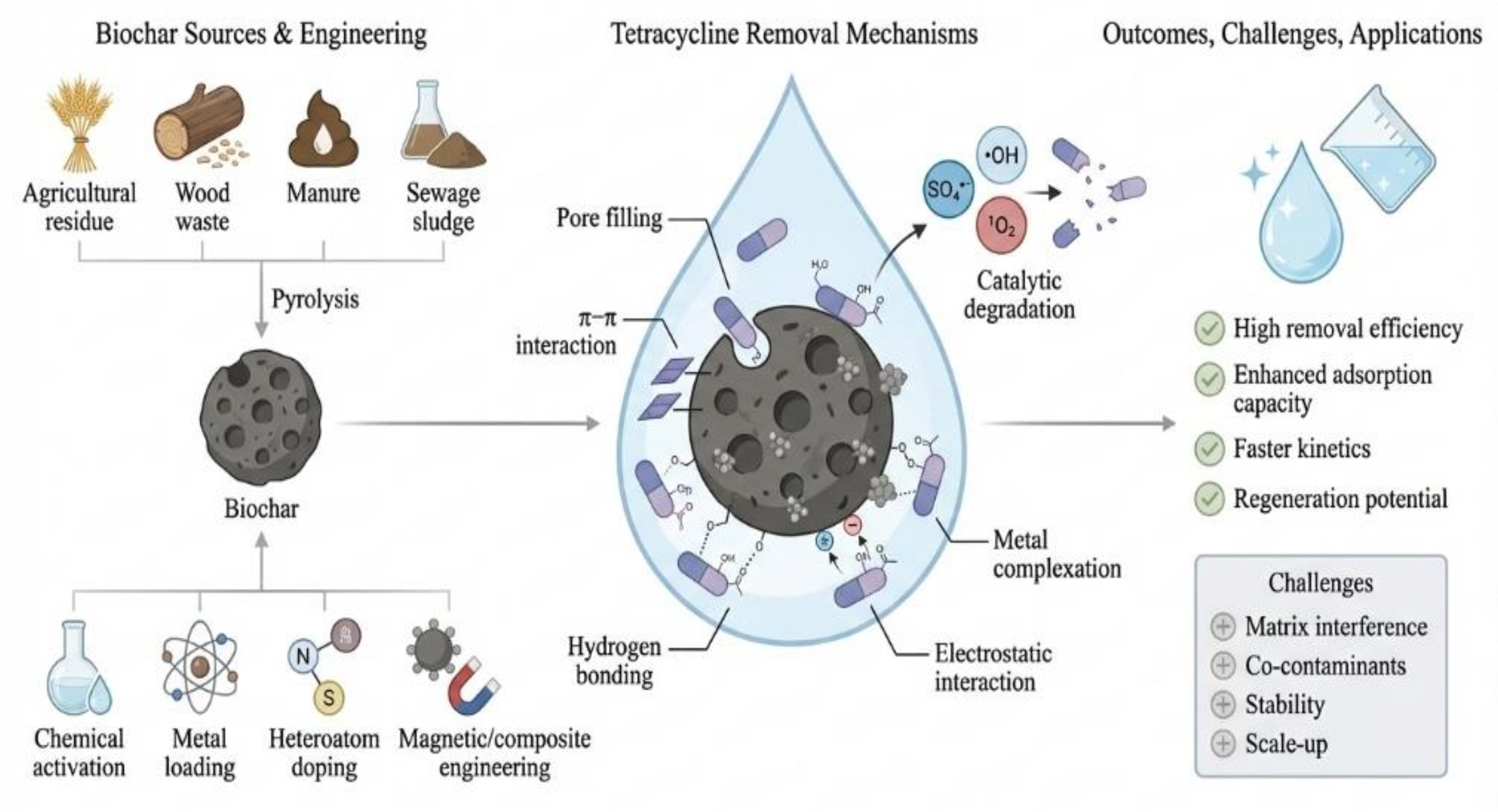
The widespread presence of tetracycline (TC) in aquatic environments poses serious risks to ecosystems and public health due to its persistence and role in promoting antimicrobial resistance. Engineered biochar has become a promising and sustainable material for removing TC because of its adjustable physicochemical properties, low cost, and multiple interaction mechanisms. This review examines the current state of biochar-based TC removal through a structure–performance–application framework that integrates material design, mechanistic insights, and real-world applications. The analysis shows that choices of feedstock, pyrolysis conditions, and modification methods—such as chemical activation, doping with heteroatoms, and metal impregnation—shape the structural features that influence adsorption and catalytic breakdown through mechanisms like pore filling, π–π interactions, hydrogen bonding, electrostatic attraction, and metal–ligand complexation. Although engineered biochars can achieve exceptionally high adsorption capacities (occasionally exceeding 1000 mg/g) under optimized laboratory conditions, most reported values fall within a broader range depending on feedstock, modification, and experimental conditions. However, their effectiveness can vary significantly in real water systems, where factors such as pH, ionic strength, natural organic matter, and other contaminants introduce competitive and inhibitory effects. Additionally, issues related to regeneration, stability, and declining performance pose major challenges for long-term use. Our review also highlights the huge gap between laboratory research and real-world implementation, stressing the importance of standardized testing, pilot-scale trials, and integration into continuous treatment systems. By linking material structure to function and operational practicality, our work offers a comprehensive guide for designing and scaling up engineered biochar technologies to effectively remove tetracycline from complex aquatic environments.
- Open Access
- Review
Engineered Biochar for Tetracycline Removal under Realistic Water Matrices: Structure–Performance–Deployment Framework
Author Information
Received: 01 Apr 2026 | Revised: 28 Apr 2026 | Accepted: 14 May 2026 | Published: 15 Jun 2026
Abstract
Graphical Abstract
Keywords
engineered biochar | tetracycline removal | adsorption mechanisms | catalytic degradation | regeneration and reuse
References
- 1.
Kemper, N. Veterinary Antibiotics in the Aquatic and Terrestrial Environment. Ecol. Indic. 2008, 8, 1–13. https://doi.org/10.1016/j.ecolind.2007.06.002.
- 2.
Milić, N.; Milanović, M.; Letić, N.G.; et al. Occurrence of Antibiotics as Emerging Contaminant Substances in Aquatic Environment. Int. J. Environ. Health Res. 2013, 23, 296–310. https://doi.org/10.1080/09603123.2012.733934.
- 3.
Manyi-Loh, C.; Mamphweli, S.; Meyer, E.; et al. Antibiotic Use in Agriculture and Its Consequential Resistance in Environmental Sources: Potential Public Health Implications. Molecules 2018, 23, 795. https://doi.org/10.3390/molecules23040795.
- 4.
Nguyen, H.N.; Le, P.T.; Nguyen, T.P.; et al. Removing Emerging Organic Pollutants (Oxytetracycline) by Engineered Biochars Originated from Agricultural Wastes. Environ. Prog. Sustain. Energy 2025, 44, e14512. https://doi.org/10.1002/ep.14512.
- 5.
Scaria, J.; Anupama, K.V.; Nidheesh, P.V. Tetracyclines in the Environment: An Overview on the Occurrence, Fate, Toxicity, Detection, Removal Methods, and Sludge Management. Sci. Total Environ. 2021, 771, 145291. https://doi.org/10.1016/j.scitotenv.2021.145291.
- 6.
Daghrir, R.; Drogui, P. Tetracycline Antibiotics in the Environment: A Review. Environ. Chem. Lett. 2013, 11, 209–227. https://doi.org/10.1007/s10311-013-0404-8.
- 7.
Luo, Y.; Xu, L.; Rysz, M.; et al. Occurrence and Transport of Tetracycline, Sulfonamide, Quinolone, and Macrolide Antibiotics in the Haihe River Basin, China. Environ. Sci. Technol. 2011, 45, 1827–1833. https://doi.org/10.1021/es104009s.
- 8.
Calangi, J.D.; Borres, J.L.; Grande, M.K.P.F.; et al. Removal of Tetracycline from Aqueous Solution via Fenton Process Using Iron-Impregnated Bamboo Biochar. IOP Conf. Ser. Mater. Sci. Eng. 2024, 1318, 012049. https://doi.org/10.1088/1757-899x/1318/1/012049.
- 9.
Kraemer, S.A.; Ramachandran, A.; Perron, G.G. Antibiotic Pollution in the Environment: From Microbial Ecology to Public Policy. Microorganisms 2019, 7, 180. https://doi.org/10.3390/microorganisms7060180.
- 10.
Fiaz, A.; Zhu, D.; Sun, J. Environmental Fate of Tetracycline Antibiotics: Degradation Pathway Mechanisms, Challenges, and Perspectives. Environ. Sci. Eur. 2021, 33, 64. https://doi.org/10.1186/s12302-021-00505-y.
- 11.
Ohore, O.E.; Zhang, S.; Guo, S.; et al. The Fate of Tetracycline in Vegetated Mesocosmic Wetlands and Its Impact on the Water Quality and Epiphytic Microbes. J. Hazard. Mater. 2021, 417, 126148. https://doi.org/10.1016/j.jhazmat.2021.126148.
- 12.
Deng, Y.; Chen, J.; She, A.; et al. A Novel Fe-Loaded Porous Hydrothermal Biochar for Removing Tetracycline from Wastewater: Performance, Mechanism, and Fixed-Bed Column. J. Environ. Chem. Eng. 2024, 12, 112256. https://doi.org/10.1016/j.jece.2024.112256.
- 13.
Wang, Y.; Xu, L.; Wei, F.; et al. Insights into the Adsorption Mechanism of Tetracycline on Hierarchically Porous Carbon and the Effect of Nanoporous Geometry. Chem. Eng. J. 2022, 437, 135454. https://doi.org/10.1016/j.cej.2022.135454.
- 14.
Fady, P.E.; Richardson, A.K.; Barron, L.P.; et al. Biochar Filtration of Drug-Resistant Bacteria and Active Pharmaceutical Ingredients to Combat Antimicrobial Resistance. Sci. Rep. 2025, 15, 6642. https://doi.org/10.1038/s41598-024-83825-2.
- 15.
Shirani, Z.; Carrasco-Navarro, V.; Majlesi, S.; et al. Efficiency and Ecotoxicity of Activated Biochar in the Treatment of Artificial Wastewater Contaminated by Pharmaceuticals. J. Environ. Manag. 2024, 371, 123224. https://doi.org/10.1016/j.jenvman.2024.123224.
- 16.
Oberoi, A.S.; Jia, Y.; Zhang, H.; et al. Insights into the Fate and Removal of Antibiotics in Engineered Biological Treatment Systems: A Critical Review. Environ. Sci. Technol. 2019, 53, 7234–7264. https://doi.org/10.1021/acs.est.9b01131.
- 17.
Amangelsin, Y.; Semenova, Y.; Dadar, M.; et al. The Impact of Tetracycline Pollution on the Aquatic Environment and Removal Strategies. Antibiotics 2023, 12, 440. https://doi.org/10.3390/antibiotics12030440.
- 18.
Tang, C.; Xu, C.; Zhong, G.; et al. Unveiling Activation Mechanism of Persulfate by Homologous Hemp-Derived Biochar Catalysts for Enhanced Tetracycline Wastewater Remediation. Bioresour. Technol. 2024, 400, 130684. https://doi.org/10.1016/j.biortech.2024.130684.
- 19.
Gopal, G.; Alex, S.A.; Chandrasekaran, N.; et al. A Review on Tetracycline Removal from Aqueous Systems by Advanced Treatment Techniques. RSC Adv. 2020, 10, 27081–27095. https://doi.org/10.1039/d0ra04264a.
- 20.
Yu, X.; Bai, M.; Li, X.; et al. Tetracycline Removal by Immobilized Indigenous Bacterial Consortium Using Biochar and Biomass: Removal Performance and Mechanisms. Bioresour. Technol. 2024, 413, 131463. https://doi.org/10.1016/j.biortech.2024.131463.
- 21.
Zhao, Z.; Nie, T.; Zhou, W. Enhanced Biochar Stabilities and Adsorption Properties for Tetracycline by Synthesizing Silica-Composited Biochar. Environ. Pollut. 2019, 254, 113015. https://doi.org/10.1016/j.envpol.2019.113015.
- 22.
Zhang, D.; He, Q.; Hu, X.; et al. Enhanced Adsorption for the Removal of Tetracycline Hydrochloride (TC) Using Ball-Milled Biochar Derived from Crayfish Shell. Colloids Surf. A Physicochem. Eng. Asp. 2021, 615, 126254. https://doi.org/10.1016/j.colsurfa.2021.126254.
- 23.
Varadharajan, V.; Senthilkumar, D.S.; Senthilkumar, K.; et al. Process Modeling and Toxicological Evaluation of Adsorption of Tetracycline onto the Magnetized Cotton Dust Biochar. J. Water Process Eng. 2022, 49, 103046. https://doi.org/10.1016/j.jwpe.2022.103046.
- 24.
Huang, G.; Wang, M.; Liu, Q.; et al. Efficient Removal of Tetracycline in Water Using Modified Eggplant Straw Biochar Supported Green Nanoscale Zerovalent Iron: Synthesis, Removal Performance, and Mechanism. RSC Adv. 2024, 14, 3567–3577. https://doi.org/10.1039/d3ra08417e.
- 25.
Sun, J.; Ji, L.; Han, X.; et al. Mesoporous Activated Biochar from Crab Shell with Enhanced Adsorption Performance for Tetracycline. Foods 2023, 12, 1042. https://doi.org/10.3390/foods12051042.
- 26.
Ding, J.; Liang, J.; Wang, Q.; et al. Enhanced Tetracycline Adsorption Using KOH-Modified Biochar Derived from Waste Activated Sludge in Aqueous Solutions. Toxics 2024, 12, 691. https://doi.org/10.3390/toxics12100691.
- 27.
Chen, J.; Yu, X.; Li, C.; et al. Removal of Tetracycline via the Synergistic Effect of Biochar Adsorption and Enhanced Activation of Persulfate. Chem. Eng. J. 2020, 382, 122916. https://doi.org/10.1016/j.cej.2019.122916.
- 28.
Fan, S.; Wang, Y.; Li, Y.; et al. Removal of Tetracycline from Aqueous Solution by Biochar Derived from Rice Straw. Environ. Sci. Pollut. Res. 2018, 25, 29529–29540. https://doi.org/10.1007/s11356-018-2976-0.
- 29.
Guo, Y.; Zhang, Q.; Feng, W.; et al. Coadsorption of Tetracycline and Copper(II) by KOH-Modified Biomass and Biochar Derived from Corn Straw in Aqueous Solution. Water 2025, 17, 284. https://doi.org/10.3390/w17020284.
- 30.
Wang, H.; Chu, Y.; Fang, C.; et al. Sorption of Tetracycline on Biochar Derived from Rice Straw under Different Temperatures. PLoS ONE 2017, 12, e0182776. https://doi.org/10.1371/journal.pone.0182776.
- 31.
Wang, H.; Fang, C.; Wang, Q.; et al. Sorption of Tetracycline on Biochar Derived from Rice Straw and Swine Manure. RSC Adv. 2018, 8, 16260–16268. https://doi.org/10.1039/c8ra01454j.
- 32.
Zhang, L.; Xiao, J.; Che, H.; et al. Novel Magnetic N-Doped Biochar Derived from Sugarcane Bagasse and Red Mud for Effective Adsorption of Tetracycline Hydrochloride. J. Environ. Chem. Eng. 2024, 12, 113041. https://doi.org/10.1016/j.jece.2024.113041.
- 33.
Junfeng, W.; Bowen, H.; Xiaoqing, W.; et al. Preparation of N,S-Codoped Magnetic Bagasse Biochar and Adsorption Characteristics for Tetracycline. RSC Adv. 2022, 12, 11786–11795. https://doi.org/10.1039/d1ra08404f.
- 34.
Li, Y.; Li, H.; Zhang, Y.; et al. Preparation of Magnetic Biochar Used Bioleached Sludge to Enhance Tetracycline Removal in a Heterogeneous Fenton-Like System. Process Saf. Environ. Prot. 2024, 189, 302–312. https://doi.org/10.1016/j.psep.2024.06.072.
- 35.
Ma, H.; Zhang, B.; Wang, S.; et al. Enhanced Removal of Tetracycline by Vitamin C-Modified Cow Manure Biochar in Water. Sci. Rep. 2024, 14, 12345. https://doi.org/10.1038/s41598-024-73210-4.
- 36.
Ma, J.; Zhou, B.; Zhang, H.; et al. Activated Municipal Wasted Sludge Biochar Supported by Nanoscale Fe/Cu Composites for Tetracycline Removal from Water. Chem. Eng. Res. Des. 2019, 149, 209–219. https://doi.org/10.1016/j.cherd.2019.07.013.
- 37.
Zhao, X.; Zhu, G.; Liu, J.; et al. Efficient Removal of Tetracycline from Water by One-Step Pyrolytic Porous Biochar Derived from Antibiotic Fermentation Residue. Nanomaterials 2024, 14, 1377. https://doi.org/10.3390/nano14171377.
- 38.
Zhao, X.; Liao, Z.; Zhao, Q.; et al. A Low Cost Magnetic Biochar Manufactured Solely from Solid Wastes by One-Step Pyrolysis for Removal of Tetracycline. Sci. Rep. 2025, 15, 5678. https://doi.org/10.1038/s41598-025-14532-9.
- 39.
Deng, B.; Su, Y. Adsorption Mechanism in Water Treatment by Biochar and Its Modified Materials: A Review. Appl. Comput. Eng. 2025, 180, 190–199. https://doi.org/10.54254/2755-2721/2026.ka27177.
- 40.
Liu, Y.; Gao, W.; Yin, S.; et al. Efficient Removal of Tetracycline from Aqueous Solution by K2CO3 Activated Penicillin Fermentation Residue Biochar. Front. Chem. 2022, 10, 1078877. https://doi.org/10.3389/fchem.2022.1078877.
- 41.
Wang, L.; OʼConnor, D.; Rinklebe, J.; et al. Biochar Aging: Mechanisms, Physicochemical Changes, Assessment, and Implications for Field Applications. Environ. Sci. Technol. 2020, 54, 14797–14814. https://doi.org/10.1021/acs.est.0c04033.
- 42.
García Rodríguez, J.; Miino, M.C.; Ferri, E.N.; et al. Wastewater Remediation Treatments Aimed at Water Reuse: Recent Outcomes from Pilot- and Full-Scale Tests. Appl. Sci. 2025, 15, 2448. https://doi.org/10.3390/app15052448.
- 43.
Fu, B.; Ge, C.; Yue, L.; et al. Characterization of Biochar Derived from Pineapple Peel Waste and Its Application for Sorption of Oxytetracycline from Aqueous Solution. BioResources 2016, 11, 9017–9035.
- 44.
Liu, X.; Shao, Z.; Wang, Y.; et al. New Use for Lentinus edodes Bran Biochar for Tetracycline Removal. Environ. Res. 2023, 216, 114651. https://doi.org/10.1016/j.envres.2022.114651.
- 45.
Zhao, J.; Gao, F.; Sun, Y.; et al. New Use for Biochar Derived from Bovine Manure for Tetracycline Removal. J. Environ. Chem. Eng. 2021, 9, 105585. https://doi.org/10.1016/j.jece.2021.105585.
- 46.
Zhao, B.; Zhang, J. Tetracycline Degradation by Peroxydisulfate Activated by Waste Pulp/Paper Mill Sludge Biochars Derived at Different Pyrolysis Temperature. Water 2022, 14, 1583. https://doi.org/10.3390/w14101583.
- 47.
Duan, W.; Zhang, M.; Zhou, R. Efficient Degradation of Antibiotic Wastewater by Biochar Derived from Water Hyacinth Stems via Periodate Activation: Pyridinic N and Carbon Structures Improved the Electron Transfer Process. Water Sci. Technol. 2024, 89, 212–224. https://doi.org/10.2166/wst.2023.408.
- 48.
Deng, Y.; Xiao, T.; She, A.; et al. One-Step Synthesis of Iron and Nitrogen Co-Doped Porous Biochar for Efficient Removal of Tetracycline from Water: Adsorption Performance and Fixed-Bed Column. J. Environ. Manag. 2024, 352, 119984. https://doi.org/10.1016/j.jenvman.2023.119984.
- 49.
Sun, A.; Bian, S.; Li, L.; et al. Preparation of Highly Adsorptive Biochar by Sequential Iron Impregnation under Refluxing and Pyrolysis at Low Temperature for Removal of Tetracycline. Environ. Pollut. 2024, 348, 123886. https://doi.org/10.1016/j.envpol.2024.123886.
- 50.
Zhang, Q.; Zhang, H.; Hua, Q.; et al. Effect on the Adsorption Performance and Mechanism of Antibiotics Tetracyclines by the Magnetic Biochar Used Peanut Shells as Raw Materials. Mater. Res. Express 2024, 11, 045001. https://doi.org/10.1088/2053-1591/ad3719.
- 51.
Wu, Y.; Long, D.; Yang, F.; et al. Tetracycline Adsorption on Magnetic Sludge Biochar: Effects of pH and Natural Organic Matters. Research Square 2022. in press. https://doi.org/10.21203/rs.3.rs-1419427/v1.
- 52.
Wang, H.; Srinivasakannan, C.; Liu, M.; et al. Microwave-Assisted Synthesis of Porous Graphitized Biochar as a Super Sorbent for Tetracycline Separation. Biochem. Eng. J. 2024, 205, 109291. https://doi.org/10.1016/j.bej.2024.109291.
- 53.
Hong, G.; Yu, Z.; Kong, D.; et al. Removal of Tetracycline from Aqueous Solution by Magnetic Biochar Modified with Different Iron Valence and K2C2O4: A Comparative Study and Mechanism. J. Anal. Appl. Pyrolysis 2025, 187, 107005. https://doi.org/10.1016/j.jaap.2025.107005.
- 54.
Huang, D.; Wang, X.; Zhang, C.; et al. Sorptive Removal of Ionizable Antibiotic Sulfamethazine from Aqueous Solution by Graphene Oxide-Coated Biochar Nanocomposites: Influencing Factors and Mechanism. Chemosphere 2017, 186, 414–421. https://doi.org/10.1016/j.chemosphere.2017.07.154.
- 55.
Zhao, Y.; Geng, J.; Wang, X.; et al. Tetracycline Adsorption on Kaolinite: pH, Metal Cations and Humic Acid Effects. Ecotoxicology 2011, 20, 1141–1147. https://doi.org/10.1007/s10646-011-0665-6.
- 56.
Ali, S.L. Tetracycline Hydrochloride. Anal. Profiles Drug Subst. Excipients 1984, 13, 597–653. https://doi.org/10.1016/S0099-5428(08)60204-X.
- 57.
Murtaza, G.; Ahmed, Z.; Dai, D.Q.; et al. A Review of Mechanism and Adsorption Capacities of Biochar-Based Engineered Composites for Removing Aquatic Pollutants from Contaminated Water. Front. Environ. Sci. 2022, 10, 1035865. https://doi.org/10.3389/fenvs.2022.1035865.
- 58.
Zhang, X.; Hou, J.; Zhang, S.; et al. Standardization and Micromechanistic Study of Tetracycline Adsorption by Biochar. Biochar 2024, 6, 12. https://doi.org/10.1007/s42773-023-00299-7.
- 59.
Borthakur, P.; Aryafard, M.; Zara, Z.; et al. Computational and Experimental Assessment of pH and Specific Ions on the Solute Solvent Interactions of Clay-Biochar Composites towards Tetracycline Adsorption: Implications on Wastewater Treatment. J. Environ. Manag. 2021, 283, 111989. https://doi.org/10.1016/j.jenvman.2021.111989.
- 60.
Wang, Q.; Luo, B.; Wang, Z.; et al. Pore Engineering in Biomass-Derived Carbon Materials for Enhanced Energy, Catalysis, and Environmental Applications. Molecules 2024, 29, 5172. https://doi.org/10.3390/molecules29215172.
- 61.
Saghir, S.; Pu, C.; Fu, E.; et al. Synthesis of High Surface Area Porous Biochar Obtained from Pistachio Shells for the Efficient Adsorption of Organic Dyes from Polluted Water. Surf. Interfaces 2022, 34, 102357. https://doi.org/10.1016/j.surfin.2022.102357.
- 62.
Zheng, Z.; Zhao, B.; Guo, Y.; et al. Preparation of Mesoporous Batatas Biochar via Soft-Template Method for High Efficiency Removal of Tetracycline. Sci. Total Environ. 2021, 787, 147397. https://doi.org/10.1016/j.scitotenv.2021.147397.
- 63.
Song, Q.; Liang, J.; Fang, Y.; et al. Selective Adsorption Behavior/Mechanism of Antibiotic Contaminants on Novel Boron Nitride Bundles. J. Hazard. Mater. 2019, 364, 654–662. https://doi.org/10.1016/j.jhazmat.2018.10.054.
- 64.
Ninh, P.T.T.; Ngoc Tuyen, L.T.; Dat, N.D.; et al. Two-Stage Preparation of Highly Mesoporous Carbon for Super-Adsorption of Paracetamol and Tetracycline in Water: Important Contribution of Pore Filling and π–π Interaction. Environ. Res. 2023, 218, 114927. https://doi.org/10.1016/j.envres.2022.114927.
- 65.
Bakshi, S.; Laird, D.A.; Smith, R.G.; et al. Capture and Release of Orthophosphate by Fe-Modified Biochars: Mechanisms and Environmental Applications. ACS Sustain. Chem. Eng. 2021, 9, 658–668. https://doi.org/10.1021/acssuschemeng.0c06108.
- 66.
Kohzadi, S.; Marzban, N.; Libra, J.A.; et al. Removal of RhB from Water by Fe-Modified Hydrochar and Biochar—An Experimental Evaluation Supported by Genetic Programming. J. Mol. Liq. 2023, 369, 120971. https://doi.org/10.1016/j.molliq.2022.120971.
- 67.
Peng, B.; Chen, L.; Que, C.; et al. Adsorption of Antibiotics on Graphene and Biochar in Aqueous Solutions Induced by π–π Interactions. Sci. Rep. 2016, 6, 31920. https://doi.org/10.1038/srep31920.
- 68.
Wang, Z.; Du, Y.; Jiang, Y.; et al. Fe(V) Dominates the Toxicity Increase Pathway during Ferrate(VI) Degradation of Fluoroquinolone Antibiotics. ACS EST Eng. 2023, 3, 883–893. https://doi.org/10.1021/acsestengg.2c00442.
- 69.
Nguyen, V.D.; Luu, T.A.; Chang-Chien, G.P.; et al. Progress in Biochar Derived Adsorbents: Preparation, Modification Strategies, and Applications in Remediation of Antibiotics from Wastewater. Mater. Adv. 2025, 6, 8839–8876. https://doi.org/10.1039/d5ma00872g.
- 70.
Tan, Z.; Yuan, S.; Hong, M.; et al. Mechanism of Negative Surface Charge Formation on Biochar and Its Effect on the Fixation of Soil Cd. J. Hazard. Mater. 2020, 384, 121370. https://doi.org/10.1016/j.jhazmat.2019.121370.
- 71.
Wang, S.; Kwak, J.H.; Islam, M.S.; et al. Biochar Surface Complexation and Ni(II), Cu(II), and Cd(II) Adsorption in Aqueous Solutions Depend on Feedstock Type. Sci. Total Environ. 2020, 712, 136538. https://doi.org/10.1016/j.scitotenv.2020.136538.
- 72.
Trefalt, G.; Behrens, S.H.; Borkovec, M. Charge Regulation in the Electrical Double Layer: Ion Adsorption and Surface Interactions. Langmuir 2015, 32, 380–400. https://doi.org/10.1021/acs.langmuir.5b03611.
- 73.
Hansen, J.P.; Löwen, H. Effective Interactions between Electric Double Layers. Annu. Rev. Phys. Chem. 2000, 51, 209–242. https://doi.org/10.1146/annurev.physchem.51.1.209.
- 74.
Wu, J. Understanding the Electric Double-Layer Structure, Capacitance, and Charging Dynamics. Chem. Rev. 2022, 122, 10821–10859. https://doi.org/10.1021/acs.chemrev.2c00097.
- 75.
Zhang, X.; Wang, Y.; Cai, J.; et al. Bio/Hydrochar Sorbents for Environmental Remediation. Energy Environ. Mater. 2020, 3, 453–468. https://doi.org/10.1002/eem2.12074.
- 76.
Sen, P.; Bhattacharya, P.; Mukherjee, G.; et al. Advancements in Doping Strategies for Enhanced Photocatalysts and Adsorbents in Environmental Remediation. Technologies 2023, 11, 144. https://doi.org/10.3390/technologies11050144.
- 77.
Zare, E.N.; Mudhoo, A.; Khan, M.A.; et al. Water Decontamination Using Bio-Based, Chemically Functionalized, Doped, and Ionic Liquid-Enhanced Adsorbents: Review. Environ. Chem. Lett. 2021, 19, 3075–3114. https://doi.org/10.1007/s10311-021-01207-w.
- 78.
Terrón, D.; Sanromán, A.; Pazos, M. Metal–Organic Frameworks: Next-Generation Materials for Environmental Remediation. Catalysts 2025, 15, 244. https://doi.org/10.3390/catal15030244.
- 79.
Al-Khatib, I.A.; Rahman, R.O.A.; Imai, T.; et al. A Comprehensive Review of Agricultural Residue-Derived Bioadsorbents for Emerging Contaminant Removal. Water 2025, 17, 2141. https://doi.org/10.3390/w17142141.
- 80.
Iroegbu, A.O.C.; Teffo, M.L.; Sadiku, E.R.; et al. Advancing Wastewater Treatment with Green and Scalable Metal–Organic Frameworks: From Synthetic Strategies to Real-World Deployment. NPJ Clean Water 2025, 8, 85. https://doi.org/10.1038/s41545-025-00514-x.
- 81.
Kumari, S.; Dong, Y.; Safferman, S.I. Phosphorus Adsorption and Recovery from Waste Streams Using Biochar: Review of Mechanisms, Modifications, and Agricultural Applications. Appl. Water Sci. 2025, 15, 162. https://doi.org/10.1007/s13201-025-02523-0.
- 82.
Abhishek, K.; Parashar, N.; Patel, M.; et al. Recent Advancements in Antimony (Sb) Removal from Water and Wastewater by Carbon-Based Materials: A Systematic Review. Environ. Monit. Assess. 2023, 195, 758. https://doi.org/10.1007/s10661-023-11322-6.
- 83.
Yu, F.; Pan, J.; Zhang, X.; et al. Adsorption of Contaminants from Aqueous Solutions by Modified Biochar: A Review. Environ. Chem. 2022, 19, 53–81. https://doi.org/10.1071/EN22014.
- 84.
Song, W.; Yu, Z.; Li, H.; et al. Insights into the Factors Influencing the Oxidation of Antibiotic Pollutants in Nitrogen-Doped Biochar/PMS System: The Roles of Physicochemical Properties and Reaction Pathways. Chem. Eng. J. 2024, 498, 155601. https://doi.org/10.1016/j.cej.2024.155601.
- 85.
Wang, M.; Wang, Y.; Li, Y.; et al. Persulfate Oxidation of Tetracycline, Antibiotic Resistant Bacteria, and Resistance Genes Activated by Fe Doped Biochar Catalysts: Synergy of Radical and Non-Radical Processes. Chem. Eng. J. 2023, 464, 142558. https://doi.org/10.1016/j.cej.2023.142558.
- 86.
Xue, Q.; Song, B.; Feng, Q.; et al. Efficiently Removal of Tetracycline via Synergistic Photocatalysis with Fenton Reaction with Biochar/FeOOH. Appl. Surf. Sci. 2024, 645, 158869. https://doi.org/10.1016/j.apsusc.2023.158869.
- 87.
Zeng, S.; Kan, E. Comparative Insights into Performance and Mechanisms of Fenton and Persulfate Oxidation on Iron-Functionalized Activated Biochar for Removal of Aqueous Tetracycline Antibiotics. SSRN 2024. in press. http://doi.org/10.2139/ssrn.4847255.
- 88.
Zhang, Y.; Liang, S.; He, R.; et al. Enhanced Adsorption and Degradation of Antibiotics by Doping Corncob Biochar/PMS with Heteroatoms at Different Preparation Temperatures: Mechanism, Pathway, and Relative Contribution of Reactive Oxygen Species. J. Water Process Eng. 2022, 46, 102626. https://doi.org/10.1016/j.jwpe.2022.102626.
- 89.
Lu, J.; Lu, Q.; Di, L.; et al. Iron-Based Biochar as Efficient Persulfate Activation Catalyst for Emerging Pollutants Removal: A Review. Chin. Chem. Lett. 2023, 34, 108357. https://doi.org/10.1016/j.cclet.2023.108357.
- 90.
Lu, Y.; Cai, Y.; Zhang, S.; et al. Application of Biochar-Based Photocatalysts for Adsorption-(Photo)degradation/Reduction of Environmental Contaminants: Mechanism, Challenges and Perspective. Biochar 2022, 4, 45. https://doi.org/10.1007/s42773-022-00173-y.
- 91.
Fu, Z.; Chen, Y.; Lu, Y.; et al. KMnO4 Modified Biochar Derived from Swine Manure for Tetracycline Removal. Water Pract. Technol. 2022, 17, 11. https://doi.org/10.2166/wpt.2022.129.
- 92.
Wu, J.; Lu, J.; Zhang, C.; et al. Adsorptive Removal of Tetracyclines and Fluoroquinolones Using Yak Dung Biochar. Bull. Environ. Contam. Toxicol. 2019, 102, 407–412. https://doi.org/10.1007/s00128-018-2516-0.
- 93.
Zhang, G.; Wo, R.; Sun, Z.; et al. Effective Magnetic MOFs Adsorbent for the Removal of Bisphenol A, Tetracycline, Congo Red and Methylene Blue Pollutions. Nanomaterials 2021, 11, 1917. https://doi.org/10.3390/nano11081917.
- 94.
Zhang, M.; Meng, J.; Liu, Q.; et al. Corn Stover-Derived Biochar for Efficient Adsorption of Oxytetracycline from Wastewater. J. Mater. Res. 2019, 34, 3050–3060. https://doi.org/10.1557/jmr.2019.198.
- 95.
Zhao, Z.; Li, P.; Zhang, M.; et al. Unlocking the Potential of Chinese Herbal Medicine Residue-Derived Biochar as an Efficient Adsorbent for High-Performance Tetracycline Removal. Environ. Res. 2024, 252, 118425. https://doi.org/10.1016/j.envres.2024.118425.
- 96.
Shen, Y.; Zhang, X.; Ye, M.; et al. Effects of Fe-Modified Digestate Hydrochar at Different Hydrothermal Temperatures on Anaerobic Digestion of Swine Manure. Bioresour. Technol. 2024, 395, 130393. https://doi.org/10.1016/j.biortech.2024.130393.
- 97.
Jiang, H.; Ma, J.; Zhang, M.; et al. Calcium Carbonate Self-Fixed Crayfish Shell Composite Biochar for Removing Tetracycline from Water. Colloids Surf. A Physicochem. Eng. Asp. 2025, 711, 136371. https://doi.org/10.1016/j.colsurfa.2025.136371.
- 98.
Xu, S.; Yang, J.; Marrakchi, F.; et al. Macro- and Micro-Algae-Based Carbon Composite for Pharmaceutical Wastewater Treatment: Batch Adsorption and Mechanism Study. Process Saf. Environ. Prot. 2023, 176, 641–652. https://doi.org/10.1016/j.psep.2023.06.020.
- 99.
Ortiz-Ramos, U.; Leyva-Ramos, R.; Mendoza-Mendoza, E.; et al. Removal of Tetracycline from Aqueous Solutions by Adsorption on Raw Ca-Bentonite. Effect of Operating Conditions and Adsorption Mechanism. Chem. Eng. J. 2022, 432, 134428. https://doi.org/10.1016/j.cej.2021.134428.
- 100.
Zheng, X.; Pan, C.; Zheng, S.; et al. Functionalized Magnetic Chitosan-Based Adsorbent for Efficient Tetracycline Removal: Deep Investigation of Adsorption Behaviors and Mechanisms. Sep. Purif. Technol. 2024, 335, 126212. https://doi.org/10.1016/j.seppur.2023.126212.
- 101.
Deng, H.; Wang, Y.; Touqeer, A.; et al. Adsorption Mechanism and Performance of Tetracycline on Different Biochar-Based Amphoteric Clays. Phys. Chem. Earth Parts A/B/C 2023, 129, 103352. https://doi.org/10.1016/j.pce.2022.103352.
- 102.
Wang, Y.; Xu, S.; Wang, Q.; et al. Tetracycline Removal from Aqueous Solution by Magnetic Biochar Modified with Different Iron Valences: A Comparative Study. Sep. Purif. Technol. 2024, 339, 126614. https://doi.org/10.1016/j.seppur.2024.126614.
- 103.
Liu, X.; Tournassat, C.; Grangeon, S.; et al. Molecular-Level Understanding of Metal Ion Retention in Clay-Rich Materials. Nat. Rev. Earth Environ. 2022, 3, 461–476. https://doi.org/10.1038/s43017-022-00301-z.
- 104.
Wu, Y.; Yang, M.; Long, D.; et al. Tetracycline Adsorption on Magnetic Sludge Biochar: Effects of pH, Humic Acid (HA), and Fulvic Acid (FA). Micromachines 2022, 13, 1057. https://doi.org/10.3390/mi13071057.
- 105.
Chen, B.; Guan, H.; Zhang, Y.; et al. Performance and Mechanism of Pb2+ and Cd2+ Ions’ Adsorption via Modified Antibiotic Residue-Based Hydrochar. Heliyon 2023, 9, e14930. https://doi.org/10.1016/j.heliyon.2023.e14930.
- 106.
Liu, C.; Zheng, N.; Tang, C.; et al. Multiscale Synergistic Effect of Fe/Mn Oxides and Biochar on Bifunctional Adsorption of Tetracycline and Cu2+ in Water at a Wide pH Range. Sep. Purif. Technol. 2026, 382, 135783. https://doi.org/10.1016/j.seppur.2025.135783.
- 107.
Shi, L.; Zhong, J.; Wu, M.; et al. Turning Waste into Treasure: A Magnetic Sludge-Based Biochar for Efficient Co-Removal of Tetracycline and Cu2+. Langmuir 2025, 41, 32994–33008. https://doi.org/10.1021/acs.langmuir.5c05131.
- 108.
Saxena, R.; Saxena, M.; Lochab, A. Recent Progress in Nanomaterials for Adsorptive Removal of Organic Contaminants from Wastewater. ChemistrySelect 2020, 5, 335–353. https://doi.org/10.1002/slct.201903542.
- 109.
Ahmed, M.B.; Zhou, J.L.; Ngo, H.H.; et al. Sorption of Hydrophobic Organic Contaminants on Functionalized Biochar: Protagonist Role of π–π Electron-Donor-Acceptor Interactions and Hydrogen Bonds. J. Hazard. Mater. 2018, 360, 270–278. https://doi.org/10.1016/j.jhazmat.2018.08.005.
- 110.
Tan, X.F.; Zhu, S.S.; Wang, R.P.; et al. Role of Biochar Surface Characteristics in the Adsorption of Aromatic Compounds: Pore Structure and Functional Groups. Chin. Chem. Lett. 2021, 32, 2939–2946. https://doi.org/10.1016/j.cclet.2021.04.059.
- 111.
Fang, Q.; Chen, B.; Lin, Y.; et al. Aromatic and Hydrophobic Surfaces of Wood-Derived Biochar Enhance Perchlorate Adsorption via Hydrogen Bonding to Oxygen-Containing Organic Groups. Environ. Sci. Technol. 2013, 48, 279–288. https://doi.org/10.1021/es403711y.
- 112.
Ma, C.; Huang, H.; Gao, X.; et al. Honeycomb Tubular Biochar from Fargesia Leaves as an Effective Adsorbent for Tetracyclines Pollutants. J. Taiwan Inst. Chem. Eng. 2018, 91, 299–308. https://doi.org/10.1016/j.jtice.2018.05.032.
- 113.
Wu, H.; Xie, H.; He, G.; et al. Effects of the pH and Anions on the Adsorption of Tetracycline on Iron-Montmorillonite. Appl. Clay Sci. 2016, 119, 161–169. https://doi.org/10.1016/j.clay.2015.08.001.
- 114.
Xiao, Y.; Du, Y.; Huang, X.; et al. Preparation of Biochar Carbonized with Sulfuric Acid and Study on Its Adsorption Properties to Antibiotics. ChemistrySelect 2025, 10, e202500240. https://doi.org/10.1002/slct.202500240.
- 115.
Pi, Z.; Hou, K.; Yao, F.; et al. In-Situ Regeneration of Tetracycline-Saturated Hierarchical Porous Carbon by Peroxydisulfate Oxidation Process: Performance, Mechanism and Application. Chem. Eng. J. 2022, 427, 131749. https://doi.org/10.1016/j.cej.2021.131749.
- 116.
Xing, J.; Huang, J.; Wang, X.; et al. Removal of Low-Concentration Tetracycline from Water by a Two-Step Process of Adsorption Enrichment and Photocatalytic Regeneration. J. Environ. Manag. 2023, 343, 118210. https://doi.org/10.1016/j.jenvman.2023.118210.
- 117.
Li, B.; Ma, J.; Zhou, L.; et al. Magnetic Microsphere to Remove Tetracycline from Water: Adsorption, H2O2 Oxidation and Regeneration. Chem. Eng. J. 2017, 330, 191–201. https://doi.org/10.1016/j.cej.2017.07.054.
- 118.
Anderson, K.A.; Garza-Rubalcava, U.; Widdowson, M.A.; et al. Sorption-Desorption Processes Contributing to the Natural Attenuation of cis-1,2-Dichloroethene in Porous Media. J. Hazard. Mater. 2025, 494, 138500. https://doi.org/10.1016/j.jhazmat.2025.138500.
- 119.
Andrunik, M.; Smol, M. Life After Adsorption: Regeneration, Management, and Sustainability of PFAS Adsorbents in Water Treatment. Water 2025, 17, 2813. https://doi.org/10.3390/w17192813.
- 120.
Nguyen, A.H.; Youn, S.; Yang, Y.; et al. Alkaline-Modified Biochar and Nitrifying Microbiome Synergistically Mitigate the Toxicity of Oxytetracycline and Its Toxic By-Products. Chem. Eng. J. 2024, 481, 148527. https://doi.org/10.1016/j.cej.2024.148527.
- 121.
Ashworth, D.J.; Schmidt, M.P.; Ibekwe, A.M. Performance of Acid- and Base-Modified Biochars for the Removal of Antibiotics from Water under Dynamic Conditions. J. Environ. Chem. Eng. 2023, 11, 111616. https://doi.org/10.1016/j.jece.2023.111616.
- 122.
Nguyen, V.T.; Nguyen, T.B.; Huang, C.P.; et al. Alkaline Modified Biochar Derived from Spent Coffee Ground for Removal of Tetracycline from Aqueous Solutions. J. Water Process Eng. 2021, 40, 101908. https://doi.org/10.1016/j.jwpe.2020.101908.
- 123.
Hasan, M.; Chakma, S.; Liang, X.; et al. Engineered Biochar for Metal Recycling and Repurposed Applications. Energies 2024, 17, 4674. https://doi.org/10.3390/en17184674.
- 124.
Nasrollahpour, S.; Pulicharla, R.; Brar, S.K. Functionalized Biochar for the Removal of Poly- and Perfluoroalkyl Substances in Aqueous Media. iScience 2025, 28, 112113. https://doi.org/10.1016/j.isci.2025.112113.
- 125.
Abdelsamad, A.M.A.; Khalil, A.S.G.; Ulbricht, M. Mesoporous Silica Nanoparticles for Rapid Removal of PFOA: Impact of Surface Functional Groups on Adsorption Efficiency and Adsorbent Regeneration. Environ. Pollut. 2025, 383, 126796. https://doi.org/10.1016/j.envpol.2025.126796.
- 126.
Tomczyk, A.; Szewczuk-Karpisz, K. Effect of Biochar Modification by Vitamin C, Hydrogen Peroxide or Silver Nanoparticles on Its Physicochemistry and Tetracycline Removal. Materials 2022, 15, 5379. https://doi.org/10.3390/ma15155379.
- 127.
Ghasemlou, S. Enzymatic Removal of Tetracycline Antibiotics from Synthetic Wastewater Using Soybean Peroxidase. Masterʼs Thesis, University of Windsor, Windsor, ON, Canada, 2025.
- 128.
Akhtar, M.S.; Ali, S.; Zaman, W. Innovative Adsorbents for Pollutant Removal: Exploring the Latest Research and Applications. Molecules 2024, 29, 4317. https://doi.org/10.3390/molecules29184317.
- 129.
Isaeva, V.I.; Vedenyapina, M.D.; Kurmysheva, A.Y.; et al. Modern Carbon-Based Materials for Adsorptive Removal of Organic and Inorganic Pollutants from Water and Wastewater. Molecules 2021, 26, 6628. https://doi.org/10.3390/molecules26216628.
- 130.
Zhang, S.; Shao, T.; Kose, H.S.; et al. Adsorption of Aromatic Compounds by Carbonaceous Adsorbents: A Comparative Study on Granular Activated Carbon, Activated Carbon Fiber, and Carbon Nanotubes. Environ. Sci. Technol. 2010, 44, 6377–6383. https://doi.org/10.1021/ES100874Y.
- 131.
Li, D.; Yadav, A.; Zhou, H.; et al. Advances and Applications of Metal-Organic Frameworks (MOFs) in Emerging Technologies: A Comprehensive Review. Glob. Chall. 2024, 8, 2300244. https://doi.org/10.1002/gch2.202300244.
- 132.
Ding, M.; Cai, X.; Jiang, H.L. Improving MOF Stability: Approaches and Applications. Chem. Sci. 2019, 10, 10209–10230. https://doi.org/10.1039/C9SC03916C.
- 133.
Yuan, S.; Feng, L.; Wang, K.; et al. Stable Metal–Organic Frameworks: Design, Synthesis, and Applications. Adv. Mater. 2018, 30, 1704303. https://doi.org/10.1002/adma.201704303.
- 134.
Wang, L.; Ok, Y.S.; Tsang, D.C.W.; et al. New Trends in Biochar Pyrolysis and Modification Strategies: Feedstock, Pyrolysis Conditions, Sustainability Concerns and Implications for Soil Amendment. Soil Use Manag. 2020, 36, 358–386. https://doi.org/10.1111/sum.12592.
- 135.
Liu, W.J.; Jiang, H.; Yu, H.Q. Development of Biochar-Based Functional Materials: Toward a Sustainable Platform Carbon Material. Chem. Rev. 2015, 115, 12251–12285. https://doi.org/10.1021/acs.chemrev.5b00195.
- 136.
Li, C.; Li, J.; Pan, L.; et al. Treatment of Digestate Residues for Energy Recovery and Biochar Production: From Lab to Pilot-Scale Verification. J. Clean. Prod. 2020, 265, 121852. https://doi.org/10.1016/j.jclepro.2020.121852.
- 137.
Gallego-Ramírez, C.; Chica, E.; Rubio-Clemente, A. Combination of Biochar and Advanced Oxidation Processes for the Sustainable Elimination of Pharmaceuticals in Water. Sustainability 2024, 16, 10761. https://doi.org/10.3390/su162310761.
- 138.
Muh, E.; Tabet, F.; Amara, S. Biomass Conversion to Fuels and Value-Added Chemicals: A Comprehensive Review of the Thermochemical Processes. Curr. Altern. Energy 2019, 4, 3–25. https://doi.org/10.2174/2405463103666191022121648.
- 139.
Huber, G.W.; Iborra, S.; Corma, A. Synthesis of Transportation Fuels from Biomass: Chemistry, Catalysts, and Engineering. Chem. Rev. 2006, 106, 4044–4098. https://doi.org/10.1021/CR068360D.
- 140.
Akhtar, M.S.; Naseem, M.T.; Ali, S.; et al. Metal-Based Catalysts in Biomass Transformation: From Plant Feedstocks to Renewable Fuels and Chemicals. Catalysts 2025, 15, 40. https://doi.org/10.3390/catal15010040.
- 141.
Zuo, W.; Mao, Y.; Zhan, W.; et al. Activating Peroxymonosulfate with Fe-Doped Biochar for Efficient Removal of Tetracycline: Dual Action of Reactive Oxygen Species and Electron Transfer. J. Environ. Manag. 2024, 359, 120979. https://doi.org/10.1016/j.jenvman.2024.120979.
- 142.
Rao, D.; Rajput, P.; Choudhary, R.; et al. Multifaceted Characteristics of Biochar and Its Implementation in Environmental Management in a Sustainable Way. Environ. Qual. Manag. 2024, 34, e22305. https://doi.org/10.1002/tqem.22305.

This work is licensed under a Creative Commons Attribution 4.0 International License.

 Suite 4002 Level 4, 447 Collins Street, Melbourne, Victoria 3000, Australia
 General Inquiries: info@sciltp.com