
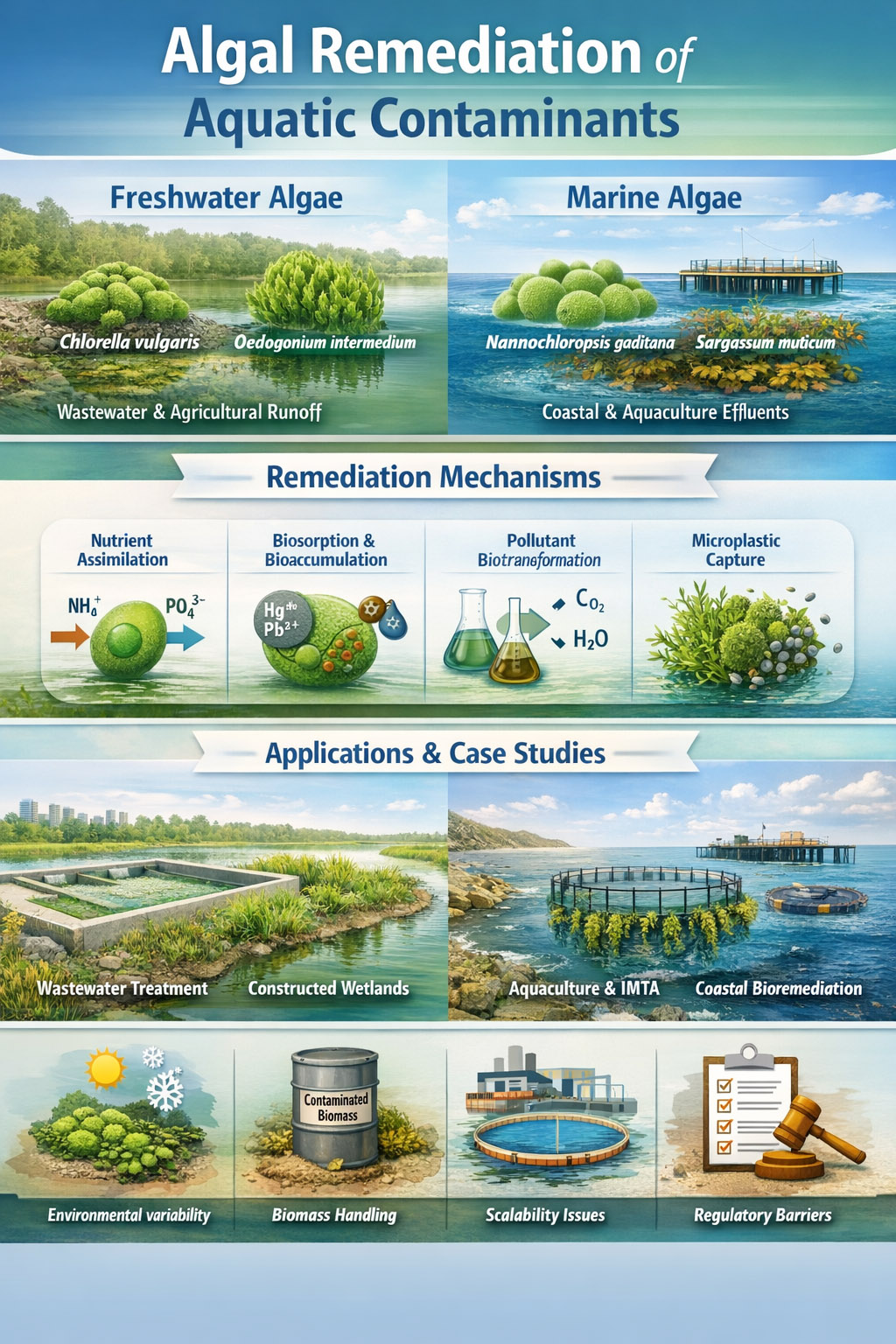
Algae are emerging not merely as passive nature-based engineered bio-platforms, but as dynamic bio-circular platforms capable of simultaneously removing complex contaminant mixtures while generating vaporizable biomass within integrated water-resource systems. Freshwater and marine micro- and macroalgae possess diverse physiological and biochemical traits that enable them to assimilate excess nitrogen and phosphorus, adsorb and accumulate metals, bind organic pollutants, and immobilize emerging contaminants such as pharmaceuticals, hydrocarbons, and microplastics. This review synthesizes current knowledge on algal remediation across ecosystems, highlighting species‑specific mechanisms including nutrient assimilation, biosorption, bioaccumulation, enzymatic biotransformation, extracellular polymeric substance production, and physical interception of suspended particles. Freshwater species such as Chlorella, Scenedesmus, Oedogonium, and Cladophora demonstrate high nutrient uptake rates and strong capacity to remove metals and organic contaminants in wastewater treatment and agricultural runoff systems. Marine taxa including Nannochloropsis, Tetraselmis, Ulva, Gracilaria, and Sargassum exhibit exceptional tolerance to salinity and complex pollutant mixtures, in context-dependent performance variability, making them effective in coastal remediation, aquaculture effluent treatment, and biosorption-based applications. Case studies from municipal wastewater facilities, constructed wetlands, integrated multi-trophic aquaculture, and coastal bioremediation platforms demonstrate high removal efficiencies and the potential for biomass valorization within circular bioeconomy frameworks. Despite these advances, challenges remain related to environmental variability, biological contamination, scalability, regulatory constraints, and the safe management of pollutant‑laden biomass. Future progress will depend on advances in strain selection, system engineering, microbial consortia design, digital monitoring, and supportive policy frameworks. Overall, algae represent a robust, adaptable, and ecologically compatible approach to restoring water quality in freshwater and marine ecosystems increasingly affected by anthropogenic pressures.
- Open Access
- Review
Algae as Nature’s Filters: Micro- and Macroalgal Solutions for Nutrient and Contaminant Removal in Aquatic Systems
Author Information
Received: 22 Apr 2026 | Revised: 01 Jun 2026 | Accepted: 10 Jun 2026 | Published: 17 Jun 2026
Abstract
Graphical Abstract
Keywords
microalgae | macroalgae | phycoremediation | nutrient removal | wastewater contaminants | freshwater and marine ecosystems
References
- 1.
Bamaniya, P.; Vaghela, D.T.; Tandel, V.; et al. Linking Terrestrial and Aquatic Systems: Pollutant Transport, Bioaccumulation Cycles, and Global Food Security. In Plastic Tides: Tackling Plastic Pollution for Global Food Security; Abubakr, A., Malik, M., Amin, A., Eds.; Springer: Cham, Switzerland, 2026; pp. 195–228. https://doi.org/10.1007/978-3-032-17411-6_8.
- 2.
Shamshad, J.; Ur Rehman, R. Innovative approaches to sustainable wastewater treatment: A comprehensive exploration of conventional and emerging technologies. Environ. Sci. Adv. 2024, 4, 189–222. https://doi.org/10.1039/d4va00136b.
- 3.
Ramesh, B.; Saravanan, A.; Senthil Kumar, P.; et al. A review on algae biosorption for the removal of hazardous pollutants from wastewater: Limiting factors, prospects and recommendations. Environ. Pollut. 2023, 327, 121572. https://doi.org/10.1016/j.envpol.2023.121572.
- 4.
Osathanunkul, M.; Thanaporn, S.; Karapetsi, L.; et al. Diversity of Bioactive Compounds in Microalgae: Key Classes and Functional Applications. Mar. Drugs 2025, 23, 222. https://doi.org/10.3390/md23060222.
- 5.
Nur, M.M.A.; Mahreni; Murni, S.W.; Setyoningrum, T.M.; et al. Innovative strategies for utilizing microalgae as dual-purpose biofertilizers and phycoremediators in agroecosystems. Biotechnol. Rep. 2025, 45, e00870. https://doi.org/10.1016/j.btre.2024.e00870.
- 6.
Jolaosho, T.L.; Rasaq, M.F.; Omotoye, E.V.; et al. Microplastics in freshwater and marine ecosystems: Occurrence, characterization, sources, distribution dynamics, fate, transport processes, potential mitigation strategies, and policy interventions. Ecotoxicol. Environ. Saf. 2025, 294, 118036. https://doi.org/10.1016/j.ecoenv.2025.118036.
- 7.
Müller, A.; Österlund, H.; Marsalek, J.; et al. The pollution conveyed by urban runoff: A review of sources. Sci. Total Environ. 2020, 709, 136125. https://doi.org/10.1016/j.scitotenv.2019.136125.
- 8.
Singh, C.K.; Sodhi, K.K.; V, N.; et al. Managing the complexity of emerging contaminants in aquatic environments: Exploring their ecotoxicological impacts, detection techniques, and the use of innovative technologies for their remediation. Discov. Catal. 2025, 2, 9. https://doi.org/10.1007/s44344-025-00013-8.
- 9.
Omokaro, G.O.; Nafula, Z.S.; Iloabuchi, N.E.; et al. Microalgae as biofactories for sustainable applications: Advancing carbon sequestration, bioenergy, and environmental remediation. Sustain. Chem. Clim. Action 2025, 7, 100098. https://doi.org/10.1016/j.scca.2025.100098.
- 10.
Astuti, S.P.; Hashmi, Z.; Bilad, M.R.; et al. Freshwater microalgae as bioindicators: A review of trait-based advances, ecosystem insights, and biomonitoring innovations. Environ. Chall. 2026, 22, 101428. https://doi.org/10.1016/j.envc.2026.101428.
- 11.
Pachés, M.; Martínez-Guijarro, R.; González-Camejo, J.; et al. Selecting the most suitable microalgae species to treat the effluent from an anaerobic membrane bioreactor. Environ. Technol. 2020, 41, 267–276. https://doi.org/10.1080/09593330.2018.1496148.
- 12.
de Oliveira, K.L.; da Silva Oliveira, J.L.; Moraes, E.A.; et al. Cultivation of microalgae Chlorella vulgaris, Monoraphidium sp. and Scenedesmus obliquus in wastewater from the household appliance industry for bioremediation and biofuel production. 3 Biotech 2024, 14, 294. https://doi.org/10.1007/s13205-024-04142-z.
- 13.
Majewska, M.; Harshkova, D.; Pokora, W.; et al. Does diclofenac act like a photosynthetic herbicide on green algae? Chlamydomonas reinhardtii synchronous culture-based study with atrazine as reference. Ecotoxicol. Environ. Saf. 2021, 208, 111630. https://doi.org/10.1016/j.ecoenv.2020.111630.
- 14.
Akmukhanova, N.R.; Seiilbek, S.N.; Zayadan, B.K.; et al. Harnessing Microalgae and Cyanobacteria for Sustainable Pesticide Biodegradation: Advances, Challenges, and Ecological Benefits. Microorganisms 2025, 13, 2404. https://doi.org/10.3390/microorganisms13102404.
- 15.
Panchal, S.K.; Ghattamaneni, N.K.R.; Magnusson, M.; et al. Freshwater Macroalgae, Oedogonium, Grown in Wastewater Reduce Diet-Induced Metabolic Syndrome in Rats. Int. J. Mol. Sci. 2022, 23, 13811. https://doi.org/10.3390/ijms232213811.
- 16.
Lawton, R.; de Nys, R.; Paul, N. Selecting Reliable and Robust Freshwater Macroalgae for Biomass Applications. PLoS ONE 2013, 8, e64168. https://doi.org/10.1371/journal.pone.0064168.
- 17.
Neveux, N.; Magnusson, M.; Mata, L.; et al. The treatment of municipal wastewater by the macroalga Oedogonium sp. and its potential for the production of biocrude. Algal Res. 2016, 13, 284–292. https://doi.org/10.1016/j.algal.2015.12.010.
- 18.
Guruge, H. Ecological, Morphological and Biochemical Study of Freshwater Red Algae Batrachospermum sp. Bachelor’s Thesis, Munster Technological University, Cork, Ireland, 2021. https://doi.org/10.13140/RG.2.2.26663.00166.
- 19.
Barra, L.; Greco, S. The Potential of Microalgae in Phycoremediation. In Microalgae-Current and Potential Applications; Aydin, S., Ed.; IntechOpen: London, UK, 2023. https://doi.org/10.5772/intechopen.1003212.
- 20.
Gopalakrishnan, K.; Kashian, D.R. Extracellular polymeric substances in green alga facilitate microplastic deposition. Chemosphere 2022, 286, 131814. https://doi.org/10.1016/j.chemosphere.2021.131814.
- 21.
Abdel-Raouf, N.; Al-Homaidan, A.A.; Ibraheem, I.B.M. Microalgae and wastewater treatment. Saudi J. Biol. Sci. 2012, 19, 257–275. https://doi.org/10.1016/j.sjbs.2012.04.005.
- 22.
Fernandez-Fernandez, M.I.; Vega, P.; Jaramillo-Morán, M.A.; et al. Hybrid Constructed Wetland to Improve Organic Matter and Nutrient Removal. Water 2020, 12, 2023. https://doi.org/10.3390/w12072023.
- 23.
Jayabal, R. Microalgae-bacteria systems in wastewater treatment and biofuel production: Challenges, advances, and future perspectives. Algal Res. 2025, 91, 104228. https://doi.org/10.1016/j.algal.2025.104228.
- 24.
El-Sheekh, M.M.; El-Kassas, H.Y.; Ali, S.S. Microalgae-based bioremediation of refractory pollutants: An approach towards environmental sustainability. Microb. Cell Factories 2025, 24, 19. https://doi.org/10.1186/s12934-024-02638-0.
- 25.
Wijesinghe, S.M.K.; Karunarathna, B.G.H.D.; Kumarawansha, W.K.M.G.; et al. Marine pollution: The global challenge of ocean contaminants and mitigation efforts. Anthr. Coasts 2026, 9, 5. https://doi.org/10.1007/s44218-025-00107-8.
- 26.
Rasmussen, J.A.; Ingleton, T.; Bennett, W.W.; et al. The effects of estuarine outflows on coastal marine ecosystems in New South Wales, Australia. Mar. Pollut. Bull. 2024, 208, 116915. https://doi.org/10.1016/j.marpolbul.2024.116915.
- 27.
Madesh, S.; Gopi, S.; Sau, A.; et al. Chemical contaminants and environmental stressors induced teratogenic effect in aquatic ecosystem—A comprehensive review. Toxicol. Rep. 2024, 13, 101819. https://doi.org/10.1016/j.toxrep.2024.101819.
- 28.
Akhtar, A.B.T.; Naseem, S.; Yasar, A.; et al. Persistent Organic Pollutants (POPs): Sources, Types, Impacts, and Their Remediation. In Environmental Pollution and Remediation; Prasad, R., Ed.; Springer: Singapore, 2021; pp. 213–246. https://doi.org/10.1007/978-981-15-5499-5_8.
- 29.
Farale, H.; Sreevidhya, K.B.; Bathinapatla, A.; et al. Impact of plastic contaminants on marine ecosystems and advancement in the detection of micro/nano plastics: A review. J. Hazard. Mater. Adv. 2025, 18, 100736. https://doi.org/10.1016/j.hazadv.2025.100736.
- 30.
Mallek, M.; Barceló, D. Analysis and Risks of Emerging Contaminants and Microplastics in Natural and Treated Waters and Human Health: A Critical Review. J. Xenobiotics 2026, 16, 93. https://doi.org/10.3390/jox16030093.
- 31.
Mamozai, W.; Hesam, A.M.; Hemma, W.H. Impacts of Crude Oils on Water Quality: A Comprehensive Review. Eur. J. Theor. Appl. Sci. 2024, 2, 126–138. https://doi.org/10.59324/ejtas.2024.2(1).09.
- 32.
Voulvoulis, N.; Scrimshaw, M.D.; Lester, J.N. Comparative environmental assessment of biocides used in antifouling paints. Chemosphere 2002, 47, 789–795. https://doi.org/10.1016/S0045-6535(01)00336-8.
- 33.
Sun, S.; Hu, X.; Kang, W.; et al. Combined effects of microplastics and warming enhance algal carbon and nitrogen storage. Water Res. 2023, 233, 119815. https://doi.org/10.1016/j.watres.2023.119815.
- 34.
Cadar, E.; Popescu, A.; Dragan, A.-M.-L.; et al. Bioactive Compounds of Marine Algae and Their Potential Health and Nutraceutical Applications: A Review. Mar. Drugs 2025, 23, 152. https://doi.org/10.3390/md23040152.
- 35.
Esteves, M.V.; Marques, D.M.C.; de Almeida, J.D.; et al. Marine Microalgae–Microorganism Co-Cultures: An Insight into Nannochloropsis sp. Use and Biotechnological Applications. Foods 2025, 14, 1522. https://doi.org/10.3390/foods14091522.
- 36.
Srivastava, P.; Singh, S.; Dubey, S. Exploring Role of Bioactive Molecules produced by Diatoms in Heavy Metal Alleviation. Int. J. Sci. Eng. Technol. 2025, 13. https://doi.org/10.5281/zenodo.17184342.
- 37.
Rojas-Villalta, D.; Rojas-Rodríguez, D.; Villanueva-Ilama, M.; et al. Exploring Extremotolerant and Extremophilic Microalgae: New Frontiers in Sustainable Biotechnological Applications. Biology 2024, 13, 712. https://doi.org/10.3390/biology13090712.
- 38.
Anisha, G.S.; Padmakumari, S.; Patel, A.K.; et al. Fucoidan from Marine Macroalgae: Biological Actions and Applications in Regenerative Medicine, Drug Delivery Systems and Food Industry. Bioengineering 2022, 9, 472. https://doi.org/10.3390/bioengineering9090472.
- 39.
Wang, S.; Qiu, Y.; Zhu, F. A comparative review of red, green, and brown seaweed: Bioactive components, health effects, and machine learning approaches. Food Res. Int. 2026, 234, 118420. https://doi.org/10.1016/j.foodres.2026.118420.
- 40.
Baghel, R.S.; Reddy, C.R.K.; Jha, B. Characterization of agarophytic seaweeds from the biorefinery context. Bioresour. Technol. 2014, 159, 280–285. https://doi.org/10.1016/j.biortech.2014.02.083.
- 41.
Khan, N.; Sudhakar, K.; Mamat, R. Eco-friendly nutrient from ocean: Exploring Ulva seaweed potential as a sustainable food source. J. Agric. Food Res. 2024, 17, 101239. https://doi.org/10.1016/j.jafr.2024.101239.
- 42.
Wichard, T.; Mapelli-Brahm, P.; Barba, F.J.; et al. Green seaweed Ulva spp. bioprocessing: Bioactive molecules, emerging extraction technologies, and industrial applications in the circular bioeconomy. Bioresour. Technol. 2026, 445, 134066. https://doi.org/10.1016/j.biortech.2026.134066.
- 43.
Theobald, E.J.; Irving, A.D.; Capper, A.; et al. Selection of marine macroalgae for nutrient biofilter and bioproduct trials in the coastal waters of Queensland, Australia. Aquac. Int. 2024, 32, 9631–9669. https://doi.org/10.1007/s10499-024-01632-y.
- 44.
Yang, X.; Wang, H.; Zhang, L.; et al. Marine algae facilitate transfer of microplastics and associated pollutants into food webs. Sci. Total Environ. 2021, 787, 147535. https://doi.org/10.1016/j.scitotenv.2021.147535.
- 45.
Narvarte, B.C.V.; Hinaloc, L.A.R.; Gonzaga, S.M.C.; et al. Exploring the suitable extractive species in an IMTA: Inorganic nutrient removal from mariculture effluents by commercially important marine macroalgae. Bot. Mar. 2025, 68, 403–415. https://doi.org/10.1515/bot-2025-0014.
- 46.
Ansari, F.A.; Hassan, H.; Al-Ouweini, A.S.S.; et al. An Integrated Algal Biorefinery Approach for Wastewater Treatment and Biomass Valorisation. Sustainability 2026, 18, 2123. https://doi.org/10.3390/su18042123.
- 47.
Okomoda, V.T.; Abdulrahman, A.K.; Khatoon, H.; et al. Performance Characteristics of Ankistrodesmus falcatus in Different Culture Media and Concentration. Plants 2021, 10, 755. https://doi.org/10.3390/plants10040755.
- 48.
Bautista-Chamizo, E.; Sendra, M.; De Orte, M.R.; et al. Comparative effects of seawater acidification on microalgae: Single and multispecies toxicity tests. Sci. Total Environ. 2019, 649, 224–232. https://doi.org/10.1016/j.scitotenv.2018.08.225.
- 49.
Wu, J.; Rogers, S.W.; Schaummann, R.; et al. A Comparison of Multiple Macroalgae Cultivation Systems and End-Use Strategies of Saccharina latissima and Gracilaria tikvahiae Based on Techno-Economic Analysis and Life Cycle Assessment. Sustainability 2023, 15, 12072. https://doi.org/10.3390/su151512072.
- 50.
Davis, T.A.; Volesky, B.; Mucci, A. A review of the biochemistry of heavy metal biosorption by brown algae. Water Res. 2003, 37, 4311–4330. https://doi.org/10.1016/S0043-1354(03)00293-8.
- 51.
Mansour, A.T.; Alprol, A.E.; Ashour, M.; et al. Do Red Seaweed Nanoparticles Enhance Bioremediation Capacity of Toxic Dyes from Aqueous Solution? Gels 2022, 8, 310. https://doi.org/10.3390/gels8050310.
- 52.
La Bella, E.; Occhipinti, P.S.; Puglisi, I.; et al. Comparative Phycoremediation Performance of Three Microalgae Species in Two Different Magnitude of Pollutants in Wastewater from Farmhouse. Sustainability 2023, 15, 11644. https://doi.org/10.3390/su151511644.
- 53.
Posadas, E.; Alcántara, C.; García-Encina, P.A.; et al. 3—Microalgae cultivation in wastewater. In Microalgae-Based Biofuels and Bioproducts; Gonzalez-Fernandez, C., Muñoz, R., Eds.; Woodhead Publishing: Cambridge, UK, 2017; pp. 67–91. https://doi.org/10.1016/B978-0-08-101023-5.00003-0.
- 54.
González Fernández, L.A.; Medellín Castillo, N.A.; Sánchez Polo, M.; et al. Algal-Based Carbonaceous Materials for Environmental Remediation: Advances in Wastewater Treatment, Carbon Sequestration, and Biofuel Applications. Processes 2025, 13, 556. https://doi.org/10.3390/pr13020556.
- 55.
Alazaiza, M.Y.D.; Albahnasawi, A.; Ahmad, Z.; et al. Potential use of algae for the bioremediation of different types of wastewater and contaminants: Production of bioproducts and biofuel for green circular economy. J. Environ. Manag. 2022, 324, 116415. https://doi.org/10.1016/j.jenvman.2022.116415.
- 56.
Calijuri, M.L.; Do Couto, E.D.A.; Assemany, P.P.; et al. Microalgae-Based Wastewater Treatment and Biomass Valorization: Insights, Challenges, and Opportunities from 15 Years of Research. ACS Omega 2025, 10, 49273–49299. https://doi.org/10.1021/acsomega.5c04364.
- 57.
Delran, P.; Barthe, L.; Peydecastaing, J.; et al. Advances in the development of microalgal biorefinery processes: The case of Tetraselmis suecica. Biotechnol. Adv. 2026, 90, 108900. https://doi.org/10.1016/j.biotechadv.2026.108900.
- 58.
Faruque, M.O.; Uddin, S.; Hossain, M.M.; et al. A comprehensive review on microalgae-driven heavy metals removal from industrial wastewater using living and nonliving microalgae. J. Hazard. Mater. Adv. 2024, 16, 100492. https://doi.org/10.1016/j.hazadv.2024.100492.
- 59.
Lodeiro, P.; Cordero, B.; Barriada, J.L.; et al. Biosorption of cadmium by biomass of brown marine macroalgae. Bioresour. Technol. 2005, 96, 1796–1803. https://doi.org/10.1016/j.biortech.2005.01.002.
- 60.
Ferreira, M.; Salgado, J.M.; Fernandes, H.; et al. Potential of Red, Green and Brown Seaweeds as Substrates for Solid State Fermentation to Increase Their Nutritional Value and to Produce Enzymes. Foods 2022, 11, 3864. https://doi.org/10.3390/foods11233864.
- 61.
Danouche, M.; El Ghachtouli, N.; El Arroussi, H. Phycoremediation mechanisms of heavy metals using living green microalgae: Physicochemical and molecular approaches for enhancing selectivity and removal capacity. Heliyon 2021, 7, e07609. https://doi.org/10.1016/j.heliyon.2021.e07609.
- 62.
Chugh, M.; Kumar, L.; Shah, M.P.; et al. Bioremediation of heavy metals: An insight into removal mechanisms, recovery of by-products, challenges, and future opportunities. Energy Nexus 2022, 7, 100129. https://doi.org/10.1016/j.nexus.2022.100129.
- 63.
Folgar, S.; Torres, E.; Pérez-Rama, M.; et al. Dunaliella salina as marine microalga highly tolerant to but a poor remover of cadmium. J. Hazard. Mater. 2009, 165, 486–493. https://doi.org/10.1016/j.jhazmat.2008.10.010.
- 64.
Narayanan, I.; Rajamanickam, R.; Singh, R.K.; et al. Microalgae-based remediation of pharmaceutical contaminants: Emerging strategies and technological synergies. Discov. Appl. Sci. 2025, 7, 1288. https://doi.org/10.1007/s42452-025-07226-4.
- 65.
Paniagua-Michel, J.; Banat, I.M. Unravelling Diatoms’ Potential for the Bioremediation of Oil Hydrocarbons in Marine Environments. Clean Technol. 2024, 6, 93–115. https://doi.org/10.3390/cleantechnol6010007.
- 66.
Paterson, S.; Gómez-Cortés, P.; de la Fuente, M.A.; et al. Bioactivity and Digestibility of Microalgae Tetraselmis sp. and Nannochloropsis sp. as Basis of Their Potential as Novel Functional Foods. Nutrients 2023, 15, 477. https://doi.org/10.3390/nu15020477.
- 67.
Xiao, R.; Zheng, Y. Overview of microalgal extracellular polymeric substances (EPS) and their applications. Biotechnol. Adv. 2016, 34, 1225–1244. https://doi.org/10.1016/j.biotechadv.2016.08.004.
- 68.
Minhas, A.K.; Gaur, S.; Sunny, S.; et al. Microalgae-Based Wastewater Treatment Processes for the Bioremediation and Valorization of Biomass: A Review. Phycology 2026, 6, 18. https://doi.org/10.3390/phycology6010018.
- 69.
Mohsenpour, S.F.; Hennige, S.; Willoughby, N.; et al. Integrating micro-algae into wastewater treatment: A review. Sci. Total Environ. 2021, 752, 142168. https://doi.org/10.1016/j.scitotenv.2020.142168.
- 70.
Guo, Z.; Wang, L.; Jiang, Z.; et al. Comparison studies of epiphytic microbial communities on four macroalgae and their rocky substrates. Mar. Pollut. Bull. 2022, 176, 113435. https://doi.org/10.1016/j.marpolbul.2022.113435.
- 71.
Li, X.; Liu, W.; Zhang, J.; et al. Effective removal of microplastics by filamentous algae and its magnetic biochar: Performance and mechanism. Chemosphere 2024, 358, 142152. https://doi.org/10.1016/j.chemosphere.2024.142152.
- 72.
Garden, C.J.; Smith, A.M. Voyages of seaweeds: The role of macroalgae in sediment transport. Sediment. Geol. 2015, 318, 1–9. https://doi.org/10.1016/j.sedgeo.2014.11.007.
- 73.
Verma, L.; Ekka, A.; Banjara, R.A.; et al. A Review on Bacterial Exopolysaccharides for Heavy Metal Remediation: Mechanisms, Challenges, and Sustainable Applications. Water Environ. Res. 2025, 97, e70184. https://doi.org/10.1002/wer.70184.
- 74.
Filote, C.; Roșca, M.; Hlihor, R.M.; et al. Sustainable Application of Biosorption and Bioaccumulation of Persistent Pollutants in Wastewater Treatment: Current Practice. Processes 2021, 9, 1696. https://doi.org/10.3390/pr9101696.
- 75.
Wang, T.; Patyal, S.; Naushad, M.; et al. Sustainable water remediation with algae-derived adsorbents: From synthesis strategies to adsorption performance and mechanisms. RSC Adv. 2026, 16, 18770–18800. https://doi.org/10.1039/d5ra09740a.
- 76.
Popa, M.D.; Simionov, I.-A.; Petrea, S.M.; et al. Efficiency of Microalgae Employment in Nutrient Removal (Nitrogen and Phosphorous) from Municipal Wastewater. Water 2025, 17, 260. https://doi.org/10.3390/w17020260.
- 77.
Nezbrytska, I.; Shamanskyi, S.; Pavliukh, L.; et al. Application of Euglena gracilis in wastewater treatment processes. BioTechnologia 2022, 103, 323–330. https://doi.org/10.5114/bta.2022.120702.
- 78.
Mousavi, S.; Najafpour, G.D.; Mohammadi, M.; et al. Cultivation of newly isolated microalgae Coelastrum sp. in wastewater for simultaneous CO2 fixation, lipid production and wastewater treatment. Bioprocess Biosyst. Eng. 2018, 41, 519–530. https://doi.org/10.1007/s00449-017-1887-7.
- 79.
Jayasooriya, N.; Gavin, C.; Craggs, R.; et al. Properties of cellulose from four freshwater macroalgae cultivated under high nutrient conditions. Cellulose 2026, 33, 1927–1943. https://doi.org/10.1007/s10570-026-06974-9.
- 80.
Gordon, B.A.; Lenhart, C.; Peterson, H.; et al. Reduction of nutrient loads from agricultural subsurface drainage water in a small, edge-of-field constructed treatment wetland. Ecol. Eng. 2021, 160, 106128. https://doi.org/10.1016/j.ecoleng.2020.106128.
- 81.
Volodina, A.; Gerb, M. Findings of Water Net Hydrodictyon reticulatum (Hydrodictyaceae, Chlorophyta) in the Curonian Lagoon. Bot. Lith. 2013, 19. https://doi.org/10.2478/botlit-2013-0006.
- 82.
Van Oosten, M.J.; Maggio, A. Functional biology of halophytes in the phytoremediation of heavy metal contaminated soils. Environ. Exp. Bot. 2015, 111, 135–146. https://doi.org/10.1016/j.envexpbot.2014.11.010.
- 83.
Salari, Z.; Danafar, F.; Dabaghi, S.; et al. Sustainable synthesis of silver nanoparticles using macroalgae Spirogyra varians and analysis of their antibacterial activity. J. Saudi Chem. Soc. 2016, 20, 459–464. https://doi.org/10.1016/j.jscs.2014.10.004.
- 84.
Minggat, E.; Roseli, W.; Tanaka, Y. Nutrient Absorption and Biomass Production by the Marine Diatom Chaetoceros muelleri: Effects of Temperature, Salinity, Photoperiod, and Light Intensity. J. Ecol. Eng. 2021, 22, 231–240. https://doi.org/10.12911/22998993/129253.
- 85.
Rajaram, M.G.; Nagaraj, S.; Manjunath, M.; et al. Biofuel and Biochemical Analysis of Amphora coffeaeformis RR03, a Novel Marine Diatom, Cultivated in an Open Raceway Pond. Energies 2018, 11, 1341. https://doi.org/10.3390/en11061341.
- 86.
Reis Batista, I.; Garcia, A.B.; van Dalen, P.; et al. Culturing Chaetoceros muelleri using simplified media with different N sources: Effects on production and lipid content. Eur. J. Phycol. 2015, 50, 92–99. https://doi.org/10.1080/09670262.2014.994137.
- 87.
Leandro, A.; Pereira, L.; Gonçalves, A.M.M. Diverse Applications of Marine Macroalgae. Mar. Drugs 2020, 18, 17. https://doi.org/10.3390/md18010017.
- 88.
Ramesh, C.H.; Koushik, S.; Shunmugaraj, T.; et al. Bioinvasive Seaweed Genus, Turbinaria in Coral Reefs of Gulf of Mannar. J. Life Sci. Res. 2019, 6, 1–4.
- 89.
He, Q.; Zhang, J.; Chai, Z.; et al. Gracilariopsis longissima as biofilter for an Integrated Multi-Trophic aquaculture (IMTA) system with Sciaenops ocellatus: Bioremediation efficiency and production in a recirculating system. Indian J. Geo-Mar. Sci. 2014, 43, 528–537.
- 90.
Rajapaksha, Y.; Jayarathne, K.; Nadeesha, D.; et al. Seaweeds for Bioremediation: Removal of Oil From Seawater. 2020. Available online: https://www.researchgate.net/publication/357900791_Seaweeds_for_Bioremediation_Removal_of_Oil_From_Seawater (accessed on 20 May 2026).
- 91.
Al-Thani, R.F.; Yasseen, B.T. Cyanoremediation of Polluted Seawater in the Arabian Gulf: Risks and Benefits to Human Health. Processes 2024, 12, 2733. https://doi.org/10.3390/pr12122733.
- 92.
Jiang, Y.; Niu, S.; Wu, J. The role of algae in regulating the fate of microplastics: A review for processes, mechanisms, and influencing factors. Sci. Total Environ. 2024, 949, 175227. https://doi.org/10.1016/j.scitotenv.2024.175227.
- 93.
Ng, K.L.; Suk, K.F.; Cheung, K.W.; et al. Macroalgal morphology mediates microplastic accumulation on thallus and in sediments. Sci. Total Environ. 2022, 825, 153987. https://doi.org/10.1016/j.scitotenv.2022.153987.
- 94.
Yang, K.; Wang, J.; Zheng, J.; et al. Microalgae-based wastewater treatment: Advances and challenges in membrane harvesting technologies. Sep. Purif. Technol. 2025, 360, 130805. https://doi.org/10.1016/j.seppur.2024.130805.
- 95.
Amaro, H.M.; Salgado, E.M.; Nunes, O.C.; et al. Microalgae systems—Environmental agents for wastewater treatment and further potential biomass valorisation. J. Environ. Manag. 2023, 337, 117678. https://doi.org/10.1016/j.jenvman.2023.117678.
- 96.
Mitrovic, S.M.; Oliver, R.L.; Rees, C.; et al. Critical flow velocities for the growth and dominance of Anabaena circinalis in some turbid freshwater rivers. Freshw. Biol. 2003, 48, 164–174. https://doi.org/10.1046/j.1365-2427.2003.00957.x.
- 97.
Plouviez, M.; Copedo, J.; Ingebrigtsen, R.; et al. Chapter 14—Biological contaminants in large-scale microalgae cultures. In Handbook of Microalgae-Based Processes and Products, 2nd ed.; Jacob-Lopes, E., Maroneze, M.M., Queiroz, M.I., et al., Eds.; Academic Press: Cambridge, MA, USA, 2026; pp. 271–297. https://doi.org/10.1016/B978-0-443-34082-6.00013-1.
- 98.
Naseema Rasheed, R.; Pourbakhtiar, A.; Mehdizadeh Allaf, M.; et al. Microalgal co-cultivation -recent methods, trends in omic-studies, applications, and future challenges. Front. Bioeng. Biotechnol. 2023, 11, 1193424. https://doi.org/10.3389/fbioe.2023.1193424.
- 99.
Song, U.; Park, H. Importance of biomass management acts and policies after phytoremediation. J. Ecol. Environ. 2017, 41, 13. https://doi.org/10.1186/s41610-017-0033-4.
- 100.
Ali, S.S.; Mastropetros, S.G.; Schagerl, M.; et al. Recent advances in wastewater microalgae-based biofuels production: A state-of-the-art review. Energy Rep. 2022, 8, 13253–13280. https://doi.org/10.1016/j.egyr.2022.09.143.
- 101.
Koko, I.; Ibrahim, E.; Almomani, F.; et al. Breaking the barriers towards large-scale microalgae-based bio-hydrogen production. Int. J. Hydrogen Energy 2025, 193, 152133. https://doi.org/10.1016/j.ijhydene.2025.152133.
- 102.
Fabris, M.; Abbriano, R.M.; Pernice, M.; et al. Emerging Technologies in Algal Biotechnology: Toward the Establishment of a Sustainable, Algae-Based Bioeconomy. Front. Plant Sci. 2020, 11, 279. https://doi.org/10.3389/fpls.2020.00279.
- 103.
Zhang, C.; Singh, R.P.; Yadav, P.; et al. Recent advances in biotechnology and bioengineering for efficient microalgal biofuel production. Fuel Process. Technol. 2025, 270, 108199. https://doi.org/10.1016/j.fuproc.2025.108199.
- 104.
Abonyi, M.N.; Obi, C.C.; Nwabanne, J.T.; et al. Emerging and ecofriendly biological methods for agricultural wastewater treatment. Environ. Syst. Res. 2024, 13, 45. https://doi.org/10.1186/s40068-024-00373-4.
- 105.
Sarker, N.K.; Kaparaju, P. Microalgal Bioeconomy: A Green Economy Approach Towards Achieving Sustainable Development Goals. Sustainability 2024, 16, 11218. https://doi.org/10.3390/su162411218.

This work is licensed under a Creative Commons Attribution 4.0 International License.

 Suite 4002 Level 4, 447 Collins Street, Melbourne, Victoria 3000, Australia
 General Inquiries: info@sciltp.com