
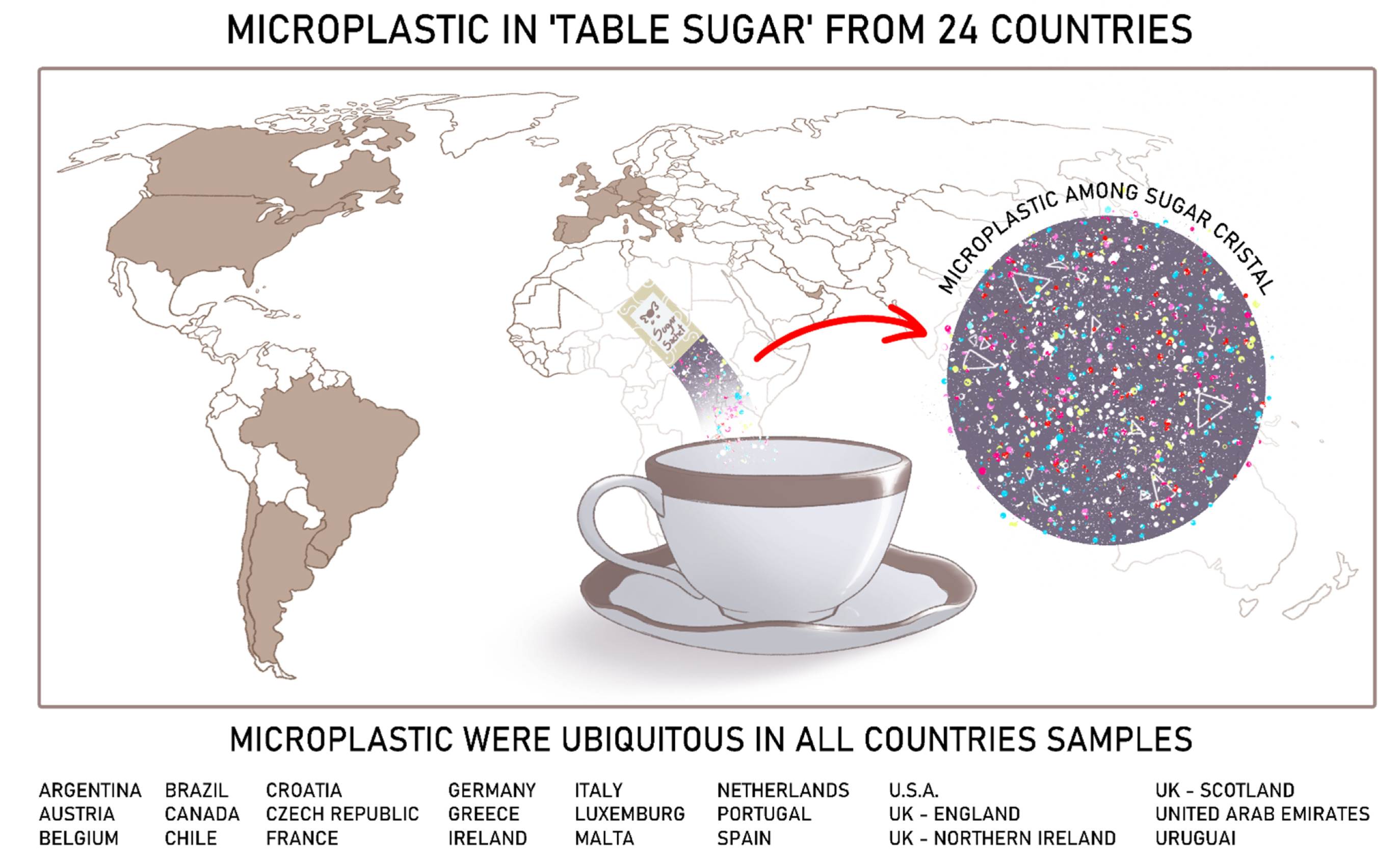
This study evaluates microplastic (MPs) contamination in table sugar packaged in sachets consumed in 24 countries, 18 from Europe, five from America, and one in Asia, emphasizing the ubiquity of MPs in food products. The samples were obtained in a sampling effort involving several people. 100 samples of 3 g of sugar were analyzed (3 replicates each) in a stereoscope with and attached camera, revealing a 100% contamination rate, with 3977 MPs particles identified. Filaments (56.63%) predominated over fragments (43.37%), with blue and black particles being the most frequent. Polymer analysis using Raman spectroscopy identified polyurethane (PU—predominant), polyethylene terephthalate (PET) and polyethylene (PE) as the main types of MPs. Considering estimated dietary intake (EDI) values calculated by EDI = (SgC × MPp)/SM, Brazil and the USA ranked as the countries with the highest levels of total MPs intake. These findings highlight sugar as an important pathway for dietary exposure to MPs, raising critical concerns about the risks to human health and food safety. Regulatory interventions and improved processing protocols are imperative to mitigate MP contamination in sugar and other widely consumed processed foods.
- Open Access
- Article
Evaluation of Microplastic Contamination in Table Sugar: What Does Sugar Have Besides Its Sweetness?
- João Marcos Schuab 1, 2,
- Gustavo Zambon Dalbó 1, 2,
- Sophia Pires Peixoto Berquó 1, 3,
- Bruna Luz Fernandes 1, 2,
- Karina Machado Menezes 1, 2,
- Mateus Marçal Alves 1, 2,
- Eduarda Andrade 1, 2,
- Raadma Souza 1, 2,
- Antônio Augusto Lopes Marins 2, 4,
- Enrique Ronald Yapuchura Ocaris 5 and
- Mercia Barcellos da Costa 1, 2, *
Author Information
Received: 21 June 2025 | Revised: 05 August 2025 | Accepted: 06 August 2025 | Published: 13 August 2025
Abstract
Graphical Abstract
Keywords
microplastic ingestion | table sugar | food hazard | human health | raman spectroscopy
References
- 1.
Rillig, M.C.; Kim, S.W.; Kim, T.Y.; et al. The global plastic toxicity debt. Environ. Sci. Technol. 2021, 55, 2717–2719.
- 2.
Roy, P.; Mohanty, A.K.; Misra, M. Microplastics in the ecosystems: Their implications and mitigation pathway. Environ. Sci. Adv. 2022, 1, 9–29.
- 3.
Browne, M.A.; Galloway, T.; Thompson, R. Microplastic—an emerging contaminant of potential concern. Integr. Environ. Assess. Manag. 2007, 3, 559–561.
- 4.
Ryan, P.G.; Moore, C.J.; Van Franeker, J.A.; et al. Monitoring the abundance of plastic debris in the marine environment. Philos. Trans. R. Soc. B Biol. Sci. 2009, 364, 1999–2012.
- 5.
Liebezeit, G.; Liebezeit, E. Non-pollen particulates in honey and sugar. Food Addit. Contam. Part A 2013, 30, 2136–2140.
- 6.
Fendall, L.S.; Sewell, M.A. Contributing to marine pollution by washing your face: Microplastics in facial cleansers. Mar. Pollut. Bull. 2009, 58, 1225–1228.
- 7.
Matavos-Aramyan, S. Addressing the microplastic crisis: A multifaceted approach to removal and regulation. Environ. Adv. 2024, 17, 100579.
- 8.
Sun, X.; Chen, B.; Li, Q.; et al. Toxicities of polystyrene nanoand microplastics toward marine bacterium halomonas alkaliphila. Sci. Total Environ. 2018, 642, 1378–1385.
- 9.
Yong, C.Q.Y.; Valiyaveetill, S.; Tang, B.L. Toxicity of microplastics and nanoplastics in mammalian systems. Int. J. Environ. Res. Public Health 2020, 17, 1509.
- 10.
Wang, F.; Zhang, Q.; Cui, J.; et al. Polystyrene microplastics induce endoplasmic reticulum stress, apoptosis, and inflammation by disrupting the gut microbiota in carp intestines. Environ. Pollut. 2023, 323, 121233.
- 11.
Meaza, I.; Toyoda, J.H.; Sr, J.P.W. Microplastics in sea turtles, marine mammals and humans: A one environmental health perspective. Front. Environ. Sci. 2021, 8, 575614.
- 12.
Rahman, M.; Kim, E.-S.; Sung, H.-C. Microplastics as an emerging threat to amphibians: Current status and future perspectives. Heliyon 2024, 10, e28220.
- 13.
Silva, J.V.F.; Lansac-Tôha, F.M.; Segovia, B.T.; et al. Experimental evaluation of microplastic consumption by using a size-fractionation approach in the planktonic communities. Sci. Total Environ. 2022, 821, 153045.
- 14.
Huang, P.; Zhang, Y.; Hussain, N.; et al. A bibliometric analysis of global research hotspots and progress on microplastics in soil-plant systems. Environ. Pollut. 2024, 341, 122890.
- 15.
Vignesh, K.S.; Prapanchan, V.N.; Indhiya Selvan, V.N.; et al. Microplastics, their abundance, and distribution in water and sediments in North Chennai, India: An assessment of pollution risk and human health impacts. J. Contam. Hydrol. 2024, 263, 104339.
- 16.
Andrady, A.L. Microplastics in the marine environment. Mar. Pollut. Bull. 2011, 62, 1596–1605. https://doi.org/10.1016/j.marpolbul.2011.05.030.
- 17.
Schuab, J.M.; Quirino, W.P.; Paula, M.S.; et al. Abundance of microplastic in different coastal areas using Phragmatopoma caudata (Kroyer in Morch, 1863) (Polychaeta: Sabelariidae) as an indicator. Sci. Total Environ. 2023, 880, 163219.
- 18.
Schuab, J.M.; Paula, M.S.; Ocaris, E.R.Y.; et al. First record of microplastic in the Brazilian sea hare Aplysia brasiliana Rang, 1828 (Mollusca: Aplysiidae). Sci. Total Environ. 2023, 895, 165156.
- 19.
Arias, A.H.; Alvarez, G.; Pozo, K.; et al. Beached microplastics at the Bahia Blanca Estuary (Argentina): Plastic pellets as potential vectors of environmental pollution by POPs. Mar. Pollut. Bull. 2023, 187, 114520.
- 20.
Eerkes-Medrano, D.; Thompson, R.C.; Aldridge, D.C. Microplastics in freshwater systems: A review of the emerging threats, identification of knowledge gaps, and prioritization of research needs. Water Res. 2015, 75, 63–82.
- 21.
Hahladakis, J.N.; Velis, C.A.; Weber, R.; et al. An overview of chemical additives present in plastics: Migration, release, fate and environmental impact during their use, disposal and recycling. J. Hazard. Mater. 2018, 344, 179–199.
- 22.
Tang, S.; Lin, L.; Wang, X.; et al. Pb (II) uptake onto nylon microplastics: Interaction mechanism and adsorption performance. J. Hazard. Mater. 2020, 386, 121960.
- 23.
Lo, H.S.; Wong, C.Y.; Tam, N.F.Y.; et al. Spatial distribution and source identification of hydrophobic organic compounds (HOCs) on sedimentary microplastic in Hong Kong. Chemosphere 2019, 219, 418–426.
- 24.
Velzeboer, I.; Kwadijk, C.J.A.F.; Koelmans, A.A. Strong sorption of PCBs to nanoplastics, microplastics, carbon nanotubes, and fullerenes. Environ. Sci. Technol. 2014, 48, 4869–4876.
- 25.
Wang, F.; Wong, C.S.; Chen, D.; et al. Interaction of toxic chemicals with microplastics: A critical review. Water Res. 2018, 139, 208–219.
- 26.
Chua, E.M.; Shimeta, J.; Nugegoda, D.; et al. Assimilation of polybrominated diphenyl ethers from microplastics by the marine amphipod, Allorchestes compressa. Environ. Sci. Technol. 2014, 48, 8127–8134.
- 27.
World Health Organization. WHO Calls for More Research into Microplastics and a Crackdown on Plastic Pollution; World Health Organization: Geneva, Switzerland, 2019. Available online: https://www.who.int/news/item/22-08-2019-who-calls-for-more-research-into-microplastics-and-a-crackdown-on-plastic-pollution (accessed on 23 December 2024).
- 28.
Deng, Y.; Zhang, Y.; Lemos, B.; et al. Tissue accumulation of microplastics in mice and biomarker responses suggest widespread health risks of exposure. Sci. Rep. 2017, 7, 1–10.
- 29.
Setälä, O.; Fleming-Lehtinen, V.; Lehtiniemi, M. Ingestion and transfer of microplastics in the planktonic food web. Environ. Pollut. 2014, 185, 77–83.
- 30.
Ragusa, A.; Svelato, A.; Santacroce, C.; et al. Plasticenta: First evidence of microplastics in human placenta. Environ. Int. 2021, 146, 106274.
- 31.
Conti, G.O.; Ferrante, M.; Banni, M.; et al. Micro-and nano-plastics in edible fruit and vegetables. The first diet risks assessment for the general population. Environ. Res. 2020, 187, 109677.
- 32.
Hernandez, L.M.; Xu, E.G.; Larsson, H.C.; et al. Plastic teabags release billions of microparticles and nanoparticles into tea. Environ. Sci. Technol. 2019, 53, 12300–12310.
- 33.
Mintenig, S.M.; Löder, M.G.J.; Primpke, S.; et al. Low numbers of microplastics detected in drinking water from ground water sources. Sci. Total Environ. 2019, 648, 631–635.
- 34.
Yurtsever, M. Are nonwoven fabrics used in food made of cellulose or plastic? Cellulose/plastic separation by using Schweizer’s reagent and analysis based on a sample of tea bags. Process Saf. Environ. Prot. 2021, 151, 188–194.
- 35.
Schwabl, P.; Köppel, S.; Königshofer, P.; et al. Detection of Various Microplastics in Human Stool: A Prospective Case Series. Ann. Intern. Med. 2019, 171, 453–457. https://doi.org/10.7326/M19-0618.
- 36.
Zheng, Y.; Luo, S.; Xu, M.; et al. Transepithelial transport of nanoparticles in oral drug delivery: From the perspective of surface and holistic property modulation. Acta Pharm. Sin. B 2024, 14, 3876–3900.
- 37.
Prata, J.C. Airborne microplastics: Consequences to human health? Environ. Pollut. 2018, 234, 115–126.
- 38.
Gaspari, J.; Wright, S.L.; Dris, R.; et al. Microplastics in air: Are we breathing it in? Curr. Opin. Environ. Sci. Health 2018, 1, 1–5.
- 39.
Saha, S.C.; Saha, G. Effect of microplastics deposition on human lung airways: A review with computational benefits and challenges. Heliyon 2024, 10, e24355.
- 40.
Zhu, L.; Zhu, J.; Zuo, R.; et al. Identification of microplastics in human placenta using laser direct infrared spectroscopy. Sci. Total Environ. 2023, 856, 159060.
- 41.
Oberdörster, G.; Ferin, J.; Lehnert, B.E. Correlation between particle size, in vivo particle persistence, and lung injury. Environ. Health Perspect. 1994, 102, 173–179.
- 42.
Jenner, L.C.; Rotchell, J.M.; Bennett, R.T.; et al. Detection of microplastics in human lung tissue using μFTIR spectroscopy. Sci. Total Environ. 2022, 831, 154907.
- 43.
Leslie, H.A.; Van Velzen, M.J.; Brandsma, S.H.; et al. Discovery and quantification of plastic particle pollution in human blood. Environ. Int. 2022, 163, 107199.
- 44.
Yang, Y.; Xie, E.; Du, Z.; et al. Detection of Various Microplastics in Patients Undergoing Cardiac Surgery. Environ. Sci. Technol. 2023, 57, 10911–10918.
- 45.
Hu, C.J.; Garcia, M.A.; Nihart, A.; et al. Microplastic presence in dog and human testis and its potential association with sperm count and weights of testis and epididymis. Toxicol. Sci. 2024, 200, 235–240.
- 46.
Cho, Y.; Shim, W.J.; Jang, M.; et al. Nationwide monitoring of microplastics in bivalves from the coastal environment of Korea. Environ. Pollut. 2021, 270, 116175.
- 47.
Costa, M.B.; Otegui, M.B.P.; Zamprogno, G.C.; et al. Abundance, composition, and distribution of microplastics in intertidal sediment and soft tissues of four species of Bivalvia from Southeast Brazilian urban beaches. Sci. Total Environ. 2023, 857, 159352.
- 48.
Severini, M.F.; Buzzi, N.S.; López, A.F.; et al. Chemical composition and abundance of microplastics in the muscle of commercial shrimp Pleoticus muelleri at an impacted coastal environment (Southwestern Atlantic). Mar. Pollut. Bull. 2020, 161, 111700.
- 49.
Mistri, M.; Sfriso, A.A.; Casoni, E.; et al. Microplastic accumulation in commercial fish from the Adriatic Sea. Mar. Pollut. Bull. 2022, 174, 113279.
- 50.
Danopoulos, E.; Twiddy, M.; Rotchell, J.M. Microplastic contamination of drinking water: A systematic review. PLoS ONE, 2020, 15, e0236838.
- 51.
Kosuth, M.; Mason, S.A.; Wattenberg, E.V. Anthropogenic contamination of tap water, beer, and sea salt. PLoS ONE, 2018, 13, e0194970.
- 52.
Li, H.; Zhu, L.; Ma, M.; et al. Occurrence of microplastics in commercially sold bottled water. Sci. Total Environ. 2023, 867, 161553.
- 53.
Oßmann, B.E.; Sarau, G.; Holtmannspötter, H.; et al. Small-sized microplastics and pigmented particles in bottled mineral water. Water Res. 2018, 141, 307–316.
- 54.
Mason, S.A.; Welch, V.G.; Neratko, J. Synthetic polymer contamination in bottled water. Front. Chem. 2018, 6, 407.
- 55.
Da Costa Filho, P.A.; Andrey, D.; Eriksen, B.; et al. Detection and characterization of small-sized microplastics (≥5 μm) in milk products. Sci. Rep. 2021, 11, 24046.
- 56.
Kutralam-Muniasamy, G.; Pérez-Guevara, F.; Elizalde-Martínez, I.; et al. Branded milks—Are they immune from microplastics contamination? Sci. Total Environ. 2020, 714, 136823.
- 57.
Liebezeit, G.; Liebezeit, E. Synthetic particles as contaminants in German beers. Food Addit. Contam. Part A 2014, 31, 1574–1578.
- 58.
Diaz-Basantes, M.F.; Conesa, J.A.; Fullana, A. Microplastics in honey, beer, milk, and refreshments in Ecuador as emerging contaminants. Sustainability 2020, 12, 5514.
- 59.
Li, Y.; Peng, L.; Fu, J.; et al. A microscopic survey on microplastics in beverages: The case of beer, mineral water and tea. Analyst 2022, 147, 1099.
- 60.
Shruti, V.C.; Pérez-Guevara, F.; Elizalde-Martínez, I.; et al. First study of its kind on the microplastic contamination of soft drinks, cold tea, and energy drinks—Future research and environmental considerations. Sci. Total Environ. 2020, 726, 138580.
- 61.
Makhdoumi, P.; Naghshbandi, M.; Ghaderzadeh, K.; et al. Micro-plastic occurrence in bottled vinegar: Qualification, quantification, and human risk exposure. Process Saf. Environ. Prot. 2021, 152, 404–413.
- 62.
Karami, A.; Golieskardi, A.; Choo, C.K.; et al. Microplastic and mesoplastic contamination in canned sardines and sprats. Sci. Total Environ. 2017, 612, 1380–1386.
- 63.
Yurtsever, M. Microplastics pollution threat in table salt: An abiotic sea product. Ege J. Fish. Aquat. Sci. 2018, 35, 243–249. https://doi.org/10.12714/egejfas.2018.35.3.03.
- 64.
Kapukotuwa, R.W.M.G.K.; Jayasena, N.; Weerakoon, K.C.; et al. High levels of microplastics in commercial salt and industrial salterns in Sri Lanka. Mar. Pollut. Bull. 2022, 174, 113239.
- 65.
Zhang, Q.; Liu, L.; Jiang, Y.; et al. Microplastics in infant milk powder. Environ. Pollut. 2023, 323, 121225.
- 66.
Apaza, H.; Chevez, L.; Loro, H. Near-infrared hyperspectral imaging spectroscopy to detect microplastics and pieces of plastic in almond flour. Int. J. Comput. Syst. Eng. 2021, 15, 90–93.
- 67.
Dessi, C.; Okoffo, E.D.; O’Brien, J.W.; et al. Plastics contamination of store-bought rice. J. Hazard. Mater. 2021, 416, 125778.
- 68.
Makhdoumi, P.; Pirsaheb, M.; Amin, A.A.; et al. Microplastic pollution in table salt and sugar: Occurrence, qualification and quantification, and risk assessment. J. Food Compos. Anal. 2023, 105, 105261.
- 69.
Garrido, G.E.; Constanzo, V. Microplastics in Food Commodities: A Food Safety Review on Human Exposure through Dietary Sources; Food Safety and Quality Series, 18; Food and Agriculture Organisation of the United Nations (FAO): Rome, Italy, 2022. Available online: https://www.fao.org/3/cb8220en/cb8220en.pdf (accessed on 23 December 2024).
- 70.
ISO Sugar. 2022. Available online: https://www.isosugar.org/ (accessed on 23 December 2024).
- 71.
Toro, S.J.H.; Gómez-Narváez, F.; Contreras-Calderón, J.; et al. Acrylamide in sugar products. Curr. Opin. Food Sci. 2022, 45, 100841.
- 72.
Tomaszewska, J.; Bieliński, D.; Binczarski, M.; et al. Products of sugar beet processing as raw materials for chemicals and biodegradable polymers. RSC Adv. 2018, 8, 3161–3177.
- 73.
Yurtsever, M.; Cuvelek, M.A. Abundance of microplastics in the agro-industrial product beet sugar; food or plastifood. Process Saf. Environ. Prot. 2024, 188, 467–479.
- 74.
Russell, A. Sugar Production from Sugar Cane. Practical Action. Available online: https://answers.practicalaction.org/our-resources/item/sugar-production-from-sugar-cane (accessed on 17 March 2024).
- 75.
Babu, A.S.; Adeyeye, S.A.O. Extraction of sugar from sugar beets and cane sugar. In Extraction Processes in the Food Industry; Woodhead Publishing: Sawston, UK, 2024; pp. 177–196.
- 76.
Fanaei, R.; Nikbakht, A.M.; Hassanpour, A. A computational experimental investigation of thermal vapor compressor as an energy-saving tool for the crystallization of sugar in a sugar processing plant. J. Food Process Eng. 2021, 44, e13727.
- 77.
Singh, R. Membrane Technology and Engineering for Water Purification: Application, Systems Design and Operation; Butterworth-Heinemann: Oxford, UK, 2014.
- 78.
Gregory, M.R.; Andrady, A.L. Plastics in the Marine Environment.Plastics and the Environment; John Wiley and Sons: Hoboken, NJ, USA, 2003.
- 79.
Thompson, R.C.; Olsen, Y.; Mitchell, R.P.; et al. Lost at sea: Where is all the plastic? Science 2004, 304, 838.
- 80.
Gregory, M.R.; Andrady, A.L. Plastics in the Marine Environment. In Plastics and the Environment; Andrady, A.L., Ed.; John Wiley and Sons: Hoboken, NJ, USA, 2003.
- 81.
Damaj, S.; Trad, F.; Goevert, D.; et al. Bridging the Gaps between Microplastics and Human Health. Microplastics 2024, 3, 46–66.
- 82.
Barboza, L.G.A.; Lopes, C.; Oliveira, P.; et al. Microplastics in wild fish from the Northeast Atlantic Ocean and its potential for causing neurotoxic effects, lipid oxidative damage, and human health risks associated with ingestion exposure. Sci. Total Environ. 2020, 717, 134625.
- 83.
Bhuyan, M.S. Effects of microplastics on fish and in human health. Front. Environ. Sci. 2022, 10, 827289.
- 84.
D’Angelo, S.; Meccariello, R. Microplastics: A threat for male fertility. Int. J. Environ. Res. Public Health 2021, 18, 2392.
- 85.
Shapiro, L.; Katchur, N. Microplastic exposure and the onset of Parkinson’s disease: The effects of microplastics in the body and similarities to the pathogenesis of Parkinson’s disease. J. Stud. Res. 2022, 11, 1–10.
- 86.
Khan, M.T.; Cheng, Y.L.; Hafeez, S.; et al. Microplastics in wastewater. In Handbook of Microplastics in the Environment; Rocha-Santos, T., Costa, M., Mouneyrac, C., Eds.; Springer International Publishing: Berlin/Heidelberg, Germany, 2020; pp. 1–33.
- 87.
Sharma, M.D.; Elanjickal, A.I.; Mankar, J.S.; et al. Assessment of cancer risk of microplastics enriched with polycyclic aromatic hydrocarbons. J. Hazard. Mater. 2020, 398, 122994.
- 88.
Ghosh, S.; Sinha, J.K.; Ghosh, S.; et al. Microplastics as an emerging threat to the global environment and human health. Sustainability 2023, 15, 10821.
- 89.
Basaran, B.; Aytan, Ü.; Şentürk, Y.; et al. Microplastic contamination in some beverages marketed in Türkiye: Characteristics, dietary exposure and risk assessment. FCT 2024, 189, 114730.
- 90.
Shim, W.J.; Hong, S.H.; Eo, S.E. Identification methods in microplastic analysis: A review. Anal. Methods 2017, 9, 1384–1391.
- 91.
Mariano, S.; Tacconi, S.; Fidaleo, M.; et al. Micro and Nanoplastics Identification: Classic Methods and Innovative Detection Techniques. Front. Toxicol. 2021, 3, 636640.
- 92.
Olivatto, G. P.; Ando, R. A.; Fernandes, R. F.; et al. A critical comparison of the main characterization techniques for microplastics identification in an accelerated aging laboratory experiment. Water Emerg. Contam. Nanoplastics 2024, 3, 7. http://dx.doi.org/10.20517/wecn.2023.69.
- 93.
Tian, Y.; Fang, G.; Wu, F.; et al. Raman spectroscopic technologies for chiral discrimination: Current status and new frontiers. Coord. Chem. Rev. 2025, 526, 216375.
- 94.
Luo, H.; Liu, C.; He, D.; et al. Environmental behaviors of microplastics in aquatic systems: A systematic review on degradation, adsorption, toxicity and biofilm under aging conditions. J. Hazard. Mater. 2022, 423, 126915.
- 95.
Costa, M.B.; Schuab, J.M.; Sad, C.M.; et al. Microplastic atmospheric pollution in an urban Southern Brazil region: What can spider webs tell us? J. Hazard. Mater. 2024, 477, 135190.
- 96.
Aznar, M.; Domeño, C.; Osorio, J.; et al. Release of volatile compounds from cooking plastic bags under different heating sources. Food Packag. Shelf Life 2020, 26, 100552.
- 97.
Pacheco, L.S.; Tobias, D.K.; Li, Y.; et al. Sugar-sweetened or artificially-sweetened beverage consumption, physical activity, and risk of cardiovascular disease in adults: A prospective cohort study. Am. J. Clin. Nutr. 2024, 119, 669–681.
- 98.
Prattichizzo, F.; Ceriello, A.; Pelegrini, V.; et al. Micro-nanoplastics and cardiovascular diseases: Evidence and perspectives. Eur. Heart J. 2024, 45, 4099–4110.
- 99.
Veit, M.; van Asten, R.; Olie, A.; et al. The role of dietary sugars, overweight, and obesity in type 2 diabetes mellitus: a narrative review. Eur. J. Clin. Nutr. 2022. 76,1497–1501. http://doi.org/10.1038/s41430-022-01114-5.
- 100.
Shi, Z.; Zhu, W.; Lei, Z.; et al. Intake of Added Sugar from Different Sources and Risk of All-Cause Mortality and Cardiovascular Diseases: The Role of Body Mass Index. J. Nutr. 2024, 154, 3457–3464.
- 101.
Nucci, L.B.; Rinaldi, A.E.M.; Ramos, A.F.; et al. Impact of a reduction in sugar-sweetened beverage consumption on the burden of type 2 diabetes in Brazil: A modeling study. Diabetes Res. Clin. Pract. 2022, 192, 110087.
- 102.
Magriplis, E.; Michas, G.; Petridi, E.; et al. Dietary Sugar Intake and Its Association with Obesity in Children and Adolescents. Children 2021, 8, 676. https://doi.org/10.3390/children8080676.
- 103.
Khawaja, A.H.; Qassim, S.; Hassan, N.A.G.M.; et al. Added sugar: Nutritional knowledge and consumption pattern of a principal driver of obesity and diabetes among undergraduates in UAE. Diabetes Metab. Syndr. Clin. Res. Rev. 2019, 13, 2579–2584.
- 104.
Chen, X.; Zhuang, J.; Chen, Q.; et al. Polyvinyl chloride microplastics induced gut barrier dysfunction, microbiota dysbiosis and metabolism disorder in adult mice. Ecotoxicol. Environ. Saf. 2022, 241, 113809.
- 105.
Eichinger, J.; Tretola, M.; Seifert, J.; et al. Review: Interactions between microplastics and the gastrointestinal microbiome. Ital. J. Anim. Sci. 2024, 23, 1044–1056.

This work is licensed under a Creative Commons Attribution 4.0 International License.
