
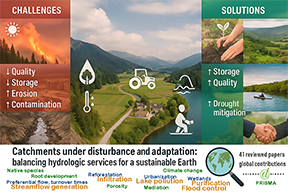
Water has shaped the Earth’s surface into catchments that support a diversity of ecosystem services, such as water and nutrient cycling, soil formation and habitat. Besides supporting, catchments regulate services like flood attenuation and water quality improvements through organism-mediated chemical processes. Catchments are also the geosphere where the water is stored in lakes, wetlands, reservoirs or underground, to be later provided as service to the economic activities such as agriculture or industry, as well as to the humans as drinking water. Finally, catchments may incorporate unique landscapes that leverage recreational and cultural services targeting tourism and social well-being. But catchments are also the geographical domain where humans and meteorological agents dynamize ecosystem services though land use changes and climate shifts. Consequently, catchments are disturbed through amplified soil erosion, water balance reconfigurations, etc., and eventually adapt overtime, either evolving towards a pre-disturbance condition or towards new landscapes. Disturbance and adaption are research questions in the spotlight, with growing published literature on the subject. Thus, a review focused on the latest findings (last couple of years) is worth of consideration and was the motivation to write this opinion paper. While gathering relevant papers from the Science Direct, Web of Science and Scopus databases, we realized that current research essentially shows how disturbance and natural feedbacks of catchments challenge the sustainable physical Earth by shaking support, regulation and provision hydrologic services. Thus, using the PRISMA methodolgy we assembled papers on these dimensions and discussed their roles in separate sections. Key results retrieved from the reviewed articles (41 in total, including contributions from all the continents) comprised new methods of preferential flow and turnover times in the soil layer and concurrent impacts on stream flow generation, including intermittence analyses. Important results also comprehended global assessments of lake contamination related to urbanization, as well as reports about exacerbation of water-rock interactions caused by increasing temperatures and concomitant raise of stream water solute concentrations. A common headlight to most articles was reforestation as measure to improve catchment water storage and quality, with focuses put on catchment’s physico-chemical processes such as infiltration, properties such as porosity or root development, and water yields, depending on whether the reviewed article was dealing with support, regulation or provision services, respectively. Articles on wetlands and climate shifts were not forgotten and exposed the need to expand mangrove systems to handle water purification in lowlands, as well as the role of mediation among competing interests to mitigate water shortfalls resulting from extreme and prolonged and prolonged droughts. We believe that, altogether, the findings reported in the selected papers and summarized in the discussion allowed a panoramic view over catchments as pools of cycling water and elements, as well as on the services and disservices they can be linked to.
- Open Access
- Review
The sustainable Earth screened through the lens of catchment water services
- Fernando António Leal Pacheco 1, * and
- Luís Filipe Sanches Fernandes 2, *
Author Information
Received: 18 June 2025 | Revised: 21 August 2025 | Accepted: 05 September 2025 | Published: 12 September 2025
Abstract
Graphical Abstract
Keywords
characterization and monitoring | forests | wetlands | revegetation | storage infrastructure | payments for ecosystem services
References
- 1.Water, N. How climate change alters the water cycle. Nat. Water 2023, 1, 485 https://doi.org/10.1038/s44221-023-00104-6.
- 2.Yang, D.; Yang, Y.; Xia, J. Hydrological cycle and water resources in a changing world: A review. Geogr. Sustain. 2021, 2, 115–122. https://doi.org/10.1016/j.geosus.2021.05.003.
- 3.Mayou, L.A.; Alamdari, N.; Ahmadisharaf, E.; et al. Impacts of future climate and land use/land cover change on urban runoff using fine-scale hydrologic modeling. J. Environ. Manag. 2024, 362, 121284. https://doi.org/10.1016/j.jenvman.2024.121284.
- 4.Sun, L.; Yu, H.; Sun, M.; et al. Coupled impacts of climate and land use changes on regional ecosystem services. J. Environ. Manag. 2023, 326, 116753. https://doi.org/10.1016/j.jenvman.2022.116753.
- 5.Ekström, E.; Brandimarte, L.; Ferreira, C.S.S. Flood mitigation at catchment scale: Assessing the effectiveness of constructed wetlands. In Nature-Based Solutions in Supporting Sustainable Development Goals; Elsevier: Amsterdam, The Netherlands, 2025; pp. 53–81. https://doi.org/10.1016/B978-0-443-21782-1.00005-1.
- 6.Wei, X.; Jones, J.; Hou, Y.; et al. Local considerations are the key to managing global forests for water. Sci. Bull. 2025, 70, 448–451. https://doi.org/10.1016/j.scib.2024.11.045.
- 7.Juan-Diego, E.; Mendoza, A.; Arganis-Juárez, M.L.; et al. Alteration of Catchments and Rivers, and the Effect on Floods: An Overview of Processes and Restoration Actions. Water 2025, 17, 1177. https://doi.org/10.3390/w17081177.
- 8.Saccon, P. Water for agriculture, irrigation management. Appl. Soil Ecol. 2018, 123, 793–796. https://doi.org/10.1016/j.apsoil.2017.10.037.
- 9.Limaye, S.D. Watershed management for sustainable water supply and food security. Int. J. Hydrol. 2019, 3, 1. https://doi.org/10.15406/ijh.2019.03.00153.
- 10.Randles, R.; Finnegan, A. Guidelines for writing a systematic review. Nurse Educ. Today 2023, 125, 105803. https://doi.org/10.1016/j.nedt.2023.105803.
- 11.Moher, D. Preferred Reporting Items for Systematic Reviews and Meta-Analyses: The PRISMA Statement. Ann. Intern. Med. 2009, 151, 264. https://doi.org/10.7326/0003-4819-151-4-200908180-00135.
- 12.Page, M.J.; McKenzie, J.E.; Bossuyt, P.M.; et al. The PRISMA 2020 statement: An updated guideline for reporting systematic reviews. BMJ 2021, 88, 105906. https://doi.org/10.1136/bmj.n71.
- 13.Pérez, A.B.D.; Revilla, C.V.; Aguilar, O.A.G.; et al. Religion and Spirituality in University Students: A Systematic Review of the Literature. Int. J. Relig. Spiritual. Soc. 2023, 14, 135–162. https://doi.org/10.18848/2154-8633/CGP/v14i03/135-162.
- 14.Ștefănică, M.; Sandu, C.B.; Butnaru, G.I.; et al. The Nexus between Tourism Activities and Environmental Degradation: Romanian Tourists’ Opinions. Sustainability 2021, 13, 9210. https://doi.org/10.3390/su13169210.
- 15.Kalinauskas, M.; Shuhani, Y.; Pinto, L.V.; et al. Mapping ecosystem services in protected areas. A systematic review. Sci. Total Environ. 2024, 912, 169248. https://doi.org/10.1016/j.scitotenv.2023.169248.
- 16.Kaffas, K.; Murgia, I.; Menapace, A.; et al. Controls on preferential flow and its role on streamflow generation in a Mediterranean forested catchment. J. Hydrol. 2025, 660, 133469. https://doi.org/10.1016/j.jhydrol.2025.133469.
- 17.Ying, Z.; Tetzlaff, D.; Freymueller, J.; et al. Developing a conceptual model of groundwater—Surface water interactions in a drought sensitive lowland catchment using multi-proxy data. J. Hydrol. 2024, 628, 130550. https://doi.org/10.1016/j.jhydrol.2023.130550.
- 18.Quichimbo-Miguitama, F.; Pesántez, J.; Crespo, P.; et al. Key controls on water transit times along a tropical precipitation gradient. J. Hydrol. 2024, 645, 132134. https://doi.org/10.1016/j.jhydrol.2024.132134.
- 19.Wang, F.; Tetzlaff, D.; Goldhammer, T.; et al. Hydrological connectivity drives intra- and inter-annual variation in water quality in an intermittent stream network in a mixed land use catchment under drought. J. Hydrol. 2025, 648, 132420. https://doi.org/10.1016/j.jhydrol.2024.132420.
- 20.Di Renzo, D.; Marrocchino, E.; Telloli, C.; et al. Multidisciplinary hydrogeochemical and isotopic assessment of the Pordenone Plain (Northeastern Italy) for water resources sustainability. Appl. Geochem. 2024, 175, 106161. https://doi.org/10.1016/j.apgeochem.2024.106161.
- 21.Liu, X.; Xiang, W.; Song, J.; et al. Spatial variations in groundwater hydrochemistry, sources, and controls across catchments on Chinese Loess Plateau. J. Hydrol. Reg. Stud. 2024, 53, 101791. https://doi.org/10.1016/j.ejrh.2024.101791.
- 22.Mengistie, G.K.; Haile, A.T.; Ferede, M.; et al. Citizen science-based WEAP modeling of water use impact on environmental flow in urbanized Big Akaki catchment, Ethiopia. J. Hydrol. Reg. Stud. 2025, 59, 102435. https://doi.org/10.1016/j.ejrh.2025.102435.
- 23.Kaptein, N.D.; Clulow, A.D.; Everson, C.S.; et al. The influence of different tree species and age on the surface water balance of a small commercial forestry catchment. J. Hydrol. Reg. Stud. 2024, 54, 101893. https://doi.org/10.1016/j.ejrh.2024.101893.
- 24.Zhao, D.; Jiao, Y.; He, K.; et al. Evaluating the effect of natural-artificial linear landscape elements on flow and sediment connectivity in a typical agricultural terraced catchment, China. Catena 2024, 234, 107561. https://doi.org/10.1016/j.catena.2023.107561.
- 25.Barbosa-Briones, E.; Cardona-Benavides, A.; Ortiz-Rodríguez, A.J.; et al. Evaluation of hydrological and sediment connectivity in catchments with mining activity in semiarid central Mexico. Geomorphol. 2024, 450, 109071. https://doi.org/10.1016/j.geomorph.2024.109071.
- 26.Caroni, R.; Greife, A.J.; Bresciani, M.; et al. Examining global trends of satellite-derived water quality variables in shallow lakes. Remote Sens. Appl. Soc. Environ. 2025, 38, 101565. https://doi.org/10.1016/j.rsase.2025.101565.
- 27.Stevenson, J.L.; Malcolm, I.; Tetzlaff, D.; et al. Hydroclimatic non-stationarity drives stream hydrochemistry dynamics through controls on catchment connectivity and water ages. J. Hydrol. 2024, 635, 131214. https://doi.org/10.1016/j.jhydrol.2024.131214.
- 28.Sun, X.; Mörth, C.-M.; Porcelli, D.; et al. Increase of chemical weathering in the Lena River Catchment under a warmer climate. Chem. Geol. 2024, 662, 122248. https://doi.org/10.1016/j.chemgeo.2024.122248.
- 29.Xu, J.; Liu, M.; Yi, J.; et al. Influence of vegetation restoration strategies on seasonal soil water deficit in a subtropical hilly catchment of southwest China. Catena 2025, 248, 108578. https://doi.org/10.1016/j.catena.2024.108578.
- 30.Xu, J.; Liu, M.; Yi, J.; et al. Evaluating the soil hydraulic functions of vegetation restoration in a subtropical hilly catchment: Insights from continuous soil moisture monitoring. J. Hydrol. 2024, 629, 130578. https://doi.org/10.1016/j.jhydrol.2023.130578.
- 31.Jaikawna, H.; Pagdee, A. Water purification—An essential service from forest ecosystems, and farming practices in the Pong River Basin, Northeast Thailand. In Trees For People; Elsevier: Amsterdam, The Netherlands, 2024; Volume 16, p. 100599. https://doi.org/10.1016/j.tfp.2024.100599.
- 32.Cui, X.; Ouyang, W.; Wang, J.; et al. The neglected role of forest eco-hydrological process representation in regulating watershed nitrogen loss. Water Res. 2025, 282, 123735. https://doi.org/10.1016/j.watres.2025.123735.
- 33.Dou, J.; Xia, R.; Xia, X.; et al. Extreme rainfall drives the shift in dominant water quality “Sink” from forest land to grassland in the Yellow River Basin. J. Hydrol. 2025, 658, 133218. https://doi.org/10.1016/j.jhydrol.2025.133218.
- 34.dos Reis Oliveira, P.C.; Gualda, G.A.F.; Rossi, G.F.; et al. Forest restoration improves habitat and water quality in tropical streams: A multiscale landscape assessment. Sci. Total Environ. 2025, 963, 178256. https://doi.org/10.1016/j.scitotenv.2024.178256.
- 35.Liao, Y.; Pan, T.; Deng, Y.; et al. Comparing of soil matrix infiltration and preferential flow across different land use types in karst landscapes: Implications for soil and water conservation. Catena 2025, 256, 109127. https://doi.org/10.1016/j.catena.2025.109127.
- 36.Zhu, P.; Zhang, G.; Wang, C.; et al. Variation in soil infiltration properties under different land use/cover in the black soil region of Northeast China. Int. Soil Water Conserv. Res. 2024, 12, 379–387. https://doi.org/10.1016/j.iswcr.2023.07.007.
- 37.Zhang, W.; Zhu, X.; Xiong, X.; et al. Changes in soil infiltration and water flow paths: Insights from subtropical forest succession sequence. Catena 2023, 221, 106748. https://doi.org/10.1016/j.catena.2022.106748.
- 38.Wang, D.; Niu, J.; Dai, Z.; et al. Forest restoration effects on soil preferential flow in the paleo-periglacial eastern liaoning mountainous regions, China. J. Clean. Prod. 2024, 467, 142974. https://doi.org/10.1016/j.jclepro.2024.142974.
- 39.Zhu, Y.; Sun, L.; Jamshidi, A.H.; et al. Effect of forest conversion on soil water infiltration in the Dabie mountainous area, China. J. Hydrol. Reg. Stud. 2025, 59, 102351. https://doi.org/10.1016/j.ejrh.2025.102351.
- 40.Yi, Q.; Huixin, G.; Yaomin, Z.; et al. Global conservation priorities for wetlands and setting post-2025 targets. Commun. Earth Environ. 2024, 5, 4. https://doi.org/10.1038/s43247-023-01195-5.
- 41.Enu, K.B.; Merk, F.; Su, H.; et al. A scenario-based analysis of wetlands as nature-based solutions for flood risk mitigation using the TELEMAC-2D model. Nat. Based Solut. 2025, 7, 100236. https://doi.org/10.1016/j.nbsj.2025.100236.
- 42.Donnelly, J.P.; Jensco, K.; Kimball, J.S.; et al. Beneficial ‘inefficiencies’ of western ranching: Flood-irrigated hay production sustains wetland systems by mimicking historic hydrologic processes. Agric. Ecosyst. Environ. 2024, 370, 109051. https://doi.org/10.1016/j.agee.2024.109051.
- 43.Gupta, R.; Chembolu, V.; Marjoribanks, T.I.; et al. Assessing the efficacy of hydro-ecological based wetland management approach for flood resilience of a large river catchment. J. Hydrol. 2024, 641, 131761. https://doi.org/10.1016/j.jhydrol.2024.131761.
- 44.Wu, Y.; Sun, J.; Hu, B.; et al. Wetland-based solutions against extreme flood and severe drought: Efficiency evaluation of risk mitigation. Clim. Risk Manag. 2023, 40, 100505. https://doi.org/10.1016/j.crm.2023.100505.
- 45.Zhang, L.; Xu, B.; Wei, Z.; et al. Atmospheric microplastic deposition in Guilin karst wetlands: Sources and agricultural impact. Atmos. Pollut. Res. 2025, 16, 102537. https://doi.org/10.1016/j.apr.2025.102537.
- 46.Rahman, S.U.; Han, J.-C.; Zhou, Y.; et al. Eco-resilience of China’s mangrove wetlands: The impact of heavy metal pollution and dynamics. Environ. Res. 2025, 277, 121552. https://doi.org/10.1016/j.envres.2025.121552.
- 47.Sumarga, E.; Willemen, L.; Rosleine, D.; et al. Water provision benefits from karst ecosystems: An example for Watuputih groundwater basin, North Kendeng Mountain, Indonesia. Environ. Sustain. Indic. 2024, 24, 100518. https://doi.org/10.1016/j.indic.2024.100518.
- 48.Ebrahim, G.Y.; Lautze, J.F.; McCartney, M.; et al. Beyond dams: Assessing integrated water storage in the Shashe catchment, Limpopo River Basin. J. Hydrol. Reg. Stud. 2024, 55, 101913. https://doi.org/10.1016/j.ejrh.2024.101913.
- 49.Eekhout, J.P.C.; Delsman, I.; Baartman, J.E.M.; et al. How future changes in irrigation water supply and demand affect water security in a Mediterranean catchment. Agric. Water Manag. 2024, 297, 108818. https://doi.org/10.1016/j.agwat.2024.108818.
- 50.Dlamini, N.; Senzanje, A.; Mabhaudhi, T. Assessing climate change impacts on surface water availability using the WEAP model: A case study of the Buffalo river catchment, South Africa. J. Hydrol. Reg. Stud. 2023, 46, 101330. https://doi.org/10.1016/j.ejrh.2023.101330.
- 51.Filoso, S.; Bezerra, M.O.; Weiss, K.C.B.; et al. Impacts of forest restoration on water yield: A systematic review. PLoS ONE 2017, 12, e0183210. https://doi.org/10.1371/journal.pone.0183210.
- 52.Li, P.; Yang, D.; Chaubey, I.; et al. Evolution of the freshwater provisioning services under climate change and vegetation restoration influences. Ecol. Indic. 2022, 143, 109362. https://doi.org/10.1016/j.ecolind.2022.109362.
- 53.Yohannes, H.; Argaw, M.; Seifu, W. Impact of land use/land cover change on surface water hydrology in Akaki river catchment, Awash basin, Ethiopia. Phys. Chem. Earth Parts A/B/C 2024, 135, 103690. https://doi.org/10.1016/j.pce.2024.103690.
- 54.Jones, J.; Ellison, D.; Ferraz, S.; et al. Forest restoration and hydrology. For. Ecol. Manag. 2022, 520, 120342. https://doi.org/10.1016/j.foreco.2022.120342.
- 55.Pissarra, T.C.T.; Fernandes, L.F.S.; Pacheco, F.A.L. Production of clean water in agriculture headwater catchments: A model based on the payment for environmental services. Sci. Total Environ. 2021, 785, 147331. https://doi.org/10.1016/j.scitotenv.2021.147331.
- 56.Anjinho, P.S.; Barbosa, M.A.G.A.; Peponi, A.; et al. Enhancing Water Ecosystem Services Using Environmental Zoning in Land Use Planning. Sustain. 2024, 16, 4803. https://doi.org/10.3390/su16114803.
- 57.Sanga, G.J.; Mungatana, E.D. Integrating ecology and economics in understanding responses in securing land-use externalities internalization in water catchments. Ecol. Econ. 2016, 121, 28–39. https://doi.org/10.1016/j.ecolecon.2015.11.011.
- 58.Mdee, A.; Ofori, A.; Lopez-Gonzalez, G.; et al. The top 100 global water questions: Results of a scoping exercise. One Earth 2022, 5, 563–573. https://doi.org/10.1016/j.oneear.2022.04.009.

How to Cite
Pacheco, F. A. L.; Fernandes, L. F. S. The sustainable Earth screened through the lens of catchment water services. Earth: Environmental Sustainability 2025, 1 (1), 114–129. https://doi.org/10.53941/eesus.2025.100009.
RIS
BibTex
Copyright & License

Copyright (c) 2025 by the authors.
This work is licensed under a Creative Commons Attribution 4.0 International License.
Contents
References
