
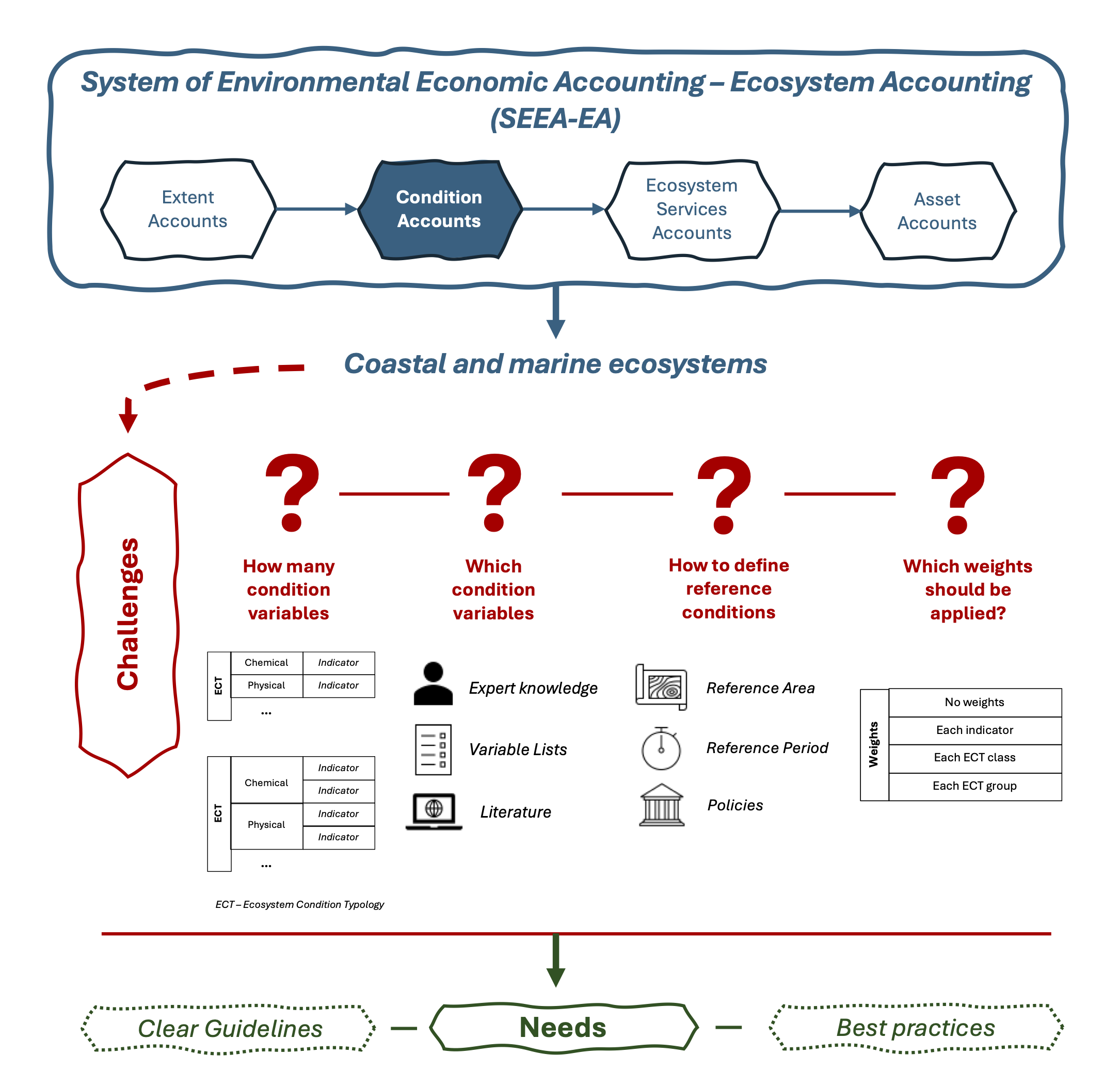
The importance of coastal and marine ecosystems has been extensively explored due to their capacity to supply ecosystem services and thus contribute to human wellbeing. Nevertheless, these are some of the most anthropogenically impacted ecosystems globally. It is necessary to fully account for the contribution of nature and integrate this information into countries’ socio-economic dynamics. The System of Environmental-Economic Accounting—Ecosystem Accounting (SEEA-EA) was adopted by the United Nations in 2021 as a statistical standard to integrate the contribution of ecosystems and their services into the national accounts system. Since its adoption, the SEEA-EA has been increasingly implemented worldwide. However, its application in the coastal and marine environment is still limited. This is especially true when assessing ecosystem condition. As a relatively new topic within the SEEA-EA, there are many uncertainties within the community on how to assess marine ecosystem condition. The lack of standard guidelines makes it more difficult. This opinion article explored the three main challenges that hinder the operationalisation of assessing ecosystem condition. Specifically, the challenges of defining meaningful ecosystem condition variables in terms of representativeness and data availability. Then, the article explored the difficulties in rescaling condition variables into indicators by correctly defining appropriate reference conditions. Finally, it examined the challenges of calculating the condition index unbiasedly using indicator weights. Overall, there are still many critical challenges that need to be addressed. For this, it is essential to define clear guidelines and best practices for the community to accurately and meaningfully assess the condition of coastal and marine ecosystems.
- Open Access
- Opinion
Challenges in Compiling Marine Ecosystem Condition Accounts
Author Information
Received: 02 July 2025 | Revised: 18 September 2025 | Accepted: 28 September 2025 | Published: 13 October 2025
Abstract
Graphical Abstract
Keywords
SEEA-EA | coastal | ocean accounting | ecosystem accounting | sea
References
- 1.
Refulio-Coronado, S.; Lacasse, K.; Dalton, T.; et al. Coastal and Marine Socio-Ecological Systems: A Systematic Review of the Literature. Front. Mar. Sci. 2021, 8, 648006.
- 2.
Howard, J.; Sutton-Grier, A.; Herr, D.; et al. Clarifying the Role of Coastal and Marine Systems in Climate Mitigation. Front. Ecol. Environ. 2017, 15, 42–50.
- 3.
Barbier, E.B. Marine Ecosystem Services. Curr. Biol. 2017, 27, R507–R510.
- 4.
Halpern, B.S.; Frazier, M.; Afflerbach, J.; et al. Recent Pace of Change in Human Impact on the World’s Ocean. Sci. Rep. 2019, 9, 11609.
- 5.
Solé Figueras, L.; Zandt, E.I.; Buschbaum, C.; et al. How Are the Impacts of Multiple Anthropogenic Drivers Considered in Marine Ecosystem Service Research? A Systematic Literature Review. J. Appl. Ecol. 2024, 61, 1212–1226.
- 6.
Pike, E.P.; MacCarthy, J.M.; Hameed, S.O.; et al. Ocean Protection Quality Is Lagging behind Quantity: Applying a Scientific Framework to Assess Real Marine Protected Area Progress against the 30 by 30 Target. Conserv. Lett. 2024, 17, e13020.
- 7.
Brandon, C.; Brandon, K.; Fairbrass, A.; et al. Integrating Natural Capital into National Accounts: Three Decades of Promise and Challenge. Rev. Environ. Econ. Policy 2021, 15, 134–153.
- 8.
Edens, B.; Maes, J.; Hein, L.; et al. Establishing the SEEA ecosystem accounting as a global standard. Ecosyst. Serv. 2022, 54, 101413. https://doi.org/10.1016/j.ecoser.2022.101413.
- 9.
United Nations. System of Environmental-Economic Accounting-Ecosystem Accounting (SEEA EA). United Nations, New York. 2024. Available online: https://seea.un.org/ecosystem-accounting (accessed on 3 July 2025).
- 10.
Comte, A.; Sylvie Campagne, C.; Lange, S.; et al. Ecosystem Accounting: Past Scientific Developments and future challenges. Ecosyst. Serv. 2022, 58, 101486. https://doi.org/10.1016/j.ecoser.2022.101486.
- 11.
Lange, S.; Campagne, C.S.; Comte, A.; et al. Progress on ecosystem accounting in Europe. Ecosyst. Serv. 2022, 57, 101473. https://doi.org/10.1016/j.ecoser.2022.101473.
- 12.
Cummins, G.H.; Navarro, M.L.; Griffin, K.; et al. A global review of Ocean Ecosystem Accounts and their data: Lessons learned and implications for marine policy. Mar. Policy 2025, 153, 105636. https://doi.org/10.1016/j.marpol.2023.105636.
- 13.
Grilli, G.; Luisetti, T.; Thornton, A.; et al. Developing Ecosystem Accounts for the Marine and Coastal Environment: Limitations, Opportunities and Lessons Learned from the United Kingdom Experience. J. Ocean Coast. Econ. 2021, 8, 1.
- 14.
Alarcon Blazquez, M.; van der Veeren, R.; Gacutan, J.; et al. Compiling Preliminary SEEA Ecosystem Accounts for the OSPAR Regional Sea: Experimental Findings and Lessons Learned. One Ecosyst. 2023, 4, e108104.
- 15.
Comte, A.; Quemmerais-Amice, F.; Scemama, P.; et al. Experimenting Marine Extent and Condition Accounts in France. Mar. Policy 2025, 172, 106532.
- 16.
Dvarskas, A. Experimental ecosystem accounting for coastal and marine areas: A pilot application of the SEEA-EEA in Long Island coastal bays. Mar. Policy 2019, 100, 141–151. https://doi.org/10.1016/j.marpol.2018.11.017.
- 17.
Chen, W.; Van Assche, K.A.; Hynes, S.; et al. Ecosystem Accounting’s Potential to Support Coastal and Marine Governance. Mar. Policy 2020, 112, 103758.
- 18.
Ha, D.; Pelletier, M.-C.; Weller-Wong, A.; et al. Applying marine and coastal ecosystem accounting in an estuary managed by a not-for-profit organisation: Evidence from Australia. One Ecosyst. 2025, 10, 1–32. https://doi.org/10.3897/oneeco.10.e153237.
- 19.
Lu, Y.; Wang, L. How to Automate Timely Large-Scale Mangrove Mapping with Remote Sensing. Remote Sens. Environ. 2021, 264, 112584.
- 20.
Kokkoris, I.P.; Smets, B.; Hein, L.; et al. The role of earth observation in ecosystem accounting: A review of advances, challenges and future directions. Ecosystem Services, 2024, 70, 101659. https://doi.org/10.1016/j.ecoser.2024.101659.
- 21.
Fraschetti, S.; Strong, J.; Buhl-Mortensen, L.; et al. (Eds.) Marine Habitat Mapping; European Marine Board: Ostend, Belgium, 2024. ISSN: 2593-5232; ISBN: 9789464206234. https://doi.org/10.5281/zenodo.11203128.
- 22.
Addamo, A.M.; La Notte, A.; Guillen, J. Status of Mapping, Assessment and Valuation of Marine Ecosystem Services in the European Seas. Ecosyst. Serv. 2024, 67, 101631.
- 23.
Inácio, M.; Pinto, L.; Baltranaitė, E.; et al. Mapping and Assessing Marine Ecosystem Services Supply in the Baltic Sea. Sci. Total Environ. 2024, 950, 175199.
- 24.
Contreras del Valle, M.F.; Starnfeld, F. Valuation of Marine and Coastal Ecosystem Services: Bio-Bridge Initiative in Central America and the Dominican Republic; Deutsche Gesellschaft für Internationale Zusammenarbeit (GIZ) GmbH: Bonn, Germany, 2022.
- 25.
Smit, K.P.; Bernard, A.T.F.; Lombard, A.T.; et al. Assessing Marine Ecosystem Condition: A Review to Support Indicator Choice and Framework Development. Ecol. Indic. 2021, 121, 107148.
- 26.
La Notte, A.; Czúcz, B.; Vallecillo, S.; et al. Ecosystem Condition Underpins the Generation of Ecosystem Services: An Accounting Perspective. One Ecosyst. 2022, 7, e81487.
- 27.
Halpern, B.S.; Longo, C.; Hardy, D.; et al. An Index to Assess the Health and Benefits of the Global Ocean. Nature 2012, 488, 615–620.
- 28.
Vallecillo Rodriguez, S.; Maes, J.; Teller, A.; et al. EU-Wide Methodology to Map and Assess Ecosystem Condition, EUR 31226 EN; Publications Office of the European Union, Luxembourg, 2022; ISBN 978-92-76-57029-5. https://doi.org/10.2760/13048.
- 29.
Rosenberg, R.; Blomqvist, M.; Nilsson, H.C.; et al. Marine Quality Assessment by Use of Benthic Species-Abundance Distributions: A Proposed New Protocol within the European Union Water Framework Directive. Mar. Pollut. Bull. 2004, 49, 728–739.
- 30.
Borja, A.; Franco, J.; Pérez, V. A Marine Biotic Index to Establish the Ecological Quality of Soft-Bottom Benthos within European Estuarine and Coastal Environments. Mar. Pollut. Bull. 2000, 40, 1100–1114.
- 31.
GOAP. Technical Guidance on Ocean Accounting for Sustainable Development; Global Ocean Accounts Partnership: Sydney, Australia, 2021; 186p.
- 32.
Natural England. Marine Natural Capital Assessment Guidance; Natural England: York, UK, 2025; Archive for Marine Species and Habitats Data (DASSH). (Interactive Resource).
- 33.
Virtanen, E.; Forsblom, L.; Saikkonen, L.; et al. Marine Ecosystem Extent and Condition Pilot Accounts for Finland. One Ecosyst. 2024, 9, e138839.
- 34.
Navarro, M.L.; Monk, J.; Cummins, G.H.; et al. Embracing Uncertainty in Ocean Accounts. Mar. Policy 2024, 162, 106040.
- 35.
Czúcz, B.; Keith, H.; Driver, A.; et al. A Common Typology for Ecosystem Characteristics and Ecosystem Condition Variables. One Ecosyst. 2021, 6, 1–16.
- 36.
Borja, A.; Elliott, M.; Teixeira, H.; et al. Addressing the Cumulative Impacts of Multiple Human Pressures in Marine Systems, for the Sustainable Use of the Seas. Front. Ocean Sustain. 2024, 1, 1308125.
- 37.
McNellie, M.J.; Oliver, I.; Dorrough, J.; et al. Reference State and Benchmark Concepts for Better Biodiversity Conservation in Contemporary Ecosystems. Glob. Change Biol. 2020, 26, 6702–6714.
- 38.
Sguotti, C.; Blöcker, A.M.; Färber, L.; et al. Irreversibility of Regime Shifts in the North Sea. Front. Mar. Sci. 2022, 9, 945204.
- 39.
Marcos, C.; Díaz, D.; Fietz, K.; et al. Reviewing the Ecosystem Services, Societal Goods, and Benefits of Marine Protected Areas. Front. Mar. Sci. 2021, 8, 613819.
- 40.
Aminian-Biquet, J.; Gorjanc, S.; Sletten, J.; et al. Over 80% of the European Union’s Marine Protected Area Only Marginally Regulates Human Activities. One Earth 2024, 7, 1614–1629.
- 41.
Giakoumi, S.; McGowan, J.; Mills, M.; et al. Revisiting “Success” and “Failure” of Marine Protected Areas: A Conservation Scientist Perspective. Front. Mar. Sci. 2018, 5, 223.
- 42.
HELCOM. State of the Baltic Sea. Third HELCOM holistic assessment 2016–2021. Balt. Sea Enviro Proc 2023, 194, 69.
- 43.
Jakobsson, S.; Töpper, J.P.; Evju, M.; et al. Setting Reference Levels and Limits for Good Ecological Condition in Terrestrial Ecosystems—Insights from a Case Study Based on the IBECA Approach. Ecol. Indic. 2020, 116, 106492.
- 44.
Steenbeek, J.; Buszowski, J.; Chagaris, D.; et al. Making Spatial-Temporal Marine Ecosystem Modelling Better—A Perspective. Environ. Model. Softw. 2021, 145, 105209.
- 45.
Thurstan, R.H.; McClenachan, L.; Crowder, L.B.; et al. Filling Historical Data Gaps to Foster Solutions in Marine Conservation. Ocean Amp; Coast. Manag. 2015, 115, 31–40.
- 46.
Piehl, S.; Carstensen, J.; Neumann, T.; et al. Predicting historical oxygen deficiency areas in the western Baltic Sea: A multi-model approach. Mar. Pollut. Bull. 2025, 221, 118464. https://doi.org/10.1016/j.marpolbul.2025.118464.
- 47.
Martini, F.; Conroy, K.; King, E.; et al. A Capacity Index to Connect Ecosystem Condition to Ecosystem Services Accounts. Ecol. Indic. 2024, 167, 112731.
- 48.
Bruzón, A.G.; Arrogante-Funes, P.; Santos-Martín, F. Modelling and Testing Forest Ecosystems Condition Account. J. Environ. Manag. 2023, 345, 118676.
- 49.
Kallio, N.; Andersen, J.H.; Carstensen, J.; et al. Challenges in Expert Ratings of Marine Habitat and Species Sensitivity to Anthropogenic Pressures. Sci. Rep. 2025, 15, 12546.

This work is licensed under a Creative Commons Attribution 4.0 International License.
