
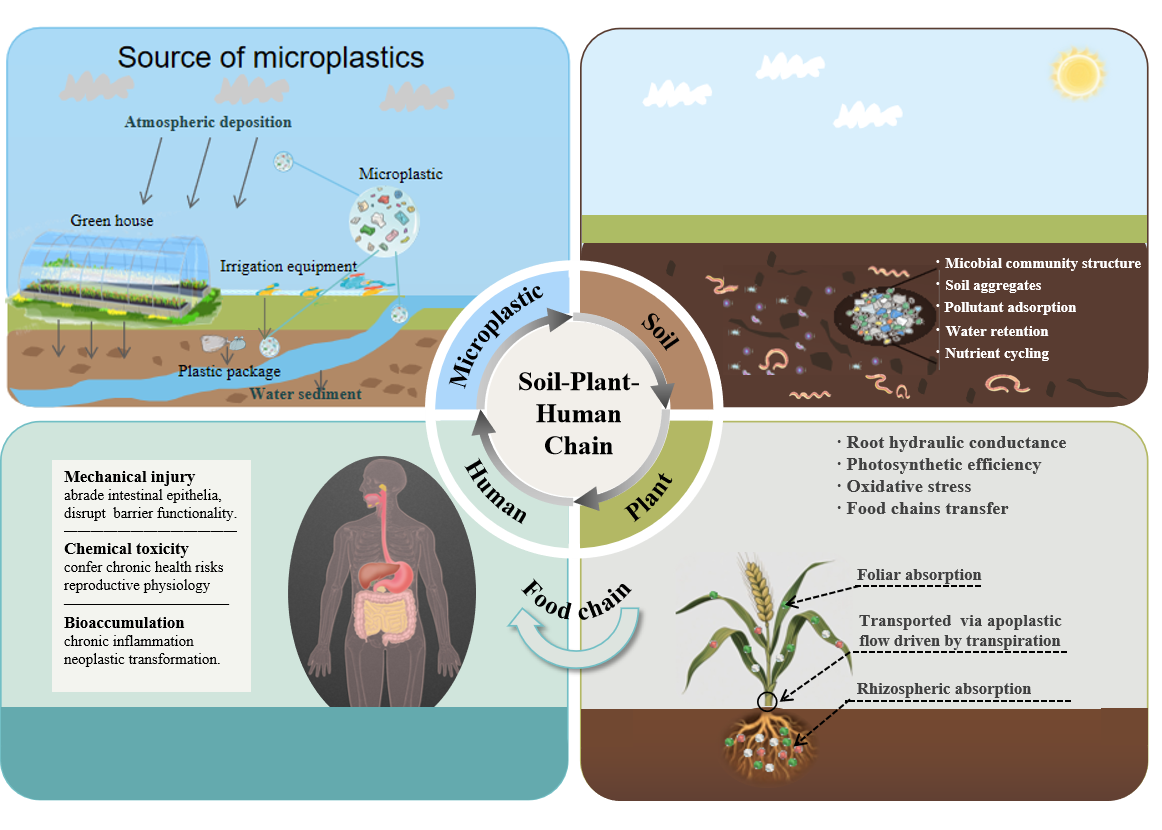
The widespread contamination of agricultural soils with microplastics (MPs), primarily resulting from plastic mulching and organic amendments, has transformed these systems into long-term sinks for plastic particles. This perspective synthesizes current knowledge on the transport and impacts of MPs across the soil-plant-human continuum. We underscore the pathways by which MPs infiltrate crops via root uptake and foliar deposition, accumulate in edible tissues, and ultimately reach humans through dietary exposure. The associated health risks, including gastrointestinal accumulation, systemic inflammation, endocrine disruption, and the co-transport of adsorbed toxic pollutants, raise pressing concerns for food safety and public health. Moving beyond presence-based assessments, we integrate field-relevant effect thresholds with polymer-specific sorption behaviors to predict cascading impacts along the exposure pathway. Furthermore, we propose a transdisciplinary Soil–Plant–Food (SPF) governance framework that emphasizes actionable strategies for source reduction, process interception, and endpoint regulation. We further call for harmonized monitoring protocols, the establishment of maximum residue limits, and the development of targeted mitigation technologies to enable evidence-based risk management and protect food security and human health.
- Open Access
- Perspective
Microplastic Contamination across the Soil-Plant-Human Continuum: Mechanisms and Chain-Specific Governance
Author Information
Received: 15 July 2025 | Revised: 19 September 2025 | Accepted: 09 October 2025 | Published: 13 October 2025
Abstract
Graphical Abstract
Keywords
microplastics | food chain | human health | ecotoxicology | agricultural systems
References
- 1.
Deng, P.; Hu, X.; Wang, R.; et al. Spatial Risks of Microplastics in Soils and the Cascading Effects Thereof. Environ. Sci. Technol. 2025, 59, 10299–10309.
- 2.
Li, S.; Ding, F.; Flury, M.; et al. Macro- and microplastic accumulation in soil after 32 years of plastic film mulching. Environ. Pollut. 2022, 300, 118945.
- 3.
Meizoso-Regueira, T.; Fuentes, J.; Cusworth, S.J.; et al. Prediction of future microplastic accumulation in agricultural soils. Environ. Pollut. 2024, 359, 124587.
- 4.
Kedzierski, M.; Cirederf-Boulant, D.; Palazot, M.; et al. Continents of plastics: An estimate of the stock of microplastics in agricultural soils. Sci. Total Environ. 2023, 880, 163294.
- 5.
Zhang S.; Lian X.; Yang X.; et al. Dynamics of residual film mass and microplastic abundance in long-term plastic-mulched cotton fields. Front. Agric. Sci. Eng. 2026, 13, 25627.
- 6.
Qian, N.; Gao, X.; Lang, X.; et al. Rapid single-particle chemical imaging of nanoplastics by SRS microscopy. Proc. Natl. Acad. Sci. USA 2024, 121, e2300582121.
- 7.
Cox, K.D.; Covernton, G.A.; Davies, H.L.; et al. Human Consumption of Microplastics. Environ. Sci. Technol. 2019, 53, 7068–7074.
- 8.
Aydın, R.B.; Yozukmaz, A.; Şener, İ.; et al. Occurrence of Microplastics in Most Consumed Fruits and Vegetables from Turkey and Public Risk Assessment for Consumers. Life 2023, 13, 1686.
- 9.
Guo, J.-J.; Huang, X.-P.; Xiang, L.; et al. Source, migration and toxicology of microplastics in soil. Environ. Int. 2020, 137, 105263.
- 10.
Weithmann, N.; Möller, J.N.; Löder, M.G.J.; et al. Organic fertilizer as a vehicle for the entry of microplastic into the environment. Sci. Adv. 2018, 4, eaap8060.
- 11.
Scheurer, M.; Bigalke, M. Microplastics in Swiss Floodplain Soils. Environ. Sci. Technol. 2018, 52, 3591–3598.
- 12.
Weber, C.J.; Santowski, A.; Chifflard, P. Investigating the dispersal of macro- and microplastics on agricultural fields 30 years after sewage sludge application. Sci. Rep. 2022, 12, 6401.
- 13.
Ramage, S.J.F.F.; Coull, M.; Cooper, P.; et al. Microplastics in agricultural soils following sewage sludge applications: Evidence from a 25-year study. Chemosphere 2025, 376, 144277.
- 14.
Weber, C.J.; Kundel, D.; Fliessbach, A.; et al. Baseline levels of microplastics in agricultural soils obscure the effects of additional microplastics from recycled fertilizers. Microplastics Nanoplastics 2025, 5, 30.
- 15.
de Souza Machado, A.A.; Lau, C.W.; Till, J.; et al. Impacts of Microplastics on the Soil Biophysical Environment. Environ. Sci. Technol. 2018, 52, 9656–9665.
- 16.
He, L.; Li, Z.; Jia, Q.; et al. Soil microplastics pollution in agriculture. Science 2023, 379, 547–547.
- 17.
Rillig, M.C.; Lehmann, A. Microplastic in terrestrial ecosystems. Science 2020, 368, 1430–1431.
- 18.
Huang, W.; Xia, X. Element cycling with micro(nano)plastics. Science 2024, 385, 933–935.
- 19.
Fischer, F.C.; Cirpka, O.A.; Goss, K.-U.; et al. Application of Experimental Polystyrene Partition Constants and Diffusion Coefficients to Predict the Sorption of Neutral Organic Chemicals to Multiwell Plates in in Vivo and in Vitro Bioassays. Environ. Sci. Technol. 2018, 52, 13511–13522.
- 20.
Lohmann, R. Critical Review of Low-Density Polyethylene’s Partitioning and Diffusion Coefficients for Trace Organic Contaminants and Implications for Its Use As a Passive Sampler. Environ. Sci. Technol. 2012, 46, 606–618.
- 21.
Castan, S.; Henkel, C.; Hüffer, T.; et al. Microplastics and nanoplastics barely enhance contaminant mobility in agricultural soils. Commun. Earth Environ. 2021, 2, 193.
- 22.
Luo, Y.; Li, L.; Feng, Y.; et al. Quantitative tracing of uptake and transport of submicrometre plastics in crop plants using lanthanide chelates as a dual-functional tracer. Nat. Nanotechnol. 2022, 17, 424–431.
- 23.
Jiang, X.; White, J.C.; He, E.; et al. Foliar Exposure of Deuterium Stable Isotope-Labeled Nanoplastics to Lettuce: Quantitative Determination of Foliar Uptake, Transport, and Trophic Transfer in a Terrestrial Food Chain. Environ. Sci. Technol. 2024, 58, 15438–15449.
- 24.
Li, Y.; Zhang, J.; Xu, L.; et al. Leaf absorption contributes to accumulation of microplastics in plants. Nature 2025, 641, 666–673.
- 25.
Liu, Y.; Guo, R.; Zhang, S.; et al. Uptake and translocation of nano/microplastics by rice seedlings: Evidence from a hydroponic experiment. J. Hazard. Mater. 2022, 421, 126700.
- 26.
Parkinson, S.J.; Tungsirisurp, S.; Joshi, C.; et al. Polymer nanoparticles pass the plant interface. Nat. Commun. 2022, 13, 7385.
- 27.
de Souza Machado, A.A.; Lau, C.W.; Kloas, W.; et al. Microplastics Can Change Soil Properties and Affect Plant Performance. Environ. Sci. Technol. 2019, 53, 6044–6052.
- 28.
Han, Y.; Teng, Y.; Wang, X.; et al. Biodegradable PBAT microplastics adversely affect pakchoi (Brassica chinensis L.) growth and the rhizosphere ecology: Focusing on rhizosphere microbial community composition, element metabolic potential, and root exudates. Sci. Total Environ. 2024, 912, 169048.
- 29.
Hernandez, L.M.; Xu, E.G.; Larsson, H.C.E.; et al. Plastic Teabags Release Billions of Microparticles and Nanoparticles into Tea. Environ. Sci. Technol. 2019, 53, 12300–12310.
- 30.
Yadav, H.; Khan, M.R.H.; Quadir, M.; et al. Cutting Boards: An Overlooked Source of Microplastics in Human Food? Environ. Sci. Technol. 2023, 57, 8225–8235.
- 31.
Li, D.; Shi, Y.; Yang, L.; et al. Microplastic release from the degradation of polypropylene feeding bottles during infant formula preparation. Nat. Food 2020, 1, 746–754.
- 32.
Wang, F.; Wang, X.; Song, N. Polyethylene microplastics increase cadmium uptake in lettuce (Lactuca sativa L.) by altering the soil microenvironment. Sci. Total Environ. 2021, 784, 147133.
- 33.
Dessì, C.; Okoffo, E.D.; O’Brien, J.W.; et al. Plastics contamination of store-bought rice. J. Hazard. Mater. 2021, 416, 125778.
- 34.
Lin, S.; Zhang, H.; Wang, C.; et al. Metabolomics Reveal Nanoplastic-Induced Mitochondrial Damage in Human Liver and Lung Cells. Environ. Sci. Technol. 2022, 56, 12483–12493.
- 35.
Zhang, Q.; Xu, E.G.; Li, J.; et al. A Review of Microplastics in Table Salt, Drinking Water, and Air: Direct Human Exposure. Environ. Sci. Technol. 2020, 54, 3740–3751.
- 36.
Yan, Z.; Liu, Y.; Zhang, T.; et al. Analysis of Microplastics in Human Feces Reveals a Correlation between Fecal Microplastics and Inflammatory Bowel Disease Status. Environ. Sci. Technol. 2022, 56, 414–421.
- 37.
Yang, Q.; Peng, Y.; Wu, X.; et al. Microplastics in human skeletal tissues: Presence, distribution and health implications. Environ. Int. 2025, 196, 109316.
- 38.
Yao, S.; Li, X.; Wang, T.; et al. Soil Metabolome Impacts the Formation of the Eco-corona and Adsorption Processes on Microplastic Surfaces. Environ. Sci. Technol. 2023, 57, 8139–8148.
- 39.
Ragusa, A.; Svelato, A.; Santacroce, C.; et al. Plasticenta: First evidence of microplastics in human placenta. Environ. Int. 2021, 146, 106274.
- 40.
Chen, Z.; Yin, X.; Geng, Y.-Q.; et al. Subchronic Exposure to Polystyrene Nanoplastics Disrupts Placental Development and Calcium Homeostasis: Insights from In Vivo and In Vitro Models. ACS Nano 2025, 19, 13825–13841.
- 41.
Marfella, R.; Prattichizzo, F.; Sardu, C.; et al. Microplastics and Nanoplastics in Atheromas and Cardiovascular Events. Engl. J. Med. 2024, 390, 900–910.
- 42.
EFSA Panel on Contaminants in the Food Chain (CONTAM). Presence of microplastics and nanoplastics in food, with particular focus on seafood. EFSA J. 2016, 14, e04501.
- 43.
Wright, S.L.; Kelly, F.J. Plastic and Human Health: A Micro Issue? Environ. Sci. Technol. 2017, 51, 6634–6647.
- 44.
An, Q.; Zhou, T.; Wen, C.; et al. The effects of microplastics on heavy metals bioavailability in soils: A meta-analysis. J. Hazard. Mater. 2023, 460, 132369.
- 45.
Mohamed Nor, N.H.; Koelmans, A.A. Transfer of PCBs from Microplastics under Simulated Gut Fluid Conditions Is Biphasic and Reversible. Environ. Sci. Technol. 2019, 53, 1874–1883.
- 46.
Li, W.; Zu, B.; Li, L.; et al. Desorption of bisphenol A from microplastics under simulated gastrointestinal conditions. Front. Mar. Sci. 2023, 10, 1195964.
- 47.
Zhang, Y.; Men, J.; Yin, K.; et al. Activation of gut metabolite ACSL4/LPCAT3 by microplastics in drinking water mediates ferroptosis via gut–kidney axis. Commun. Biol. 2025, 8, 211.
- 48.
Stevens, S.; McPartland, M.; Bartosova, Z.; et al. Plastic Food Packaging from Five Countries Contains Endocrine- and Metabolism-Disrupting Chemicals. Environ. Sci. Technol. 2024, 58, 4859–4871.
- 49.
Kim, D.; Kim, D.; Kim, H.-K.; et al. Organ-specific accumulation and toxicity analysis of orally administered polyethylene terephthalate microplastics. Sci. Rep. 2025, 15, 6616.
- 50.
Lane, T.; Wardani, I.; Koelmans, A.A. Exposure scenarios for human health risk assessment of nano- and microplastic particles. Microplastics Nanoplastics 2025, 5, 28.
- 51.
Mohamed Nor, N.H.; Kooi, M.; Diepens, N.J.; et al. Lifetime Accumulation of Microplastic in Children and Adults. Environ. Sci. Technol. 2021, 55, 5084–5096.
- 52.
Wang, W.; Wang, J. Different partition of polycyclic aromatic hydrocarbon on environmental particulates in freshwater: Microplastics in comparison to natural sediment. Ecotoxicol. Environ. Saf. 2018, 147, 648–655.
- 53.
Rochman, C.M.; Manzano, C.; Hentschel, B.T.; et al. Polystyrene plastic: A source and sink for polycyclic aromatic hydrocarbons in the marine environment. Environ. Sci. Technol. 2013, 47, 13976–13984.
- 54.
Nelson, T.F.; Baumgartner, R.; Jaggi, M.; et al. Biodegradation of poly(butylene succinate) in soil laboratory incubations assessed by stable carbon isotope labelling. Nat. Commun. 2022, 13, 5691.
- 55.
New York City Department of Sanitation. Single-Use Plastic Carryout Bags. Available online: https://www.nyc.gov/site/dsny/businesses/materials-handling/single-use-plastic-bags.page (accessed on 12 September 2025).
- 56.
Sheng, D.; Jing, S.; He, X.; et al. Plastic pollution in agricultural landscapes: An overlooked threat to pollination, biocontrol and food security. Nat. Commun. 2024, 15, 8413.
- 57.
Deng, Y.; Chen, H.; Huang, Y.; et al. Long-Term Exposure to Environmentally Relevant Doses of Large Polystyrene Microplastics Disturbs Lipid Homeostasis via Bowel Function Interference. Environ. Sci. Technol. 2022, 56, 15805–15817.
- 58.
Allen, S.; Allen, D.; Phoenix, V.R.; et al. Atmospheric transport and deposition of microplastics in a remote mountain catchment. Nat. Geosci. 2019, 12, 339–344.
- 59.
Evangelou, I.; Tatsii, D.; Bucci, S.; et al. Atmospheric Resuspension of Microplastics from Bare Soil Regions. Environ. Sci. Technol. 2024, 58, 9741–9749.

This work is licensed under a Creative Commons Attribution 4.0 International License.
