
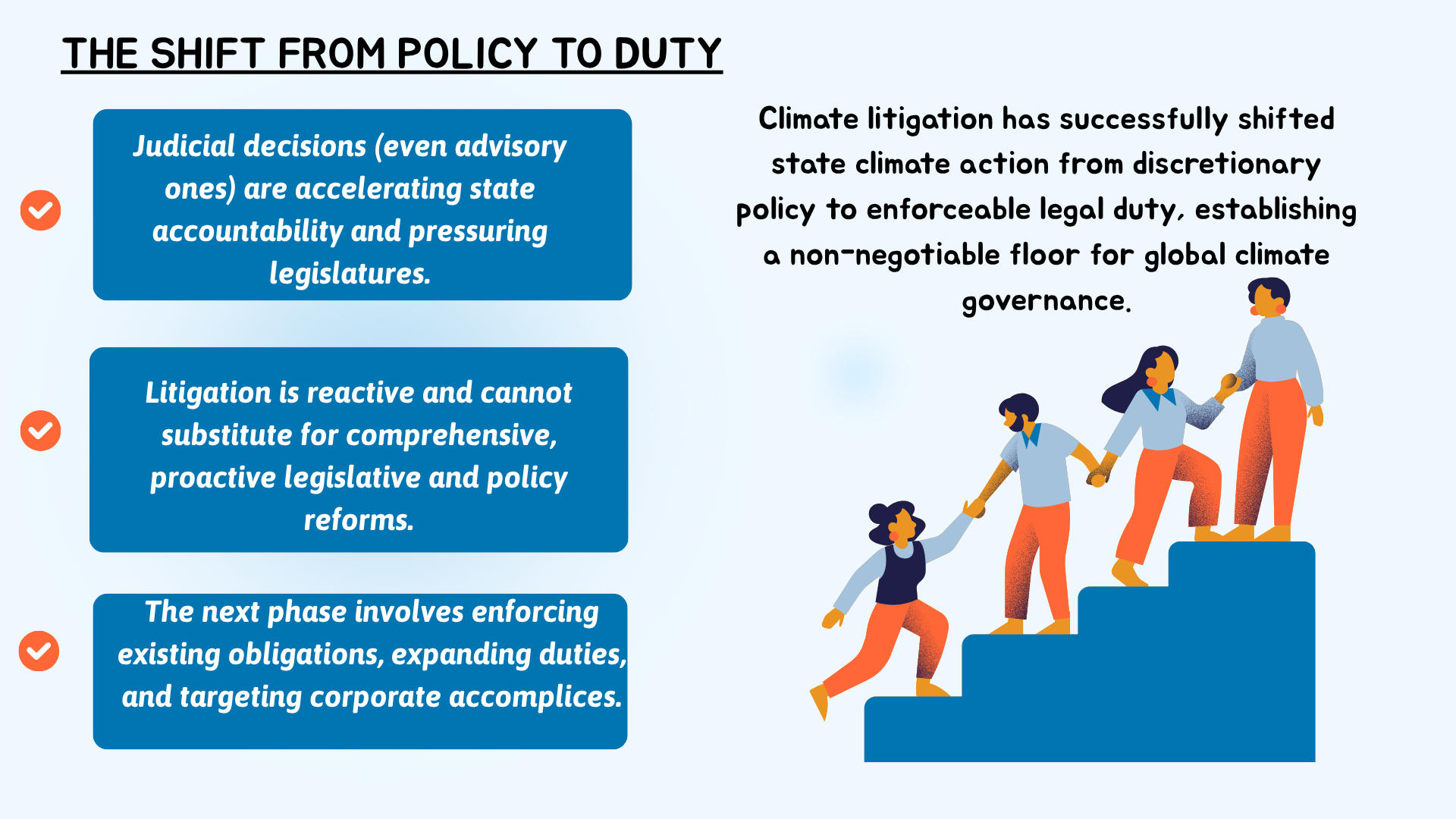
This opinion paper examines the rapidly evolving landscape of climate-related litigation against states and public entities, analyzing how these legal challenges are reshaping climate governance and accountability mechanisms. Drawing on landmark cases from diverse jurisdictions, this analysis traces the evolution of legal arguments—from early rights-based claims to emerging doctrines centered on fiduciary obligations and intergenerational equity. The analysis would explore courts’ shifting interpretations of governmental climate obligations, highlighting the transition from viewing climate action as discretionary policy to recognizing it as a legally enforceable duty. This work critically evaluates litigation’s effectiveness as a climate action tool compared with other regulatory approaches, identifying both its catalytic potential and inherent limitations. By synthesizing recent judicial developments, this work aims to provide timely insights for policymakers, legal practitioners, and climate advocates on how litigation is influencing climate policy, driving regulatory innovation, and potentially accelerating the transition to more ambitious climate action.
- Open Access
- Opinion
Climate Litigation Against States: Emerging Trends
- Rūta Slidžiauskaitė-Maskoliūnė
Author Information
Received: 01 July 2025 | Revised: 08 October 2025 | Accepted: 10 October 2025 | Published: 03 November 2025
Abstract
Graphical Abstract
Keywords
climate litigation | human rights | climate change | environmental law | judicial accountability
References
- 1.
Judgment/Supreme Court of the Netherlands/Number 19/00135/Date 20 December 2019. Available online: https://www.urgenda.nl/wp-content/uploads/ENG-Dutch-Supreme-Court-Urgenda-v-Netherlands-20-12-2019.pdf (accessed on 8 August 2025).
- 2.
United Nations Framework Convention on Climate Change. Available online: https://unfccc.int/process-and-meetings/united-nations-framework-convention-on-climate-change (accessed 28 July 2025).
- 3.
Massachusetts v. EPA, 549 U.S. 497 (2007). Available online: https://en.wikipedia.org/wiki/Massachusetts_v._EPA (accessed on 2 September 2025).
- 4.
ESCR-Net. Neubauer et al. v. Germany. Available online: https://www.escr-net.org/caselaw/2023/neubauer-et-al-v-germany/ (accessed on 17 June 2025).
- 5.
Kyoto Protocol to the United Nations Framework Convention on Climate Change, 11 December 1997. Available online: https://treaties.un.org/doc/Publication/MTDSG/Volume%20II/Chapter%20XXVII/xxvii-7-a.en.pdf (accessed on 16 February 2005).
- 6.
Paris Agreement. Available online: https://unfccc.int/sites/default/files/english_paris_agreement.pdf (accessed on 4 November 2016).
- 7.
Universal Declaration of Human Rights. Available online: https://www.ohchr.org/en/resources/educators/human-rights-education-training/universal-declaration-human-rights-1948 (accessed on 28 July 2025).
- 8.
European Convention on Human Rights. Available online: https://www.echr.coe.int/documents/d/echr/convention_ENG (accessed on 28 July 2025).
- 9.
American Convention on Human Rights. Available online: https://en.wikipedia.org/wiki/American_Convention_on_Human_Rights (accessed on 28 July 2025).
- 10.
The Climate Litigation Database. Available online: http://climatecasechart.com/ (accessed on 21 June 2025).
- 11.
Constitution of the Republic of South Africa, 1996—Chapter 2: Bill of Rights. Available online: https://www.gov.za/documents/constitution/chapter-2-bill-rights (accessed on 11 September 2025).
- 12.
Director: Mineral Development, Gauteng Region and Another v Save the Vaal Environment and Others (133/98) [1999] ZASCA 9; [1999] 2 All SA 381 (A); 1999 (2) SA 709 (SCA); 1999 (8) BCLR 845 (SCA) (12 March 1999). Available online: https://www.saflii.org/za/cases/ZASCA/1999/9.html (accessed on 11 September 2025).
- 13.
Constitution of the Portuguese Republic. Seventh Revision [2005]. Available online: https://www.parlamento.pt/sites/EN/Parliament/Documents/Constitution7th.pdf (accessed on 11 September 2025).
- 14.
Constitución Política 1 de 1991 Asamblea Nacional Constituyente. Available online: https://www.funcionpublica.gov.co/eva/gestornormativo/norma.php?i=4125 (accessed on 11 September 2025).
- 15.
Duarte Agostinho and Others v. Portugal and Others (Relinquishment). Available online: https://hudoc.echr.coe.int/eng#{%22itemid%22:[%22002-13724%22]} (accessed on 30 June 2025).
- 16.
Judgment of the Court (Sixth Chamber) of 25 March 2021. Available online: https://eur-lex.europa.eu/legal-content/EN/TXT/?uri=CELEX:62019CJ0565 (accessed on 30 June 2025).
- 17.
In The United States District Court for The District of Oregon Eugene Division. Available online: https://storage.courtlistener.com/recap/gov.uscourts.ord.123110/gov.uscourts.ord.123110.601.0.pdf (accessed on 13 September 2025).
- 18.
Response of Australia to The Views of The Human Rights Committee in Communication NO. 3624/2019 (Billy et al. v Australia). Available online: https://www.ila-americanbranch.org/wp-content/uploads/2023/09/CCPR_B1.pdf (accessed on 5 July 2025).
- 19.
International Covenant on Civil and Political Rights. Available online: https://www.ohchr.org/en/instruments-mechanisms/instruments/international-covenant-civil-and-political-rights (accessed on 28 July 2025).
- 20.
Natural Justice. Leghari v. Federation of Pakistan. Available online: https://naturaljustice.org/wp-content/uploads/2022/03/Leghari-v.-Federation-of-Pakistan.pdf (accessed on 20 June 2025).
- 21.
Ashgar Leghari v. Federation of Pakistan, W.P. No. 25501/2015, Lahore High Court Green Bench. Available online: https://climatecasechart.com/wp-content/uploads/non-us-case-documents/2015/20150414_2015-W.P.-No.-25501201_decision.pdf (accessed on 20 June 2025).
- 22.
Framework for Implementation of Climate Change Policy (2014–2030). Available online: https://www.gcisc.org.pk/Framework%20for%20Implementation%20of%20CC%20Policy.pdf (accessed on 28 July 2025).
- 23.
Bushfire Survivors for Climate Action Incorporated v. Environment Protection Authority, [2021] NSWLEC 92 (Land and Environment Court of New South Wales, 27 August 2021). Available online: https://climatecasechart.com/wp-content/uploads/non-us-case-documents/2021/20210826_2021-NSWLEC-92-2020-NSWLEC-152-leave-granted-to-BSCA-to-file-and-serve-expert-evidence-on-climate-change-science_judgment-1.pdf (accessed on 20 June 2025).
- 24.
PSB et al. v. Brazil (The Climate Fund Case), Supremo Tribunal Federal [STF] [Federal Supreme Court], Direct Action of Unconstitutionality by Omission No. 59, 30 June 2022 (Braz.). Available online: https://climatecasechart.com/wp-content/uploads/non-us-case-documents/2022/20220701_ADPF-708_decision-2.pdf (accessed on 20 June 2025).
- 25.
British Institute of International and Comparative Law. The Brazilian Supreme Court and the Climate Fund Case. Available online: https://www.biicl.org/blog/100/the-brazilian-supreme-court-and-the-climate-fund-case (accessed on 25 June 2025).
- 26.
Case of Verein KlimaSeniorinnen Schweiz and Others v. Switzerland, App. No. 53600/20, European Court of Human Rights (9 April 2024). Available online: https://hudoc.echr.coe.int/eng#{%22itemid%22:[%22001-233206%22]} (accessed on 25 June 2025).
- 27.
Greenpeace Nordic and Others against Norway, App. No. 34068/21, European Court of Human Rights (Pending). Available online: https://hudoc.echr.coe.int/fre#{%22itemid%22:[%22001-214943%22]} (accessed on 20 June 2025).
- 28.
Uricchio v. Italy and 31 Others, App. No. 14615/21, European Court of Human Rights (Pending). Available online: https://hudoc.echr.coe.int/eng#{%22itemid%22:[%22001-243677%22]} (accessed on 20 June 2025).
- 29.
De Conto v. Italy and 32 Others, App. No. 14620/21, European Court of Human Rights (Pending). Available online: https://hudoc.echr.coe.int/eng#{%22itemid%22:[%22001-243672%22]} (accessed on 20 June 2025).
- 30.
Case C-682/17, ExxonMobil Production Deutschland GmbH v Bundesrepublik Deutschland (challenging EU Emissions Trading Scheme regulations). Available online: https://eur-lex.europa.eu/legal-content/EN/TXT/?uri=CELEX%3A62017CJ0682 (accessed on 21 June 2025).
- 31.
Case T-625/22: Action brought on 7 October 2022—Austria v Commission. Available online: https://eur-lex.europa.eu/legal-content/EN/TXT/?uri=CELEX%3A62022TN0625&qid=1751283806339 (accessed on 21 June 2025).
- 32.
Nuclear Tests (Australia v. France). Available online: https://www.icj-cij.org/case/58 (accessed on 7 July 2025).
- 33.
Pulp Mills on the River Uruguay (Argentina v. Uruguay). Available online: https://www.icj-cij.org/case/135 (accessed on 21 September 2025).
- 34.
G.A. Res. 77/276, U.N. Doc. A/RES/77/276 (29 March 2023) (Request for an Advisory Opinion of the International Court of Justice on the Obligations of States in Respect of Climate Change). Available online: https://docs.un.org/en/A/77/L.58 (accessed on 21 June 2025).
- 35.
International Court of Justice:Obligations of States in respect of Climate Change. Available online: https://www.icj-cij.org/sites/default/files/case-related/187/187-20250723-pre-01-00-en.pdf (accessed on 11 September 2025).
- 36.
Request for Advisory Opinion Submitted by the Commission of Small Island States on Climate Change and International Law. Available online: https://www.itlos.org/fileadmin/itlos/documents/cases/31/Request_for_Advisory_Opinion_COSIS_12.12.22.pdf (accessed on 17 June 2025).
- 37.
United Nations Convention on the Law of the Sea. Available online: https://treaties.un.org/Pages/ViewDetailsIII.aspx?src=TREATY&mtdsg_no=XXI-6&chapter=21&Temp=mtdsg3&clang=_en (accessed on 15 June 2025).
- 38.
Advisory Opinion on the Legal Consequences of the Separation of the Chagos Archipelago from Mauritius in 1965, ITLOS Case No. 31, Advisory Opinion of 21 May 2024. Available online: https://www.itlos.org/fileadmin/itlos/documents/cases/31/Advisory_Opinion/C31_Adv_Op_21.05.2024_corr.pdf (accessed on 17 June 2025).


This work is licensed under a Creative Commons Attribution 4.0 International License.
