
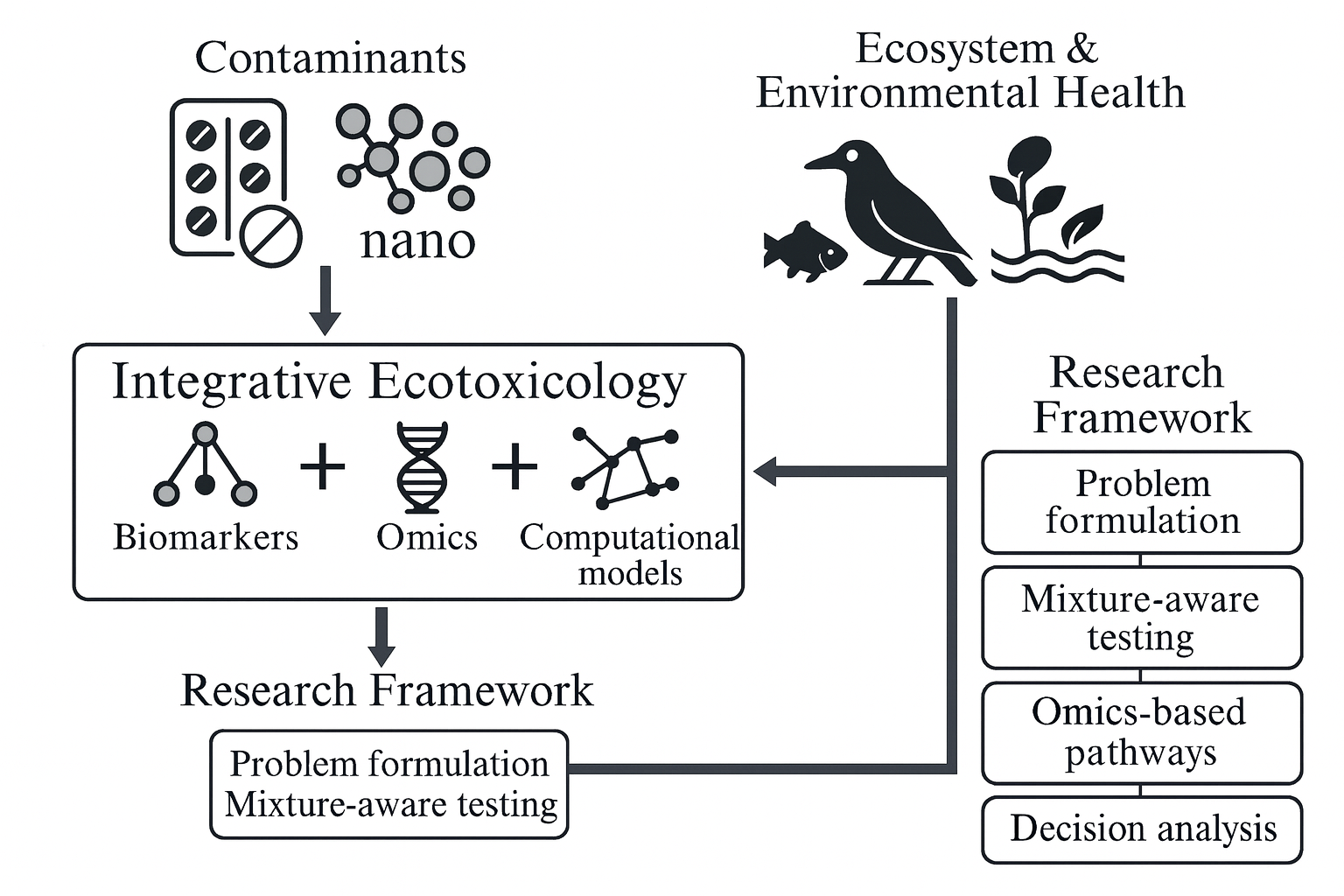
Background: Ecotoxicology increasingly faces complex mixtures and multilevel responses that single-compound, single-species assays cannot capture. Aim and objectives: To synthesize recent evidence (2022–2024) on integrative ecotoxicology (combining biomarkers, omics, computational models, and bioindicators) with emphasis on pharmaceuticals and nanoplastics, and to outline gaps and a practical framework for research and policy. Methods: A PRISMA-guided search was conducted in Web of Science, Scopus, PubMed, Google Scholar, and Springer Link (2022–2024). Duplicates were removed in Mendeley; screening used Rayyan with PICO-style inclusion/exclusion. The qualitative synthesis was complemented by bibliometric mapping (VOSviewer) to visualize thematic co-occurrences. Results: Fifty-two articles met criteria. Across aquatic and terrestrial models, integrative designs consistently revealed sublethal effects (oxidative stress, AChE inhibition, dysregulated apoptosis, teratogenicity) and molecular pathway disruption identified by transcriptomics/proteomics/metabolomics. Computational approaches (Bayesian networks; multivariate models) improved risk prioritization. Case studies showed synergism (e.g., nanoplastics-diclofenac) and highlighted soil interfaces (biochar-mediated metal speciation; earthworm biomarkers). Conclusions: Integrative ecotoxicology strengthens causal inference across biological levels and supports One Health and regulatory decision-making. Priority needs include standardized multi-level designs, mixture-aware endpoints, cross-matrix comparability (wáter-sediment-soil), FAIR data pipelines, and translation to policies (e.g., effluent standards, product stewardship). A concise research framework for policy formulation is proposed that links problem formulation, mixture-aware testing, omics-based pathways, and decision analysis.
- Open Access
- Review
Integrative Ecotoxicology of Pharmaceuticals and Nanoplastics: A PRISMA-Guided Bibliometric Review Linking Ecosystem and Environmental Health
Author Information
Received: 14 August 2025 | Revised: 16 October 2025 | Accepted: 31 October 2025 | Published: 21 November 2025
Abstract
Graphical Abstract
References
- 1.
Elaiyaraja, A.; Mayilsamy, M.; Vimalkumar, K.; et al. Aquatic and human health risk assessment of humanogenic emerging contaminants (HECs), phthalate esters from the Indian Rivers. Chemosphere 2022, 306, 135624. https://doi.org/10.1016/j.chemosphere.2022.135624.
- 2.
Mwelwa, S.; Chungu, D.; Tailoka, F.; et al. Biotransfer of heavy metals along the soil-plant-edible insect-human food chain in Africa. Sci. Total Environ. 2023, 881, 163150. https://doi.org/10.1016/j.scitotenv.2023.163150.
- 3.
Olivares-Rubio, H.F.; Ontiveros-Cuadras, J.F.; Celis-Hernández, O.; et al. Spatial distribution of PAHs, nickel, and vanadium in sediments from a large coastal lagoon near a petroleum extraction area in the southern Gulf of Mexico. Mar. Pollut. Bull. 2024, 207, 116901. https://doi.org/10.1016/j.marpolbul.2024.116901.
- 4.
Ramírez-Moreno, F.J.; Gómez-Oliván, L.M.; Islas-Flores, H.; et al. A comprehensive approach to how hospital effluents lead to oxidative stress and shift the gene expression in target organs of Danio rerio. Sci. Total Environ. 2023, 887, 164057. https://doi.org/10.1016/j.scitotenv.2023.164057.
- 5.
Felisbino, K.; Kirsten, N.; Milhorini, S.S.; et al. Teratogenic effects of the dicamba herbicide in zebrafish (Danio rerio) embryos. Environ. Pollut. 2023, 334, 122187. https://doi.org/10.1016/j.envpol.2023.122187.
- 6.
Colominas-Ciuro, R.; Gray, F.E.; Arikan, K.; et al. Effects of persistent organic pollutants on telomere dynamics are sex and age-specific in a wild long-lived bird. Sci. Total Environ. 2024, 943, 173785. https://doi.org/10.1016/j.scitotenv.2024.173785.
- 7.
Amaral, I.; Antunes, S.C.; Rebelo, D.; et al. Biopesticide spinosad: Unraveling ecotoxicological effects on zebrafish, Danio rerio. Environ. Toxicol. Pharmacol. 2024, 108, 104458. https://doi.org/10.1016/j.etap.2024.104458.
- 8.
Kuang, H.-X.; Li, M.-Y.; Zhou, Y.; et al. Volatile organic compounds and metals/metalloids exposure in children after e-waste control: Implications for priority control pollutants and exposure mitigation measures. J. Hazard. Mater. 2023, 455, 131598. https://doi.org/10.1016/j.jhazmat.2023.131598.
- 9.
Walther, E.J.; Arthur, D.E.; Cyr, A.; et al. Ecotoxicology of mercury in burbot (Lota lota) from interior Alaska and insights towards human health. Chemosphere 2022, 298, 134279. https://doi.org/10.1016/j.chemosphere.2022.134279.
- 10.
Pietropoli, E.; Bardhi, A.; Simonato, V.; et al. Comparative toxicity assessment of alternative versus legacy PFAS: Implications for two primary trophic levels in freshwater ecosystems. J. Hazard. Mater. 2024, 477, 135269. https://doi.org/10.1016/j.jhazmat.2024.135269.
- 11.
Yang, S.; Zhang, T.; Ge, Y.; et al. Sentinel supervised lung-on-a-chip: A new environmental toxicology platform for nanoplastic-induced lung injury. J. Hazard. Mater. 2023, 458, 131962. https://doi.org/10.1016/j.jhazmat.2023.131962.
- 12.
Herrera-Vázquez, S.E.; Elizalde-Velázquez, G.A.; Gómez-Oliván, L.M.; et al. Ecotoxicological evaluation of chitosan biopolymer films particles in adult zebrafish (Danio rerio): A comparative study with polystyrene microplastics. Sci. Total Environ. 2024, 929, 172757. https://doi.org/10.1016/j.scitotenv.2024.172757.
- 13.
Shin, H.; Jeong, S.; Hong, J.; et al. Rapid generation of aged tire-wear particles using dry-, wet-, and cryo-milling for ecotoxicity testing. Environ. Pollut. 2023, 330, 121787. https://doi.org/10.1016/j.envpol.2023.121787.
- 14.
Kandaswamy, K.; Guru, A.; Panda, S.P.; et al. Polystyrene nanoplastics synergistically exacerbate diclofenac toxicity in embryonic development and the health of adult zebrafish. Comp. Biochem. Physiol. C 2024, 281, 109926. https://doi.org/10.1016/j.cbpc.2024.109926.
- 15.
Lei, B.; Wang, X.; Wang, L.; et al. Combining chemical analysis and toxicological methods to access the ecological risk of complex contamination in Daye Lake. Sci. Total Environ. 2024, 944, 173690. https://doi.org/10.1016/j.scitotenv.2024.173690.
- 16.
Moher, D.; Liberati, A.; Tetzlaff, J.; et al. Preferred Reporting Items for Systematic Reviews and Meta-Analyses: The PRISMA Statement. PLoS Med. 2009, 6, e1000097. https://doi.org/10.1371/journal.pmed.1000097.
- 17.
Creswell, J.W. Introducing and focusing a study. In Qualitative Inquiry and Research Design: Choosing among Five Approaches, 3rd ed.; Sage: Sauzende Oaks, CA, USA, 2007; pp. 129–144.
- 18.
Elizalde-Velázquez, G.A.; Gomora-Martínez, O.; Raldua, D.; et al. Understanding the impact of environmentally relevant alkyl C12–16 dimethylbenzyl ammonium chloride concentrations on zebrafish health. Sci. Total Environ. 2024, 953, 175984. https://doi.org/10.1016/j.scitotenv.2024.175984.
- 19.
Beale, D.J.; Nguyen, T.V.; Bose, U.; et al. Metabolic disruptions and impaired reproductive fitness in wild-caught freshwater turtles (Emydura macquarii macquarii) exposed to elevated per- and polyfluoroalkyl substances (PFAS). Sci. Total Environ. 2024, 926, 171743. https://doi.org/10.1016/j.scitotenv.2024.171743.
- 20.
Orozco-Hernández, J.M.; Gómez-Oliván, L.M.; Elizalde-Velázquez, G.A.; et al. Fluoxetine-induced neurotoxicity at environmentally relevant concentrations in adult zebrafish Danio rerio. Neurotoxicology 2022, 90, 121–129. https://doi.org/10.1016/j.neuro.2022.03.007.
- 21.
Pietrini, F.; Iannilli, V.; Passatore, L.; et al. Ecotoxicological and genotoxic effects of dimethyl phthalate (DMP) on Lemna minor L. and Spirodela polyrhiza (L.) Schleid. plants under a short-term laboratory assay. Sci. Total Environ. 2022, 806, 150972. https://doi.org/10.1016/j.scitotenv.2021.150972.
- 22.
Zhang, H.; Li, K.; Zhao, X.; et al. Occurrence, consumption level, fate and ecotoxicology risk of beta-agonist pharmaceuticals in a wastewater treatment plant in Eastern China. Environ. Monit. Assess. 2023, 195, 481. https://doi.org/10.1007/s10661-023-11099-8.
- 23.
Silva, M.R.; Faial, K.C.F.; Freitas, A.C.; et al. Use of the gonadal structures of the mangrove crab Ucides cordatus as a biomarker for environmental contamination by metals. Mar. Pollut. Bull. 2024, 198, 115862. https://doi.org/10.1016/j.marpolbul.2023.115862.
- 24.
Casotti Rienda, I.; Nunes, T.; Gonçalves, C.; et al. Road dust resuspension in a coastal Atlantic intermunicipal urban area with industrial facilities: Emission factors, chemical composition, and ecotoxicity. Atmos. Res. 2023, 294, 106977. https://doi.org/10.1016/j.atmosres.2023.106977.
- 25.
Tang, Y.; Wang, C.; Holm, P.E.; et al. Impacts of biochar materials on copper speciation, bioavailability, and toxicity in CCA-polluted soil. J. Hazard. Mater. 2023, 459, 132067. https://doi.org/10.1016/j.jhazmat.2023.132067.
- 26.
Barbir, J.; Arato, E.; Chen, C.-Y.; et al. Assessing ecotoxicity of an innovative bio-based mulch film: A multi-environmental and multi-bioassay approach. Front. Environ. Sci. 2023, 11, 1171261. https://doi.org/10.3389/fenvs.2023.1171261.
- 27.
Sales Junior, S.F.; Soares, L.O.S.; Cunha, D.P.; et al. Biomarker response index in earthworms following chronic exposure to landfill leachate: Behavioral, cytotoxicity and antioxidant alterations. J. Environ. Manag. 2024, 351, 119990. https://doi.org/10.1016/j.jenvman.2023.119990.
- 28.
Farias de Araujo, G.; Espírito Santo, D.G.; Sales Junior, S.F.; et al. Toxicological approaches to assess photocatalytic degradation products of acetamiprid using Eisenia andrei. Sci. Total Environ. 2024, 906, 167271. https://doi.org/10.1016/j.scitotenv.2023.167271.
- 29.
Chen, F.; Zhang, W.; Hua, Z.; et al. Unlocking the phytoremediation potential of organic acids: A study on alleviating lead toxicity in canola (Brassica napus L.). Sci. Total Environ. 2024, 914, 169980. https://doi.org/10.1016/j.scitotenv.2024.169980.
- 30.
Duarte, B.; Feijão, E.; Franzitta, M.; et al. LipidTOX: A fatty acid-based index efficient for ecotoxicological studies with marine model diatoms exposed to legacy and emerging contaminants. Ecol. Indic. 2022, 139, 108885. https://doi.org/10.1016/j.ecolind.2022.108885.
- 31.
Konda, S.; Nagendla, N.K.; Williams, M.; et al. Investigating pharmaceuticals and personal care products in Musi River: An exploratory study in Hyderabad, India. J. Hazard. Mater. Adv. 2024, 14, 100420. https://doi.org/10.1016/j.hazadv.2024.100420.
- 32.
Caixeta, E.S.; Meza Bravo, J.V.; Pereira, B.B. Ecotoxicological assessment of water and sediment river samples to evaluate the environmental risks of anthropogenic contamination. Chemosphere 2022, 306, 135595. https://doi.org/10.1016/j.chemosphere.2022.135595.
- 33.
Chung, J.; Kim, S.-H.; Hwang, D.-S.; et al. Integrated chemical and ecotoxicological assessment of metal contamination in the Andong watershed: Identifying key toxicants and ecological risks. Water 2024, 16, 3176. https://doi.org/10.3390/w16223176.
- 34.
Yüksel, B.; Ustaoglu, F.; Aydın, H.; et al. Appraisal of metallic accumulation in the surface sediment of a fish breeding dam in Türkiye: A stochastic approach to ecotoxicological risk assessment. Mar. Pollut. Bull. 2024, 203, 116488. https://doi.org/10.1016/j.marpolbul.2024.116488.
- 35.
Gonçalves Morais, L.; Gusso-Choueri, P.K.; Abreu, F.E.L.; et al. Multilevel assessment of chlorothalonil sediment toxicity to Latin American estuarine biota: Effects on biomarkers, reproduction, and survival in different benthic organisms. Sci. Total Environ. 2023, 872, 162215. https://doi.org/10.1016/j.scitotenv.2023.162215.
- 36.
Nwinyimagu, A.J.; Eyo, J.E.; Nwonumara, G.N. Distribution and ecological risk assessment of herbicide residues in water, sediment and fish from Anyim River, Ebonyi State, Nigeria. Environ. Toxicol. Pharmacol. 2023, 100, 104131. https://doi.org/10.1016/j.etap.2023.104131.
- 37.
Oliva, A.L.; Girones, L.; Recabarren-Villalon, T.V.; et al. Occurrence, behavior and the associated health risk of organochlorine pesticides in sediments and fish from Bahía Blanca Estuary, Argentina. Mar. Pollut. Bull. 2022, 185, 114247. https://doi.org/10.1016/j.marpolbul.2022.114247.
- 38.
Gonçalves dos Santos, H.A.; Kitamura, R.S.A.; Soares, G.C.B.; et al. Assessing the water quality in a World Heritage Site using biomarkers in top fish predators. Sci. Total Environ. 2024, 927, 172072. https://doi.org/10.1016/j.scitotenv.2024.172072.
- 39.
Pereira, S.; Oliveira, I.B.; Sousa, M.L.; et al. Antifouling activity and ecotoxicological profile of the cyanobacterial oxadiazine nocuolin A. Chemosphere 2024, 365, 143318. https://doi.org/10.1016/j.chemosphere.2024.143318.
- 40.
Siekiera, J.; Jankowiak, L.; Siekiera, A.; et al. Relationships between pesticides, polychlorinated biphenyls, blood parameters and oxidative stress of white stork Ciconia ciconia chicks in Poland. Environ. Sci. Pollut. Res. 2024, 31, 43996–44004. https://doi.org/10.1007/s11356-024-34072-5.
- 41.
Ruiz-Lara, K.; García-Medina, S.; Galar-Martínez, M.; et al. The evaluation of liver dysfunction and oxidative stress due to urban environmental pollution in the Mexican population related to Madin Dam, State of Mexico: A pilot study. Environ. Sci. Pollut. Res. 2023, 30, 6950–6964. https://doi.org/10.1007/s11356-022-22724-3.
- 42.
Mohd Razali, N.S.; Ikhwanuddin, M.; Maulidiani, M.; et al. Ecotoxicological impact of heavy metals on wild mud crabs (Scylla olivacea) in Malaysia: An integrative approach of omics, molecular docking and human risk assessment. Sci. Total Environ. 2024, 946, 174210. https://doi.org/10.1016/j.scitotenv.2024.174210.
- 43.
Campos, C.F.; Santos, V.S.V.; de Campos, J.O.; et al. Assessment of genotoxicity of air pollution in urban areas using an integrated model of passive biomonitoring. Environ. Pollut. 2024, 355, 124219. https://doi.org/10.1016/j.envpol.2024.124219.
- 44.
Echeverri-Jaramillo, G.; Jaramillo-Colorado, B.; Junca, H.; et al. Towards the development of microbial ecotoxicology testing using chlorpyrifos-contaminated sediments and marine yeast isolates as a model. Microorganisms 2022, 10, 2019. https://doi.org/10.3390/microorganisms10102019.
- 45.
El-Said, G.F.; Abdel-Mohsen, H.A.; El-Sadaawy, M.M.; et al. Ecotoxicological, ecological, and human health risks of total carbohydrates and some inorganic pollutants on the Nile Delta region along the Egyptian Mediterranean Coast. Mar. Pollut. Bull. 2024, 207, 116816. https://doi.org/10.1016/j.marpolbul.2024.116816.
- 46.
Freire da Silva, M.R.; Souza, K.S.; Santana da Silva, F.H.; et al. Hidden ecotoxicological dangers: Investigating pathogen circulation and non-toxic risks hazards in a crucial Brazilian watershed. Aquat. Toxicol. 2024, 271, 106931. https://doi.org/10.1016/j.aquatox.2024.106931.
- 47.
Saeed, M.S.; Fahd, F.; Khan, F.; et al. Human health risk model for microplastic exposure in the Arctic region. Sci. Total Environ. 2023, 895, 165150. https://doi.org/10.1016/j.scitotenv.2023.165150.
- 48.
Shetaia, S.A.; Nasr, R.A.; Lasheen, E.S.R.; et al. Assessment of heavy metals contamination of sediments and surface waters of Bitter Lake, Suez Canal, Egypt: Ecological risks and human health. Mar. Pollut. Bull. 2023, 192, 115096. https://doi.org/10.1016/j.marpolbul.2023.115096.
- 49.
Shi, Q.; Qin, H.; Yang, J.; et al. Polycyclic aromatic hydrocarbons in fish from four lakes in central and eastern China: Bioaccumulation, pollution characteristics, sources, and health risk assessment. Sci. Total Environ. 2024, 951, 175530. https://doi.org/10.1016/j.scitotenv.2024.175530.
- 50.
Teng, T.; Huang, W.E.; Li, G.; et al. Application of magnetic-nanoparticle functionalized whole-cell biosensor array for bioavailability and ecotoxicity estimation at urban contaminated sites. Sci. Total Environ. 2023, 896, 165292. https://doi.org/10.1016/j.scitotenv.2023.165292.
- 51.
Wróbel, M.; Trzyna, A.; Zeynalli, F.; et al. The comprehensive health risk assessment of Polish smelters with ecotoxicological studies. Int. J. Environ. Res. Public Health 2022, 19, 12634. https://doi.org/10.3390/ijerph191912634.


This work is licensed under a Creative Commons Attribution 4.0 International License.
