
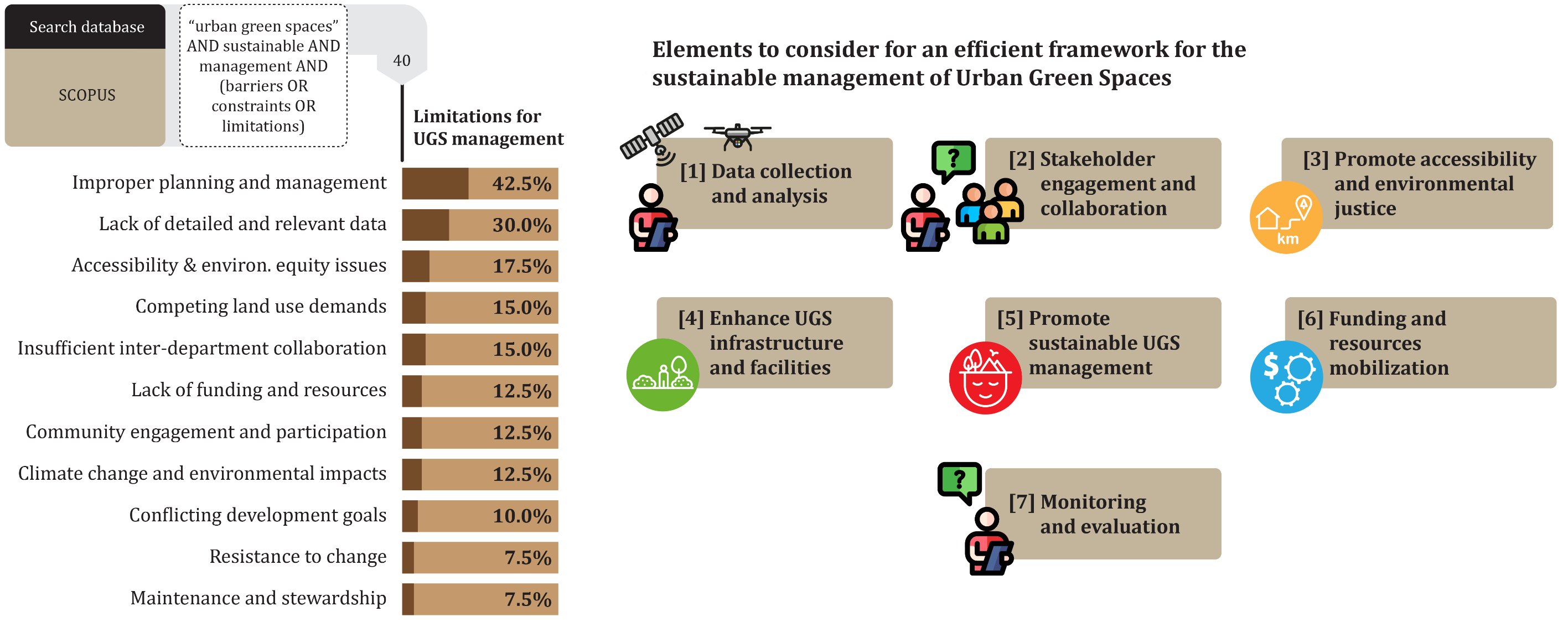
Urban green spaces (UGS) are crucial for delivering ecosystem services (ES), enhancing urban resilience, and enhancing public well-being. However, despite increased awareness and policy attention, the management of UGS continues to face significant challenges. This work synthesises findings from literature published between January 2010 and September 2025 addressing the limitations affecting UGS management in urban contexts, with a world coverage. A total of 40 documents were assessed. The analysis identifies a set of recurrent themes such as improper planning and management (42.5% of the documents), lack of supporting data (30.0%), accessibility and environmental equity issues (including gentrification risks) (17.5%), competing land use demands (15.0%), fragmented governance and inter-institutional silos (15.0%), financial and human resource constraints (12.5%), limited stakeholder participation (12.5%), or resistance to bottom-up approaches (7.5%). Despite contextual variations, shared principles emerge across case studies, including the importance of co-governance, multifunctionality, participatory planning, and integrated decision-making. Addressing these systemic barriers will require long-term investment, intersectoral collaboration, and planning cultures that prioritise equity, adaptability, and local capacity. The findings underscore the importance of cross-sector coordination, equitable access, and context-sensitive approaches in supporting transformative change in UGS planning and management. The review concludes by outlining research gaps and suggesting priorities for policy and practice that align with environmental sustainability and social justice goals. A final section proposes measures to address the highlighted issues in an integrated way, oriented towards the definition of a UGS sustainable management framework.
- Open Access
- Review
Barriers to Sustainable Urban Green Space Management: A Review of Limitations and Integrative Proposals
- Luís Valença Pinto
Author Information
Received: 02 July 2025 | Revised: 29 September 2025 | Accepted: 05 November 2025 | Published: 11 November 2025
Abstract
Graphical Abstract
Keywords
urban green spaces | environmental justice | participatory planning | green infrastructure governance | nature-based solutions | sustainable management
References
- 1.
United Nations Department of Economic and Social Affairs. The Sustainable Development Goals Report 2024; United Nations: New York, NY, USA, 2024; ISBN 978-92-1-003135-6.
- 2.
United Nations. Transforming Our World: The 2030 Agenda for Sustainable Development; United Nations: New York, USA, 2015.
- 3.
Ak, M.; Gölbey, A.G. The Role of Urban Green Spaces in Sustainable Urban Planning. J. Urban Landsc. Plan. 2022, 2, 85–97.
- 4.
Vargas-Hernández, J.G.; Pallagst, K.; Zdunek-Wielgołaska, J. Urban Green Spaces as a Component of an Ecosystem. In Handbook of Engaged Sustainability; Marques, J., Ed.; Springer International Publishing: Cham, Switzerland, 2018; pp. 1–32; ISBN 978-3-319-53121-2.
- 5.
Taylor, L.; Hochuli, D.F. Defining Greenspace: Multiple Uses across Multiple Disciplines. Landsc. Urban Plann. 2017, 158, 25–38. https://doi.org/10.1016/j.landurbplan.2016.09.024.
- 6.
Battiston, A.; Schifanella, R. On the Need to Move from a Single Indicator to a Multi-Dimensional Framework to Measure Accessibility to Urban Green. arXiv 2023, arXiv:2308.05538.
- 7.
Korkou, M.; Tarigan, A.K.M.M.; Hanslin, H.M. The Multifunctionality Concept in Urban Green Infrastructure Planning: A Systematic Literature Review. Urban For. Urban Green. 2023, 85, 127975. https://doi.org/10.1016/j.ufug.2023.127975.
- 8.
Wang, D.; Xu, P.-Y.; An, B.-W.; et al. Urban Green Infrastructure: Bridging Biodiversity Conservation and Sustainable Urban Development through Adaptive Management Approach. Front. Ecol. Evol. 2024, 12, 1440477. https://doi.org/10.3389/fevo.2024.1440477.
- 9.
Huang, B.; Qi, J.; Pathak, M.; et al. Climate-Driven Transformations: A Framework for the Sustainable Urban Landscape System to Enhance Heat Resilience. Sustain. Cities Soc. 2025, 131, 106684. https://doi.org/10.1016/j.scs.2025.106684.
- 10.
Bleicher, J.; Kumar, P. A Novel Framework Integrating Resilient and Sustainable Urbanism for Designing Climate Resilient Sustainable Urban Neighbourhoods. Sustain. Cities Soc. 2025, 130, 106577. https://doi.org/10.1016/j.scs.2025.106577.
- 11.
Veerkamp, C.; Schipper, A.M.; Hedlund, K.; et al. A Review of Studies Assessing Ecosystem Services Provided by Urban Green and Blue Infrastructure. Ecosyst. Serv. 2021, 51, 101300. https://doi.org/10.1016/j.ecoser.2021.101300.
- 12.
Rahman, I.; Grunwald, A.; Saha, S. Access to Cultural Ecosystem Services and How Urban Green Spaces Marginalize Underprivileged Groups. NPJ Urban Sustain. 2025, 5, 36. https://doi.org/10.1038/s42949-025-00221-z.
- 13.
Hansen, R.; Buizer, M.; Buijs, A.; et al. Transformative or Piecemeal? Changes in Green Space Planning and Governance in Eleven European Cities. Eur. Plan. Stud. 2023, 31, 2401–2424. https://doi.org/10.1080/09654313.2022.2139594.
- 14.
Jones, L.; Holland, R.A.; Ball, J.; et al. A Place-Based Participatory Mapping Approach for Assessing Cultural Ecosystem Services in Urban Green Space. People Nat. 2020, 2, 123–137. https://doi.org/10.1002/pan3.10073.
- 15.
Kirby, M.G.; Scott, A.J.; Walsh, C.L. Translating Policy to Place: Exploring Cultural Ecosystem Services in Areas of Green Belt through Participatory Mapping. Ecosyst. People 2023, 19, 2276752. https://doi.org/10.1080/26395916.2023.2276752.
- 16.
Kahila-Tani, M.; Kyttä, M.; Geertman, S. Does Mapping Improve Public Participation? Exploring the Pros and Cons of Using Public Participation GIS in Urban Planning Practices. Landsc. Urban Plann. 2019, 186, 45–55. https://doi.org/10.1016/j.landurbplan.2019.02.019.
- 17.
Kauark-Fontes, B.; Marchetti, L.; Salbitano, F. Integration of Nature-Based Solutions (NBS) in Local Policy and Planning toward Transformative Change. Evidence from Barcelona, Lisbon, and Turin. E&S 2023, 28, art25. https://doi.org/10.5751/ES-14182-280225.
- 18.
Leone, M.; Misiune, I.; Pinto, L.V.; et al. Lost in Implementation? A Field Study of the Uptake of the ‘Green Infrastructure’ Term and Concept in Urban Policies. Ecosyst. People 2023, 19, 2220831. https://doi.org/10.1080/26395916.2023.2220831.
- 19.
Valença Pinto, L. A Data-Based Framework for Efficient Urban Green Space Management—Contributions from Socio-Environmental Sciences. Ph.D. Thesis, Mykolas Romeris University, Vilnius, Lithuania, 2025.
- 20.
Aly, D.; Dimitrijevic, B. Systems Approach to the Sustainable Management of Urban Public Parks. Urban For. Urban Green. 2022, 68, 127482. https://doi.org/10.1016/j.ufug.2022.127482.
- 21.
Costadone, L.; Vierikko, K. Are Traditional Urban Greening Actions Compliant with the European Greening Plans Guidance? Urban For. Urban Green. 2023, 90, 128131. https://doi.org/10.1016/j.ufug.2023.128131.
- 22.
Kabisch, N. Ecosystem Service Implementation and Governance Challenges in Urban Green Space Planning—The Case of Berlin, Germany. Land Use Policy 2015, 42, 557–567. https://doi.org/10.1016/j.landusepol.2014.09.005.
- 23.
Mpofu, T.P.Z. Environmental Challenges of Urbanization: A Case Study for Open Green Space Management. Res. J. Agric. Environ. Manag. 2013, 2, 105–110.
- 24.
Zong, M.; Xu, G.; Yanai, S. Building Local Partnership through Community Parks in Central Tokyo: Perspectives from Different Participants. Front. Sustain. Cities 2024, 6, 1445754.
- 25.
Rambhia, M.; Volk, R.; Rismanchi, B.; et al. Prioritizing Urban Green Spaces in Resource Constrained Scenarios. Resour. Environ. Sustain. 2024, 16, 100150.
- 26.
Rutt, R.L.; Gulsrud, N.M. Green Justice in the City: A New Agenda for Urban Green Space Research in Europe. Urban For. Urban Green. 2016, 19, 123–127. https://doi.org/10.1016/j.ufug.2016.07.004.
- 27.
Daniels, B.; Zaunbrecher, B.S.; Paas, B.; et al. Assessment of Urban Green Space Structures and Their Quality from a Multidimensional Perspective. Sci. Total Environ. 2018, 615, 1364–1378. https://doi.org/10.1016/j.scitotenv.2017.09.167.
- 28.
Galdino, V.L.; Cielo-Filho, R.; Câmara, C.D.; et al. A Planning Framework to Guide the Creation of Urban Green Spaces Using Existing Forest Fragments in the Urban Territory: A Case Study from Foz Do Iguaçu, Brazil. Trees For. People 2022, 10, 100347. https://doi.org/10.1016/j.tfp.2022.100347.
- 29.
Hasan, S.M.; Haider, M.A. Green Infrastructure Development for a Sustainable Urban Environment in Chittagong City, Bangladesh. J. Archit./Plan. Res. Stud. 2023, 20, 1–23.
- 30.
Lindholst, A.C.; Konijnendijk van den Bosch, C.C.; Kjøller, C.P.; et al. Urban Green Space Qualities Reframed toward a Public Value Management Paradigm: The Case of the Nordic Green Space Award. Urban For. Urban Green. 2016, 17, 166–176. https://doi.org/10.1016/j.ufug.2016.04.007.
- 31.
Malik, A.A.M. The Role of Stakeholders Related to the Management of Ecological Function of Urban Green Open Space. Case Study: City of Depok, Indonesia. IOP Conf. Ser. Earth Environ. Sci 2017, 99, 012001. https://doi.org/10.1088/1755-1315/99/1/012001.
- 32.
Qin, L.; Zong, W.; Peng, K.; et al. Assessing Spatial Heterogeneity in Urban Park Vitality for a Sustainable Built Environment: A Case Study of Changsha. Land 2024, 13, 480.
- 33.
Šunjević, M.Z.; Nedučin, D.; Bozovic, R.; et al. Effects of Urban Vegetation on PM Mitigation: The Case of a Street in Novi Sad, Serbia; Утицај Урбаног Зеленила На Смањење Концентрације Pm Честица: Случај Улице У Новом Саду. J. Serb. Chem. Soc. 2024, 89, 743–755.
- 34.
Xu, F.; Yan, J.; Heremans, S.; et al. Pan-European Urban Green Space Dynamics: A View from Space between 1990 and 2015. Landsc. Urban Plann. 2022, 226, 104477. https://doi.org/10.1016/j.landurbplan.2022.104477.
- 35.
Raymond, C.M.; Gottwald, S.; Kuoppa, J.; et al. Integrating Multiple Elements of Environmental Justice into Urban Blue Space Planning Using Public Participation Geographic Information Systems. Landsc. Urban Plann. 2016, 153, 198–208. https://doi.org/10.1016/j.landurbplan.2016.05.005.
- 36.
Li, Y.; Li, T.; Liu, W.; et al. Urban Green Space Planning and Design Based on Big Data Analysis and BDA-UGSPD Model. Teh. Vjesn. 2024, 31, 543–550.
- 37.
Randrup, T.B.; Svännel, J.; Sunding, A.; et al. Urban Open Space Management in the Nordic Countries. Identification of Current Challenges Based on Managers’ Perceptions. Cities 2021, 115, 103225. https://doi.org/10.1016/j.cities.2021.103225.
- 38.
Feltynowski, M.; Kronenberg, J.; Bergier, T.; et al. Challenges of Urban Green Space Management in the Face of Using Inadequate Data. Urban For. Urban Green. 2018, 31, 56–66. https://doi.org/10.1016/j.ufug.2017.12.003.
- 39.
Wolff, S.; Schulp, C.J.E.; Verburg, P.H. Mapping Ecosystem Services Demand: A Review of Current Research and Future Perspectives. Ecol. Indic. 2015, 55, 159–171. https://doi.org/10.1016/j.ecolind.2015.03.016.
- 40.
Zhang, W.; Yang, B.; Wang, R.; et al. An Analysis of the Effects of Different Urban Park Space Environment Construction on National Health. Front. Environ. Sci. 2024, 12, 1433319.
- 41.
Huang, Y.; Sanatani, R.P.; Liu, C.; et al. No “True” Greenery: Deciphering the Bias of Satellite and Street View Imagery in Urban Greenery Measurement. Build. Environ. 2025, 269, 112395.
- 42.
Ives, C.D.; Oke, C.; Hehir, A.; et al. Capturing Residents’ Values for Urban Green Space: Mapping, Analysis and Guidance for Practice. Landsc. Urban Plann. 2017, 161, 32–43. https://doi.org/10.1016/j.landurbplan.2016.12.010.
- 43.
Laatikainen, T.; Tenkanen, H.; Kyttä, M.; et al. Comparing Conventional and PPGIS Approaches in Measuring Equality of Access to Urban Aquatic Environments. Landsc. Urban Plann. 2015, 144, 22–33. https://doi.org/10.1016/j.landurbplan.2015.08.004.
- 44.
Latinopoulos, D. Using a Spatial Hedonic Analysis to Evaluate the Effect of Sea View on Hotel Prices. Tour. Manag. 2018, 65, 87–99. https://doi.org/10.1016/j.tourman.2017.09.019.
- 45.
Rigolon, A. A Complex Landscape of Inequity in Access to Urban Parks: A Literature Review. Landsc. Urban Plann. 2016, 153, 160–169. https://doi.org/10.1016/j.landurbplan.2016.05.017.
- 46.
World Health Organization. Urban Green Spaces—A Brief for Action; Copenhagen: Copenhagen, Denmark, 2017.
- 47.
You, H. Characterizing the Inequalities in Urban Public Green Space Provision in Shenzhen, China. Habitat Int. 2016, 56, 176–180. https://doi.org/10.1016/j.habitatint.2016.05.006.
- 48.
Bressane, A.; Loureiro, A.I.S.; Medeiros, L.C.D.C.; et al. Overcoming Barriers to Managing Urban Green Spaces in Metropolitan Areas: Prospects from a Case Study in an Emerging Economy. Sustainability 2024, 16, 7019. https://doi.org/10.3390/su16167019.
- 49.
Haaland, C.; van den Bosch, C.K. Challenges and Strategies for Urban Green-Space Planning in Cities Undergoing Densification: A Review. Urban For. Urban Green. 2015, 14, 760–771. https://doi.org/10.1016/j.ufug.2015.07.009.
- 50.
Koprowska, K.; Łaszkiewicz, E.; Kronenberg, J. Is Urban Sprawl Linked to Green Space Availability? Ecol. Indic. 2020, 108, 105723. https://doi.org/10.1016/j.ecolind.2019.105723.
- 51.
Jia, J.; Zhang, K.; Liu, H.; et al. A Framework Supporting Green Stormwater Management for Urban Designers. J. Environ. Manag. 2024, 370, 122650.
- 52.
Davies, C.; Lafortezza, R. Urban green infrastructure in Europe: Is greenspace planning and policy compliant? Land Use Policy 2017, 69, 93–101. https://doi.org/10.1016/j.landusepol.2017.08.018.
- 53.
Schetke, S.; Qureshi, S.; Lautenbach, S.; et al. What Determines the Use of Urban Green Spaces in Highly Urbanized Areas?—Examples from Two Fast Growing Asian Cities. Urban For. Urban Green. 2016, 16, 150–159. https://doi.org/10.1016/j.ufug.2016.02.009.
- 54.
Dapsopoulou, M.; Bellas, G.; Zianis, D.; et al. Sustainable Management of Green Waste in Urban Settings: A Case Study on Energy Recovery and Heating Solutions in the Municipality of Athens (Greece). Recycling 2024, 9, 117.
- 55.
Wang, A.; Wang, J.; Zhang, R.; et al. Mitigating Urban Heat and Air Pollution Considering Green and Transportation Infrastructure. Transp. Res. Part A Policy Pract. 2024, 184, 104079. https://doi.org/10.1016/j.tra.2024.104079.
- 56.
Zhang, Q.; Jiang, R.; Jiang, X.; et al. Supply–Demand Spatial Patterns of Cultural Services in Urban Green Spaces: A Case Study of Nanjing, China. Land 2025, 14, 1044.
- 57.
Dennis, M.; James, P. Considerations in the Valuation of Urban Green Space: Accounting for User Participation. Ecosyst. Serv. 2016, 21, 120–129. https://doi.org/10.1016/j.ecoser.2016.08.003.
- 58.
Brown, G.; Fagerholm, N. Empirical PPGIS/PGIS Mapping of Ecosystem Services: A Review and Evaluation. Ecosyst. Serv. 2015, 13, 119–133. https://doi.org/10.1016/j.ecoser.2014.10.007.
- 59.
Hussain, T.; Wang, D.; Li, B. Stakeholder Perspectives on the Role of Social Media in Urban Green Space, Land Management, and Resilience in Gilgit-Baltistan. Land 2024, 13, 962. https://doi.org/10.3390/land13070962.
- 60.
Chen, S.-T.; Stevinson, C.; Yang, C.-H.; et al. Cross-Sectional and Longitudinal Associations of Outdoor Walking with Overall Mental Health in Later Life. Exp. Gerontol. 2021, 151, 111428. https://doi.org/10.1016/j.exger.2021.111428.
- 61.
Sun, W.; Ren, J.; Zhai, J.; et al. ‘Just Green Enough’ in Urban Renewal: A Multifunctional and Pragmatic Approach in Realizing Multiscale Urban Green Space Optimization in Built-up Residential Areas. Urban For. Urban Green. 2023, 82, 127891. https://doi.org/10.1016/j.ufug.2023.127891.
- 62.
VanderWilde, C. Striving for Just Green Enough. Agora 2017, 11, 62–66.
- 63.
Sikorska, D.; Łaszkiewicz, E.; Krauze, K.; et al. The Role of Informal Green Spaces in Reducing Inequalities in Urban Green Space Availability to Children and Seniors. Environ. Sci. Policy 2020, 108, 144–154. https://doi.org/10.1016/j.envsci.2020.03.007.
- 64.
Rodríguez-Pose, A.; Storper, M. Housing, Urban Growth and Inequalities: The Limits to Deregulation and Upzoning in Reducing Economic and Spatial Inequality. Urban Stud. 2020, 57, 223–248. https://doi.org/10.1177/0042098019859458.
- 65.
Sun, R.; Li, F.; Chen, L. A Demand Index for Recreational Ecosystem Services Associated with Urban Parks in Beijing, China. J. Environ. Manag. 2019, 251, 109612. https://doi.org/10.1016/j.jenvman.2019.109612.
- 66.
Mouratidis, K.; De Vos, J.; Yiannakou, A.; et al. Sustainable Transport Modes, Travel Satisfaction, and Emotions: Evidence from Car-Dependent Compact Cities. Travel Behav. Soc. 2023, 33, 100613. https://doi.org/10.1016/j.tbs.2023.100613.
- 67.
Kuss, P.; Nicholas, K.A. A Dozen Effective Interventions to Reduce Car Use in European Cities: Lessons Learned from a Meta-Analysis and Transition Management. Case Stud. Transp. Policy 2022, 10, 1494–1513. https://doi.org/10.1016/j.cstp.2022.02.001.
- 68.
Shuhani, Y.; Das, M.; Pinto, L.V.; et al. Are Nature-Based Solutions Effective to Improve Flood Regulation in Vilnius Center? In Proceedings of the XVII International Scientific Conference “Monitoring of Geological Processes and Ecological Condition of the Environment”, Kiev, Ukraine, 7 November 2023; p. 5.
- 69.
Sörensen, J.; Persson, A.S.; Olsson, J.A. A Data Management Framework for Strategic Urban Planning Using Blue-Green Infrastructure. J. Environ. Manag. 2021, 299, 113658. https://doi.org/10.1016/j.jenvman.2021.113658.


This work is licensed under a Creative Commons Attribution 4.0 International License.
