
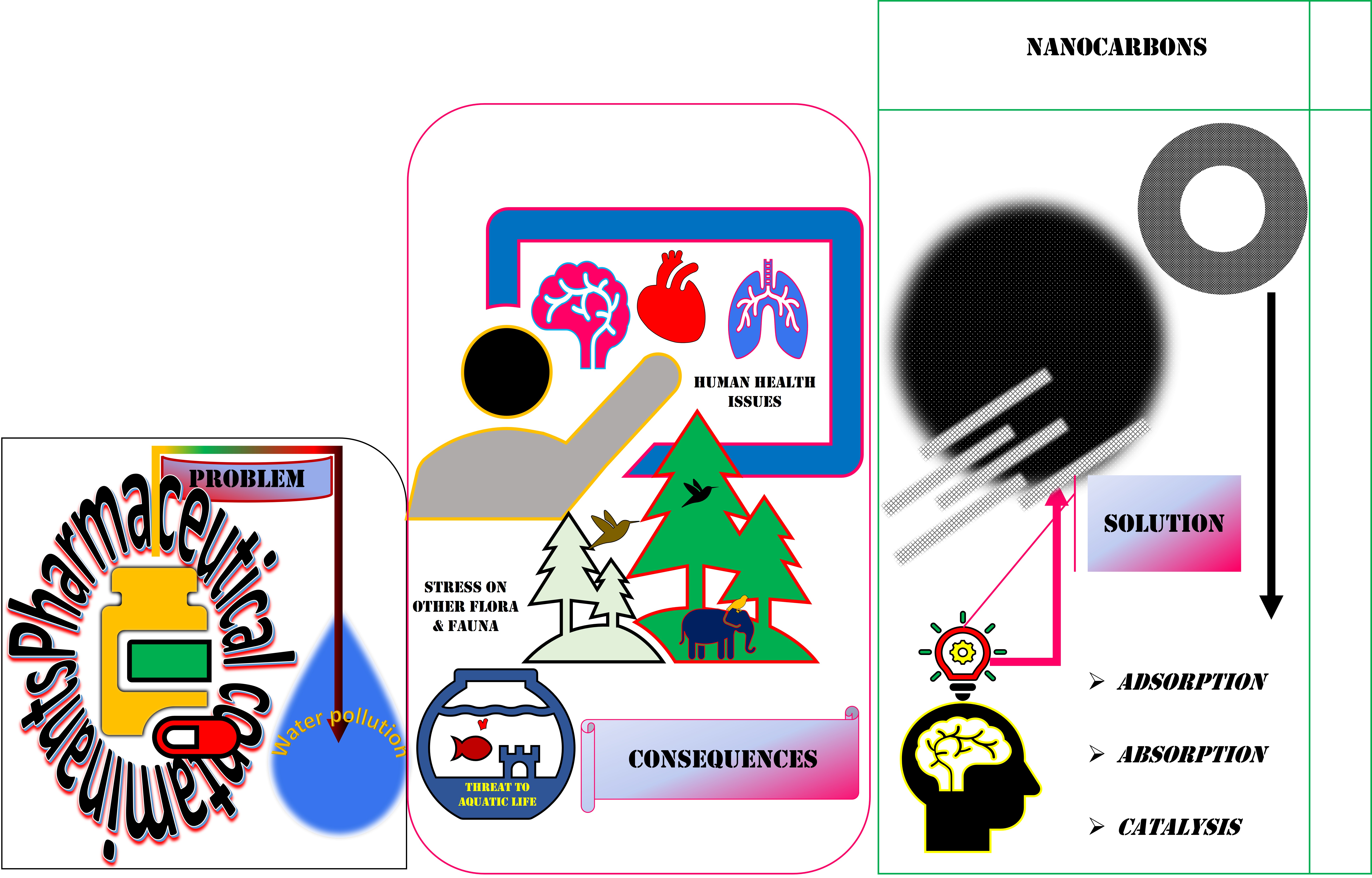
Nanomaterials have been an area of great research for the pollution control in recent decades due to their beneficial properties such as higher efficiency, low cost, easier fabrication, and higher surface area. Nanocarbons have been considered as a promising nanomaterial in remediation of emerging pollutants. Pharmaceutical compounds are one of the major products of healthcare which are present in different environments including water resources. These compounds include several categories of chemicals and medicines such as antibiotics, analgesics, antidepressants, hormones, and anticonvulsants. These pharmaceutical compounds enter the environment through sources such as pharmaceutical effluents, hospital waste, livestock farming, landfill leachate, and aquaculture industry. Considering the environmental and human health concerns associated with these pharmaceutical contaminants, the presented review is focused on understanding the mechanisms of pharmaceuticals removal through carbon-based nanomaterials by the processes such as adsorption and catalysis. In addition, it explores the factors which affect the removal efficiency of the pharmaceuticals by nanocarbons. Moreover, recent advances and emerging technologies such as hybrid materials and composites, smart and responsive nanocarbon systems, membrane technologies and artificial intelligence for predictive performance have been discussed. The review article also provides the information on critical challenges and future perspectives in the research area.
- Open Access
- Review
Nanocarbons as Potential Tool for the Removal of Pharmaceutical Compounds from Water Resources: An Updated Review
- Deepak Sharma 1,
- Pritha Chakraborty 2,
- Jithin Thomas 3,
- Mridul Umesh 4,
- Basheer Thazeem 5,
- Subhrangsu Sundar Maitra 6,
- Kanchan Kumari 7 and
- Vinay Kumar 8,*
Author Information
Received: 04 August 2025 | Revised: 05 November 2025 | Accepted: 05 November 2025 | Published: 19 November 2025
Abstract
Graphical Abstract
Keywords
nanocarbon | pharmaceutical waste | toxicity | pollution | health problems
References
- 1.
Sheoran, K.; Kaur, H.; Siwal, S.S.; et al. Recent advances of carbon-based nanomaterials (CBNMs) for wastewater treatment: Synthesis and application. Chemosphere 2022, 299, 134364.
- 2.
Baloch, M.Y.J.; Zhang, W.; Sultana, T.; et al. Innovation, Utilization of sewage sludge to manage saline–alkali soil and increase crop production: Is it safe or not? Environ. Technol. Innov. 2023, 32, 103266.
- 3.
Zubair, M.; Arshad, M.; Ullah, A. Chitosan-Based Materials for Water and Wastewater Treatment. In Handbook of Chitin and Chitosan; Elsevier: Amsterdam, The Netherlands, 2020; pp. 773–809.
- 4.
Elgarahy, A.M.; Eloffy, M.; Guibal, E.; et al. Use of biopolymers in wastewater treatment: A brief review of current trends and prospects. Chin. J. Chem. Eng. 2023, 64, 292–320.
- 5.
de Ilurdoz, M.S.; Sadhwani, J.J.; Reboso, J.V. Antibiotic removal processes from water & wastewater for the protection of the aquatic environment-a review. J. Water Process Eng. 2022, 45, 102474.
- 6.
Wilkinson, J.L.; Boxall, A.B.; Kolpin, D.W.; et al. Pharmaceutical pollution of the world’s rivers. Proc. Natl. Acad. Sci. USA 2022, 119, e2113947119.
- 7.
Samal, K.; Mahapatra, S.; Ali, M.H. Pharmaceutical wastewater as Emerging Contaminants (EC): Treatment technologies, impact on environment and human health. Energy Nexus 2022, 6, 100076.
- 8.
Xu, L.; Zhang, H.; Xiong, P.; et al. Occurrence, fate, and risk assessment of typical tetracycline antibiotics in the aquatic environment: A review. Sci. Total Environ. 2020, 753, 141975.
- 9.
Tyumina, E.A.; Bazhutin, G.A.; Cartagena Gómez, A.P.; et al. Nonsteroidal anti-inflammatory drugs as emerging contaminants. Microbiology 2020, 89, 148–163.
- 10.
Valdez-Carrillo, M.; Abrell, L.; Ramírez-Hernández, J.; et al. Research, Pharmaceuticals as emerging contaminants in the aquatic environment of Latin America: A review. Environ. Sci. Pollut. Res. 2020, 27, 44863–44891.
- 11.
Hejna, M.; Kapuścińska, D.; Aksmann, A.J. Pharmaceuticals in the aquatic environment: A review on eco-toxicology and the remediation potential of algae. Int. J. Environ. Res. Public Health 2022, 19, 7717.
- 12.
Bhushan, S.; Rana, M.S.; Raychaudhuri, S.; et al. Algae-And Bacteria-Driven Technologies for Pharmaceutical Remediation in Wastewater. In Removal of Toxic Pollutants Through Microbiological and Tertiary Treatment; Elsevier: Amsterdam, The Netherlands, 2020; pp. 373–408.
- 13.
Ortúzar, M.; Esterhuizen, M.; Olicón-Hernández, D.R.; et al. Pharmaceutical pollution in aquatic environments: A concise review of environmental impacts and bioremediation systems. Front. Microbiol. 2022, 13, 869332.
- 14.
Das, R.; Raj, D. Sources, distribution, and impacts of emerging contaminants–a critical review on contamination of landfill leachate. J. Hazard. Mater. Adv. 2025, 17, 100602.
- 15.
Khasawneh, O.F.S.; Palaniandy, P.J.P.S. Occurrence and removal of pharmaceuticals in wastewater treatment plants. Process Saf. Environ. Prot. 2021, 150, 532–556.
- 16.
Morin-Crini, N.; Lichtfouse, E.; Fourmentin, M.; et al. Removal of emerging contaminants from wastewater using advanced treatments. A review. Environ. Chem. Lett. 2022, 20, 1333–1375.
- 17.
Papagiannaki, D.; Belay, M.H.; Gonçalves, N.P.; et al. From monitoring to treatment, how to improve water quality: The pharmaceuticals case. Chem. Eng. J. Adv. 2022, 10, 100245.
- 18.
Patel, M.; Kumar, R.; Kishor, K.; et al. Pharmaceuticals of emerging concern in aquatic systems: Chemistry, occurrence, effects, and removal methods. Chem. Rev. 2019, 119, 3510–3673.
- 19.
Yu, G.; Wang, Y.; Cao, H.; et al. Technology, Reactive oxygen species and catalytic active sites in heterogeneous catalytic ozonation for water purification. Environ. Sci. Technol. 2020, 54, 5931–5946.
- 20.
Ojha, A.; Tiwary, D.; Oraon, R.; et al. Research, Degradations of endocrine-disrupting chemicals and pharmaceutical compounds in wastewater with carbon-based nanomaterials: A critical review. Environ. Sci. Pollut. Res. 2021, 28, 30573–30594.
- 21.
Ahmed, S.; Mofijur, M.; Nuzhat, S.; et al. Recent developments in physical, biological, chemical, and hybrid treatment techniques for removing emerging contaminants from wastewater. J. Hazard. Mater. 2021, 416, 125912.
- 22.
Parra-Saldivar, R.; Castillo-Zacarías, C.; Bilal, M.; et al. Sources of Pharmaceuticals in Water. In The Handbook of Environmental Chemistry; Springer Nature: Switzerland, 2020; pp. 33–47.
- 23.
Singh, A.K.; Kaur, R.; Verma, S.; et al. Antimicrobials and antibiotic resistance genes in water bodies: Pollution, risk, and control. Front. Environ. Sci. 2022, 10, 830861.
- 24.
Yi, X.; Lin, C.; Ong, E.J.L.; et al. Occurrence and distribution of trace levels of antibiotics in surface waters and soils driven by non-point source pollution and anthropogenic pressure. Chemosphere 2019, 216, 213–223.
- 25.
Singh, P.K.; Kumar, U.; Kumar, I.; et al. Critical review on toxic contaminants in surface water ecosystem: Sources, monitoring, and its impact on human health. Environ. Sci. Pollut. Res. Int. 2024, 31, 56428–56462.
- 26.
Akhter, S.; Bhat, M.A.; Ahmed, S.; et al. Antibiotic residue contamination in the aquatic environment, sources and associated potential health risks. Environ. Geochem. Health 2024, 46, 387.
- 27.
Maghsodian, Z.; Sanati, A.M.; Mashifana, T.; et al. Occurrence and distribution of antibiotics in the water, sediment, and Biota of freshwater and marine environments: A review. Antibiotics 2022, 11, 1461.
- 28.
Jurado, A.; Vázquez-Suñé, E.; Pujades, E. Urban groundwater contamination by non-steroidal anti-inflammatory drugs. Water 2021, 13, 720.
- 29.
Placova, K.; Halfar, J.; Brozova, K.; et al. Issues of Non-Steroidal Anti-Inflammatory Drugs in Aquatic Environments: A Review Study. In Proceedings of the 4th International Conference on Advances in Environmental Engineering, Ostrava, Czech Republic, 20–22 November 2023; p. 13.
- 30.
Chen, Y.; Wang, J.; Xu, P.; et al. Antidepressants as emerging contaminants: Occurrence in wastewater treatment plants and surface waters in Hangzhou, China. Front. Public Health 2022, 10, 963257.
- 31.
Moreira, D.G.; Aires, A.; de Lourdes Pereira, M.; et al. Levels and effects of antidepressant drugs to aquatic organisms. Comp. Biochem. Physiol. Part C Toxicol. Pharmacol. 2022, 256, 109322.
- 32.
Kanan, S.; Moyet, M.; Obeideen, K.; et al. Occurrence, analysis and removal of pesticides, hormones, pharmaceuticals, and other contaminants in soil and water streams for the past two decades: A review. Res. Chem. Intermed. 2022, 48, 3633–3683.
- 33.
Liu, Q.; Wang, L.; Xu, X.; et al. Antiepileptic drugs in aquatic environments: Occurrence, toxicity, transformation mechanisms and fate. Crit. Rev. Environ. Sci. Technol. 2023, 53, 2030–2054.
- 34.
Klanovicz, N.; Scapini, T.; Dalastra, C.; et al. Antiepileptic Drugs: From Public to Environmental Health Problem. In Biochar and its Application in Bioremediation; Springer: Singapore, 2021; pp. 209–229.
- 35.
Thi, L.-A.P.; Panchangam, S.C.; Do, H.-T.; et al. Prospects and Challenges of Photocatalysis for Degradation and Mineralization of Antiviral Drugs. In Nanostructured Photocatalysts; Elsevier: Amsterdam, The Netherlands, 2021; pp. 489–517.
- 36.
Cristóvão, M.B.; Bernardo, J.; Bento-Silva, A.; et al. Treatment of anticancer drugs in a real wastewater effluent using nanofiltration: A pilot scale study. Sep. Purif. Technol. 2022, 288, 120565.
- 37.
Kayode-Afolayan, S.D.; Ahuekwe, E.F.; Nwinyi, O.C. Impacts of pharmaceutical effluents on aquatic ecosystems. Sci. Afr. 2022, 17, e01288.
- 38.
Hao, C.; Lissemore, L.; Nguyen, B.; et al. Determination of pharmaceuticals in environmental waters by liquid chromatography/electrospray ionization/tandem mass spectrometry. Anal. Bioanal. Chem. 2006, 384, 505–513.
- 39.
Ferguson, P.J.; Bernot, M.J.; Doll, J.C.; et al. Detection of pharmaceuticals and personal care products (PPCPs) in near-shore habitats of southern Lake Michigan. Sci. Total Environ. 2013, 458, 187–196.
- 40.
Ebele, A.J.; Abou-Elwafa Abdallah, M.; Harrad, S. Pharmaceuticals and personal care products (PPCPs) in the freshwater aquatic environment. Emerg. Contam. 2017, 3, 1–16.
- 41.
Xie, Z.-H.; He, C.-S.; Zhou, H.-Y.; et al. Effects of molecular structure on organic contaminants’ degradation efficiency and dominant ROS in the advanced oxidation process with multiple ROS. Environ. Sci. Technol. 2022, 56, 8784–8795.
- 42.
Sayadi, M.H.; Chamanehpour, E.; Fahoul, N. Recent advances and future outlook for treatment of pharmaceutical from water: An overview. Int. J. Environ. Sci. Technol. 2022, 20, 3437–3454.
- 43.
Yousefi Seyf, J.; Zarei, F.; Jalalinejad, A. Valorization of pharmaceutical waste by recovery of active pharmaceutical ingredients from expired or unused finished pharmaceutical products with thermodynamic modeling. Org. Process Res. Dev. 2025, 29, 1333–1344.
- 44.
Rúa-Gómez, P.C.; Püttmann, W. Impact of wastewater treatment plant discharge of lidocaine, tramadol, venlafaxine and their metabolites on the quality of surface waters and groundwater. J. Environ. Monit. 2012, 14, 1391.
- 45.
Ohoro, C.R.; Adeniji, A.O.; Elsheikh, E.A.E.; et al. Influence of physicochemical parameters on PPCP occurrences in the wetlands. Environ. Monit. Assess. 2022, 194, 339.
- 46.
Coimbra, R.N.; Escapa, C.; Otero, M. Removal of pharmaceuticals from water: Conventional and alternative treatments. Water 2021, 13, 487.
- 47.
Eniola, J.O.; Kumar, R.; Barakat, M.A.; et al. A review on conventional and advanced hybrid technologies for pharmaceutical wastewater treatment. J. Clean. Prod. 2022, 356, 131826.
- 48.
Simazaki, D.; Fujiwara, J.; Manabe, S.; et al. Removal of selected pharmaceuticals by chlorination, coagulation-sedimentation and powdered activated carbon treatment. Water Sci. Technol. 2008, 58, 1129–1135.
- 49.
Date, M.; Jaspal, D. Pharmaceutical wastewater remediation: A review of treatment techniques. Ind. Eng. Chem. Res. 2023, 62, 20492–20505.
- 50.
Roslan, N.N.; Lau, H.L.H.; Suhaimi, N.A.A.; et al. Recent advances in advanced oxidation processes for degrading pharmaceuticals in wastewater-A review. Catalysts 2024, 14, 189.
- 51.
Vilatela, J.J.; Eder, D. Nanocarbon composites and hybrids in sustainability: A review. ChemSusChem 2012, 5, 456–478.
- 52.
Rahchamandi, S.Y.R.; Mirhadi, E.; Gheybi, F.; et al. Engineering carbon-based nanomaterials for the delivery of platinum compounds: An innovative cancer disarming frontier. Environ. Res. 2024, 262, 119933.
- 53.
Gonçalves, G. Nanocarbon-Based Composites and Their Thermal, Electrical, and Mechanical Properties. C J. Carbon Res. 2025, 11, 21.
- 54.
Kurniawan, D.; Xia, Z.; Dai, L.; et al. Zero-dimensional nano-carbons: Synthesis, properties, and applications. Appl. Phys. Rev. 2024, 11, 021311.
- 55.
Raja, I.S.; Song, S.-J.; Kang, M.S.; et al. Toxicity of zero-and one-dimensional carbon nanomaterials. Nanomaterials 2019, 9, 1214.
- 56.
Kilic, M.E.; Lee, K.-R. Four-penta-graphenes: Novel two-dimensional fenestrane-based auxetic nanocarbon allotropes for nanoelectronics and optoelectronics. Carbon 2022, 195, 154–164.
- 57.
Huang, B.; Liu, Y.; Xie, Z. Two dimensional nanocarbons from biomass and biological molecules: Synthetic strategies and energy related applications. J. Energy Chem. 2021, 54, 795–814.
- 58.
Tang, C.; Han, H.; Zhang, R.; et al. A Geometrically Flexible Three-Dimensional Nanocarbon. J. Am. Chem. Soc. 2024, 146, 20158–20167.
- 59.
Sun, Z.; Fang, S.; Hu, Y.H. 3D graphene materials: From understanding to design and synthesis control. Chem. Rev. 2020, 120, 10336–10453.
- 60.
Mora, A.; Verma, P.; Kumar, S. Electrical conductivity of CNT/polymer composites: 3D printing, measurements and modeling. Compos. B Eng. 2020, 183, 107600.
- 61.
Zhu, H.; Xu, C.; Wu, D.; et al. Direct synthesis of long single-walled carbon nanotube strands. Science 2002, 296, 884–886.
- 62.
Aqel, A.; Abou El-Nour, K.M.; Ammar, R.A.; et al. Carbon nanotubes, science and technology part (I) structure, synthesis and characterization. Arab. J. Chem. 2012, 5, 1–23.
- 63.
Iijima, S.; Ichihashi, T. Single-shell carbon nanotubes of 1-nm diameter. Nature 1993, 363, 603–605.
- 64.
Syduzzaman, M.; Saad, M.S.I.; Piam, M.F.; et al. Carbon nanotubes: Structure, properties and applications in the aerospace industry. Results Mater. 2025, 25, 100654.
- 65.
Geim, A.K.; Novoselov, K.S. The rise of graphene. Nat. Mater. 2007, 6, 183–191.
- 66.
Novoselov, K.S. Graphene: Materials in the flatland (Nobel Lecture). Angew. Chem. Int. Ed. 2011, 50, 6986–7002.
- 67.
Manimegalai, S.; Vickram, S.; Deena, S.R.; et al. Carbon-based nanomaterial intervention and efficient removal of various contaminants from effluents—A review. Chemosphere 2023, 312, 137319.
- 68.
Foo, M.E.; Gopinath, S.C. Feasibility of graphene in biomedical applications. Biomed. Pharmacother. 2017, 94, 354–361.
- 69.
Phiri, J.; Gane, P.; Maloney, T.C. General overview of graphene: Production, properties and application in polymer composites. Mater. Sci. Eng. B 2017, 215, 9–28.
- 70.
Park, S.; Lee, K.-S.; Bozoklu, G.; et al. Graphene oxide papers modified by divalent ions—Enhancing mechanical properties via chemical cross-linking. ACS Nano 2008, 2, 572–578.
- 71.
Lee, X.J.; Hiew, B.Y.Z.; Lai, K.C.; et al. Review on graphene and its derivatives: Synthesis methods and potential industrial implementation. J. Taiwan Inst. Chem. Eng. 2019, 98, 163–180.
- 72.
Edwards, R.S.; Coleman, K.S. Graphene synthesis: Relationship to applications. Nanoscale 2013, 5, 38–51.
- 73.
Compton, O.C.; Nguyen, S.T. Graphene oxide, highly reduced graphene oxide, and graphene: Versatile building blocks for carbon-based materials. Small 2010, 6, 711–723.
- 74.
Sindi, A.M. Applications of graphene oxide and reduced graphene oxide in advanced dental materials and therapies. J. Taibah Univ. Med. Sci 2024, 19, 403–421.
- 75.
Khan, A.; Wang, J.; Li, J.; et al. The role of graphene oxide and graphene oxide-based nanomaterials in the removal of pharmaceuticals from aqueous media: A review. Environ. Sci. Pollut. Res. 2017, 24, 7938–7958.
- 76.
Thakur, K.; Kandasubramanian, B. Graphene and graphene oxide-based composites for removal of organic pollutants: A review. J. Chem. Eng. Data 2019, 64, 833–867.
- 77.
Yan, H.; Yang, H.; Li, A.; et al. pH-tunable surface charge of chitosan/graphene oxide composite adsorbent for efficient removal of multiple pollutants from water. Chem. Eng. J 2016, 284, 1397–1405.
- 78.
Ioannidou, O.; Zabaniotou, A. Agricultural residues as precursors for activated carbon production-A review. Renew. Sustain. Energy Rev. 2007, 11, 1966–2005.
- 79.
Foo, K.; Hameed, B. A short review of activated carbon assisted electrosorption process: An overview, current stage and future prospects. J. Hazard. Mater. 2009, 170, 552–559.
- 80.
Heidarinejad, Z.; Dehghani, M.H.; Heidari, M.; et al. Methods for preparation and activation of activated carbon: A review. Environ. Chem. Lett. 2020, 18, 393–415.
- 81.
Shao, Y.; Li, J.; Fang, X.; et al. Chemical modification of bamboo activated carbon surface and its adsorption property of simultaneous removal of phosphate and nitrate. Chemosphere 2022, 287, 132118.
- 82.
Aljeboree, A.M.; Alshirifi, A.N. Adsorption of Pharmaceuticals as emerging contaminants from aqueous solutions on to friendly surfaces such as activated carbon: A review. J. Pharm. Sci. Res. 2018, 10, 2252–2257.
- 83.
Kaur, H.; Bansiwal, A.; Hippargi, G.; et al. Effect of hydrophobicity of pharmaceuticals and personal care products for adsorption on activated carbon: Adsorption isotherms, kinetics and mechanism. Environ. Sci. Pollut. Res. 2018, 25, 20473–20485.
- 84.
Viegas, R.M.; Mestre, A.S.; Mesquita, E.; et al. Assessing the applicability of a new carob waste-derived powdered activated carbon to control pharmaceutical compounds in wastewater treatment. Sci. Total Environ. 2020, 743, 140791.
- 85.
Mukoko, T.; Mupa, M.; Guyo, U.; et al. Preparation of rice hull activated carbon for the removal of selected pharmaceutical waste compounds in hospital effluent. J. Environ. Anal. Toxicol. 2015, S7. https://doi.org/10.4172/2161-0525.S7-008.
- 86.
Kroto, H.W.; Heath, J.R.; O’Brien, S.C.; et al. C60: Buckminsterfullerene. Nature 1985, 318, 162–163.
- 87.
Dresselhaus, M.; Dresselhaus, G.; Eklund, P. Fullerenes. J. Mater. Res. 1993, 8, 2054–2097.
- 88.
Lee, J.; Hong, S.; Mackeyev, Y.; et al. Photosensitized oxidation of emerging organic pollutants by tetrakis C60 aminofullerene-derivatized silica under visible light irradiation. Environ. Sci. Technol. 2011, 45, 10598–10604.
- 89.
Elessawy, N.A.; Elnouby, M.; Gouda, M.H.; et al. Ciprofloxacin removal using magnetic fullerene nanocomposite obtained from sustainable PET bottle wastes: Adsorption process optimization, kinetics, isotherm, regeneration and recycling studies. Chemosphere 2020, 239, 124728.
- 90.
Lim, S.Y.; Shen, W.; Gao, Z. Carbon quantum dots and their applications. Chem. Soc. Rev. 2015, 44, 362–381.
- 91.
Lin, P.; Chen, J.-W.; Chang, L.W.; et al. Computational and ultrastructural toxicology of a nanoparticle, Quantum Dot 705, in mice. Environ. Sci. Technol. 2008, 42, 6264–6270.
- 92.
Parambil, A.M.; Priyadarshini, E.; Goutam, R.; et al. Self-assembled mesoporous silica decorated with biogenic carbon dot nanospheres hybrid nanomaterial for efficient removal of aqueous Methoxy-DDT via a Short-Bed Adsorption column technique. Environ. Res. 2024, 260, 119653.
- 93.
Kah, M.; Sigmund, G.; Xiao, F.; et al. Sorption of ionizable and ionic organic compounds to biochar, activated carbon and other carbonaceous materials. Water Res. 2017, 124, 673–692.
- 94.
Sarti, E.; Chenet, T.; Stevanin, C.; et al. High-silica zeolites as sorbent media for adsorption and pre-concentration of pharmaceuticals in aqueous solutions. Molecules 2020, 25, 3331.
- 95.
Liu, Y.; Liu, X.; Lu, S.; et al. Adsorption and biodegradation of sulfamethoxazole and ofloxacin on zeolite: Influence of particle diameter and redox potential. Chem. Eng. J. 2022, 384, 123346.
- 96.
Fraiha, O.; Hadoudi, N.; Zaki, N.; et al. Comprehensive review on the adsorption of pharmaceutical products from wastewater by clay materials. Desalin. Water Treat. 2024, 317, 100114.
- 97.
Firmansyah, M.L.; Alwan, Y.; Ullah, N. A comprehensive review on the adsorptive removal of pharmaceutical pollutants: Occurrence, toxicology, molecular simulation and mechanistic insights. Talanta Open 2025, 12, 100491.
- 98.
Mansouri, F.; Chouchene, K.; Roche, N.; et al. Removal of pharmaceuticals from water by adsorption and advanced oxidation processes: State of the art and trends. Appl. Sci. 2021, 11, 6659.
- 99.
Olusegun, S.J.; Souza, T.G.; Souza, G.d.O.; et al. Iron-based materials for the adsorption and photocatalytic degradation of pharmaceutical drugs: A comprehensive review of the mechanism pathway. J. Water Process Eng. 2023, 51, 103457.
- 100.
Tatarchuk, T.; Soltys, L.; Macyk, W. Magnetic adsorbents for removal of pharmaceuticals: A review of adsorption properties. J. Mol. Liq. 2023, 384, 122174.
- 101.
Liu, Y.; Li, N.; Du, C.; et al. Various hydrogen bonds make different fates of pharmaceutical contaminants on oxygen-rich nanomaterials. Environ. Pollut. 2023, 316, 120572.
- 102.
Pavlenko, V.; Żółtowska, S.; Haruna, A.; et al. A comprehensive review of template-assisted porous carbons: Modern preparation methods and advanced applications. Mater. Sci. Eng. R Rep. 2022, 149, 100682.
- 103.
Mohapatra, L.; Cheon, D.; Yoo, S.H. Carbon-based nanomaterials for catalytic wastewater treatment: A review. Molecules 2023, 28, 1805.
- 104.
Xin, L.; Hu, J.; Xiang, Y.; et al. Carbon-based nanocomposites as fenton-like catalysts in wastewater treatment applications: A review. Materials 2021, 14, 2643.
- 105.
Guo, L.; Liu, D.; Han, R.; et al. Advances in Activation of Persulfate by Novel Carbon-Based Materials: Degradation of Emerging Contaminants, Mechanisms, and Perspectives. Crystals 2025, 15, 432.
- 106.
Saroa, A.; Singh, A.; Jindal, N.; et al. Nanotechnology-assisted treatment of pharmaceuticals contaminated water. Bioengineered 2023, 14, 2260919.
- 107.
Ruziwa, D.T.; Oluwalana, A.E.; Mupa, M.; et al. Pharmaceuticals in wastewater and their photocatalytic degradation using nano-enabled photocatalysts. J. Water Process Eng. 2023, 54, 103880.
- 108.
Hooshmand, S.; Kargozar, S.; Ghorbani, A.; et al. Biomedical waste management by using nanophotocatalysts: The need for new options. Materials 2020, 13, 3511.
- 109.
Ai, L.; Yang, Y.; Wang, B.; et al. Insights into photoluminescence mechanisms of carbon dots: Advances and perspectives. Sci. Bull. 2021, 66, 839–856.
- 110.
Emon, S.H.; Hossain, M.I.; Khanam, M.; et al. Expanding horizons: Taking advantage of graphene’s surface area for advanced applications. Appl. Sci. 2025, 15, 1541.
- 111.
Chakravorty, A.; Roy, S. A review of photocatalysis, basic principles, processes, and materials. Sustain. Chem. Environ. 2024, 8, 100155.
- 112.
Mahalakshmi, D.; Nandhini, J.; Karthikeyan, E.; et al. Carbon nanomaterials for emerging contaminant remediation: Addressing pharmaceutical pollution in the water cycle with precision. Water Cycle 2025, 6, 449–472.
- 113.
Pikula, K.; Johari, S.A.; Santos-Oliveira, R.; et al. Joint toxicity and interaction of carbon-based nanomaterials with co-existing pollutants in aquatic environments: A review. Int. J. Mol. Sci. 2024, 25, 11798.
- 114.
Jiwanti, P.K.; Wardhana, B.Y.; Sutanto, L.G.; et al. Recent development of nano-carbon material in pharmaceutical application: A review. Molecules 2022, 27, 7578.
- 115.
Zaremba, O.T.; Goldt, A.E.; Khabushev, E.M.; et al. Highly efficient doping of carbon nanotube films with chloroauric acid by dip-coating. Mater. Sci. Eng. B 2022, 278, 115648.
- 116.
Adewoye, T.L.; Ogunleye, O.O.; Abdulkareem, A.S.; et al. Optimization of the adsorption of total organic carbon from produced water using functionalized multi-walled carbon nanotubes. Heliyon 2021, 7, e05866.
- 117.
Santra, T.S.; Mohan, L. Nanomaterials and Their Biomedical Applications; Springer Nature: Singapore, 2021.
- 118.
Ansari, A.S.; Azzahra, G.; Nugroho, F.G.; et al. Oxides and Metal Oxide/Carbon Hybrid Materials for Efficient Photocatalytic Organic Pollutant Removal. Catalysts 2025, 15, 134.
- 119.
Abd-Elsalam, K.A.; Zahid, M. Aquananotechnology: Applications of Nanomaterials for Water Purification; Elsevier: Amsterdam, The Netherlands, 2020.
- 120.
Hasnain, M.S.; Nayak, A.K.; Aminabhavi, T.M. Advanced Nanoformulations: Theranostic Nanosystems; Academic Press: London, UK, 2023, Volume 3.
- 121.
Wakejo, W.K.; Maged, A.; Meshesha, B.T.; et al. Tuneable functionalized biochar for simultaneous removal of pharmaceuticals from binary mixture. Colloids Surf. A Physicochem. Eng. Asp. 2024, 681, 132718.
- 122.
Mustapha, S.I.; Muritala, K.B.; Afolabi, A.M.; et al. Phenol removal from pharmaceutical effluent using silver doped magnetite biochar: Adsorption efficiency and kinetic studies. Chem. Eng. Commun. 2025, 213, 21–41.
- 123.
Leao, M.B.; Fernandes, A.N.; Ferreira de Matos Jauris, C. Nanocarbon Dimensionality and Oxidation Degree Influence the Sorption of Atenolol: Implications for Water Treatment. ACS Appl. Nano Mater. 2024, 7, 8307–8317.
- 124.
Zhao, Y.-G.; Sun, Y.-F.; Gao, H.-G.; et al. Preparation of a superhydrophobic nano carbon skeleton microsphere for efficient removal of toluene in medical campus. Polymer 2025, 335, 128777.
- 125.
Makhseed, S.I.; Mustafa, S.A.; Hayssam, M.; et al. Ultrahigh-surface-area phenothiazine-derived nanocarbon for adsorptive removal of iodine and pharmaceutical pollutants. Sep. Purif. Technol. 2025, 378, 134746.
- 126.
Homaeigohar, S. Water Treatment with New Nanomaterials. Water 2020, 12, 1507.
- 127.
Kumar, S.; Kumar, P.; Pathak, C.S. Silver Micro-Nanoparticles: Properties, Synthesis, Characterization, and Applications; Books on Demand: London, UK, 2021.
- 128.
Bhanvase, B.A.; Barai, D.P. Bio-derived Carbon Nanostructures: Fundamentals, Synthesis and Applications; Elsevier: Amsterdam, The Netherlands, 2024.
- 129.
Rizzo, C.; Marullo, S.; Dintcheva, N.T.; et al. Carbon Nanomaterial Doped Ionic Liquid Gels for the Removal of Pharmaceutically Active Compounds from Water. Molecules 2019, 24, 2788.
- 130.
Pal, V.K.; Kumar, D.; Gupta, A.; et al. Nanocarbons Decorated TiO2 as Advanced Nanocomposite Fabric to Tackle a Mixed Pollutant System of Dye (Mb) and Pharmaceutical Active Compound (Cpf). Available online: https://papers.ssrn.com/sol3/papers.cfm?abstract_id=4832709 (accessed on 5 October 2025).
- 131.
Nille, O.S.; Kolekar, A.G.; Devre, P.V.; et al. Nanocarbon eco-hydrogel kit: On-site visual metal ion sensing and dye cleanup, advancing the circular economy in environmental remediation. Analyst 2024, 150, 69–80.
- 132.
Zhang, Z.; Zhang, W.; Lichtfouse, E. Membranes for Environmental Applications; Springer Nature: Cham, Switzerland, 2020.
- 133.
Frenzilli, G. Nanotechnology for Environmental and Biomedical Research. Nanomaterials 2020, 10, 2220.
- 134.
Ray, S.S.; Gusain, R.; Kumar, N. Carbon Nanomaterial-Based Adsorbents for Water Purification: Fundamentals and Applications; Elsevier: Amsterdam, The Netherlands, 2020.
- 135.
Thomas, S.; Ahmadi, M.; Afkhami, A.; et al. Micro- and Nanotechnology Enabled Applications for Portable Miniaturized Analytical Systems; Elsevier: Amsterdam, The Netherlands, 2021.
- 136.
Zarzycki, P.K. Pure and Functionalized Carbon Based Nanomaterials: Analytical, Biomedical, Civil and Environmental Engineering Applications; CRC Press: Boca Raton, FL, USA, 2020.
- 137.
Sharon, M.; Sharon, M. Carbon Nanofibers: Fundamentals and Applications; John Wiley & Sons: Hoboken, NJ, USA, 2021.
- 138.
Arnault, J.-C.; Eder, D. Synthesis and Applications of Nanocarbons; John Wiley & Sons: Hoboken, NJ, USA, 2020.
- 139.
Fan, M.; Hu, J.; Cao, R.; et al. A review on experimental design for pollutants removal in water treatment with the aid of artificial intelligence. Chemosphere 2018, 200, 330–343.
- 140.
Yang, J.; Du, Q.; Ma, R.; et al. Artificial intelligence simulation of water treatment using a novel bimodal micromesoporous nanocomposite. J. Mol. Liq. 2021, 340, 117296.
- 141.
Syah, R.; Piri, F.; Elveny, M.; et al. Artificial Intelligence simulation of water treatment using nanostructure composite ordered materials. J. Mol. Liq. 2022, 345, 117046.
- 142.
Alam, G.; Ihsanullah, I.; Naushad, M.; et al. Applications of artificial intelligence in water treatment for optimization and automation of adsorption processes. Chem. Eng. J. 2022, 427, 130011.
- 143.
Wassim, J. Artificial Intelligence in the Age of Nanotechnology; IGI Global: Hershey, PA, USA, 2023.
- 144.
Gupta, R.K. NanoCarbon: A Wonder Material for Energy Applications. In Fundamentals and Advancement for Energy Storage Applications; Springer Nature: Singapore, 2024.
- 145.
Nazal, M.K. An overview of carbon-based materials for the removal of pharmaceutical active compounds. In Carbon-Based Material for Environmental Protection and Remediation; IntechOpen: London, UK, 2020.
- 146.
González-Poggini, S.; Rosenkranz, A.; Colet-Lagrille, M. Two-dimensional nanomaterials for the removal of pharmaceuticals from wastewater: A critical review. Processes 2021, 9, 2160.
- 147.
Malik, A.; Haider, A.; Qamar, M.A.; et al. Advancements in CNT-based materials for optimized pharmaceutical removal via adsorption and photocatalysis. Rev. Inorg. Chem. 2025, 45, 453–478.
- 148.
Loganathan, P.; Vigneswaran, S.; Kandasamy, J.; et al. Treatment trends and combined methods in removing pharmaceuticals and personal care products from wastewater—A review. Membranes 2023, 13, 158.
- 149.
Malode, S.J.; Pandiaraj, S.; Alodhayb, A.; et al. Carbon nanomaterials for biomedical applications: Progress and outlook. ACS Appl. Bio Mater. 2024, 7, 752–777.


This work is licensed under a Creative Commons Attribution 4.0 International License.
