
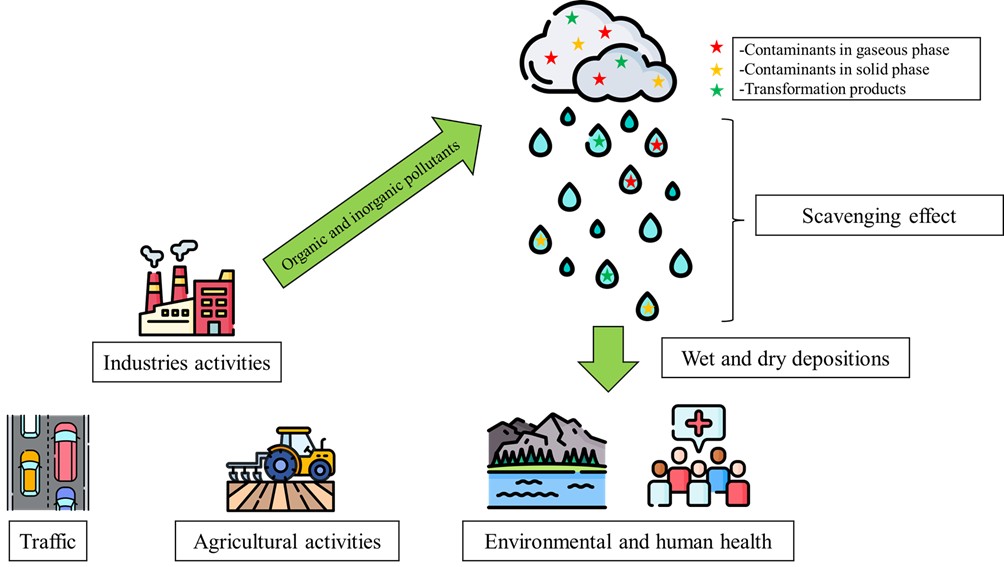
Rainwater plays a key yet often underestimated role in the atmospheric transport and deposition of environmental contaminants, contributing to the dissemination of both traditional and emerging pollutants across urban, industrial, and remote areas. For the first time, rainwater as an analytical matrix is systematically addressed, providing a critical synthesis of the objectives, strategies, and methodological approaches required for a comprehensive investigation of atmospheric contamination mediated by precipitation. This review aims to provide a comprehensive overview of the major classes of contaminants detected in rainwater and to critically examine the analytical strategies currently employed for their determination at trace and ultra-trace levels. The manuscript discusses the most widely applied sample preparation techniques, with particular emphasis on solid-phase extraction using polymeric and mixed-mode sorbents, alongside complementary approaches such as liquid-liquid extraction, solid-phase microextraction, and treatments of the particulate fraction. Instrumental methodologies based on gas chromatography and high-performance liquid chromatography coupled with mass spectrometry are presented as the gold standard for multiresidue analysis of organic pollutants, while ion chromatography and ICP-MS are highlighted for inorganic and metal contamination profiling. The review highlights current trends, methodological strengths, and limitations in rainwater analysis. Overall, this work underscores the importance of integrated and robust analytical approaches to achieve a comprehensive assessment of rainwater contamination and identifies existing gaps in linking analytical data with atmospheric processes, source attribution, and health risk assessment, thereby reinforcing the relevance of rainwater monitoring in environmental and public health studies.
- Open Access
- Article
Pollutants in Rainwater: Analytical Advances, Key Challenges, and Environmental Significance
- Nina Felli,
- Massimo Giuseppe De Cesaris *,
- Lorenzo Antonelli,
- Giulia Bertini,
- Chiara Dal Bosco and
- Alessandra Gentili
Author Information
Received: 20 October 2025 | Revised: 14 January 2026 | Accepted: 20 January 2026 | Published: 28 January 2026
Abstract
Graphical Abstract
Keywords
rainwater contamination | emerging pollutants | atmospheric deposition | health implication | analytical chemistry
References
- 1.
Edo, G.I.; Itoje-akpokiniovo, L.O.; Obasohan, P.; et al. Impact of Environmental Pollution from Human Activities on Water, Air Quality and Climate Change. Ecol. Front. 2024, 44, 874–889. https://doi.org/10.1016/j.ecofro.2024.02.014.
- 2.
Lee, T.H.Y.; Srinuansom, K.; Snyder, S.A.; et al. Atmosphere-Transported Emerging and Persistent Contaminants (EPCs) in Rainfall and Throughfall: Insights from a Rural Site in Northern Thailand. Atmosphere 2023, 14, 1603. https://doi.org/10.3390/atmos14111603.
- 3.
Kim, S.K.; Kannan, K. Perfluorinated Acids in Air, Rain, Snow, Surface Runoff, and Lakes: Relative Importance of Pathways to Contamination of Urban Lakes. Environ. Sci. Technol. 2007, 41, 8328–8334. https://doi.org/10.1021/es072107t.
- 4.
Barroso, P.J.; Santos, J.L.; Martín, J.; et al. Emerging Contaminants in the Atmosphere: Analysis, Occurrence and Future Challenges. Crit. Rev. Environ. Sci. Technol. 2019, 49, 104–171. https://doi.org/10.1080/10643389.2018.1540761.
- 5.
Alfonso, M.B.; Arias, A.H.; Ronda, A.C.; et al. Continental Microplastics: Presence, Features, and Environmental Transport Pathways. Sci. Total Environ. 2021, 799, 149447. https://doi.org/10.1016/j.scitotenv.2021.149447.
- 6.
Abbasi, T.; Abbasi, S.A. Sources of Pollution in Rooftop Rainwater Harvesting Systems and Their Control. Crit. Rev. Environ. Sci. Technol. 2011, 41, 2097–2167. https://doi.org/10.1080/10643389.2010.497438.
- 7.
Pamuru, S.T.; Forgione, E.; Croft, K.; et al. Chemical Characterization of Urban Stormwater: Traditional and Emerging Contaminants. Sci. Total Environ. 2022, 813, 151887. https://doi.org/10.1016/j.scitotenv.2021.151887.
- 8.
Polkowska, Z.; Astel, A.; Walna, B.; et al. Chemometric Analysis of Rainwater and Throughfall at Several Sites in Poland. Atmos. Environ. 2005, 39, 837–855. https://doi.org/10.1016/j.atmosenv.2004.10.026.
- 9.
Zhang, S.; Yu, J.; Pan, T.; et al. Difference between Rainfall and Throughfall Chemistry for Different Forest Stands in the Qinling Mountains, China. Hydrol. Res. 2021, 52, 523–535. https://doi.org/10.2166/nh.2021.015.
- 10.
Fayyazbakhsh, A.; Bell, M.L.; Zhu, X.; et al. Engine Emissions with Air Pollutants and Greenhouse Gases and Their Control Technologies. J. Clean. Prod. 2022, 376, 134260. https://doi.org/10.1016/j.jclepro.2022.134260.
- 11.
Lucci, E.; Dal Bosco, C.; Antonelli, L.; et al. Enantioselective High-Performance Liquid Chromatographic Separations to Study Occurrence and Fate of Chiral Pesticides in Soil, Water, and Agricultural Products. J. Chromatogr. A 2022, 1685, 463595. https://doi.org/10.1016/j.chroma.2022.463595.
- 12.
Rosso, B.; Corami, F.; Vezzaro, L.; et al. Quantification and Characterization of Additives, Plasticizers, and Small Microplastics (5–100 Μm) in Highway Stormwater Runoff. J. Environ. Manage. 2022, 324, 116348. https://doi.org/10.1016/j.jenvman.2022.116348.
- 13.
Morin-Crini, N.; Lichtfouse, E.; Liu, G.; et al. Worldwide Cases of Water Pollution by Emerging Contaminants: A Review. Environ. Chem. Lett. 2022, 20, 2311–2338. https://doi.org/10.1007/s10311-022-01447-4.
- 14.
Li, X.; Shen, X.; Jiang, W.; et al. Comprehensive Review of Emerging Contaminants: Detection Technologies, Environmental Impact, and Management Strategies. Ecotoxicol. Environ. Saf. 2024, 278, 116420. https://doi.org/10.1016/j.ecoenv.2024.116420.
- 15.
Brião, V.B.; Cadore, J.S.; Graciola, S.; et al. Rainwater for Drinking Purposes: An Overview of Challenges and Perspectives. Wiley Interdiscip. Rev. Water 2024, 11, 1–18. https://doi.org/10.1002/wat2.1746.
- 16.
Maniam, G.; Zakaria, N.A.; Leo, C.P.; et al. An Assessment of Technological Development and Applications of Decentralized Water Reuse: A Critical Review and Conceptual Framework. Wiley Interdiscip. Rev. Water 2022, 9, 1–31. https://doi.org/10.1002/wat2.1588.
- 17.
Hamilton, K.; Reyneke, B.; Waso, M.; et al. A Global Review of the Microbiological Quality and Potential Health Risks Associated with Roof-Harvested Rainwater Tanks. npj Clean Water 2019, 2, 7. https://doi.org/10.1038/s41545-019-0030-5.
- 18.
Philip, J.M.; Aravind, U.K.; Aravindakumar, C.T. Emerging Contaminants in Indian Environmental Matrices—A Review. Chemosphere 2018, 190, 307–326. https://doi.org/10.1016/j.chemosphere.2017.09.120.
- 19.
Bossi, R.; Vorkamp, K.; Skov, H. Concentrations of Organochlorine Pesticides, Polybrominated Diphenyl Ethers and Perfluorinated Compounds in the Atmosphere of North Greenland. Environ. Pollut. 2016, 217, 4–10. https://doi.org/10.1016/j.envpol.2015.12.026.
- 20.
Geissen, V.; Mol, H.; Klumpp, E.; et al. Emerging Pollutants in the Environment: A Challenge for Water Resource Management. Int. Soil Water Conserv. Res. 2015, 3, 57–65. https://doi.org/10.1016/j.iswcr.2015.03.002.
- 21.
Balducci, C.; Perilli, M.; Romagnoli, P.; et al. New Developments on Emerging Organic Pollutants in the Atmosphere. Environ. Sci. Pollut. Res. 2012, 19, 1875–1884. https://doi.org/10.1007/s11356-012-0815-2.
- 22.
Williams, J.; Koppmann, R. Volatile Organic Compounds in the Atmosphere: An Overview. In Volatile Organic Compounds in the Atmosphere; Koppmann, R., Ed.; Wiley: Chichester, UK, 2007.
- 23.
Brüggemann, M.; Mayer, S.; Brown, D.; et al. Measuring Pesticides in the Atmosphere: Current Status, Emerging Trends and Future Perspectives. Environ. Sci. Eur. 2024, 36, 39. https://doi.org/10.1186/s12302-024-00870-4.
- 24.
Hester, R.E.; Harrison, R. Volatile Organic Compounds in the Atmosphereitle; Royal Society of Chemistry: Cambridge, UK, 1995; ISBN 0-85404-215-6.
- 25.
Zeng, J.; Han, G.; Wu, Q.; et al. Chemical Evolution of Rainfall in China’s First Eco-Civilization Demonstration City: Implication for the Provenance Identification of Pollutants and Rainwater Acid Neutralization. Sci. Total Environ. 2024, 910, 168567. https://doi.org/10.1016/j.scitotenv.2023.168567.
- 26.
Yao, D.; Tang, G.; Wang, Y.; et al. Significant Contribution of Spring Northwest Transport to Volatile Organic Compounds in Beijing. J. Environ. Sci. China 2021, 104, 169–181. https://doi.org/10.1016/j.jes.2020.11.023.
- 27.
Shi, J.; Wang, Y.; Han, X.; et al. Differentiation Analysis of VOCs in Kunming during Rainy and Dry Seasons Based on Monitoring High Temporal Resolution. Atmos. Pollut. Res. 2024, 15, 101996. https://doi.org/10.1016/j.apr.2023.101996.
- 28.
Liu, Y.; Yin, S.; Zhang, S.; et al. Drivers and Impacts of Decreasing Concentrations of Atmospheric Volatile Organic Compounds (VOCs) in Beijing during 2016–2020. Sci. Total Environ. 2024, 906, 167847. https://doi.org/10.1016/j.scitotenv.2023.167847.
- 29.
Montano, L.; Baldini, G.M.; Piscopo, M.; et al. Polycyclic Aromatic Hydrocarbons (PAHs) in the Environment: Occupational Exposure, Health Risks and Fertility Implications. Toxics 2025, 13, 151. https://doi.org/10.3390/toxics13030151.
- 30.
Li, Y.; Duan, X. Wet Deposition of Polycyclic Aromatic Hydrocarbons in a Remote Area of Central South China from 2014 to 2017. Atmos. Sci. Lett. 2024, 25, 1–12. https://doi.org/10.1002/asl.1201.
- 31.
Paul, D. Boehm Polycyclic Aromatic Hydrocarbons (PAHs). In Environmental Forensics Contaminant Specific Guide; Morrison, R.D., Murphy, B.L., Eds.; Academic Press: Cambridge, MA, USA, 1964; pp. 313–337.
- 32.
Fernández, P.; Grimalt, J.O.; Vilanova, R.M. Atmospheric Gas-Particle Partitioning of Polycyclic Aromatic Hydrocarbons in High Mountain Regions of Europe. Environ. Sci. Technol. 2002, 36, 1162–1168. https://doi.org/10.1021/es010190t.
- 33.
Mu, G.; Bian, D.; Zou, M.; et al. Pollution and Risk Assessment of Polycyclic Aromatic Hydrocarbons in Urban Rivers in a Northeastern Chinese City: Implications for Continuous Rainfall Events. Sustainability 2023, 15, 5777. https://doi.org/10.3390/su15075777.
- 34.
Nguyen, T.N.T.; Park, M.K.; Son, J.M.; et al. Spatial Distribution and Temporal Variation of Polycyclic Aromatic Hydrocarbons in Runoff and Surface Water. Sci. Total Environ. 2021, 793, 148339. https://doi.org/10.1016/j.scitotenv.2021.148339.
- 35.
Wang, W.; Yuan, B.; Peng, Y.; et al. Direct Observations Indicate Photodegradable Oxygenated Volatile Organic Compounds (OVOCs) as Larger Contributors to Radicals and Ozone Production in the Atmosphere. Atmos. Chem. Phys. 2022, 22, 4117–4128. https://doi.org/10.5194/acp-22-4117-2022.
- 36.
Xia, S.Y.; Wang, C.; Zhu, B.; et al. Long-Term Observations of Oxygenated Volatile Organic Compounds (OVOCs) in an Urban Atmosphere in Southern China, 2014–2019. Environ. Pollut. 2021, 270, 116301. https://doi.org/10.1016/j.envpol.2020.116301.
- 37.
Liu, G.; Ma, X.; Li, W.; et al. Pollution Characteristics, Source Appointment and Environmental Effect of Oxygenated Volatile Organic Compounds in Guangdong-Hong Kong-Macao Greater Bay Area: Implication for Air Quality Management. Sci. Total Environ. 2024, 919, 170836. https://doi.org/10.1016/j.scitotenv.2024.170836.
- 38.
Chen, D.; Xu, Y.; Xu, J.; et al. The Vertical Distribution of VOCs and Their Impact on the Environment: A Review. Atmosphere 2022, 13, 1940. https://doi.org/10.3390/atmos13121940.
- 39.
Pfannerstill, E.Y.; Reijrink, N.G.; Edtbauer, A.; et al. Total OH Reactivity over the Amazon Rainforest: Variability with Temperature, Wind, Rain, Altitude, Time of Day, Season, and an Overall Budget Closure. Atmos. Chem. Phys. 2021, 21, 6231–6256. https://doi.org/10.5194/acp-21-6231-2021.
- 40.
Hui, L.; Chen, Y.; Feng, X.; et al. The Critical Role of Oxygenated Volatile Organic Compounds ( OVOCs ) in Shaping Photochemical O3 Chemistry and Control Strategy in a Subtropical Coastal Environment. Atmos. Chem. Phys. 2025, 25, 18355–18371.
- 41.
Miglioranza, K.S.B.; Ondarza, P.M.; Grondona, S.I. et al. Persistent Organic Contaminants. In Marine Analytical Chemistry; Blasco, J., Tovar-Sánchez, A., Eds.; Springer International Publishing: Cham, Switzerland, 2022; pp. 275–306.
- 42.
Noori, A.A.; Gülegen, B.; Birgül, A.; et al. Atmospheric Wet Deposition Monitoring of PCDD/Fs in an Urban Site: Fluxes, Rain Concentrations and Washout Ratios. Environ. Pollut. 2025, 374, 126224. https://doi.org/10.1016/j.envpol.2025.126224.
- 43.
Ashraf, M.A. Persistent Organic Pollutants (POPs): A Global Issue, a Global Challenge. Environ. Sci. Pollut. Res. 2017, 24, 4223–4227. https://doi.org/10.1007/s11356-015-5225-9.
- 44.
Muir, D.; Gunnarsdóttir, M.J.; Koziol, K.; et al. Local Sources versus Long-Range Transport of Organic Contaminants in the Arctic: Future Developments Related to Climate Change. Environ. Sci. Adv. 2025, 4, 355–408. https://doi.org/10.1039/d4va00240g.
- 45.
Borghini, F.; Grimalt, J.O.; Sanchez-Hernandez, J.C.; et al. Organochlorine Pollutants in Soils and Mosses from Victoria Land (Antarctica). Chemosphere 2005, 58, 271–278. https://doi.org/10.1016/j.chemosphere.2004.07.025.
- 46.
Casas, G.; Martinez-Varela, A.; Vila-Costa, M.; et al. Rain Amplification of Persistent Organic Pollutants. Environ. Sci. Technol. 2021, 55, 12961–12972. https://doi.org/10.1021/acs.est.1c03295.
- 47.
Luarte, T.; Gómez-Aburto, V.A.; Poblete-Castro, I.; et al. Levels of Persistent Organic Pollutants (POPs) in the Antarctic Atmosphere over Time (1980 to 2021) and Estimation of Their Atmospheric Half-Lives. Atmos. Chem. Phys. 2023, 23, 8103–8118. https://doi.org/10.5194/acp-23-8103-2023.
- 48.
Poissant, L.; Schmit, J.P.; Béron, P. Trace Inorganic Elements in Rainfall in the Montreal Island. Atmos. Environ. 1994, 28, 339–346. https://doi.org/10.1016/1352-2310(94)90109-0.
- 49.
Villanueva, F.; Ródenas, M.; Ruus, A.; et al. Sampling and Analysis Techniques for Inorganic Air Pollutants in Indoor Air. Appl. Spectrosc. Rev. 2022, 57, 531–579. https://doi.org/10.1080/05704928.2021.2020807.
- 50.
Sarkar, S.; Jaswal, A.; Singh, A. Sources of Inorganic Nonmetallic Contaminants (Synthetic Fertilizers, Pesticides) in Agricultural Soil and Their Impacts on the Adjacent Ecosystems. Bioremediation Emerg. Contam. Soils 2024, 135–161. https://doi.org/10.1016/B978-0-443-13993-2.00007-4.
- 51.
Srivastava, D.; Vu, T.V.; Tong, S.; et al.Formation of Secondary Organic Aerosols from Anthropogenic Precursors in Laboratory Studies. npj Clim. Atmos. Sci. 2022, 5, 22. https://doi.org/10.1038/s41612-022-00238-6.
- 52.
Huston, R.; Chan, Y.C.; Gardner, T.; et al. Characterisation of Atmospheric Deposition as a Source of Contaminants in Urban Rainwater Tanks. Water Res. 2009, 43, 1630–1640. https://doi.org/10.1016/j.watres.2008.12.045.
- 53.
Piwowarska, D.; Kiedrzyńska, E.; Jaszczyszyn, K. A Global Perspective on the Nature and Fate of Heavy Metals Polluting Water Ecosystems, and Their Impact and Remediation. Crit. Rev. Environ. Sci. Technol. 2024, 54, 1436–1458. https://doi.org/10.1080/10643389.2024.2317112.
- 54.
Rudnicka-Kępa, P.; Zaborska, A. Sources, Fate and Distribution of Inorganic Contaminants in the Svalbard Area, Representative of a Typical Arctic Critical Environment—A Review. Environ. Monit. Assess. 2021, 193, 724. https://doi.org/10.1007/s10661-021-09305-6.
- 55.
Cie’sla, M.; Gruca-Rokosz, R. Fate of Heavy Metals in Ecosystems of Dam Reservoirs: Transport, Distribution and Significance of the Origin of Organic Matter. Environ. Pollut. 2024, 361, 124811. https://doi.org/10.1016/j.envpol.2024.124811.
- 56.
Wu, Y.S.; Osman, A.I.; Hosny, M.; et al. The Toxicity of Mercury and Its Chemical Compounds: Molecular Mechanisms and Environmental and Human Health Implications: A Comprehensive Review. ACS Omega 2024, 9, 5100–5126. https://doi.org/10.1021/acsomega.3c07047.
- 57.
Alonso, L.L.; Demetrio, P.M.; Etchegoyen, M.A.; et al. Science of the Total Environment Glyphosate and Atrazine in Rainfall and Soils in Agroproductive Areas of the Pampas Region in Argentina. Sci. Total Environ. 2018, 645, 89–96. https://doi.org/10.1016/j.scitotenv.2018.07.134.
- 58.
Lamprea, K.; Bressy, A.; Mirande-bret, C.; et al. Alkylphenol and Bisphenol A Contamination of Urban Runoff: An Evaluation of the Emission Potentials of Various Construction Materials and Automotive Supplies. Environ Sci Pollut Res.2018, 25, 21887–21900.
- 59.
Costa, M.E.L.; Carvalho, D.J.; Koide, S. Assessment of Pollutants from Diffuse Pollution through the Correlation between Rainfall and Runoff Characteristics Using Emc and First Flush Analysis. Water 2021, 13, 2552. https://doi.org/10.3390/w13182552.
- 60.
Suchara, I.; Florek, M.; Godzik, B.; et al. Mapping of Main Sources of Pollutants and Their Transport in the Visegrad Space. Part I: Eight Toxic Metals.—Expert Group on Bio-Monitoring the Atmospheric Deposition Loads in the Visegrad Countries; SILVA TAROUCA Research Institute for Landscape and Ornamental Gardening: Průhonice, Czech, 2007; ISBN 9788085116533.
- 61.
Liyandeniya, A.; Priyantha, N.; Deeyamulla, M. Comparison of Chemical Composition of Wet-Only and Dry-Only Deposition at Peradeniya in Sri Lanka. Res. Sq. 2023, 1–17. https://doi.org/10.21203/rs.3.rs-2779523/v1.
- 62.
Stedman, J.R.; Heyes, C.J.; Irwin, J.G. A Comparison of Bulk and Wet-Only Precipitation Collectors at Rural Sites in the United Kingdom. Water. Air. Soil Pollut. 1990, 52, 377–395. https://doi.org/10.1007/BF00229445.
- 63.
Cape, J.N.; van Dijk, N.; Tang, Y.S. Measurement of Dry Deposition to Bulk Precipitation Collectors Using a Novel Flushing Sampler. J. Environ. Monit. 2009, 11, 353–358. https://doi.org/10.1039/b813812e.
- 64.
Chantara, S; Chunsuk, N. Comparison of Wet-Only and Bulk Deposition at Chiang Mai ( Thailand ) Based on Rainwater Chemical Composition. Atmos. Environ. 2008, 42, 5511–5518. https://doi.org/10.1016/j.atmosenv.2008.03.022.
- 65.
Peden, M.E.; Skowron, L.M.; McGurk, F.M. Sample Handling, Analysis and Storage Procedures; UNT Digital Library: Denton, TX, USA, 1979; 71p.
- 66.
Desboeufs, K.; Fu, F.; Bressac, M.; et al. Wet Deposition in the Remote Western and Central Mediterranean as a Source of Trace Metals to Surface Seawater. Atmos. Chem. Phys. 2022, 22, 2309–2332. https://doi.org/10.5194/acp-22-2309-2022.
- 67.
EPA. U.S. Method 1640: Determination of Trace Elements in Water; EPA: Washington, DC, USA, 1997.
- 68.
Zhang, H.; Zhao, Z.; Cai, A.; et al. Source Apportionment of Heavy Metals in Wet Deposition in a Typical Industry City Based on Multiple Models. Atmosphere 2022, 13, 1716. https://doi.org/10.3390/atmos13101716.
- 69.
Fonvielle, J.A.; Felgate, S.L.; Tanentzap, A.J.; et al. Assessment of Sample Freezing as a Preservation Technique for Analysing the Molecular Composition of Dissolved Organic Matter in Aquatic Systems. RSC Adv. 2023, 13, 24594–24603. https://doi.org/10.1039/d3ra01349a.
- 70.
Fourrier, P.; Dulaquais, G.; Riso, R. Influence of the Conservation Mode of Seawater for Dissolved Organic Carbon Analysis. Mar. Environ. Res. 2022, 181, 105754. https://doi.org/10.1016/j.marenvres.2022.105754.
- 71.
ASTM. ASTM D5012-20. Standard Practice for Preparation of Materials Used for the Collection and Preservation of Atmospheric Wet Deposition; ASTM: West Conshohocken, PA, USA, 2020.
- 72.
Amodio, M.; Catino, S.; Dambruoso, P.R.; et al. Atmospheric Deposition: Sampling Procedures, Analytical Methods, and Main Recent Findings from the Scientific Literature. Adv. Meteorol. 2014, 2014, 161730. https://doi.org/10.1155/2014/161730.
- 73.
Vet, R.; Artz, R.S.; Carou, S.; et al. A Global Assessment of Precipitation Chemistry and Deposition of Sulfur, Nitrogen, Sea Salt, Base Cations, Organic Acids, Acidity and PH, and Phosphorus. Atmos. Environ. 2014, 93, 3–100. https://doi.org/10.1016/j.atmosenv.2013.10.060.
- 74.
World Meteorological Organization. Manual for the GAW Precipitation Chemistry Programme: Guidelines, Data Quality Objectives and Standard Operating Procedures; World Meteorological Organization: Geneva, Switzerland, 2004; No. 160.
- 75.
Zhang, Z.; Hibberd, A.; Zhou, J.L. Analysis of Emerging Contaminants in Sewage Effluent and River Water: Comparison between Spot and Passive Sampling. Anal. Chim. Acta 2008, 607, 37–44. https://doi.org/10.1016/j.aca.2007.11.024.
- 76.
De Cesaris, M.G.; Felli, N.; Antonelli, L., E.L.; et al. Extraction of Organic Contaminants from Grab and Composite Water Samples. In Sample Handling and Trace Analysis of Pollutants; Barcelo, D., Pico, Y., Eds.; Elsevier: Amsterdam, The Netherlands, 2024; p. 822, ISBN 978-0-323-85601-0.
- 77.
Fortuny, G.; Pineda, L.; Rúbies, A.; et al. Determination of 61 Organic Pollutants in Drinking Water by Solid Phase Extraction Followed by Liquid and Gas Chromatography Coupled to Tandem Mass Spectrometry: An Analytical Strategy for a Routine Laboratory. Int. J. Environ. Anal. Chem. 2013, 93, 707–726. https://doi.org/10.1080/03067319.2011.649745.
- 78.
Kilic, S.; Kilic, M. Determination of Organic Pollutants and Pollution Sources in Sequentially Collected Rainwater Samples in Isparta Province. Environ. Monit. Assess. 2025, 197, 1–22. https://doi.org/10.1007/s10661-025-13872-3.
- 79.
Décuq, C.; Bourdat-Deschamps, M.; Benoit, P.; et al. A Multiresidue Analytical Method on Air and Rainwater for Assessing Pesticide Atmospheric Contamination in Untreated Areas. Sci. Total Environ. 2022, 823, 153582. https://doi.org/10.1016/j.scitotenv.2022.153582.
- 80.
Hollender, J.; Schymanski, E.L.; Ahrens, L.; et al. NORMAN Guidance on Suspect and Non-Target Screening in Environmental Monitoring; Springer: Berlin/Heidelberg, Germany, 2023; Volume 35, ISBN 1230202300779.
- 81.
Sauret-Szczepanski, N.; Mirabel, P.; Wortham, H. Development of an SPME-GC-MS/MS Method for the Determination of Pesticides in Rainwater: Laboratory and Field Experiments. Environ. Pollut. 2006, 139, 133–142. https://doi.org/10.1016/j.envpol.2005.04.024.
- 82.
Correa, M.A.; Franco, S.A.; Luisa, M.G.; et al. Characterization Methods of Ions and Metals in Particulate Matter Pollutants on PM2.5 and PM10 Samples from Several Emission Sources. Sustainability 2023, 15, 4402. https://doi.org/10.3390/su15054402.
- 83.
Garc, M.C.; Carlos, G.; Grindlay, G. Standardization of Microwave-Assisted Extraction Procedures for Characterizing Non-Labile Metallic Nanoparticles in Environmental Solid Samples by Means of Single Particle ICP-MS. J. Anal. At. Spectrom. 2024, 39, 1736–1740. https://doi.org/10.1039/d4ja00123k.
- 84.
Clark, A.E.; Yoon, S.; Sheesley, R.J.; et al. Pressurized Liquid Extraction Technique for the Analysis of Pesticides, PCBs, PBDEs, OPEs, PAHs, Alkanes, Hopanes, and Steranes in Atmospheric Particulate Matter. Chemosphere 2015, 137, 33–44. https://doi.org/10.1016/j.chemosphere.2015.04.051.
- 85.
Galindo-Miranda, J.M.; Guízar-González, C.; Becerril-Bravo, E.J.; et al. Occurrence of Emerging Contaminants in Environmental Surface Waters and Their Analytical Methodology—A Review. Water Supply 2019, 19, 1871–1884. https://doi.org/10.2166/ws.2019.087.
- 86.
Pfotenhauer, D.; Sellers, E.; Olson, M.; et al. PFAS Concentrations and Deposition in Precipitation: An Intensive 5-Month Study at National Atmospheric Deposition Program—National Trends Sites (NADP-NTN) across Wisconsin, USA. Atmos. Environ. 2022, 291, 119368. https://doi.org/10.1016/j.atmosenv.2022.119368.
- 87.
Felli, N.; Migneco, L.M.; Francolini, I.; et al. Hypercrosslinked β-Cyclodextrin Polymer for the Dispersive Solid-Phase Extraction of Organic Pollutants from Sea Water and Wastewater. Talanta 2025, 290, 1–9. https://doi.org/10.1016/j.talanta.2025.127773.
- 88.
Felli, N.; Lorenzet, A.; Di, V.; et al. Cyclodextrin-Based Nanosponges for the Dispersive-Solid Phase Extraction of Pesticides from Environmental Waters. Microchem. J. 2024, 207, 112135.
- 89.
Chambers, E.; Wagrowski-Diehl, D.M.; Lu, Z.; et al. Systematic and Comprehensive Strategy for Reducing Matrix Effects in LC/MS/MS Analyses. J. Chromatogr. B Anal. Technol. Biomed. Life Sci. 2007, 852, 22–34. https://doi.org/10.1016/j.jchromb.2006.12.030.
- 90.
Williams, M.L.; Olomukoro, A.A.; Emmons, R.V.; et al. Matrix Effects Demystified: Strategies for Resolving Challenges in Analytical Separations of Complex Samples. J. Sep. Sci. 2023, 46, 2300571. https://doi.org/10.1002/jssc.202300571.
- 91.
Zweigle, J.; Tisler, S.; Bevilacqua, M.; et al. Prioritization Strategies for Non-Target Screening in Environmental Samples by Chromatography—High-Resolution Mass Spectrometry: A Tutorial. J. Chromatogr. A 2025, 1751, 465944. https://doi.org/10.1016/j.chroma.2025.465944.
- 92.
Anton Kaufmann, P.T. Capabilities and Limitations of High-Resolution Mass Spectrometry (HRMS): Time-of-Flight and OrbitrapTM. In Chemical Analysis of Non-Antimicrobial Veterinary Drug Residues in Food; Kay, J.F., MacNeil, J.D., Wang, J., Eds.; John Wiley & Sons: Hoboken, NJ, USA, 2016.
- 93.
Søndergaard, J.; Asmund, G.; Larsen, M.M. Trace Elements Determination in Seawater by ICP-MS with on-Line Pre-Concentration on a Chelex-100 Column Using a “standard” Instrument Setup. MethodsX 2015, 2, 323–330. https://doi.org/10.1016/j.mex.2015.06.003.
- 94.
Dehouck, P.; Cordeiro, F.; Snell, J.; et al. State of the Art in the Determination of Trace Elements in Seawater: A Worldwide Proficiency Test. Anal. Bioanal. Chem. 2016, 408, 3223–3232. https://doi.org/10.1007/s00216-016-9390-6.
- 95.
Ngere, J.B.; Ebrahimi, K.H.; Williams, R.; et al. Ion-Exchange Chromatography Coupled to Mass Spectrometry in Life Science, Environmental, and Medical Research. Anal. Chem. 2023, 95, 152–166. https://doi.org/10.1021/acs.analchem.2c04298.
- 96.
Shi, Z.; Chow, C.W.K.; Fabris, R.; et al. Applications of Online UV-Vis Spectrophotometer for Drinking Water Quality Monitoring and Process Control: A Review. Sensors 2022, 22, 2987. https://doi.org/10.3390/s22082987.
- 97.
Baranwal, J.; Barse, B.; Gatto, G.; et al. Electrochemical Sensors and Their Applications: A Review. Chemosensors 2022, 10, 363. https://doi.org/10.3390/chemosensors10090363.
- 98.
Ejigu, A.; Tefera, M.; Guadie, A.; et al. A Review of Voltammetric Techniques for Sensitive Detection of Organophosphate Pesticides in Environmental Samples. ACS Omega 2025, 10, 29929–29949. https://doi.org/10.1021/acsomega.5c01514.
- 99.
Karakas, D.; Berberler, E.; Ozel, H.U. Source Identification of Water-Insoluble Single Particulate Matters in Rain Sequences. Atmos. Pollut. Res. 2022, 13, 101499. https://doi.org/10.1016/j.apr.2022.101499.
- 100.
Kilic, M.; Pamukoglu, M.Y. Characterization of Water-Insoluble Particulate Matters in Sequential Rain Samples Collected by a Novel Automatic Sampler in Antalya , Turkey. Atmos. Pollut. Res. 2023, 14, 101722. https://doi.org/10.1016/j.apr.2023.101722.
- 101.
Foken, T.; Beyrich, F.; Wulfmeyer, V. Introduction to Atmospheric Measurements. In Springer Handbook of Atmospheric Measurements; Foken, T., Ed.; Springer: Berlin/Heidelberg, Germany, 2021.
- 102.
Dupont, M.F.; Elbourne, A.; Cozzolino, D.; et al. Chemometrics for Environmental Monitoring: A Review. Anal. Methods 2020, 12, 4597–4620.
- 103.
Cauteruccio, A.; Colli, M.; Stagnaro, M.; et al. In-Situ Precipitation Measurements. In Springer Handbook of Atmospheric Measurements; Foken, T., Ed.; Springer: Berlin/Heidelberg, Germany, 2021; pp. 359–400.
- 104.
Latif, S.D.; Alyaa Binti Hazrin, N.; Hoon Koo, C.; et al. Assessing Rainfall Prediction Models: Exploring the Advantages of Machine Learning and Remote Sensing Approaches. Alex. Eng. J. 2023, 82, 16–25. https://doi.org/10.1016/j.aej.2023.09.060.
- 105.
Nozie, B.; Kalberer, M.; Claeys, M.; et al. The Molecular Identi Fi Cation of Organic Compounds in the Atmosphere: State of the Art and Challenges. Chem. Rev. 2015, 115, 3919–3983. https://doi.org/10.1021/cr5003485.
- 106.
Vega, E.; Wellens, A.; Alarcón, A.L.; et al. Spatiotemporal Variations in Chemical Composition of Wet Atmospheric Deposition in Mexico City. Aerosol Air Qual. Res. 2023, 23, 230023. https://doi.org/10.4209/aaqr.230023.
- 107.
Mimura, A.M.S.; Almeida, J.M.; Vaz, F.A.S.; et al. Chemical Composition Monitoring of Tropical Rainwater during an Atypical Dry Year. Atmos. Res. 2016, 169, 391–399. https://doi.org/10.1016/j.atmosres.2015.11.001.
- 108.
Scheyer, A.; Morville, S.; Mirabel, P.; et al. Pesticides Analysed in Rainwater in Alsace Region (Eastern France): Comparison between Urban and Rural Sites. Atmos. Environ. 2007, 41, 7241–7252. https://doi.org/10.1016/j.atmosenv.2007.05.025.
- 109.
Mullaugh, K.M.; Hamilton, J.M.; Avery, G.B.; et al. Chemosphere Temporal and Spatial Variability of Trace Volatile Organic Compounds in Rainwater. Chemosphere 2015, 134, 203–209. https://doi.org/10.1016/j.chemosphere.2015.04.027.


This work is licensed under a Creative Commons Attribution 4.0 International License.
