
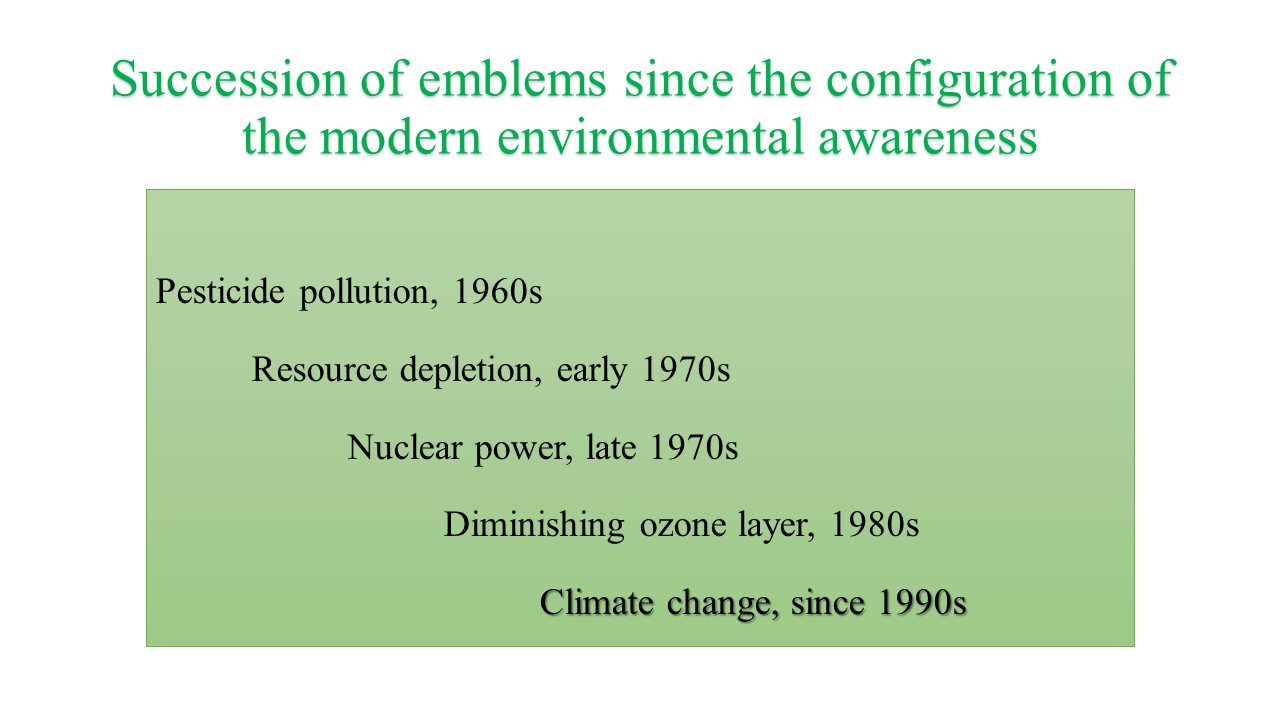
The planetary ecological deterioration continues unabated despite half a century of global environmental concern and three decades promoting sustainable development. In addition, this period has not served to consolidate an awareness congruent with the nature of the eco-social crisis for most of the population. The paradigm of economic growth is still hegemonic, while the emergence of climate change as the latest environmental emblem has resulted in a modification of the mental frame through which individuals comprehend socio-natural interactions and, consequently, the imperatives for global sustainability. Today, a common misconception is the belief that climate change is the main factor of the contemporary ecological deterioration, and that an eventual decarbonisation of the economy will be sufficient to resolve the eco-social crisis. In contrast to other environmental concerns that have dominated public and political attention, such as the issue of resource scarcity, the rise and consolidation of climate change as an ‘environmental emblem’ is a consequence of its compatibility with the paradigm of economic growth. I argue that the prominence of climate change in environmental discourse, while undoubtedly raising awareness of one of the core planetary boundaries, has, in reality, actively hindered a holistic comprehension of the eco-social crisis. Its alignment and promotion within the growth paradigm is fostering a ‘decarbonisation-only’ mindset that obscures and misrepresents other vital planetary boundaries, such as the biosphere integrity. This perspective paper examines the ascendancy of climate change, considering its cognitive and political implications, before proposing targeted measures to make meaningful progress in both awareness and mitigation policies.
- Open Access
- Perspective
Beyond Carbon Tunnel Vision: How Climate Change Hegemony Distorts Environmental Awareness and Hinders Comprehensive Action
Author Information
Received: 03 Nov 2025 | Revised: 01 Jan 2026 | Accepted: 02 Feb 2026 | Published: 12 Feb 2026
Abstract
Graphical Abstract
Keywords
carbon tunnel vision | climate change | discourse analysis | environmental perception | growth paradigm | planetary boundaries
References
- 1.
UNEP. Global Environmental Outlook, GEO-6: Summary for Policymakers; United Nations Environment Programme: Nairobi, Kenya, 2019.
- 2.
IPCC. Synthesis Report of the IPCC Sixth Assessment Report (AR6)—Summary for Policymakers; Cambridge University Press: Cambridge, UK, 2021.
- 3.
McElwee, P.D.; Harrison, P.A.; van Huysen, T.L.; et al. IPBES Nexus Assessment: Summary for Policymakers; IPBES: Bonn, Germany, 2025.
- 4.
Ceballos, G.; Ehrlich, P.R.; Barnosky, A.D.; et al. Accelerated Modern Human–Induced Species Losses: Entering the Sixth Mass Extinction. Sci. Adv. 2015, 1, e1400253.
- 5.
WMO. WMO Confirms 2024 as Warmest Year on Record at about 1.55 °C Above Pre-Industrial Level; World Meteorological Organization: Geneva, Switzerland, 2025. Available online: https://wmo.int/news/media-centre/wmo-confirms-2024-warmest-year-record-about-155degc-above-pre-industrial-level (accessed on 30 October 2025).
- 6.
Pelletier, N. Of Laws and Limits: An Ecological Economic Perspective on Redressing the Failure of Contemporary Global Environmental Governance. Glob. Environ. Chang. 2010, 20, 220–228.
- 7.
Steffen, W.; Broadgate, W.; Deutsch, L.; et al. The Trajectory of the Anthropocene: The Great Acceleration. Anthropocene Rev. 2015, 2, 81–98.
- 8.
Krausmann, F.; Lauk, C.; Haas, W.; et al. From Resource Extraction to Outflows of Wastes and Emissions: The Socioeconomic Metabolism of the Global Economy, 1900–2015. Glob. Environ. Chang. 2018, 52, 131–140.
- 9.
Kennedy, C.M.; Oakleaf, J.R.; Theobald, D.M.; et al. Global Human Modification of Terrestrial Systems. In NASA Socioeconomic Data and Applications Center (SEDAC) Data Set; SEDAC: Palisades, NY, USA, 2020.
- 10.
Rockström, J.; Gupta, J.; Qin, D.; et al. Safe and Just Earth System Boundaries. Nature 2023, 619, 102–111.
- 11.
Kallis, G. Degrowth; Agenda Publishing: Newcastle upon Tyne, UK, 2018.
- 12.
Nair, C. The Limits to Growth in the Asian Century. In Limits and Beyond: 50 Years on from The Limits to Growth, What Did We Learn and What’s Next? A Report to the Club of Rome; Bardi, U., Alvarez, C., Eds.; Exapt Press: London, UK, 2022.
- 13.
Drews, S.; Van Den Bergh, J.C. Public Views on Economic Growth, the Environment and Prosperity: Results of a Questionnaire Survey. Glob. Environ. Chang. 2016, 39, 1–14.
- 14.
Dunlap, R.E. Trends in Public Opinion Toward Environmental Issues: 1965–1990. Soc. Nat. Resour. 1991, 4, 285–312.
- 15.
Hajer, M.A. The Politics of Environmental Discourse: Ecological Modernization and the Policy Process; Oxford University Press: Oxford, UK, 1997.
- 16.
Dryzek, J.S. The Politics of the Earth: Environmental Discourses; Oxford University Press: Oxford, UK, 2022.
- 17.
Thunberg, G. No One Is Too Small to Make a Difference; Penguin: New York, USA, 2019.
- 18.
Cullis-Suzuki, S. Severn Suzuki: Speech at U.N. Conference on Environment and Development. American Rhetoric: Online Speech Bank. Available online: https://www.americanrhetoric.com/speeches/severnsuzukiunearthsummit.htm (accessed on 23 July 2025).
- 19.
Takala, M. Environmental Awareness and Human Activity. Int. J. Psychol. 1991, 26, 585–597.
- 20.
Veríssimo, D.; MacMillan, D.C.; Smith, R.J.; et al. Has Climate Change Taken Prominence Over Biodiversity Conservation? BioScience 2014, 64, 625–629.
- 21.
Crist, E. Beyond the Climate Crisis: A Critique of Climate Change Discourse. Telos 2007, 141, 29–55.
- 22.
Hulme, M. Climate Emergency Politics Is Dangerous. Issues Sci. Technol. 2019, 36, 23–25.
- 23.
Konietzko, J. Moving Beyond Carbon Tunnel Vision with a Sustainability Data Strategy. Forbes, 7 April 2022. Available online: www.forbes.com/sites/cognizant/2022/04/07/moving-beyond-carbon-tunnel-vision-with-a-sustainability-data-strategy/?sh=74e6b69670a7 (accessed on 9 January 2026).
- 24.
Hajer, M.; Versteeg, W. A Decade of Discourse Analysis of Environmental Politics: Achievements, Challenges, Perspectives. J. Environ. Policy Plan. 2005, 7, 175–184.
- 25.
Leipold, S.; Feindt, P.H.; Winkel, G.; et al. Discourse Analysis of Environmental Policy Revisited: Traditions, Trends, Perspectives. J. Environ. Policy Plan. 2019, 21, 445–463.
- 26.
Stevenson, H. Contemporary Discourses of Green Political Economy: A Q Method Analysis. J. Environ. Policy Plan. 2019, 21, 533–548.
- 27.
Lakoff, G. Why It Matters How We Frame the Environment. Environ. Commun. 2010, 4, 70–81.
- 28.
Schuldt, J.P.; Roh, S. Media Frames and Cognitive Accessibility: What Do “Global Warming” and “Climate Change” Evoke in Partisan Minds? Environ. Commun. 2014, 8, 529–548.
- 29.
Stecula, D.A.; Merkley, E. Framing Climate Change: Economics, Ideology, and Uncertainty in American News Media Content from 1988 to 2014. Front. Commun. 2019, 4, 6.
- 30.
Cohen, S.; Demeritt, D.; Robinson, J.; et al. Climate Change and Sustainable Development: Towards Dialogue. Glob. Environ. Chang. 1998, 8, 341–371.
- 31.
Taylor, C. The Discourses of Climate Change. In Climate Change and Global Policy Regimes: Towards Institutional Legitimacy; Palgrave Macmillan: London, UK, 2013; pp. 17–31.
- 32.
Fosado-Centeno, E. The Socio-Political Construction of Climate Change: Looking for Paths to Sustainability and Gender Justice. Sustainability 2020, 12, 3382.
- 33.
Casellas, A. La Geografía Crítica y el Discurso de la Sostenibilidad. Perspectivas y Acciones. Doc. Anàl. Geogr. 2010, 56, 573–581.
- 34.
Knox-Hayes, J.; Hayes, J. Technocratic Norms, Political Culture and Climate Change Governance. Geogr. Ann. B 2014, 96, 261–276.
- 35.
Fressoz, J.B. Sin Transición. Una Nueva Historia de la Energía; Arpa: Barcelona, Spain, 2025.
- 36.
Bonneuil, C.; Choquet, P.L.; Franta, B. Early Warnings and Emerging Accountability: Total’s Responses to Global Warming, 1971–2021. Glob. Environ. Chang. 2021, 71, 102386.
- 37.
European Commission. Europeans’ Attitudes Towards Climate Change; European Commission: Brussels, Belgium, 2008.
- 38.
Hermansen, E.A.; Boasson, E.L.; Peters, G.P. Climate Action Post-Paris: How Can the IPCC Stay Relevant? NPJ Clim. Action 2023, 2, 30.
- 39.
Oreskes, N. The Scientific Consensus on Climate Change. Science 2004, 306, 1686.
- 40.
Kempton, W. Lay Perspectives on Global Climate Change. Glob. Environ. Chang. 1991, 1, 183–208.
- 41.
Nisbet, M.C.; Myers, T. The Polls—Trends: Twenty Years of Public Opinion About Global Warming. Public Opin. Q. 2007, 71, 444–470.
- 42.
Sampei, Y.; Aoyagi-Usui, M. Mass-Media Coverage, Its Influence on Public Awareness of Climate-Change Issues, and Implications for Japan’s National Campaign to Reduce Greenhouse Gas Emissions. Glob. Environ. Chang. 2009, 19, 203–212.
- 43.
Risbey, J.S. The New Climate Discourse: Alarmist or Alarming? Glob. Environ. Chang. 2008, 18, 26–37.
- 44.
Hulme, M. The Conquering of Climate: Discourses of Fear and Their Dissolution. Geogr. J. 2008, 174, 5–16.
- 45.
Nisbet, M. Communicating Climate Change: Why Frames Matter for Public Engagement. Environment 2009, 51, 12–23.
- 46.
Gore’s Organization to Spend $300M on Climate Change Campaign. 31 March 2008. Available online: https://www.cbc.ca/news/world/gore-s-organization-to-spend-300m-on-climate-change-campaign-1.710167 (accessed on 2 December 2025).
- 47.
Legagneux, P.; Casajus, N.; Cazelles, K.; et al. Our House Is Burning: Discrepancy in Climate Change vs. Biodiversity Coverage in the Media as Compared to Scientific Literature. Front. Ecol. Evol. 2018, 5, 297310.
- 48.
Happer, C.; Philo, G. New Approaches to Understanding the Role of the News Media in the Formation of Public Attitudes and Behaviours on Climate Change. Eur. J. Commun. 2016, 31, 136–151.
- 49.
Poushter, J.; Huang, C. Climate Change Still Seen as the Top Global Threat, but Cyberattacks Are a Rising Concern; Pew Research Center: Washington, DC, USA, 2019.
- 50.
McCright, A.M.; Dunlap, R.E.; Xiao, C. Increasing Influence of Party Identification on Perceived Scientific Agreement and Support for Government Action on Climate Change in the United States, 2006–2012. Weather Clim. Soc. 2014, 6, 194–201.
- 51.
Poushter, J.; Fagan, M.; Gubbala, S. Climate Change Remains Top Global Threat Across 19-Country Survey; Pew Research Center: Washington, DC, USA, 2022.
- 52.
WEF. The Global Risks Report 2023, 18th ed.; World Economic Forum: Cologny, Switzerland, 2023.
- 53.
CED. Climate Emergency Declarations in 2366 Jurisdictions and Local Governments Cover 1 Billion Citizens. Climate Emergency Declaration, 24 March 2025. Available online: https://climateemergencydeclaration.org/climate-emergency-declarations-cover-15-million-citizens/ (accessed on 12 January 2026).
- 54.
Agencies. Why the Guardian Is Changing the Language It Uses About the Environment. 17 May 2019. Available online: https://www.theguardian.com/environment/2019/may/17/why-the-guardian-is-changing-the-language-it-uses-about-the-environment (accessed on 12 December 2025).
- 55.
IPCC. Climate Change 2022: Mitigation of Climate Change. Contribution of Working Group III to the Sixth Assessment Report of the Intergovernmental Panel on Climate Change; Cambridge University Press: Cambridge, UK, 2022.
- 56.
Räthzel, N.; Uzzell, D. Changing Relations in Global Environmental Change. Glob. Environ. Chang. 2009, 19, 326–335.
- 57.
Fairclough, N. Discourse and Contemporary Social Change; Polity Press: Cambridge, UK, 1993.
- 58.
Wood, M.L.; Stoltz, D.S.; Van Ness, J.; et al. Schemas and Frames. Sociol. Theory 2018, 36, 244–261.
- 59.
Lakoff, G. No Pienses en un Elefante: Lenguaje y Debate Político; Editorial Complutense: Madrid, Spain, 2007.
- 60.
Maxwell, S.L.; Fuller, R.A.; Brooks, T.M.; et al. Biodiversity: The Ravages of Guns, Nets and Bulldozers. Nature 2016, 536, 143–145.
- 61.
Dobson, A.; Rowe, Z.; Berger, J.; et al. Biodiversity Loss Due to More Than Climate Change. Science 2021, 374, 699–700.
- 62.
Laurent, A.; Olsen, S.I.; Hauschild, M.Z. Limitations of Carbon Footprint as Indicator of Environmental Sustainability. Environ. Sci. Technol. 2012, 46, 4100–4108.
- 63.
Ivanova, D.; Barrett, J.; Wiedenhofer, D.; et al. Quantifying the Potential for Climate Change Mitigation of Consumption Options. Environ. Res. Lett. 2020, 15, 093001.
- 64.
La ONU Advierte de Que el Cambio Climático Es la Peor Amenaza Para el Mundo. El Periódico de la Energía, 15 May 2018. Available online: https://elperiodicodelaenergia.com/la-onu-advierte-de-que-el-cambio-climatico-es-la-peor-amenaza-para-el-mundo/ (accessed on 30 October 2025).
- 65.
Grohol, M.; Veeh, C. Study on the Critical Raw Materials for the EU 2023—Final Report; Publications Office of the European Union: Luxembourg, 2023.
- 66.
Valero, A.; Valero, A.; Calvo, G.; et al. Global Material Requirements for the Energy Transition. An Exergy Flow Analysis of Decarbonisation Pathways. Energy 2018, 159, 1175–1184.
- 67.
Patterson, J.; Wyborn, C.; Westman, L.; et al. The Political Effects of Emergency Frames in Sustainability. Nat. Sustain. 2021, 4, 841–850.
- 68.
Clémençon, R. Is Sustainable Development Bad for Global Biodiversity Conservation? Glob. Sustain. 2021, 4, e16.
- 69.
Meadows, D.H.; Meadows, D.H.; Randers, J.; et al. The Limits to Growth: A Report to the Club of Rome; Univers Books: Brooklyn, NY, USA, 1972.
- 70.
Turiel, A. Petrocalipsis: Crisis Energética Global y Cómo (No) la Vamos a Solucionar; Editorial Alfabeto: Madrid, Spain, 2020.
- 71.
Lawrence, M.; Homer-Dixon, T.; Janzwood, S.; et al. Global Polycrisis: The Causal Mechanisms of Crisis Entanglement. Glob. Sustain. 2024, 7, e6.
- 72.
Mark, S.; Holder, S.; Hoyer, D.; et al. Understanding Polycrisis: Definitions, Applications, and Responses. Glob. Sustain. 2025, 8, e35.
- 73.
Aquilonius, J. Climate Course to Be Compulsory in Barcelona. Universitetsläraren, 24 October 2023. Available online: https://universitetslararen.se/2023/10/24/climate-course-to-be-compulsory-in-barcelona/ (accessed on 30 June 2025).
- 74.
Forés, E. Com Comunicar la Crisi Climàtica? Estat de la Qüestió i Recomanacions Deontològiques per a Periodistes; Fundació Consell de la Informació de Catalunya: Barcelona, Spain, 2024.
- 75.
Niemeyer, S.; Dryzek, J.S. The Ends of Deliberation: Meta-Consensus and Inter-Subjective Rationality as Ideal Outcomes. Swiss Polit. Sci. Rev. 2007, 13, 497–526.
- 76.
Dryzek, J.S.; Pickering, J. Deliberation as a Catalyst for Reflexive Environmental Governance. Ecol. Econ. 2017, 131, 353–360.


This work is licensed under a Creative Commons Attribution 4.0 International License.

 Suite 4002 Level 4, 447 Collins Street, Melbourne, Victoria 3000, Australia
 General Inquiries: info@sciltp.com