
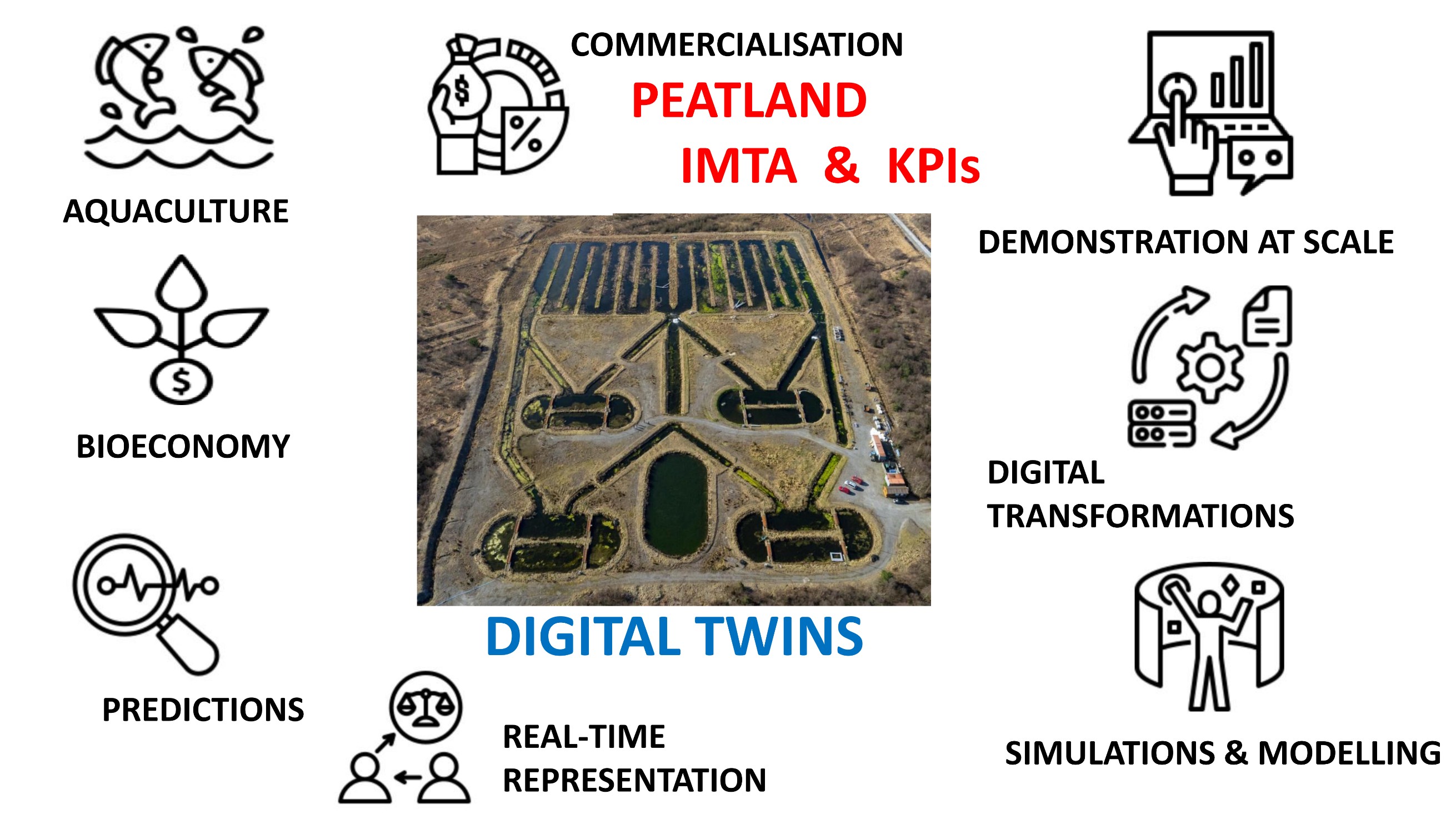
Developing the bioeconomy is important for resource management, food security and to protect our fragile environment. Critical to meeting emerging circular ambitions is the effective demonstration of viable biobased products at scale for appropriate business models and to mitigate risk. This case study addresses the use of digital twins (DTs) to support development of a novel integrated-multitrophic aquaculture (IMTA) demonstration site in the Irish peatlands for various needs using a living laboratory concept. It highlights the role of harnessing cross-cutting multi-actors for advancing DTs across this IMTA site such as using an integrated Penta Helix hub framework that intimates key measurement and performance indicators for the bioeconomy sector. Combinational use of such digital tools will advance eco-innovation along with linked educational and societal needs from a bottom-up user perspective that will commensurately tailor top-down local and regional policies with a global orientation. Clustering and connecting bioeconomy demonstration activities using DTs will potentially meet expectations for real time diversification and added value that will inform regional resilience, competitiveness and job creations.
- Open Access
- Review
A Digital Living Laboratory Approach to Determine Appropriate Key Performance Indicators for Advancing Needs of Bioeconomy Sector Using a Peatland-Based Integrated Multitrophic Aquaculture Demonstration Site—A Perspective
- Qian Wang 1,
- Yuansong Qiao 1,
- Antoine Fort 2,
- Emer A. O’Neil 2,
- Damien Toner 3,
- Eoghan Clifford 4, 5,
- Bernardete Rodrigues 4, 5 and
- Neil J. Rowan 2, 5, 6, *
Author Information
Received: 26 October 2025 | Revised: 28 February 2026 | Accepted: 02 March 2026 | Published: 12 March 2026
Abstract
Graphical Abstract
Keywords
digital twin | living laboratory | bioeconomy policy | key performance indicators | IMTA | innovation helix hubs
References
- 1.
Rowan, N.J. Peatlands-based demonstration of bioeconomy innovations at scale to help achieve many of the United Nation’s Sustainable Development Goals. Resour. Environ. Sustain. 2025, 21, 100238. https://doi.org/10.1016/j.resenv.2025.100238.
- 2.
Skondras, A.; Nastis, S.A.; Skalidi, I.; et al. Governance Strategies for Sustainable Circular Bioeconomy Development in Europe: Insights and Typologies. Sustainability 2024, 16, 5140. https://doi.org/10.3390/su16125140.
- 3.
Tan, E.C.D.; Lamers, P. Circular Bioeconomy Concepts—A Perspective. Front. Sustain. 2021, 2, 701509. https://doi.org/10.3389/frsus.2021.701509.
- 4.
Ellen MacArthur Foundation. What Is a Circular Economy? 2019. Available online: https://www.ellenmacarthurfoundation.org/circular-economy/concept (accessed on 17 October 2025).
- 5.
Dietz, T.; Börner, J.; Förster, J.J.; et al. Governance of the bioeconomy: A global comparative study of national bioeconomy strategies. Sustainability 2018, 10, 3190.
- 6.
Rowan, N.J.; Murray, N.; Qiao, Y.; et al. Digital transformation of peatland eco-innovations (“Paludiculture”): Enabling a paradigm shift towards the real-time sustainable production of “green-friendly” products and services. Sci. Total Environ. 2022, 838, 156328. https://doi.org/10.1016/j.scitotenv.2022.156328.
- 7.
Rowan, N.J. The role of digital technologies in supporting and improving fishery and aquaculture across the supply chain—Quo Vadis? Aquac. Fish. 2023, 8, 365–374.
- 8.
Galanakis, C.M.; Rizou, M.; Aldawoud, T.M.S.; et al. Innovations and technology disruptions in the food sector within the COVID-19 pandemic and post-lockdown era. Trends Food Sci. Technol. 2021, 110, 193–200.
- 9.
O’Neill, E.A.; Rowan, N.J.; Fogarty, A.M. Novel use of the alga Pseudokirchneriella subcapitata, as an early-warning indicator to identify climate change ambiguity in aquatic environments using freshwater finfish as a case study. Sci. Total Environ. 2019, 692, 209–218.
- 10.
O’Neill, E.A.; Rowan, N.J. Microalgae as a natural ecological bioindicator for the simple real-time monitoring of aquaculture wastewater quality including provision for assessing impact of extremes in climate variance—A comparative case study from the Republic of Ireland. Sci. Total Environ. 2022, 802, 149800. https://doi.org/10.1016/j.scitotenv.2021.149800.
- 11.
Rowan, N.J.; Fort, A.; O’Neill, E.A.; et al. Development of a novel recirculatory multitrophic peatland system for the production of high-value bio-based products at scale embracing zero waste and pollution principles to unlock sustainable development goals. Case Stud. Chem. Environ. Eng. 2024, 9, 100763. https://doi.org/10.1016/j.cscee.2024.100763.
- 12.
Fletcher, S.; Saunders, J.; Herbert, R.; et al. Description of the Ecosystem Services Provided by Broad-Scale Habitats and Features of Conservation Importance: They are Likely to Be Protected by Marine Protected Areas in the Marine Conservation Zone Project Area. In Natural England Commissioned Reports; Number 088; Natural England: York, UK, 2012.
- 13.
Sakinah, L. Putting Indonesia’s Aquaculture Sector on the Map. The Fish Site. 2024. Available online: https://thefishsite.com/articles/putting-indonesia-aquaculture-sector-on-the-map-ita-sualia (accessed on 21 October 2025).
- 14.
Van Beijnen, J.; Yan, G. The Multi-Tropic Revolution: A Deep Dive with IMTA Guru Thierry Chopin. The Fish Site. 2024. Available online: https://thefishsite.com/articles/the-multi-trophic-revolution-a-deep-dive-with-imta-guru-thierry-chopin-polyculture-salmon-mussels-seaweed (accessed on 21 October 2025).
- 15.
Verdouw, C.; Tekinerdogan, B.; Beulens, A.; et al. Digital twins in smart farming. Agric. Syst. 2021, 189, 103046. https://doi.org/10.1016/j.agsy.2020.103046.
- 16.
Leng, J.; Wang, D.; Shen, W.; et al. Digital twins-based smart manufacturing system design in Industry 4.0: A review. J. Manuf. Syst. 2021, 60, 119–137. https://doi.org/10.1016/j.jmsy.2021.05.011.
- 17.
Belyaev, A.; Diedrich, C. Specification Demonstrator I4.0-Language, version 2.0; Otto-von-Guericke-University Magdeburg: Magdeburg, Germany, 2019.
- 18.
Falcão, R.; Matar, R.; Rauch, B.; et al. A Reference Architecture for Enabling Interoperability and Data Sovereignty in the Agricultural Data Space. Information 2023, 14, 197. https://doi.org/10.3390/info14030197.
- 19.
Falcão, R.; Matar, R.; Rauch, B. Using I4.0 Digital Twins in Agriculture. In Software Architecture, ECSA 2022 Tracks and Workshops; Batista, T., Bureš, T., Raibulet, C.; et al., Eds.; Springer International Publishing: Cham, Switzerland, 2023; pp. 483–498. https://doi.org/10.1007/978-3-031-36889-9_32.
- 20.
Yue, K.; Shen, Y. An overview of disruptive technologies for aquaculture. Aquac. Fish. 2022, 7, 111–120. https://doi.org/10.1016/j.aaf.2021.04.009.
- 21.
Precision Aquaculture: A Short Review on Engineering Innovations | Aquaculture International. Available online: https://link.springer.com/article/10.1007/s10499-019-00443-w (accessed on 14 October 2025).
- 22.
Le, N.-B.-V.; Huh, J.-H. AgTech: Building Smart Aquaculture Assistant System Integrated IoT and Big Data Analysis。 IEEE Trans. Agri. Food Electron. 2024, 2, 471–482. https://doi.org/10.1109/TAFE.2024.3416415.
- 23.
Pontus-X Ecosystem. Available online: https://www.pontus-x.eu/#ecosystem (accessed on 16 October 2025).
- 24.
Rowan, N.J.; Casey, O. ‘Empower Eco’ multi-actor HUB: A triple helix ‘academia-industry-authority’ approach to creating and sharing potentially disruptive tools for addressing novel and emerging new Green Deal opportunities under a United Nations Sustainable Development Goals framework. Curr. Opin. Environ. Sci. Health 2021, 21, 100254. https://doi.org/10.1016/j.coesh.2021.100254.
- 25.
Richter, S.; Szarka, N.; Beama, A.; et al. Enhancing the circular bioeconomy transition in Germany: A systematic scenario analysis. Sustain. Prod. Consum. 2025, 53, 125–146.
- 26.
Naughton, S.; Kavanagh, S.; Lynch, M.; et al. Synchronizing use of sophisticated wet-laboratory and in-field handheld technologies for real-time monitoring of key microalgae, bacteria and physicochemical parameters influencing efficacy of water quality in a freshwater aquaculture recirculation system: A case study from the Republic of Ireland. Aquaculture 2020, 526, 735377. https://doi.org/10.1016/j.aquaculture.2020.735377.
- 27.
O’Neill, E.A.; Bennett, M.M.K.; Rowan, N.J. Peatland-based innovation can potentially support and enable the sustainable development goals of the United Nations: Case study from the Republic of Ireland. Case Stud. Chem. Environ. Eng. 2022, 6, 100251. https://doi.org/10.1016/j.cscee.2022.100251.
- 28.
EU Just Transition Fund—Bioeconomy Demonstration Call Two, Available online: https://www.emra.ie/eu-jtf-bioeconomy-demonstration-initiative-scheme-call-2/ (accessed on 26 October 2025).
- 29.
Ruiz-Salmon, I.; Laso, J.; Margallo, M.; et al. Life cycle assessment of fish and seafood processed products—A review of methodologies and new challenges. Sci. Total Environ. 2021, 761, 144094. https://doi.org/10.1016/j.scitotenv.2020.144094
- 30.
O’Neill, E.A.; Morse, A.P.; Rowan, N.J. Effects of climate and environmental variance on the performance of a novel peatland-based integrated multi-trophic aquaculture (IMTA) system: Implications and opportunities for advancing research and disruptive innovation post COVID-19 era. Sci. Total Environ. 2022, 819, 153073. https://doi.org/10.1016/j.scitotenv.2022.153073.
- 31.
Brasil, J.A.T.; de Macedo, M.B.; de Oliveria, P.; et al. Can we scale digital twins of nature –based solutions for stormwater and transboundary water security projects. Hydroinformatics 2022, 24, 749–764. https://doi.org/10.2166/hydro.2022.142.
- 32.
Wang, A.J.; Li, H.; He, Z.; et al. Digital twins for wastewater treatment: A technical review. Engineering 2024, 36, 21–35. https://doi.org/10.1016/j.eng.2024.04.012.
- 33.
Rowan, N.J. Operational Research Underpinning the Development of a Novel Integrated Multi-Trophic Aquaculture (IMTA) Peatlands-Based System for Demonstrating the Bioeconomy. Appl. Sci. 2026, 16, 1583. https://doi.org/10.3390/app16031583.
- 34.
Rowan, N.J. Embracing a Penta helix hub framework for co-creating sustaining and potentially disruptive sterilization innovation that enables artificial intelligence and sustainability: A scoping review. Sci. Total Environ. 2025, 972, 179018. https://doi.org/10.1016/j.scitotenv.2025.179018.
- 35.
Rowan, N.J. Digital technologies to unlock safe and sustainable opportunities for medical device and healthcare sectors with a focus on the combined use of digital twin and extended reality applications: A review. Sci. Total Environ. 2024, 926, 171672. https://doi.org/10.1016/j.scitotenv.2024.171672.
- 36.
McBride, O. Shared Island Bioeconomy Demonstration Initiative Launched. The Fishing Daily. 2024. Available online: https://thefishingdaily.com/latest-news/shared-island-bioeconomy-demonstration-initiative-launched/ (accessed on 15 October 2025).
- 37.
Sachs, J.D.; Lafortune, G.; Fuller, G.; et al. Implementing the SDG Stimulus. In Sustainable Development Report 2023; Dublin University Press: Dublin, Ireland, 2023. https://doi.org/10.25546/102924.
- 38.
O’Neill, E.; Jansen, M.; Tiwari, B.; et al. Development of IMTA-based bioeconomy sites in peatlands for change of land use to green innovation that promotes zero-waste, zero-pollution and climate-action principles. In Degrowth and Green Growth, Sustainable Innovation. IntechOpen: London, UK, 2024.
- 39.
Tahar, A.; Kennedy, A.; Fitzgerald, R.; et al. Full water quality monitoring of a traditional flow through rainbow trout farm. Fishes, 2018, 3, 28. https://doi.org/10.3390/fishes3030028.
- 40.
Rowan, N.J.; Galanakis, C.M. Unlocking challenges and opportunities presented by COVID-19 pandemic for cross-cutting disruption in agri-food and green deal innovations: Quo Vadis? Sci. Total Environ. 2020, 748, https://doi.org/10.1016/j.scitotenv.2020.141362.
- 41.
Almeida, C.; Loubet, P.; Pacheco da Costa, T.; et al. Packaging environmental impact on seafood supply chains: A review of life cycle assessment studies. J. Industrial Ecol. 2022, 26, 1961-1978. https://doi.org/10.1111/jiec.13189.
- 42.
Rowan N.J.; Pogue, R. Editorial overview: Green new deal era—Current challenges and emerging opportunities for developing sustaining and disruptive innovation. Current Opin. Environ. Sci. Health 2021. 22, https://doi.org/10.1016/j.coesh.2021.100294.
- 43.
Cooney, R.; Baptista de Sousa, D.; Fernandez Rios Mellett, S.; et al. A circular economy framework for seafood waste valorisation to meet challenges and opportunities for intensive production and sustainability. J. Clean. Prod. 2023, 392, 136283. https://doi.org/10.1016/j.jclepro.2023.136283.
- 44.
Pogue R.; Murphy, E.; Fehrenbach, G.W.; et al. Exploiting immunomodulatory properties of β-glucans derived from natural products for improving health and sustainability in aquaculture-farmed organisms: Concise review of existing knowledge, innovation and future opportunities. Current Opin. Environ. Sci. Health, 2021, 21, https://doi.org/10.1016/j.coesh.2021.100248.
- 45.
O’Neill, E.A.; Fehrenbach, G.; Murphy, E.; et al. Use of next generation sequencing and bioinformatics for profiling freshwater eukaryotic microalgae in a novel peatland integrated multi-trophic aquaculture (IMTA) system: Case study from the Republic of Ireland. Sci. Total Environ. 2022, 851, 158392. https://doi.org/10.1016/j.scitotenv.2022.158392.
- 46.
Domegan, C. Social marketing and behavioural change in a systems setting. Curr. Opin. Environ. Sci. Health. 2021, 23, 100275. https://doi.org/10.1016/j.coesh.2021.100275.
- 47.
Rowan N. J. Current decontamination challenges and potentially complementary solutions to safeguard the vulnerable seafood industry from recalcitrant human norovirus in live shellfish: Quo Vadis? Sci. Total Environ. 2023, 874, https://doi.org/10.1016/j.scitotenv.2023.162380.
- 48.
Kremer, T.; Murray, N.; Buckley, J.; et al. Use of real-time immersive digital training and educational technologies to improve patient safety during the processing of reusable medical devices: Quo Vadis? Sci. Total Environ. 2023, 900, 165673. https://doi.org/10.1016/j.scitotenv.2023.165673.
- 49.
Schuelke-Leech, B.A. A model for understanding the orders of magnitude of disruptive technologies. Technol. Forecast. Soc. Chang. 2018, 129, 261–274. https://10.1016/j.techfore.2017.09.033.
- 50.
Wan-Mohtar, W.; IIham, Z.; Rowan, N.J. The value of microbial bioreactors to meet challenges in the circular bioeconomy. Front. Bioeng. Biotechnol. 2023, 11, 1181822. https://doi.org/10.3389/fbioe.2023.1181822.
- 51.
Zhang, Y.; Ishikawa, M.; Jiang, N.; et al. Fermentation-Based Strategies for the Feed Industry: Nutritional Augmentation, Environmental Sustainability. Fermentation 2026, 12, 103. https://doi.org/10.3390/fermentation12020103.
- 52.
Coronado-Contreras, S.A.; Ibarra-Manzanares, Z.G.; Casas-Rodriguez, A.D.; et al. Bio-Circular Economy and Digitalization: Pathways for Biomass Valorization and Sustainable Biorefineries. Biomass 2026, 6, 1. https://doi.org/10.3390/biomass6010001.
- 53.
Keohavong, B. Digital innovation integration into biotechnology for development of sustainable protein frontiers for poultry nutrition in a circular bioeconomy. Poult. Sci. 2026, 105, 106276. https://doi.org/10.1016/j.psj.2025.106276.
- 54.
Nneonma, U.C.; Chekwudi, O.F.; Nnenna, U.J.; et al. Hybrid biofactories: Integrating microalgae and engineered microbiomes for enhanced biofuel production in circular carbon systems. Front. Energy Res. 2025, 13, 1654079. https://doi.org/10.3389/fenrg.2025.1654079.
- 55.
Fabris, M.; Abbriano, R.M.; Pernice, M.; et al. Emerging Technologies in Algal Biotechnology: Toward the Establishment of a Sustainable, Algae-Based Bioeconomy. Front. Plant Sci. 2020, 11, 279. https://doi.org/10.3389/fpls.2020.00279.
- 56.
Peladarinos, N.; Piromalis, D.; Cheimaras, V.; et al. Enhancing Smart Agriculture by Implementing Digital Twins: A Comprehensive Review. Sensors 2023, 23, 7128; https://doi.org/10.3390/s23167128.
- 57.
O’Neill, E.A.; Rowan, N.J. Potential disruptive effects of zoosporic parasites on peatland-based organic freshwater aquaculture: Case study from the Republic of Ireland. Sci. Total Environ. 2023, 868, 161495. https://doi.org/10.1016/j.scitotenv.2023.161495.


This work is licensed under a Creative Commons Attribution 4.0 International License.
