
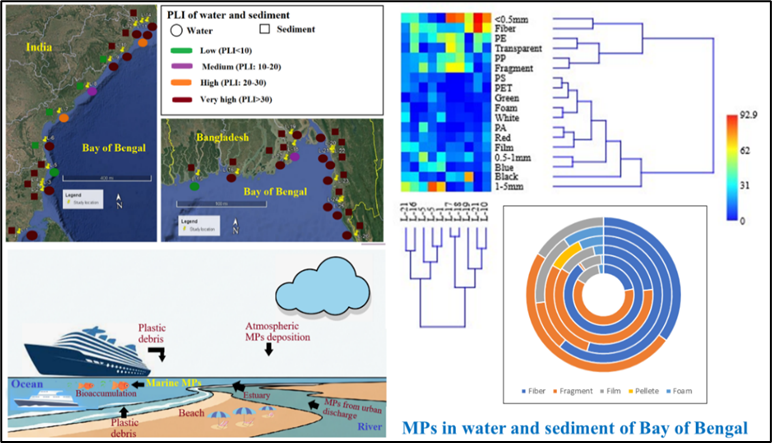
- Microplastic abundance in the Bay of Bengal reached up to 263,000 MPs/m3 in water and 815 MPs/kg in sediment.
- Transparent and white MPs dominated, with size <1 mm
- Polyethylene was the most prevalent polymer, followed by PP, PA, PS, and PET.
- Over 75% of water and 83% of sediment sites exceeded extreme pollution thresholds.
- Marine microplastics pathways highlight their transboundary nature, driven by riverine, land-based, oceanic, and atmospheric inputs.
- Open Access
- Review
Characterization, Risk, and Pathway of Microplastics in Coastal Areas of the Bay of Bengal: A Systematic Review and Quantitative Synthesis
Author Information
Received: 15 Jan 2026 | Revised: 10 Mar 2026 | Accepted: 17 Mar 2026 | Published: 24 Mar 2026
Highlights
Abstract
Microplastics (MPs) have become a global concern, as they are widespread in aquatic environments and pose ecological risk, which threatens both marine and freshwater organisms. This study seeks to provide a comparative and comprehensive illustration of MP pollution in the water and sediments of the Bay of Bengal coastal areas, including islands, estuaries, and beaches. It also highlights associated risks and pathways of microplastics. The analysis is based on data reported in peer-reviewed publications from the past decade. The study found microplastics in water varied widely, from 2.35 to 263,000 MPs/m3, while sediments ranged between 1 and 815 MPs/kg. The highest levels were observed at the Thoothukudi coast in water samples and the Muttukadu backwater estuary in sediments. Transparent and white colored particles were reported as dominant in 53% and 65% studies on water and sediment, respectively, which were largely linked to packaging items, plastic bags, and other disposable materials. Microplastics sizes <1 mm were the most prevalent in the study area, which may result from the extensive degradation of plastic debris. Fibers and fragments were the dominant shapes in both water and sediment that may come from synthetic textiles, fishing gear, packaging materials, etc. Polyethylene was the most frequently reported polymer, with packaging materials and single-use plastics being possible sources, followed by polypropylene, polyamide, polystyrene, and PET. Statistical analyses, including Pearson’s correlation, PCA, and HCA, showed correlations among shapes, colors, sizes, and polymers, reflecting multiple pollution sources. Risk assessments through PLI, PHI, and ERI indices revealed that most sites exceeded extreme pollution thresholds, highlighting serious ecological threats to biodiversity and human health. Therefore, integrated regional strategies are urgently needed to mitigate this issue.
Graphical Abstract
Keywords
microplastics | abundance | risk assessment | pathway | Bay of Bengal
References
- 1.
Tang, L.; Feng, J.C.; Li, C.; et al. Global occurrence, drivers, and environmental risks of microplastics in marine environments. J. Environ. Manag. 2023, 329, 116961.
- 2.
Arat, S.A. An overview of microplastic in marine waters: Sources, abundance, characteristics and negative effects on various marine organisms. Desalination Water Treat. 2024, 317, 100138.
- 3.
Yang, H.; Chen, G.; Wang, J. Microplastics in the marine environment: Sources, fates, impacts and microbial degradation. Toxics 2021, 9, 41.
- 4.
Shakil, M.S.Z.; Mostafa, M.G. Source, identification, distribution, and abundance of microplastics in rivers and their ecological impacts: A review. Environ. Ecosyst. Sci. 2025, 9, 48–56.
- 5.
Mia, M.S.; Islam, A.R.M.T.; Ali, M.M.; et al. Microplastics in sediment and surface water from an island ecosystem in Bay of Bengal. Reg. Stud. Mar. Sci. 2024, 69, 103332.
- 6.
Yousuf, A.H.M.; Shampa, M.T.A.; Rifat, M.N.H.; et al. Microplastics in the Bay of Bengal: A critical review of bioaccumulation and ecological impacts across Bangladesh. J. Sea Res. 2025, 207, 102615.
- 7.
Jolaosho, T.L.; Rasaq, M.F.; Omotoye, E.V.; et al. Microplastics in freshwater and marine ecosystems: Occurrence, characterization, sources, distribution dynamics, fate, transport processes, potential mitigation strategies, and policy interventions. Ecotoxicol. Environ. Saf. 2025, 294, 118036.
- 8.
Kushwaha, M.; Shankar, S.; Goel, D.; et al. Microplastics pollution in the marine environment: A review of sources, impacts and mitigation. Mar. Pollut. Bull. 2024, 209, 117109.
- 9.
Grattagliano, A.; Grattagliano, Z.; Manfra, L.; et al. An Overview on Microplastics Hazards to the Marine Ecosystem and Humans’ Health. Water 2025, 17, 916.
- 10.
Chen, X.; Yu, X.; Zhang, L.; et al. Organic pollutants adsorbed on microplastics: Potential indicators for source appointment of microplastics. J. Hazard. Mater. 2024, 465, 133225.
- 11.
Bi, S.; Liu, S.; Liu, E.; et al. Adsorption behavior and mechanism of heavy metals onto microplastics: A meta-analysis assisted by machine learning. Environ. Pollut. 2024, 360, 124634.
- 12.
Keerthika, K.; Padmavathy, P.; Rani, V.; et al. Spatial, seasonal and ecological risk assessment of microplastics in sediment and surface water along the Thoothukudi, south Tamil Nadu, south east India. Environ. Monit. Assess. 2022, 194, 820.
- 13.
Islam, K.R.; Debnath, P.C.; Rahman, M.S.; et al. Tracing the Journey of Microplastics in the Northern Bay of Bengal Marine Ecosystems, Bangladesh: A Comprehensive Study on Source Appointments, Distribution, and Potential Risks. J. Hazard. Mater. Adv. 2025, 19, 100829.
- 14.
Shamseer, L.; Moher, D.; Clarke, M.; et al. Preferred reporting items for systematic review and meta-analysis protocols (PRISMA-P) 2015: Elaboration and explanation. BMJ 2015, 349, g7647.
- 15.
Moher, D.; Shamseer, L.; Clarke, M.; et al. Preferred reporting items for systematic review and meta-analysis protocols (PRISMA-P) 2015 statement. Syst. Rev. 2015, 4, 1.
- 16.
Harikrishnan, S.; Senthil Nathan, D.; Sridharan, M.; et al. Characterisation and distribution of microplastics in the inner shelf sediments of the southeast coast of India, Bay of Bengal. J. Earth Syst. Sci. 2024, 133, 116.
- 17.
Nithin, A.; Sundaramanickam, A.; Saha, M.; et al. Risk assessments of microplastics accumulated in estuarine sediments at Cuddalore, Tamil Nadu, southeast coast of India. Environ. Monit. Assess. 2023, 195, 890.
- 18.
Joshi, C.; Phyllei, S.W.E.; Bhatt, S.; et al. Microplastic surge in the Ariyankuppam river, Puducherry, India: A study on abundance, characterization, and pollution load index. J. Contam. Hydrol. 2025, 274, 104669.
- 19.
Ramakrishnan, D.; Sathiyamoorthy, M. Seasonal distribution, source apportionment and risk exposure of microplastic contaminants along the Muttukadu backwater estuary, Tamil Nadu, India. Results Eng. 2024, 23, 102776.
- 20.
Velmurugan, P.M.; Vijayaprabhakaran, K.; Anbuselvan, N.; et al. Microplastics pollution in tropical estuary (Muttukadu Backwater), Southeast Coast of India: Occurrence, distribution characteristics, potential sources and ecological risk assessment. J. Hazard. Mater. Adv. 2024, 16, 100521.
- 21.
Mandal, A.; Singh, N.; Mondal, A.; et al. The extent of microplastic pollution along the eastern coast of India: Focussing on marine waters, beach sand, and fish. Mar. Pollut. Bull. 2023, 194, 115265.
- 22.
Patidar, K.; Ambade, B.; Alshehri, M. Microplastics and associated polycyclic aromatic hydrocarbons in surface water and sediment of the Bay of Bengal coastal area, India: Sources, pathway and ecological risk. Environ. Geochem. Health 2024, 46, 176.
- 23.
Tripathy, B.; Sahoo, P.P.; Sundaray, H.; et al. In-vitro biodegradation of discarded marine microplastics across the eastern coast of the Bay of Bengal, India using Exiguobacterium sp. Environ. Chem. Ecotoxicol. 2024, 6, 236–247.
- 24.
Nayak, S.; Nayak, P.; Soren, S.; et al. First evidence of microplastics burden in surface waters of Budhabalanga Estuary, Chandipur, Eastern India: Potential threat to aquatic ecosystem. Appl. Biochem. Biotechnol. 2025, 197, 3447–3465.
- 25.
Rajan, K.; Khudsar, F.A.; Kumar, R. Spatio-temporal patterns of microplastic contamination in surface waters of Hooghly River Estuary: Causes and consequences. Reg. Stud. Mar. Sci. 2023, 65, 103111.
- 26.
Ahmed, A.S.S.; Billah, M.M.; Ali, M.M.; et al. Microplastic characterization and factors influencing its abundance in coastal wetlands: Insights from the world’s largest mangrove ecosystem, Sundarbans. Environ. Sci. Pollut. Res. 2025, 32, 5435–5456.
- 27.
Hossain, M.S.; Saifullah, A.S.M.; Uddin, M.J.; et al. Assessment of microplastics in coastal ecosystem of Bangladesh. Ecotoxicol. Environ. Saf. 2024, 281, 116622.
- 28.
Banik, P.; Hossain, M.B.; Nur, A.A.U.; et al. Microplastics in sediment of Kuakata Beach, Bangladesh: Occurrence, spatial distribution, and risk assessment. Front. Mar. Sci. 2022, 9, 860989.
- 29.
Arefin, S.; Islam, A.R.M.T.; Hasan, M.; et al. Microplastics contamination through a mighty estuarine island: Distribution, influencing factors, and risk assessment. Reg. Stud. Mar. Sci. 2024, 79, 103841.
- 30.
Islam, M.M.; Wang, J.; Rayhan, A.S.; et al. Assessment of spatial distribution, sources, and ecological risks of microplastics in the estuarine and coastal regions of the northern Bay of Bengal. J. Oceanol. Limnol. 2025, 43, 474–491.
- 31.
Mubin, A.N.; Islam, A.R.M.T.; Hasan, M.; et al. The path of microplastics through the rare biodiversity estuary region of the northern Bay of Bengal. J. Contam. Hydrol. 2024, 260, 104271.
- 32.
Banik, P.; Anisuzzaman, M.; Bhattacharjee, S.; et al. Quantification, characterization and risk assessment of microplastics from five major estuaries along the northern Bay of Bengal coast. Environ. Pollut. 2024, 342, 123036.
- 33.
Bappy, M.M.M.; Rahman, M.M.; Bhuiyan, M.T.; et al. Contamination, potential sources, and risk assessment of microplastics in surface waters of two public bathing beaches along the Northern Bay of Bengal. Reg. Stud. Mar. Sci. 2025, 83, 104067.
- 34.
Bhuiyan, M.T.; Rahman, M.M.; Bappy, M.M.M.; et al. The distribution, characteristics, and potential impacts of microplastics in sediments from two tourist beaches along the northern Bay of Bengal. J. Soils Sediments 2025, 25, 2047–2059.
- 35.
Rakib, M.R.J.; Al Nahian, S.; Madadi, R.; et al. Spatiotemporal trends and characteristics of microplastic contamination in a large river-dominated estuary. Environ. Sci. Process. Impacts 2023, 25, 929–940.
- 36.
Rakib, M.R.J.; Hossain, M.B.; Kumar, R.; et al. Spatial distribution and risk assessments due to the microplastics pollution in sediments of Karnaphuli River Estuary, Bangladesh. Sci. Rep. 2022, 12, 8581.
- 37.
Islam, T.; Cheng, H. Occurrence and Risk Assessment of Microplastics Pollution in the World’s Longest Natural Beach, Cox’s Bazar, Bangladesh. Water Air Soil Pollut. 2025, 236, 316.
- 38.
Keleste, E.P.; Fedelis, J.S.; Opusa, W.F.T.; et al. Assessment of Microplastic Pollution Load and Ecological Risk Index in Surface Water and Sediment Matrices in the Mangrove Ecosystem along Butuan Bay, Southern Philippines. Environ. Nat. Resour. J. 2025, 23, 196–210.
- 39.
Islam, T.; Cheng, H. Characterization and risk assessment of microplastics in shoreline sediments of the Yellow River Delta. Mar. Environ. Res. 2025, 204, 106933.
- 40.
Shekoohiyan, S.; Akbarzadeh, A. The abundance of microplastic pollution along the Jajroud river of Tehran: Estimating the water quality index and the ecological risk. Ecol. Indic. 2022, 145, 109629.
- 41.
Ranjani, M.; Veerasingam, S.; Venkatachalapathy, R.; et al. Assessment of potential ecological risk of microplastics in the coastal sediments of India: A meta-analysis. Mar. Pollut. Bull. 2021, 163, 111969.
- 42.
Alam, M.J.; Shammi, M.; Tareq, S.M. Distribution of microplastics in shoreline water and sediment of the Ganges River Basin to Meghna Estuary in Bangladesh. Ecotoxicol. Environ. Saf. 2023, 266, 115537.
- 43.
Qiu, Y.; Zhou, S.; Zhang, C.; et al. A framework for systematic microplastic ecological risk assessment at a national scale. Environ. Pollut. 2023, 327, 121631.
- 44.
Kabir, A.E.; Sekine, M.; Imai, T.; et al. Assessing small-scale freshwater microplastics pollution, land-use, source-to-sink conduits, and pollution risks: Perspectives from Japanese rivers polluted with microplastics. Sci. Total Environ. 2021, 768, 144655.
- 45.
Tomlinson, D.L.; Wilson, J.G.; Harris, C.R.; et al. Problems in the assessment of heavy-metal levels in estuaries and the formation of a pollution index. Helgoländer Meeresunters. 1980, 33, 566–575.
- 46.
Li, Y.; Qin, L.; Dou, Y.; et al. Occurrence and Risk Assessment of Microplastics in a Source Water Reservoir in Middle Reaches of Yellow River. Water 2024, 16, 2478.
- 47.
Zaman, F.; Rahman, M.A.; Haque, M.M.; et al. Pervasiveness and classification of microplastics in Landfill Leachate: Impacts, risks, and treatment efficiency. J. Hazard. Mater. Adv. 2024, 16, 100502.
- 48.
Lithner, D.; Larsson, Å.; Dave, G. Environmental and health hazard ranking and assessment of plastic polymers based on chemical composition. Sci. Total Environ. 2011, 409, 3309–3324.
- 49.
Peng, G.; Xu, P.; Zhu, B.; et al. Microplastics in freshwater river sediments in Shanghai, China: A case study of risk assessment in mega-cities. Environ. Pollut. 2018, 234, 448–456.
- 50.
Mercy, F.T.; Alam, A.R.; Akbor, M.A. Abundance and characteristics of microplastics in major urban lakes of Dhaka, Bangladesh. Heliyon 2023, 9, e14587.
- 51.
Pushan, Z.A.; Rahman, E.; Islam, N.; et al. A critical review of the emerging research on the detection and assessment of microplastics pollution in the coastal, marine, and urban Bangladesh. Front. Environ. Sci. Eng. 2022, 16, 128.
- 52.
Su, J.; Ruan, J.; Luo, D.; et al. Differential photoaging effects on colored nanoplastics in aquatic environments: Physicochemical properties and aggregation kinetics. Environ. Sci. Technol. 2023, 57, 15656.
- 53.
Sipe, J.M.; Bossa, N.; Berger, W.; et al. From bottle to microplastics: Can we estimate how our plastic products are breaking down? Sci. Total Environ. 2022, 814, 152460.
- 54.
Dąbrowska, A.; Mielańczuk, M.; Syczewski, M. The Raman spectroscopy and SEM/EDS investigation of the primary sources of microplastics from cosmetics available in Poland. Chemosphere 2022, 308, 136407.
- 55.
Bostan, N.; Ilyas, N.; Akhtar, N.; et al. Toxicity assessment of microplastic (MPs); a threat to the ecosystem. Environ. Res. 2023, 234, 116523.
- 56.
Acharya, S.; Rumi, S.S.; Hu, Y.; et al. Microfibers from synthetic textiles as a major source of microplastics in the environment: A review. Text. Res. J. 2021, 91, 2136–2156.
- 57.
Periyasamy, A.P.; Tehrani-Bagha, A. A review on microplastic emission from textile materials and its reduction techniques. Polym. Degrad. Stab. 2022, 199, 109901.
- 58.
Abd Wahid, M.Z.A.; Saufi, A.S.; Kamarulzaman, N.A.F.; et al. Spatial distribution of microplastics abundance along selected beaches in Kelantan, Malaysia. Sci. Res. J. 2025, 22, 39–66.
- 59.
Sutkar, P.R.; Gadewar, R.D.; Dhulap, V.P. Recent trends in degradation of microplastics in the environment: A state-of-the-art review. J. Hazard. Mater. Adv. 2023, 11, 100343.
- 60.
Turner, A. Foamed polystyrene in the marine environment: Sources, additives, transport, behavior, and impacts. Environ. Sci. Technol. 2020, 54, 10411–10420.
- 61.
Kuroda, M.; Isobe, A.; Uchida, K.; et al. Abundance and potential sources of floating polystyrene foam macro-and microplastics around Japan. Sci. Total Environ. 2024, 925, 171421.
- 62.
Xu, D.; Jin, T.; Xi, B.; et al. Distribution characteristics, influencing factors, and future prospects of MPs derived from agricultural mulching film in farmland soil: A review. Curr. Opin. Environ. Sci. Health 2025, 47, 100652.
- 63.
Kadac-Czapska, K.; Knez, E.; Gierszewska, M.; et al. Microplastics derived from food packaging waste—Their origin and health risks. Materials 2023, 16, 674.
- 64.
Idowu, G.A.; Oriji, A.Y.; Olorunfemi, K.O.; et al. Why Nigeria should ban single-use plastics: Excessive microplastic pollution of the water, sediments and fish species in Osun River, Nigeria. J. Hazard. Mater. Adv. 2024, 13, 100409.
- 65.
Battulga, B.; Kawahigashi, M.; Oyuntsetseg, B. Behavior and distribution of polystyrene foams on the shore of Tuul River in Mongolia. Environ. Pollut. 2020, 260, 113979.
- 66.
Ko, Y.; Hinestroza, J.P.; Uyar, T. Structural investigation on electrospun nanofibers from postconsumer polyester textiles and PET bottles. ACS Appl. Polym. Mater. 2023, 5, 7298–7307.
- 67.
Praveena, S.M.; Syahira Asmawi, M.; Chyi, J.L.Y. Microplastic emissions from household washing machines: Preliminary findings from Greater Kuala Lumpur (Malaysia). Environ. Sci. Pollut. Res. 2021, 28, 18518–18522.
- 68.
Mohamadi, M. Plastic types and applications. In Plastic Waste Treatment and Management: Gasification Processes; Springer: Berlin/Heidelberg, Germany, 2023; pp. 1–19.
- 69.
Sharma, D.; Dhanker, R.; Bhawna; et al. Fishing gears and nets as a source of microplastic. In Microplastic Pollution; Springer Nature: Singapore, 2024; pp. 127–140.
- 70.
PFC. Plastic for Change. 2021. Available online: https://www.plasticsforchange.org/blog/different-types-of-plastic (accessed on 13 December 2025).
- 71.
Picó, Y.; Soursou, V.; Alfarhan, A.H.; et al. First evidence of microplastics occurrence in mixed surface and treated wastewater from two major Saudi Arabian cities and assessment of their ecological risk. J. Hazard. Mater. 2021, 416, 125747.
- 72.
Min, R.; Ma, K.; Zhang, H.; et al. Distribution and risk assessment of microplastics in Liujiaxia Reservoir on the upper Yellow River. Chemosphere 2023, 320, 138031.
- 73.
Li, R.; Yu, L.; Chai, M.; et al. The distribution, characteristics and ecological risks of microplastics in the mangroves of Southern China. Sci. Total Environ. 2020, 708, 135025.
- 74.
Riya, K.K.; Anisuzzaman, M.; Samad Azad, M.A.; et al. Characteristics, contamination levels, and ecosystem risk assessment of microplastics in surface water of a highly urbanized river from a developing country. ACS Omega 2024, 9, 50922–50932.
- 75.
Shukur, S.A.; Hassan, F.M.; Fakhry, S.S.; et al. Evaluation of microplastic pollution in a lotic ecosystem and its ecological risk. Mar. Pollut. Bull. 2023, 194, 115401.
- 76.
Amrutha, K.; Shajikumar, S.; Warrier, A.K.; et al. Assessment of pollution and risks associated with microplastics in the riverine sediments of the Western Ghats: A heritage site in southern India. Environ. Sci. Pollut. Res. 2023, 30, 32301–32319.
- 77.
Zhang, J.; Hong, L.; Wu, K.; et al. Research Progress of Microplastic Pollution Status and Risk Assessment of Typical Rivers in China. J. Phys. Conf. Ser. 2024, 2706, 012087.
- 78.
Xiao, J.; Yang, X.; Zhang, Z.; et al. Research progress of the sources, distribution characteristics, and potential risks of microplastics in the global marine environment. Water Air Soil Pollut. 2024, 235, 717.
- 79.
Verster, C.; Bouwman, H. Land-based sources and pathways of marine plastics in a South African context. S. Afr. J. Sci. 2020, 116, 1–9.
- 80.
Sinha, S. Plastic Debris, Microplastics, and Marine Pollution. In Plastic Pollution: Challenges and Green Solutions; Springer Nature: Singapore, 2024; pp. 79–98.
- 81.
Napper, I.E.; Wright, L.S.; Barrett, A.C.; et al. Potential microplastic release from the maritime industry: Abrasion of rope. Sci. Total Environ. 2022, 804, 150155.
- 82.
Andrady, A.L. Microplastics in the marine environment. Mar. Pollut. Bull. 2011, 62, 1596–1605.
- 83.
Szewc, K.; Graca, B.; Dołęga, A. Atmospheric deposition of microplastics in the coastal zone: Characteristics and relationship with meteorological factors. Sci. Total Environ. 2021, 761, 143272.
- 84.
Habibi, N.; Uddin, S.; Behbehani, M.; et al. Is atmospheric pathway a significant contributor to microplastics in the marine environment? Emerg. Contam. 2024, 10, 100297.
- 85.
Trainic, M.; Flores, J.M.; Pinkas, I.; et al. Airborne microplastic particles detected in the remote marine atmosphere. Commun. Earth Environ. 2020, 1, 64.
- 86.
Alava, J.J. Modeling the bioaccumulation and biomagnification potential of microplastics in a cetacean foodweb of the northeastern pacific: A prospective tool to assess the risk exposure to plastic particles. Front. Mar. Sci. 2020, 7, 566101.
- 87.
Miller, M.E.; Hamann, M.; Kroon, F.J. Bioaccumulation and biomagnification of microplastics in marine organisms: A review and meta-analysis of current data. PLoS ONE 2020, 15, e0240792.
- 88.
Bhatt, V.; Chauhan, J.S. Microplastic in freshwater ecosystem: Bioaccumulation, trophic transfer, and biomagnification. Environ. Sci. Pollut. Res. 2023, 30, 9389–9400.
- 89.
Gunaalan, K.; Almeda, R.; Lorenz, C.; et al. Abundance and distribution of microplastics in surface waters of the Kattegat/Skagerrak (Denmark). Environ. Pollut. 2023, 318, 120853.
- 90.
Hemmatzadeh, M.; Sanati, A.M.; Galangash, M.M.; et al. Abundances and characteristics of microplastics in core sediments of the Persian Gulf coast, Iran. Environ. Adv. 2024, 16, 100549.
- 91.
Fikri, I.; Riani, E.; Nedi, S. Types and abundance of microplastics in seawater and sediment at Padang beach tourism area, west sumatra, Indonesia. Environ. Forensics 2025, 26, 501–511.
- 92.
Zhu, Z.; Hossain, K.B.; Wei, H.; et al. Fate and mass budget of microplastic in the Beibu Gulf, the northern South China sea. Mar. Environ. Res. 2024, 202, 106797.
- 93.
Ni’am, A.C.; Hassan, F.; Shiu, R.F.; et al. Microplastics in sediments of East Surabaya, Indonesia: Regional characteristics and potential risks. Int. J. Environ. Res. Public Health 2022, 19, 12348.
- 94.
Liu, B.; Ye, K.; Lu, Y.; et al. Occurrence and risk assessment of microplastics on the Shenzhen coast, South China. Ecotoxicol. Environ. Saf. 2024, 286, 117227.
- 95.
Wang, J.; Zheng, L.; Li, J. A critical review on the sources and instruments of marine microplastics and prospects on the relevant management in China. Waste Manag. Res. 2018, 36, 898–911.

How to Cite
Shakil, Md. S. Z.; Mostafa, M. G. Characterization, Risk, and Pathway of Microplastics in Coastal Areas of the Bay of Bengal: A Systematic Review and Quantitative Synthesis. Earth: Environmental Sustainability 2026, 2 (1), 133–153. https://doi.org/10.53941/eesus.2026.100010.
RIS
BibTex
Copyright & License

Copyright (c) 2026 by the authors.
This work is licensed under a Creative Commons Attribution 4.0 International License.
Article Metrics
353
Article Views
0
Citations
Contents
References

 Suite 4002 Level 4, 447 Collins Street, Melbourne, Victoria 3000, Australia
 General Inquiries: info@sciltp.com