
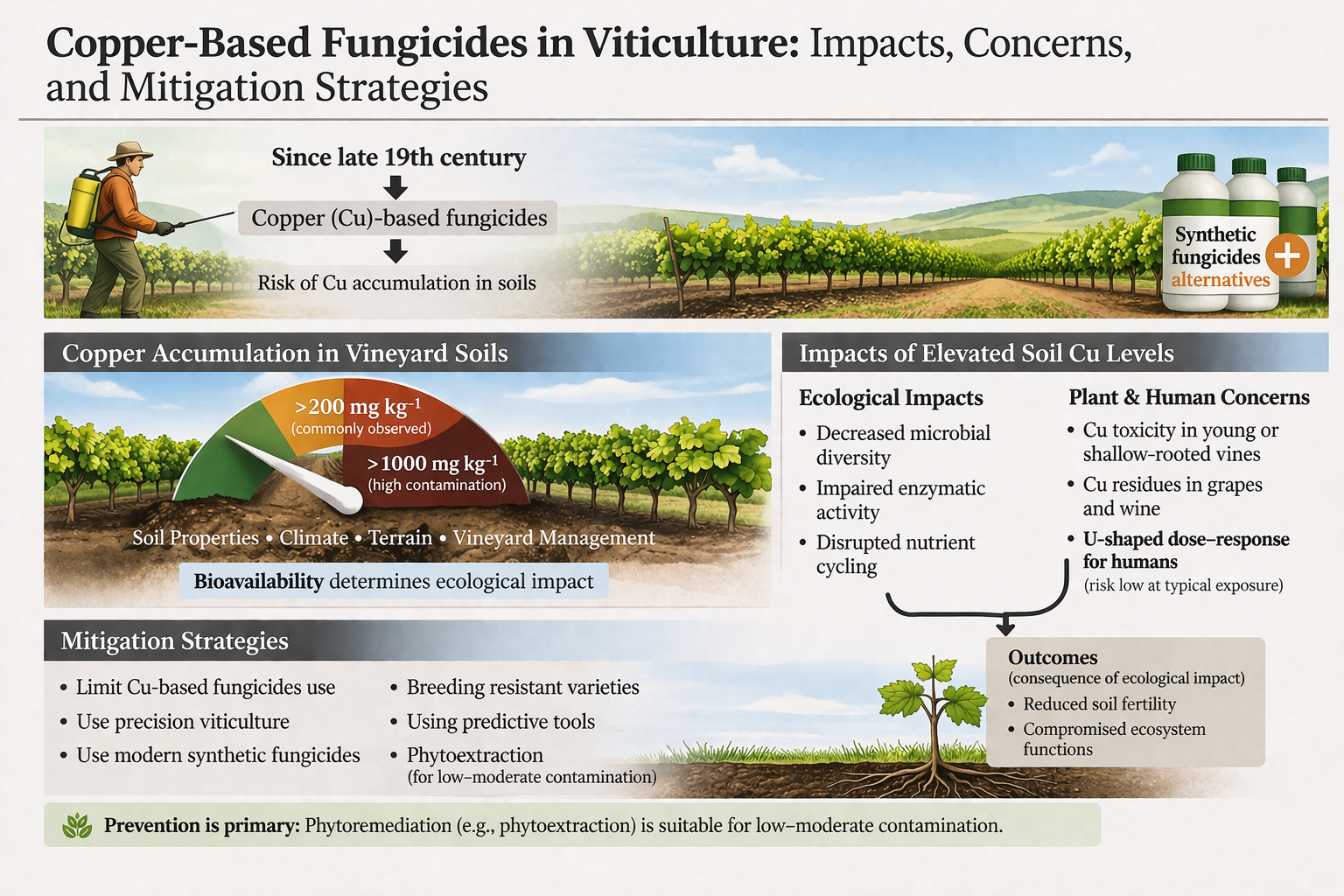
The long-term use of copper (Cu)-based fungicides in viticulture has led to substantial Cu accumulation in vineyard soils, raising concerns about soil health, ecological integrity, plant physiology, and potential human exposure. Since their introduction in the late 19th century, Cu-based fungicides have remained essential for controlling fungal diseases, particularly in organic production systems where viable alternatives are limited. In contrast to organic systems, conventional viticulture can rely on modern synthetic fungicides (such as fluxapyroxad, pyraclostrobin, tebuconazole, and fludioxonil), which provide less harmful alternatives to copper because they are applied at much lower rates and do not accumulate in soils, making them generally more environmentally benign than copper based fungicides. As a result, copper concentrations in vineyard soils frequently exceed European regulatory thresholds, often surpassing 200 mg/kg soil and occasionally exceeding 1000 mg/kg soil. Copper accumulation is influenced by soil physicochemical properties, climate, terrain, and vineyard management practices, while its bioavailability dictates its ecological and toxicological impacts. Elevated copper levels adversely affect soil biota, reducing microbial diversity, impairing enzymatic activity, and disrupting nutrient cycling and key soil functions that underpin fertility and ecosystem stability. Although mature grapevines demonstrate relatively high copper tolerance through deep rooting and physiological detoxification mechanisms, young vines and crops planted following vineyard conversion are more susceptible to copper toxicity. In humans, copper is an essential micronutrient with a U-shaped dose-response curve and toxicity is uncommon at typical dietary exposure levels. Nonetheless, copper residues in grapes and wine can occasionally exceed the maximum limits established by the International Organisation of Vine and Wine (OIV), underscoring the need for continued monitoring. Mitigating copper contamination requires preventive approaches, such as reducing copper inputs, employing forecasting tools, adopting precision viticulture technologies, and cultivating resistant varieties, alongside sustainable remediation strategies. Among these, phytoremediation, particularly phytoextraction, offers a promising, non-invasive, and cost-effective method for managing low to moderately copper contaminated vineyard soils.
- Open Access
- Review
The Legacy of Copper-Based Fungicide Use in Vineyard Soils: Accumulation, Ecotoxicity, Human Health Risks, and Sustainable Remediation
- Marija Poljak 1,
- Ivica Kisić 2,
- Monika Zovko 2,
- Milan Mesić 2 and
- Aleksandra Perčin 2,*
Author Information
Received: 28 November 2025 | Revised: 18 March 2026 | Accepted: 19 March 2026 | Published: 01 April 2026
Abstract
Graphical Abstract
Keywords
regulatory standards | soil enzymatic activity | soil functions | soil microorganisms | human health risk | phytoremediation | sustainable viticulture
References
- 1.
Ruyters, S.; Salaets, P.; Oorts, K.; et al. Copper toxicity in soils under established vineyards in Europe: A survey. Sci. Total Environ. 2013, 443, 470–477. https://doi.org/10.1016/j.scitotenv.2012.11.001.
- 2.
Fagnano, M.; Agrelli, D.; Pascale, A.; et al. Copper accumulation in agricultural soils: Risks for the food chain and soil microbial populations. Sci. Total Environ. 2020, 734, 139434. https://doi.org/10.1016/j.scitotenv.2020.139434.
- 3.
Campillo-Cora, C.; Fernández-Calviño, D.; Pérez-Rodríguez, P.; et al. Copper and zinc in rhizospheric soil of wild plants growing in long-term acid vineyard soils. Insights on availability and metal remediation. Sci. Total Environ. 2019, 672, 389–399. https://doi.org/10.1016/j.scitotenv.2019.03.301.
- 4.
Kelepertzis, E.; Massas, I.; Fligos, G.; et al. Copper accumulation in vineyard soils from Nemea, Greece. Bull. Geol. Soc. Greece 2016, 50, 2192–2199. https://doi.org/10.12681/bgsg.14275.
- 5.
Peña, N.; Antón, A.; Kamilaris, A.; et al. Modeling ecotoxicity impacts in vineyard production: Addressing spatial differentiation for copper fungicides. Sci. Total Environ. 2018, 616–617, 796–804. https://doi.org/10.1016/j.scitotenv.2017.10.243.
- 6.
Panagos, P.; Ballabio, C.; Lugato, E.; et al. Potential sources of anthropogenic copper inputs to European agricultural soils. Sustainability 2018, 10, 2380. https://doi.org/10.3390/su10072380.
- 7.
Schoffer, J.T.; Sauvé, S.; Neaman, A.; et al. Role of Leaf Litter on the Incorporation of Copper-Containing Pesticides into Soils Under Fruit Production: A Review. J. Soil. Sci. Plant Nutr. 2020, 20, 990–1000. https://doi.org/10.1007/s42729-020-00186-1.
- 8.
Corio-Costet, M.F.; Dufour, M.C.; Cigna, J. Diversity and fitness of Plasmopara viticola isolates resistant to QoI fungicides. Eur. J. Plant Pathol. 2011, 129, 315–329. https://doi.org/10.1007/s10658-010-9711-0.
- 9.
Santos, R.F.; Fraaije, B.A.; Garrido, L.D.R.; et al. Multiple resistance of Plasmopara viticola to QoI and CAA fungicides in Brazil. Plant Pathol. 2020, 69, 1708–1720. https://doi.org/10.1111/ppa.13254.
- 10.
Mackie, K.A.; Müller, T.; Zikeli, S.; et al. Long-term copper application in an organic vineyard modifies spatial distribution of soil micro-organisms. Soil. Biol. Biochem. 2013, 65, 245–253. https://doi.org/10.1016/j.soilbio.2013.06.003.
- 11.
Miotto, A.; Ceretta, C.A.; Brunetto, G.; et al. Copper uptake, accumulation and physiological changes in adult grapevines in response to excess copper in soil. Plant Soil. 2014, 374, 593–610. https://doi.org/10.1007/s11104-013-1886-7.
- 12.
Karimi, B.; Masson, V.; Guilland, C.; et al. Ecotoxicity of copper input and accumulation for soil biodiversity in vineyards. Environ. Chem. Lett. 2021, 19, 2013–2030. https://doi.org/10.1007/s10311-020-01155-x.
- 13.
Grand View Research. Copper Fungicides Market Size, Share & Trends Analysis Report (2025–2030). Copper Fungicides Market (2025–2030). Available online: https://www.grandviewresearch.com/industry-analysis/copper-fungicides-market-report (accessed on 20 November 2025).
- 14.
European Commission. Commission Implementing Regulation (EU) 2018/1981 of 13 December 2018 Renewing the Approval of the Active Substances Copper Compounds, as Candidates for Substitution, in Accordance with Regulation (EC) No 1107/2009 of the European Parliament and of the Council Concerning the Placing of Plant Protection Products on the Market, and Amending the Annex to Commission Implementing Regulation (EU) No 540/2011. 2018. Available online: https://eur-lex.europa.eu/eli/reg_impl/2018/1981/oj/eng (accessed on 10 September 2025).
- 15.
Roviello, V.; Caruso, U.; Dal Poggetto, G.; et al. Assessment of copper and heavy metals in family-run vineyard soils and wines of campania region, south Italy. Int. J. Environ. Res. Public. Health 2021, 18, 8465. https://doi.org/10.3390/ijerph18168465.
- 16.
MacKie, K.A.; Müller, T.; Kandeler, E. Remediation of copper in vineyards—A mini review. Environ. Pollut. 2012, 164, 16–26. https://doi.org/10.1016/j.envpol.2012.03.023.
- 17.
Rehman, M.; Liu, L.; Wang, Q.; et al. Copper environmental toxicology, recent advances, and future outlook: A review. Environ. Sci. Pollut. Res. 2019, 26, 18003–18016. https://doi.org/10.1007/s11356-019-05073-6.
- 18.
Gonzaga, M.I.S.; de Jesus Santos, J.C.; Ganassali Junior, L.F.; et al. Copper uptake, physiological response, and phytoremediation potential of Brassica juncea under biochar application. Int. J. Phytoremediation 2022, 24, 474–482. https://doi.org/10.1080/15226514.2021.1954875.
- 19.
Vavoulidou, E.; Avramides, E.J.; Papadopoulos, P.; et al. Copper content in agricultural soils related to cropping systems in different regions of Greece. Commun. Soil. Sci. Plant Anal. 2005, 36, 759–773. https://doi.org/10.1081/CSS-200043367.
- 20.
Fernández-Calviño, D.; Nóvoa-Muñoz, J.C.; López-Periago, E.; et al. Changes in copper content and distribution in young, old and abandoned vineyard acid soils due to land use changes. Land. Degrad. Dev. 2008, 19, 165–177. https://doi.org/10.1002/ldr.831.
- 21.
Vitanović, E.; Vidaček, Ž.; Katalinić, M.; et al. Copper in surface layer of Croatian vineyard soils. J. Agric. Environ. 2010, 8, 268–274.
- 22.
Flores Velez, L.; Ducaroir, J.; Jaunet, A.M.; et al. Study of the distribution of copper in an acid sandy vineyard soil by three different methods. Eur. J. Soil. Sci. 1996, 47, 523–532. https://doi.org/10.1111/j.1365-2389.1996.tb01852.x.
- 23.
Hummes, A.P.; Bortoluzzi, E.C.; Tonini, V.; et al. Transfer of Copper and Zinc from Soil to Grapevine-Derived Products in Young and Centenarian Vineyards. Water Air Soil. Pollut. 2019, 230, 150. https://doi.org/10.1007/s11270-019-4198-6.
- 24.
Korchagin, J.; Moterle, D.F.; Escosteguy, P.A.V.; et al. Distribution of copper and zinc fractions in a Regosol profile under centenary vineyard. Environ. Earth Sci. 2020, 79, 439. https://doi.org/10.1007/s12665-020-09209-7.
- 25.
Navel, A.; Martins, J.M.F. Effect of long term organic amendments and vegetation of vineyard soils on the microscale distribution and biogeochemistry of copper. Sci. Total Environ. 2014, 466–467, 681–689. https://doi.org/10.1016/j.scitotenv.2013.07.064.
- 26.
Wyszkowska, J.; Boros-Lajszner, E.; Lajszner, W.; et al. Reaction of soil enzymes and spring barley to copper chloride and copper sulphate. Environ. Earth Sci. 2017, 76, 403. https://doi.org/10.1007/s12665-017-6742-2.
- 27.
Kumar, V.; Pandita, S.; Singh Sidhu, G.P.; et al. Copper bioavailability, uptake, toxicity and tolerance in plants: A comprehensive review. Chemosphere 2021, 262, 127810. https://doi.org/10.1016/j.chemosphere.2020.127810.
- 28.
Mir, A.R.; Pichtel, J.; Hayat, S. Copper: Uptake, toxicity and tolerance in plants and management of Cu-contaminated soil. Biometals 2021, 34, 737–759. https://doi.org/10.1007/s10534-021-00306-z.
- 29.
Ochmian, I.; Malinowski, R. Effect of Multi-Year Protection of Grapevines with Copper Pesticides on the Content of Heavy Metals in Soil, Leaves, and Fruit. Agronomy 2024, 14, 1677. https://doi.org/10.3390/agronomy14081677.
- 30.
García-Esparza, M.A.; Capri, E.; Pirzadeh, P.; et al. Copper content of grape and wine from Italian farms. Food Addit. Contam. 2006, 23, 274–280. https://doi.org/10.1080/02652030500429117.
- 31.
Skura, E.; Koto, R.; Lika, E.; et al. Comparative characteristics of plant protection against copper and sulphur influence. Sci. Horiz. 2023, 26, 52–61. https://doi.org/10.48077/scihor.26(1).2023.52-61.
- 32.
European Commission. EU Pesticides Database. Available online: https://ec.europa.eu/food/plant/pesticides/eu-pesticides-database/start/screen/active-substances (accessed on 20 October 2025).
- 33.
Burandt, Q.C.; Deising, H.B.; von Tiedemann, A. Further Limitations of Synthetic Fungicide Use and Expansion of Organic Agriculture in Europe Will Increase the Environmental and Health Risks of Chemical Crop Protection Caused by Copper-Containing Fungicides. Environ. Toxicol. Chem. 2024, 43, 19–30. https://doi.org/10.1002/etc.5766.
- 34.
Tamm, L.; Thuerig, B.; Apostolov, S.; et al. Use of Copper-Based Fungicides in Organic Agriculture in Twelve European Countries. Agronomy 2022, 12, 673. https://doi.org/10.3390/agronomy12030673.
- 35.
Varga, K.; Fehér, J.; Trugly, B.; et al. The State of Play of Copper, Mineral Oil, External Nutrient Input, Anthelmintics, Antibiotics and Vitamin Usage and Available Reduction Strategies in Organic Farming across Europe. Sustainability 2022, 14, 3182. https://doi.org/10.3390/su14063182.
- 36.
European Council. Council Directive 86/278/EEC of 12 June 1986 on the Protection of the Environment, and in Particular of the Soil, when Sewage Sludge Is Used in Agriculture. Available online: https://eur-lex.europa.eu/legal-content/EN/TXT/?uri=CELEX:31986L0278 (accessed on 14 September 2025).
- 37.
European Commission. Commission Implementing Regulation (EU) 2021/1165 of 15 July 2021 Authorising Certain Products and Substances for Use in Organic Production and Establishing Their Lists (Text with EEA Relevance). Available online: https://eur-lex.europa.eu/legal-content/EN/TXT/?qid=1756796279947&uri=CELEX%3A32021R1165 (accessed on 8 September 2025).
- 38.
Biodynamic Federation Demeter. Production, Processing and Labelling International Standard for the Use and Certification of Demeter, Biodynamic and Related Trademarks (as of: Sept. 2023). 2024. Available online: https://demeter.net/wp-content/uploads/2024/01/2024_Int_Dem_Bio_Standard_eng.pdf (accessed on 15 September 2025).
- 39.
European Commission. Commission Implementing Regulation (EU) No 540/2011 of 25 May 2011 Implementing Regulation (EC) No 1107/2009 of the European Parliament and of the Council as Regards the List of Approved Active Substances Text with EEA Relevance. Available online: https://eur-lex.europa.eu/eli/reg_impl/2011/540/oj/eng (accessed on 17 September 2025).
- 40.
Kuhne, S.; Roßberg, D.; Rohrig, P.; et al. The Use of Copper Pesticides in Germany and the Search for Minimization and Replacement Strategies. Org. Farming 2017, 3, 66–75. https://doi.org/10.12924/of2017.03010066.
- 41.
Mirlean, N.; Roisenberg, A.; Chies, O.J. Metal contamination of vineyard soils in wet subtropics (southern Brazil). Environ. Pollut. 2007, 149, 10–17. https://doi.org/10.1016/j.envpol.2006.12.024.
- 42.
Ballabio, C.; Panagos, P.; Lugato, E.; et al. Copper distribution in European topsoils: An assessment based on LUCAS soil survey. Sci. Total Environ. 2018, 636, 282–298. https://doi.org/10.1016/j.scitotenv.2018.04.268.
- 43.
Rusjan, D. Copper in Horticulture. In Fungicides for Plant and Animal Diseases; Dhanasekaran, D., Nooruddin, T., Paneerselvam, A., Eds.; InTech: London, UK, 2012; pp. 257–281.
- 44.
Mengel, K.; Kirkby, E.A.; Kosegarten, H.; et al. Soil Copper. In Principles of Plant Nutrition; Mengel, K., Kirkby, E.A., Kosegarten, H., et al., Eds.; Springer: Dordrecht, The Netherlands, 2001; pp. 599–611.
- 45.
Romić, M.; Matijević, L.; Bakić, H.; et al. Copper Accumulation in Vineyard Soils: Distribution, Fractionation and Bioavailability Assessment. In Environmental Risk Assessment of Soil Contamination; Hernandez Soriano, M.C., Ed.; InTech: London, UK, 2014; pp. 799–825.
- 46.
Rodríguez, L.; Ruiz, E.; Alonso-Azcárate, J.; et al. Heavy metal distribution and chemical speciation in tailings and soils around a Pb-Zn mine in Spain. J. Environ. Manag. 2009, 90, 1106–1116. https://doi.org/10.1016/j.jenvman.2008.04.007.
- 47.
Zandi, P.; Yang, J.; Możdżeń, K.; et al. A review of copper speciation and transformation in plant and soil/wetland systems. Adv. Agron. 2020, 160, 249–293. https://doi.org/10.1016/bs.agron.2019.11.001.
- 48.
Zang, Y.; Wei, X.; Hao, M. Long-term effect of crop rotation and fertilisation on bioavailability and fractionation of copper in soil on the loess plateau in Northwest China. PLoS ONE 2015, 10, e0145370. https://doi.org/10.1371/journal.pone.0145370.
- 49.
Ning, Y.; Zhang, X.; Li, B.; et al. Distribution of Cd and Cu fractions in Chinese soils and their relationships with soil pH: A meta-analysis. Sustainability 2019, 11, 337. https://doi.org/10.3390/su11020337.
- 50.
Cornu, J.Y.; Huguenot, D.; Jézéquel, K.; et al. Bioremediation of copper-contaminated soils by bacteria. World J. Microbiol. Biotechnol. 2017, 33, 26. https://doi.org/10.1007/s11274-016-2191-4.
- 51.
Fu, C.; Tu, C.; Zhang, H.; et al. Soil accumulation and chemical fractions of Cu in a large and long-term coastal apple orchard, North China. J. Soils Sediments 2020, 20, 3712–3721. https://doi.org/10.1007/s11368-020-02676-2.
- 52.
Giacopelli, F.; Rossi, L.; Challita, C.; et al. Environmental sustainability of wine sector: A focus on pesticide management. Environ. Impact Assess. Rev. 2025, 115, 108022. https://doi.org/10.1016/j.eiar.2025.108022.
- 53.
Balestrini, R.; Lumini, E.; Borriello, R.; Bianciotto, V. Plant-Soil Biota Interactions. In Soil Microbiology, Ecology and Biochemistry, 5th ed.; Paul, E.A., Frey, S.D., Eds.; Elsevier: Amsterdam, The Netherlands, 2015; pp. 303–328.
- 54.
Fortunato, G.; Vaz-Moreira, I.; Nunes, O.C.; et al. Effect of copper and zinc as sulfate or nitrate salts on soil microbiome dynamics and blaVIM-positive Pseudomonas aeruginosa survival. J. Hazard. Mater. 2021, 415, 125631. https://doi.org/10.1016/j.jhazmat.2021.125631.
- 55.
Widmer, J.; Norgrove, L. Identifying candidates for the phytoremediation of copper in viticultural soils: A systematic review. Environ. Res. 2023, 216, 114518. https://doi.org/10.1016/j.envres.2022.114518.
- 56.
Palanivel, T.M.; Sivakumar, N.; Al-Ansari, A.; et al. Bioremediation of copper by active cells of Pseudomonas stutzeri LA3 isolated from an abandoned copper mine soil. J. Environ. Manag. 2020, 253, 109706. https://doi.org/10.1016/j.jenvman.2019.109706.
- 57.
Shabbir, Z.; Sardar, A.; Shabbir, A.; et al. Copper uptake, essentiality, toxicity, detoxification and risk assessment in soil-plant environment. Chemosphere 2020, 259, 127436. https://doi.org/10.1016/j.chemosphere.2020.127436.
- 58.
Abdu, N.; Abdullahi, A.A.; Abdulkadir, A. Heavy metals and soil microbes. Environ. Chem. Lett. 2017, 15, 65–84. https://doi.org/10.1007/s10311-016-0587-x.
- 59.
Shaw, J.L.A.; Ernakovich, J.G.; Judy, J.D.; et al. Long-term effects of copper exposure to agricultural soil function and microbial community structure at a controlled and experimental field site. Environ. Pollut. 2020, 263, 114411. https://doi.org/10.1016/j.envpol.2020.114411.
- 60.
McBride, M.B.; Cai, M. Copper and zinc aging in soils for a decade: Changes in metal extractability and phytotoxicity. Environ. Chem. 2016, 13, 160–167. https://doi.org/10.1071/EN15057.
- 61.
Guo, G.; Yuan, T.; Wang, W.; et al. Effect of aging on bioavailability of copper on the fluvo aquic soil. Int. J. Environ. Sci. Technol. 2011, 8, 715–722.
- 62.
Brunetto, G.; Bastos de Melo, G.W.; Terzano, R.; et al. Copper accumulation in vineyard soils: Rhizosphere processes and agronomic practices to limit its toxicity. Chemosphere 2016, 162, 293–307. https://doi.org/10.1016/j.chemosphere.2016.07.104.
- 63.
Ahmad, I.; Hayatu, S.; Ahmad, S.; et al. Effect of heavy metals on survival of certain groups of indigenous soil microbial population. J. Appl. Sci. Environ. Mgt. 2005, 9, 115–121.
- 64.
Komárek, M.; Čadková, E.; Chrastný, V.; et al. Contamination of vineyard soils with fungicides: A review of environmental and toxicological aspects. Environ. Int. 2010, 36, 138–151. https://doi.org/10.1016/j.envint.2009.10.005.
- 65.
Wightwick, A.M.; Mollah, M.R.; Partington, D.L.; et al. Copper fungicide residues in Australian vineyard soils. J. Agric. Food Chem. 2008, 56, 2457–2464. https://doi.org/10.1021/jf0727950.
- 66.
Kooch, Y.; Kartalaei, Z.M.; Haghverdi, K.; et al. Soil function indicators are influenced by land use of different ages: A case study in a semi-arid region. Sci. Total Environ. 2023, 861, 160570. https://doi.org/10.1016/j.scitotenv.2022.160570.
- 67.
Paradelo, M.; Moldrup, P.; Arthur, E.; et al. Effects of Past Copper Contamination and Soil Structure on Copper Leaching from Soil. J. Environ. Qual. 2013, 42, 1852–1862. https://doi.org/10.2134/jeq2013.05.0209.
- 68.
Poggere, G.; Gasparin, A.; Barbosa, J.Z.; et al. Soil contamination by copper: Sources, ecological risks, and mitigation strategies in Brazil. J. Trace Elem. Miner. 2023, 4, 100059. https://doi.org/10.1016/j.jtemin.2023.100059.
- 69.
Bernard, L.; Maron, P.A.; Mougel, C.; et al. Contamination of Soil by Copper Affects the Dynamics, Diversity, and Activity of Soil Bacterial Communities Involved in Wheat Decomposition and Carbon Storage. Appl. Environ. Microbiol. 2009, 75, 7565–7569. https://doi.org/10.1128/AEM.00616-09.
- 70.
Wyszkowski, M. Soil Contamination with Copper and its Effect on Selected Soil Properties After Applying Neutralizing Substances. Pol. J. Environ. Stud. 2019, 28, 2465–2471. https://doi.org/10.15244/pjoes/90357.
- 71.
Liu, C.; Song, Y.; Dong, X.; et al. Soil Enzyme Activities and Their Relationships with Soil C, N, and P in Peatlands from Different Types of Permafrost Regions, Northeast China. Front. Environ. Sci. 2021, 9, 670769. https://doi.org/10.3389/fenvs.2021.670769.
- 72.
Abbas, S.; Javed, M.T.; Ali, Q.; et al. Alteration of plant physiology by the application of biochar for remediation of organic pollutants. In Handbook of Bioremediation; Hasanuzzaman, M., Presad, M.N.V., Eds.; Elsevier: Amsterdam, The Netherlands, 2021; pp. 475–492.
- 73.
Piotrowska-Długosz, A.; Kobierski, M.; Długosz, J. Enzymatic activity and physicochemical properties of soil profiles of luvisols. Materials 2021, 14, 6364. https://doi.org/10.3390/ma14216364.
- 74.
Aponte, H.; Medina, J.; Butler, B.; et al. Meta-analysis of heavy metal effects on soil enzyme activities. Sci. Total Environ. 2020, 737, 139744. https://doi.org/10.1016/j.scitotenv.2020.139744.
- 75.
Aponte, H.; Medina, J.; Butler, B.; et al. Soil quality indices for metal(loid) contamination: An enzymatic perspective. Land. Degrad. Dev. 2020, 31, 2700–2719. https://doi.org/10.1002/ldr.3630.
- 76.
Kuziemska, B.; Wysokiński, A.; Trębicka, J. The effect of different copper doses and organic fertilisation on soil’s enzymatic activity. Plant Soil. Environ. 2020, 66, 93–98. https://doi.org/10.17221/671/2019-PSE.
- 77.
Fernández-Calviño, D.; Soler-Rovira, P.; Polo, A.; et al. Enzyme activities in vineyard soils long-term treated with copper-based fungicides. Soil. Biol. Biochem. 2010, 42, 2119–2127. https://doi.org/10.1016/j.soilbio.2010.08.007.
- 78.
Juang, K.-W.; Lee, Y.-I.; Lai, H.-Y.; et al. Copper accumulation, translocation, and toxic effects in grapevine cuttings. Environ. Sci. Pollut. Res. 2012, 19, 1315–1322. https://doi.org/10.1007/s11356-011-0657-3.
- 79.
Brunetto, G.; Rosa, D.J.; Ambrosini, V.G.; et al. Use of phosphorus fertilization and mycorrhization as strategies for reducing copper toxicity in young grapevines. Sci. Hortic. 2019, 248, 176–183. https://doi.org/10.1016/j.scienta.2019.01.026.
- 80.
Kabata-Pendias, A.; Mukherjee, A.B. Trace Elements from Soil to Human; Springer: Berlin, Germany, 2007; pp. 257–268.
- 81.
Cambrollé, J.; García, J.L.; Figueroa, M.A.; et al. Evaluating wild grapevine tolerance to copper toxicity. Chemosphere 2015, 120, 171–178. https://doi.org/10.1016/j.chemosphere.2014.06.044.
- 82.
Ambrosini, V.G.; Rosa, D.J.; Corredor Prado, J.P.; et al. Reduction of copper phytotoxicity by liming: A study of the root anatomy of young vines (Vitis labrusca L.). Plant Physiol. Biochem. 2015, 96, 270–280. https://doi.org/10.1016/j.plaphy.2015.08.012.
- 83.
Toselli, M.; Baldi, E.; Marcolini, G.; et al. Response of potted grapevines to increasing soil copper concentration. Aust. J. Grape Wine Res. 2009, 15, 85–92. https://doi.org/10.1111/j.1755-0238.2008.00040.x.
- 84.
Komárek, M.; Száková, J.; Rohošková, M.; et al. Copper contamination of vineyard soils from small wine producers: A case study from the Czech Republic. Geoderma 2008, 147, 16–22. https://doi.org/10.1016/j.geoderma.2008.07.001.
- 85.
De Conti, L.; Ceretta, C.A.; Melo, G.W.B.; et al. Intercropping of young grapevines with native grasses for phytoremediation of Cu-contaminated soils. Chemosphere 2019, 216, 147–156. https://doi.org/10.1016/j.chemosphere.2018.10.134.
- 86.
José Rodrigues Cruz, F.; Leone da Cruz Ferreira, R.; Silva Conceição, S.; et al. Copper Toxicity in Plants: Nutritional, Physiological, and Biochemical Aspects. In Advances in Plant Defense Mechanisms; Kimatu, J.N., Ed.; IntechOpen: London, UK, 2022; pp. 1–10.
- 87.
Morsch, L.; Somavilla, L.M.; Trentin, E.; et al. Root system structure as a criterion for the selection of grapevine genotypes that are tolerant to excess copper and the ability of phosphorus to mitigate toxicity. Plant Physiol. Biochem. 2022, 171, 147–156. https://doi.org/10.1016/j.plaphy.2021.12.034.
- 88.
Yang, Y.; Fang, X.; Chen, M.; et al. Copper Stress in Grapevine: Consequences, Responses, and a Novel Mitigation Strategy Using 5-Aminolevulinic Acid. Environ. Pollut. 2022, 307, 119561. https://doi.org/10.1016/j.envpol.2022.119561.
- 89.
Cambrollé, J.; García, J.L.; Ocete, R.; et al. Growth and photosynthetic responses to copper in wild grapevine. Chemosphere 2013, 93, 294–301. https://doi.org/10.1016/j.chemosphere.2013.04.080.
- 90.
Dobrei, A.; Nistor, E.; Babau, P.D.; et al. Influence of Copper Spraying on Photosynthetic Performance, Grape Ripening, Wood Maturation and Frost Resistance in Grapevine. Sci. Pap. Ser. B Hortic. 2020, 64, 277–284.
- 91.
Pietrzak, U.; Uren, N.C. Remedial options for copper-contaminated vineyard soils. Soil. Res. 2011, 49, 44–55. https://doi.org/10.1071/SR09200.
- 92.
Martins, V.; Bassil, E.; Hanana, M.; et al. Copper Homeostasis in Grapevine: Functional Characterization of the Vitis vinifera Copper Transporter 1. Planta 2014, 240, 91–101. https://doi.org/10.1007/s00425-014-2067-5.
- 93.
Čuš, F.; Česnik, H.B.; Bolta, Š.V. Pesticide residues, copper and biogenic amines in conventional and organic wines. Food Control 2022, 132, 108534. https://doi.org/10.1016/j.foodcont.2021.108534.
- 94.
Vršič, S.; Gumzej, M.; Lešnik, M.; et al. Patterns of Copper Bioaccumulation and Translocation in Grapevine Grafts Depending on Rootstocks. Agriculture 2023, 13, 1768. https://doi.org/10.3390/agriculture13091768.
- 95.
Li, X.; Dong, S.; Su, X. Copper and other heavy metals in grapes: A pilot study tracing influential factors and evaluating potential risks in China. Sci. Rep. 2018, 8, 17407. https://doi.org/10.1038/s41598-018-34767-z.
- 96.
Donici, A.; Bunea, C.I.; Călugăr, A.; et al. Investigation of the Copper Content in Vineyard Soil, Grape, Must and Wine in the Main Vineyards of Romania: A Preliminary Study. Bull. Univ. Agric. Sci. Vet. Med. Cluj-Napoca 2019, 76. https://doi.org/10.15835/buasvmcn-hort:2018.0017.
- 97.
Provenzano, M.R.; El Bilali, H.; Simeone, V.; et al. Copper contents in grapes and wines from a Mediterranean organic vineyard. Food Chem. 2010, 122, 1338–1343. https://doi.org/10.1016/j.foodchem.2010.03.103.
- 98.
Sun, X.; Ma, T.; Yu, J.; et al. Investigation of the copper contents in vineyard soil, grape must and wine and the relationship among them in the Huaizhuo Basin Region, China: A preliminary study. Food Chem. 2018, 241, 40–50. https://doi.org/10.1016/j.foodchem.2017.08.074.
- 99.
Čuš, F.; Bach, B.; Barnavon, L.; et al. Analytical determination of Dolenjska region wines quality. Food Control 2013, 33, 274–280. https://doi.org/10.1016/j.foodcont.2013.03.017.
- 100.
Lai, H.Y.; Juang, K.W.; Chen, B.C. Copper concentrations in grapevines and vineyard soils in central Taiwan. Soil. Sci. Plant Nutr. 2010, 56, 601–606. https://doi.org/10.1111/j.1747-0765.2010.00494.x.
- 101.
Stern, B.R.; Solioz, M.; Krewski, D.; et al. Copper and human health: Biochemistry, genetics, and strategies for modeling dose-response relationships. J. Toxicol. Environ. Health B Crit. Rev. 2007, 10, 157–222. https://doi.org/10.1080/10937400600755911.
- 102.
Casale, E.; Evariste, L.; Houdeau, E.; et al. Copper nanoparticles in agriculture: From expected benefits of reduced copper use to toxicity on gut health. Sci. Total Environ. 2025, 1004, 180801. https://doi.org/10.1016/j.scitotenv.2025.180801.
- 103.
Taylor, A.A.; Tsuji, J.S.; Garry, M.R.; et al. Critical Review of Exposure and Effects: Implications for Setting Regulatory Health Criteria for Ingested Copper. Environ. Manag. 2020, 65, 131–159. https://doi.org/10.1007/s00267-019-01234-y.
- 104.
Zhou, J.; Liang, J.; Hu, Y.; et al. Exposure risk of local residents to copper near the largest flash copper smelter in China. Sci. Total Environ. 2018, 630, 453–461. https://doi.org/10.1016/j.scitotenv.2018.02.211.
- 105.
Rodríguez, J.; Mandalunis, P.M. A review of metal exposure and its effects on bone health. J. Toxicol. 2018, 2018, 4854152. https://doi.org/10.1155/2018/4854152.
- 106.
Sadhra, S.S.; Wheatley, A.D.; Cross, H.J. Dietary exposure to copper in the European Union and its assessment for EU regulatory risk assessment. Sci. Total Environ. 2007, 374, 223–234. https://doi.org/10.1016/j.scitotenv.2006.12.041.
- 107.
Genchi, G.; Catalano, A.; Carocci, A.; et al. Copper, Cuproptosis, and Neurodegenerative Diseases. Int. J. Mol. Sci. 2025, 26, 9173. https://doi.org/10.3390/ijms26189173.
- 108.
Cui, H.; Li, H.; Zhang, S.; et al. Bioavailability and mobility of copper and cadmium in polluted soil after phytostabilization using different plants aided by limestone. Chemosphere 2020, 242, 125252. https://doi.org/10.1016/j.chemosphere.2019.125252.
- 109.
Zhong, G.; Wang, X.; Li, J.; et al. Insights Into the Role of Copper in Neurodegenerative Diseases and the Therapeutic Potential of Natural Compounds. Curr. Neuropharmacol. 2024, 22, 1650–1671. https://doi.org/10.2174/1570159x22666231103085859.
- 110.
Wang, Y.; Li, D.; Xu, K.; et al. Copper homeostasis and neurodegenerative diseases. Neural Regen. Res. 2024, 20, 3124–3143. https://doi.org/10.4103/NRR.NRR-D-24-00642.
- 111.
Pokorska-Niewiada, K.; Witczak, A.; Protasowicki, M.; et al. Estimation of Target Hazard Quotients and Potential Health Risks for Toxic Metals and Other Trace Elements by Consumption of Female Fish Gonads and Testicles. Int. J. Environ. Res. Public. Health 2022, 19, 2762. https://doi.org/10.3390/ijerph19052762.
- 112.
Taylor, A.A.; Tsuji, J.S.; McArdle, M.E.; et al. Recommended Reference Values for Risk Assessment of Oral Exposure to Copper. Risk Anal. 2023, 43, 211–218. https://doi.org/10.1111/risa.13906.
- 113.
Peirovi-Minaee, R.; Alami, A.; Moghaddam, A.;et al. Determination of Concentration of Metals in Grapes Grown in Gonabad Vineyards and Assessment of Associated Health Risks. Biol. Trace Elem. Res. 2023, 201, 3541–3552. https://doi.org/10.1007/s12011-022-03428-8.
- 114.
Mirzaei, M.; Marofi, S.; Solgi, E.; et al. Ecological and health risks of soil and grape heavy metals in long-term fertilized vineyards (Chaharmahal and Bakhtiari province of Iran). Environ. Geochem. Health 2020, 42, 27–43. https://doi.org/10.1007/s10653-019-00242-5.
- 115.
Prokeš, L.; Hegrová, J.; Průšová, B.; et al. Impact of traffic intensity and vehicular emissions on heavy metal content in vineyard soils, grapes, and wine: A comparative study of two vineyards in South Moravia (Czech Republic). Environ. Geochem. Health 2025, 47, 216. https://doi.org/10.1007/s10653-025-02530-9.
- 116.
Saif-Ud-din; Ali, S.; Hussain, S.; et al. Evaluation of heavy metal contamination in indigenous fruits and associated human health risk: Evidence from Fuzzy-TOPSIS approach. Glob. Nest J. 2022, 24, 435–444. https://doi.org/10.30955/gnj.004236.
- 117.
Naughton, D.P.; Petróczi, A. Heavy metal ions in wines: Meta-analysis of target hazard quotients reveal health risks. Chem. Cent. J. 2008, 2, 22. https://doi.org/10.1186/1752-153X-2-22.
- 118.
Reynolds, A.G. The Grapevine, Viticulture, and Winemaking: A Brief Introduction. In Grapevine Viruses: Molecular Biology, Diagnostics and Management; Springer: Cham, Switzerland, 2017; pp. 3–29.
- 119.
OIV. International Organisation of Vine and Wine. OIV Statistical Brief: Wine, Table Grapes & Dried Grapes in 2024. Available online: https://www.oiv.int/sites/default/files/documents/OIV_Statistical_Brief-Wine_Table_Grapes_and_Dried_Grapes_in_2024.pdf (accessed on 16 October 2025).
- 120.
Barmettler, E.; van der Heijden, M.G.A.; Rösch, A.; et al. Double the trouble: High levels of both synthetic pesticides and copper in vineyard soils. Environ. Pollut. 2025, 375, 126356. https://doi.org/10.1016/j.envpol.2025.126356.
- 121.
Schumacher, S.; Mertes, C.; Wohlfahrt, Y.; et al. VITIFIT: Aiming for Copper Reduction in Organic Viticulture—Improvement of Established Strategies and New Techniques for Plant Protection against Plasmopara viticola. BIO Web Conf. 2022, 50, 03008. https://doi.org/10.1051/bioconf/20225003008.
- 122.
Pertot, I.; El Bilali, H.; Simeone, V.; et al. Efficacy evaluation and phytotoxicity assessment of traditional and new copper compounds used in copper reduction strategies in organic viticulture in northern and southern Italy environments. IOBC/WPRS Bull. 2006, 29, 61–65.
- 123.
Droz, B.; Payraudeau, S.; Rodríguez Martín, J.A.; et al. Copper Content and Export in European Vineyard Soils Influenced by Climate and Soil Properties. Environ. Sci. Technol. 2021, 55, 7327–7334. https://doi.org/10.1021/acs.est.0c02093.
- 124.
IFOAM. Strategy for the Minimisation of Copper in Organic Farming in Europe; IFOAM: Omaha, NE, USA, 2018.
- 125.
Cataldo, E.; Fucile, M.; Mattii, G.B. A Review: Soil Management, Sustainable Strategies and Approaches to Improve the Quality of Modern Viticulture. Agronomy 2021, 11, 2359. https://doi.org/10.3390/agronomy11112359.
- 126.
Testempasis, S.I.; Karaoglanidis, G.S. Resistance of Black Aspergilli Species from Grape Vineyards to SDHI, QoI, DMI, and Phenylpyrrole Fungicides. J. Fungi 2023, 9, 221. https://doi.org/10.3390/jof9020221.
- 127.
Neaman, A.; Schoffer, J.T.; Navarro-Villarroel, C.; et al. Copper contamination in agricultural soils: A review of the effects of climate, soil properties, and prolonged copper pesticide application in vineyards and orchards. Plant Soil. Environ. 2024, 70, 407–417. https://doi.org/10.17221/501/2023-PSE.
- 128.
Cornu, J.Y.; Waterlot, C.; Lebeau, T. Advantages and limits to copper phytoextraction in vineyards. Environ. Sci. Pollut. Res. 2022, 29, 29226–29235. https://doi.org/10.1007/s11356-021-13450-3.
- 129.
Forján, R.; Rodríguez-Vila, A.; Pedrol, N.; et al. Application of Compost and Biochar with Brassica juncea L. to Reduce Phytoavailable Concentrations in a Settling Pond Mine Soil. Waste Biomass Valorization 2018, 9, 821–834. https://doi.org/10.1007/s12649-017-9843-y.
- 130.
Andreazza, R.; Bortolon, L.; Pieniz, S.; et al. Evaluation of two brazilian indigenous plants for phytostabilization and phytoremediation of copper-contaminated soils. Braz. J. Biol. 2015, 75, 868–877. https://doi.org/10.1590/1519-6984.01914.
- 131.
Napoli, M.; Cecchi, S.; Grassi, C.; et al. Phytoextraction of copper from a contaminated soil using arable and vegetable crops. Chemosphere 2019, 219, 122–129. https://doi.org/10.1016/j.chemosphere.2018.12.017.


This work is licensed under a Creative Commons Attribution 4.0 International License.
