
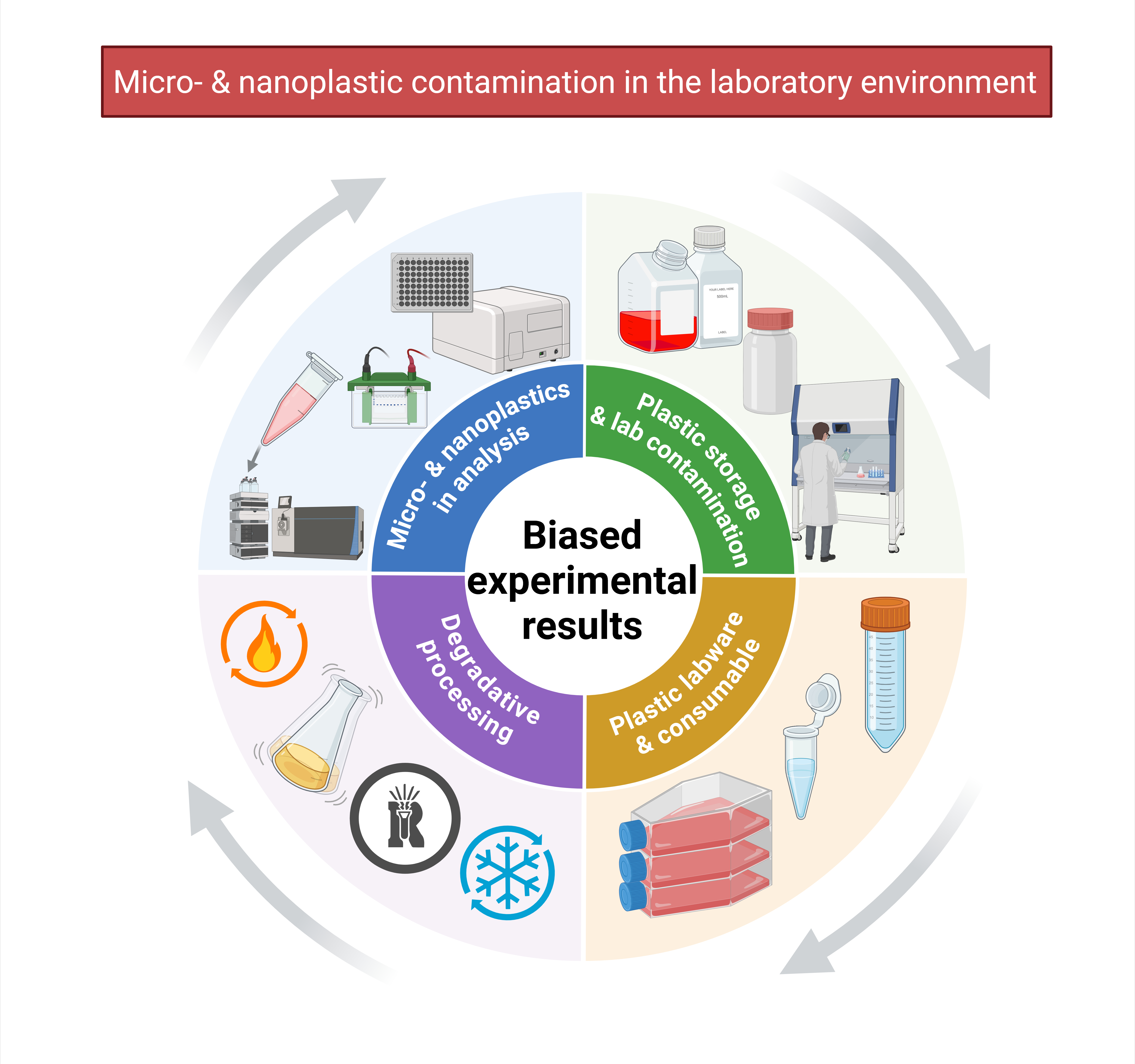
Micro- and nanoplastics (MNPs) are detected in nearly every environmental and biological sample, yet most experiments evaluating their presence and effects take place in laboratories already contaminated with MNPs. Pipette tips, plastic tubes, culture plates, filters, water systems and indoor air all shed MNPs, and, as a result, the lab itself becomes an unaccounted exposure source. At low environmentally relevant doses, this hidden background can reach or even exceed the intended experimental concentrations. This can bias exposure estimates and experimental readouts. This review synthesizes evidence on laboratory plastic contamination in MNP research. Here, we outline the major sources, airborne fibres, purified water and storage containers, plastic consumables and media preparation. We then use these data to construct scenarios of cumulative contamination for typical biological and environmental workflows, highlighting conditions under which laboratory-derived particles can approach or exceed nominal experimental doses. Finally, we analyse how this background inflates and underestimates experimental doses, generates unintended mixed-polymer exposures, and interferes with particle identification and dose–response analysis.
- Open Access
- Review
Plastic-on-Plastic: Underestimated Contamination Risks in Micro- and Nanoplastic Research
- Anna Baroni 1,
- Eugenia Romano 1,
- Sabina Pulone 1,
- Chantalle Moulton 1,*,† and
- Ennio Tasciotti 1,2,*,†
Author Information
Received: 20 January 2026 | Revised: 24 March 2026 | Accepted: 09 April 2026 | Published: 24 April 2026
Abstract
Graphical Abstract
Keywords
nanoplastics | microplastics | Laboratory contamination | plastics consumables | airborne microplastics | background contamination | quality control | exposure assessment
References
- 1.
Thompson, R.C.; Courtene-Jones, W.; Boucher, J.; et al. Twenty Years of Microplastic Pollution Research—What Have We Learned? Science 2024, 386, eadl2746. https://doi.org/10.1126/science.adl2746.
- 2.
Huang, D.; Tao, J.; Cheng, M.; et al. Microplastics and Nanoplastics in the Environment: Macroscopic Transport and Effects on Creatures. J. Hazard. Mater. 2021, 407, 124399. https://doi.org/10.1016/j.jhazmat.2020.124399.
- 3.
Pal, D.; Prabhakar, R.; Barua, V.B.; et al. Microplastics in Aquatic Systems: A Comprehensive Review of Its Distribution, Environmental Interactions, and Health Risks. Environ. Sci. Pollut. Res. 2024, 32, 56–88. https://doi.org/10.1007/s11356-024-35741-1.
- 4.
Baroni, A.; Moulton, C.; Cristina, M.; et al. Nano- and Microplastics in the Brain: An Emerging Threat to Neural Health. Nanomaterials 2025, 15, 1361. https://doi.org/10.3390/nano15171361.
- 5.
Ratnayake, A.S.; Gunawardhana, G.M.S.S.; Perera, U.L.H.P. The Biography of Microplastics (MPs): Occurrences, Sources, Weathering/Degradation, Characterization, Ecological/Human Risks, Removal Methods, Policy Development, and Current Trends and Future Perspectives. Anthr. Coasts 2024, 7, 30. https://doi.org/10.1007/s44218-024-00064-8.
- 6.
Sangkham, S.; Faikhaw, O.; Munkong, N.; et al. A Review on Microplastics and Nanoplastics in the Environment: Their Occurrence, Exposure Routes, Toxic Studies, and Potential Effects on Human Health. Mar. Pollut. Bull. 2022, 181, 113832. https://doi.org/10.1016/j.marpolbul.2022.113832.
- 7.
Abdolahpur Monikh, F.; Baun, A.; Hartmann, N.B.; et al. Exposure Protocol for Ecotoxicity Testing of Microplastics and Nanoplastics. Nat. Protoc. 2023, 18, 3534–3564. https://doi.org/10.1038/s41596-023-00886-9.
- 8.
Prata, J.; Reis, V.; Da Costa, J.; et al. Contamination Issues as a Challenge in Quality Control and Quality Assurance in Microplastics Analytics. J. Hazard. Mater. 2021, 403, 123660. https://doi.org/10.1016/j.jhazmat.2020.123660.
- 9.
De Ruijter, V.N.; Redondo-Hasselerharm, P.E.; Gouin, T.; et al. Quality Criteria for Microplastic Effect Studies in the Context of Risk Assessment: A Critical Review. Environ. Sci. Technol. 2020, 54, 11692–11705. https://doi.org/10.1021/acs.est.0c03057.
- 10.
Lee, M.; Saha, A.; Sundaram, R.; et al. Accommodating Detection Limits of Multiple Exposures in Environmental Mixture Analyses: An Overview of Statistical Approaches. Environ. Health 2024, 23, 48. https://doi.org/10.1186/s12940-024-01088-w.
- 11.
Tolcha, T.; Gemechu, T.; Al-Hamimi, S.; et al. Multivariate Optimization of a Combined Static and Dynamic Supercritical Fluid Extraction Method for Trace Analysis of Pesticides Pollutants in Organic Honey. J. Sep. Sci. 2021, 44, 1716–1726. https://doi.org/10.1002/jssc.202100047.
- 12.
Jones, N.R.; De Jersey, A.M.; Lavers, J.L.; et al. Identifying Laboratory Sources of Microplastic and Nanoplastic Contamination from the Air, Water, and Consumables. J. Hazard. Mater. 2024, 465, 133276. https://doi.org/10.1016/j.jhazmat.2023.133276.
- 13.
Gimiliani, G.T.; Izar, G. Difficulties in Comparison Among Different Microplastic Studies: The Inconsistency of Results and Lack of Guide Values. Environ. Toxicol. Chem. 2022, 41, 820–821. https://doi.org/10.1002/etc.5237.
- 14.
Kennedy, S.B.; Antonio Vital, A.L.; Kukkola, A.; et al. Trends in Quality and Risk Assessment Applicability of Microplastic Ecotoxicity Studies. J. Hazard. Mater. Adv. 2026, 21, 100942. https://doi.org/10.1016/j.hazadv.2025.100942.
- 15.
Adhikari, S.; Kelkar, V.; Kumar, R.; et al. Methods and Challenges in the Detection of Microplastics and Nanoplastics: A Mini-review. Polym. Int. 2022, 71, 543–551. https://doi.org/10.1002/pi.6348.
- 16.
Hartmann, N.B.; Hüffer, T.; Thompson, R.C.; et al. Are We Speaking the Same Language? Recommendations for a Definition and Categorization Framework for Plastic Debris. Environ. Sci. Technol. 2019, 53, 1039–1047. https://doi.org/10.1021/acs.est.8b05297.
- 17.
Yee, M.S.-L.; Hii, L.-W.; Looi, C.K.; et al. Impact of Microplastics and Nanoplastics on Human Health. Nanomaterials 2021, 11, 496. https://doi.org/10.3390/nano11020496.
- 18.
Catarino, A.I.; Patsiou, D.; Summers, S.; et al. Challenges and Recommendations in Experimentation and Risk Assessment of Nanoplastics in Aquatic Organisms. TrAC Trends Anal. Chem. 2023, 167, 117262. https://doi.org/10.1016/j.trac.2023.117262.
- 19.
Gigault, J.; El Hadri, H.; Nguyen, B.; et al. Nanoplastics Are Neither Microplastics nor Engineered Nanoparticles. Nat. Nanotechnol. 2021, 16, 501–507. https://doi.org/10.1038/s41565-021-00886-4.
- 20.
Kiran, B.R.; Kopperi, H.; Venkata Mohan, S. Micro/Nano-Plastics Occurrence, Identification, Risk Analysis and Mitigation: Challenges and Perspectives. Rev. Environ. Sci. Biotechnol. 2022, 21, 169–203. https://doi.org/10.1007/s11157-021-09609-6.
- 21.
Nene, A.; Sadeghzade, S.; Viaroli, S.; et al. Recent Advances and Future Technologies in Nano-Microplastics Detection. Environ. Sci. Eur. 2025, 37, 7. https://doi.org/10.1186/s12302-024-01044-y.
- 22.
Ivleva, N.P.; Primpke, S.; Lynch, J.M. Advances in Chemical Analysis of Micro- and Nanoplastics. Anal. Bioanal. Chem. 2023, 415, 2869–2871. https://doi.org/10.1007/s00216-023-04747-y.
- 23.
Jolaosho, T.L.; Rasaq, M.F.; Omotoye, E.V.; et al. Microplastics in Freshwater and Marine Ecosystems: Occurrence, Characterization, Sources, Distribution Dynamics, Fate, Transport Processes, Potential Mitigation Strategies, and Policy Interventions. Ecotoxicol. Environ. Saf. 2025, 294, 118036. https://doi.org/10.1016/j.ecoenv.2025.118036.
- 24.
Shi, Y.; Shi, L.; Huang, H.; et al. Analysis of Aged Microplastics: A Review. Environ. Chem. Lett. 2024, 22, 1861–1888. https://doi.org/10.1007/s10311-024-01731-5.
- 25.
Nandikes, G.; Banerjee, O.; Mirthipati, M.; et al. Separation, Identification, and Quantification of Microplastics in Environmental Samples. In Microplastic Pollutants in Biotic Systems: Environmental Impact and Remediation Techniques; Khan, N.A., Singh, L., Eds.; American Chemical Society: Washington, DC, USA, 2024; Volume 1482, pp. 1–19. ISBN 978-0-8412-9680-0.
- 26.
Bridgeman, L.; Cimbalo, A.; López-Rodríguez, D.; et al. Exploring Toxicological Pathways of Microplastics and Nanoplastics: Insights from Animal and Cellular Models. J. Hazard. Mater. 2025, 490, 137795. https://doi.org/10.1016/j.jhazmat.2025.137795.
- 27.
Zhu, Y.; Che, R.; Zong, X.; et al. A Comprehensive Review on the Source, Ingestion Route, Attachment and Toxicity of Microplastics/Nanoplastics in Human Systems. J. Environ. Manag. 2024, 352, 120039. https://doi.org/10.1016/j.jenvman.2024.120039.
- 28.
Longhin, E.M.; Rios-Mondragon, I.; Mariussen, E.; et al. Hazard Assessment of Nanomaterials: How to Meet the Requirements for (next Generation) Risk Assessment. Part. Fibre Toxicol. 2024, 21, 54. https://doi.org/10.1186/s12989-024-00615-4.
- 29.
Vogel, A.; Tentschert, J.; Pieters, R.; et al. Towards a Risk Assessment Framework for Micro- and Nanoplastic Particles for Human Health. Part. Fibre Toxicol. 2024, 21, 48. https://doi.org/10.1186/s12989-024-00602-9.
- 30.
Dhaundiyal, A.; Mittal, A. Unveiling the Microplastics: Sources, Distribution, Toxicological Impacts, Extraction Methods, Degradational Strategies, Paving the Path to a Sustainable Future. Water Air Soil Pollut. 2024, 235, 691. https://doi.org/10.1007/s11270-024-07506-6.
- 31.
Abegunde, S.M.; Alaka, M.O.; Awonyemi, O.I. Nanomaterial Toxicity: A Comprehensive Review of Mechanisms and Mitigation Strategies. Discov. Hazards 2025, 1, 3. https://doi.org/10.1007/s44475-025-00003-2.
- 32.
Freese, T.; Elzinga, N.; Heinemann, M.; et al. The Relevance of Sustainable Laboratory Practices. RSC Sustain. 2024, 2, 1300–1336. https://doi.org/10.1039/D4SU00056K.
- 33.
Dawson, A.L.; Santana, M.F.M.; Nelis, J.L.D.; et al. Taking Control of Microplastics Data: A Comparison of Control and Blank Data Correction Methods. J. Hazard. Mater. 2023, 443, 130218. https://doi.org/10.1016/j.jhazmat.2022.130218.
- 34.
Umurhan, Y.; Songsart-Power, M.; Limbu, T.B.; et al. Applications of Raman Spectroscopy for Microplastic Detection and Characterization: A Comprehensive Spectral Reference. Environ. Sci. Pollut. Res. 2025, 32, 28630–28677. https://doi.org/10.1007/s11356-025-37224-3.
- 35.
Khan, A.L.; Zaidi, A.A. Separation and Detection of Microplastics in Human Exposure Pathways: Challenges, Analytical Techniques, and Emerging Solutions. J. Xenobiot. 2025, 15, 154. https://doi.org/10.3390/jox15050154.
- 36.
Bai, R.; Fan, R.; Xie, C.; et al. Microplastics Are Overestimated Due to Poor Quality Control of Reagents. J. Hazard. Mater. 2023, 459, 132068. https://doi.org/10.1016/j.jhazmat.2023.132068.
- 37.
Noonan, M.J.; Grechi, N.; Mills, C.L.; et al. Microplastics Analytics: Why We Should Not Underestimate the Importance of Blank Controls. Microplast. Nanoplast. 2023, 3, 17. https://doi.org/10.1186/s43591-023-00065-3.
- 38.
Lao, W.; Sauers, S.; Wong, C.S. Characterization and Potential Influence of Laboratory Airborne Particle Fallout on Microplastics Analysis. J. Hazard. Mater. 2025, 499, 140309. https://doi.org/10.1016/j.jhazmat.2025.140309.
- 39.
Shruti, V.C.; Kutralam-Muniasamy, G. Blanks and Bias in Microplastic Research: Implications for Future Quality Assurance. Trends Environ. Anal. Chem. 2023, 38, e00203. https://doi.org/10.1016/j.teac.2023.e00203.
- 40.
Bogdanowicz, A.; Zubrowska-Sudol, M.; Krasinski, A.; et al. Cross-Contamination as a Problem in Collection and Analysis of Environmental Samples Containing Microplastics—A Review. Sustainability 2021, 13, 12123. https://doi.org/10.3390/su132112123.
- 41.
Gouin, T.; Ellis-Hutchings, R.; Pemberton, M.; et al. Addressing the Relevance of Polystyrene Nano- and Microplastic Particles Used to Support Exposure, Toxicity and Risk Assessment: Implications and Recommendations. Part. Fibre Toxicol. 2024, 21, 39. https://doi.org/10.1186/s12989-024-00599-1.
- 42.
Wright, S.; Cassee, F.R.; Erdely, A.; et al. Micro- and Nanoplastics Concepts for Particle and Fibre Toxicologists. Part. Fibre Toxicol. 2024, 21, 18. https://doi.org/10.1186/s12989-024-00581-x.
- 43.
Dong, D.; Gao, W.; Zhou, Q. Comparative Study on the Environmental Behavior and Ecological Risks of Microplastics and Natural Particles. Water Air Soil Pollut. 2026, 237, 162. https://doi.org/10.1007/s11270-025-08873-4.
- 44.
Schymanski, D.; Oßmann, B.E.; Benismail, N.; et al. Analysis of Microplastics in Drinking Water and Other Clean Water Samples with Micro-Raman and Micro-Infrared Spectroscopy: Minimum Requirements and Best Practice Guidelines. Anal. Bioanal. Chem. 2021, 413, 5969–5994. https://doi.org/10.1007/s00216-021-03498-y.
- 45.
Chen, Q.; Wang, P.; Liu, R.; et al. Experimental Inconsistencies Undermine Accurate Characterization of Microplastics and Identification of Environmental Drivers: A Metadata Analysis in Chinese Aquatic Environment. Ecol. Indic. 2025, 170, 113053. https://doi.org/10.1016/j.ecolind.2024.113053.
- 46.
Koelmans, A.A.; Gebreyohanes Belay, B.M.; Mintenig, S.M.; et al. Towards a Rational and Efficient Risk Assessment for Microplastics. TrAC Trends Anal. Chem. 2023, 165, 117142. https://doi.org/10.1016/j.trac.2023.117142.
- 47.
Cruz-Salas, A.A.; Álvarez-Zeferino, J.C.; Tapia-Fuentes, J.; et al. Measures to Prevent Cross-Contamination in the Analysis of Microplastics: A Short Literature Review. Rev. Int. Contam. Ambient. 2023, 39, 241–256. https://doi.org/10.20937/RICA.54740.
- 48.
Prata, J.C. Plastic Pollution: Challenges and Innovative Solutions. Environments 2024, 11, 271. https://doi.org/10.3390/environments11120271.
- 49.
Casella, C.; Cornelli, U.; Ballaz, S.; et al. Plastic Smell: A Review of the Hidden Threat of Airborne Micro and Nanoplastics to Human Health and the Environment. Toxics 2025, 13, 387. https://doi.org/10.3390/toxics13050387.
- 50.
Di Fiore, C.; Sammartino, M.P.; Giannattasio, C.; et al. Microplastic Contamination in Commercial Salt: An Issue for Their Sampling and Quantification. Food Chem. 2023, 404, 134682. https://doi.org/10.1016/j.foodchem.2022.134682.
- 51.
Malloggi, C.; Nalbone, L.; Bartalena, S.; et al. The Occurrence of Microplastics in Donax trunculus (Mollusca: Bivalvia) Collected along the Tuscany Coast (Mediterranean Sea). Animals 2024, 14, 618. https://doi.org/10.3390/ani14040618.
- 52.
Mahmud, F.; Roy, H.; Wasif, M.M.; et al. Recent Perspectives of Microplastic Analysis from Sampling to Characterization. Sustain. Chem. Environ. 2025, 12, 100290. https://doi.org/10.1016/j.scenv.2025.100290.
- 53.
Martínez-Francés, E.; Van Bavel, B.; Hurley, R.; et al. Innovative Reference Materials for Method Validation in Microplastic Analysis including Interlaboratory Comparison Exercises. Anal. Bioanal. Chem. 2023, 415, 2907–2919. https://doi.org/10.1007/s00216-023-04636-4.
- 54.
Badzoka, J.; Kappacher, C.; Lauß, J.; et al. Enabling Analytical Precision in Microplastic Analysis: Innovative Solutions for Precise Method Validation, Evaluation and Quality Control. Microplast. Nanoplast. 2025, 5, 2. https://doi.org/10.1186/s43591-024-00108-3.
- 55.
Gao, D.; Junaid, M.; Chen, X.; et al. Interaction of Micro(Nano)Plastics and Bisphenols in the Environment: A Recent Perspective on Adsorption Mechanisms, Influencing Factors and Ecotoxic Impacts. TrAC Trends Anal. Chem. 2023, 165, 117132. https://doi.org/10.1016/j.trac.2023.117132.
- 56.
Okoffo, E.; Thomas, K. Quantitative Analysis of Nanoplastics in Environmental and Potable Waters by Pyrolysis-Gas Chromatography-Mass Spectrometry. J. Hazard. Mater. 2024, 464, 133013. https://doi.org/10.1016/j.jhazmat.2023.133013.
- 57.
Vojnits, K.; De León, A.; Gibon, J.; et al. A Systematic Review of the Potential Neurotoxicity of Micro-and Nanoplastics: The Known and Unknown. Part. Fibre Toxicol. 2025, 22, 29. https://doi.org/10.1186/s12989-025-00647-4.
- 58.
Lizonova, D.; Nagarkar, A.; Demokritou, P.; et al. Effective Density of Inhaled Environmental and Engineered Nanoparticles and Its Impact on the Lung Deposition and Dosimetry. Part. Fibre Toxicol. 2024, 21, 7. https://doi.org/10.1186/s12989-024-00567-9.
- 59.
Weyrich, L.S.; Farrer, A.G.; Eisenhofer, R.; et al. Laboratory Contamination over Time during Low-biomass Sample Analysis. Mol. Ecol. Resour. 2019, 19, 982–996. https://doi.org/10.1111/1755-0998.13011.
- 60.
Koelmans, A.A.; Redondo-Hasselerharm, P.E.; Nor, N.H.M.; et al. Risk Assessment of Microplastic Particles. Nat. Rev. Mater. 2022, 7, 138–152. https://doi.org/10.1038/s41578-021-00411-y.
- 61.
Sefiloglu, F.Ö.; Brits, M.; Van Velzen, M.J.M.; et al. Microplastics in Drinking Water: Quantitative Analysis of Microplastics from Source to Tap by Pyrolysis–Gas Chromatography-Mass Spectrometry. Environ. Sci. Pollut. Res. 2025, 32, 25603–25617. https://doi.org/10.1007/s11356-025-37130-8.
- 62.
Rindelaub, J.; Miskelly, G. Inhalable Microplastics and Plastic Additives in the Indoor Air of Chemical Laboratories. J. Expo. Sci. Environ. Epidemiol. 2025, 35, 785–791. https://doi.org/10.1038/s41370-025-00768-0.
- 63.
Bhat, M. Airborne Microplastic Contamination across Diverse University Indoor Environments: A Comprehensive Ambient Analysis. Air Qual. Atmos. Health 2024, 17, 1851–1866. https://doi.org/10.1007/s11869-024-01548-9.
- 64.
Zhai, X.; Zheng, H.; Xu, Y.; et al. Characterization and Quantification of Microplastics in Indoor Environments. Heliyon 2023, 9, e15901. https://doi.org/10.1016/j.heliyon.2023.e15901.
- 65.
Kutralam-Muniasamy, G.; Shruti, V.; Pérez-Guevara, F.; et al. Common Laboratory Reagents: Are They a Double-Edged Sword in Microplastics Research? Sci. Total Environ. 2023, 87, 162610. https://doi.org/10.1016/j.scitotenv.2023.162610.
- 66.
Mason, S.A.; Welch, V.G.; Neratko, J. Synthetic Polymer Contamination in Bottled Water. Front. Chem. 2018, 6, 407. https://doi.org/10.3389/fchem.2018.00407.
- 67.
Hermabessiere, L.; Receveur, J.; Himber, C.; et al. An Irgafos® 168 Story: When the Ubiquity of an Additive Prevents Studying Its Leaching from Plastics. Sci. Total Environ. 2020, 749, 141651. https://doi.org/10.1016/j.scitotenv.2020.141651.
- 68.
Gwinnett, C.; Miller, R.Z. Are We Contaminating Our Samples? A Preliminary Study to Investigate Procedural Contamination during Field Sampling and Processing for Microplastic and Anthropogenic Microparticles. Mar. Pollut. Bull. 2021, 173, 113095. https://doi.org/10.1016/j.marpolbul.2021.113095.
- 69.
Fang, C.; Zhao, L.; Pu, R.; et al. Microplastics and Nanoplastics Released from Injection Syringe, Solid and Liquid Dimethylpolysiloxane (PDMS). J. Hazard. Mater. 2024, 474, 134782. https://doi.org/10.1016/j.jhazmat.2024.134782.
- 70.
Boakes, L.; Patmore, I.; Bancone, C.; et al. High Temporal Resolution Records of Outdoor and Indoor Airborne Microplastics. Environ. Sci. Pollut. Res. 2023, 30, 39246–39257. https://doi.org/10.1007/s11356-022-24935-0.
- 71.
Kek, H.Y.; Tan, H.; Othman, M.H.D.; et al. Critical Review on Airborne Microplastics: An Indoor Air Contaminant of Emerging Concern. Environ. Res. 2024, 245, 118055. https://doi.org/10.1016/j.envres.2023.118055.
- 72.
Jarosz, K.; Janus, R.; Wądrzyk, M.; et al. Airborne Microplastic in the Atmospheric Deposition and How to Identify and Quantify the Threat: Semi-Quantitative Approach Based on Kraków Case Study. Int. J. Environ. Res. Public Health 2022, 19, 12252. https://doi.org/10.3390/ijerph191912252.
- 73.
Prata, J.C. Influence of Intrinsic Plastics Characteristics on Nile Red Staining and Fluorescence. J. Sea Res. 2023, 195, 102431. https://doi.org/10.1016/j.seares.2023.102431.
- 74.
Aminah, I.S.; Ikejima, K. Potential Sources of Microplastic Contamination in Laboratory Analysis and a Protocol for Minimising Contamination. Environ. Monit. Assess. 2023, 195, 808. https://doi.org/10.1007/s10661-023-11410-7.
- 75.
Der, O.; Khaksar, H.; Gnecco, E. On the Formation and Characterization of Nanoplastics During Surface Wear Processes. Surfaces 2025, 8, 27. https://doi.org/10.3390/surfaces8020027.
- 76.
Hiranphinyophat, S.; Hiraoka, T.; Kobayashi, M.; et al. Fabrication of Polypropylene Nanoplastics Via Thermal Oxidation Reaction for Human Cells Responsiveness Studies. Langmuir 2023, 39, 15563–15571. https://doi.org/10.1021/acs.langmuir.3c01858.
- 77.
Lelliott, P.; Lindley, M.; Vidallon, M.; et al. Accelerated Plastic Aging in Suspension (APAS): A Simple, Reproducible Approach for the Generation of Model Micro- and Nanoplastics through Simulated Environmental Forces. bioRxiv 2025. https://doi.org/10.1101/2025.04.09.647903.
- 78.
Mattsson, K.; Björkroth, F.; Karlsson, T.; et al. Nanofragmentation of Expanded Polystyrene Under Simulated Environmental Weathering (Thermooxidative Degradation and Hydrodynamic Turbulence). Front. Mar. Sci. 2021, 7, 578178. https://doi.org/10.3389/fmars.2020.578178.
- 79.
Perera, K.; Ziajahromi, S.; Nash, S.B.; et al. Airborne Microplastics in Indoor and Outdoor Environments of a Developing Country in South Asia: Abundance, Distribution, Morphology, and Possible Sources. Environ. Sci. Technol. 2022, 56, 16676–16685. https://doi.org/10.1021/acs.est.2c05885.
- 80.
Hadri, H.; Gigault, J.; Maxit, B.; et al. Nanoplastic from Mechanically Degraded Primary and Secondary Microplastics for Environmental Assessments. NanoImpact 2020, 17, 100206. https://doi.org/10.1016/j.impact.2019.100206.
- 81.
Winkler, A.; Fumagalli, F.; Cella, C.; et al. Detection and Formation Mechanisms of Secondary Nanoplastic Released from Drinking Water Bottles. Water Res. 2022, 222, 118848. https://doi.org/10.1016/j.watres.2022.118848.
- 82.
Yang, T.; Luo, J.; Nowack, B. Characterization of Nanoplastics, Fibrils, and Microplastics Released during Washing and Abrasion of Polyester Textiles. Environ. Sci. Technol. 2021, 55, 15873–15881. https://doi.org/10.1021/acs.est.1c04826.
- 83.
Khan, A.; Jia, Z. Recent Insights into Uptake, Toxicity, and Molecular Targets of Microplastics and Nanoplastics Relevant to Human Health Impacts. iScience 2023, 26, 106061. https://doi.org/10.1016/j.isci.2023.106061.
- 84.
Stock, V.; Böhmert, L.; Lisicki, E.; et al. Uptake and Effects of Orally Ingested Polystyrene Microplastic Particles in Vitro and in Vivo. Arch. Toxicol. 2019, 93, 1817–1833. https://doi.org/10.1007/s00204-019-02478-7.
- 85.
Vianello, A.; Jensen, R.; Liu, L.; et al. Simulating Human Exposure to Indoor Airborne Microplastics Using a Breathing Thermal Manikin. Sci. Rep. 2019, 9, 8670. https://doi.org/10.1038/s41598-019-45054-w.
- 86.
Gaspar, L.; Davis, S.; Coppotelli, G.; et al. A Workflow for Assessing Particle Counts of Mixed Micro- and Nanoplastics in Exposed Laboratory Animals. Nanomaterials 2025, 15, 812. https://doi.org/10.3390/nano15110812.
- 87.
Viana, M.; Tonin, F.; Ladeira, C. Assessing the Impact of Nanoplastics in Biological Systems: Systematic Review of In Vitro Animal Studies. J. Xenobiot. 2025, 15, 75. https://doi.org/10.3390/jox15030075.
- 88.
Munno, K.; Lusher, A.; Minor, E.; et al. Patterns of Microparticles in Blank Samples: A Study to Inform Best Practices for Microplastic Analysis. Chemosphere 2023, 333, 138883. https://doi.org/10.1016/j.chemosphere.2023.138883.
- 89.
Kaile, N.; Lindivat, M.; Elio, J.; et al. Preliminary Results from Detection of Microplastics in Liquid Samples Using Flow Cytometry. Front. Mar. Sci. 2020, 7, 552688. https://doi.org/10.3389/fmars.2020.552688.
- 90.
Li, W.; Zhao, W.; Zhu, H.; et al. State of the Art in the Photochemical Degradation of (Micro)Plastics: From Fundamental Principles to Catalysts and Applications. J. Mater. Chem. A 2023, 11, 2503–2527. https://doi.org/10.1039/D2TA09523H.
- 91.
Brander, S.; Renick, V.; Foley, M.; et al. Sampling and Quality Assurance and Quality Control: A Guide for Scientists Investigating the Occurrence of Microplastics Across Matrices. Appl. Spectrosc. 2020, 74, 1099–1125. https://doi.org/10.1177/0003702820945713.
- 92.
Nguyen, B.; Claveau-Mallet, D.; Hernandez, L.; et al. Separation and Analysis of Microplastics and Nanoplastics in Complex Environmental Samples. Acc. Chem. Res. 2019, 52, 858–866. https://doi.org/10.1021/acs.accounts.8b00602.
- 93.
Petersen, E.; Barrios, A.; Henry, T.; et al. Potential Artifacts and Control Experiments in Toxicity Tests of Nanoplastic and Microplastic Particles. Environ. Sci. Technol. 2022, 56, 15192–15206. https://doi.org/10.1021/acs.est.2c04929.
- 94.
Paul-Pont, I.; Tallec, K.; González-Fernández, C.; et al. Constraints and Priorities for Conducting Experimental Exposures of Marine Organisms to Microplastics. Front. Mar. Sci. 2018, 5, 252. https://doi.org/10.3389/fmars.2018.00252.
- 95.
Boctor, J.; Hoyle, F.; Farag, M.; et al. Microplastics and Nanoplastics: Fate, Transport, and Governance from Agricultural Soil to Food Webs and Humans. Environ. Sci. Eur. 2025, 37, 68. https://doi.org/10.1186/s12302-025-01104-x.
- 96.
Da Silva Brito, W.; Mutter, F.; Wende, K.; et al. Consequences of Nano and Microplastic Exposure in Rodent Models: The Known and Unknown. Part. Fibre Toxicol. 2022, 19, 28. https://doi.org/10.1186/s12989-022-00473-y.
- 97.
Liu, Y.; Han, J.; Wang, Y.; et al. Suspected Sources of Microplastics and Nanoplastics: Contamination from Experimental Reagents and Solvents. Water Res. 2023, 249, 120925. https://doi.org/10.1016/j.watres.2023.120925.
- 98.
Bank, M.; Mitrano, D.; Rillig, M.; et al. Embrace Complexity to Understand Microplastic Pollution. Nat. Rev. Earth Environ. 2022, 3, 736–737. https://doi.org/10.1038/s43017-022-00365-x.
- 99.
Choudhury, A.; Simnani, F.Z.; Singh, D.; et al. Atmospheric Microplastic and Nanoplastic: The Toxicological Paradigm on the Cellular System. Ecotoxicol. Environ. Saf. 2023, 259, 115018. https://doi.org/10.1016/j.ecoenv.2023.115018.
- 100.
Din, K.S.; Khokhar, M.F.; Butt, S.; et al. Exploration of Microplastic Concentration in Indoor and Outdoor Air Samples: Morphological, Polymeric, and Elemental Analysis. Sci. Total Environ. 2024, 908, 168398. https://doi.org/10.1016/j.scitotenv.2023.168398.
- 101.
Witzig, C.S.; Földi, C.; Wörle, K.; et al. When Good Intentions Go Bad—False Positive Microplastic Detection Caused by Disposable Gloves. Environ. Sci. Technol. 2020, 54, 12164–12172. https://doi.org/10.1021/acs.est.0c03742.
- 102.
Lamichhane, G.; Acharya, A.; Marahatha, R.; et al. Microplastics in Environment: Global Concern, Challenges, and Controlling Measures. Int. J. Environ. Sci. Technol. 2023, 20, 4673–4694. https://doi.org/10.1007/s13762-022-04261-1.
- 103.
Xie, Y.; Li, Y.; Feng, Y.; et al. Inhalable Microplastics Prevails in Air: Exploring the Size Detection Limit. Environ. Int. 2022, 162, 107151. https://doi.org/10.1016/j.envint.2022.107151.
- 104.
Forgione, E.R.; Ferry, C.; Neumann, B.; et al. Initiating Environmental Microplastics Analysis: A Review and Planning Guide with Practical Insights from Laboratory Implementation. Sci. Total Environ. 2026, 1014, 181220. https://doi.org/10.1016/j.scitotenv.2025.181220.
- 105.
Nyadjro, E.S.; Cebrian, J.; Cox, T.E.; et al. Gaps and Pathways Towards Standardized, FAIR Microplastics Data Harmonization: A Systematic Review. Microplastics 2026, 5, 11. https://doi.org/10.3390/microplastics5010011.
- 106.
Huang, M.; Si, C.; Qiu, C.; et al. Microplastics Analysis: From Qualitative to Quantitative. Environ. Sci. Adv. 2024, 3, 1652–1668. https://doi.org/10.1039/D4VA00244J.
- 107.
Wootton, N.; Reis-Santos, P.; Przeslawski, R.; et al. A Field and Laboratory Manual for Sampling, Processing and Reporting Microplastics in Coastal and Marine Environments. Front. Mar. Sci. 2025, 12, 1674412. https://doi.org/10.3389/fmars.2025.1674412.
- 108.
Materić, D. Nanoplastics Measurements Must Have Appropriate Blanks. Proc. Natl. Acad. Sci. USA 2024, 121, e2411099121. https://doi.org/10.1073/pnas.2411099121.
- 109.
Prata, J.C.; Padrão, J.; Khan, M.T.; et al. Do’s and Don’ts of Microplastic Research: A Comprehensive Guide. Water Emerg. Contam. Nanoplast. 2024, 3, 8. https://doi.org/10.20517/wecn.2023.61.
- 110.
Hossain, R.; Sahajwalla, V. A Comprehensive Toolkit for Micro- to Nanoplastic Analysis. Environ. Sci. Nano 2026, 13, 122–149. https://doi.org/10.1039/D5EN00856E.
- 111.
Bhat, M.A.; Gaga, E.O.; Gedik, K. How Can Contamination Be Prevented during Laboratory Analysis of Atmospheric Samples for Microplastics? Environ. Monit. Assess. 2024, 196, 159. https://doi.org/10.1007/s10661-024-12345-3.
- 112.
Zheng, K.; Wang, P.; Lou, X.; et al. A Review of Airborne Micro- and Nano-Plastics: Sampling Methods, Analytical Techniques, and Exposure Risks. Environ. Pollut. 2024, 363, 125074. https://doi.org/10.1016/j.envpol.2024.125074.
- 113.
Qiu, Y.; Mintenig, S.; Barchiesi, M.; et al. Using Artificial Intelligence Tools for Data Quality Evaluation in the Context of Microplastic Human Health Risk Assessments. Environ. Int. 2025, 197, 109341. https://doi.org/10.1016/j.envint.2025.109341.
- 114.
Ciornii, D.; Hodoroaba, V.-D.; Benismail, N.; et al. Interlaboratory Comparison Reveals State of the Art in Microplastic Detection and Quantification Methods. Anal. Chem. 2025, 97, 8719–8728. https://doi.org/10.1021/acs.analchem.4c05403.

This work is licensed under a Creative Commons Attribution 4.0 International License.
