
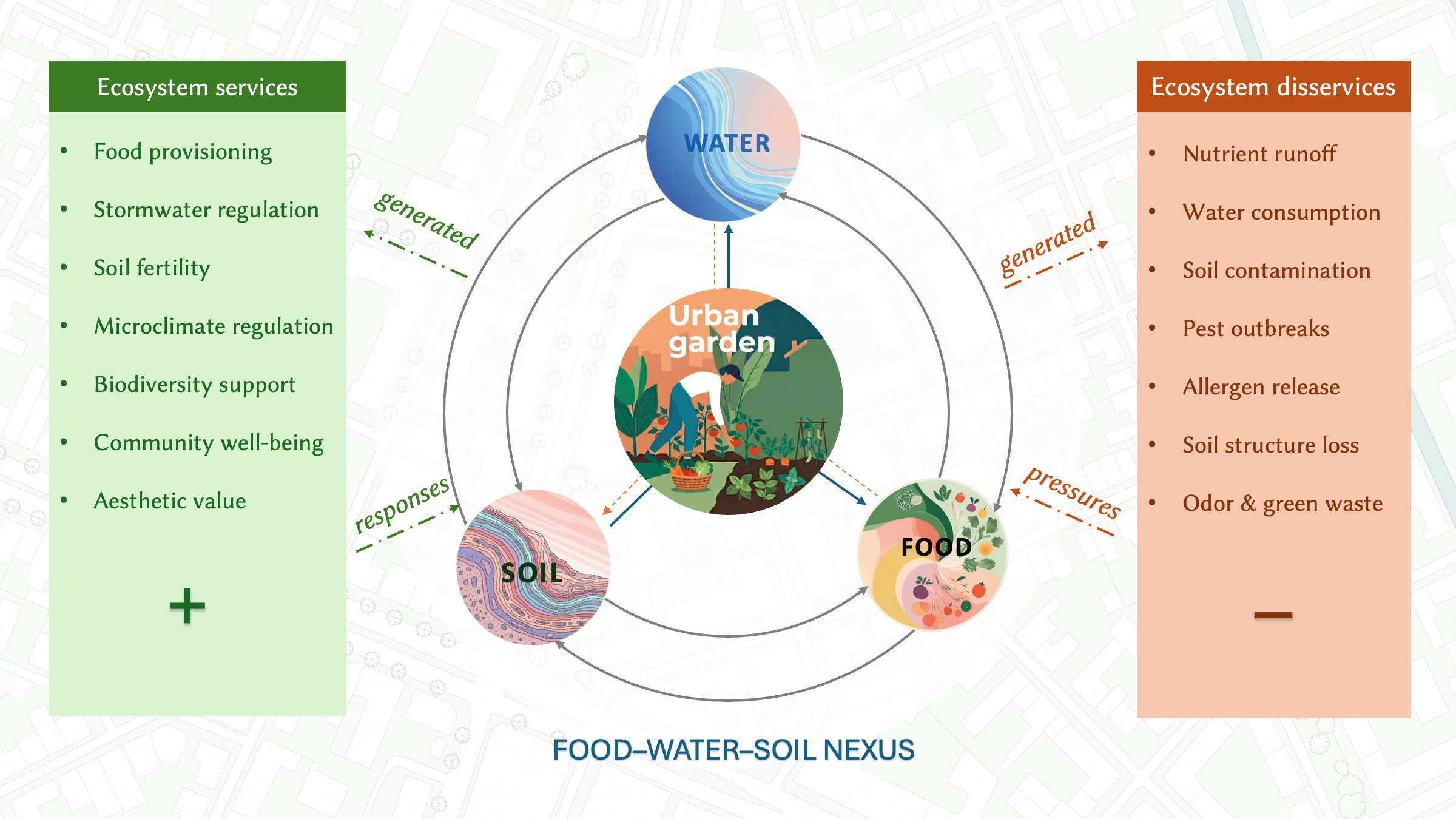
Nexus thinking is crucial for sustainable resource management, but existing frameworks often fail to capture the complexities of urban nature-based solutions, such as urban gardens. Specifically, the prevailing Water-Energy-Food nexus is often unsuitable for low-energy cultivated systems, sidelining the foundational role of soil and overlooking the co-production of ecosystem disservices (EDS) alongside ecosystem services (ES). This perspective paper addresses these gaps by proposing the Food-Water-Soil (FWS) nexus, analyzed through the dual lens of ES and EDS, as a more robust framework for assessing these systems. We argue that ES and EDS are not mere outputs but are the core mediating functions that define the system’s potential and its limits. Central to this framework is the conceptualization of soil as a living infrastructure whose dynamic properties are altered by management, thereby governing the trade-offs and synergies between food production and water dynamics. We conclude by demonstrating that adopting this FWS-ES/EDS perspective has important implications for urban governance and adaptive management. It enables a more complete understanding of system dynamics, fosters more inclusive stakeholder dialogue by making both benefits and nuisances visible, promotes coherent cross-sectoral policy, and supports a culture of long-term ecological stewardship.
- Open Access
- Perspective
Untangling the Food-Water-Soil Nexus through the Lens of Ecosystem Services and Disservices in Urban Gardens
- Pham Trung Kien 1,2,*,
- Liliane Jean-Soro 1,
- Huong Le Thi Thu 2,
- Bernard De-Gouvello 3 and
- Béatrice Bechet 1
Author Information
Received: 05 October 2025 | Revised: 01 April 2026 | Accepted: 17 April 2026 | Published: 15 May 2026
Abstract
Graphical Abstract
Keywords
Food-Water-Soil | urban nexus | urban garden | urban nature-based solutions | ecosystem services and disservices
References
- 1.
IPBES Global Assessment Report of the Intergovernmental Science-Policy Platform on Biodiversity and Ecosystem Services; Brondízio, E.S., Settele, J., Díaz, S.; et al., Eds.; Island Press: Bonn, Germany, 2019; ISBN 978-3-947851-20-1.
- 2.
Millennium Ecosystem Assessment. Ecosystems and Human Well-Being: Wetlands and Water Synthesis; World Resources Institute: Washington, DC, USA, 2005; ISBN 1597260401.
- 3.
Puppim de Oliveira, J.A.; Bellezoni, R.A.; Shih, W.Y.; et al. Innovations in Urban Green and Blue Infrastructure: Tackling Local and Global Challenges in Cities. J. Clean. Prod. 2022, 362, 132355. https://doi.org/10.1016/j.jclepro.2022.132355.
- 4.
Bush, J.; Doyon, A. Building Urban Resilience with Nature-Based Solutions: How Can Urban Planning Contribute? Cities 2019, 95, 102483. https://doi.org/10.1016/J.CITIES.2019.102483.
- 5.
Castellar, J.A.C.; Popartan, L.A.; Pueyo-Ros, J.; et al. Nature-Based Solutions in the Urban Context: Terminology, Classification and Scoring for Urban Challenges and Ecosystem Services. Sci. Total Environ. 2021, 779, 146237. https://doi.org/10.1016/j.scitotenv.2021.146237.
- 6.
Fürst, C.; Luque, S.; Geneletti, D. Nexus Thinking—How Ecosystem Services Can Contribute to Enhancing the Cross-Scale and Cross-Sectoral Coherence between Land Use, Spatial Planning and Policy-Making. Int. J. Biodivers. Sci. Ecosyst. Serv. Manag. 2017, 13, 412–421. https://doi.org/10.1080/21513732.2017.1396257.
- 7.
Ravar, Z.; Zahraie, B.; Sharifinejad, A.; et al. System Dynamics Modeling for Assessment of Water–Food–Energy Resources Security and Nexus in Gavkhuni Basin in Iran. Ecol. Indic. 2020, 108, 105682. https://doi.org/10.1016/j.ecolind.2019.105682.
- 8.
Muthee, K.; Duguma, L.; Nzyoka, J.; et al. Ecosystem-Based Adaptation Practices as a Nature-Based Solution to Promote Water-Energy-Food Nexus Balance. Sustainability 2021, 13, 1142. https://doi.org/10.3390/su13031142.
- 9.
Sambo, B.; Sperotto, A.; Torresan, S.; et al. Looking at the Water-Energy-Food Nexus through the Lens of Ecosystem Services: A New Perspective. Environ. Res. Lett. 2024, 19, 121003. https://doi.org/10.1088/1748-9326/ad96cf.
- 10.
Lyytimäki, J.; Petersen, L.K.; Normander, B.; et al. Nature as a Nuisance? Ecosystem Services and Disservices to Urban Lifestyle. Environ. Sci. 2008, 5, 161–172. https://doi.org/10.1080/15693430802055524.
- 11.
Lyytimäki, J.; Sipilä, M. Hopping on One Leg—The Challenge of Ecosystem Disservices for Urban Green Management. Urban For. Urban Green. 2009, 8, 309–315. https://doi.org/10.1016/j.ufug.2009.09.003.
- 12.
Pereira, P.; Yin, C.; Hua, T. Nature-Based Solutions, Ecosystem Services, Disservices, and Impacts on Well-Being in Urban Environments. Curr. Opin. Environ. Sci. Heal. 2023, 33, 100465. https://doi.org/10.1016/j.coesh.2023.100465.
- 13.
Lal, R.; Mohtar, R.H.; Assi, A.T.; et al. Soil as a Basic Nexus Tool: Soils at the Center of the Food–Energy–Water Nexus; Springer Nature: Berlin/Heidelberg, Germany, 2017; Volume 4, pp. 117–129.
- 14.
Hatfield, J.L.; Sauer, T.J.; Cruse, R.M. Soil: The Forgotten Piece of the Water, Food, Energy Nexus. Adv. Agron. 2017, 143, 1–46. https://doi.org/10.1016/BS.AGRON.2017.02.001.
- 15.
Panagos, P.; Borrelli, P.; Jones, A.; et al. A 1 Billion Euro Mission: A Soil Deal for Europe. Eur. J. Soil Sci. 2024, 75, e13466. https://doi.org/10.1111/ejss.13466.
- 16.
Mumaw, L.; Mata, L. Wildlife Gardening: An Urban Nexus of Social and Ecological Relationships. Front. Ecol. Environ. 2022, 20, 379–385. https://doi.org/10.1002/fee.2484.
- 17.
Nassary, E.K. Exploring the Role of Nature-Based Solutions and Emerging Technologies in Advancing Circular and Sustainable Agriculture: An Opinionated Review for Environmental Resilience. Clean. Circ. Bioeconomy 2025, 10, 100142. https://doi.org/10.1016/j.clcb.2025.100142.
- 18.
Brauman, K.A.; Garibaldi, L.A.; Polasky, S.; et al. Global Trends in Nature’s Contributions to People. Proc. Natl. Acad. Sci. USA 2020, 117, 32799–32805. https://doi.org/10.1073/pnas.2010473117.
- 19.
Edmondson, J.L.; Davies, Z.G.; Gaston, K.J.; et al. Urban Cultivation in Allotments Maintains Soil Qualities Adversely Affected by Conventional Agriculture. J. Appl. Ecol. 2014, 51, 880–889. https://doi.org/10.1111/1365-2664.12254.
- 20.
Hernández-Blanco, M.; Costanza, R. Natural Capital and Ecosystem Services. In The Routledge Handbook of Agricultural Economics; Routledge: New York, NY, USA, 2018; pp. 254–268.
- 21.
Caputo, S.; Schoen, V.; Blythe, C. Productivity and Efficiency of Community Gardens: Case Studies from the UK. Land 2023, 12, 238. https://doi.org/10.3390/land12010238.
- 22.
Azad, M.A.S.; Ancev, T. Assessing the Dynamics of Natural Capital on Farms: A Soil Natural Capital Indicator. Ecol. Econ. 2020, 168, 106500. https://doi.org/10.1016/j.ecolecon.2019.106500.
- 23.
Robinson, D.A.; Lebron, I.; Vereecken, H. On the Definition of the Natural Capital of Soils: A Framework for Description, Evaluation, and Monitoring. Soil Sci. Soc. Am. J. 2009, 73, 1904–1911. https://doi.org/10.2136/sssaj2008.0332.
- 24.
Huynh, L.T.M.; Gasparatos, A.; Su, J.; et al. Linking the Nonmaterial Dimensions of Human-Nature Relations and Human Well-Being through Cultural Ecosystem Services. Sci. Adv. 2022, 8, eabn8042. https://doi.org/10.1126/sciadv.abn8042.
- 25.
Sangha, K.K.; Gordon, I.J.; Costanza, R. Ecosystem Services and Human Wellbeing-Based Approaches Can Help Transform Our Economies. Front. Ecol. Evol. 2022, 10, 841215. https://doi.org/10.3389/fevo.2022.841215.
- 26.
Gómez-Baggethun, E.; Barton, D.N. Classifying and Valuing Ecosystem Services for Urban Planning. Ecol. Econ. 2013, 86, 235–245. https://doi.org/10.1016/j.ecolecon.2012.08.019.
- 27.
Séré, G.; Le Guern, C.; Bispo, A.; et al. Selection of Soil Health Indicators for Modelling Soil Functions to Promote Smart Urban Planning. Sci. Total Environ. 2024, 924, 171347. https://doi.org/10.1016/j.scitotenv.2024.171347.
- 28.
Le Guern, C.; Jean-Soro, L.; Béchet, B.; et al. Management Initiatives in Support of the Soil Quality of Urban Allotment Gardens: Examples from Nantes (France). Land Degrad. Dev. 2018, 29, 3681–3692. https://doi.org/10.1002/LDR.3123.
- 29.
Van der Jagt, A.P.N.; Szaraz, L.R.; Delshammar, T.; et al. Cultivating Nature-Based Solutions: The Governance of Communal Urban Gardens in the European Union. Environ. Res. 2017, 159, 264–275. https://doi.org/10.1016/J.ENVRES.2017.08.013.
- 30.
Cabral, I.; Costa, S.; Weiland, U.; et al. Urban Gardens as Multifunctional Nature-Based Solutions for Societal Goals in a Changing Climate. In Nature-Based Solutions to Climate Change Adaptation in Urban Areas: Linkages between Science, Policy and Practice; Springer International Publishing: Cham, Switzerland, 2017; pp. 237–253.
- 31.
Cortinovis, C.; Alzetta, C.; Geneletti, D. Mapping Ecosystem Services, Disservices, and Ecological Requirements to Enhance Urban Forest Planning and Management in Padova. In Ecosystem Services and Green Infrastructure: Perspectives from Spatial Planning in Italy; Springer International Publishing: Cham, Switzerland, 2021; pp. 167–179.
- 32.
López-Ridaura, S. Evaluating the Sustainability of Complex Socio-Environmental Systems. The MESMIS Framework. Ecol. Indic. 2002, 2, 135–148. https://doi.org/10.1016/S1470-160X(02)00043-2.
- 33.
Speelman, E.N.; López-Ridaura, S.; Colomer, N.A.; et al. Ten Years of Sustainability Evaluation Using the MESMIS Framework: Lessons Learned from Its Application in 28 Latin American Case Studies. Int. J. Sustain. Dev. World Ecol. 2007, 14, 345–361. https://doi.org/10.1080/13504500709469735.
- 34.
Mahmoud, I.H.; Morello, E.; Ludlow, D.; et al. Ten Co-Creation Pathways to Inform Shared Governance of Urban Living Labs in Practice: Lessons from Three European Projects. Front. Sustain. Cities 2021, 3, 690458. https://doi.org/10.3389/frsc.2021.690458.
- 35.
Lyytimäki, J. Prospects for Environmental Communication Based on 25 Years of Newspaper Coverage of Climate Change and Eutrophication in Finland. Appl. Environ. Educ. Commun. 2015, 14, 246–255. https://doi.org/10.1080/1533015X.2015.1109486.
- 36.
Webb, R.; Bai, X.; Smith, M.S.; et al. Sustainable Urban Systems: Co-Design and Framing for Transformation. Ambio 2018, 47, 57–77. https://doi.org/10.1007/s13280-017-0934-6.
- 37.
Haase, D.; Larondelle, N.; Andersson, E.; et al. A Quantitative Review of Urban Ecosystem Service Assessments: Concepts, Models, and Implementation. Ambio 2014, 43, 413–433.


This work is licensed under a Creative Commons Attribution 4.0 International License.
