
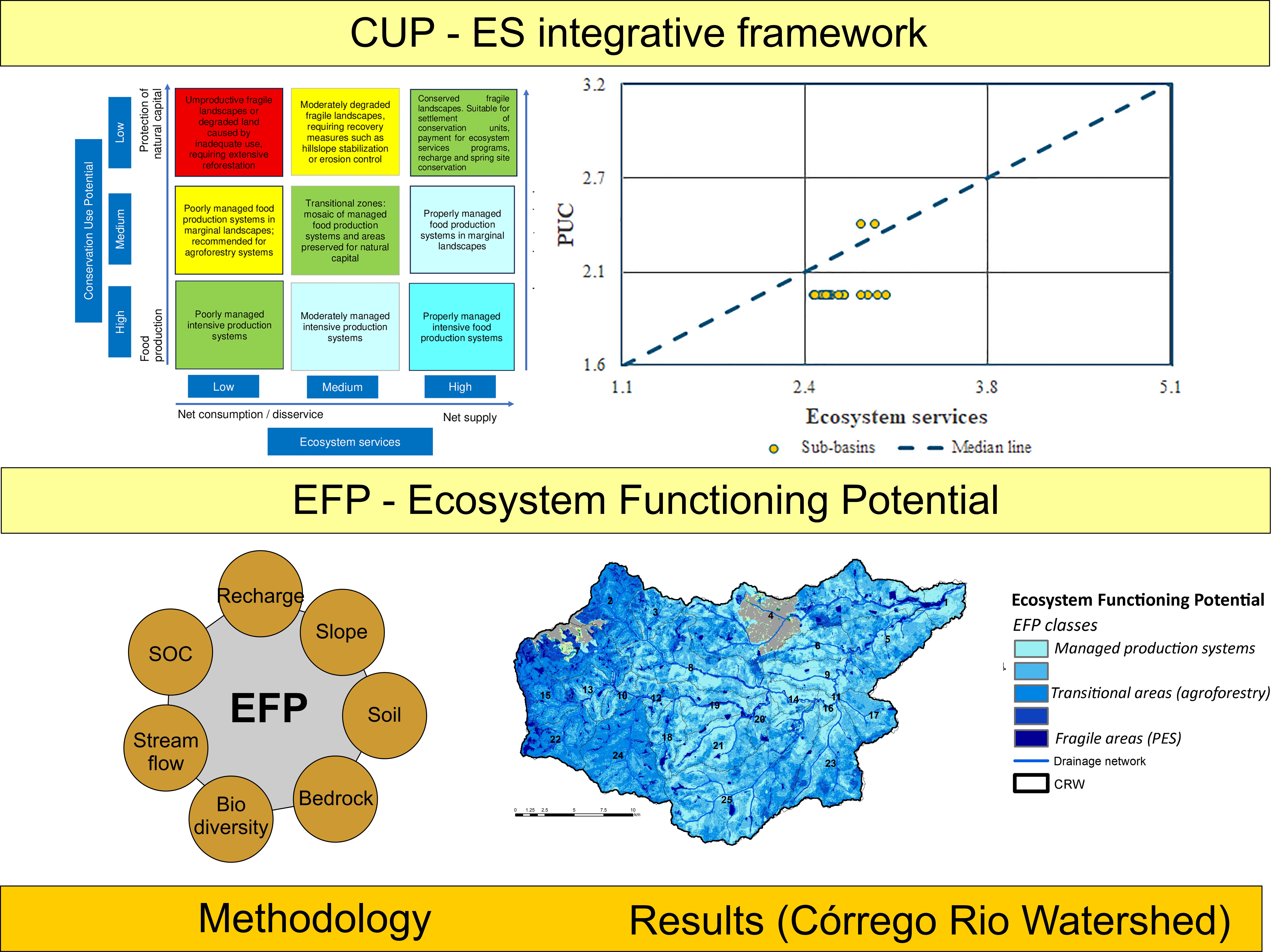
Sustainability is essential to Earth systems, but inadequate landscape planning makes it a challenge to modern societies. To help improving sustainable land use in watersheds, this study merged the so-called Conservation Use Potential (CUP) method with an Ecosystem Services (ES) accounting method. The compound CUP-ES method embeds a novel multifunctionality index, called Ecosystem Functioning Potential (EFP), which helps making sustainable land use actionable through Payment for Environmental Services (PES) schemes. The CUP and ES were assessed by a multicriteria analysis connecting a diversity of parameters, and regionalized using map algebra and zonal statistics in a Geographic Information System. The novelty of CUP-ES and EFP analyses rely on their ability to rank areas for practical interventions in the watershed: (a) land use conversions such as extensive reforestation or agroforestry systems; (b) landscape stabilization through erosion control; (c) conservationist soil management; and (d) PES to ensure the protection of natural capital and improve the supply of ecosystem services. The CUP-ES-EFP framework was applied to the Córrego Rico Watershed (CRW), located in the state of São Paulo, Brazil. The multicriteria analysis assigned different ratings and weights to soil use potential parameters (soil type, bedrock, terrain slope) as well as to provisioning (water resources) and supporting (soil carbon stock and biodiversity) ecosystem services. The key results showed that most sub-basins within the CRW correspond to moderately managed production systems (sugarcane), as they preserve ecosystem services notwithstanding the intensive use. Thus, they were recommended for conservationist soil management according to the CUP-ES interpretation. The spatial distribution of EFP suggested the implementation of PES in some areas, given their role as water resources suppliers. The main conclusion was that, the CUP-ES-EFP framework proved efficient for sustainable land use planning, being regarded as potential decision-making tool. In that context, sustainability of CRW could be reached through the balance of protected areas (the headwaters), seen as net suppliers of ES, and food production systems (the lower lands), mostly regarded as net ES consumers.
- Open Access
- Article
A Framework Model to Assess Ecosystem Functioning in Agriculture Watersheds: The Case of Córrego Rico, Brazil
- Teresa Cristina Tarlé Pissarra 1,2,
- Anildo Monteiro Caldas 3,
- Luís Filipe Sanches Fernandes 2,4,5,
- Fernando António Leal Pacheco 2,5,6,* and
- Adriana Monteiro da Costa 5,7
Author Information
Received: 27 January 2026 | Revised: 21 April 2026 | Accepted: 24 April 2026 | Published: 08 May 2026
Abstract
Graphical Abstract
Keywords
land use policy | territorial management | watersheds | soil system | ecosystem functioning
References
- 1.
Lepsch, I.F. Formação e Conservação dos Solos: Fundamentos para uma Agricultura Sustentável, 2nd ed.; Oficina de Textos: São Paulo, Brazil, 2010; ISBN 978-85-7975-008-3.
- 2.
Pereira, F.L.C.; Lombardi Neto, A. Avaliação da Aptidão Agrícola das Terras: Proposta Metodológica; Embrapa Meio Ambiente: Jaguariúna, SP, Brazil, 2004; Documentos 43.
- 3.
da Costa, A.M.; Viana, J.H.M.; Evangelista, L.P.; et al. Ponderação de variáveis ambientais para a determinação do Potencial de Uso Conservacionista para o Estado de Minas Gerais. Geografias 2017, 13, 118–133.
- 4.
Costa, M.P.P.; Salis, H.H.C.; Viana, J.H.M.; et al. Zoneamento ambiental e produtivo: Uso da modelagem para a identificação de potencialidades e limitações no uso do solo. Inf. Agropecuário 2017, 38, 81–91.
- 5.
Moges, A.S.; Wondimagegn, S.A. Impact of soil and water conservation intervention on soil physico-chemical properties in Awash Basin, Ethiopia. Soil Secur. 2025, 19, 100189. https://doi.org/10.1016/j.soisec.2025.100189.
- 6.
da Costa, A.M.; de Moura, M.S.; Navarro, I.F.; et al. Ecosystem services potential and soil conservation policies with emphasis on degraded pastures in Brazil. Geogr. Sustain. 2024, 5, 660–672. https://doi.org/10.1016/j.geosus.2024.07.010.
- 7.
de Moura, M.S.; da Silva, V.C.; Pacheco, F.A.L.; et al. Beyond land use planning and ecosystem services assessment with the conservation use potential framework: A study in the Upper Rio das Velhas basin, Brazil. Sci. Total Environ. 2024, 923, 171437. https://doi.org/10.1016/j.scitotenv.2024.171437.
- 8.
Pissarra, T.C.T.; Sanches Fernandes, L.F.; Pacheco, F.A.L. Production of clean water in agriculture headwater catchments: A model based on the payment for environmental services. Sci. Total Environ. 2021, 785, 147331. https://doi.org/10.1016/j.scitotenv.2021.147331.
- 9.
da Costa, A.M.; de Salis, H.H.C.; Araújo, B.J.R.S.; et al. Potencial de uso conservacionista em bacias hidrográficas. Rev. Geogr. 2022, 15, 127–147. https://doi.org/10.35699/2237-549X.2019.19891.
- 10.
Herrick, J.E.; Urama, K.C.; Karl, J.W.; et al. The global Land-Potential Knowledge System (LandPKS): Supporting evidence-based, site-specific land use and management through cloud computing, mobile applications, and crowdsourcing. J. Soil Water Conserv. 2013, 68, 5A–12A. https://doi.org/10.2489/jswc.68.1.5A.
- 11.
Coyne, M.S.; Pena-Yewtukhiw, E.M.; Grove, J.H.; et al. Soil health—It’s not all biology. Soil Secur. 2022, 6, 100051. https://doi.org/10.1016/j.soisec.2022.100051.
- 12.
dos Santos, H.G.; Jacomine, P.K.T.; dos Anjos, L.H.C.; et al. Sistema Brasileiro de Classificação de Solos, 5th ed.; Embrapa Solos: Rio de Janeiro, Brazil, 2018.
- 13.
Costa, B.J.R.S.; Da Silva, L.H.; Da Silva, V.C.; et al. Potencial de Uso Conservacionista (PUC) e uso e cobertura do solo na bacia hidrográfica do córrego Guavirá, PR. Perspect. Geográfica 2019, 14, 107–122.
- 14.
Gass, S.L.B.; da Silva, D.M.; de Arruda, S.F. O potencial de uso conservacionista como instrumento de gestão territorial: Uma proposta. Geographicalia 2023, 75, 67–82. https://doi.org/10.26754/ojs_geoph/geoph.2023759568.
- 15.
Karakus, C.B.; Cerit, O.; Kavak, K.S. Determination of Land Use/Cover Changes and Land Use Potentials of Sivas City and its Surroundings Using Geographical Information Systems (GIS) and Remote Sensing (RS). Procedia Earth Planet. Sci. 2015, 15, 454–461. https://doi.org/10.1016/j.proeps.2015.08.040.
- 16.
Mucida, D.P.; Gorgens, E.B.; Rech, A.R.; et al. Designing optimal agrosilvopastoral landscape by the potential for conservation use in Brazil. Sustain. Horiz. 2023, 5, 100045. https://doi.org/10.1016/j.horiz.2022.100045.
- 17.
Ehrlich, P.R.; Mooney, H.A. Extinction, Substitution, and Ecosystem Services. Bioscience 1983, 33, 248–254. https://doi.org/10.2307/1309037.
- 18.
de Mendonça, G.C.; Abdo, M.T.V.N.; da Costa, L.M.; et al. Watershed’s spatial targeting: Enhancing payments for ecosystem services to scale up agroecosystem restoration through nature-based solutions. Ecosyst. Serv. 2025, 71, 101679. https://doi.org/10.1016/j.ecoser.2024.101679.
- 19.
Fu, Y.; Zhang, J.; Zhang, C.; et al. Payments for Ecosystem Services for watershed water resource allocations. J. Hydrol. 2018, 556, 689–700. https://doi.org/10.1016/j.jhydrol.2017.11.051.
- 20.
Mota, P.K.; da Costa, A.M.; Prado, R.B.; et al. Payment for Environmental Services: A critical review of schemes, concepts, and practice in Brazil. Sci. Total Environ. 2023, 899, 165639. https://doi.org/10.1016/j.scitotenv.2023.165639.
- 21.
Arnold, J.G.; Moriasi, D.N.; Gassman, P.W.; et al. SWAT: Model Use, Calibration, and Validation. Trans. ASABE 2012, 55, 1491–1508. https://doi.org/10.13031/2013.42256.
- 22.
Rossi, M. Mapa Pedológico do Estado de São Paulo; Instituto Florestal: São Paulo, Brazil, 2017; Volume 1.
- 23.
Hartmann, L.; Walz, Y.; Hansohm, J.; et al. Assessing the contribution of land and water management approaches to sustainable land management and achieving land degradation neutrality. Front. Sustain. Resour. Manag. 2024, 3, 1423078. https://doi.org/10.3389/fsrma.2024.1423078.
- 24.
Kalogiannidis, S.; Kalfas, D.; Giannarakis, G.; et al. Integration of Water Resources Management Strategies in Land Use Planning towards Environmental Conservation. Sustainability 2023, 15, 15242. https://doi.org/10.3390/su152115242.
- 25.
Kaur, R.; Kaur, N.; Kumar, S.; et al. Carbon capture and sequestration for sustainable land use—A review. Indian J. Agric. Sci. 2023, 93, 11–18. https://doi.org/10.56093/ijas.v93i1.124838.
- 26.
Zhang, Y.; Tang, J.; Hu, X.; et al. Understanding the Spatiotemporal Patterns and Drivers of Carbon Stock in Central-Southern China’s Hilly Regions Through Land Use Change and Scenario Simulation. Sustainability 2025, 17, 5578. https://doi.org/10.3390/su17125578.
- 27.
Tucci, C.E.M. Regionalização de Vazões, 1st ed.; Universidade Federal do Rio Grande do Sul: Porto Alegre, Brazil, 2022.
- 28.
Souza, C.M.; Shimbo, J.Z.; Rosa, M.R.; et al. Reconstructing Three Decades of Land Use and Land Cover Changes in Brazilian Biomes with Landsat Archive and Earth Engine. Remote Sens. 2020, 12, 2735. https://doi.org/10.3390/rs12172735.
- 29.
Saaty, T.L.; Sodenkamp, M. The Analytic Hierarchy and Analytic Network Measurement Processes: The Measurement of Intangibles. In Handbook of Multicriteria Analysis; Springer: Berlin/Heidelberg, Germany, 2010; pp. 91–166. https://doi.org/10.1007/978-3-540-92828-7_4.
- 30.
Saaty, R.W. The analytic hierarchy process—What it is and how it is used. Math. Model. 1987, 9, 161–176. https://doi.org/10.1016/0270-0255(87)90473-8.
- 31.
Saaty, T.L. A scaling method for priorities in hierarchical structures. J. Math. Psychol. 1977, 15, 234–281. https://doi.org/10.1016/0022-2496(77)90033-5.
- 32.
Ishizaka, A.; Nemery, P. Multi-Criteria Decision Analysis; Wiley: Hoboken, NJ, USA, 2013. https://doi.org/10.1002/9781118644898.
- 33.
Schaefer, C.E.G.R.; Siqueira, R.G.; Pereira, L.F.; et al. Brazilian Latossolos (Ferralsols, Oxisols) from different biomes: A multiproxy study on the spatial variability of the most weathered tropical soils in South America. Geoderma Reg. 2025, 43, e01012. https://doi.org/10.1016/j.geodrs.2025.e01012.
- 34.
Kopittke, P.M.; Harper, S.M.; Asio, L.G.; et al. Soil degradation: An integrated model of the causes and drivers. Int. Soil Water Conserv. Res. 2025, 13, 744–755. https://doi.org/10.1016/j.iswcr.2025.07.010.
- 35.
Gupta, G.S. Land Degradation and Challenges of Food Security. Rev. Eur. Stud. 2019, 11, 63. https://doi.org/10.5539/res.v11n1p63.
- 36.
de Medeiros-Sarmento, P.S.; Ferreira, L.V.; Gastauer, M. Recovery of soil macrofauna in Amazonian secondary forests is driven by vegetation complexity rather than fallow age alone. Front. For. Glob. Chang. 2025, 8, 1713966. https://doi.org/10.3389/ffgc.2025.1713966.
- 37.
Guo, C.; Hao, J.; Ma, S.; et al. Effects of microbial fertilizers on tobacco plants and soil microbial community during the prosperously growing stage. Front. Soil Sci. 2025, 5, 1666961. https://doi.org/10.3389/fsoil.2025.1666961.
- 38.
Bajahmoum, E.A.; Almaghamsi, A. Physicochemical degradation of Avicennia marina mangrove soils in the Red Sea: Implications for coastal ecosystem services. Front. Soil Sci. 2025, 5, 1621591. https://doi.org/10.3389/fsoil.2025.1621591.
- 39.
Quansah, K.E.; Asah-Asante, R.; Xudong, F.; et al. Vegetable residue valorization for soil health and climate resilience. Front. Soil Sci. 2025, 5, 1624486. https://doi.org/10.3389/fsoil.2025.1624486.
- 40.
Vivian, J.; Chazdon, R.L.; Catling, A.A.; et al. Early evidences of links between soil microbes and forest restoration through multiple ecosystem metrics. Front. For. Glob. Chang. 2025, 8, 1540513. https://doi.org/10.3389/ffgc.2025.1540513.
- 41.
Scammacca, O.; Montagne, D.; Asins-Velis, S.; et al. Assessing and mapping changes in soil ecosystem services and soil threats in agroecosystems through scenario-based approaches—A systematic review. Sci. Total Environ. 2025, 966, 178646. https://doi.org/10.1016/j.scitotenv.2025.178646.
- 42.
Rheinhardt, R.D.; Brinson, M.M.; Meyer, G.F.; et al. Carbon storage of headwater riparian zones in an agricultural landscape. Carbon Balance Manage. 2012, 7, 4. https://doi.org/10.1186/1750-0680-7-4.
- 43.
Peters-Collaer, S.; Keeton, W.S.; Warren, D.R.; et al. An Emerging Carbon Sink in Headwater Streams and the Role of Large Wood and Riparian Forest Structure. Ecosystems 2025, 28, 24. https://doi.org/10.1007/s10021-025-00965-w.
- 44.
Pena, S.B.; Magalhães, M.R.; Abreu, M.M. Mapping headwater systems using a HS-GIS model. An application to landscape structure and land use planning in Portugal. Land Use Policy 2018, 71, 543–553. https://doi.org/10.1016/j.landusepol.2017.11.009.
- 45.
Lou, Y.; Zhu, Y.; Wei, J.; et al. Effects of Vegetation on Runoff Hydrodynamics and Erosion Morphologies in Headcut Erosion Processes in the Loess Tableland Region. Water Resour. Res. 2025, 61, e2024WR038274. https://doi.org/10.1029/2024WR038274.
- 46.
Křeček, J.; Nováková, J.; Palán, L.; et al. Role of forests in headwater control with changing environment and society. Int. Soil Water Conserv. Res. 2021, 9, 143–157. https://doi.org/10.1016/j.iswcr.2020.11.002.
- 47.
Rabot, E.; Guiresse, M.; Pittatore, Y.; et al. Development and spatialization of a soil potential multifunctionality index for agriculture (Agri-SPMI) at the regional scale. Case study in the Occitanie region (France). Soil Secur. 2022, 6, 100034. https://doi.org/10.1016/j.soisec.2022.100034.
- 48.
Costanza, R.; d’Arge, R.; de Groot, R.; et al. The value of the world’s ecosystem services and natural capital. Nature 1997, 387, 253–260. https://doi.org/10.1038/387253a0.
- 49.
Yang, Y.; Xiao, J.; Huang, Y.; et al. Understanding how agroforestry systems biodiversity drives ecosystem services in degraded habitats. J. Environ. Manage. 2025, 385, 125607. https://doi.org/10.1016/j.jenvman.2025.125607.
- 50.
Nungula, E.Z.; Chappa, L.R.; Ranjan, S.; et al. Ecosystem Services Through Agroforestry Systems and Its Sustainability. In Agroforestry; Wiley, 2024; pp 223–254. https://doi.org/10.1002/9781394231164.ch8.
- 51.
Bhandari, S.; Paudel, S.; Upadhaya, S. Socio-Economic and Environmental Benefits of Agroforestry and Its Multilevel Barriers to Adoption: A Systematic Review. Sustainability 2025, 18, 5. https://doi.org/10.3390/su18010005.
- 52.
Li, F.; Liu, H.; Wu, S.; et al. A PES framework coupling socioeconomic and ecosystem dynamics from a sustainable development perspective. J. Environ. Manage. 2023, 329, 117043. https://doi.org/10.1016/j.jenvman.2022.117043.
- 53.
Villalba, R.; Venus, T.E.; Sauer, J. The ecosystem approach to agricultural value chain finance: A framework for rural credit. World Dev. 2023, 164, 106177. https://doi.org/10.1016/j.worlddev.2022.106177.
- 54.
Brander, L.M.; de Groot, R.; Schägner, J.P.; et al. Economic values for ecosystem services: A global synthesis and way forward. Ecosyst. Serv. 2024, 66, 101606. https://doi.org/10.1016/j.ecoser.2024.101606.
- 55.
Oseph, S.; Pradeepkumar, A.P. Ecosystem Services Valuation for Sustainable Development; Springer Nature: Singapore, 2024. https://doi.org/10.1007/978-981-97-4688-0.
- 56.
Zandebasiri, M.; Jahanbazi Goujani, H.; Iranmanesh, Y.; et al. Ecosystem services valuation: A review of concepts, systems, new issues, and considerations about pollution in ecosystem services. Environ. Sci. Pollut. Res. 2023, 30, 83051–83070. https://doi.org/10.1007/s11356-023-28143-2.
- 57.
Legesse, F.; Degefa, S.; Soromessa, T. Valuation Methods in Ecosystem Services: A Meta-analysis. Res. Sq. 2022. https://doi.org/10.21203/rs.3.rs-1935778/v1.
- 58.
Kaiser, J.; Haase, D.; Krueger, T. Payments for ecosystem services: A review of definitions, the role of spatial scales, and critique. Ecol. Soc. 2021, 26, 12. https://doi.org/10.5751/ES-12307-260212.
- 59.
Nemec, K.T.; Raudsepp-Hearne, C. The use of geographic information systems to map and assess ecosystem services. Biodivers. Conserv. 2013, 22, 1–15. https://doi.org/10.1007/s10531-012-0406-z.
- 60.
Dorn, F.M.; Pachoud, C.; Jurado, E. Countering agribusiness: Analyzing the potentials for agroecology in Mendoza’s Valle de Uco through a territorial perspective. J. Peasant Stud. 2025, 1–23. https://doi.org/10.1080/03066150.2025.2551702.
- 61.
Bezner Kerr, R.; Postigo, J.C.; Smith, P.; et al. Agroecology as a transformative approach to tackle climatic, food, and ecosystemic crises. Curr. Opin. Environ. Sustain. 2023, 62, 101275. https://doi.org/10.1016/j.cosust.2023.101275.


This work is licensed under a Creative Commons Attribution 4.0 International License.
