
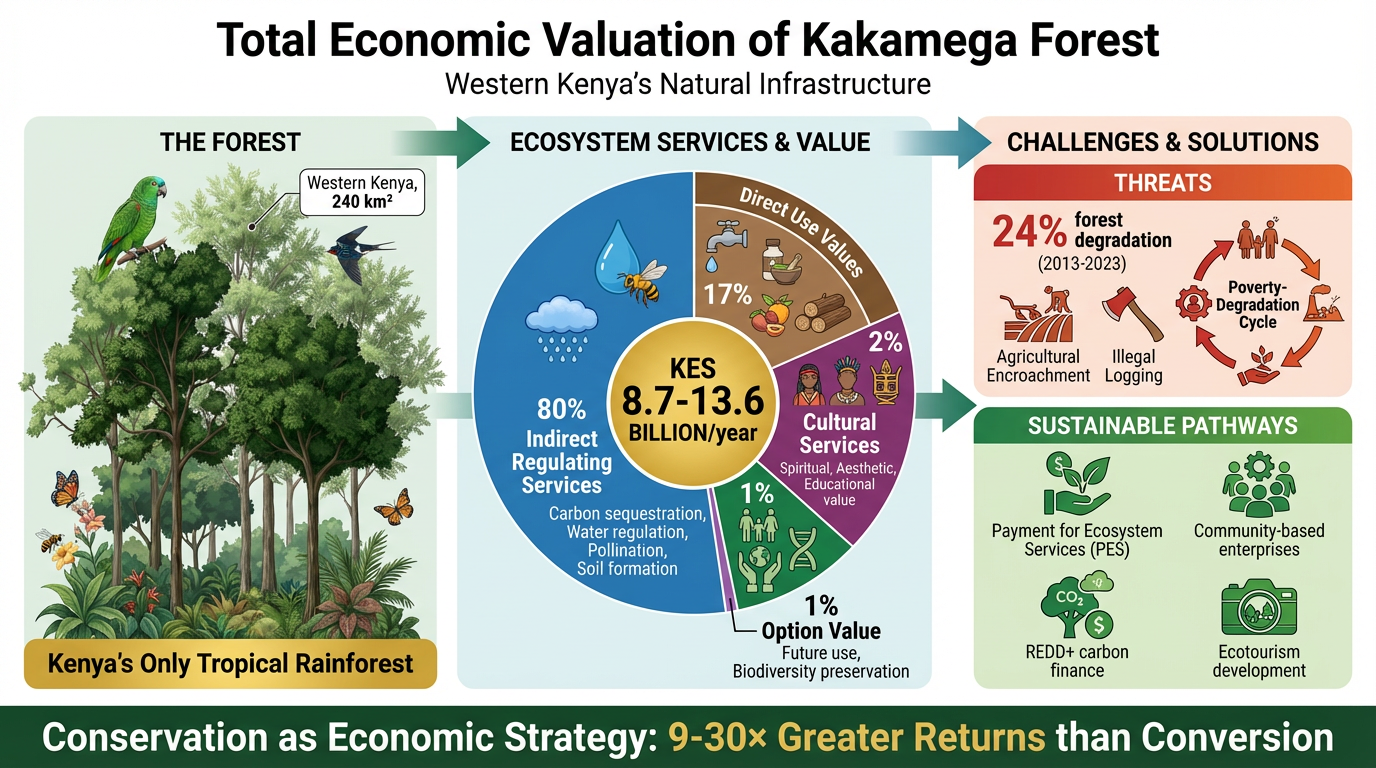
Kakamega Forest in Western Kenya is a remnant of the Guineo-Congolian rainforest and a biodiversity hotspot. It supports one of the country’s most populous and impoverished regions, yet its value as an economic asset remains underappreciated. This study integrates original spatiotemporal forest health analysis (Landsat 8, SAVI 2013–2023) with synthesized Total Economic Valuation from existing literature to provide a spatially explicit, degradation-informed valuation framework. Our synthesis estimates that the forest generates about KES 8.7–13.6 billion annually (approximately 65–102 million USD), with roughly 79% attributable to indirect regulating services. Applying the observed 24.36% net forest degradation to the indirect use value component (KES 6.8–10.9 billion) under a linear proportional assumption gives an estimated annual loss of KES 1.7–2.7 billion in ecosystem service flows. These estimates are derived from secondary data and benefit transfer. The estimated per-unit-area economic return of conserved forest exceeds that of the most common agricultural conversions, indicating that short-term opportunity-cost arguments for deforestation are not supported by the aggregate valuation. However, the observed resource-use intensity, combined with high local poverty rates, is consistent with a poverty-degradation feedback. Beyond its local relevance, this work provides a replicable methodological template for a spatially explicit, degradation-informed valuation framework in tropical forest contexts worldwide, showing how adaptive management is made possible in a time of fast land-use change by combining remote sensing with economic assessment.
- Open Access
- Article
Integrating Remote Sensing and Total Economic Valuation: A Spatially Explicit, Degradation-Adjusted Assessment of Ecosystem Services in Kakamega Forest
Author Information
Received: 29 Mar 2026 | Revised: 15 May 2026 | Accepted: 22 May 2026 | Published: 09 Jun 2026
Abstract
Graphical Abstract
Keywords
total economic value | natural capital accounting | remote sensing | Payment for Ecosystem Services (PES) | forest degradation | Kakamega Forest
References
- 1.
Lung, T.; Schaab, G. Assessing fragmentation and disturbance of west Kenyan rainforests by means of remotely sensed time series data and landscape metrics. Afr. J. Ecol. 2006, 44, 491–506. https://doi.org/10.1111/j.1365-2028.2006.00663.x.
- 2.
Mitchell, N.; Bleher, B. The Exploitation and Disturbance History of Kakamega Forest, Western Kenya; Abteilung Okologie der Universitat Bielefeld: Bielefeld, Germany, 2004.
- 3.
KNBS. Kenya Population and Housing Census: Volume IV–Distribution of Population by Socio-Economic Characteristics; Government Printer; KNBS: Nairobi, Kenya, 2019.
- 4.
Mogaka, H. Economic Aspects of Community Involvement in Sustainable Forest Management in Eastern and Southern Africa; IUCN: Fontainebleau, France, 2001.
- 5.
Seswa, F.; Manohar, S.; Kitur, E. Current floristic composition and growth forms of Equatorial Rainforest, Kakamega County, Kenya. Int. J. Agric. For. 2018, 8, 70–76. https://doi.org/10.5923/j.ijaf.20180802.04.
- 6.
Pearce, D.W.; Atkinson, G.D. Capital theory and the measurement of sustainable development: An indicator of “weak” sustainability. In The Economics of Sustainability; Routledge: Oxfordshire, UK, 2017; pp. 227–232.
- 7.
MEA. Ecosystems and Human Well-Being: Wetlands and Water; World Resources Institute: Washington, DC, USA, 2005.
- 8.
Kumar, P. The Economics of Ecosystems and Biodiversity: Ecological and Economic Foundations; Routledge: Oxfordshire, UK, 2012.
- 9.
Pearce, D.; Moran, D. The Economic Value of Biodiversity; Routledge: Oxfordshire, UK, 2013.
- 10.
Bernhard, K.P.; Shapiro, A.C.; d’Annunzio, R.; et al. Transboundary Central African Protected Area Complexes Demonstrate Varied Effectiveness in Reducing Predicted Risk of Deforestation Attributed to Small-Scale Agriculture. Remote Sens. 2024, 16, 204. https://doi.org/10.3390/rs16010204.
- 11.
Bossy, T.; Ciais, P.; Renaudineau, S.; et al. State of the art in remote sensing monitoring of carbon dynamics in African tropical forests. Front. Remote Sens. 2025, 6, 1532280. https://doi.org/10.3389/frsen.2025.1532280.
- 12.
Chomba, S.; Kariuki, J.; Lund, J.F.; et al. Roots of inequity: How the implementation of REDD+ reinforces past injustices. Land Use Policy 2016, 50, 202–213. https://doi.org/10.1016/j.landusepol.2015.09.021.
- 13.
Crafford, J.; Strohmaier, R.; Muñoz, P.; et al. The Role and Contribution of Montane Forests and Related Ecosystem Services to the Kenyan Economy; CABI: Oxfordshire, UK, 2012; 49p.
- 14.
Hettiarachchi, U.; Zhang, W.; Pham, T.T.; et al. Ecosystem Services May Provide Large Economic Values in Kenya and Vietnam: A Value Transfer Application Based on Results from a Systematic Literature Review; IFPRI discussion papers 2228; International Food Policy Research Institute (IFPRI): Washington, DC, USA, 2024.
- 15.
Ramihangihajason, T.A.; Weber, J.-L.; Rakotondraompiana, S.; et al. Natural capital accounting as a decision support tool for environmental management of a protected area in Madagascar. PLoS ONE 2025, 20, e0321948. https://doi.org/10.1371/journal.pone.0321948.
- 16.
Okumu, B.; Muchapondwa, E. Economic Valuation of Forest Ecosystem Services in Kenya: Implication for Design of PES Schemes and Participatory Forest Management. J. For. Econ. 2022, 37, 347–381. https://doi.org/10.1561/112.00000551.
- 17.
Yin, R.K. Case Study Research and Applications: Design and Methods; SAGE Publications, Inc: Thousand Oaks, CA, USA, 2018; Volume 6.
- 18.
Page, M.J.; McKenzie, J.E.; Bossuyt, P.M.; et al. The PRISMA 2020 statement: An updated guideline for reporting systematic reviews. BMJ 2021, 372, n71. https://doi.org/10.1136/bmj.n71.
- 19.
KTDA. Annual Report and Financial Statements 2018/2019; KTDA Holdings: Nairobi, Kenya, 2019.
- 20.
Costanza, R.; d’Arge, R.; de Groot, R.; et al. The value of the world’s ecosystem services and natural capital. Nature 1997, 387, 253–260. https://doi.org/10.1038/387253a0.
- 21.
Costanza, R.; de Groot, R.; Sutton, P.; et al. Changes in the global value of ecosystem services. Glob. Environ. Change 2014, 26, 152–158. https://doi.org/10.1016/j.gloenvcha.2014.04.002.
- 22.
Clark, D.A.; Clark, D.B. Getting to the canopy: Tree height growth in a neotropical rain forest. Ecology 2001, 82, 1460–1472.
- 23.
Koch, E.W.; Barbier, E.B.; Silliman, B.R.; et al. Non-linearity in ecosystem services: Temporal and spatial variability in coastal protection. Front. Ecol. Environ. 2009, 7, 29–37. https://doi.org/10.1890/080126.
- 24.
Gorelick, N.; Hancher, M.; Dixon, M.; et al. Google Earth Engine: Planetary-scale geospatial analysis for everyone. Remote Sens. Environ. 2017, 202, 18–27. https://doi.org/10.1016/j.rse.2017.06.031.
- 25.
Tyukavina, A.; Potapov, P.; Hansen, M.C.; et al. Global Trends of Forest Loss Due to Fire From 2001 to 2019. Front. Remote Sens. 2022, 3, 825190. https://doi.org/10.3389/frsen.2022.825190.
- 26.
Wambua, S. Household Energy Consumption and Dependency on Common Pool Forest Resources: The Case of Kakamega Forest, Western Kenya; Niedersächsische Staats-und Universitätsbibliothek Göttingen: Göttingen, Germany, 2013.
- 27.
Kiplagat, A.; Mburu, J.; Mugendi, D. Consumption of non timber forest products (NTFPs) in Kakamega forest, Western Kenya: Accessibility, role and value to resident rural households. In Proceedings of the 2008 IASC Biennial International Conference, Cheltenham, UK, 14–19 July 2008; pp. 1–28.
- 28.
Mugambi, M.D.; Mburu, J.I. Estimation of the tourism benefits of Kakamega forest, Kenya: A travel cost approach. Environ. Nat. Resour. Res. 2013, 3, 62.
- 29.
KACWASCO. Tariff Schedule for Water Services in Kakamega County; KACWASCO: Kakamega, Kenya, 2023. Available at https://kakamegawater.co.ke/wp-content/uploads/2023/08/Approved-Regular-Tariff-Indexation-July-2023-KACWASCO.pdf (accessed on 8 June 2026).
- 30.
Obonyo, O.A.; Agevi, H.; Tsingalia, M.H. Above-ground carbon stocks and its functional relationship with tree species diversity: The case of Kakamega and North Nandi Forests, Kenya. Sci. Rep. 2023, 13, 20921. https://doi.org/10.1038/s41598-023-47871-6.
- 31.
WRI. Deforestation Rates & Statistics for Kakamega, Kenya. Available online: https://www.globalforestwatch.org/dashboards/country/KEN/11/ (accessed on 12 May 2026).
- 32.
Kasina, J.M. Bee Pollinators and Economic Importance of Pollination in Crop Production. Ph.D. Thesis, Universitäts-und Landesbibliothek Bonn, Bonn, Germany, 2007.
- 33.
Kasina, J.M.; Mburu, J.; Kraemer, M.; et al. Economic Benefit of Crop Pollination by Bees: A Case of Kakamega Small-Holder Farming in Western Kenya. J. Econ. Entomol. 2009, 102, 467–473. https://doi.org/10.1603/029.102.0201.
- 34.
Mutoko, M.C.; Hein, L.; Shisanya, C.A. Tropical forest conservation versus conversion trade-offs: Insights from analysis of ecosystem services provided by Kakamega rainforest in Kenya. Ecosyst. Serv. 2015, 14, 1–11. https://doi.org/10.1016/j.ecoser.2015.03.003.
- 35.
KNBS. National Agriculture Production Report: 2023–2024; KNBS: Nairobi, Kenya, 2024. Available at https://www.knbs.or.ke/wp-content/uploads/2025/01/National-Agriculture-Production-Report-2024.pdf (accessed on 8 June 2026).
- 36.
Wunder, S. Payments for Environmental Services: Some Nuts and Bolts; Cifor Bogor: Kota Bogor, Indonesia, 2005; Volume 42.
- 37.
Nyongesa, J.M.; Bett, H.K.; Lagat, J.K.; et al. Estimating farmers’ stated willingness to accept pay for ecosystem services: Case of Lake Naivasha watershed Payment for Ecosystem Services scheme-Kenya. Ecol. Process. 2016, 5, 15. https://doi.org/10.1186/s13717-016-0059-z.
- 38.
Porras, I.T. All That Glitters: A Review of Payments for Watershed Services in Developing Countries; Natural Resource Issues No. 11; International Institute for Environment and Development: London, UK, 2008.
- 39.
Burgess, N.D.; Bahane, B.; Clairs, T.; et al. Getting ready for REDD+ in Tanzania: A case study of progress and challenges. Oryx 2010, 44, 339–351.
- 40.
Osewe, E.O.; Popa, B.; Vacik, H.; et al. Unlocking pathways to livelihood improvement through valuation of ecosystem services in Kakamega Forest, Kenya. Trees For. People 2025, 22, 101031. https://doi.org/10.1016/j.tfp.2025.101031.
- 41.
Ali, F.S.M.; Sommer, J.H.; Borgemeister, C.; et al. Participatory and non-participatory forest ecosystem services valuation in Sub-Saharan Africa: A systematic literature review. Discov. Sustain. 2025, 6, 199. https://doi.org/10.1007/s43621-025-00907-5.
- 42.
Baker, J.C.A.; Smith, C.; Veiga, J.A.P.; et al. Quantifying tropical forest rainfall generation. Commun. Earth Environ. 2026, 7, 150. https://doi.org/10.1038/s43247-025-03159-3.


This work is licensed under a Creative Commons Attribution 4.0 International License.

 Suite 4002 Level 4, 447 Collins Street, Melbourne, Victoria 3000, Australia
 General Inquiries: info@sciltp.com